seats KIA CEED 2015 Owner's Manual
[x] Cancel search | Manufacturer: KIA, Model Year: 2015, Model line: CEED, Model: KIA CEED 2015Pages: 1210, PDF Size: 35.92 MB
Page 73 of 1210
357
Safety features of your vehicle
(Continued)
Do not allow the passengers tolean their heads or bodies onto
doors, put their arms on the
doors, stretch their arms out of
the window, or place objects
between the doors and passen-
gers when they are seated onseats equipped with side and/or
curtain air bags.
Never try to open or repair any components of the side curtain
air bag system. We recommend
that the system be serviced by an
authorized Kia dealer.
Failure to follow the above men-tioned instructions can result in
injury or death to the vehicle occu-pants in an accident.WARNING
In order for side impact and cur- tain air bags to provide the best
protection, both front seat occu-
pants and both outboard rearoccupants should sit in anupright position with the seat
belts properly fastened.
Importantly, children should sit in
a proper child restraint system inthe rear seat.
When children are seated in the rear outboard seats, they must be
seated in the proper childrestraint system.
Make sure to put the child
restraint system as far away from
the door side as possible, and
secure the child restraint system
in a locked position.
(Continued)
JD eng 3.QXP 3/4/2015 2:41 PM Page 57
Page 80 of 1210
Safety features of your vehicle
64
3
Additional safety precautions Never let passengers ride in the
cargo area or on top of a folded-
down back seat. All occupants should
sit upright, fully back in their seats with
their seat belts on and their feet on the
floor.
Passengers should not move out of
or change seats while the vehicle is
moving. A passenger who is not wear-
ing a seat belt during a crash or emer-
gency stop can be thrown against the
inside of the vehicle, against other
occupants, or out of the vehicle.
Each seat belt is designed torestrain one occupant. If more than
one person uses the same seat belt,
they could be seriously injured or killedin a collision.
Do not use any accessories on seatbelts. Devices claiming to improve
occupant comfort or reposition the seat
belt can reduce the protection provided
by the seat belt and increase the
chance of serious injury in a crash.
Passengers should not place hardor sharp objects between them-
selves and the air bags. Carrying
hard or sharp objects on your lap or in
your mouth can result in injuries if an
air bag inflates.
Keep occupants away from the air
bag covers. All occupants should sit
upright, fully back in their seats with
their seat belts on and their feet on the
floor. If occupants are too close to the
air bag covers, they could be injured if
the air bags inflate.
Do not attach or place objects on or
near the air bag covers. Any object
attached to or placed on the front or
side impact air bag covers could inter-
fere with the proper operation of the air
bags.
Do not modify the front seats.Modification of the front seats could
interfere with the operation of the sup-
plemental restraint system sensing
components or side air bags.
Do not place items under the frontseats. Placing items under the front
seats could interfere with the operation
of the supplemental restraint system
sensing components and wiring har-
nesses.
Never hold an infant or child on yourlap. The infant or child could be seri-
ously injured or killed in the event of a
crash. All infants and children should
be properly restrained in appropriate
child safety seats or seat belts in therear seat.
WARNING
Sitting improperly or out of posi- tion can cause occupants to be
shifted too close to a deploying
air bag, strike the interior struc-
ture or be thrown from the vehicle
resulting in serious injury ordeath.
Always sit upright with the seat- back in an upright position, cen-tered on the seat cushion with
your seat belt on, legs comfort-
ably extended and your feet on
the floor.
JD eng 3.QXP 3/4/2015 2:41 PM Page 64
Page 244 of 1210
4 163
Features of your vehicle
Barrier net (wagon) (if equipped)
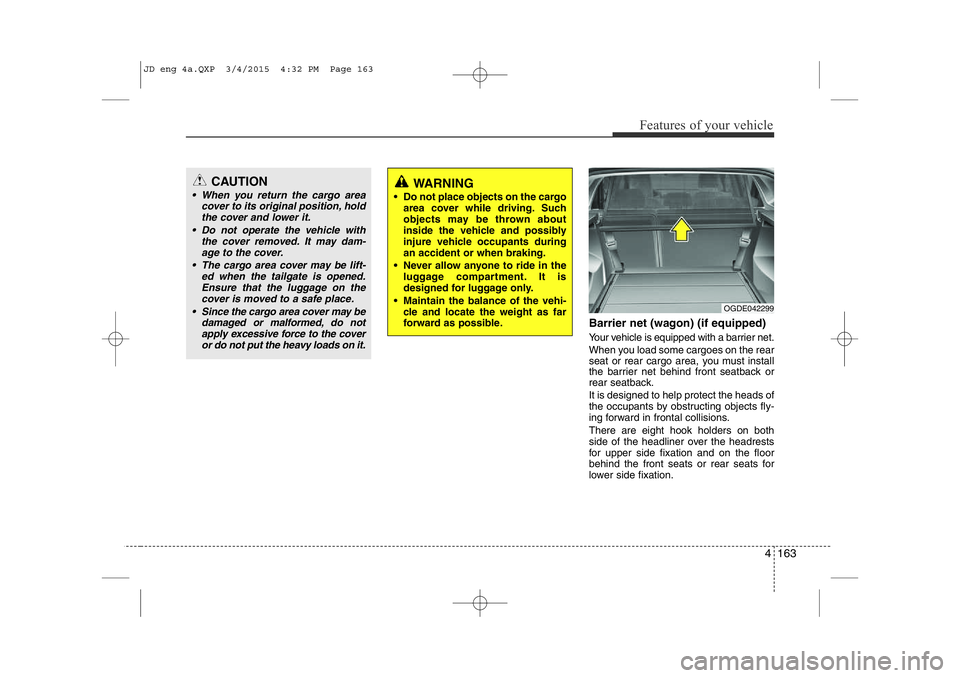
Your vehicle is equipped with a barrier net.
When you load some cargoes on the rear
seat or rear cargo area, you must install
the barrier net behind front seatback or
rear seatback. It is designed to help protect the heads of
the occupants by obstructing objects fly-
ing forward in frontal collisions. There are eight hook holders on both
side of the headliner over the headrests
for upper side fixation and on the floor
behind the front seats or rear seats for
lower side fixation.
CAUTION
• When you return the cargo areacover to its original position, holdthe cover and lower it.
• Do not operate the vehicle with the cover removed. It may dam-
age to the cover.
• The cargo area cover may be lift- ed when the tailgate is opened.Ensure that the luggage on the cover is moved to a safe place.
• Since the cargo area cover may be damaged or malformed, do not
apply excessive force to the coveror do not put the heavy loads on it.WARNING
• Do not place objects on the cargo area cover while driving. Such
objects may be thrown about
inside the vehicle and possibly
injure vehicle occupants duringan accident or when braking.
• Never allow anyone to ride in the luggage compartment. It is
designed for luggage only.
• Maintain the balance of the vehi- cle and locate the weight as far
forward as possible.
OGDE042299
JD eng 4a.QXP 3/4/2015 4:32 PM Page 163
Page 246 of 1210
4 165
Features of your vehicle
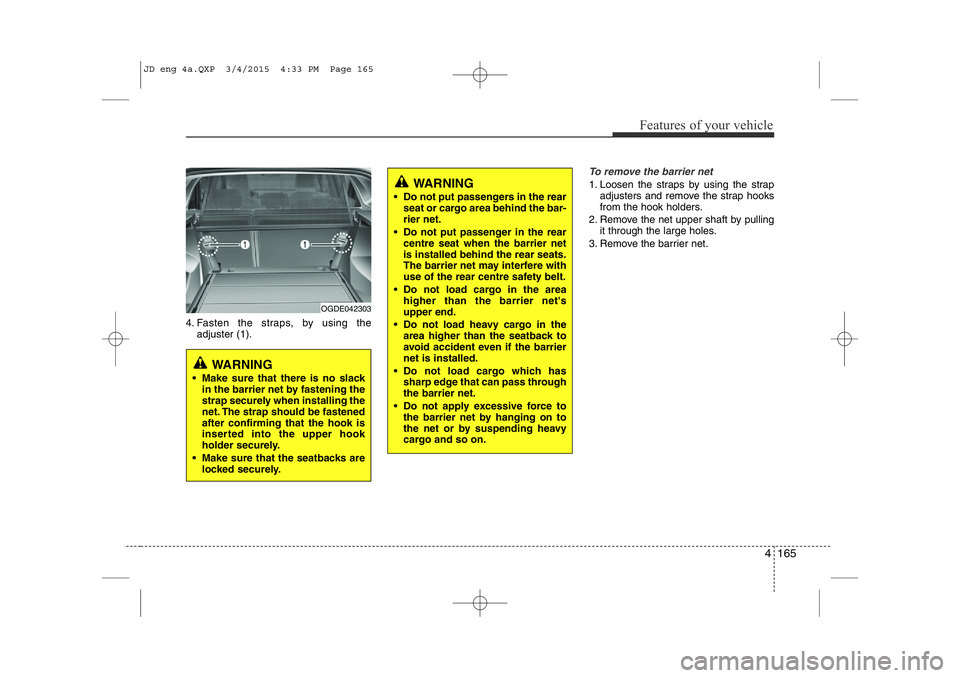
4. Fasten the straps, by using theadjuster (1).
To remove the barrier net
1. Loosen the straps by using the strapadjusters and remove the strap hooks
from the hook holders.
2. Remove the net upper shaft by pulling it through the large holes.
3. Remove the barrier net.
OGDE042303
WARNING
• Make sure that there is no slack in the barrier net by fastening the
strap securely when installing the
net. The strap should be fastenedafter confirming that the hook is
inserted into the upper hook
holder securely.
• Make sure that the seatbacks are locked securely.
WARNING
• Do not put passengers in the rear seat or cargo area behind the bar- rier net.
• Do not put passenger in the rear centre seat when the barrier netis installed behind the rear seats.
The barrier net may interfere with
use of the rear centre safety belt.
• Do not load cargo in the area higher than the barrier net'supper end.
• Do not load heavy cargo in the area higher than the seatback to
avoid accident even if the barriernet is installed.
• Do not load cargo which has sharp edge that can pass through the barrier net.
• Do not apply excessive force to the barrier net by hanging on to
the net or by suspending heavy
cargo and so on.
JD eng 4a.QXP 3/4/2015 4:33 PM Page 165
Page 574 of 1210
7 115
Maintenance
Interior care
Interior general precautions
Prevent chemicals such as perfume, cos-
metic oil, sun cream, hand cleaner, and
air freshener from contacting the interior
parts because they may cause damage
or discoloration. If they do contact the
interior parts, wipe them off immediately.
See the instructions that follow for the
proper way to clean vinyl.
Cleaning the upholstery and interiortrim
Vinyl
Remove dust and loose dirt from vinyl
with a whisk broom or vacuum cleaner.
Clean vinyl surfaces with a vinyl cleaner.
Fabric
Remove dust and loose dirt from fabric
with a whisk broom or vacuum cleaner.Clean with a mild soap solution recom-
mended for upholstery or carpets.
Remove fresh spots immediately with a
fabric spot cleaner. If fresh spots do not
receive immediate attention, the fabriccan be stained and its color can be
affected. Also, its fire-resistant properties
can be reduced if the material is not
properly maintained.
Cleaning the lap/shoulder belt web- bing
Clean the belt webbing with any mild
soap solution recommended for cleaning
upholstery or carpet. Follow the instruc-
tions provided with the soap. Do not
bleach or re-dye the webbing because
this may weaken it.
Cleaning the interior window glass
If the interior glass surfaces of the vehi-
cle become fogged (that is, covered with
an oily, greasy or waxy film), they should
be cleaned with glass cleaner. Follow the
directions on the glass cleaner container.
CAUTION
Never allow water or other liquidsto come in contact with
electrical/electronic components inside the vehicle as this may dam-age them.
CAUTION
Using anything but recommended
cleaners and procedures may affect the fabric’s appearance and fire-resistant properties.
CAUTION
When cleaning leather products
(steering wheel, seats etc.), useneutral detergents or low alcohol content solutions. If you use highalcohol content solutions or
acid/alkaline detergents, the color of the leather may fade or the sur-face may get stripped off.
CAUTION
Do not scrape or scratch the insideof the rear window. This may result
in damage to the rear windowdefroster grid.
JD eng 7.QXP 3/4/2015 3:34 PM Page 115
Page 602 of 1210
I11
Index
Seatback pocket . . . . . . . . . . . . . . . . . . . . . . . . . . . . . 3-13
Seats . . . . . . . . . . . . . . . . . . . . . . . . . . . . . . . . . . . . . . . . 3-2
Armrest . . . . . . . . . . . . . . . . . . . . . . . . . . . . . . . . . . . 3-15
Driver position memory system . . . . . . . . . . . . . . . . 3-8
Folding the rear seat. . . . . . . . . . . . . . . . . . . . . . . . . 3-16
Front seat adjustment . . . . . . . . . . . . . . . . . . . . . . . . 3-4
Headrest(front) . . . . . . . . . . . . . . . . . . . . . . . . . . . . . . 3-9
Headrest(rear) . . . . . . . . . . . . . . . . . . . . . . . . . . . . . . 3-14
Lumbar support (Automatic Seat) . . . . . . . . . . . . . . 3-7
Lumbar support (Manual seat). . . . . . . . . . . . . . . . . 3-5
Rear seat . . . . . . . . . . . . . . . . . . . . . . . . . . . . . . . . . . 3-14
Rear seat entry . . . . . . . . . . . . . . . . . . . . . . . . . . . . . 3-13
Seat warmer(front) . . . . . . . . . . . . . . . . . . . . . . . . . . 3-12
Seatback pocket . . . . . . . . . . . . . . . . . . . . . . . . . . . . 3-13
Service mode (Normal vision) . . . . . . . . . . . . . . . . . . 4-55
Service mode (Super vision). . . . . . . . . . . . . . . . . . . . 4-70
Shift lock system . . . . . . . . . . . . . . . . . . . . . . . . . . . . . 5-29
Shopping bag holder. . . . . . . . . . . . . . . . . . . . . . . . . 4-168
Side impact air bag . . . . . . . . . . . . . . . . . . . . . . . . . . . 3-55
Sliding armrest . . . . . . . . . . . . . . . . . . . . . . . . . . . . . 4-152
Smart key . . . . . . . . . . . . . . . . . . . . . . . . . . . . . . . . . . . 4-11
Smart parking assist system (SPAS) . . . . . . . . . . . . 4-100
Smooth cornering . . . . . . . . . . . . . . . . . . . . . . . . . . . . 5-65
Snow tires . . . . . . . . . . . . . . . . . . . . . . . . . . . . . . . . . . 5-67
Spare tire
Compact spare tire . . . . . . . . . . . . . . . . . . . . . . . . . . 6-15 Compact spare tire replacement . . . . . . . . . . . . . . . 7-60
Removing and storing the spare tire . . . . . . . . . . . 6-10
SPAS . . . . . . . . . . . . . . . . . . . . . . . . . . . . . . . . . . . . . . 4-100
Special driving conditions . . . . . . . . . . . . . . . . . . . . . 5-64 Driving at night. . . . . . . . . . . . . . . . . . . . . . . . . . . . . 5-65
Driving in flooded areas. . . . . . . . . . . . . . . . . . . . . . 5-66
Driving in the rain . . . . . . . . . . . . . . . . . . . . . . . . . . 5-65
Driving off-road . . . . . . . . . . . . . . . . . . . . . . . . . . . . 5-66
Hazardous driving conditions . . . . . . . . . . . . . . . . . 5-64
Highway driving . . . . . . . . . . . . . . . . . . . . . . . . . . . . 5-66
Rocking the vehicle. . . . . . . . . . . . . . . . . . . . . . . . . . 5-64
Smooth cornering . . . . . . . . . . . . . . . . . . . . . . . . . . . 5-65
Speed limit control system . . . . . . . . . . . . . . . . . . . . . 5-56
Speed limiter indicator (Normal vision) . . . . . . . . . . 4-51
Speed limiter indicator (Super vision) . . . . . . . . . . . 4-66
Speedometer (Normal vision) . . . . . . . . . . . . . . . . . . 4-47
Speedometer (Super vision) . . . . . . . . . . . . . . . . . . . . 4-62
Sports mode . . . . . . . . . . . . . . . . . . . . . . . . . . . . . . . . . 5-27
SRS components and functions . . . . . . . . . . . . . . . . . 3-47
Starting difficulties, see engine will not start . . . . . . . 6-4
Static bending light . . . . . . . . . . . . . . . . . . . . . . . . . . 4-112
Steering wheel . . . . . . . . . . . . . . . . . . . . . . . . . . . . . . . 4-37 Electric power steering . . . . . . . . . . . . . . . . . . . . . . 4-37
Flex steering wheel . . . . . . . . . . . . . . . . . . . . . . . . . . 4-40
Heated steering wheel . . . . . . . . . . . . . . . . . . . . . . . 4-38
Horn . . . . . . . . . . . . . . . . . . . . . . . . . . . . . . . . . . . . . . 4-39
JD eng Index.QXP 3/12/2015 3:06 PM Page 11
Page 623 of 1210
33
Safety features of your vehicle
✽✽NOTICE
If you have a collision accident, the front
seat may be damaged.
In this case we recommend that you
have a seat system checked by an autho-
rised Kia dealer.
WARNING - Driver’s seat
Never attempt to adjust seat whilst the vehicle is moving. This
could result in loss of control,and an accident causing death,
serious injury, or property dam-
age.
Do not allow anything to interfere with the normal position of the
seatback. Storing items against a
seatback or in any other way
interfering with proper locking of
a seatback could result in serious
or fatal injury in a sudden stop orcollision.
Always drive and ride with your seatback upright and the lap por-
tion of the seat belt snug and low
across the hips. This is the best
position to protect you in case ofan accident.
In order to avoid unnecessary and perhaps severe air bag
injuries, always sit as far back as
possible from the steering wheel
whilst maintaining comfortable
control of the vehicle. It is recom-
mended that your chest is at least
250 mm (10 inches) away fromthe steering wheel.WARNING - Loose objects
Loose objects in the driver’s foot
area could interfere with the opera-
tion of the foot pedals, possibly
causing an accident. Do not place
anything under the front seats.WARNING - Driver respon-
sibility for front seat pas-
senger
Riding in a vehicle with a front seat-
back reclined could lead to serious
or fatal injury in an accident. If a
front seat is reclined during an
accident, the occupant’s hips may
slide under the lap portion of the
seat belt applying great force to the
unprotected abdomen. Serious orfatal internal injuries could result.
The driver must advise the front
passenger to keep the seatback in
an upright position whenever the
vehicle is in motion.
WARNING
Do not use a sitting cushion that reduces friction between the seat
and passenger. The passenger's
hips may slide under the lap por-tion of the seat belt during an acci-
dent or a sudden stop. Serious orfatal internal injuries could resultbecause the seat belt can't operate
normally.
JD RHD 3.QXP 4/14/2015 6:39 PM Page 3
Page 624 of 1210
Safety features of your vehicle
4
3
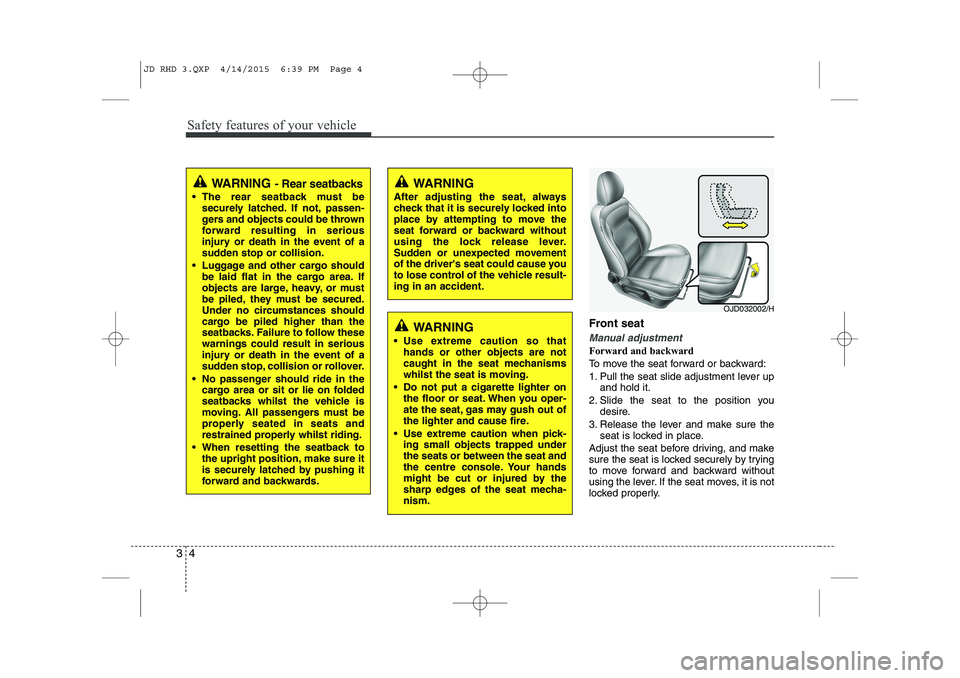
Front seat
Manual adjustment
Forward and backward
To move the seat forward or backward:
1. Pull the seat slide adjustment lever up
and hold it.
2. Slide the seat to the position you desire.
3. Release the lever and make sure the seat is locked in place.
Adjust the seat before driving, and make
sure the seat is locked securely by trying
to move forward and backward without
using the lever. If the seat moves, it is not
locked properly.
WARNING - Rear seatbacks
The rear seatback must be securely latched. If not, passen-
gers and objects could be thrown
forward resulting in serious
injury or death in the event of a
sudden stop or collision.
Luggage and other cargo should be laid flat in the cargo area. If
objects are large, heavy, or must
be piled, they must be secured.
Under no circumstances should
cargo be piled higher than the
seatbacks. Failure to follow thesewarnings could result in serious
injury or death in the event of a
sudden stop, collision or rollover.
No passenger should ride in the cargo area or sit or lie on folded
seatbacks whilst the vehicle is
moving. All passengers must be
properly seated in seats and
restrained properly whilst riding.
When resetting the seatback to the upright position, make sure it
is securely latched by pushing it
forward and backwards.WARNING
After adjusting the seat, always
check that it is securely locked into
place by attempting to move the
seat forward or backward without
using the lock release lever.
Sudden or unexpected movement
of the driver's seat could cause you
to lose control of the vehicle result-ing in an accident.
WARNING
Use extreme caution so that hands or other objects are not
caught in the seat mechanisms
whilst the seat is moving.
Do not put a cigarette lighter on the floor or seat. When you oper-
ate the seat, gas may gush out of
the lighter and cause fire.
Use extreme caution when pick- ing small objects trapped underthe seats or between the seat and
the centre console. Your hands
might be cut or injured by the
sharp edges of the seat mecha-nism.
OJD032002/H
JD RHD 3.QXP 4/14/2015 6:39 PM Page 4
Page 629 of 1210
39
Safety features of your vehicle
Recalling positions from memory
1. Shift the shift lever into P or N (forAutomatic transaxle) or Neutral (for
manual transaxle) whilst the engine
start/stop button is ON or ignition
switch ON.
2. To recall the position in the memory, press the desired memory button (1 or
2). The system will beep once, then the
driver’s seat will automatically adjust tothe stored position.
Adjusting the control switch for the dri-
ver’s seat whilst the system is recalling
the stored position will cause the move-
ment to stop and move in the direction
that the control switch is moved.Easy access function (if equipped)
The system will move the driver's seat
automatically as follows:
Without smart key system - It will move the driver’s seat rearwardwhen the ignition key is removed and
front driver’s door is opened.
- It will move the driver’s seat forward when the ignition key is inserted.
With smart key system - It will move the driver’s seat rearwardwhen the engine start/stop button ischanged to the OFF position and front
driver’s door is opened.
- It will move the driver’s seat forward when the engine start/stop button is
changed to the ACC or START posi-tion.
You can activate or deactivate this feature.
Refer to "User settings" in section 4.
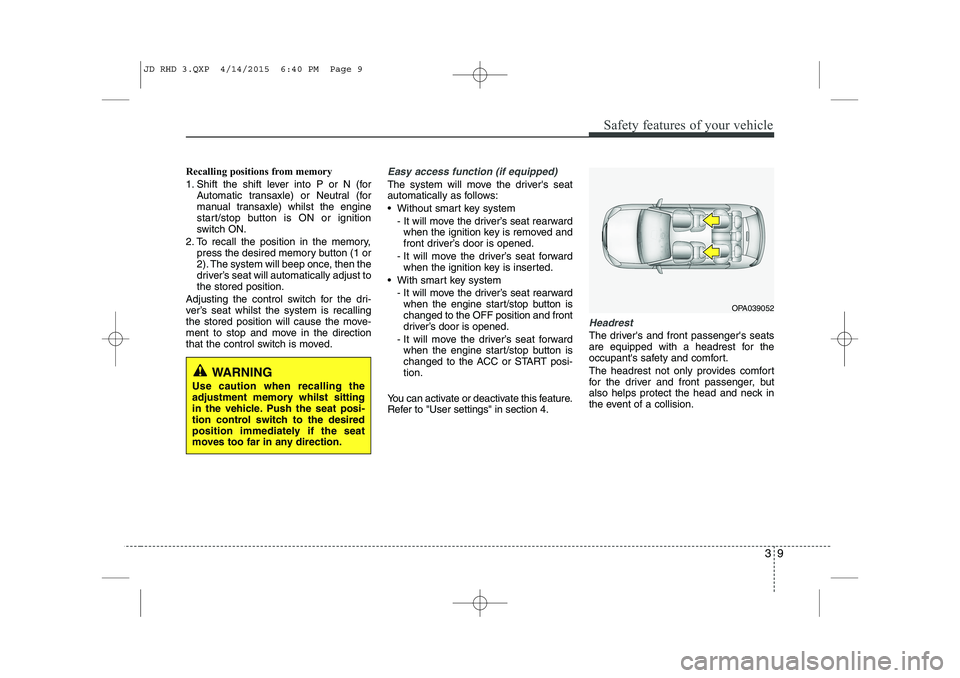
Headrest
The driver's and front passenger's seats
are equipped with a headrest for the
occupant's safety and comfort.
The headrest not only provides comfort
for the driver and front passenger, but
also helps protect the head and neck in
the event of a collision.
WARNING
Use caution when recalling the
adjustment memory whilst sitting
in the vehicle. Push the seat posi-
tion control switch to the desired
position immediately if the seat
moves too far in any direction.
OPA039052
JD RHD 3.QXP 4/14/2015 6:40 PM Page 9
Page 632 of 1210
Safety features of your vehicle
12
3
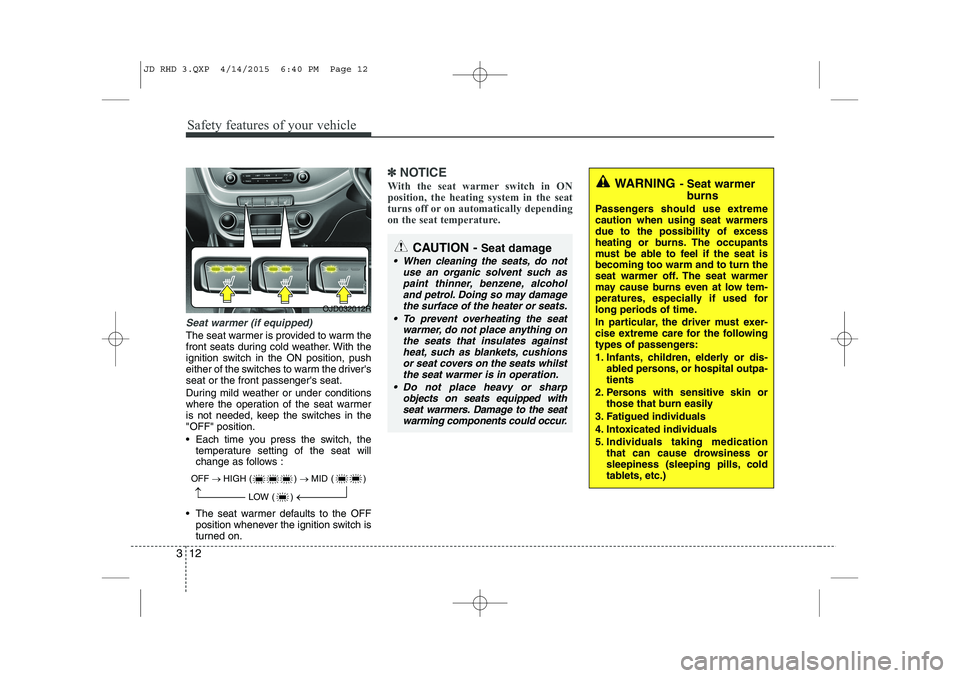
Seat warmer (if equipped)
The seat warmer is provided to warm the
front seats during cold weather. With the
ignition switch in the ON position, push
either of the switches to warm the driver'sseat or the front passenger's seat.
During mild weather or under conditions
where the operation of the seat warmer
is not needed, keep the switches in the"OFF" position.
Each time you press the switch, the
temperature setting of the seat will
change as follows :
The seat warmer defaults to the OFF position whenever the ignition switch is
turned on.
✽✽ NOTICE
With the seat warmer switch in ON
position, the heating system in the seat
turns off or on automatically depending
on the seat temperature.
OJD032012R
OFF HIGH ( ) MID ( )
LOW ( )
CAUTION - Seat damage
When cleaning the seats, do not
use an organic solvent such aspaint thinner, benzene, alcohol
and petrol. Doing so may damagethe surface of the heater or seats.
To prevent overheating the seat warmer, do not place anything onthe seats that insulates against
heat, such as blankets, cushions or seat covers on the seats whilstthe seat warmer is in operation.
Do not place heavy or sharp objects on seats equipped withseat warmers. Damage to the seat warming components could occur.
WARNING - Seat warmer
burns
Passengers should use extreme
caution when using seat warmers
due to the possibility of excess
heating or burns. The occupants
must be able to feel if the seat isbecoming too warm and to turn the
seat warmer off. The seat warmer
may cause burns even at low tem-
peratures, especially if used for
long periods of time.
In particular, the driver must exer-
cise extreme care for the following
types of passengers:
1. Infants, children, elderly or dis- abled persons, or hospital outpa- tients
2. Persons with sensitive skin or those that burn easily
3. Fatigued individuals
4. Intoxicated individuals
5. Individuals taking medication that can cause drowsiness or
sleepiness (sleeping pills, cold
tablets, etc.)
JD RHD 3.QXP 4/14/2015 6:40 PM Page 12