engine oil KIA CEED 2015 Service Manual
[x] Cancel search | Manufacturer: KIA, Model Year: 2015, Model line: CEED, Model: KIA CEED 2015Pages: 1210, PDF Size: 35.92 MB
Page 493 of 1210
Maintenance
34
7
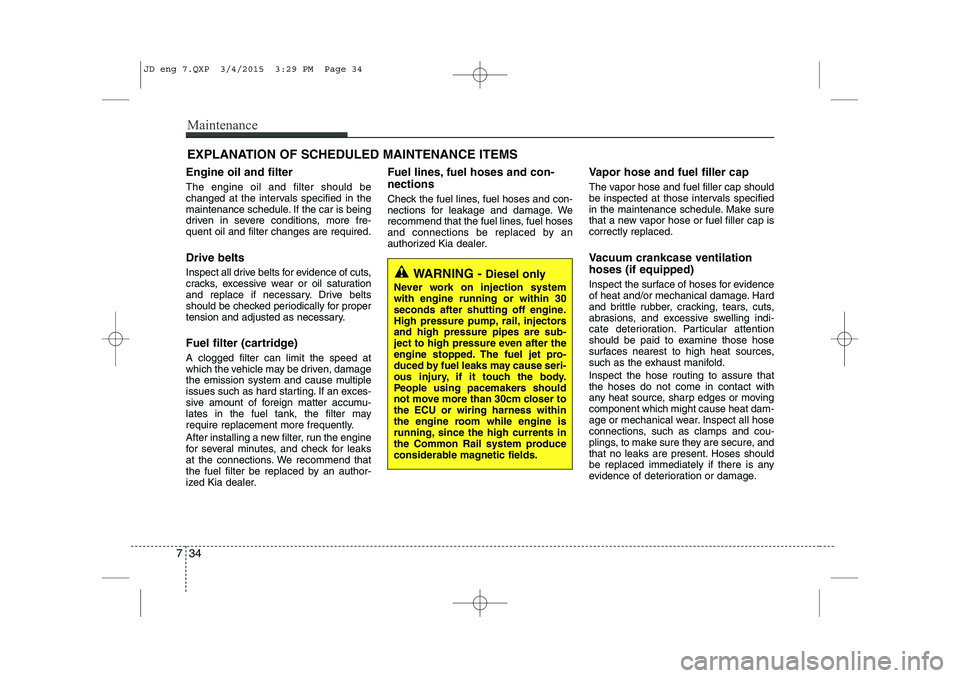
EXPLANATION OF SCHEDULED MAINTENANCE ITEMS
Engine oil and filter The engine oil and filter should be
changed at the intervals specified in the
maintenance schedule. If the car is being
driven in severe conditions, more fre-quent oil and filter changes are required. Drive belts
Inspect all drive belts for evidence of cuts,
cracks, excessive wear or oil saturation
and replace if necessary. Drive belts
should be checked periodically for proper
tension and adjusted as necessary.
Fuel filter (cartridge) A clogged filter can limit the speed at
which the vehicle may be driven, damage
the emission system and cause multiple
issues such as hard starting. If an exces-
sive amount of foreign matter accumu-
lates in the fuel tank, the filter may
require replacement more frequently.
After installing a new filter, run the engine
for several minutes, and check for leaks
at the connections. We recommend that
the fuel filter be replaced by an author-
ized Kia dealer. Fuel lines, fuel hoses and con- nections
Check the fuel lines, fuel hoses and con-
nections for leakage and damage. We
recommend that the fuel lines, fuel hoses
and connections be replaced by an
authorized Kia dealer.
Vapor hose and fuel filler cap
The vapor hose and fuel filler cap should
be inspected at those intervals specified
in the maintenance schedule. Make sure
that a new vapor hose or fuel filler cap iscorrectly replaced.
Vacuum crankcase ventilation hoses (if equipped)
Inspect the surface of hoses for evidence
of heat and/or mechanical damage. Hard
and brittle rubber, cracking, tears, cuts,
abrasions, and excessive swelling indi-
cate deterioration. Particular attention
should be paid to examine those hose
surfaces nearest to high heat sources,
such as the exhaust manifold. Inspect the hose routing to assure that the hoses do not come in contact with
any heat source, sharp edges or movingcomponent which might cause heat dam-
age or mechanical wear. Inspect all hose
connections, such as clamps and cou-
plings, to make sure they are secure, and
that no leaks are present. Hoses should
be replaced immediately if there is any
evidence of deterioration or damage.
WARNING -
Diesel only
Never work on injection system with engine running or within 30
seconds after shutting off engine.
High pressure pump, rail, injectorsand high pressure pipes are sub-
ject to high pressure even after the
engine stopped. The fuel jet pro-
duced by fuel leaks may cause seri-
ous injury, if it touch the body.
People using pacemakers should
not move more than 30cm closer tothe ECU or wiring harness within
the engine room while engine is
running, since the high currents in
the Common Rail system produce
considerable magnetic fields.
JD eng 7.QXP 3/4/2015 3:29 PM Page 34
Page 496 of 1210
737
Maintenance
ENGINE OIL
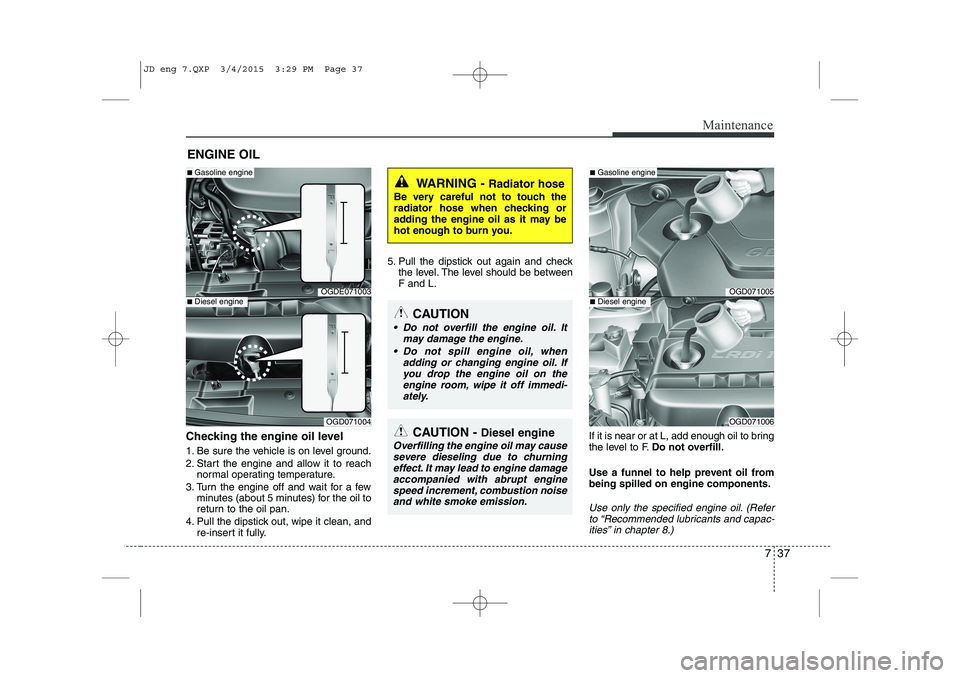
Checking the engine oil level
1. Be sure the vehicle is on level ground.
2. Start the engine and allow it to reach normal operating temperature.
3. Turn the engine off and wait for a few minutes (about 5 minutes) for the oil to
return to the oil pan.
4. Pull the dipstick out, wipe it clean, and re-insert it fully. 5. Pull the dipstick out again and check
the level. The level should be between F and L.
If it is near or at L, add enough oil to bring
the level to F.Do not overfill.
Use a funnel to help prevent oil frombeing spilled on engine components.
Use only the specified engine oil. (Refer to “Recommended lubricants and capac-
ities” in chapter 8.)
WARNING - Radiator hose
Be very careful not to touch the
radiator hose when checking or
adding the engine oil as it may be
hot enough to burn you.
CAUTION - Diesel engine
Overfilling the engine oil may cause
severe dieseling due to churningeffect. It may lead to engine damage
accompanied with abrupt enginespeed increment, combustion noise and white smoke emission.
CAUTION
Do not overfill the engine oil. It
may damage the engine.
Do not spill engine oil, when adding or changing engine oil. Ifyou drop the engine oil on theengine room, wipe it off immedi-
ately.
OGDE071003
■ Gasoline engine
OGD071004
■Diesel engineOGD071005
■Gasoline engine
OGD071006
■Diesel engine
JD eng 7.QXP 3/4/2015 3:29 PM Page 37
Page 497 of 1210
Maintenance
38
7
Changing the engine oil and filter
We recommend that the engine oil and
filter be replaced by an authorized Kia
dealer.
WARNING
Used engine oil may cause irrita- tion or cancer of the skin if left in
contact with the skin for prolonged
periods of time. Used engine oil
contains chemicals that have
caused cancer in laboratory ani-
mals. Always protect your skin by
washing your hands thoroughlywith soap and warm water as soon
as possible after handling used oil.
JD eng 7.QXP 3/4/2015 3:29 PM Page 38
Page 501 of 1210
Maintenance
42
7
BRAKE/CLUTCH FLUID
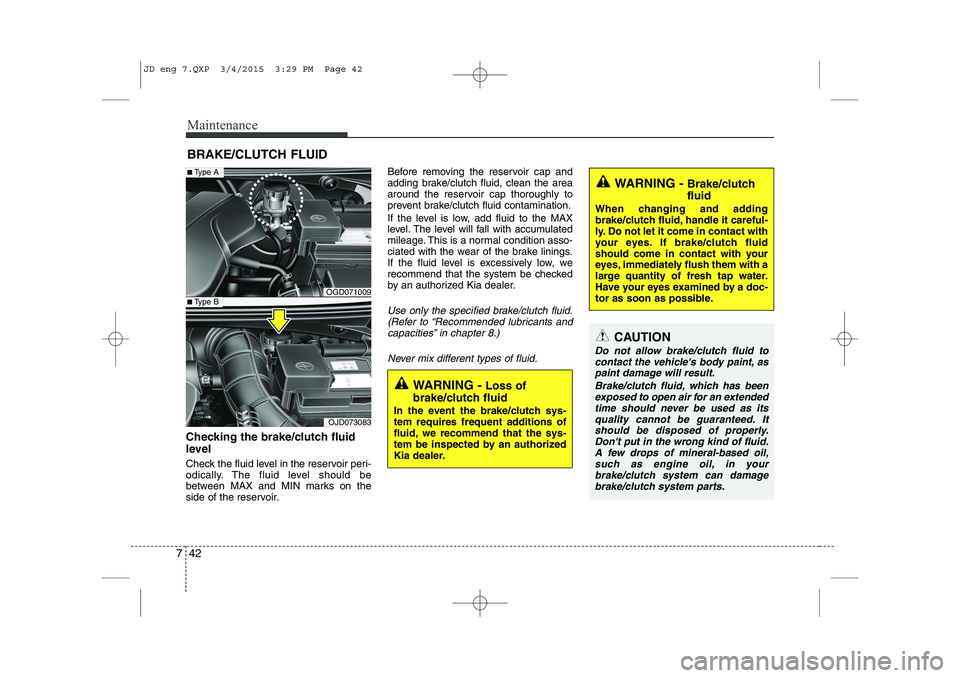
Checking the brake/clutch fluid
level
Check the fluid level in the reservoir peri-
odically. The fluid level should be
between MAX and MIN marks on the
side of the reservoir. Before removing the reservoir cap and
adding brake/clutch fluid, clean the area
around the reservoir cap thoroughly to
prevent brake/clutch fluid contamination.
If the level is low, add fluid to the MAX
level. The level will fall with accumulated
mileage. This is a normal condition asso-
ciated with the wear of the brake linings.
If the fluid level is excessively low, we
recommend that the system be checked
by an authorized Kia dealer.
Use only the specified brake/clutch fluid.
(Refer to “Recommended lubricants andcapacities” in chapter 8.)
Never mix different types of fluid.
WARNING - Brake/clutch fluid
When changing and adding
brake/clutch fluid, handle it careful-
ly. Do not let it come in contact with
your eyes. If brake/clutch fluid
should come in contact with your
eyes, immediately flush them with a
large quantity of fresh tap water.
Have your eyes examined by a doc-
tor as soon as possible.
WARNING - Loss of
brake/clutch fluid
In the event the brake/clutch sys-
tem requires frequent additions of
fluid, we recommend that the sys-
tem be inspected by an authorized
Kia dealer.
CAUTION
Do not allow brake/clutch fluid to contact the vehicle's body paint, aspaint damage will result.
Brake/clutch fluid, which has beenexposed to open air for an extended time should never be used as itsquality cannot be guaranteed. Itshould be disposed of properly.
Don't put in the wrong kind of fluid.A few drops of mineral-based oil, such as engine oil, in yourbrake/clutch system can damage
brake/clutch system parts.
OGD071009
■ Type A
OJD073083
■Type B
JD eng 7.QXP 3/4/2015 3:29 PM Page 42
Page 512 of 1210
753
Maintenance
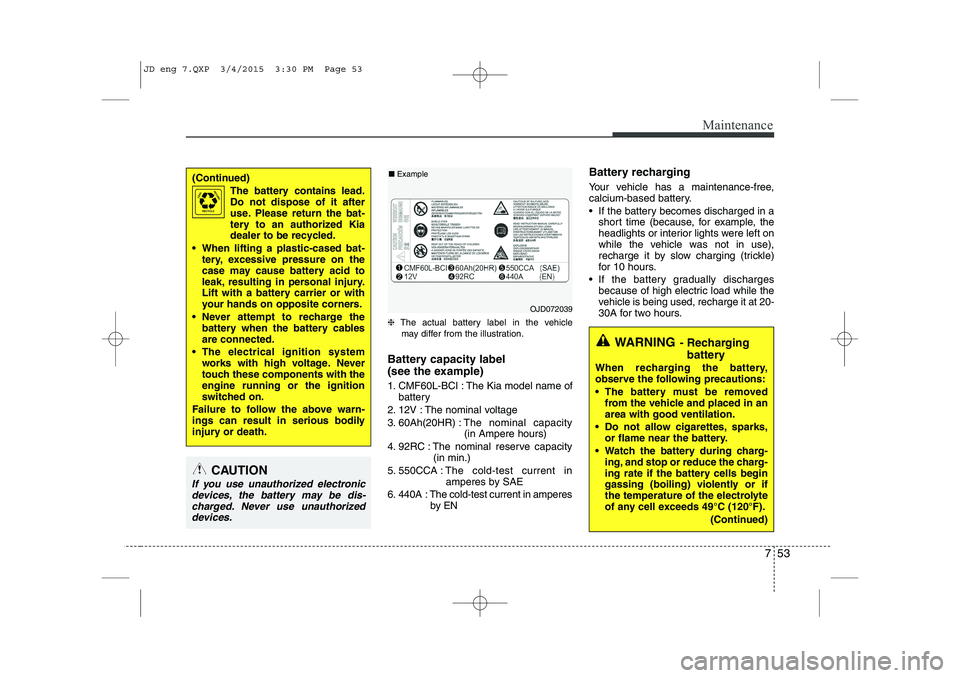
❈The actual battery label in the vehicle
may differ from the illustration.
Battery capacity label
(see the example)
1. CMF60L-BCI : The Kia model name of battery
2. 12V : The nominal voltage
3. 60Ah(20HR) : The nominal capacity
(in Ampere hours)
4. 92RC : The nominal reserve capacity (in min.)
5. 550CCA : The cold-test current in
amperes by SAE
6. 440A : The cold-test current in amperes by EN Battery recharging
Your vehicle has a maintenance-free,
calcium-based battery.
If the battery becomes discharged in a
short time (because, for example, the
headlights or interior lights were left on
while the vehicle was not in use),
recharge it by slow charging (trickle)
for 10 hours.
If the battery gradually discharges because of high electric load while the
vehicle is being used, recharge it at 20-
30A for two hours.
(Continued)
The battery contains lead.
Do not dispose of it after
use. Please return the bat-
tery to an authorized Kia
dealer to be recycled.
When lifting a plastic-cased bat- tery, excessive pressure on the
case may cause battery acid to
leak, resulting in personal injury.
Lift with a battery carrier or with
your hands on opposite corners.
Never attempt to recharge the battery when the battery cablesare connected.
The electrical ignition system works with high voltage. Never
touch these components with theengine running or the ignition
switched on.
Failure to follow the above warn-
ings can result in serious bodily
injury or death.
CAUTION
If you use unauthorized electronic devices, the battery may be dis-charged. Never use unauthorizeddevices.
OJD072039
WARNING - Recharging
battery
When recharging the battery,
observe the following precautions:
The battery must be removed from the vehicle and placed in an area with good ventilation.
Do not allow cigarettes, sparks, or flame near the battery.
Watch the battery during charg- ing, and stop or reduce the charg-
ing rate if the battery cells begin
gassing (boiling) violently or if
the temperature of the electrolyte
of any cell exceeds 49°C (120°F).
(Continued)
■Example
JD eng 7.QXP 3/4/2015 3:30 PM Page 53
Page 525 of 1210
Maintenance
66
7
FUSES
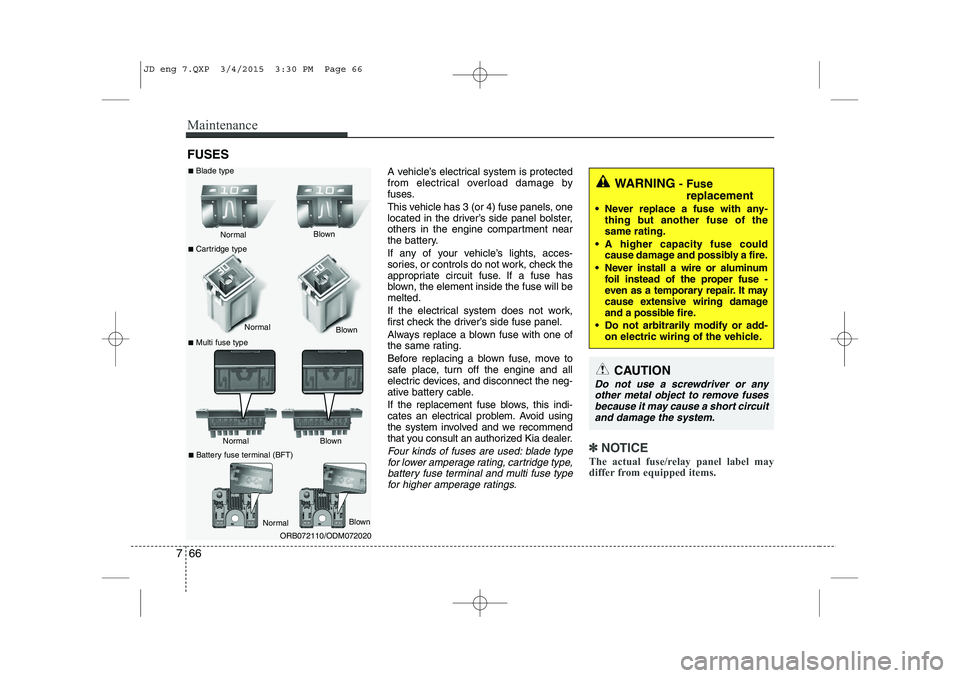
A vehicle’s electrical system is protected
from electrical overload damage by
fuses.
This vehicle has 3 (or 4) fuse panels, one
located in the driver’s side panel bolster,
others in the engine compartment near
the battery.
If any of your vehicle’s lights, acces-
sories, or controls do not work, check the
appropriate circuit fuse. If a fuse has
blown, the element inside the fuse will bemelted.
If the electrical system does not work,
first check the driver’s side fuse panel.
Always replace a blown fuse with one of
the same rating.
Before replacing a blown fuse, move to
safe place, turn off the engine and all
electric devices, and disconnect the neg-
ative battery cable.
If the replacement fuse blows, this indi-
cates an electrical problem. Avoid using
the system involved and we recommend
that you consult an authorized Kia dealer.
Four kinds of fuses are used: blade typefor lower amperage rating, cartridge type,battery fuse terminal and multi fuse type for higher amperage ratings.✽✽ NOTICE
The actual fuse/relay panel label may
differ from equipped items.
WARNING - Fuse
replacement
Never replace a fuse with any- thing but another fuse of the same rating.
A higher capacity fuse could cause damage and possibly a fire.
Never install a wire or aluminum foil instead of the proper fuse -
even as a temporary repair. It may
cause extensive wiring damage
and a possible fire.
Do not arbitrarily modify or add- on electric wiring of the vehicle.
CAUTION
Do not use a screwdriver or any
other metal object to remove fuses
because it may cause a short circuitand damage the system.
Normal
Normal
■
Blade type
■ Cartridge type
■ Multi fuse type Blown
Blown
Normal Blown
ORB072110/ODM072020
Normal
Blown
■
Battery fuse terminal (BFT)
JD eng 7.QXP 3/4/2015 3:30 PM Page 66
Page 570 of 1210
7 111
Maintenance
Waxing
Wax the vehicle when water will no longer bead on the paint.
Always wash and dry the vehicle before
waxing. Use a good quality liquid or
paste wax, and follow the manufacturer’s
instructions. Wax all metal trim to protect
it and to maintain its luster.
Removing oil, tar, and similar materials
with a spot remover will usually strip the
wax from the finish. Be sure to re-wax
these areas even if the rest of the vehicle
does not yet need waxing.Finish damage repair
Deep scratches or stone chips in the
painted surface must be repaired
promptly. Exposed metal will quickly rust
and may develop into a major repair
expense.
✽✽NOTICE
If your vehicle is damaged and requires
any metal repair or replacement, be sure
the body shop applies anti-corrosion
materials to the parts repaired or
replaced.
CAUTION
Wiping dust or dirt off the body with a dry cloth will scratch the
finish.
Do not use steel wool, abrasive cleaners, or strong detergentscontaining highly alkaline orcaustic agents on chrome-plated
or anodized aluminum parts. Thismay result in damage to the pro- tective coating and cause discol-oration or paint deterioration.
CAUTION
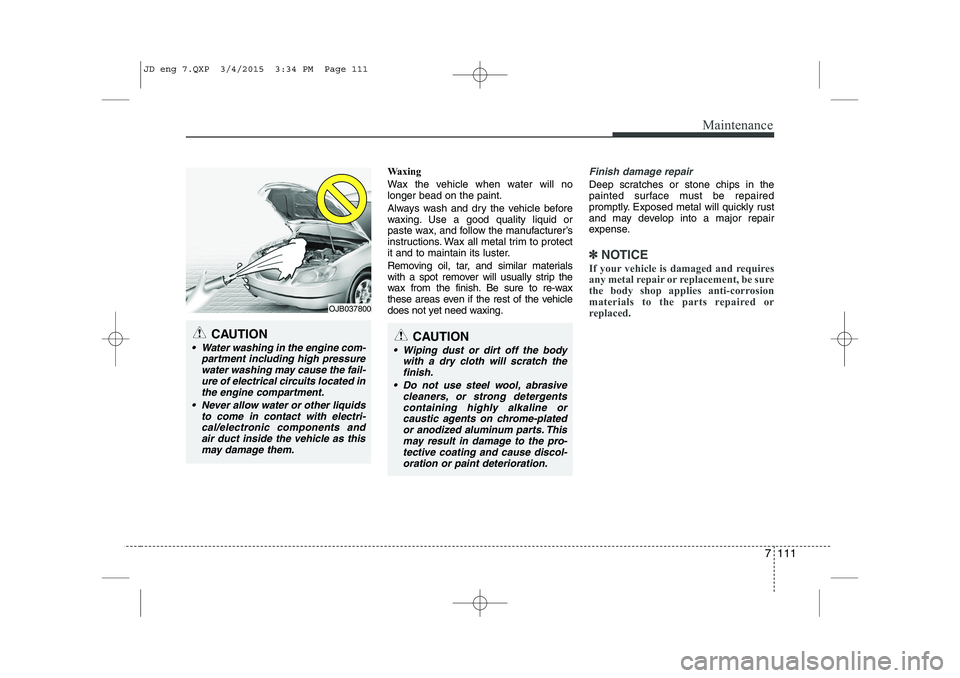
Water washing in the engine com- partment including high pressure
water washing may cause the fail-ure of electrical circuits located inthe engine compartment.
Never allow water or other liquids to come in contact with electri-cal/electronic components andair duct inside the vehicle as this may damage them.
OJB037800
JD eng 7.QXP 3/4/2015 3:34 PM Page 111
Page 586 of 1210
Specifications & Consumer information
8
8
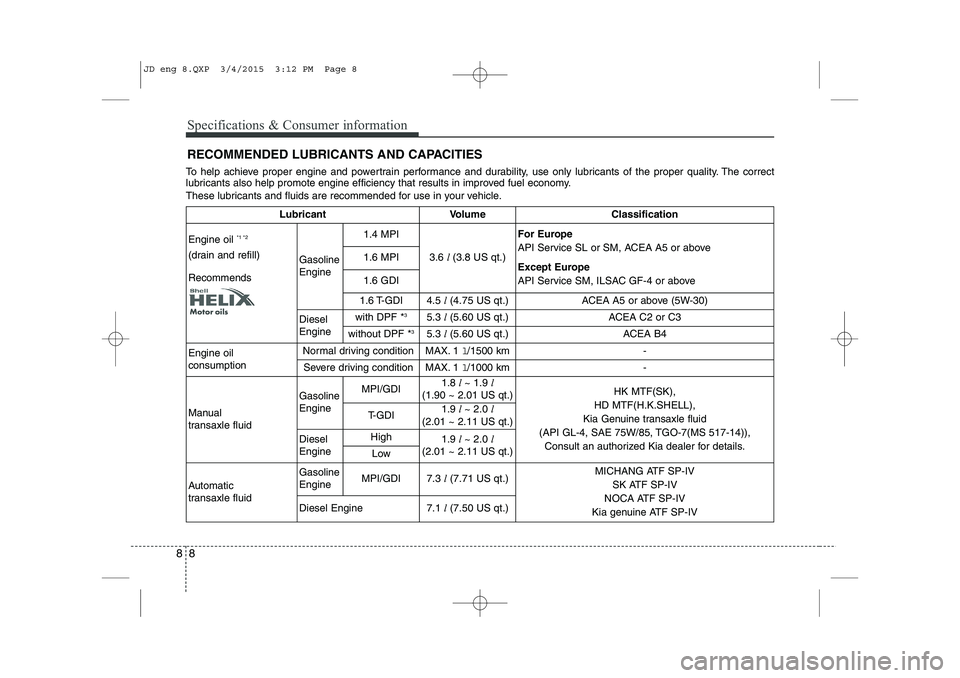
To help achieve proper engine and powertrain performance and durability, use only lubricants of the proper quality. The correct
lubricants also help promote engine efficiency that results in improved fuel economy.
These lubricants and fluids are recommended for use in your vehicle. RECOMMENDED LUBRICANTS AND CAPACITIES
Lubricant Volume Classification
Engine oil *1 *2
(drain and refill) Recommends Gasoline Engine1.4 MPI
3.6 l(3.8 US qt.) For Europe
API Service SL or SM, ACEA A5 or above
Except Europe
API Service SM, ILSAC GF-4 or above
1.6 MPI 1.6 GDI
1.6 T-GDI 4.5
l(4.75 US qt.)
ACEA A5 or above (5W-30)
Diesel Engine with DPF *
3
5.3 l(5.60 US qt.)
ACEA C2 or C3
without DPF * 3
5.3 l(5.60 US qt.)
ACEA B4
Engine oil consumption Normal driving condition
MAX. 1 l /1500 km -
Severe driving condition MAX. 1 l /1000 km -
Manual
transaxle fluid GasolineEngine
MPI/GDI
1.8
l ~ 1.9 l
(1.90 ~ 2.01 US qt.) HK MTF(SK),
HD MTF(H.K.SHELL),
Kia Genuine transaxle fluid
(API GL-4, SAE 75W/85, TGO-7(MS 517-14)), Consult an authorized Kia dealer for details.
T-GDI
1.9
l ~ 2.0 l
(2.01 ~ 2.11 US qt.)
DieselEngine High
1.9 l ~ 2.0 l
(2.01 ~ 2.11 US qt.)
Low
Automatic
transaxle fluid GasolineEngine
MPI/GDI
7.3
l(7.71 US qt.) MICHANG ATF SP-IV
SK ATF SP-IV
NOCA ATF SP-IV
Kia genuine ATF SP-IV
Diesel Engine7.1 l(7.50 US qt.)
JD eng 8.QXP 3/4/2015 3:12 PM Page 8
Page 587 of 1210
89
Specifications & Consumer information
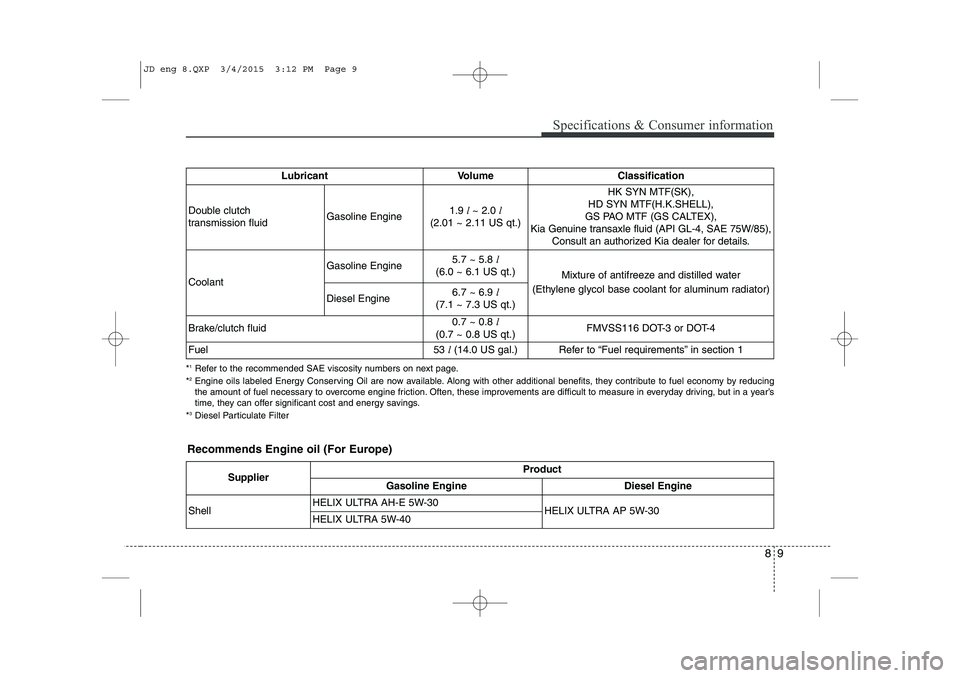
Lubricant Volume Classification
Double clutch
transmission fluidGasoline Engine1.9 l ~ 2.0 l
(2.01 ~ 2.11 US qt.)
HK SYN MTF(SK),
HD SYN MTF(H.K.SHELL),
GS PAO MTF (GS CALTEX),
Kia Genuine transaxle fluid (API GL-4, SAE 75W/85), Consult an authorized Kia dealer for details.
Coolant
Gasoline Engine5.7 ~ 5.8 l
(6.0 ~ 6.1 US qt.)
Mixture of antifreeze and distilled water
(Ethylene glycol base coolant for aluminum radiator)
Diesel Engine6.7 ~ 6.9 l
(7.1 ~ 7.3 US qt.)
Brake/clutch fluid0.7 ~ 0.8 l
(0.7 ~ 0.8 US qt.)FMVSS116 DOT-3 or DOT-4
Fuel 53
l(14.0 US gal.)
Refer to “Fuel requirements” in section 1
Recommends Engine oil (For Europe)
*
1
Refer to the recommended SAE viscosity numbers on next page.
* 2
Engine oils labeled Energy Conserving Oil are now available. Along with other additional benefits, they contribute to fuel economy by reducing
the amount of fuel necessary to overcome engine friction. Often, these improvements are difficult to measure in everyday driving, but in a year’s
time, they can offer significant cost and energy savings.
* 3
Diesel Particulate Filter
Supplier Product
Gasoline Engine Diesel Engine
Shell HELIX ULTRA AH-E 5W-30
HELIX ULTRA AP 5W-30
HELIX ULTRA 5W-40
JD eng 8.QXP 3/4/2015 3:12 PM Page 9
Page 588 of 1210
Specifications & Consumer information
10
8
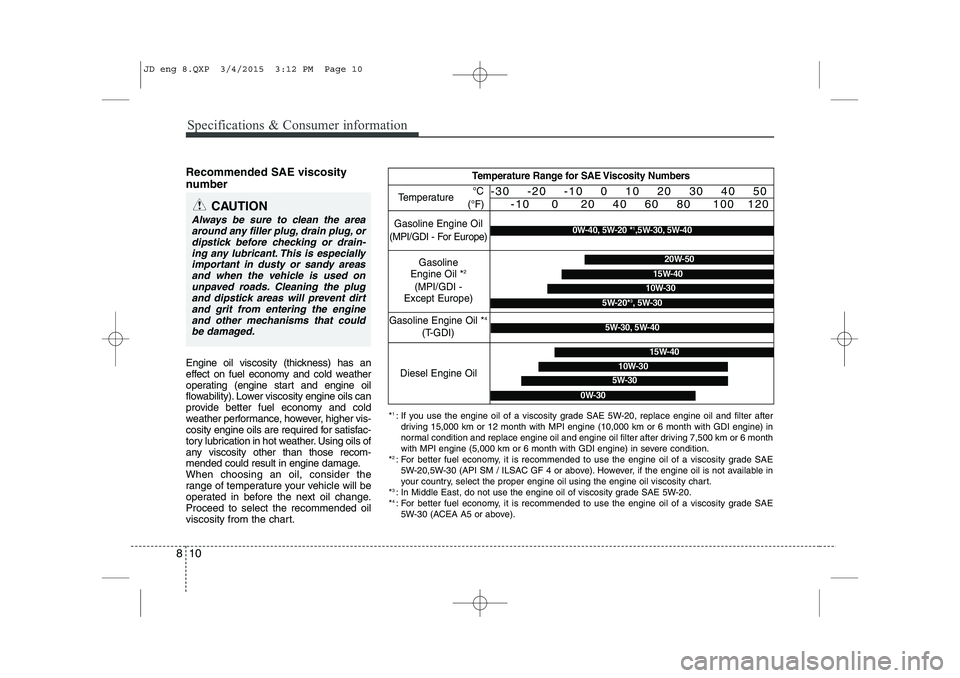
Recommended SAE viscosity
number
Engine oil viscosity (thickness) has an
effect on fuel economy and cold weather
operating (engine start and engine oil
flowability). Lower viscosity engine oils can
provide better fuel economy and cold
weather performance, however, higher vis-
cosity engine oils are required for satisfac-
tory lubrication in hot weather. Using oils of
any viscosity other than those recom-
mended could result in engine damage.When choosing an oil, consider the
range of temperature your vehicle will be
operated in before the next oil change.Proceed to select the recommended oil
viscosity from the chart.
CAUTION
Always be sure to clean the area
around any filler plug, drain plug, or
dipstick before checking or drain-ing any lubricant. This is especiallyimportant in dusty or sandy areas
and when the vehicle is used onunpaved roads. Cleaning the plugand dipstick areas will prevent dirtand grit from entering the engine
and other mechanisms that couldbe damaged.
* 1
: If you use the engine oil of a viscosity grade SAE 5W-20, replace engine oil and filter after
driving 15,000 km or 12 month with MPI engine (10,000 km or 6 month with GDI engine) in
normal condition and replace engine oil and engine oil filter after driving 7,500 km or 6 month
with MPI engine (5,000 km or 6 month with GDI engine) in severe condition.
* 2
: For better fuel economy, it is recommended to use the engine oil of a viscosity grade SAE
5W-20,5W-30 (API SM / ILSAC GF 4 or above). However, if the engine oil is not available in
your country, select the proper engine oil using the engine oil viscosity chart.
* 3
: In Middle East, do not use the engine oil of viscosity grade SAE 5W-20.
* 4
: For better fuel economy, it is recommended to use the engine oil of a viscosity grade SAE
5W-30 (ACEA A5 or above).
Temperature Range for SAE Viscosity Numbers
Temperature
Gasoline Engine Oil
(MPI/GDI - For Europe) °C
(°F)-30 -20 -10 0 10 20 30 40 50 -10 0 20 40 60 80 100 120
0W-40, 5W-20 * 1
,5W-30, 5W-40
Gasoline
Engine Oil * 2
(MPI/GDI -
Except Europe)20W-50
10W-30
15W-40
5W-20* 3
, 5W-30
Diesel Engine Oil5W-30
15W-40
10W-30
0W-30
Gasoline Engine Oil * 4
(T-GDI)5W-30, 5W-40
JD eng 8.QXP 3/4/2015 3:12 PM Page 10