parts KIA CEED 2015 Service Manual
[x] Cancel search | Manufacturer: KIA, Model Year: 2015, Model line: CEED, Model: KIA CEED 2015Pages: 1210, PDF Size: 35.92 MB
Page 574 of 1210
7 115
Maintenance
Interior care
Interior general precautions
Prevent chemicals such as perfume, cos-
metic oil, sun cream, hand cleaner, and
air freshener from contacting the interior
parts because they may cause damage
or discoloration. If they do contact the
interior parts, wipe them off immediately.
See the instructions that follow for the
proper way to clean vinyl.
Cleaning the upholstery and interiortrim
Vinyl
Remove dust and loose dirt from vinyl
with a whisk broom or vacuum cleaner.
Clean vinyl surfaces with a vinyl cleaner.
Fabric
Remove dust and loose dirt from fabric
with a whisk broom or vacuum cleaner.Clean with a mild soap solution recom-
mended for upholstery or carpets.
Remove fresh spots immediately with a
fabric spot cleaner. If fresh spots do not
receive immediate attention, the fabriccan be stained and its color can be
affected. Also, its fire-resistant properties
can be reduced if the material is not
properly maintained.
Cleaning the lap/shoulder belt web- bing
Clean the belt webbing with any mild
soap solution recommended for cleaning
upholstery or carpet. Follow the instruc-
tions provided with the soap. Do not
bleach or re-dye the webbing because
this may weaken it.
Cleaning the interior window glass
If the interior glass surfaces of the vehi-
cle become fogged (that is, covered with
an oily, greasy or waxy film), they should
be cleaned with glass cleaner. Follow the
directions on the glass cleaner container.
CAUTION
Never allow water or other liquidsto come in contact with
electrical/electronic components inside the vehicle as this may dam-age them.
CAUTION
Using anything but recommended
cleaners and procedures may affect the fabric’s appearance and fire-resistant properties.
CAUTION
When cleaning leather products
(steering wheel, seats etc.), useneutral detergents or low alcohol content solutions. If you use highalcohol content solutions or
acid/alkaline detergents, the color of the leather may fade or the sur-face may get stripped off.
CAUTION
Do not scrape or scratch the insideof the rear window. This may result
in damage to the rear windowdefroster grid.
JD eng 7.QXP 3/4/2015 3:34 PM Page 115
Page 631 of 1210
311
Safety features of your vehicle
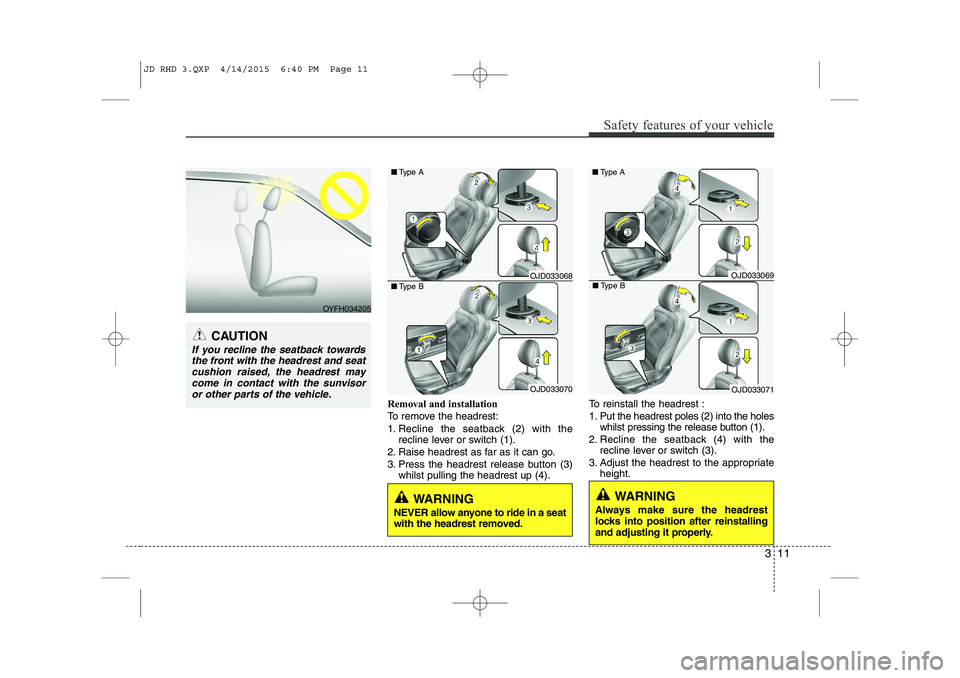
Removal and installation
To remove the headrest:
1. Recline the seatback (2) with therecline lever or switch (1).
2. Raise headrest as far as it can go.
3. Press the headrest release button (3) whilst pulling the headrest up (4). To reinstall the headrest :
1. Put the headrest poles (2) into the holes
whilst pressing the release button (1).
2. Recline the seatback (4) with the recline lever or switch (3).
3. Adjust the headrest to the appropriate height.
OJD033069
OJD033071
■
Type A
■ Type B
WARNING
NEVER allow anyone to ride in a seat
with the headrest removed.
OJD033068
OJD033070
■
Type A
■ Type B
WARNING
Always make sure the headrest
locks into position after reinstalling
and adjusting it properly.
OYFH034205
CAUTION
If you recline the seatback towards the front with the headrest and seat cushion raised, the headrest maycome in contact with the sunvisoror other parts of the vehicle.
JD RHD 3.QXP 4/14/2015 6:40 PM Page 11
Page 650 of 1210
Safety features of your vehicle
30
3
Care of seat belts
Seat belt systems should never be disas-
sembled or modified. In addition, care
should be taken to assure that seat belts
and belt hardware are not damaged by
seat hinges, doors or other abuse.Periodic inspection
It is recommended that all seat belts be
inspected periodically for wear or dam-
age of any kind. Any damaged parts
should be replaced as soon as possible.
Keep belts clean and dry
Seat belts should be kept clean and dry.
If belts become dirty, they can be
cleaned by using a mild soap solution
and warm water. Bleach, dye, strong
detergents or abrasives should not be
used because they may damage and
weaken the fabric.
When to replace seat belts
Entire in-use seat belt assembly or
assemblies should be replaced if the
vehicle has been involved in an accident.
This should be done even if no damage
is visible. We recommend that you con-
sult an authorised Kia dealer.
WARNING
Riding with a reclined seatback
increases your chance of serious
or fatal injuries in the event of a col-
lision or sudden stop. The protec-
tion of your restraint system (seat
belts and air bags) is greatly
reduced by reclining your seat.
Seat belts must be snug against
your hips and chest to work proper-
ly. The more the seatback is
reclined, the greater the chancethat an occupant's hips will slideunder the lap belt causing seriousinternal injuries or the occupant's
neck could strike the shoulder belt.
Drivers and passengers should
always sit well back in their seats,
properly belted, and with the seat-
backs upright.
WARNING
When you return the rear seatback to its upright position after the rear
seatback was folded down, be care-
ful not to damage the seat belt web-
bing or buckle. Be sure that the
webbing or buckle does not get
caught or pinched in the rear seat.
A seat belt with damaged webbing
or buckle will not be as strong and
could possibly fail during a colli-
sion or sudden stop, resulting in
serious injury. If the webbing or
buckles are damaged, get them
replaced immediately.
JD RHD 3.QXP 4/14/2015 6:41 PM Page 30
Page 662 of 1210
Safety features of your vehicle
42
3
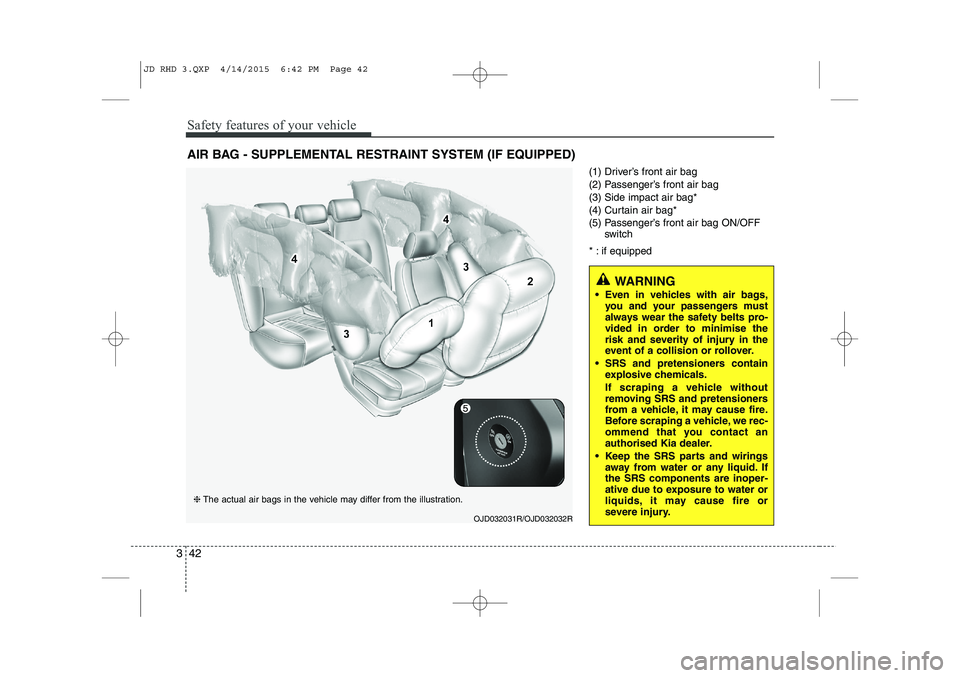
(1) Driver’s front air bag
(2) Passenger’s front air bag(3) Side impact air bag*
(4) Curtain air bag*
(5) Passenger’s front air bag ON/OFF
switch
* : if equipped
AIR BAG - SUPPLEMENTAL RESTRAINT SYSTEM (IF EQUIPPED)
OJD032031R/OJD032032R
❈
The actual air bags in the vehicle may differ from the illustration.
WARNING
Even in vehicles with air bags, you and your passengers must
always wear the safety belts pro-
vided in order to minimise the
risk and severity of injury in the
event of a collision or rollover.
SRS and pretensioners contain explosive chemicals.
If scraping a vehicle without
removing SRS and pretensioners
from a vehicle, it may cause fire.
Before scraping a vehicle, we rec-
ommend that you contact an
authorised Kia dealer.
Keep the SRS parts and wirings away from water or any liquid. Ifthe SRS components are inoper-
ative due to exposure to water or
liquids, it may cause fire or
severe injury.
JD RHD 3.QXP 4/14/2015 6:42 PM Page 42
Page 664 of 1210
Safety features of your vehicle
44
3
Noise and smoke
When the air bags inflate, they make a loud
noise and they leave smoke and powder in
the air inside of the vehicle. This is normaland is a result of the ignition of the air bag
inflator. After the air bag inflates, you may
feel substantial discomfort in breathing due
to the contact of your chest with both the
seat belt and the air bag, as well as from
breathing the smoke and powder. Open
your doors and/or windows as soon as
possible after impact in order to reduce
discomfort and prevent prolonged
exposure to the smoke and powder.
Though smoke and powder are non-
toxic, it may cause irritation to the skin
(eyes, nose and throat, etc.). If this is the
case, wash and rinse with cold waterimmediately and consult the doctor if the
symptom persists.
Do not install a child restraint on the
front passenger’s seat
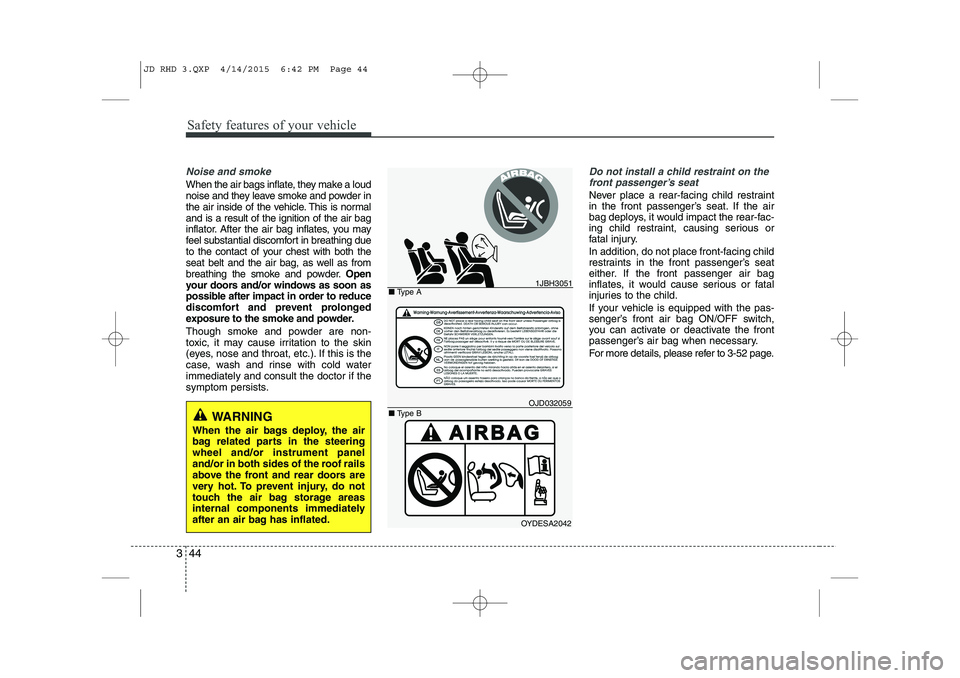
Never place a rear-facing child restraint
in the front passenger’s seat. If the air
bag deploys, it would impact the rear-fac-
ing child restraint, causing serious or
fatal injury.
In addition, do not place front-facing child
restraints in the front passenger’s seat
either. If the front passenger air bag
inflates, it would cause serious or fatal
injuries to the child.
If your vehicle is equipped with the pas-
senger’s front air bag ON/OFF switch,
you can activate or deactivate the front
passenger’s air bag when necessary.
For more details, please refer to 3-52 page.
WARNING
When the air bags deploy, the air
bag related parts in the steeringwheel and/or instrument panel
and/or in both sides of the roof rails
above the front and rear doors are
very hot. To prevent injury, do not
touch the air bag storage areas
internal components immediately
after an air bag has inflated.
OYDESA2042
1JBH3051
■ Type B■ Type A
OJD032059
JD RHD 3.QXP 4/14/2015 6:42 PM Page 44
Page 679 of 1210
359
Safety features of your vehicle
Air bag inflation conditions
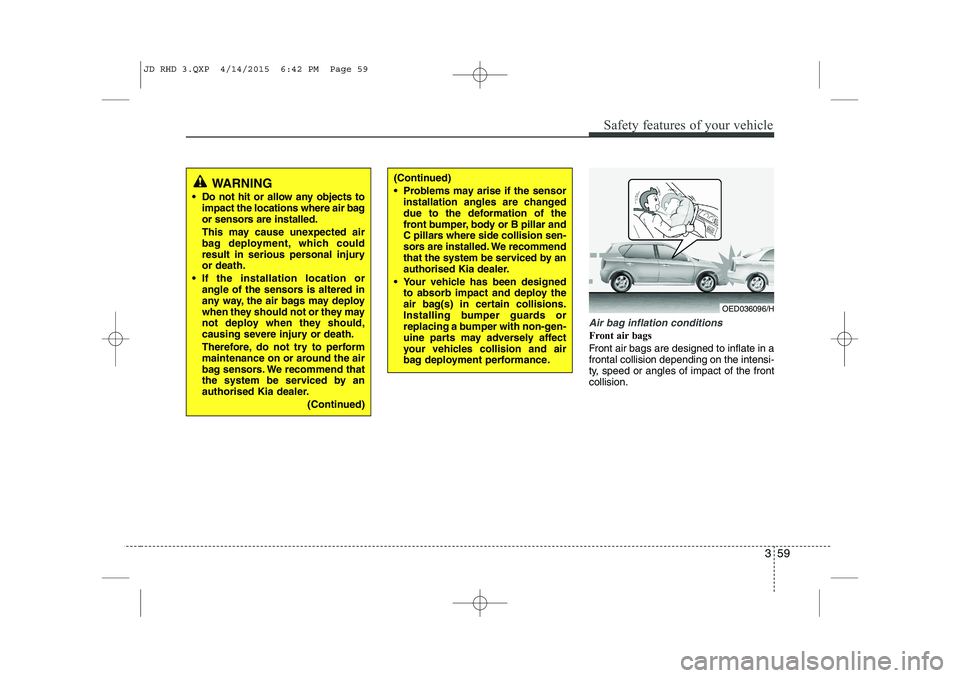
Front air bags
Front air bags are designed to inflate in a frontal collision depending on the intensi-
ty, speed or angles of impact of the frontcollision.
WARNING
Do not hit or allow any objects to impact the locations where air bag
or sensors are installed.
This may cause unexpected air
bag deployment, which could
result in serious personal injuryor death.
If the installation location or angle of the sensors is altered in
any way, the air bags may deploy
when they should not or they may
not deploy when they should,
causing severe injury or death.
Therefore, do not try to perform
maintenance on or around the air
bag sensors. We recommend that
the system be serviced by an
authorised Kia dealer.
(Continued)(Continued)
Problems may arise if the sensorinstallation angles are changed
due to the deformation of the
front bumper, body or B pillar and
C pillars where side collision sen-
sors are installed. We recommend
that the system be serviced by an
authorised Kia dealer.
Your vehicle has been designed to absorb impact and deploy the
air bag(s) in certain collisions.
Installing bumper guards or
replacing a bumper with non-gen-
uine parts may adversely affect
your vehicles collision and air
bag deployment performance.
OED036096/H
JD RHD 3.QXP 4/14/2015 6:42 PM Page 59
Page 683 of 1210
363
Safety features of your vehicle
SRS Care
The SRS is virtually maintenance-free
and so there are no parts you can safely
service by yourself. If the SRS air bag
warning light does not illuminate, or con-
tinuously remains on, we recommend
that the system be inspected by an
authorised Kia dealer.
WARNING
Modification to SRS components or wiring, including the addition
of any kind of badges to the pad
covers or modifications to the
body structure, can adversely
affect SRS performance and lead
to possible injury.
For cleaning the air bag pad cov- ers, use only a soft, dry cloth or
one which has been moistened
with plain water. Solvents or
cleaners could adversely affect
the air bag covers and proper
deployment of the system.
No objects should be placed over or near the air bag modules on
the steering wheel, instrument
panel, and the front passenger's
panel above the glove box,
because any such object could
cause harm if the vehicle is in a
crash severe enough to cause
the air bags to inflate.
(Continued)(Continued)
If the air bags inflate, we recom-mend that the system be replaced
by an authorised Kia dealer.
Do not tamper with or disconnect SRS wiring, or other components
of the SRS system. Doing so
could result in injury, due to acci-
dental inflation of the air bags or
by rendering the SRS inopera-
tive.
If components of the air bag sys- tem must be discarded, or if the
vehicle must be scrapped, certain
safety precautions must be
observed. An authorised Kia
dealer knows these precautions
and can give you the necessary
information. Failure to follow
these precautions and proce-dures could increase the risk of
personal injury.
If your car was flooded and has soaked carpeting or water on floor-
ing, you shouldn't try to start the
engine; we recommend that you
contact an authorised Kia dealer.
JD RHD 3.QXP 4/14/2015 6:42 PM Page 63
Page 689 of 1210
Features of your vehicle
4
4
Record your key number
The key code number is
stamped on the keycode tag attached to the
key set. Should you lose
your keys, we recom-
mend that you contact an authorised Kia
dealer. Remove the key code tag and
store it in a safe place. Also, record the
code number and keep it in a safe and
handy place, but not in the vehicle.
Key operations
• Used to start the engine.
• Used to lock and unlock the doors. Immobiliser system
Your vehicle may be equipped with an electronic engine immobiliser system to
reduce the risk of unauthorised vehicle
use.
Your immobiliser system is comprised of
a small transponder in the key and elec-
tronic devices inside the vehicle.
Vehicles without smart key system
With the immobiliser system, whenever
you insert your ignition key into the igni-
tion switch and turn it to ON, it checks
and determines and verifies if the ignition
key is valid or not.
If the key is valid, the engine will start.
If the key is invalid, the engine will not
start.
To deactivate the immobiliser system:
Insert the ignition key into the key cylin-
der and turn it to the ON position.
To activate the immobiliser system:
Turn the ignition key to the OFF position.
The immobiliser system activates auto-
matically. Without a valid ignition key for
your vehicle, the engine will not start.
KEYS
WARNING
- Ignition key
Leaving children unattended in a
vehicle with the ignition key (Smart
key) is dangerous even if the key is
not in the ignition or start button is
ACC or ON position. Children copy
adults and they could place the key
in the ignition or press the start but-
ton. The ignition key (Smart key)
would enable children to operate
power windows or other controls, or
even make the vehicle move, which
could result in serious bodily injury
or even death. Never leave the keys
in your vehicle with unsupervised
children, when the engine is running.
WARNING
We recommend that you use parts
for replacement from an authorised
Kia dealer. If an aftermarket key is
used, the ignition switch may not
return to ON after START. If this
happens, the starter will continue
to operate causing damage to the
starter motor and possible fire due
to excessive current in the wiring.
JD RHD 4a(~171).QXP 4/14/2015 6:55 PM Page 4
Page 707 of 1210
Features of your vehicle
22
4
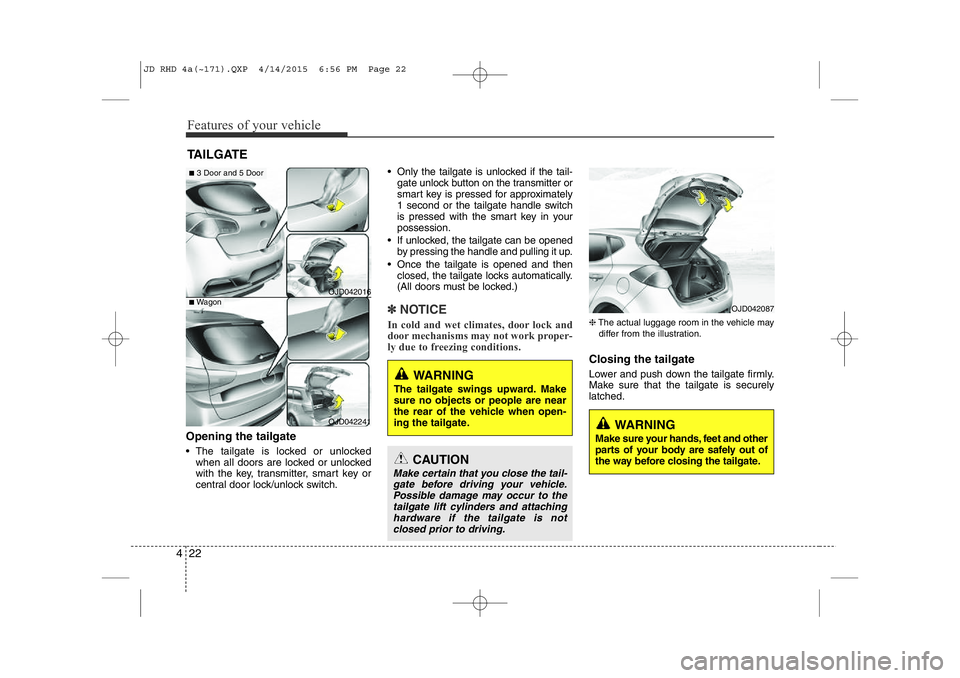
Opening the tailgate
• The tailgate is locked or unlocked
when all doors are locked or unlocked
with the key, transmitter, smart key or
central door lock/unlock switch. • Only the tailgate is unlocked if the tail-
gate unlock button on the transmitter or
smart key is pressed for approximately
1 second or the tailgate handle switch
is pressed with the smart key in your possession.
• If unlocked, the tailgate can be opened by pressing the handle and pulling it up.
• Once the tailgate is opened and then closed, the tailgate locks automatically.
(All doors must be locked.)
✽NOTICE
In cold and wet climates, door lock and
door mechanisms may not work proper-
ly due to freezing conditions.
❈ The actual luggage room in the vehicle may
differ from the illustration.
Closing the tailgate
Lower and push down the tailgate firmly.
Make sure that the tailgate is securelylatched.
TAILGATE
WARNING
The tailgate swings upward. Make sure no objects or people are near
the rear of the vehicle when open-
ing the tailgate.
CAUTION
Make certain that you close the tail- gate before driving your vehicle.Possible damage may occur to the tailgate lift cylinders and attaching
hardware if the tailgate is notclosed prior to driving.
WARNING
Make sure your hands, feet and other
parts of your body are safely out of
the way before closing the tailgate.
OJD042087
OJD042016
OJD042241
■ 3 Door and 5 Door
■Wagon
JD RHD 4a(~171).QXP 4/14/2015 6:56 PM Page 22
Page 713 of 1210
Features of your vehicle
28
4
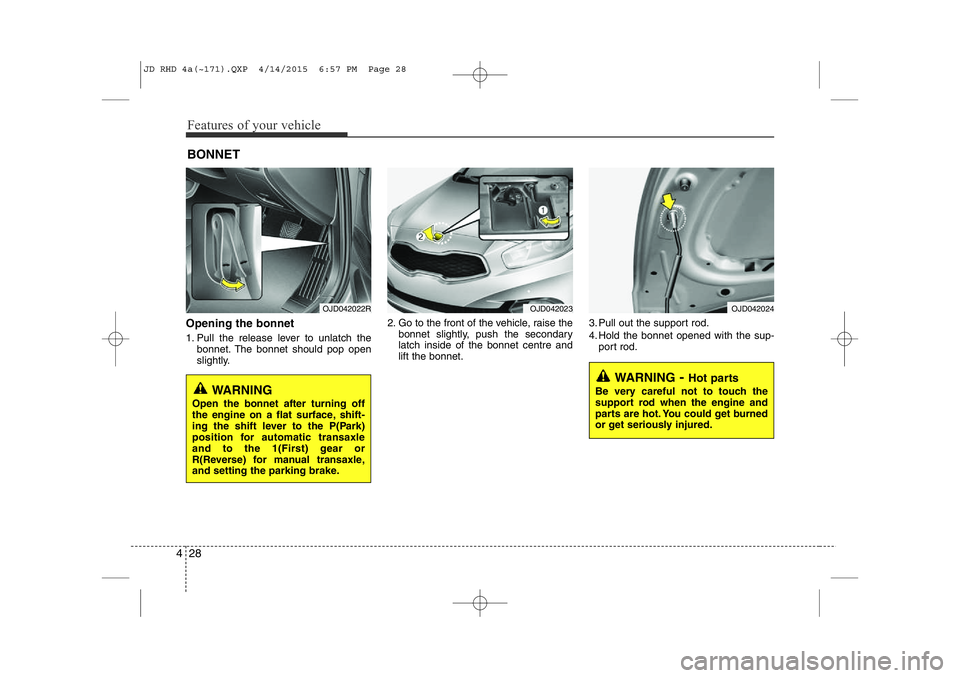
Opening the bonnet
1. Pull the release lever to unlatch the
bonnet. The bonnet should pop open
slightly. 2. Go to the front of the vehicle, raise the
bonnet slightly, push the secondarylatch inside of the bonnet centre andlift the bonnet. 3. Pull out the support rod.
4. Hold the bonnet opened with the sup-
port rod.
BONNET
OJD042022R
WARNING
Open the bonnet after turning off
the engine on a flat surface, shift-
ing the shift lever to the P(Park)
position for automatic transaxle
and to the 1(First) gear or
R(Reverse) for manual transaxle,
and setting the parking brake.
WARNING - Hot parts
Be very careful not to touch the
support rod when the engine and
parts are hot. You could get burned
or get seriously injured.
OJD042023OJD042024
JD RHD 4a(~171).QXP 4/14/2015 6:57 PM Page 28