torque KIA CEED 2015 Owners Manual
[x] Cancel search | Manufacturer: KIA, Model Year: 2015, Model line: CEED, Model: KIA CEED 2015Pages: 1210, PDF Size: 35.92 MB
Page 118 of 1210
437
Features of your vehicle
STEERING WHEEL
Electronic power steering
Power steering uses the motor to assist
you in steering the vehicle. If the engine
is off or if the power steering system
becomes inoperative, the vehicle may
still be steered, but it will require
increased steering effort.
The electronic power steering is con-
trolled by the power steering control unit
which senses the steering wheel torque
and vehicle speed to command the
motor.
The steering effort becomes heavier as
the vehicle’s speed increases and
becomes lighter as the vehicle’s speed
decreases for better control of the steer- ing wheel.
Should you notice any change in the
effort required to steer during normal
vehicle operation, we recommend that
the system be checked by an authorized
Kia dealer.✽NOTICE
The following symptoms may occur dur-
ing normal vehicle operation:
• The EPS warning light does not illu- minate.
• The steering effort is high immediate-
ly after turning the ignition switch on.
This happens as the system performs
the EPS system diagnostics. When the
diagnostics is completed, the steering
wheel will return to its normal condi-
tion.
• A click noise may be heard from the EPS relay after the ignition switch is
turned to the ON or LOCK/OFF posi-
tion.
• Motor noise may be heard when the
vehicle is at a stop or at a low driving
speed.
• The steering effort increases if the
steering wheel is rotated continuously
when the vehicle is not in motion.
However, after a few minutes, it will
return to its normal conditions. (Continued)(Continued)
• If an error is detected in the electric
power steering system, EPS will stop
assisting driver in steering the vehicle to
prevent accidents and the warning light
on the cluster will illuminate or blink.
We recommend that the system be
checked by an authorized Kia dealer as
soon as possible.
• When you operate the steering wheel in low temperature, abnormal noise could
occur. If temperature rises, the noise
will disappear. This is a normal condi-
tion.
• When the vehicle is stationary, if you turn the steering wheel all the way to
the left or right continuously, the
steering wheel becomes heavier from
the end. This is not a system malfunc-
tion but for your safety. As time pass-
es, the steering wheel returns to its
normal condition.
• When the charging system warning light comes on or the voltage is low
(When the alternator (or battery) does
not operate normally or it malfunc-
tions), the steering wheel may get
heavy and become difficult to control
operate abnormally.
JD eng 4a.QXP 3/4/2015 4:23 PM Page 37
Page 141 of 1210
Features of your vehicle
60
4
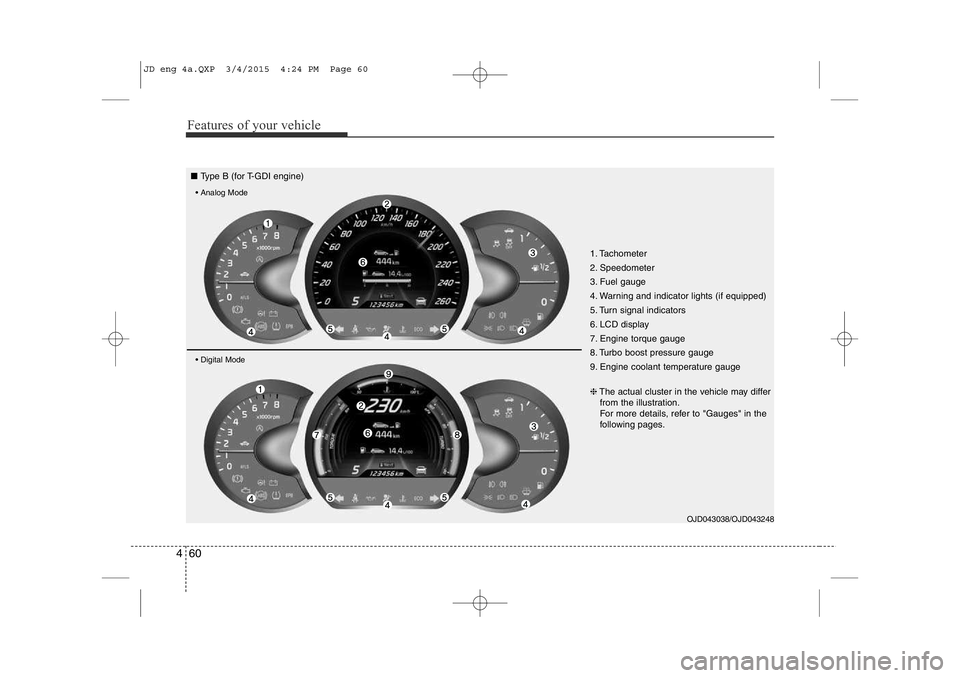
1. Tachometer
2. Speedometer
3. Fuel gauge
4. Warning and indicator lights (if equipped)
5. Turn signal indicators
6. LCD display
7. Engine torque gauge
8. Turbo boost pressure gauge
9. Engine coolant temperature gauge
OJD043038/OJD043248
❈
The actual cluster in the vehicle may differ
from the illustration.
For more details, refer to "Gauges" in the
following pages.
■ Type B (for T-GDI engine)
• Analog Mode • Digital Mode
JD eng 4a.QXP 3/4/2015 4:24 PM Page 60
Page 144 of 1210
463
Features of your vehicle
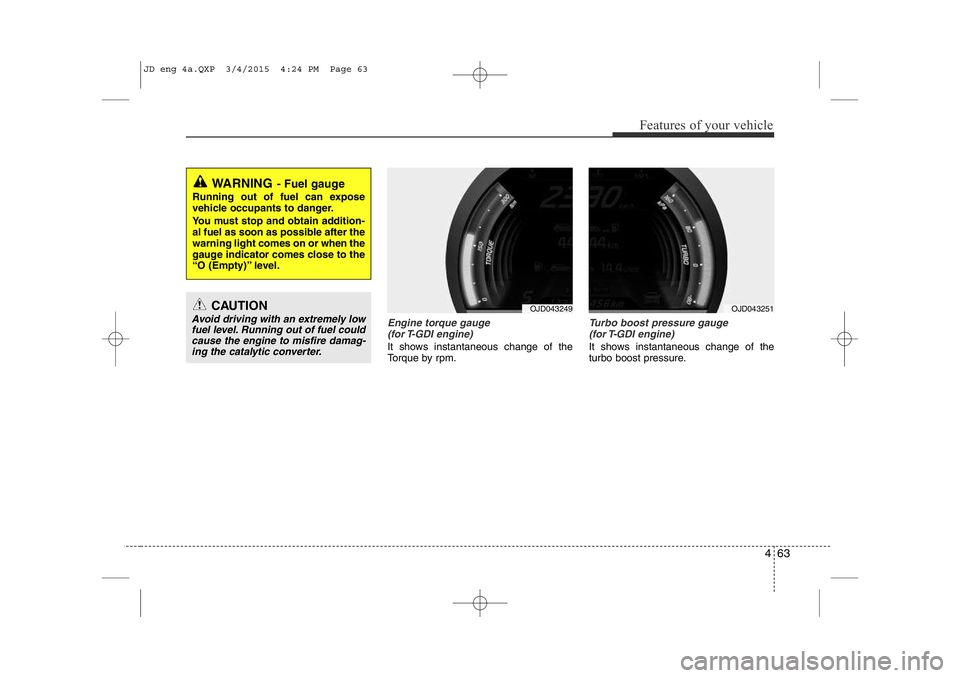
Engine torque gauge(for T-GDI engine)
It shows instantaneous change of the
Torque by rpm.
Turbo boost pressure gauge (for T-GDI engine)
It shows instantaneous change of the
turbo boost pressure.
WARNING - Fuel gauge
Running out of fuel can expose
vehicle occupants to danger.
You must stop and obtain addition-
al fuel as soon as possible after the warning light comes on or when the
gauge indicator comes close to the
“O (Empty)” level.
CAUTION
Avoid driving with an extremely low fuel level. Running out of fuel could
cause the engine to misfire damag-ing the catalytic converter.OJD043249OJD043251
JD eng 4a.QXP 3/4/2015 4:24 PM Page 63
Page 159 of 1210

Features of your vehicle
78
4
Check steering wheel lock system
(if equipped)
If the steering wheel does not lock nor-
mally when the engine start/stop button
changes to the OFF position, the warning
illuminates for 10 seconds on the LCD
display. Also, the warning chime sounds
for 3 seconds and the engine start/stop
button light blinks for 10 seconds. Check "BRAKE SWITCH" fuse
When the brake switch fuse is discon-
nected, the warning illuminates for 10
seconds on the LCD display.
Replace the fuse with a new one. If that
is not possible you can start the engine
by pressing the engine start/stop button
for 10 seconds in ACC.
Torque reduced due to overheating (for
T-GDI engine)
When the engine coolant temperature
exceeds 115°C, this message will be dis-
played and the torque will be reduced to
protect the engine.
OJD042069/OJD042201
■
Normal vision
■SupervisionOJD042076/OJD042208
■
Normal vision
■SupervisionOJD043509
JD eng 4a.QXP 3/4/2015 4:26 PM Page 78
Page 370 of 1210

Driving your vehicle
24
5
✽✽
NOTICE
The double clutch transmission gives the driving feel of a Manual
Transaxle, yet provides the ease of a
fully Automatic Transaxle. Unlike a
traditional Automatic Transaxle, the
gear shifting can be felt (and heard)
on the double clutch transmission
- Think of it as an automatically shift-ing Manual Transaxle.
- Shift into Drive range and you get great shifting feedback and sound,
but no shifting hassle.
Dry-type clutch transfers driving
torque and also delivers direct driving
feel which can be felt different from
smooth Automatic Transaxle with slip
of torque converter. This might be
easily felt especially at launch & low
vehicle speed.
Double clutch transmission adopts dry-type double clutch, which is dif-
ferent from torque converter of
Automatic Transaxle, and shows bet-
ter acceleration performance during
driving. But, initial launch might be
little bit slower than Automatic
Transaxle.
(Continued)(Continued)
When rapidly accelerating at low
vehicle speed, engine could rev at high
rpm depending on vehicle drive con-
dition.
For smooth launch at uphill, press
down the accelerator pedal properly
depending on the vehicle drive condi-
tion.
If you release your foot from the accel-
erator pedal at low vehicle speed, you
may feel strong engine brake, which is
similar to manual transaxle.
In case if you want to speed down at
downhill, you may use sport mode or
paddle shift to downshift, and also use
foot brake properly depending on
driving condition to get enough decel-
eration.
When you turn the ignition on and off, you may hear clicking sounds as the
transmission solenoids turn on and
off, cycling through a self test. This is
a normal sound for the Double Clutch
Transmission.For smooth operation, depress the brake
pedal when shifting from N (Neutral) to aforward or reverse gear.
WARNING - Automatic
transaxle
Always check the surrounding areas near your vehicle for peo-
ple, especially children, before
shifting a vehicle into D (Drive) or
R (Reverse).
Before leaving the driver’s seat, always make sure the shift lever
is in the P (Park) position; then
set the parking brake fully and
shut the engine off. Unexpected
and sudden vehicle movementcan occur if these precautions
are not followed in the order iden-tified.
JD eng 5.QXP 3/4/2015 2:51 PM Page 24
Page 371 of 1210
525
Driving your vehicle
CAUTION
To avoid damage to yourtransaxle, do not accelerate the
engine in R (Reverse) or any for- ward gear position with thebrakes on.
When stopped on an upgrade, do not hold the vehicle stationarywith engine power. Use the serv- ice brake or the parking brake.
Do not shift from N (Neutral) or P (Park) into D (Drive), or R
(Reverse) when the engine isabove idle speed.
CAUTION - Double clutch
transmission
If the vehicle is held by applying accelerator pedal at the hill, the
transmission and clutch will bedamaged. To hold at the hill, usethe parking brake or foot brake.
An overload of the clutch is indi- cated by a longitudinal judder anda blinking display. To exclude aclutch-damage, the clutch isopened and the torque flow inter-
rupted. If the clutch is opened,apply the foot brake and wait someminutes before driving again.
Ignoring the warnings can lead to severe injuries and damage onthe car.
If the LCD warning is active, the foot brake has to be applied.
When the problem of gear system occurs, the transaxle indicator
will blink. For your safety, we rec-ommend that you contact an authorized Kia dealer and havethe system checked.
(Continued)
(Continued) When the clutch is overheated, the safe protection mode oper-ates. According to the safe pro-tection mode, the transaxle indi-
cator blinks with buzzer sound.The buzzer beeps 3 times.
In this time, the LCD warningabout safe protection mode also
displays. In this condition, thedriving may not be smoothly. Ifyou ignore this warning, the driv-ing condition is getting worse and
the system may have problem. Toreturn the normal driving condi- tion, apply the foot brake and
stop the vehicle for few minutes before driving off.
While shifting the gear automati- cally, you may feel a correspon-ding shifting of gear. However, it
is not malfunction.
JD eng 5.QXP 3/4/2015 2:51 PM Page 25
Page 378 of 1210
Driving your vehicle
32
5
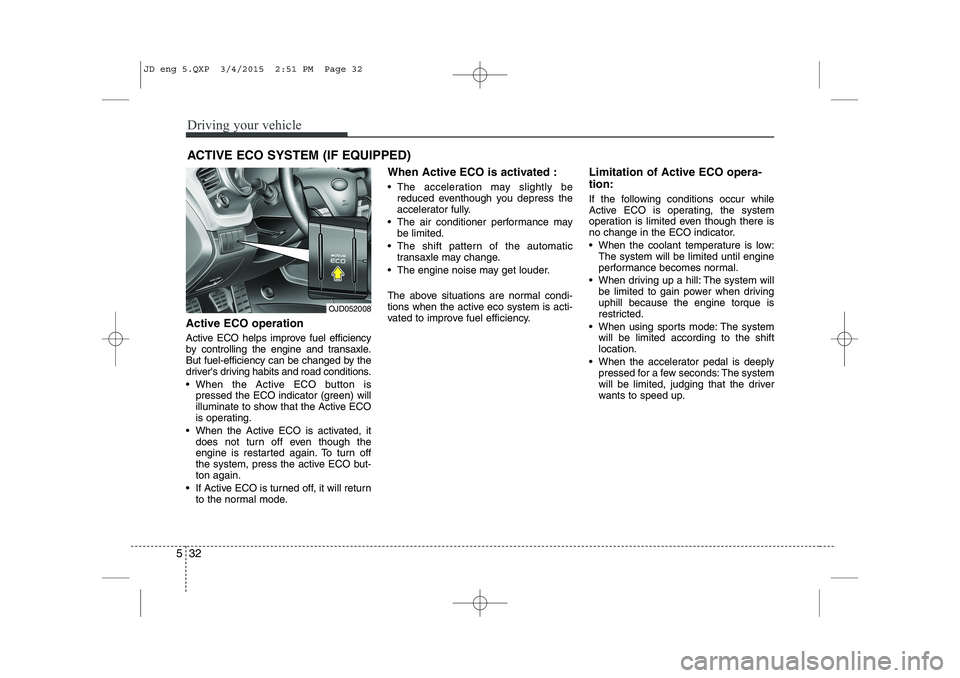
Active ECO operation
Active ECO helps improve fuel efficiency
by controlling the engine and transaxle.
But fuel-efficiency can be changed by the
driver's driving habits and road conditions.
When the Active ECO button is
pressed the ECO indicator (green) will
illuminate to show that the Active ECO
is operating.
When the Active ECO is activated, it does not turn off even though the
engine is restarted again. To turn off
the system, press the active ECO but-ton again.
If Active ECO is turned off, it will return to the normal mode. When Active ECO is activated :
The acceleration may slightly be
reduced eventhough you depress the
accelerator fully.
The air conditioner performance may be limited.
The shift pattern of the automatic transaxle may change.
The engine noise may get louder.
The above situations are normal condi-
tions when the active eco system is acti-
vated to improve fuel efficiency. Limitation of Active ECO opera- tion:
If the following conditions occur while
Active ECO is operating, the system
operation is limited even though there is
no change in the ECO indicator.
When the coolant temperature is low:
The system will be limited until engine
performance becomes normal.
When driving up a hill: The system will be limited to gain power when drivinguphill because the engine torque is
restricted.
When using sports mode: The system will be limited according to the shiftlocation.
When the accelerator pedal is deeply pressed for a few seconds: The system
will be limited, judging that the driver
wants to speed up.
ACTIVE ECO SYSTEM (IF EQUIPPED)
OJD052008
JD eng 5.QXP 3/4/2015 2:51 PM Page 32
Page 427 of 1210
What to do in an emergency
Road warning ............................................................6-2 Hazard warning flasher .................................................6-2
In case of an emergency while driving ....................6-3 If the engine stalls at a crossroad or crossing..............6-3
If you have a flat tire while driving ..............................6-3
If engine stalls while driving .........................................6-3
If the engine will not start ........................................6-4 If engine doesn’t turn over or turns over slowly.........6-4
If engine turns over normally but does not start ........6-4
Emergency starting ...................................................6-5 Jump starting ..................................................................6-5
Push-starting ...................................................................6-7
If the engine overheats ..............................................6-8
If you have a flat tire (with spare tire) ....................6-9 Jack and tools .................................................................6-9
Removing and storing the spare tire ..........................6-10
Changing tires...............................................................6-10
Wheel nut tightening torque .......................................6-14
Jack label.......................................................................6-17
EC Declaration of Conformity for Jack.....................6-18
If you have a flat tire
(with Tire Mobility Kit) ........................................6-19 Introduction ..................................................................6-19
Components of the Tire Mobility Kit .........................6-20
Using the Tire Mobility Kit .........................................6-21
Distributing the sealant................................................6-22 Producing the tire inflation pressure..........................6-22
Notes on the safe use of
the Tire Mobility Kit .............6-23
Technical Data ..............................................................6-23
Tire Pressure Monitoring System (TPMS) ...........6-24 Tire Pressure Monitoring System (TPMS) malfunction indicator ...............................................6-26
Changing a tire with TPMS ........................................6-27
Towing ......................................................................6-29 Towing service...............................................................6-29
Removable towing hook...............................................6-30
Emergency towing ........................................................6-30
Emergency commodity ...........................................6-33 Fire extinguisher...........................................................6-33
First aid kit....................................................................6-33
Triangle reflector ..........................................................6-33
Tire pressure gauge ......................................................6-33
6
JD eng 6.QXP 3/12/2015 3:05 PM Page 1
Page 440 of 1210
What to do in an emergency
14
6
Wheel nut tightening torque:
Steel wheel & aluminium alloy wheel:
9~11 kg.m (65~79 lb.ft)
If you have a tire gauge, remove the
valve cap and check the air pressure.
If the pressure is lower than recom-
mended, drive slowly to the nearest
service station and inflate to the cor-
rect pressure. If it is too high, adjust it
until it is correct. Always reinstall the
valve cap after checking or adjusting
tire pressure. If the cap is not
replaced, air may leak from the tire. If
you lose a valve cap, buy another and
install it as soon as possible.
After you have changed wheels,
always secure the flat tire in its place
and return the jack and tools to their
proper storage locations. To prevent the jack, jack handle,
wheel lug nut wrench and spare tire
from rattling while the vehicle is in
motion, store them properly.CAUTION
Your vehicle has metric threads
on the wheel studs and nuts.Make certain during wheel removal that the same nuts thatwere removed are reinstalled -or, if replaced, that nuts with metric threads and the samechamfer configuration are used.Installation of a non-metric thread nut on a metric stud orvice-versa will not secure thewheel to the hub properly andwill damage the stud so that it must be replaced.
Note that most lug nuts do nothave metric threads. Be sure touse extreme care in checking for thread style before installingaftermarket lug nuts or wheels.If in doubt, we recommend thatyou consult an authorized Kia dealer.
WARNING - Wheel studs
If the studs are damaged, they
may lose their ability to retain
the wheel. This could lead to theloss of the wheel and a collisionresulting in serious injuries.
WARNING - Inadequate
spare tire pressure
Check the inflation pressures as
soon as possible after installing
the spare tire. Adjust it to the
specified pressure, if necessary.
Refer to “Tires and wheels” in
chapter 8.
JD eng 6.QXP 3/12/2015 3:05 PM Page 14
Page 495 of 1210
Maintenance
36
7
Brake hoses and lines
Visually check for proper installation,
chafing, cracks, deterioration and any
leakage. Replace any deteriorated or
damaged parts immediately. Brake fluid
Check brake fluid level in the brake fluid
reservoir. The level should be between
“MIN” and “MAX” marks on the side of
the reservoir. Use only hydraulic brake
fluid conforming to DOT 3 or DOT 4specification. Brake pads, calipers and rotors
Check the pads for excessive wear, discs
for run out and wear, and calipers for fluid
leakage.
For more information on checking the
pads or lining wear limit, refer to the Kia
web site.
(http://brakeman
ual.kia.co.kr)
Suspension mounting bolts
Check the suspension connections for
looseness or damage. Retighten to the
specified torque.
Parking brake
Inspect the parking brake system
including the EPB actuator, wiring
and connectors. Steering gear box, linkage &
boots/lower arm ball joint
With the vehicle stopped and engine off,
check for excessive free-play in the
steering wheel.
Check the linkage for bends or damage.
Check the dust boots and ball joints for
deterioration, cracks, or damage.
Replace any damaged parts. Drive shafts and boots
Check the drive shafts, boots and clamps
for cracks, deterioration, or damage.
Replace any damaged parts and, if nec-
essary, repack the grease.
Air conditioning refrigerant/ compressor (if equipped)
Check the air conditioning lines and con-
nections for leakage and damage.
JD eng 7.QXP 3/4/2015 3:29 PM Page 36