oil KIA CEED 2016 User Guide
[x] Cancel search | Manufacturer: KIA, Model Year: 2016, Model line: CEED, Model: KIA CEED 2016Pages: 643, PDF Size: 38.19 MB
Page 227 of 643
Features of your vehicle
144
4
✽✽
NOTICE
Replace the filter according to the Maintenance Schedule.
If the car is being driven in severe
conditions such as dusty, rough roads,
more frequent climate control air fil-
ter inspections and changes are
required.
When the air flow rate suddenly
decreases, we recommend that the
system be checked by an authorized
Kia dealer.Checking the amount of air con-
ditioner refrigerant and compres-sor lubricant
When the amount of refrigerant is low,
the performance of the air conditioning is
reduced. Overfilling also has a bad influ-ence on the air conditioning system.
Therefore, if abnormal operation is found,
we recommend that the system be inspect-
ed by an authorized Kia dealer.
*: Your vehicle is filled with R-134a or R-1234yf according to the regulation in
your country at the time of producing.
You can find out which air conditioning
refrigerant is applied your vehicle at
the label inside of hood. Refer to chap-
ter 8 for more detail location of air con-
ditioning refrigerant label.
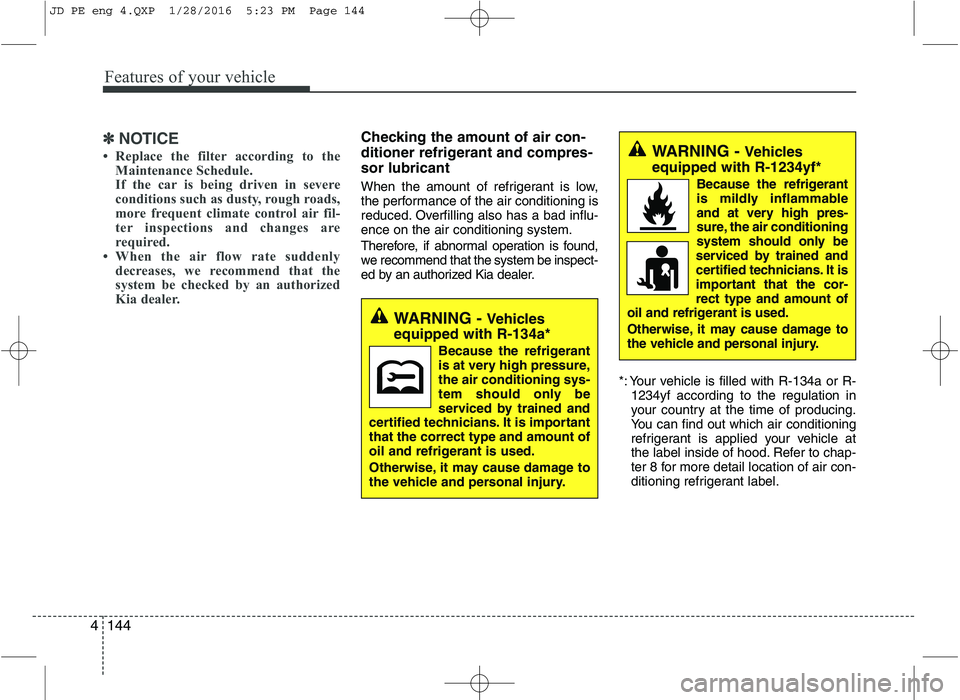
WARNING - Vehicles
equipped with R-1234yf*
Because the refrigerant
is mildly inflammable
and at very high pres-
sure, the air conditioning
system should only be
serviced by trained and
certified technicians. It is
important that the cor-rect type and amount of
oil and refrigerant is used.
Otherwise, it may cause damage to
the vehicle and personal injury.
WARNING - Vehicles
equipped with R-134a*
Because the refrigerant
is at very high pressure,the air conditioning sys-
tem should only be
serviced by trained and
certified technicians. It is importantthat the correct type and amount of
oil and refrigerant is used.
Otherwise, it may cause damage to
the vehicle and personal injury.
JD PE eng 4.QXP 1/28/2016 5:23 PM Page 144
Page 237 of 643
Features of your vehicle
154
4
Air conditioning (if equipped)
Kia Air Conditioning Systems are filled
with environmentally friendly refrigerant*.
1. Start the engine. Push the air condi-
tioning button.
2. Set the mode to the position.
3. Set the air intake control to the outside air or recirculated air position.
4. Adjust the fan speed control and tem- perature control to maintain maximum
comfort.
*: Your vehicle is filled with R-134a or R- 1234yf according to the regulation in
your country at the time of producing.
You can find out which air conditioning
refrigerant is applied to your vehicle at
the label inside of hood. Refer to chap-
ter 8 for more detail location of air con-
ditioning refrigerant label.✽✽ NOTICE
When using the air conditioning sys- tem, monitor the temperature gauge
closely while driving up hills or in
heavy traffic when outside tempera-
tures are high. Air conditioning sys-
tem operation may cause engine over-
heating. Continue to use the blower
fan but turn the air conditioning sys-
tem off if the temperature gauge indi-
cates engine overheating.
When opening the windows in humid weather air conditioning may create
water droplets inside the vehicle.
Since excessive water droplets may
cause damage to electrical equipment,
air conditioning should only be used
with the windows closed.CAUTION
The refrigerant system should
only be serviced by trained andcertified technicians to insureproper and safe operation.
The refrigerant system should be serviced in a well-ventilated place.
The air conditioning evaporator (cooling coil) shall never berepaired or replaced with oneremoved from a used or salvaged
vehicle and new replacement MAC evaporators shall be certi-fied (and labeled) as meeting SAEStandard J2842.
JD PE eng 4.QXP 1/28/2016 5:24 PM Page 154
Page 239 of 643
Features of your vehicle
156
4
✽✽
NOTICE
Replace the filter according to the Maintenance Schedule.
If the car is being driven in severe
conditions such as dusty, rough roads,
more frequent climate control air fil-
ter inspections and changes are
required.
When the air flow rate suddenly
decreases, we recommend that the
system be checked by an authorized
Kia dealer.Checking the amount of air con-
ditioner refrigerant and compres-sor lubricant
When the amount of refrigerant is low,
the performance of the air conditioning is
reduced. Overfilling also has a bad influ-ence on the air conditioning system.
Therefore, if abnormal operation is
found, we recommend that the system be
inspected by an authorized Kia dealer.
*: Your vehicle is filled with R-134a or R-1234yf according to the regulation in
your country at the time of producing.
You can find out which air conditioning
refrigerant is applied your vehicle at
the label inside of hood. Refer to chap-
ter 8 for more detail location of air con-
ditioning refrigerant label.
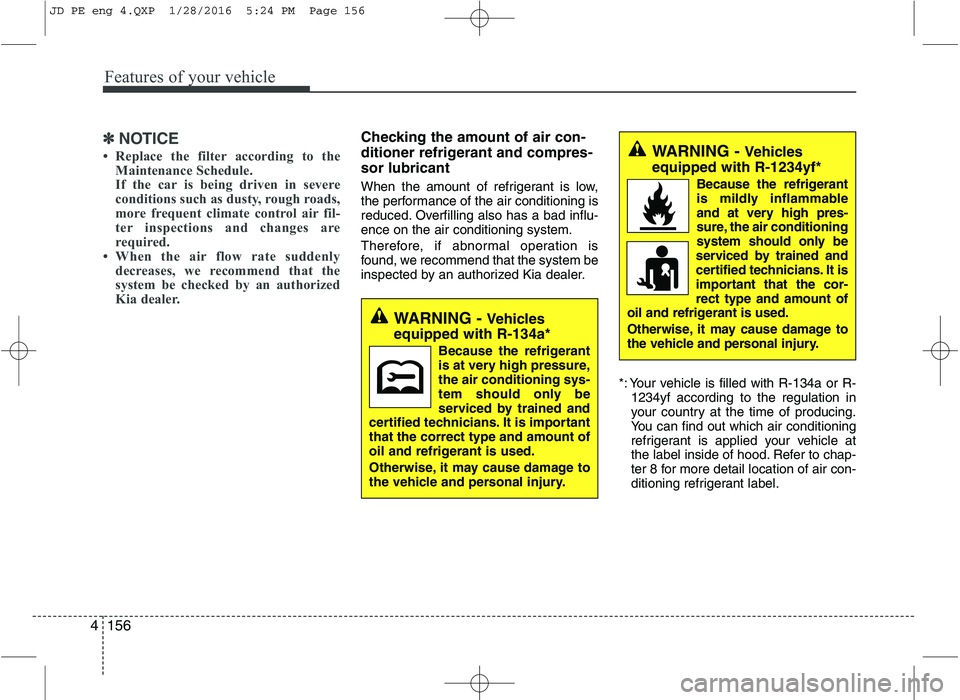
WARNING - Vehicles
equipped with R-1234yf*
Because the refrigerant
is mildly inflammable
and at very high pres-
sure, the air conditioning
system should only be
serviced by trained and
certified technicians. It is
important that the cor-rect type and amount of
oil and refrigerant is used.
Otherwise, it may cause damage to
the vehicle and personal injury.
WARNING - Vehicles
equipped with R-134a*
Because the refrigerant
is at very high pressure,the air conditioning sys-
tem should only be
serviced by trained and
certified technicians. It is importantthat the correct type and amount of
oil and refrigerant is used.
Otherwise, it may cause damage to
the vehicle and personal injury.
JD PE eng 4.QXP 1/28/2016 5:24 PM Page 156
Page 254 of 643
4171
Features of your vehicle
Luggage net (holder) (if equipped)
To keep items from shifting in the cargo
area, you can use the four holders locat-ed in the cargo area to attach the lug-gage net.This symbol indicates theposition of the front holders
(wagon).
If necessary, we recommend that you
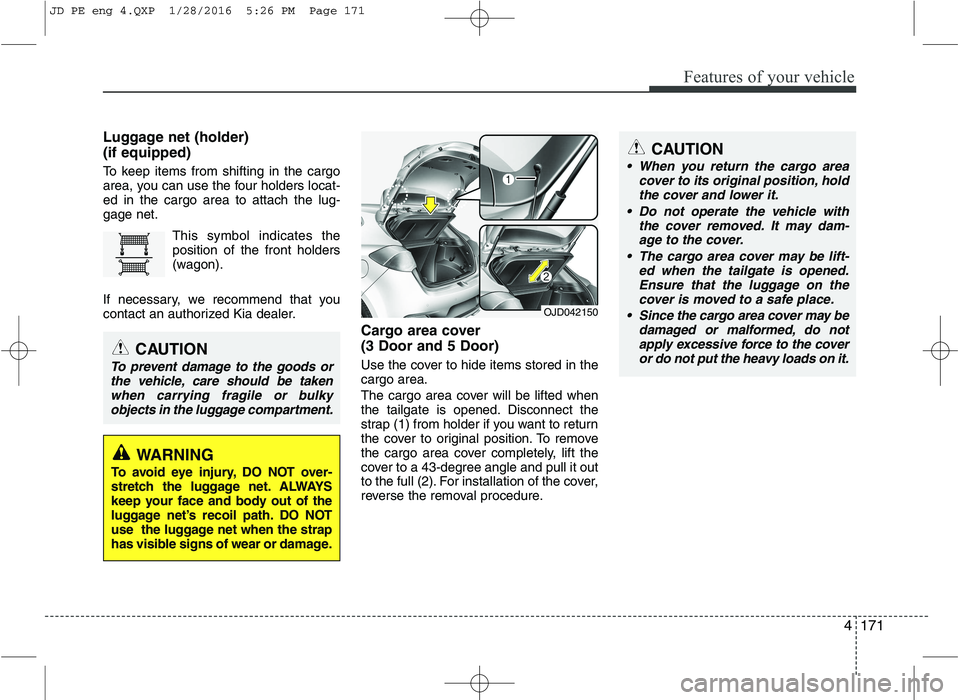
contact an authorized Kia dealer. Cargo area cover (3 Door and 5 Door)
Use the cover to hide items stored in the cargo area.
The cargo area cover will be lifted when
the tailgate is opened. Disconnect the
strap (1) from holder if you want to return
the cover to original position. To remove
the cargo area cover completely, lift the
cover to a 43-degree angle and pull it out
to the full (2). For installation of the cover,
reverse the removal procedure.
CAUTION
To prevent damage to the goods orthe vehicle, care should be takenwhen carrying fragile or bulky
objects in the luggage compartment.
WARNING
To avoid eye injury, DO NOT over-
stretch the luggage net. ALWAYS
keep your face and body out of the
luggage net’s recoil path. DO NOT
use the luggage net when the strap
has visible signs of wear or damage.
OJD042150
CAUTION
When you return the cargo area cover to its original position, holdthe cover and lower it.
Do not operate the vehicle with the cover removed. It may dam-
age to the cover.
The cargo area cover may be lift- ed when the tailgate is opened.Ensure that the luggage on the cover is moved to a safe place.
Since the cargo area cover may be damaged or malformed, do notapply excessive force to the coveror do not put the heavy loads on it.
JD PE eng 4.QXP 1/28/2016 5:26 PM Page 171
Page 375 of 643
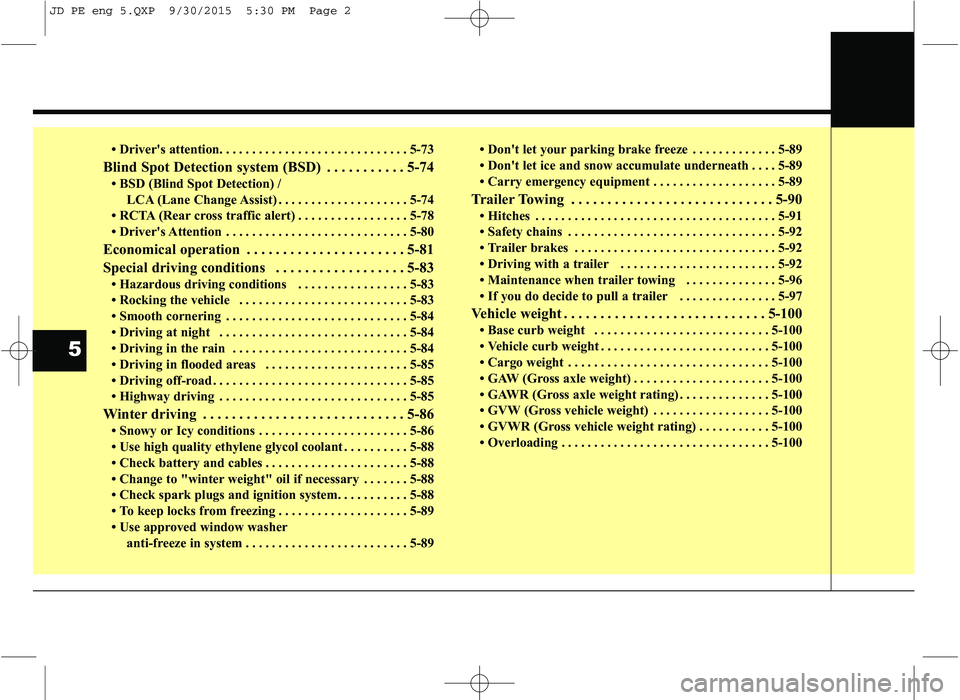
Driver's attention. . . . . . . . . . . . . . . . . . . . . . . . . . . . . 5-73
Blind Spot Detection system (BSD) . . . . . . . . . . . 5-74 BSD (Blind Spot Detection) / LCA (Lane Change Assist) . . . . . . . . . . . . . . . . . . . . 5-74
RCTA (Rear cross traffic alert) . . . . . . . . . . . . . . . . . 5-78
Driver's Attention . . . . . . . . . . . . . . . . . . . . . . . . . . . . 5-80
Economical operation . . . . . . . . . . . . . . . . . . . . . . 5-81
Special driving conditions . . . . . . . . . . . . . . . . . . 5-83 Hazardous driving conditions . . . . . . . . . . . . . . . . . 5-83
Rocking the vehicle . . . . . . . . . . . . . . . . . . . . . . . . . . 5-83
Smooth cornering . . . . . . . . . . . . . . . . . . . . . . . . . . . . 5-84
Driving at night . . . . . . . . . . . . . . . . . . . . . . . . . . . . . 5-84
Driving in the rain . . . . . . . . . . . . . . . . . . . . . . . . . . . 5-84
Driving in flooded areas . . . . . . . . . . . . . . . . . . . . . . 5-85
Driving off-road . . . . . . . . . . . . . . . . . . . . . . . . . . . . . . 5-85
Highway driving . . . . . . . . . . . . . . . . . . . . . . . . . . . . . 5-85
Winter driving . . . . . . . . . . . . . . . . . . . . . . . . . . . . 5-86 Snowy or Icy conditions . . . . . . . . . . . . . . . . . . . . . . . 5-86
Use high quality ethylene glycol coolant . . . . . . . . . . 5-88
Check battery and cables . . . . . . . . . . . . . . . . . . . . . . 5-88
Change to "winter weight" oil if necessary . . . . . . . 5-88
Check spark plugs and ignition system. . . . . . . . . . . 5-88
To keep locks from freezing . . . . . . . . . . . . . . . . . . . . 5-89
Use approved window washer anti-freeze in system . . . . . . . . . . . . . . . . . . . . . . . . . 5-89 Don't let your parking brake freeze . . . . . . . . . . . . . 5-89
Don't let ice and snow accumulate underneath . . . . 5-89
Carry emergency equipment . . . . . . . . . . . . . . . . . . . 5-89
Trailer Towing . . . . . . . . . . . . . . . . . . . . . . . . . . . . 5-90 Hitches . . . . . . . . . . . . . . . . . . . . . . . . . . . . . . . . . . . . . 5-91
Safety chains . . . . . . . . . . . . . . . . . . . . . . . . . . . . . . . . 5-92
Trailer brakes . . . . . . . . . . . . . . . . . . . . . . . . . . . . . . . 5-92
Driving with a trailer . . . . . . . . . . . . . . . . . . . . . . . . 5-92
Maintenance when trailer towing . . . . . . . . . . . . . . 5-96
If you do decide to pull a trailer . . . . . . . . . . . . . . . 5-97
Vehicle weight . . . . . . . . . . . . . . . . . . . . . . . . . . . . 5-100 Base curb weight . . . . . . . . . . . . . . . . . . . . . . . . . . . 5-100
Vehicle curb weight . . . . . . . . . . . . . . . . . . . . . . . . . . 5-100
Cargo weight . . . . . . . . . . . . . . . . . . . . . . . . . . . . . . . 5-100
GAW (Gross axle weight) . . . . . . . . . . . . . . . . . . . . . 5-100
GAWR (Gross axle weight rating) . . . . . . . . . . . . . . 5-100
GVW (Gross vehicle weight) . . . . . . . . . . . . . . . . . . 5-100
GVWR (Gross vehicle weight rating) . . . . . . . . . . . 5-100
Overloading . . . . . . . . . . . . . . . . . . . . . . . . . . . . . . . . 5-100
5
JD PE eng 5.QXP 9/30/2015 5:30 PM Page 2
Page 376 of 643
53
Driving your vehicle
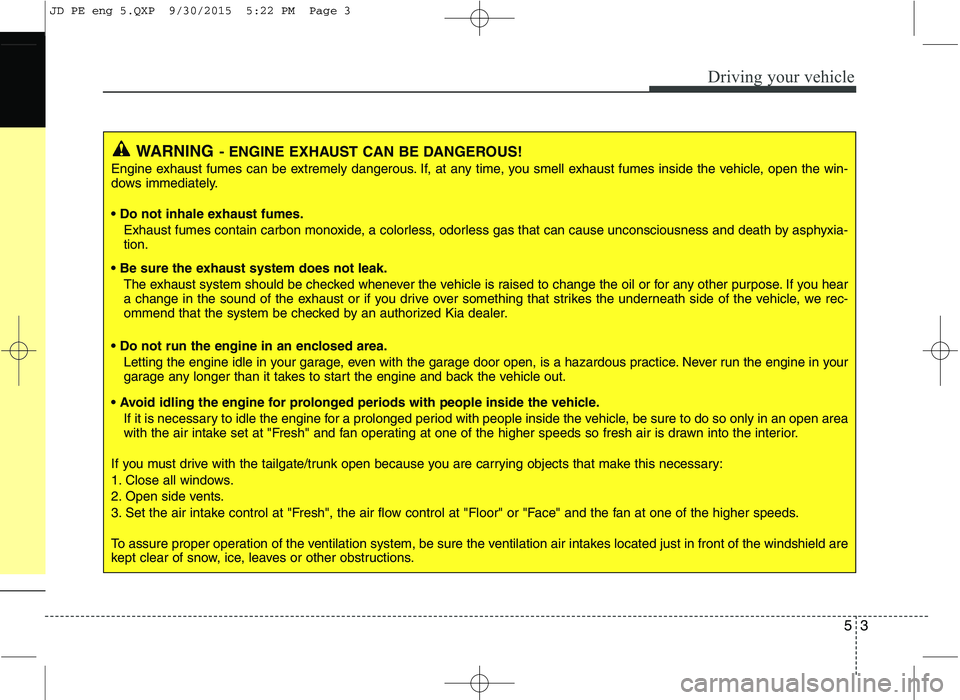
WARNING- ENGINE EXHAUST CAN BE DANGEROUS!
Engine exhaust fumes can be extremely dangerous. If, at any time, you smell exhaust fumes inside the vehicle, open the win-
dows immediately.
• Do not inhale exhaust fumes.
Exhaust fumes contain carbon monoxide, a colorless, odorless gas that can cause unconsciousness and death by asphyxia- tion.
The exhaust system should be checked whenever the vehicle is raised to change the oil or for any other purpose. If you hear
a change in the sound of the exhaust or if you drive over something that strikes the underneath side of the vehicle, we rec-
ommend that the system be checked by an authorized Kia dealer.
Letting the engine idle in your garage, even with the garage door open, is a hazardous practice. Never run the engine in your
garage any longer than it takes to start the engine and back the vehicle out.
If it is necessary to idle the engine for a prolonged period with people inside the vehicle, be sure to do so only in an open a rea
with the air intake set at "Fresh" and fan operating at one of the higher speeds so fresh air is drawn into the interior.
If you must drive with the tailgate/trunk open because you are carrying objects that make this necessary:
1. Close all windows.
2. Open side vents.
3. Set the air intake control at "Fresh", the air flow control at "Floor" or "Face" and the fan at one of the higher speeds.
To assure proper operation of the ventilation system, be sure the ventilation air intakes located just in front of the windshie ld are
kept clear of snow, ice, leaves or other obstructions.
JD PE eng 5.QXP 9/30/2015 5:22 PM Page 3
Page 377 of 643
Driving your vehicle
4
5
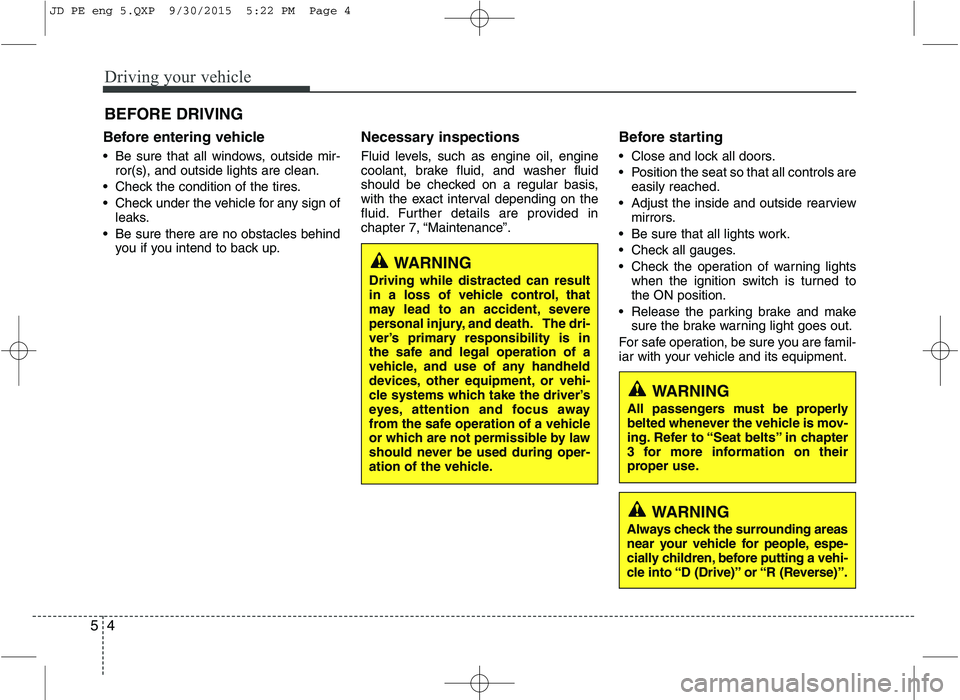
Before entering vehicle
• Be sure that all windows, outside mir-
ror(s), and outside lights are clean.
Check the condition of the tires.
Check under the vehicle for any sign of leaks.
Be sure there are no obstacles behind you if you intend to back up. Necessary inspections
Fluid levels, such as engine oil, engine
coolant, brake fluid, and washer fluid
should be checked on a regular basis,
with the exact interval depending on the
fluid. Further details are provided in
chapter 7, “Maintenance”.
Before starting
Close and lock all doors.
Position the seat so that all controls are
easily reached.
Adjust the inside and outside rearview mirrors.
Be sure that all lights work.
Check all gauges.
Check the operation of warning lights when the ignition switch is turned to the ON position.
Release the parking brake and make sure the brake warning light goes out.
For safe operation, be sure you are famil-
iar with your vehicle and its equipment.
BEFORE DRIVING
WARNING
All passengers must be properly
belted whenever the vehicle is mov-
ing. Refer to “Seat belts” in chapter
3 for more information on their
proper use.
WARNING
Always check the surrounding areas
near your vehicle for people, espe-
cially children, before putting a vehi-
cle into “D (Drive)” or “R (Reverse)”.
WARNING
Driving while distracted can result
in a loss of vehicle control, that
may lead to an accident, severe
personal injury, and death. The dri-
ver’s primary responsibility is in
the safe and legal operation of a
vehicle, and use of any handheld
devices, other equipment, or vehi-
cle systems which take the driver’s
eyes, attention and focus away
from the safe operation of a vehicle
or which are not permissible by law
should never be used during oper-
ation of the vehicle.
JD PE eng 5.QXP 9/30/2015 5:22 PM Page 4
Page 458 of 643

585
Driving your vehicle
Driving in flooded areas
Avoid driving through flooded areas
unless you are sure the water is no high-
er than the bottom of the wheel hub.
Drive through any water slowly. Allowadequate stopping distance because
brake performance may be affected.
After driving through water, dry the
brakes by gently applying them several
times while the vehicle is moving slowly.
Driving off-road
Drive carefully off-road because your
vehicle may be damaged by rocks or
roots of trees. Become familiar with the
off-road conditions where you are going
to drive before you begin driving.Highway driving
Tires
Adjust the tire inflation pressures to
specification. Low tire inflation pressures
will result in overheating and possible
failure of the tires.
Avoid using worn or damaged tires which
may result in reduced traction or tire fail-
ure.
✽✽
NOTICE
Never exceed the maximum tire inflation
pressure shown on the tires.
Fuel, engine coolant and engine oil
High speed travel consumes more fuel
than urban motoring. Do not forget to
check both engine coolant and engine oil.
Drive belt
A loose or damaged drive belt may result
in overheating of the engine.
WARNING
Underinflated or overinflated tires can cause poor handling,
loss of vehicle control, and sud-den tire failure leading to acci-
dents, injuries, and even death.
Always check the tires for proper
inflation before driving. For prop-
er tire pressures, refer to chapter
8, “Tires and wheels”.
(Continued)
(Continued)
Driving on tires with no or insuffi-cient tread is dangerous. Worn- out tires can result in loss of
vehicle control, collisions, injury,
and even death. Worn-out tiresshould be replaced as soon as
possible and should never be
used for driving. Always check
the tire tread before driving your
vehicle. For further information
and tread limits, refer to chapter
7, “Tires and wheels”.
JD PE eng 5.QXP 9/30/2015 5:27 PM Page 85
Page 461 of 643

Driving your vehicle
88
5
Use high quality ethylene glycol coolant
Your vehicle is delivered with high quality
ethylene glycol coolant in the cooling
system. It is the only type of coolant that
should be used because it helps prevent
corrosion in the cooling system, lubri-
cates the water pump and prevents
freezing. Be sure to replace or replenish
your coolant in accordance with the
maintenance schedule. Before winter,
have your coolant tested to assure that
its freezing point is sufficient for the tem-
peratures anticipated during the winter.
Check battery and cables
Winter puts additional burdens on the
battery system. Visually inspect the bat-
tery and cables as described in chapter
7. We recommend that the system be
checked by an authorized Kia dealer. Change to "winter weight" oil if
necessary In some climates it is recommended that
a lower viscosity "winter weight" oil be
used during cold weather. See chapter 8
for recommendations. If you aren't sure
what weight oil you should use, we rec-
ommend that you consult an authorized
Kia dealer.
Check spark plugs and ignition system
Inspect your spark plugs as described in
chapter 7 and replace them if necessary.
Also check all ignition wiring and compo-
nents to be sure they are not cracked,
worn or damaged in any way.
CAUTION
Chains that are the wrong size or
improperly installed can damageyour vehicle's brake lines, sus-pension, body and wheels.
Stop driving and retighten the chains any time you hear themhitting the vehicle.
WARNING - Tire chains
The use of chains may adversely affect vehicle handling.
Do not exceed 30 km/h (20 mph) or the chain manufacturer’s rec-
ommended speed limit, whichev-
er is lower.
Drive carefully and avoid bumps, holes, sharp turns, and other
road hazards, which may cause
the vehicle to bounce.
Avoid sharp turns or locked- wheel braking.
JD PE eng 5.QXP 9/30/2015 5:27 PM Page 88
Page 469 of 643

Driving your vehicle
96
5
When you are ready to leave after park-
ing on a hill
1. With the manual transaxle in Neutral
or automatic transaxle in P (Park),
apply your brakes and hold the brake
pedal down while you:
and
2. Slowly remove your foot from the brake pedal.
3. Drive slowly until the trailer is clear of the chocks.
4. Stop and have someone pick up and store the chocks. Maintenance when trailer towing
Your vehicle will need service more often
when you regularly pull a trailer.
Important items to pay particular atten-tion to include engine oil, automatic
transaxle fluid, axle lubricant and cooling
system fluid. Brake condition is another
important item to frequently check. Each
item is covered in this manual, and the
Index will help you find them quickly. If
you’re trailering, it is a good idea to
review these chapters before you start
your trip.
Do not forget to also maintain your trailer
and hitch. Follow the maintenance
schedule that accompanied your trailer
and check it periodically. Preferably, con-
duct the check at the start of each day’s
driving. Most importantly, all hitch nutsand bolts should be tight.CAUTION
Due to higher load during trailer
usage, overheating might occurin hot days or during uphill driv-ing. If the coolant gauge indicates
over-heating, switch off the airconditioner and stop the vehicle in a safe area to cool down theengine.
When towing check transaxle fluid more frequently.
If your vehicle is not equipped with an air conditioner, youshould install a condenser fan to improve engine performance
when towing a trailer.
JD PE eng 5.QXP 9/30/2015 5:28 PM Page 96