service KIA CEED 2016 Owner's Manual
[x] Cancel search | Manufacturer: KIA, Model Year: 2016, Model line: CEED, Model: KIA CEED 2016Pages: 643, PDF Size: 38.19 MB
Page 293 of 643
Features of your vehicle
210
4 SCAN
Press the key
Shortly pressing the key (under 0.8
seconds): TA On/Off
Pressing and holding the key(over 0.8 seconds): The broadcast sta-
tion increases and previews each
broadcasts for 5 seconds each.
After scanning all stations, returns
and plays the current broadcaststation.
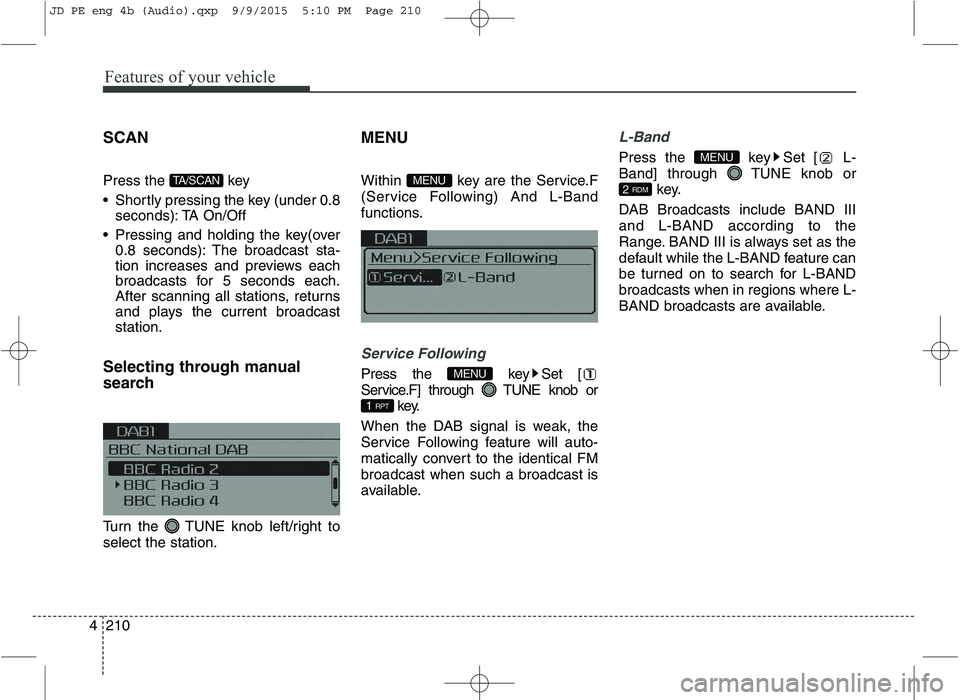
Selecting through manual
search
Turn the TUNE knob left/right to select the station. MENU
Within key are the Service.F
(Service Following) And L-Band
functions.
Service Following
Press the key Set [
Service.F] through TUNE knob or
key.
When the DAB signal is weak, the
Service Following feature will auto-
matically convert to the identical FMbroadcast when such a broadcast is
available.
L-Band
Press the key Set [ L-
Band] through TUNE knob or key.
DAB Broadcasts include BAND IIIand L-BAND according to the
Range. BAND III is always set as the
default while the L-BAND feature can
be turned on to search for L-BANDbroadcasts when in regions where L-
BAND broadcasts are available.
2 RDM
MENU
1 RPT
MENU
MENUTA/SCAN
JD PE eng 4b (Audio).qxp 9/9/2015 5:10 PM Page 210
Page 398 of 643
525
Driving your vehicle
R (Reverse)
Use this position to drive the vehicle
backward.
N (Neutral)
The wheels and transaxle are not
engaged. The vehicle will roll freely even
on the slightest incline unless the parking
brake or service brakes are applied.D (Drive)
This is the normal forward driving posi-
tion. The transaxle will automatically shift
through a 6-gear sequence, providing the
best fuel economy and power.
For extra power when passing another
vehicle or climbing grades, depress the
accelerator pedal fully (more than 80%)
until the kick down mechanism works
with a clicking noise, at which time the
transaxle will automatically downshift to
the next lower gear.
✽✽
NOTICE
Always come to a complete stop before shifting into D (Drive).
A clicking noise heard from the kick down mechanism by depressing the
accelerator pedal fully is a normal
condition.
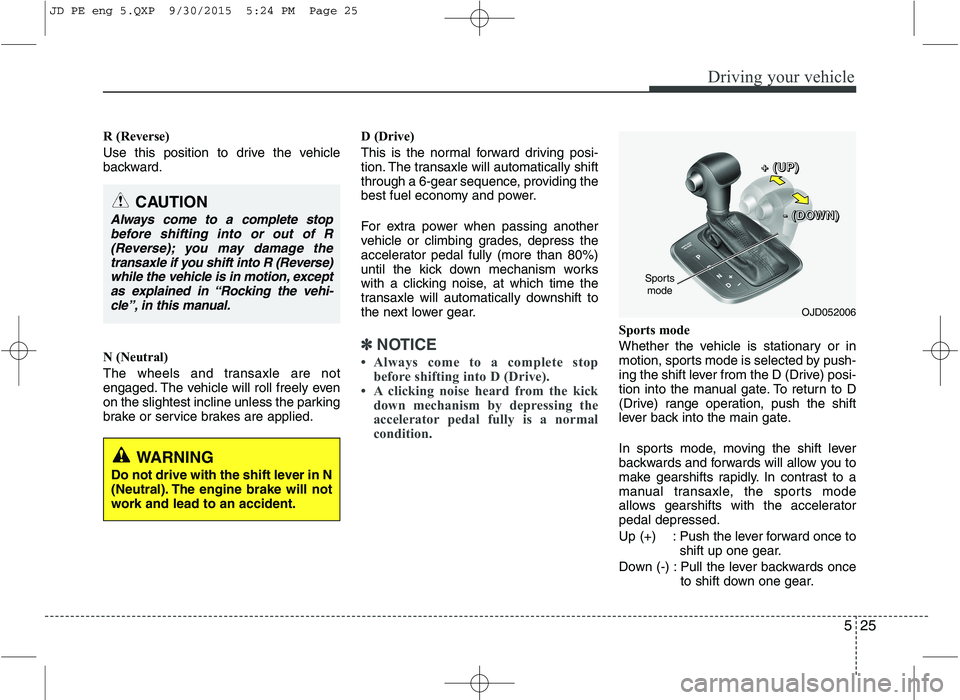
Sports mode
Whether the vehicle is stationary or in
motion, sports mode is selected by push-
ing the shift lever from the D (Drive) posi-
tion into the manual gate. To return to D
(Drive) range operation, push the shift
lever back into the main gate.
In sports mode, moving the shift lever
backwards and forwards will allow you to
make gearshifts rapidly. In contrast to a
manual transaxle, the sports mode
allows gearshifts with the acceleratorpedal depressed.
Up (+) : Push the lever forward once to
shift up one gear.
Down (-) : Pull the lever backwards once to shift down one gear.
CAUTION
Always come to a complete stop
before shifting into or out of R(Reverse); you may damage the transaxle if you shift into R (Reverse)while the vehicle is in motion, except
as explained in “Rocking the vehi-cle”, in this manual.
OJD052006
Sports
mode
++++ ((((UUUUPPPP))))
---- ((((DDDDOOOOWWWWNNNN))))
WARNING
Do not drive with the shift lever in N
(Neutral). The engine brake will not
work and lead to an accident.
JD PE eng 5.QXP 9/30/2015 5:24 PM Page 25
Page 402 of 643
529
Driving your vehicle
Moving up a steep grade from a stand-ing start
To move up a steep grade from a stand-
ing start, depress the brake pedal, shift
the shift lever to D (Drive). Select the
appropriate gear depending on load
weight and steepness of the grade, and
release the parking brake. Depress the
accelerator gradually while releasing the
service brakes.
When accelerating from a stop on a
steep hill, the vehicle may have a ten-
dency to roll backwards. Shifting the
shift lever into 2 (Second Gear) will
help prevent the vehicle from rolling
backwards.
WARNING
If your vehicle becomes stuck in
snow, mud, sand, etc., then you
may attempt to rock the vehicle free
by moving it forward and backward.
Do not attempt this procedure if
people or objects are anywhere
near the vehicle. During the rocking
operation the vehicle may suddenly
move forward of backward as it
becomes unstuck, causing injury
or damage to nearby people orobjects.
JD PE eng 5.QXP 9/30/2015 5:24 PM Page 29
Page 411 of 643
Driving your vehicle
38
5
Moving up a steep grade from a stand-
ing start
To move up a steep grade from a stand-
ing start, depress the brake pedal, shift
the shift lever to D (Drive). Select the
appropriate gear depending on load
weight and steepness of the grade, and
release the parking brake. Depress the
accelerator gradually while releasing the
service brakes.
WARNING
If your vehicle becomes stuck in
snow, mud, sand, etc., then you may
attempt to rock the vehicle free by
moving it forward and backward. Do
not attempt this procedure if people
or objects are anywhere near the
vehicle. During the rocking opera-
tion the vehicle may suddenly move
forward of backward as it becomes
unstuck, causing injury or damage
to nearby people or objects.WARNING
Always buckle-up! In a collision, an unbelted occupant is signifi-
cantly more likely to be seriously
injured or killed than a properlybelted occupant.
Avoid high speeds when corner- ing or turning.
Do not make quick steering wheel movements, such as sharp
lane changes or fast, sharp turns.
The risk of rollover is greatly increased if you lose control of
your vehicle at highway speeds.
Loss of control often occurs if two or more wheels drop off the
roadway and the driver over-
steers to reenter the roadway.
In the event your vehicle leaves the roadway, do not steer sharply.
Instead, slow down before pulling
back into the travel lanes.
Never exceed posted speed lim- its.
JD PE eng 5.QXP 9/30/2015 5:24 PM Page 38
Page 414 of 643
541
Driving your vehicle
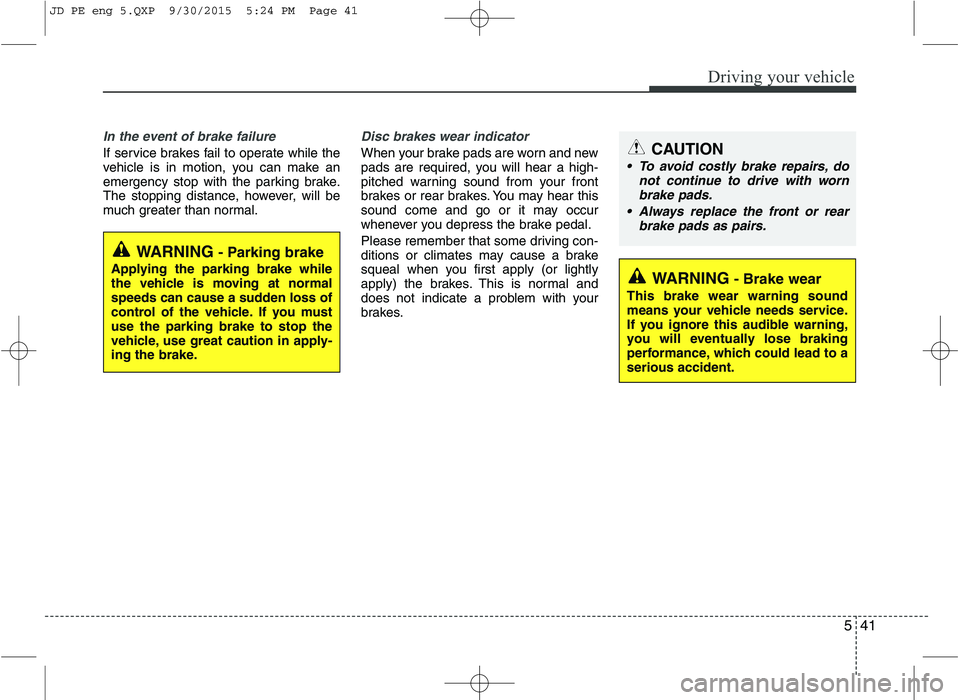
In the event of brake failure
If service brakes fail to operate while the
vehicle is in motion, you can make an
emergency stop with the parking brake.
The stopping distance, however, will be
much greater than normal.
Disc brakes wear indicator
When your brake pads are worn and new
pads are required, you will hear a high-
pitched warning sound from your front
brakes or rear brakes. You may hear this
sound come and go or it may occur
whenever you depress the brake pedal.
Please remember that some driving con-
ditions or climates may cause a brake
squeal when you first apply (or lightly
apply) the brakes. This is normal and
does not indicate a problem with your
brakes.
WARNING- Brake wear
This brake wear warning sound
means your vehicle needs service.
If you ignore this audible warning,
you will eventually lose braking
performance, which could lead to aserious accident.
CAUTION
To avoid costly brake repairs, do not continue to drive with wornbrake pads.
Always replace the front or rear brake pads as pairs.
WARNING - Parking brake
Applying the parking brake while
the vehicle is moving at normal
speeds can cause a sudden loss of
control of the vehicle. If you mustuse the parking brake to stop the
vehicle, use great caution in apply-
ing the brake.
JD PE eng 5.QXP 9/30/2015 5:24 PM Page 41
Page 450 of 643
577
Driving your vehicle
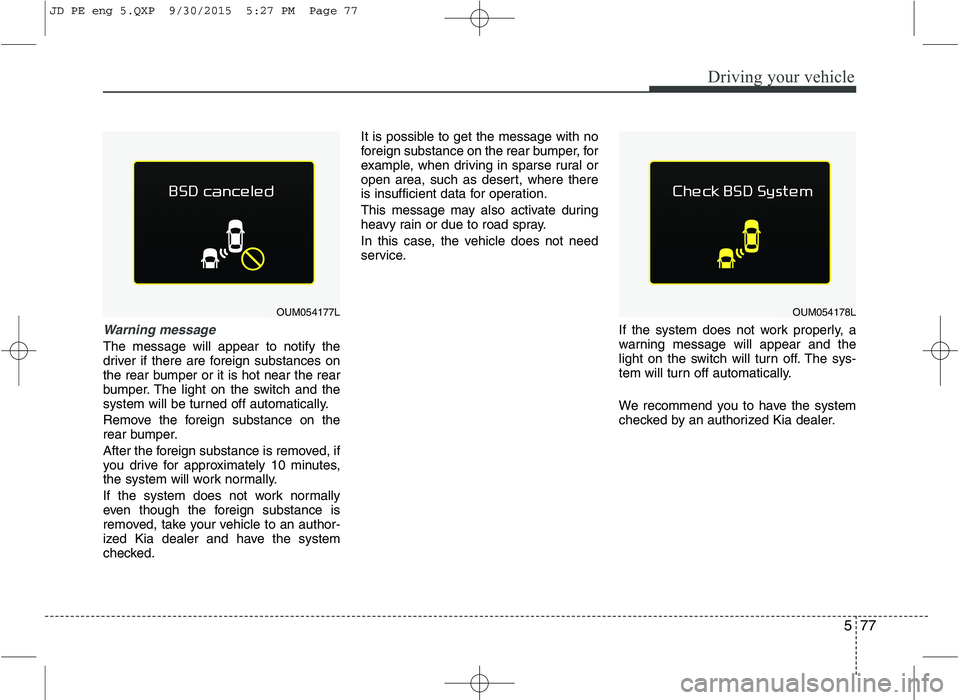
Warning message
The message will appear to notify the
driver if there are foreign substances on
the rear bumper or it is hot near the rear
bumper. The light on the switch and the
system will be turned off automatically.
Remove the foreign substance on the
rear bumper.
After the foreign substance is removed, if
you drive for approximately 10 minutes,
the system will work normally.
If the system does not work normally
even though the foreign substance is
removed, take your vehicle to an author-
ized Kia dealer and have the system
checked.It is possible to get the message with no
foreign substance on the rear bumper, for
example, when driving in sparse rural or
open area, such as desert, where there
is insufficient data for operation.
This message may also activate during
heavy rain or due to road spray.
In this case, the vehicle does not need
service.
If the system does not work properly, a
warning message will appear and the
light on the switch will turn off. The sys-
tem will turn off automatically.
We recommend you to have the system
checked by an authorized Kia dealer.
OUM054177LOUM054178L
JD PE eng 5.QXP 9/30/2015 5:27 PM Page 77
Page 454 of 643
581
Driving your vehicle
ECONOMICAL OPERATION
Your vehicle's fuel economy depends
mainly on your style of driving, where you
drive and when you drive.
Each of these factors affects how many
kilometers (miles) you can get from a
liter (gallon) of fuel. To operate your vehi-
cle as economically as possible, use the
following driving suggestions to help
save money in both fuel and repairs:
Drive smoothly. Accelerate at a moder- ate rate. Do not make "jack-rabbit"
starts or full-throttle shifts and maintain
a steady cruising speed. Do not race
between stoplights. Try to adjust your
speed to the traffic so you do not have
to change speeds unnecessarily. Avoid
heavy traffic whenever possible.
Always maintain a safe distance from
other vehicles so you can avoid unnec-
essary braking. This also reduces
brake wear.
Drive at a moderate speed. The faster you drive, the more fuel your vehicle
uses. Driving at a moderate speed,
especially on the highway, is one of the
most effective ways to reduce fuel con-sumption. Do not "ride" the brake or clutch pedal.
This can increase fuel consumption
and also increase wear on these com-
ponents. In addition, driving with your
foot resting on the brake pedal may
cause the brakes to overheat, which
reduces their effectiveness and may
lead to more serious consequences.
Take care of your tires. Keep them inflated to the recommended pressure.
Incorrect inflation, either too much or
too little, results in unnecessary tire
wear. Check the tire pressures at leastonce a month.
Be sure that the wheels are aligned correctly. Improper alignment can
result from hitting curbs or driving too
fast over irregular surfaces. Poor align-
ment causes faster tire wear and may
also result in other problems as well as
greater fuel consumption. Keep your vehicle in good condition.
For better fuel economy and reduced
maintenance costs, maintain your vehi-cle in accordance with the mainte-
nance schedule. If you drive your vehi-
cle in severe conditions, more frequentmaintenance is required.
Keep your vehicle clean. For maximum service, your vehicle should be kept
clean and free of corrosive materials. It
is especially important that mud, dirt,
ice, etc. not be allowed to accumulate
on the underside of the vehicle. This
extra weight can result in increased
fuel consumption and also contributeto corrosion.
Travel lightly. Do not carry unnecessary weight in your vehicle. Weight reduces
fuel economy.
Do not let the engine idle longer than necessary. If you are waiting (and not
in traffic), turn off your engine and
restart only when you're ready to go.
JD PE eng 5.QXP 9/30/2015 5:27 PM Page 81
Page 455 of 643
Driving your vehicle
82
5
Remember, your vehicle does not
require extended warm-up. After the
engine has started, allow the engine to
run for 10 to 20 seconds prior to plac-
ing the vehicle in gear. In very cold
weather, however, give your engine a
slightly longer warm-up period.
Do not "lug" or "over-rev" the engine. Lugging is driving too slowly in too
high a gear resulting engine bucking. If
this happens, shift to a lower gear.
Over-revving is racing the engine
beyond its safe limit. This can be avoid-
ed by shifting at the recommended
speeds.
Use your air conditioning sparingly. The air conditioning system is operat-
ed by engine power so your fuel econ-
omy is reduced when you use it.
Open windows at high speeds can reduce fuel economy.
Fuel economy is less in crosswinds and headwinds. To help offset some of
this loss, slow down when driving in
these conditions. Keeping a vehicle in good operating con-
dition is important both for economy and
safety. We recommend in general that the
vehicle be serviced by an authorized Kia
dealer.
WARNING
- Engine off dur-
ing motion
Never turn the engine off to coast
down hills or anytime the vehicle is
in motion. The power steering and
power brakes will not function
properly without the engine run-
ning. Instead, keep the engine on
and downshift to an appropriate
gear for engine braking effect. In
addition, turning off the ignition
while driving could engage the
steering wheel lock (if equipped)
resulting in loss of vehicle steering
which could cause serious injuryor death.
JD PE eng 5.QXP 9/30/2015 5:27 PM Page 82
Page 469 of 643

Driving your vehicle
96
5
When you are ready to leave after park-
ing on a hill
1. With the manual transaxle in Neutral
or automatic transaxle in P (Park),
apply your brakes and hold the brake
pedal down while you:
and
2. Slowly remove your foot from the brake pedal.
3. Drive slowly until the trailer is clear of the chocks.
4. Stop and have someone pick up and store the chocks. Maintenance when trailer towing
Your vehicle will need service more often
when you regularly pull a trailer.
Important items to pay particular atten-tion to include engine oil, automatic
transaxle fluid, axle lubricant and cooling
system fluid. Brake condition is another
important item to frequently check. Each
item is covered in this manual, and the
Index will help you find them quickly. If
you’re trailering, it is a good idea to
review these chapters before you start
your trip.
Do not forget to also maintain your trailer
and hitch. Follow the maintenance
schedule that accompanied your trailer
and check it periodically. Preferably, con-
duct the check at the start of each day’s
driving. Most importantly, all hitch nutsand bolts should be tight.CAUTION
Due to higher load during trailer
usage, overheating might occurin hot days or during uphill driv-ing. If the coolant gauge indicates
over-heating, switch off the airconditioner and stop the vehicle in a safe area to cool down theengine.
When towing check transaxle fluid more frequently.
If your vehicle is not equipped with an air conditioner, youshould install a condenser fan to improve engine performance
when towing a trailer.
JD PE eng 5.QXP 9/30/2015 5:28 PM Page 96
Page 474 of 643
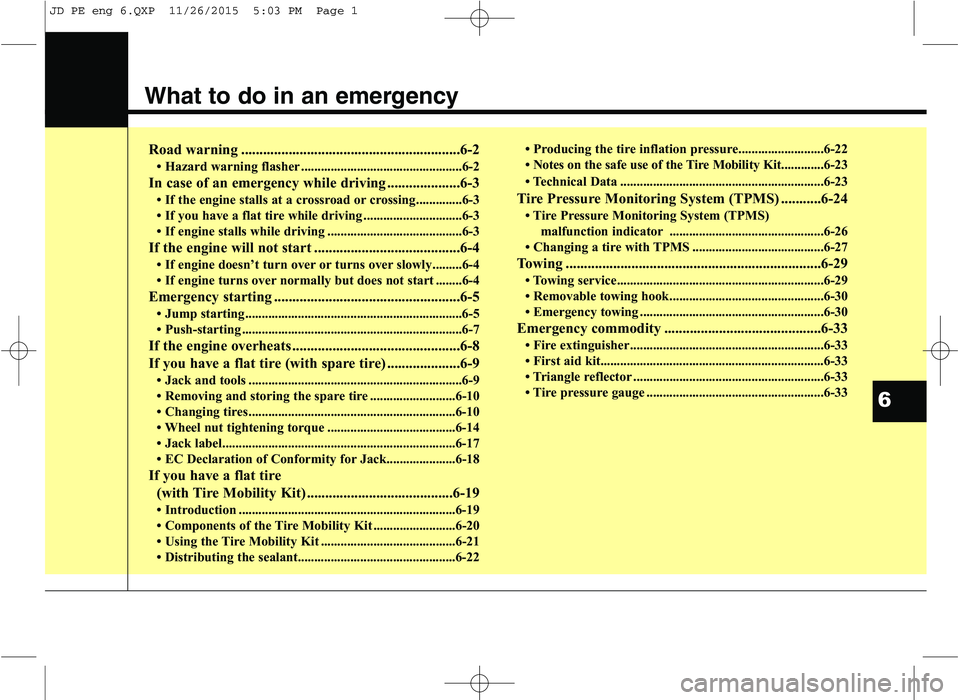
What to do in an emergency
Road warning ............................................................6-2 Hazard warning flasher .................................................6-2
In case of an emergency while driving ....................6-3 If the engine stalls at a crossroad or crossing..............6-3
If you have a flat tire while driving ..............................6-3
If engine stalls while driving .........................................6-3
If the engine will not start ........................................6-4 If engine doesn’t turn over or turns over slowly.........6-4
If engine turns over normally but does not start ........6-4
Emergency starting ...................................................6-5 Jump starting ..................................................................6-5
Push-starting ...................................................................6-7
If the engine overheats ..............................................6-8
If you have a flat tire (with spare tire) ....................6-9 Jack and tools .................................................................6-9
Removing and storing the spare tire ..........................6-10
Changing tires...............................................................6-10
Wheel nut tightening torque .......................................6-14
Jack label.......................................................................6-17
EC Declaration of Conformity for Jack.....................6-18
If you have a flat tire
(with Tire Mobility Kit) ........................................6-19 Introduction ..................................................................6-19
Components of the Tire Mobility Kit .........................6-20
Using the Tire Mobility Kit .........................................6-21
Distributing the sealant................................................6-22 Producing the tire inflation pressure..........................6-22
Notes on the safe use of
the Tire Mobility Kit .............6-23
Technical Data ..............................................................6-23
Tire Pressure Monitoring System (TPMS) ...........6-24 Tire Pressure Monitoring System (TPMS) malfunction indicator ...............................................6-26
Changing a tire with TPMS ........................................6-27
Towing ......................................................................6-29 Towing service...............................................................6-29
Removable towing hook...............................................6-30
Emergency towing ........................................................6-30
Emergency commodity ...........................................6-33 Fire extinguisher...........................................................6-33
First aid kit....................................................................6-33
Triangle reflector ..........................................................6-33
Tire pressure gauge ......................................................6-33
6
JD PE eng 6.QXP 11/26/2015 5:03 PM Page 1