clutch KIA CEED 2016 Owner's Guide
[x] Cancel search | Manufacturer: KIA, Model Year: 2016, Model line: CEED, Model: KIA CEED 2016Pages: 643, PDF Size: 38.19 MB
Page 434 of 643
561
Driving your vehicle
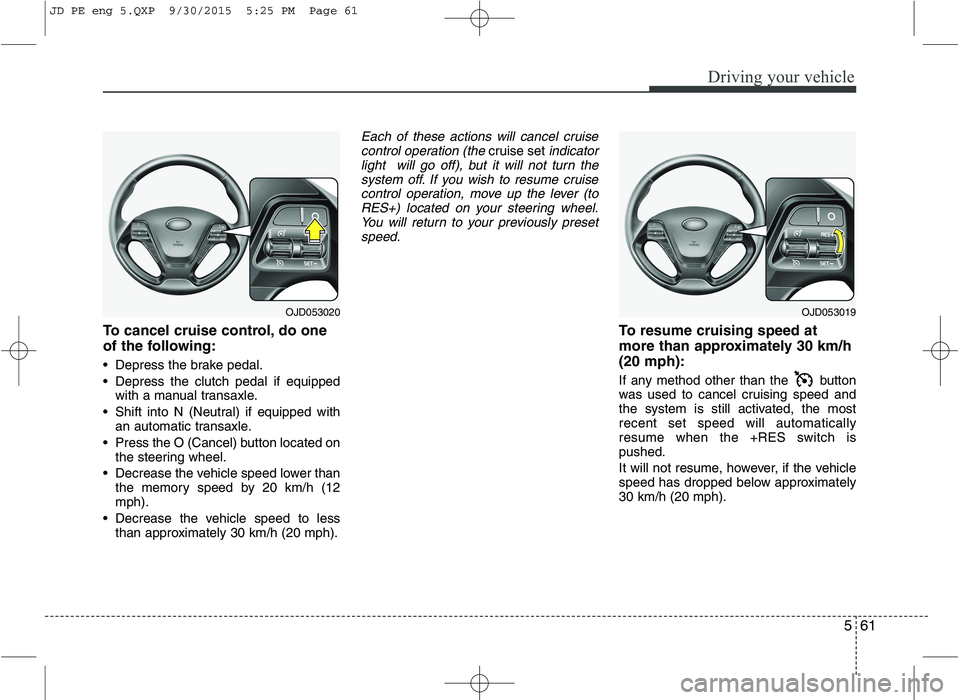
To cancel cruise control, do one
of the following:
Depress the brake pedal.
Depress the clutch pedal if equippedwith a manual transaxle.
Shift into N (Neutral) if equipped with an automatic transaxle.
Press the O (Cancel) button located on the steering wheel.
Decrease the vehicle speed lower than the memory speed by 20 km/h (12 mph).
Decrease the vehicle speed to less than approximately 30 km/h (20 mph).
Each of these actions will cancel cruise
control operation (the cruise setindicator
light will go off), but it will not turn the
system off. If you wish to resume cruisecontrol operation, move up the lever (toRES+) located on your steering wheel. You will return to your previously preset
speed.
To resume cruising speed at
more than approximately 30 km/h(20 mph):
If any method other than the button
was used to cancel cruising speed and
the system is still activated, the mostrecent set speed will automatically
resume when the +RES switch ispushed.
It will not resume, however, if the vehicle
speed has dropped below approximately30 km/h (20 mph).
OJD053020OJD053019
JD PE eng 5.QXP 9/30/2015 5:25 PM Page 61
Page 454 of 643
581
Driving your vehicle
ECONOMICAL OPERATION
Your vehicle's fuel economy depends
mainly on your style of driving, where you
drive and when you drive.
Each of these factors affects how many
kilometers (miles) you can get from a
liter (gallon) of fuel. To operate your vehi-
cle as economically as possible, use the
following driving suggestions to help
save money in both fuel and repairs:
Drive smoothly. Accelerate at a moder- ate rate. Do not make "jack-rabbit"
starts or full-throttle shifts and maintain
a steady cruising speed. Do not race
between stoplights. Try to adjust your
speed to the traffic so you do not have
to change speeds unnecessarily. Avoid
heavy traffic whenever possible.
Always maintain a safe distance from
other vehicles so you can avoid unnec-
essary braking. This also reduces
brake wear.
Drive at a moderate speed. The faster you drive, the more fuel your vehicle
uses. Driving at a moderate speed,
especially on the highway, is one of the
most effective ways to reduce fuel con-sumption. Do not "ride" the brake or clutch pedal.
This can increase fuel consumption
and also increase wear on these com-
ponents. In addition, driving with your
foot resting on the brake pedal may
cause the brakes to overheat, which
reduces their effectiveness and may
lead to more serious consequences.
Take care of your tires. Keep them inflated to the recommended pressure.
Incorrect inflation, either too much or
too little, results in unnecessary tire
wear. Check the tire pressures at leastonce a month.
Be sure that the wheels are aligned correctly. Improper alignment can
result from hitting curbs or driving too
fast over irregular surfaces. Poor align-
ment causes faster tire wear and may
also result in other problems as well as
greater fuel consumption. Keep your vehicle in good condition.
For better fuel economy and reduced
maintenance costs, maintain your vehi-cle in accordance with the mainte-
nance schedule. If you drive your vehi-
cle in severe conditions, more frequentmaintenance is required.
Keep your vehicle clean. For maximum service, your vehicle should be kept
clean and free of corrosive materials. It
is especially important that mud, dirt,
ice, etc. not be allowed to accumulate
on the underside of the vehicle. This
extra weight can result in increased
fuel consumption and also contributeto corrosion.
Travel lightly. Do not carry unnecessary weight in your vehicle. Weight reduces
fuel economy.
Do not let the engine idle longer than necessary. If you are waiting (and not
in traffic), turn off your engine and
restart only when you're ready to go.
JD PE eng 5.QXP 9/30/2015 5:27 PM Page 81
Page 467 of 643
Driving your vehicle
94
5
Driving on grades
Reduce speed and shift to a lower gear
before you start down a long or steep
downgrade. If you don’t shift down, you
might have to use your brakes so much
that they would get hot and no longer
operate efficiently.
On a long uphill grade, shift down and
reduce your speed to around 70 km/h (45mph) to reduce the possibility of engine
and transaxle overheating.
If your trailer weighs more than the max-
imum trailer weight without trailer brakes
and you have an automatic transaxle,
you should drive in D (Drive) when tow-
ing a trailer.
Operating your vehicle in D (Drive) when
towing a trailer will minimize heat build up
and extend the life of your transaxle.CAUTION
When towing a trailer on steep
grades (in excess of 6%) pay closeattention to the engine coolanttemperature gauge to ensure the
engine does not overheat.
If the coolant temperature redwarning light illuminates or thecoolant temperature gaugemoves towards “130”, pull over
and stop as soon as it is safe todo so, and allow the engine to idle until it cools down. You may pro-ceed once the engine has cooled
sufficiently.
You must decide driving speed depending on trailer weight anduphill grade to reduce the possi-bility of engine and transaxle
overheating.
(Continued)
(Continued) For vehicles equipped with a dual clutch transmission when towing
a trailer on steep grades, theclutch in the transmission could overheat.
When the clutch is overheated,the safe protection mode
engages. If the safe protectionmode engages, the gear position indicator on the cluster blinks
with a chime sound.
At this time, a warning messagewill appear on the LCD displayand driving may not be smooth.
If you ignore this warning, the driv-ing condition may become worse.
To return to normal driving condi-tion, stop the vehicle on a flatroad and apply the foot brake for a few minutes before driving off.
JD PE eng 5.QXP 9/30/2015 5:28 PM Page 94
Page 470 of 643
597
Driving your vehicle
If you do decide to pull a trailer
Here are some important points if you decide to pull a trailer:
Consider using a sway control. You can ask a hitch dealer about sway control.
Do not do any towing with your car during its first 2,000 km (1,200 miles) in order to allow the engine to properly break in. Failure
to heed this caution may result in serious engine or transaxle damage.
When towing a trailer, we recommend that you consult an authorized Kia dealer on additional requirements such as a towing kit, etc.
Always drive your vehicle at a moderate speed (less than 100 km/h (60 mph)).
On a long uphill grade, do not exceed 70 km/h (45 mph) or the posted towing speed limit, whichever is lower.
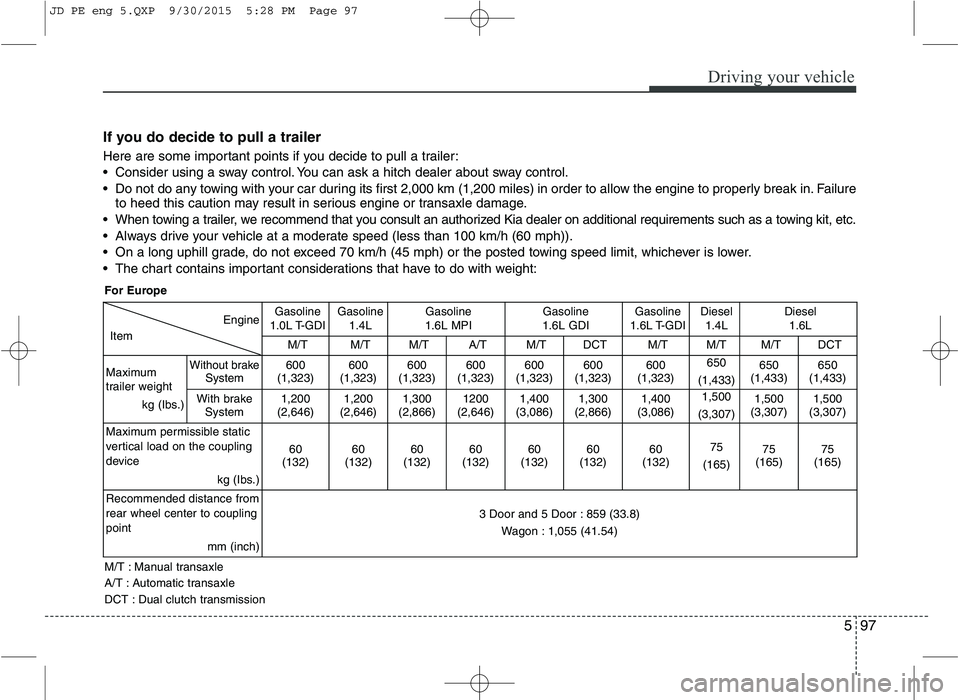
The chart contains important considerations that have to do with weight:
Engine
Item
Gasoline
1.0L T-GDIGasoline 1.4LGasoline
1.6L MPI Gasoline
1.6L GDIGasoline
1.6L T-GDIDiesel 1.4L Diesel
1.6L
M/TM/TM/TA/T M/T DCTM/TM/T M/T DCT
Maximum
trailer weight kg (Ibs.)
Without brakeSystem600
(1,323)600
(1,323)600
(1,323)600
(1,323) 600
(1,323) 600
(1,323)600
(1,323)650
(1,433) 650
(1,433) 650
(1,433)
With brake System
1,200
(2,646)1,200
(2,646)1,300
(2,866)1200
(2,646) 1,400
(3,086) 1,300
(2,866)1,400
(3,086)1,500
(3,307) 1,500
(3,307) 1,500
(3,307)
Maximum permissible static
vertical load on the coupling
device kg (Ibs.)
60
(132)60
(132)60
(132)60
(132) 60
(132) 60
(132)60
(132)75
(165) 75
(165) 75
(165)
Recommended distance from rear wheel center to couplingpoint mm (inch)
3 Door and 5 Door : 859 (33.8)Wagon : 1,055 (41.54)
For Europe
M/T : Manual transaxle
A/T : Automatic transaxle
DCT : Dual clutch transmission
JD PE eng 5.QXP 9/30/2015 5:28 PM Page 97
Page 476 of 643

63
What to do in an emergency
IN CASE OF AN EMERGENCY WHILE DRIVING
If the engine stalls at a crossroad
or crossing
If the engine stalls at a crossroad or crossing, set the shift lever in the N
(Neutral) position and then push the
vehicle to a safe place.
If your vehicle has a manual transaxle not equipped with a ignition lock
switch, the vehicle can move forward
by shifting to the 2(Second) or 3(Third)
gear and then turning the starter with-out depressing the clutch pedal. If you have a flat tire while driving
If a tire goes flat while you are driving:
1. Take your foot off the accelerator pedal
and let the vehicle slow down while
driving straight ahead. Do not apply the
brakes immediately or attempt to pull
off the road as this may cause a loss of
control. When the vehicle has slowed
to such a speed that it is safe to do so,
brake carefully and pull off the road.
Drive off the road as far as possible
and park on firm, level ground. If you
are on a divided highway, do not park
in the median area between the two
traffic lanes.
2. When the vehicle is stopped, turn on your emergency hazard flashers, set
the parking brake and put the transaxle
in P (automatic transaxle) or reverse
(manual transaxle).
3. Have all passengers get out of the vehicle. Be sure they all get out on the
side of the vehicle that is away from
traffic.
4. When changing a flat tire, follow the instruction provided later in this chap-
ter. If engine stalls while driving
1. Reduce your speed gradually, keeping
a straight line. Move cautiously off the
road to a safe place.
2. Turn on your emergency flashers.
3. Try to start the engine again. If your vehicle does not start, we recommend
that you consult an authorized Kia
dealer.
JD PE eng 6.QXP 11/26/2015 5:03 PM Page 3
Page 505 of 643
What to do in an emergency
32
6
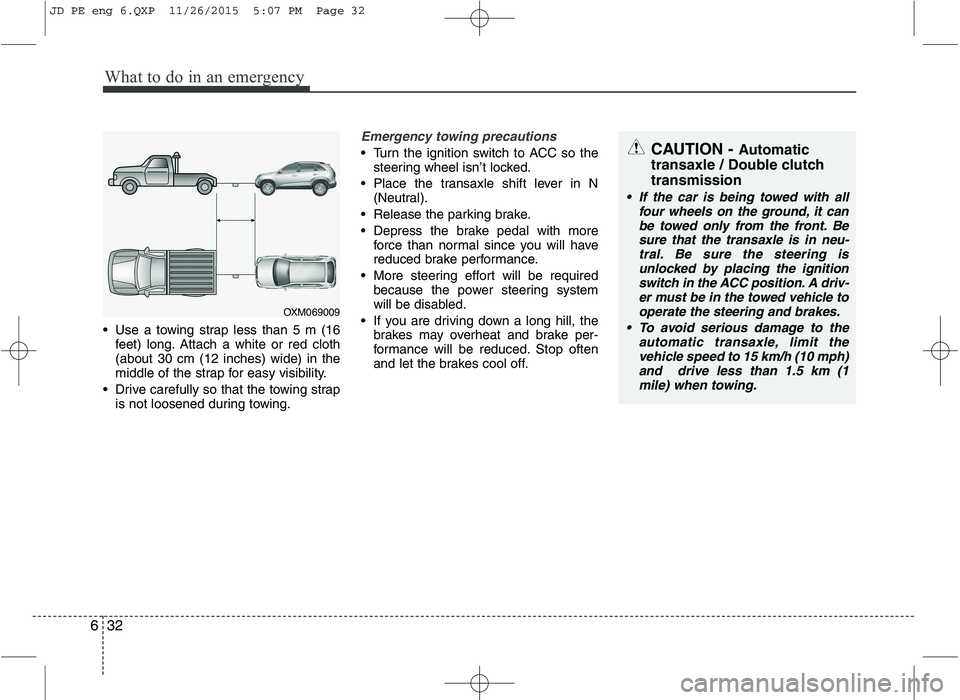
Use a towing strap less than 5 m (16
feet) long. Attach a white or red cloth (about 30 cm (12 inches) wide) in the
middle of the strap for easy visibility.
Drive carefully so that the towing strap is not loosened during towing.
Emergency towing precautions
Turn the ignition switch to ACC so the
steering wheel isn’t locked.
Place the transaxle shift lever in N (Neutral).
Release the parking brake.
Depress the brake pedal with more force than normal since you will have
reduced brake performance.
More steering effort will be required because the power steering system
will be disabled.
If you are driving down a long hill, the brakes may overheat and brake per-
formance will be reduced. Stop often
and let the brakes cool off.
OXM069009
CAUTION - Automatic
transaxle / Double clutch transmission
If the car is being towed with all four wheels on the ground, it canbe towed only from the front. Be sure that the transaxle is in neu-
tral. Be sure the steering is unlocked by placing the ignitionswitch in the ACC position. A driv- er must be in the towed vehicle to
operate the steering and brakes.
To avoid serious damage to the automatic transaxle, limit thevehicle speed to 15 km/h (10 mph)and drive less than 1.5 km (1
mile) when towing.
JD PE eng 6.QXP 11/26/2015 5:07 PM Page 32
Page 507 of 643
Maintenance
Engine compartment . . . . . . . . . . . . . . . . . . . . . . . . 7-3
Maintenance services . . . . . . . . . . . . . . . . . . . . . . . . 7-7 Owner’s responsibility . . . . . . . . . . . . . . . . . . . . . . . . . 7-7
Owner maintenance precautions . . . . . . . . . . . . . . . . 7-7
Engine compartment precautions (Diesel engine). . . 7-8
Owner maintenance . . . . . . . . . . . . . . . . . . . . . . . . . 7-9 Owner maintenance schedule . . . . . . . . . . . . . . . . . . . 7-9
Scheduled maintenance service . . . . . . . . . . . . . . . 7-11 For Europe, Except Russia . . . . . . . . . . . . . . . . . . . . . 7-12
Except Europe, For Russia . . . . . . . . . . . . . . . . . . . . . 7-28
Explanation of scheduled maintenance items . . . . 7-24
Engine oil . . . . . . . . . . . . . . . . . . . . . . . . . . . . . . . . . 7-27 Checking the engine oil level . . . . . . . . . . . . . . . . . . . . 7-27
Changing the engine oil and filter . . . . . . . . . . . . . . . 7-28
Engine coolant . . . . . . . . . . . . . . . . . . . . . . . . . . . . . 7-29 Checking the coolant level . . . . . . . . . . . . . . . . . . . . . . 7-29
Changing the coolant . . . . . . . . . . . . . . . . . . . . . . . . . . 7-31
Brake/clutch fluid . . . . . . . . . . . . . . . . . . . . . . . . . . 7-32 Checking the brake fluid level . . . . . . . . . . . . . . . . . . 7-32
Washer fluid . . . . . . . . . . . . . . . . . . . . . . . . . . . . . . . 7-33 Checking the washer fluid level . . . . . . . . . . . . . . . . . 7-33
Parking brake - hand type . . . . . . . . . . . . . . . . . . . 7-33 Checking the parking brake . . . . . . . . . . . . . . . . . . . . 7-33
Fuel filter (for Diesel) . . . . . . . . . . . . . . . . . . . . . . . 7-34 Draining water from fuel filter . . . . . . . . . . . . . . . . . . 7-34 Air cleaner . . . . . . . . . . . . . . . . . . . . . . . . . . . . . . . . 7-35
Filter replacement . . . . . . . . . . . . . . . . . . . . . . . . . . . . 7-35
Climate control air filter . . . . . . . . . . . . . . . . . . . . . 7-37 Filter inspection . . . . . . . . . . . . . . . . . . . . . . . . . . . . . . 7-37
Filter replacement . . . . . . . . . . . . . . . . . . . . . . . . . . . . 7-37
Wiper blades . . . . . . . . . . . . . . . . . . . . . . . . . . . . . . . 7-39 Blade inspection . . . . . . . . . . . . . . . . . . . . . . . . . . . . . . 7-39
Blade replacement . . . . . . . . . . . . . . . . . . . . . . . . . . . . 7-39
Battery. . . . . . . . . . . . . . . . . . . . . . . . . . . . . . . . . . . . 7-42 For best battery service . . . . . . . . . . . . . . . . . . . . . . . . 7-42
Battery capacity label . . . . . . . . . . . . . . . . . . . . . . . . . 7-43
Battery recharging . . . . . . . . . . . . . . . . . . . . . . . . . . . . 7-43
Reset items . . . . . . . . . . . . . . . . . . . . . . . . . . . . . . . . . . 7-44
Tires and wheels . . . . . . . . . . . . . . . . . . . . . . . . . . . . 7-45 Tire care. . . . . . . . . . . . . . . . . . . . . . . . . . . . . . . . . . . . . 7-45
Recommended cold tire inflation pressures. . . . . . . . 7-45
Checking tire inflation pressure . . . . . . . . . . . . . . . . . 7-47
Tire rotation . . . . . . . . . . . . . . . . . . . . . . . . . . . . . . . . . 7-48
Wheel alignment and tire balance . . . . . . . . . . . . . . . 7-49
Tire replacement . . . . . . . . . . . . . . . . . . . . . . . . . . . . . . 7-49
Wheel replacement . . . . . . . . . . . . . . . . . . . . . . . . . . . . 7-51
Tire traction . . . . . . . . . . . . . . . . . . . . . . . . . . . . . . . . . 7-51
Tire maintenance . . . . . . . . . . . . . . . . . . . . . . . . . . . . . 7-51
Tire sidewall labeling . . . . . . . . . . . . . . . . . . . . . . . . . . 7-51
Low aspect ratio tire . . . . . . . . . . . . . . . . . . . . . . . . . . 7-55
7
JD PE eng 7.QXP 1/28/2016 5:34 PM Page 1
Page 509 of 643
73
Maintenance
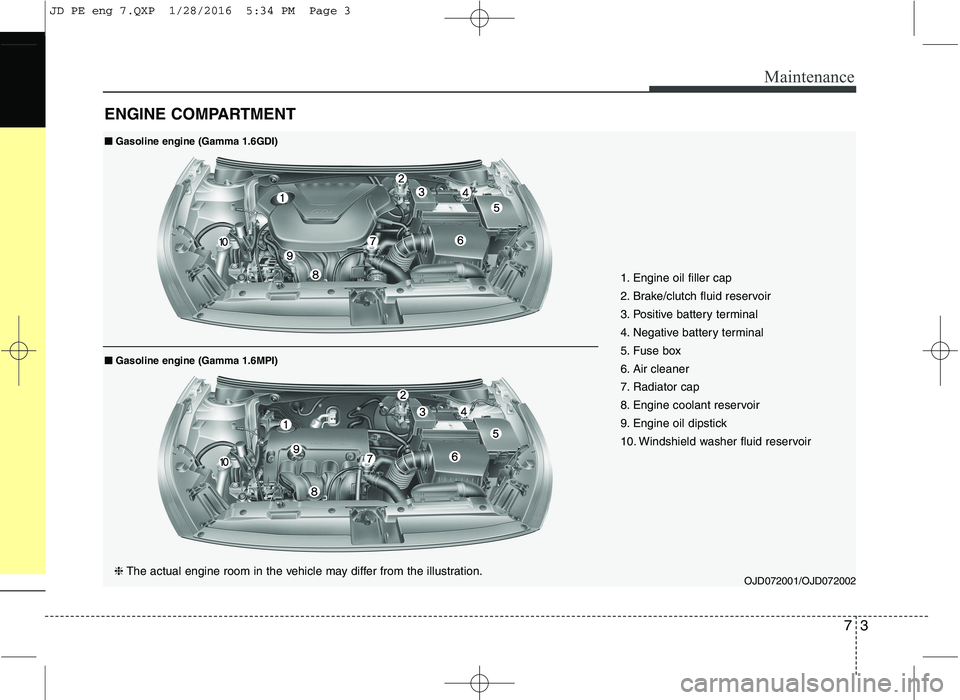
ENGINE COMPARTMENT
OJD072001/OJD072002
❈
The actual engine room in the vehicle may differ from the illustration. 1. Engine oil filler cap
2. Brake/clutch fluid reservoir
3. Positive battery terminal
4. Negative battery terminal
5. Fuse box
6. Air cleaner
7. Radiator cap
8. Engine coolant reservoir
9. Engine oil dipstick
10. Windshield washer fluid reservoir
■■
Gasoline engine (Gamma 1.6GDI)
■■Gasoline engine (Gamma 1.6MPI)
JD PE eng 7.QXP 1/28/2016 5:34 PM Page 3
Page 510 of 643
Maintenance
4
7
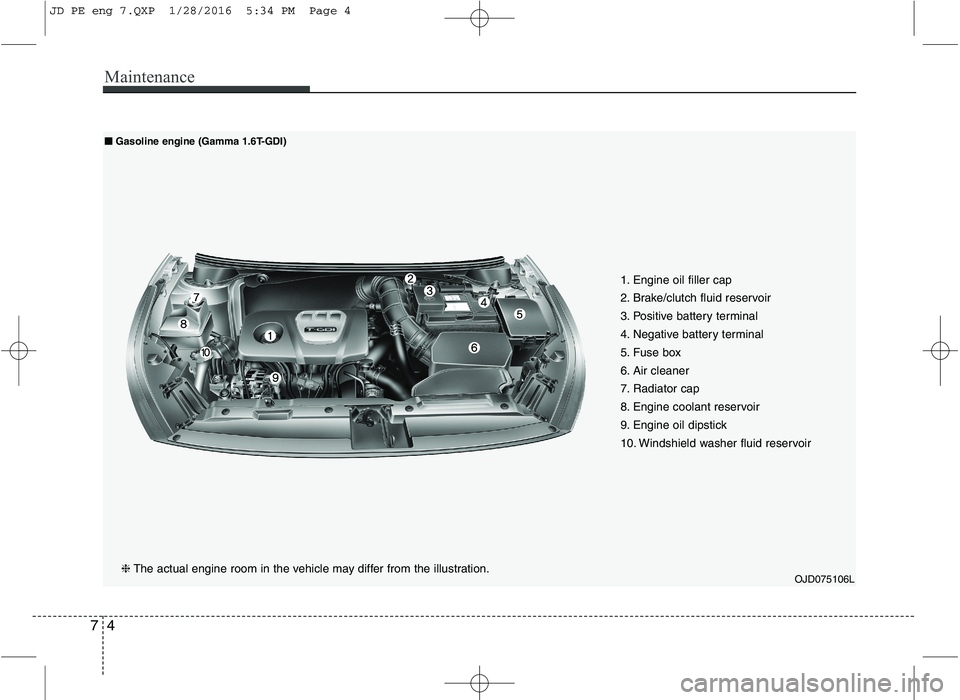
OJD075106L❈ The actual engine room in the vehicle may differ from the illustration.
■
■
Gasoline engine (Gamma 1.6T-GDI)
1. Engine oil filler cap
2. Brake/clutch fluid reservoir
3. Positive battery terminal
4. Negative battery terminal
5. Fuse box
6. Air cleaner
7. Radiator cap
8. Engine coolant reservoir
9. Engine oil dipstick
10. Windshield washer fluid reservoir
JD PE eng 7.QXP 1/28/2016 5:34 PM Page 4
Page 511 of 643
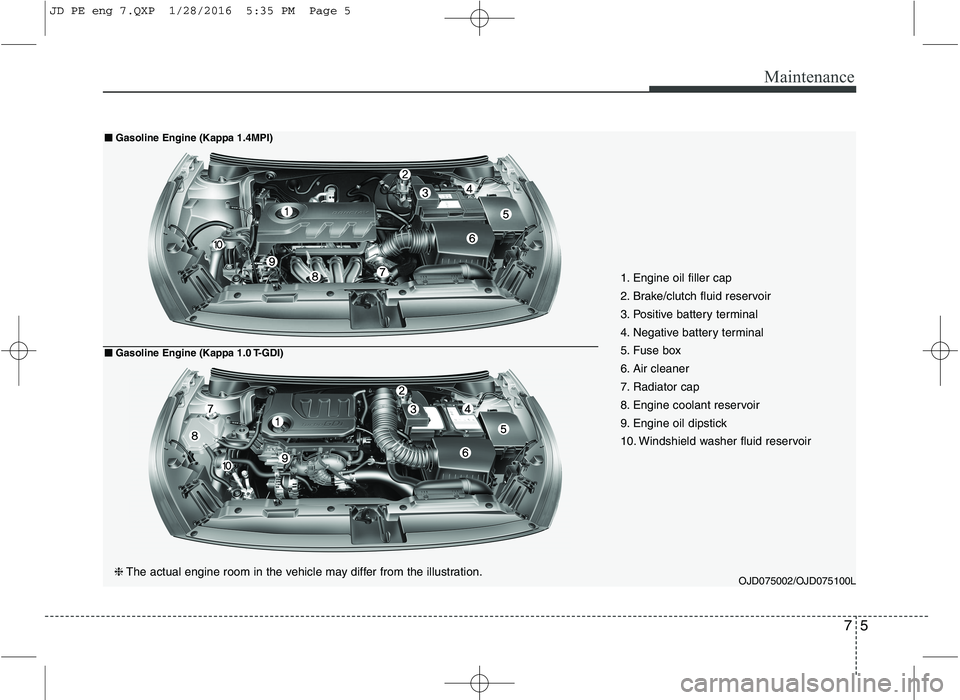
75
Maintenance
OJD075002/OJD075100L
❈
The actual engine room in the vehicle may differ from the illustration. 1. Engine oil filler cap
2. Brake/clutch fluid reservoir
3. Positive battery terminal
4. Negative battery terminal
5. Fuse box
6. Air cleaner
7. Radiator cap
8. Engine coolant reservoir
9. Engine oil dipstick
10. Windshield washer fluid reservoir
■■
Gasoline Engine (Kappa 1.4MPI)
■■Gasoline Engine (Kappa 1.0 T-GDI)
JD PE eng 7.QXP 1/28/2016 5:35 PM Page 5