fuel filter KIA CEED 2017 User Guide
[x] Cancel search | Manufacturer: KIA, Model Year: 2017, Model line: CEED, Model: KIA CEED 2017Pages: 653, PDF Size: 54.59 MB
Page 539 of 653

721
Maintenance
NORMAL MAINTENANCE SCHEDULE - EXCEPT EUROPE (INCLUDING RUSSIA) (CONT.)
MAINTENANCE INTERVALS
MAINTENANCE ITEM Number of months or driving distance, whichever comes first
Months
122436 4860 7284 96
Kmx1,000
153045 6075 90105 120
Milesx1,000
102030 4050 6070 80
Fuel filler cap (Diesel) II
Fuel tank air filter (Gasoline, if equipped)IRIR
Fuel lines, fuel hoses and connections (Diesel)IIII
Fuel lines, fuel hoses and connections (Gasoline)II
Intercooler, in/out hose, air intake hose
(Gasoline T-GDI)IIIIIIII
Manual transaxle fluid (if equipped) II
Parking brake (Hand type)IIII
Spark plugs (Gamma MPI, Nickel)RR
Spark plugs (Gamma/Kappa T-GDI ,Iridium) * 5Replace every 75,000 km (50,000 miles) or 60 months
Spark plugs (Gamma GDI, Kappa MPI, Iridium)Replace every 150,000 km (100,000 miles) or 120 months
Steering gear rack, linkage and bootsIIIIIIII
Tire (pressure & tread wear)IIIIIIII
Valve clearance (Gasoline) *6I
Vapor hose and fuel filler cap (Gasoline)II
Automatic transaxle fluidNo check, No service required
ERA-GLONASS system battery (if equipped)Replace every 3 years
JD PE eng 7.QXP 03.01.2017 17:17 Page 21
Page 542 of 653

Maintenance
24
7
EXPLANATION OF SCHEDULED MAINTENANCE ITEMS
Engine oil and filter The engine oil and filter should be
changed at the intervals specified in the
maintenance schedule. If the car is being
driven in severe conditions, more fre-quent oil and filter changes are required. Drive belts
Inspect all drive belts for evidence of cuts,
cracks, excessive wear or oil saturation
and replace if necessary. Drive belts
should be checked periodically for proper
tension and adjusted as necessary.
Fuel filter (cartridge) A clogged filter can limit the speed at
which the vehicle may be driven, damage
the emission system and cause multiple
issues such as hard starting. If an exces-
sive amount of foreign matter accumu-
lates in the fuel tank, the filter may
require replacement more frequently.
After installing a new filter, run the engine
for several minutes, and check for leaks
at the connections. We recommend that
the fuel filter be replaced by an author-
ized Kia dealer. Fuel lines, fuel hoses and con- nections
Check the fuel lines, fuel hoses and con-
nections for leakage and damage. We
recommend that the fuel lines, fuel hoses
and connections be replaced by an
authorized Kia dealer.
Vapor hose and fuel filler cap
The vapor hose and fuel filler cap should
be inspected at those intervals specified
in the maintenance schedule. Make sure
that a new vapor hose or fuel filler cap iscorrectly replaced.
Vacuum crankcase ventilation hoses (if equipped)
Inspect the surface of hoses for evidence
of heat and/or mechanical damage. Hard
and brittle rubber, cracking, tears, cuts,
abrasions, and excessive swelling indi-
cate deterioration. Particular attention
should be paid to examine those hose
surfaces nearest to high heat sources,
such as the exhaust manifold. Inspect the hose routing to assure that the hoses do not come in contact with
any heat source, sharp edges or movingcomponent which might cause heat dam-
age or mechanical wear. Inspect all hose
connections, such as clamps and cou-
plings, to make sure they are secure, and
that no leaks are present. Hoses should
be replaced immediately if there is any
evidence of deterioration or damage.
WARNING -
Diesel only
Never work on injection system with engine running or within 30
seconds after shutting off engine.
High pressure pump, rail, injectorsand high pressure pipes are sub-
ject to high pressure even after the
engine stopped. The fuel jet pro-
duced by fuel leaks may cause seri-
ous injury, if it touch the body.
People using pacemakers should
not move more than 30cm closer tothe ECU or wiring harness within
the engine room while engine is
running, since the high currents in
the Common Rail system produce
considerable magnetic fields.
JD PE eng 7.QXP 03.01.2017 17:17 Page 24
Page 552 of 653
Maintenance
34
7
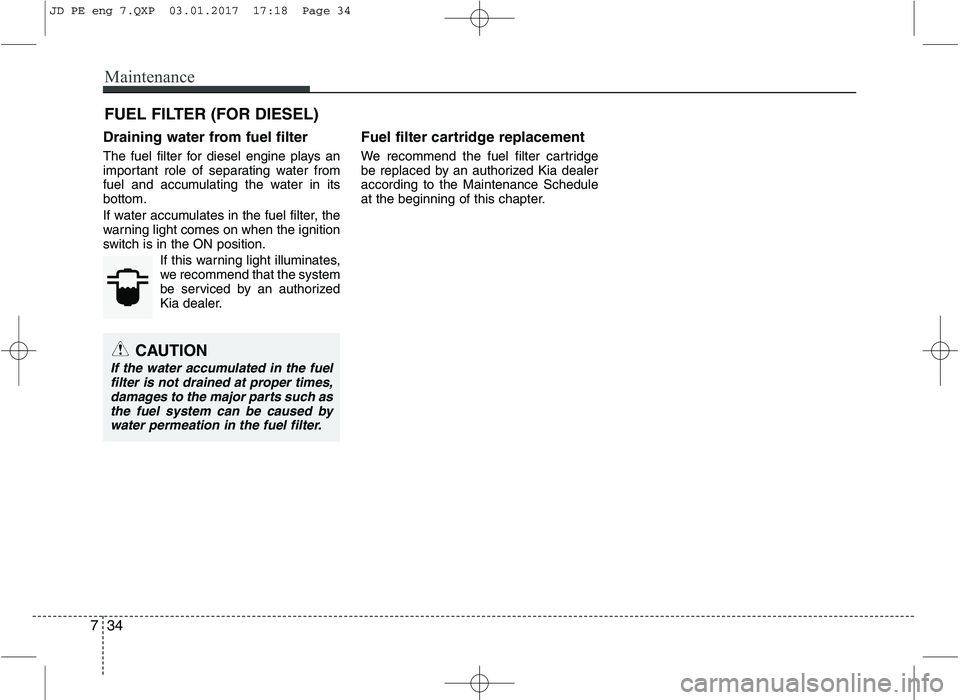
FUEL FILTER (FOR DIESEL)
Draining water from fuel filter
The fuel filter for diesel engine plays an
important role of separating water from
fuel and accumulating the water in itsbottom.
If water accumulates in the fuel filter, the
warning light comes on when the ignition
switch is in the ON position. If this warning light illuminates,
we recommend that the system
be serviced by an authorized
Kia dealer. Fuel filter cartridge replacement
We recommend the fuel filter cartridge
be replaced by an authorized Kia dealeraccording to the Maintenance Schedule
at the beginning of this chapter.
CAUTION
If the water accumulated in the fuel
filter is not drained at proper times,
damages to the major parts such asthe fuel system can be caused bywater permeation in the fuel filter.
JD PE eng 7.QXP 03.01.2017 17:18 Page 34
Page 625 of 653
7107
Maintenance
EMISSION CONTROL SYSTEM
The emission control system of your
vehicle is covered by a written limited
warranty. Please see the warranty infor-
mation contained in the Warranty &
Maintenance book in your vehicle.
Your vehicle is equipped with an emis- sion control system to meet all emission
regulations. There are three emission control sys-
tems which are as follows.
(1) Crankcase emission control system
(2) Evaporative emission control system(3) Exhaust emission control system In order to assure the proper function of
the emission control systems, it is rec-
ommended that you have your car
inspected and maintained by an author-
ized Kia dealer in accordance with the
maintenance schedule. Caution for the Inspection and
Maintenance Test (With Electronic
Stability Control (ESC) system)
To prevent the vehicle from misfir-
ing during dynamometer testing,
turn the Electronic Stability Control
(ESC) system off by pressing the
ESC switch.
After dynamometer testing is com- pleted, turn the ESC system back on
by pressing the ESC switch again.
1. Crankcase emission control system
The positive crankcase ventilation sys-
tem is employed to prevent air pollution
caused by blow-by gases being emitted
from the crankcase. This system supplies
fresh filtered air to the crankcase through
the air intake hose. Inside the crankcase,
the fresh air mixes with blow-by gases,
which then pass through the PCV valveinto the induction system. 2. Evaporative emission control
System
The Evaporative Emission Control
System is designed to prevent fuel
vapors from escaping into the atmos-
phere.
Canister
Fuel vapors generated inside the fuel tank are absorbed and stored in the
onboard canister. When the engine is
running, the fuel vapors absorbed in the
canister are drawn into the surge tank
through the purge control solenoid valve.
Purge Control Solenoid Valve (PCSV)
The purge control solenoid valve is con-
trolled by the Engine Control Module
(ECM); when the engine coolant temper-
ature is low during idling, the PCSV clos-
es so that evaporated fuel is not taken
into the engine. After the engine warms-
up during ordinary driving, the PCSV
opens to introduce evaporated fuel to the
engine.
JD PE eng 7.QXP 03.01.2017 17:24 Page 107
Page 627 of 653
7109
Maintenance
Operating precautions for catalyticconverters (if equipped)Your vehicle is equipped with a catalytic
converter emission control device.
Therefore, the following precautions
must be observed:
Make sure to refuel your vehicle according to the "Fuel requirements" suggested in chapter 1.
Do not operate the vehicle when there are signs of engine malfunction, such
as misfire or a noticeable loss of per-
formance.
Do not misuse or abuse the engine. Examples of misuse are coasting withthe ignition off and descending steep
grades in gear with the ignition off.
Do not operate the engine at high idle speed for extended periods (5 minutesor more).
Do not modify or tamper with any part of the engine or emission control sys-
tem. We recommend that the system be
inspected by an authorized Kia dealer.
Avoid driving with an extremely low fuel level. Running out of fuel cause the
engine to misfire, damaging the cat-
alytic converter.
Failure to observe these precautionscould result in damage to the catalytic
converter and to your vehicle.
Additionally, such actions could void your
warranties.Diesel Particulate Filter (if equipped)
The Diesel Particulate Filter (DPF) sys-
tem removes the soot in the exhaust gas.
Unlike a disposable air filter, the DPF
system automatically burns (oxidizes)
and removes the accumulated soot
according to the driving condition. In
other words, the active burning by engine
control system and high exhaust gas
temperature caused by normal/high driv-
ing condition burns and removes the
accumulated soot.
However, if the vehicle continues to be
driven at repeated short
distance or driven at low speed for a long
time, the accumulated soot may not be
automatically removed because of low
exhaust gas temperature. More than a
certain amount of soot deposited, the
malfunction indicator light ( ) illumi-
nates. When the malfunction indicator light
blinks, it may stop blinking by driving the
vehicle at more than 60km/h (37 mph) orat more than second gear with 1500 ~
2500 engine rpm for a certain time (for
about 25 minutes).
WARNING - Fire
A hot exhaust system can ignite flammable items under your vehi-
cle. Do not park, idle, or drive the
vehicle over or near flammable
objects, such as dry grass, paper,
leaves, etc.
The exhaust system and catalytic system are very hot while the
engine is running or immediately
after the engine is turned off.
Keep away from the exhaust sys-
tem and catalytic, you may get
burned.
Also, do not remove the heat sink
around the exhaust system, do
not seal the bottom of the vehicle
or do not coat the vehicle for cor-
rosion control. It may present a
fire risk under certain conditions.
JD PE eng 7.QXP 03.01.2017 17:24 Page 109
Page 639 of 653
811
Specifications & Consumer information
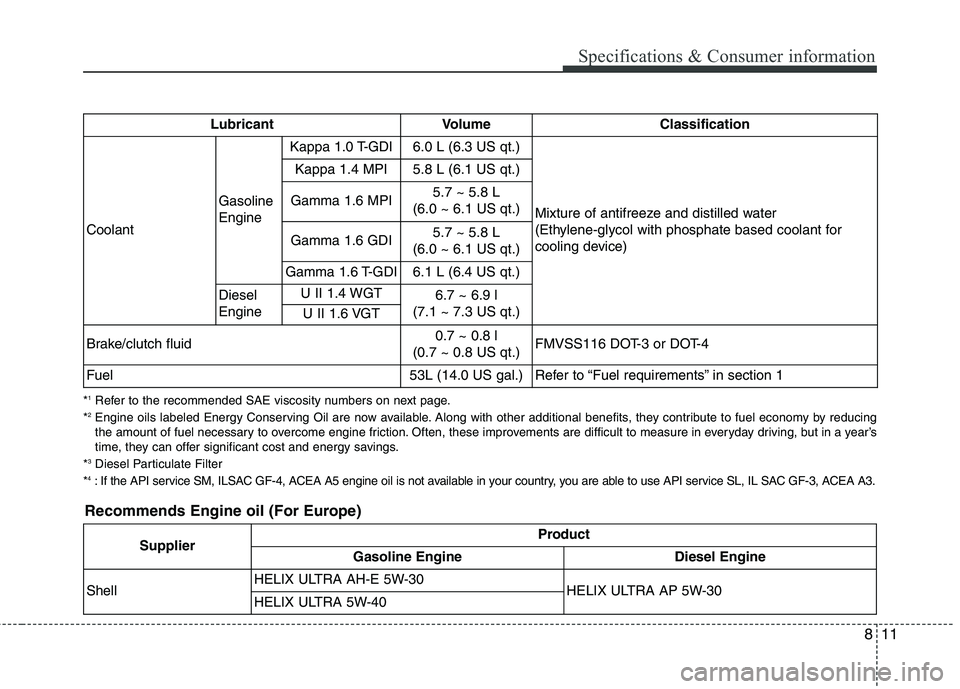
Recommends Engine oil (For Europe)
*
1
Refer to the recommended SAE viscosity numbers on next page.
* 2
Engine oils labeled Energy Conserving Oil are now available. Along with other additional benefits, they contribute to fuel economy by reducing
the amount of fuel necessary to overcome engine friction. Often, these improvements are difficult to measure in everyday driving, but in a year’s
time, they can offer significant cost and energy savings.
* 3
Diesel Particulate Filter
* 4
: If the API service SM, ILSAC GF-4, ACEA A5 engine oil is not available in your country, you are able to use API service SL, IL SAC GF-3, ACEA A3.
Supplier Product
Gasoline Engine Diesel Engine
Shell HELIX ULTRA AH-E 5W-30
HELIX ULTRA AP 5W-30
HELIX ULTRA 5W-40
Lubricant Volume Classification
Coolant
Gasoline Engine
Kappa 1.0 T-GDI6.0 L (6.3 US qt.)
Mixture of antifreeze and distilled water
(Ethylene-glycol with phosphate based coolant for
cooling device)
Kappa 1.4 MPI5.8 L (6.1 US qt.)
Gamma 1.6 MPI5.7 ~ 5.8 L
(6.0 ~ 6.1 US qt.)
Gamma 1.6 GDI5.7 ~ 5.8 L
(6.0 ~ 6.1 US qt.)
Gamma 1.6 T-GDI6.1 L (6.4 US qt.)
Diesel EngineU II 1.4 WGT6.7 ~ 6.9 l
(7.1 ~ 7.3 US qt.)
U II 1.6 VGT
Brake/clutch fluid0.7 ~ 0.8 l
(0.7 ~ 0.8 US qt.)FMVSS116 DOT-3 or DOT-4
Fuel53L (14.0 US gal.)Refer to “Fuel requirements” in section 1
Page 640 of 653
Specifications & Consumer information
12
8
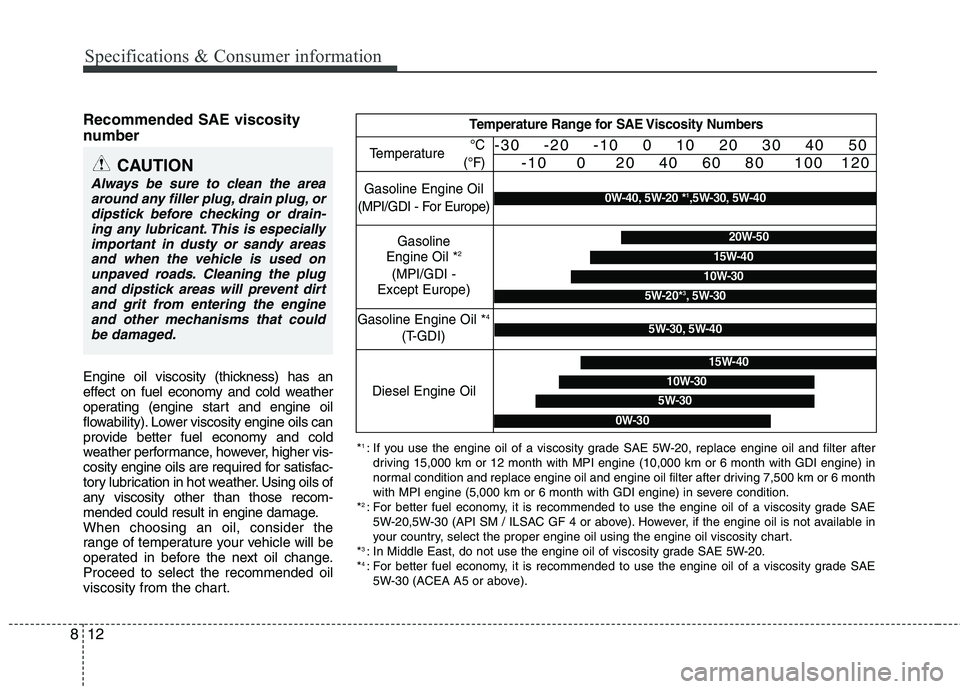
Recommended SAE viscosity
number
Engine oil viscosity (thickness) has an
effect on fuel economy and cold weather
operating (engine start and engine oil
flowability). Lower viscosity engine oils can
provide better fuel economy and cold
weather performance, however, higher vis-
cosity engine oils are required for satisfac-
tory lubrication in hot weather. Using oils of
any viscosity other than those recom-
mended could result in engine damage.When choosing an oil, consider the
range of temperature your vehicle will be
operated in before the next oil change.Proceed to select the recommended oil
viscosity from the chart.
CAUTION
Always be sure to clean the area
around any filler plug, drain plug, or
dipstick before checking or drain- ing any lubricant. This is especiallyimportant in dusty or sandy areas
and when the vehicle is used onunpaved roads. Cleaning the plugand dipstick areas will prevent dirtand grit from entering the engine
and other mechanisms that couldbe damaged.
* 1
: If you use the engine oil of a viscosity grade SAE 5W-20, replace engine oil and filter after
driving 15,000 km or 12 month with MPI engine (10,000 km or 6 month with GDI engine) in
normal condition and replace engine oil and engine oil filter after driving 7,500 km or 6 month
with MPI engine (5,000 km or 6 month with GDI engine) in severe condition.
* 2
: For better fuel economy, it is recommended to use the engine oil of a viscosity grade SAE
5W-20,5W-30 (API SM / ILSAC GF 4 or above). However, if the engine oil is not available in
your country, select the proper engine oil using the engine oil viscosity chart.
* 3
: In Middle East, do not use the engine oil of viscosity grade SAE 5W-20.
* 4
: For better fuel economy, it is recommended to use the engine oil of a viscosity grade SAE
5W-30 (ACEA A5 or above).
Temperature Range for SAE Viscosity Numbers
Temperature
Gasoline Engine Oil
(MPI/GDI - For Europe) °C
(°F)-30 -20 -10 0 10 20 30 40 50 -10 0 20 40 60 80 100 120
0W-40, 5W-20 * 1
,5W-30, 5W-40
Gasoline
Engine Oil * 2
(MPI/GDI -
Except Europe)20W-50
10W-30
15W-40
5W-20* 3
, 5W-30
Diesel Engine Oil5W-30
15W-40
10W-30
0W-30
Gasoline Engine Oil * 4
(T-GDI)5W-30, 5W-40
Page 647 of 653
Index
4
I
Engine coolant ..............................................................7-29
Changing the coolant ..................................................7-31
Checking the coolant level..........................................7-29
Engine number ..............................................................8-14
Engine oil ......................................................................7-27 Changing the engine oil and filter ..............................7-28
Checking the engine oil level ....................................7-27
Engine start/stop button ..................................................5-9 Engine start/stop button position ..................................5-9
Illuminated engine start/stop button ............................5-9
Starting the engine ......................................................5-12
Explanation of scheduled maintenance items ..............7-24
Exterior features ..........................................................4-182 Mounting bracket for roof carrier ............................4-182
Roof rack ..................................................................4-183
Exterior overview (Front) ................................................2-2
Exterior overview (Rear) ................................................2-3
Fuel filler lid ..................................................................4-31 Closing the fuel filler lid ............................................4-31
Opening the fuel filler lid ..........................................4-31
Fuel filter (for Diesel)....................................................7-34 Draining water from fuel filter ..................................7-34
Fuel requirements ............................................................1-2 Diesel engine ................................................................1-4
Gasoline engine ............................................................1-2 Fuses ..............................................................................7-56
Fuse/relay panel description ......................................7-61
Gross vehicle weight ......................................................8-5
Hazard warning flasher................................................4-120
Hood ..............................................................................4-29 Closing the hood ........................................................4-30
Opening the hood ........................................................4-29
How to use this manual ..................................................1-2
If the engine overheats ....................................................6-8
If the engine will not start ..............................................6-4 If engine doesn’t turn over or turns over slowly ..........6-4
If engine turns over normally but does not start ..........6-4
If you have a flat tire (with spare tire) ............................6-9 Changing tires ............................................................6-10
EC Declaration of Conformity for Jack......................6-18
Jack and tools ................................................................6-9
Jack label ....................................................................6-17
Removing and storing the spare tire ..........................6-10
Wheel nut tightening torque ......................................6-14
F
G
H
I