trailer KIA CEED 2017 Owners Manual
[x] Cancel search | Manufacturer: KIA, Model Year: 2017, Model line: CEED, Model: KIA CEED 2017Pages: 653, PDF Size: 54.59 MB
Page 8 of 653
15
Introduction
Biodiesel
Commercially supplied Diesel blends of no more than 7% biodiesel, commonly
known as "B7 Diesel" may be used in
your vehicle if Biodiesel meets EN 14214
or equivalent specifications. (EN stands
for "European Norm"). The use of biofu-
els exceeding 7% made from rapeseed
methyl ester (RME), fatty acid methyl
ester (FAME), vegetable oil methyl ester
(VME) etc. or mixing diesel exceeding7% with biodiesel will cause increased
wear or damage to the engine and fuel
system. Repair or replacement of worn ordamaged components due to the use of
non approved fuels will not be covered by
the manufactures warranty.No special break-in period is needed. By
following a few simple precautions for the
first 1,000 km (600 miles) you may add to
the performance, economy and life of
your vehicle.
Do not race the engine.
While driving, keep your engine speed
(rpm, or revolutions per minute)
between 2,000 rpm and 4,000 rpm.
Do not maintain a single speed for long periods of time, either fast or slow.
Varying engine speed is needed to
properly break-in the engine.
Avoid hard stops, except in emergen- cies, to allow the brakes to seat prop-
erly.
Don't tow a trailer during the first 2,000 km (1,200 miles) of operation.CAUTION
Do not let any gasoline or water
enter the tank. This would make it
necessary to drain it out and tobleed the lines to avoid jamming theinjection pump and damaging the engine.
CAUTION - Diesel Fuel
(if equipped with DPF)
It is recommended to use the regu- lated automotive diesel fuel for diesel vehicle equipped with the
DPF system.
If you use diesel fuel including highsulfur (more than 50 ppm sulfur) andunspecified additives, it can cause the DPF system to be damaged and
white smoke can be emitted.
CAUTION
Never use any fuel, whether diesel, B7 biodiesel or otherwise,that fails to meet the latest petro-leum industry specification.
Never use any fuel additives or treatments that are not recom-mended or approved by the vehi-cle manufacturer.
VEHICLE BREAK-IN PROCESS
Page 181 of 653
497
Features of your vehicle
Non-operational conditions of rear parking assist system
The rear parking assist system may
not operate properly when:
1. Moisture is frozen to the sensor. (It willoperate normally when the moisture has been cleared.)
2. The sensor is covered with foreign matter, such as snow or water, or the
sensor cover is blocked. (It will operate
normally when the material is removed
or the sensor is no longer blocked.)
3. Driving on uneven road surfaces (unpaved roads, gravel, bumps, gradi-ent).
4. Objects generating excessive noise (vehicle horns, loud motorcycle
engines, or truck air brakes) are within
range of the sensor.
5. Heavy rain or water spray exists.
6. Wireless transmitters or mobile phones are within range of the sensor.
7. Trailer towing. The detecting range may decrease when:
1. The sensor is stained with foreign mat-
ter such as snow or water. (The sens-
ing range will return to normal when
removed.)
2. Outside air temperature is extremely hot or cold.
The following objects may not be rec-
ognized by the sensor:
1. Sharp or slim objects such as ropes, chains or small poles.
2. Objects which tend to absorb the sen- sor frequency such as clothes, spongy
material or snow.
3. Undetectable objects smaller than 1 m (40 in.) and narrower than 14 cm (6 in.)
in diameter. Rear parking assist system pre- cautions
The rear parking assist system may
not sound sequentially depending on the speed and shapes of the objectsdetected.
The rear parking assist system may malfunction if the vehicle bumperheight or sensor installation has been
modified or damaged. Any non-factory
installed equipment or accessories
may also interfere with the sensor per-
formance.
The sensor may not recognize objects less than 30 cm (11.8 in.) from the sen-
sor, or it may sense an incorrect dis-
tance. Use caution.
When the sensor is frozen or stained with snow, dirt, or water, the sensor
may be inoperative until the stains are
removed using a soft cloth.
Do not push, scratch or strike the sen- sor. Sensor damage could occur.
Page 190 of 653

Features of your vehicle
106
4
Non-operating condition
Never use the Smart Parking Assist
System in the below conditions.
Curved parking space
Inclined roads
A vehicle loaded with longer or wider
cargo compared to the vehicle
Diagonal parking space
Parking space with trash, grass or bar- riers
Heavy snow or rain
A pole close to the parking line
Bumpy roads
A vehicle equipped with a snow chain or spare tire
Tire pressure lower or higher than the standard tire pressure
A trailer connected to the vehicle
Slippery or uneven road
Big vehicles such as buses or trucks parked
Sensor covered with foreign matter, such as snow or water
Moisture frozen on the sensor.
A motorcycle or bicycle parked
A trash can or obstacle near Heavy wind
Wheel changed to an unauthorized
size
A problem with the wheel alignment
Next to a garden or bush
A accessory installed on the detective area the of sensors (such as number plate holder)
Vehicle leaned severely to one side
Strong sunlight or very cold weather
Ultrasonic interference other vehicle's. Such as horn sounds of other vehicles,
motorcycle's engine noise, air brake
noise of heavy vehicles and with the
other vehicle's parking assist system
working.
Near a circular pillar or narrow pillar, or a pillar surrounded by object such as
fire extinguisher, etc.
The sensor is positioned incorrectly by an impact to the bumper
WARNING
Do not use the Smart Parking
Assist System in the following con-
ditions for unexpected results mayoccur and cause a serious accident.
1. Parking on inclines
The driver must apply the accelera- tor and brake pedal when parking
on inclines. If the driver is unfamil-
iar with applying the accelerator
and brake pedal, a car accident may
occur.
(Continued)
OJD042156
Page 380 of 653

• Driver's attention. . . . . . . . . . . . . . . . . . . . . . . . . . . . . 5-73
Blind Spot Detection system (BSD) . . . . . . . . . . . 5-74 LCA (Lane Change Assist) . . . . . . . . . . . . . . . . . . . . 5-74
. . . . . . . . . . . . . . . . . 5-78
. . . . . . . . . . . . . . . . . . . . . . . . . . . . 5-80
Economical operation . . . . . . . . . . . . . . . . . . . . . . 5-81
Special driving conditions . . . . . . . . . . . . . . . . . . . 5-83 . . . . . . . . . . . . . . . . . . 5-83
. . . . . . . . . . . . . . . . . . . . . . . . . . . 5-83
. . . . . . . . . . . . . . . . . . . . . . . . . . . . 5-84
. . . . . . . . . . . . . . . . . . . . . . . . . . . . . . 5-84
. . . . . . . . . . . . . . . . . . . . . . . . . . . . 5-84
. . . . . . . . . . . . . . . . . . . . . . . 5-85
. . . . . . . . . . . . . . . . . . . . . . . . . . . . . . 5-85
. . . . . . . . . . . . . . . . . . . . . . . . . . . . . 5-85
Winter driving . . . . . . . . . . . . . . . . . . . . . . . . . . . . 5-86 . . . . . . . . . . . . . . . . . . . . . . . 5-86
. . . . . . . . . . 5-88
. . . . . . . . . . . . . . . . . . . . . . 5-88
. . . . . . . 5-88
. . . . . . . . . . . . . . . . . . . . 5-89
anti-freeze in system . . . . . . . . . . . . . . . . . . . . . . . . . 5-89 . . . . . . . . . . . . . 5-89
. . . . 5-89
. . . . . . . . . . . . . . . . . . . 5-89
Trailer Towing . . . . . . . . . . . . . . . . . . . . . . . . . . . . 5-90 . . . . . . . . . . . . . . . . . . . . . . . . . . . . . . . . . . . . . 5-91
. . . . . . . . . . . . . . . . . . . . . . . . . . . . . . . . 5-92
. . . . . . . . . . . . . . . . . . . . . . . . . . . . . . . 5-92
. . . . . . . . . . . . . . . . . . . . . . . . . 5-92
. . . . . . . . . . . . . . . 5-96
. . . . . . . . . . . . . . . . 5-97
Vehicle weight . . . . . . . . . . . . . . . . . . . . . . . . . . . . 5-100 . . . . . . . . . . . . . . . . . . . . . . . . . . . . 5-100
. . . . . . . . . . . . . . . . . . . . . . . . . . 5-100
. . . . . . . . . . . . . . . . . . . . . . . . . . . . . . . 5-100
. . . . . . . . . . . . . . . . . . . . . 5-100
. . . . . . . . . . . . . . 5-100
. . . . . . . . . . . . . . . . . . 5-100
. . . . . . . . . . . 5-100
. . . . . . . . . . . . . . . . . . . . . . . . . . . . . . . . 5-100
5
Page 422 of 653

Driving your vehicle
44
5
Electric parking brake (EPB) (if equipped)
Applying the parking brake
To apply the EPB (electric parking
brake):
Pull up the EPB switch.
Make sure the warning light comes on.
✽✽
NOTICE
On a steep incline or when pulling a
trailer if the vehicle does not stand still,
do as follows:
1. Apply the EPB.
2. Pull up the EPB switch for more than 3 seconds.
Releasing the parking brake
To release the EPB (electric parking
brake), press the EPB switch in the fol-
lowing condition:
Have the ignition switch or enginestart/stop button in the ON position.
Depress the brake pedal.
Make sure the brake warning light goes
off.
OJD052012
CAUTION
Do not operate the parking brake while the vehicle is moving exceptin an emergency situation. It could
damage the vehicle system and endanger driving safety.
OJD052013
Page 423 of 653

545
Driving your vehicle
To release EPB (electric parking brake)
automatically:
Manual transaxle vehicle1. Start the engine.
2. Fasten the driver's seat belt.
3. Close the driver's door, engine hood and tailgate.
4. Depress the clutch pedal with the gear engaged.
5. Depress the accelerator pedal while releasing the clutch pedal.
Automatic transaxle vehicle 1. Start the engine.
2. Fasten the driver's seat belt.
3. Close the driver's door, engine hood and tailgate.
4. Depress the accelerator pedal while the shift lever is in R (Rear), D (Drive).
Shift lever in P (Park)
With the engine running depress thebrake pedal and shift out of P (Park) to
R (Rear) or D (Drive).
Shift lever in N (Neutral) With the engine running depress the
brake pedal and shift out of N (Neutral)
to R (Rear) or D (Drive).
Make sure the brake warning light goes
off.✽✽ NOTICE
For your safety, you can engage the EPB even though the ignition switch or
engine stop/start button is in the OFF
position, but you cannot release it.
For your safety, depress the brake
pedal and release the parking brake
manually with the EPB switch when
you drive downhill or when backing up
the vehicle.
✽
✽ NOTICE - Manual transaxle
A vehicle towing a trailer on a hill or on
an incline may slightly roll backwards
when starting the vehicle. To prevent the
situation follow the below instructions.
1. Depress the clutch pedal and select a gear.
2. Keep pulling up the EPB switch.
3. Depress the accelerator pedal and slowly release the clutch pedal.
4. If the vehicle starts off with enough driving power release the EPB switch.
Do not follow the above procedure when
driving on a flat level ground. The vehi-
cle may suddenly move forward.
CAUTION
If the parking brake warning light is still on even though the EPB
has been released, we recom- mend that the system be checkedby an authorized Kia dealer.
Do not drive your vehicle with the EPB applied. It may cause exces-sive brake pad and brake rotorwear.
Page 455 of 653

577
Driving your vehicle
✽✽NOTICE
The system may not work properly when the bumper has been damaged,
or if the rear bumper has been
replaced or repaired.
The sensing range differs somewhat
according to the width of the road.
When the road is narrow, the system
may detect other vehicles in the next
lane Or when the road is wide, the sys-
tem may not detect other vehicles in
the next lane.
The system may turn off due to strong electromagnetic waves.
Warning message
This warning message may appearwhen : - One or both of the sensors on the
rear bumper is blocked by dirt or snow
or a foreign object.
- Driving in rural areas where the BSD
sensor does not detect another vehicle
for an extended period of time.
- When there is inclement weather
such as heavy snow or rain.
- A trailer or carrier is installed. (To use
the BSD system, remove the trailer or
carrier from your vehicle.)
If any of these conditions occur, the light
on the BSD switch and the system will
turn off automatically.
OUM054177L
WARNING
The warning light on the outside rearview mirror will illuminate
whenever a vehicle is detected at
the rear side by the system.
To avoid accidents, do not focus
only on the warning light and neg-
lect to see the surrounding of the
vehicle.
Drive safely even though the vehi- cle is equipped with a Blind SpotDetection System (BSD) and Rear
Cross Traffic Alert (RCTA). Do not
solely rely on the system but check
your surrounding before changing
lanes or backing the vehicle up.
The system may not alert the driver
in some conditions so always
check your surroundings whiledriving.
The Blind Spot Detection System (BSD) and Rear Cross Traffic Alert
(RCTA) are not a substitute for
proper and safe driving practices.
Always drive safely and use cau-
tion when changing lanes or back-
ing up your vehicle. The Blind Spot
Detection System (BSD) may not
detect every object alongside the
vehicle.
Page 458 of 653

Driving your vehicle
80
5
The BSD indicator on the outer side view
mirror may not illuminate properly when:
• The outside rearview mirror housing is
damaged.
The mirror is covered with dirt, snow, or debris.
The window is covered with dirt, snow, or debris.
The window is tinted.
Driver’s Attention
The driver must be cautious in the below
situations, because the system may not
detect other vehicles or objects in certain
circumstances.
The vehicle drives on a curved road or through a tollgate.
The vehicle is turning left or right at a crossroad.
The sensor is polluted with rain, snow, mud, etc.
The rear bumper where the sensor is located is covered with a foreign object
such as a bumper sticker, a bumper
guard, a bike rack, etc.
The rear bumper is damaged, or the sensor is out of the original defaultposition. The vehicle height gets lower or higher
due to heavy loading in the luggage
compartment, abnormal tire pressure,etc.
The vehicle drives in inclement weath- er such as heavy rain or snow.
There is a fixed object near the vehicle, such as a guardrail, person, animal,etc.
The vehicle is driven near areas con- taining metal substances such as a
construction zone, railroad, etc.
A big vehicle is near such as a bus or truck.
A motorcycle or bicycle is near.
A flat trailer is near.
If the vehicle has started at the same time as the vehicle next to you and has
accelerated.
When the other vehicle passes at a very fast speed.
While changing lanes.
When going down or up a steep, uneven road.
When the other vehicle approaches very close.
When a trailer or carrier is installed.
When the temperature near the rear bumper area is high or low. When the sensors are blocked by other
vehicles, walls or parking-lot pillars.
When the detected vehicle also moves back, as your vehicle drives back.
If there are small objects in the detect- ing area such as a shopping cart or a
baby stroller.
If there is a low height vehicle such as a sports car.
When other vehicles are close to your vehicle.
When the vehicle in the next lane moves two lanes away from you OR
when the vehicle two lanes away
moves to the next lane from you.
When driving through a narrow road with many plants.
When driving through a large area with few cars or structures around, such as
a desert, rural area, etc.
When driving on wet surface.
Page 468 of 653
Driving your vehicle
90
5
If you are considering towing with your
vehicle, you should first check with your
country's Department of Motor Vehicles
to determine their legal requirements.
Since laws vary the requirements for tow-
ing trailers, cars, or other types of vehicles
or apparatus may differ. We recommend
that you ask an authorized Kia dealer.✽✽
NOTICE - For Europe
The technically permissible maximum load on the rear axle(s) may be
exceeded by not more than 15 % and
the technically permissible maximum
laden mass of the vehicle may be
exceeded by not more than 10 % or
100 kg (220.4 lbs), whichever value is
lower. In this case, do not exceed 100
km/h (62.1 mph) for vehicle of catego-
ry M1 or 80 km/h (49.7 mph) for vehi-
cle of category N1.
When towing a trailer, the additional load imposed at the trailer coupling
device may cause the rear tire maxi-
mum load ratings to be exceeded, but
not by more than 15%. In such a case,
do not exceed 100km/h, and the rear
tire pressure should be at least 20
kPa(0.2 bar) above the tire pressure(s)
as recommended for normal use (i.e.
without a trailer attached).
TRAILER TOWING
CAUTION
Pulling a trailer improperly can
damage your vehicle and result in
costly repairs not covered by yourwarranty. To pull a trailer correctly, follow the advice in this chapter.
WARNING - Towing a trailer
If you don't use the correct equip-
ment and/or drive improperly, you
can lose control when you pull a trail-
er. For example, if the trailer is too
heavy, the brakes may not work well -
or even at all. You and your passen-
gers could be seriously or fatally
injured. Pull a trailer only if you have
followed all the steps in this chapter.
WARNING - Weight limits
Before towing, make sure the total
trailer weight, GCW (gross combi-
nation weight), GVW (gross vehicle
weight), GAW (gross axle weight )and trailer tongue load are all with-in the limits.
WARNING
When you tow the trailer, make sure
that you turn off the ISG function.
Page 469 of 653
591
Driving your vehicle
Your vehicle can tow a trailer. To identify
what the vehicle trailering capacity is for
your vehicle, you should read the infor-
mation in “Weight of the trailer” that
appears later in this chapter.
Remember that trailering is different than
just driving your vehicle by itself.
Trailering means changes in handling,
durability, and fuel economy. Successful,
safe trailering requires correct equip-
ment, and it has to be used properly.
This chapter contains many time-tested,
important trailering tips and safety rules.
Many of these are important for your
safety and that of your passengers.
Please read this chapter carefully before
you pull a trailer. Load-pulling components such as the
engine, transaxle, wheel assemblies, and
tires are forced to work harder against the
load of the added weight. The engine is
required to operate at relatively higher
speeds and under greater loads. This addi-
tional burden generates extra heat. The
trailer also considerably adds wind resist-
ance, increasing the pulling requirements.Hitches
It's important to have the correct hitch
equipment. Crosswinds, large trucks
going by, and rough roads are a few rea-
sons why you’ll need the right hitch. Here
are some rules to follow:
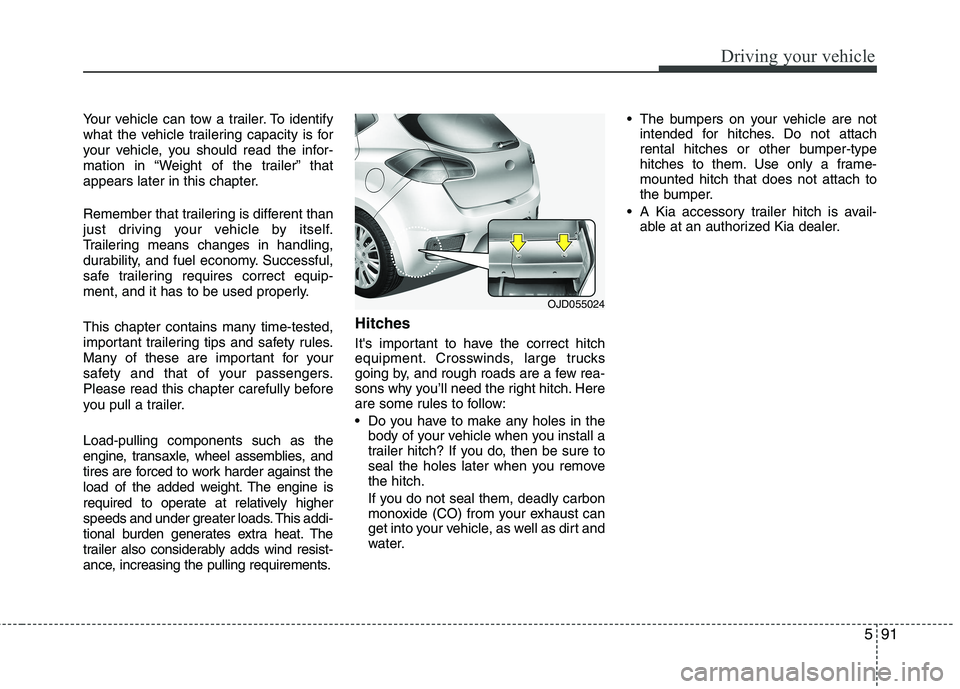
Do you have to make any holes in the
body of your vehicle when you install a
trailer hitch? If you do, then be sure to
seal the holes later when you removethe hitch.
If you do not seal them, deadly carbon
monoxide (CO) from your exhaust can
get into your vehicle, as well as dirt and
water. The bumpers on your vehicle are not
intended for hitches. Do not attach
rental hitches or other bumper-type
hitches to them. Use only a frame-mounted hitch that does not attach to
the bumper.
A Kia accessory trailer hitch is avail- able at an authorized Kia dealer.
OJD055024