engine oil KIA CERATO 2007 User Guide
[x] Cancel search | Manufacturer: KIA, Model Year: 2007, Model line: CERATO, Model: KIA CERATO 2007Pages: 329, PDF Size: 34.09 MB
Page 271 of 329
1 23456789
Maintenance
6
7
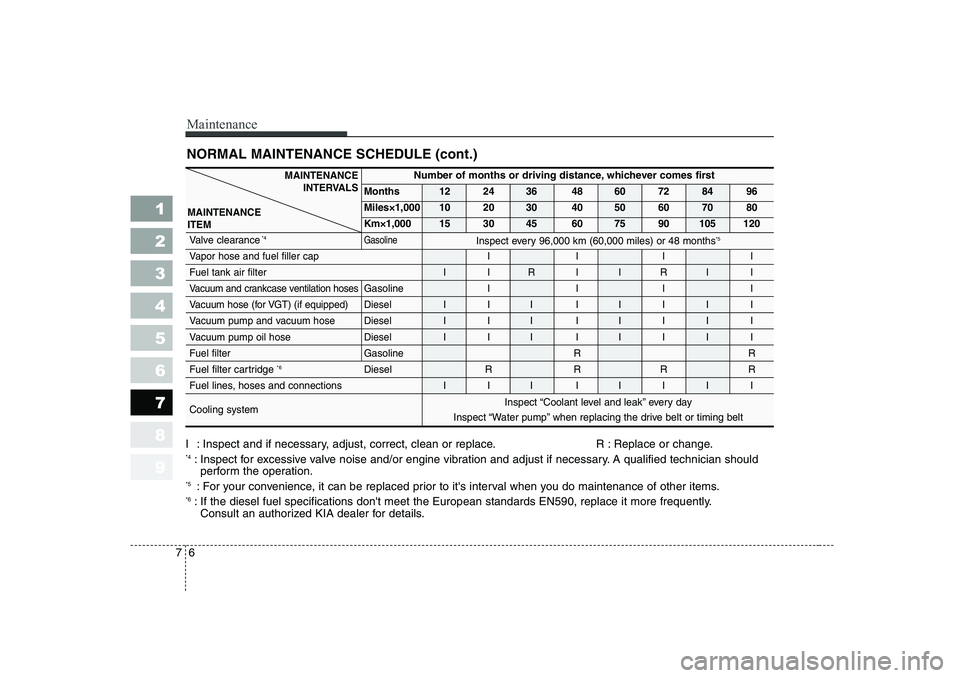
NORMAL MAINTENANCE SCHEDULE (cont.)
MAINTENANCE
INTERVALS
MAINTENANCE ITEMNumber of months or driving distance, whichever comes first
Months 12 24 36 48 60 72 84 96
Miles×1,000 10 20 30 40 50 60 70 80
Km×1,000 15 30 45 60 75 90 105 120
Valve clearance *4
Gasoline
Vapor hose and fuel filler cap
I I I I
Fuel tank air filter I I R I I R I I
Vacuum and crankcase ventilation hosesGasolineIIII
Vacuum hose (for VGT) (if equipped) Diesel
III IIIII
Vacuum pump and vacuum hose DieselIII IIIII
Vacuum pump oil hose DieselIII IIIII
Fuel filterGasoline RR
Fuel filter cartridge *6
Diesel R R R R
Fuel lines, hoses and connections I I I I I I I I Cooling system
Inspect every 96,000 km (60,000 miles) or 48 months *5
Inspect “Coolant level and leak” every day
Inspect “Water pump” when replacing the drive belt or timing belt
I : Inspect and if necessary, adjust, correct, clean or replace. R : Replace or change. *4 : Inspect for excessive valve noise and/or engine vibration and adjust if necessary. A qualified technician should
perform the operation.
*5 : For your convenience, it can be replaced prior to it's interval when you do maintenance of other items.
*6 : If the diesel fuel specifications don't meet the European standards EN590, replace it more frequently.
Consult an authorized KIA dealer for details.
Page 274 of 329
79
Maintenance
1 23456789
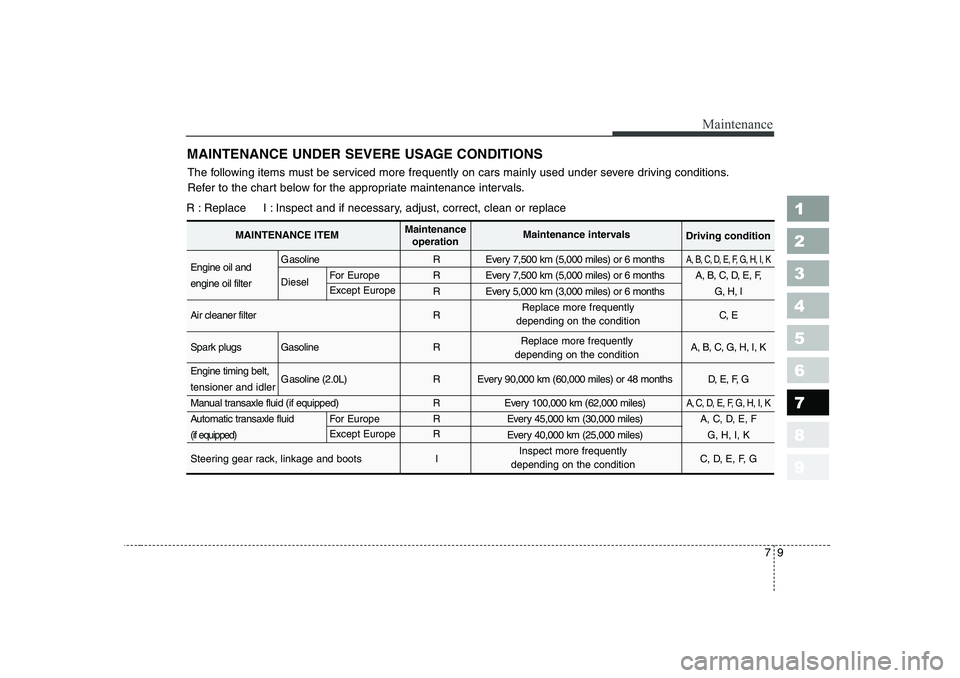
MAINTENANCE UNDER SEVERE USAGE CONDITIONS
The following items must be serviced more frequently on cars mainly used under severe driving conditions.
Refer to the chart below for the appropriate maintenance intervals.
R : Replace I : Inspect and if necessary, adjust, correct, clean or replaceEngine oil and G asoline R Every 7,500 km (5,000 miles) or 6 months
A, B, C, D, E, F, G, H, I, K
engine oil filterDiesel
For EuropeR Every 7,500 km (5,000 miles) or 6 months A, B, C, D, E, F,
Except EuropeR Every 5,000 km (3,000 miles) or 6 months G, H, I
Air cleaner filter R C, E
Spark plugs Gasoline R A, B, C, G, H, I, K
Engine timing belt, G asoline (2.0L) R Every 90,000 km (60,000 miles) or 48 months D, E, F, G
tensioner and idler
Manual transaxle fluid (if equipped)
REvery 100,000 km (62,000 miles)A, C, D, E, F, G, H, I, K
Automatic transaxle fluid For EuropeR Every 45,000 km (30,000 miles)A, C, D, E, F
(if equipped) Except Europe R
Every 40,000 km (25,000 miles)G, H, I, K
Steering gear rack, linkage and boots I
C, D, E, F, G
MAINTENANCE ITEMMaintenance
operation Maintenance intervals
Driving condition
Replace more frequently
depending on the condition
Inspect more frequently
depending on the condition Replace more frequently
depending on the condition
Page 276 of 329
711
Maintenance
1 23456789
OWNER MAINTENANCE
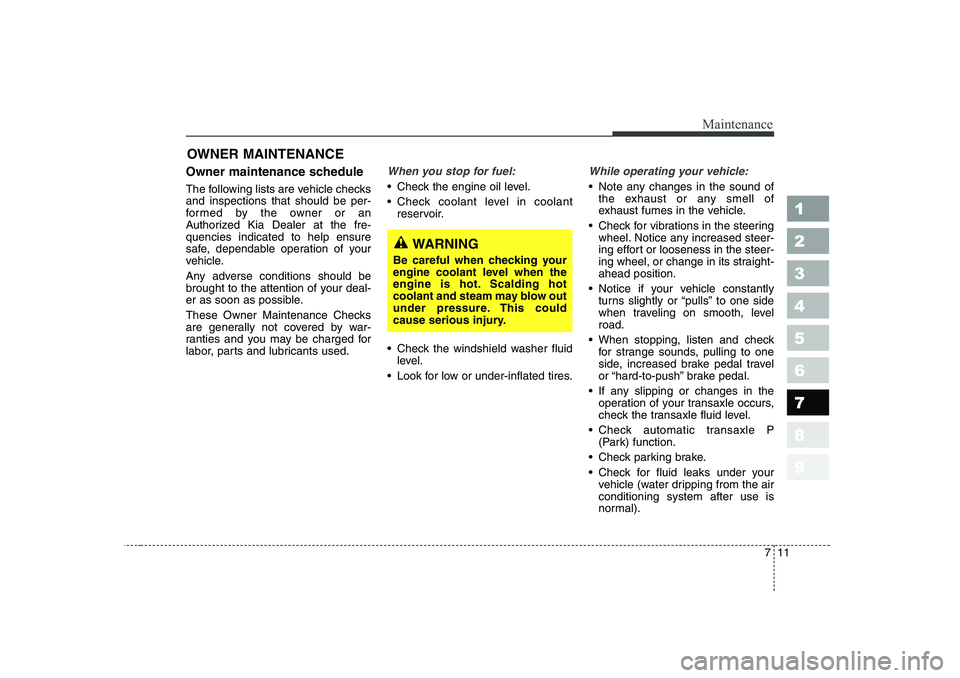
Owner maintenance schedule
The following lists are vehicle checks and inspections that should be per-
formed by the owner or an
Authorized Kia Dealer at the fre-quencies indicated to help ensure
safe, dependable operation of your
vehicle.
Any adverse conditions should be
brought to the attention of your deal-
er as soon as possible.
These Owner Maintenance Checks
are generally not covered by war-
ranties and you may be charged for
labor, parts and lubricants used.
When you stop for fuel:
Check the engine oil level.
Check coolant level in coolant reservoir.
Check the windshield washer fluid level.
Look for low or under-inflated tires.
While operating your vehicle:
Note any changes in the sound of the exhaust or any smell of
exhaust fumes in the vehicle.
Check for vibrations in the steering wheel. Notice any increased steer-
ing effort or looseness in the steer-
ing wheel, or change in its straight-ahead position.
Notice if your vehicle constantly turns slightly or “pulls” to one side
when traveling on smooth, levelroad.
When stopping, listen and check for strange sounds, pulling to one
side, increased brake pedal travel
or “hard-to-push” brake pedal.
If any slipping or changes in the operation of your transaxle occurs,
check the transaxle fluid level.
Check automatic transaxle P (Park) function.
Check parking brake.
Check for fluid leaks under your vehicle (water dripping from the air conditioning system after use is
normal).
WARNING
Be careful when checking your
engine coolant level when the
engine is hot. Scalding hot
coolant and steam may blow out
under pressure. This could
cause serious injury.
Page 279 of 329
Maintenance
14
7
1 23456789
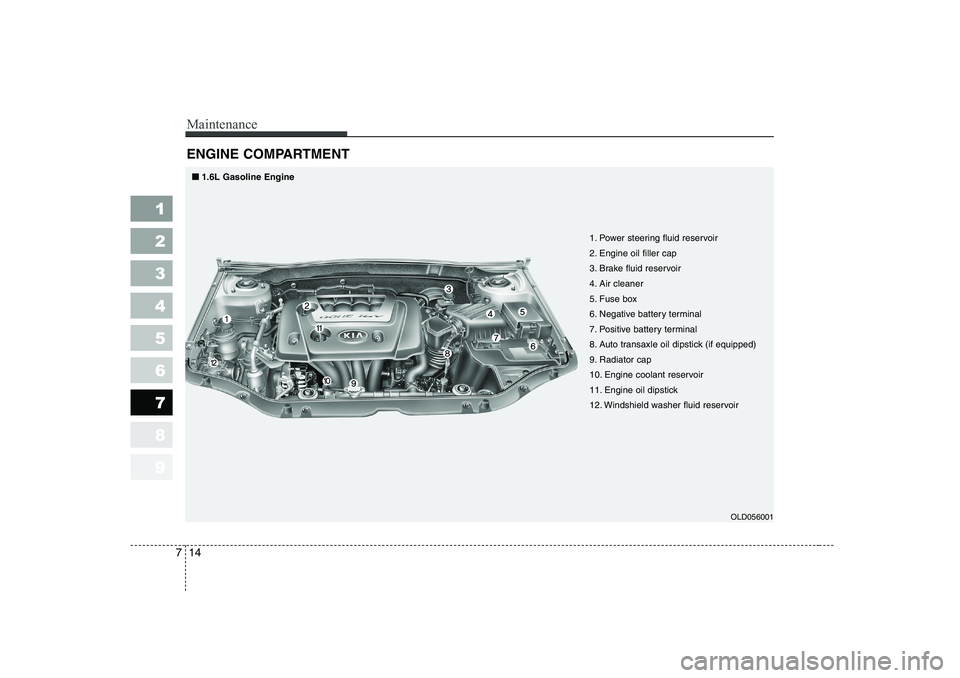
ENGINE COMPARTMENT
OLD056001
1. Power steering fluid reservoir
2. Engine oil filler cap
3. Brake fluid reservoir
4. Air cleaner
5. Fuse box
6. Negative battery terminal
7. Positive battery terminal
8. Auto transaxle oil dipstick (if equipped)
9. Radiator cap
10. Engine coolant reservoir
11. Engine oil dipstick
12. Windshield washer fluid reservoir
■
■
1.6L Gasoline Engine
Page 280 of 329
715
Maintenance
1 23456789
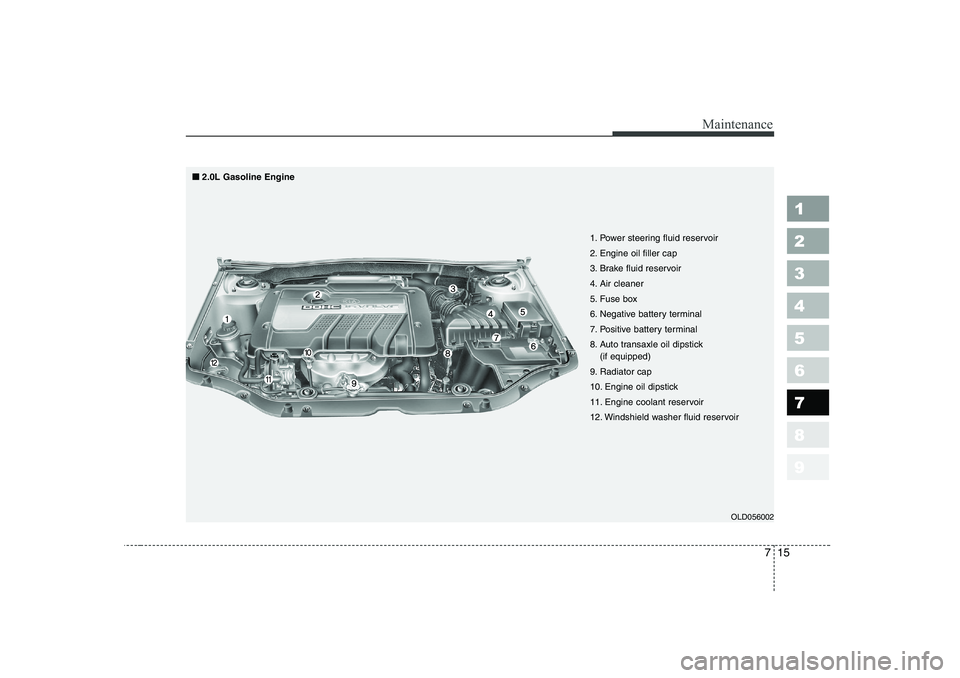
OLD056002
1. Power steering fluid reservoir
2. Engine oil filler cap
3. Brake fluid reservoir
4. Air cleaner
5. Fuse box
6. Negative battery terminal
7. Positive battery terminal
8. Auto transaxle oil dipstick
(if equipped)
9. Radiator cap
10. Engine oil dipstick
11. Engine coolant reservoir
12. Windshield washer fluid reservoir
■■ 2.0L Gasoline Engine
Page 281 of 329
Maintenance
16
7
1 23456789
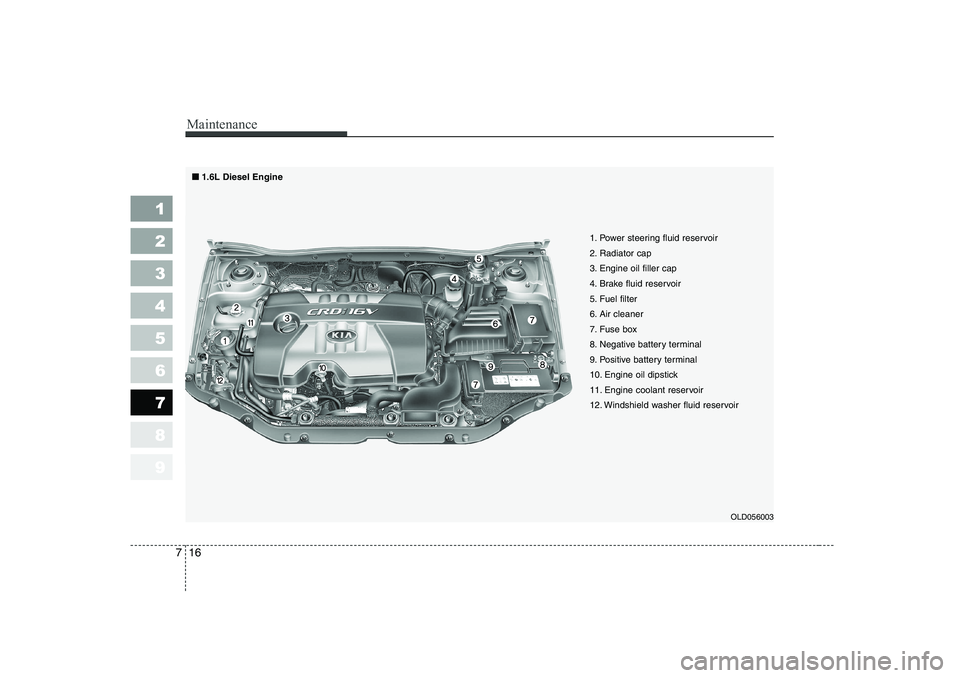
OLD056003
1. Power steering fluid reservoir
2. Radiator cap
3. Engine oil filler cap
4. Brake fluid reservoir
5. Fuel filter
6. Air cleaner
7. Fuse box
8. Negative battery terminal
9. Positive battery terminal
10. Engine oil dipstick
11. Engine coolant reservoir
12. Windshield washer fluid reservoir
■■
1.6L Diesel Engine
Page 282 of 329
717
Maintenance
1 23456789
ENGINE OIL AND OIL FILTER
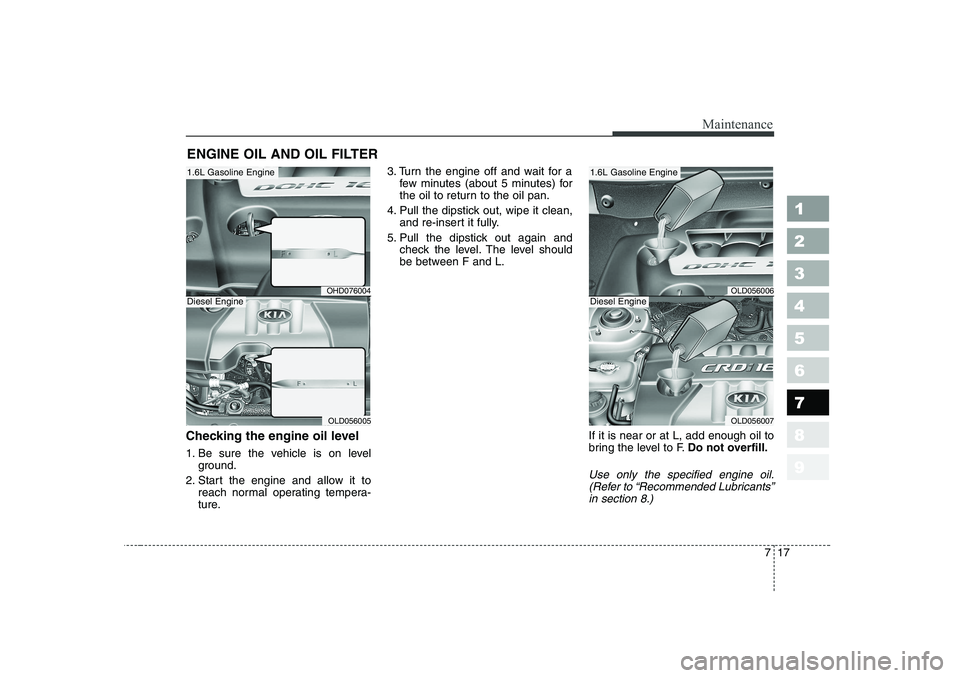
Checking the engine oil level
1. Be sure the vehicle is on level ground.
2. Start the engine and allow it to reach normal operating tempera-
ture. 3. Turn the engine off and wait for a
few minutes (about 5 minutes) for
the oil to return to the oil pan.
4. Pull the dipstick out, wipe it clean, and re-insert it fully.
5. Pull the dipstick out again and check the level. The level should
be between F and L.
If it is near or at L, add enough oil to
bring the level to F.Do not overfill.
Use only the specified engine oil.
(Refer to “Recommended Lubricants”in section 8.)
OHD076004
OLD056005
1.6L Gasoline Engine
Diesel EngineOLD056006
OLD056007
1.6L Gasoline Engine
Diesel Engine
Page 283 of 329
Maintenance
18
7
1 23456789
Changing the engine oil and filter
Have engine oil and filter changed by
an authorized KIA dealer accordingto the Maintenance Schedule at thebeginning of this section. The high-pressure cooling system
has a reservoir filled with year-round
antifreeze coolant. The reservoir is
filled at the factory.
Check the antifreeze protection and
coolant level at least once a week, atthe beginning of the winter season,
and before traveling to a colder cli-
mate.
Checking the coolant level
WARNING
Used engine oil may cause irri- tation or cancer of the skin if left
in contact with the skin for pro-
longed periods of time. Used
engine oil contains chemicals
that have caused cancer in lab-
oratory animals. Always protect
your skin by washing your
hands thoroughly with soap and
warm water as soon as possibleafter handling used oil.
ENGINE COOLING SYSTEM
WARNING - Removing
radiator cap
Never attempt to remove the radiator cap while the engine
is operating or hot. Doing somight lead to cooling system
and engine damage and could
result in serious personal
injury from escaping hotcoolant or steam.
(Continued)
(Continued)
Turn the engine off and waituntil it cools down. Even then,
use extreme care when
removing the radiator cap.
Wrap a thick towel around it,
and turn it counterclockwise
slowly to the first stop. Step
back while the pressure is
released from the cooling sys-
tem. When you are sure all thepressure has been released,
press down on the cap, using
a thick towel, and continue
turning counterclockwise to
remove it.
Even if the engine is not oper- ating, do not remove the radi-ator cap or the drain plugwhile the engine and radiator
are hot. Hot coolant and steam
may still blow out under pres-
sure, causing serious injury.
Page 287 of 329
Maintenance
22
7
1 23456789
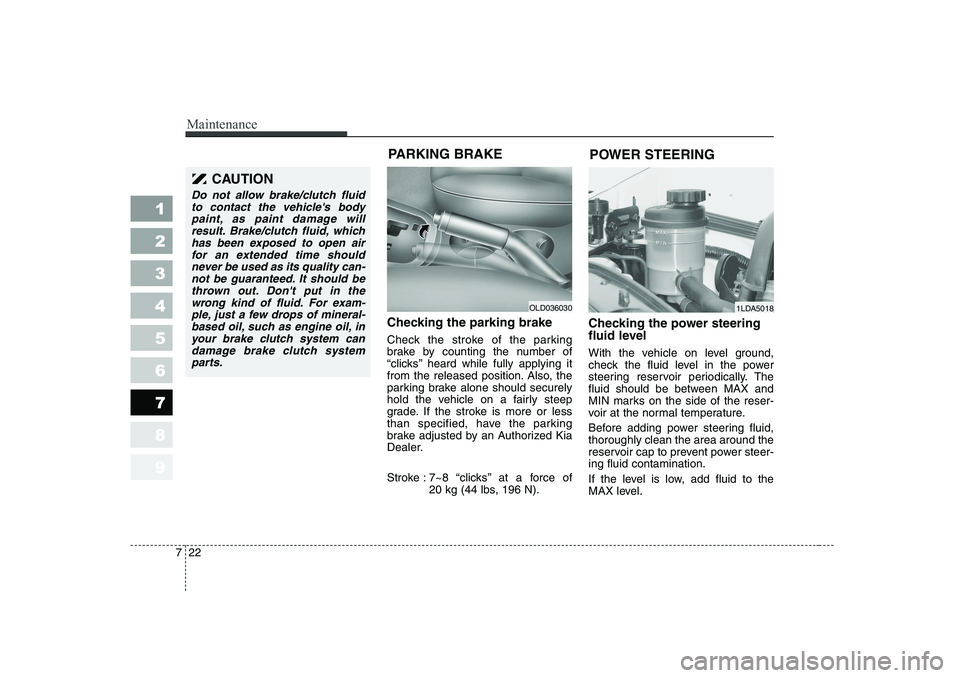
Checking the parking brake
Check the stroke of the parking
brake by counting the number of
“clicks’’ heard while fully applying it
from the released position. Also, the
parking brake alone should securely
hold the vehicle on a fairly steep
grade. If the stroke is more or less
than specified, have the parking
brake adjusted by an Authorized Kia
Dealer.
Stroke : 7~8 “clicks’’ at a force of
20 kg (44 lbs, 196 N). Checking the power steering
fluid level
With the vehicle on level ground,
check the fluid level in the power
steering reservoir periodically. The
fluid should be between MAX and
MIN marks on the side of the reser-
voir at the normal temperature.
Before adding power steering fluid, thoroughly clean the area around the
reservoir cap to prevent power steer-ing fluid contamination.
If the level is low, add fluid to the
MAX level.
OLD036030
PARKING BRAKE 1LDA5018
POWER STEERING
CAUTION
Do not allow brake/clutch fluid
to contact the vehicle's bodypaint, as paint damage will result. Brake/clutch fluid, whichhas been exposed to open airfor an extended time shouldnever be used as its quality can- not be guaranteed. It should bethrown out. Don't put in thewrong kind of fluid. For exam- ple, just a few drops of mineral-based oil, such as engine oil, inyour brake clutch system can damage brake clutch systemparts.
Page 290 of 329
725
Maintenance
1 23456789
✽✽NOTICE
“COLD (C)” scale is for reference
only and should NOT be used todetermine transaxle fluid level. ✽
✽
NOTICE
New automatic transaxle fluid
should be red. The red dye is addedso the assembly plant can identify itas automatic transaxle fluid and dis-
tinguish it from engine oil or
antifreeze. The red dye, which is not
an indicator of fluid quality, is not
permanent. As the vehicle is driven,the automatic transaxle fluid will
begin to look darker. The color may
eventually appear light brown.
Therefore, have an Authorized Kia
dealer change the automatictransaxle fluid according to theScheduled Maintenance at thebeginning of this section.
Changing the automatic transaxle fluid
Have automatic transaxle fluid
changed by an authorized KIA deal-er according to the MaintenanceSchedule at the beginning of thissection.
CAUTION
Low fluid level causes transaxle slippage. Overfillingcan cause foaming, loss offluid and transaxle malfunc-tion.
The use of a non-specified fluid could result in transaxlemalfunction and failure.
WARNING - Parking brake
To avoid sudden movement of
the vehicle, apply parking brakeand depress the brake pedal
before moving the shift lever.
WARNING - Transaxle fluid
The transaxle fluid level should
be checked when the engine isat normal operating tempera-
ture. This means that the
engine, radiator, radiator hose
and exhaust system etc., are
very hot. Exercise great care not
to burn yourself during this pro-
cedure.