service KIA CERATO 2007 Owner's Manual
[x] Cancel search | Manufacturer: KIA, Model Year: 2007, Model line: CERATO, Model: KIA CERATO 2007Pages: 329, PDF Size: 34.09 MB
Page 300 of 329

735
Maintenance
1 23456789
For best battery service :
Keep the battery securely mount-ed.
Keep the battery top clean and dry.
Keep the terminals and connec- tions clean, tight, and coated with
petroleum jelly or terminal grease.
Rinse any spilled electrolyte from the battery immediately with a
solution of water and baking soda.
If the vehicle is not going to be used for an extended time, discon-
nect the battery cables. Battery recharging
Your vehicle has a maintenance-free,
calcium-based battery.
If the battery becomes discharged
in a short time (because, for exam-
ple, the headlights or interior lights
were left on while the vehicle was
not in use), recharge it by slow
charging (trickle) for 10 hours.
If the battery gradually discharges because of high electric load while
the vehicle is being used, recharge
it at 20-30A for two hours.
Items to be reset after the battery
has been discharged or the bat-tery has been disconnected.
Clock (See section 3)
Climate control system (See section 4)
Audio (See section 3)
Sunroof (See section 3)
1LDE5028
Page 307 of 329
Maintenance
42
7
1 23456789
Uniform tire quality grading
Tread wear
The tread wear grade is a compara-
tive rating based on the wear rate ofthe tire when tested under controlled
conditions on a specified govern-
ment test course. For example, a tire
graded 150 would wear one-and-a-
half times as well on the government
course as a tire graded 100. The relative performance of tiresdepends upon the actual conditions
of their use. However, performance
may differ from the norm because of
variations in driving habits, service
practices and differences in road
characteristics and climate.
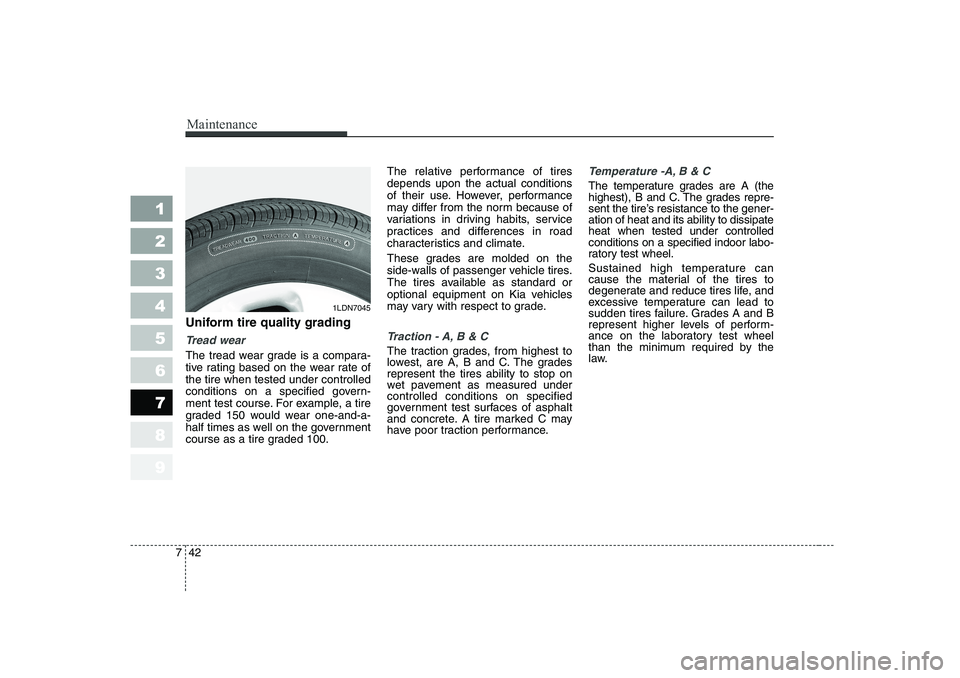
These grades are molded on the
side-walls of passenger vehicle tires.
The tires available as standard or
optional equipment on Kia vehicles
may vary with respect to grade.
Traction - A, B & C
The traction grades, from highest to
lowest, are A, B and C. The gradesrepresent the tires ability to stop on
wet pavement as measured undercontrolled conditions on specified
government test surfaces of asphalt
and concrete. A tire marked C may
have poor traction performance.
Temperature -A, B & C
The temperature grades are A (the
highest), B and C. The grades repre-
sent the tire’s resistance to the gener-ation of heat and its ability to dissipateheat when tested under controlledconditions on a specified indoor labo-
ratory test wheel.
Sustained high temperature can
cause the material of the tires to
degenerate and reduce tires life, and
excessive temperature can lead to
sudden tires failure. Grades A and B
represent higher levels of perform-
ance on the laboratory test wheel
than the minimum required by the
law.
1LDN7045
Page 308 of 329
743
Maintenance
1 23456789
Checking a tire life
Tire strength and performance
decline with age. Any tires that are
over 6 year old, including the spare
(determined by the tire manufacturedate), should be replaced regardless
of mileage. You can find the tire man-
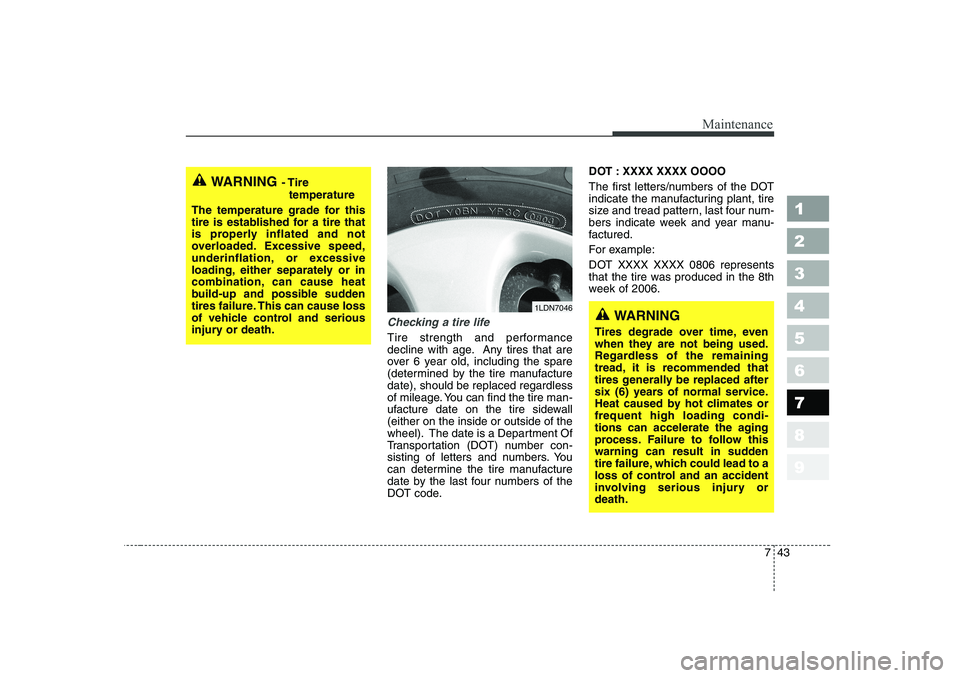
ufacture date on the tire sidewall(either on the inside or outside of the
wheel). The date is a Department Of
Transportation (DOT) number con-
sisting of letters and numbers. You
can determine the tire manufacture
date by the last four numbers of the
DOT code.DOT : XXXX XXXX OOOO
The first letters/numbers of the DOT
indicate the manufacturing plant, tire
size and tread pattern, last four num-
bers indicate week and year manu-
factured.
For example:
DOT XXXX XXXX 0806 represents
that the tire was produced in the 8th
week of 2006.
WARNING
Tires degrade over time, even
when they are not being used.
Regardless of the remaining
tread, it is recommended that
tires generally be replaced after
six (6) years of normal service.
Heat caused by hot climates orfrequent high loading condi-
tions can accelerate the aging
process. Failure to follow this
warning can result in sudden
tire failure, which could lead to a
loss of control and an accident
involving serious injury ordeath.
WARNING - Tire
temperature
The temperature grade for this
tire is established for a tire that
is properly inflated and not
overloaded. Excessive speed,
underinflation, or excessive
loading, either separately or in
combination, can cause heat
build-up and possible sudden
tires failure. This can cause loss
of vehicle control and serious
injury or death.
1LDN7046
Page 313 of 329
Maintenance
48
7
1 23456789
License plate lights bulb replacement
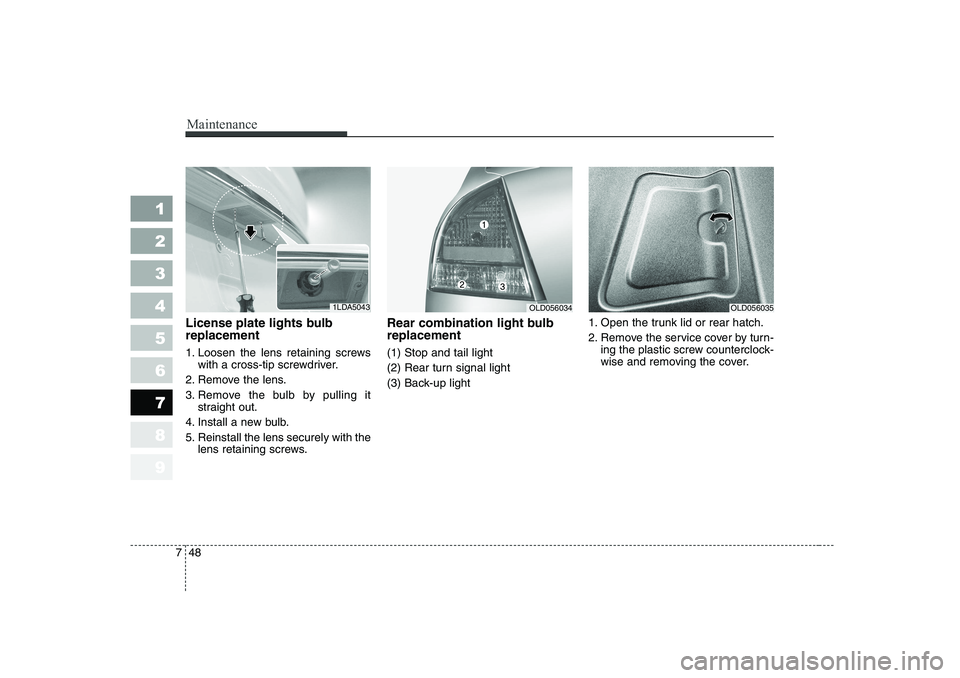
1. Loosen the lens retaining screws
with a cross-tip screwdriver.
2. Remove the lens.
3. Remove the bulb by pulling it straight out.
4. Install a new bulb.
5. Reinstall the lens securely with the lens retaining screws. Rear combination light bulb replacement (1) Stop and tail light
(2) Rear turn signal light
(3) Back-up light
1. Open the trunk lid or rear hatch.
2. Remove the service cover by turn-
ing the plastic screw counterclock-
wise and removing the cover.
1LDA5043OLD056035OLD056034
Page 314 of 329
749
Maintenance
1 23456789
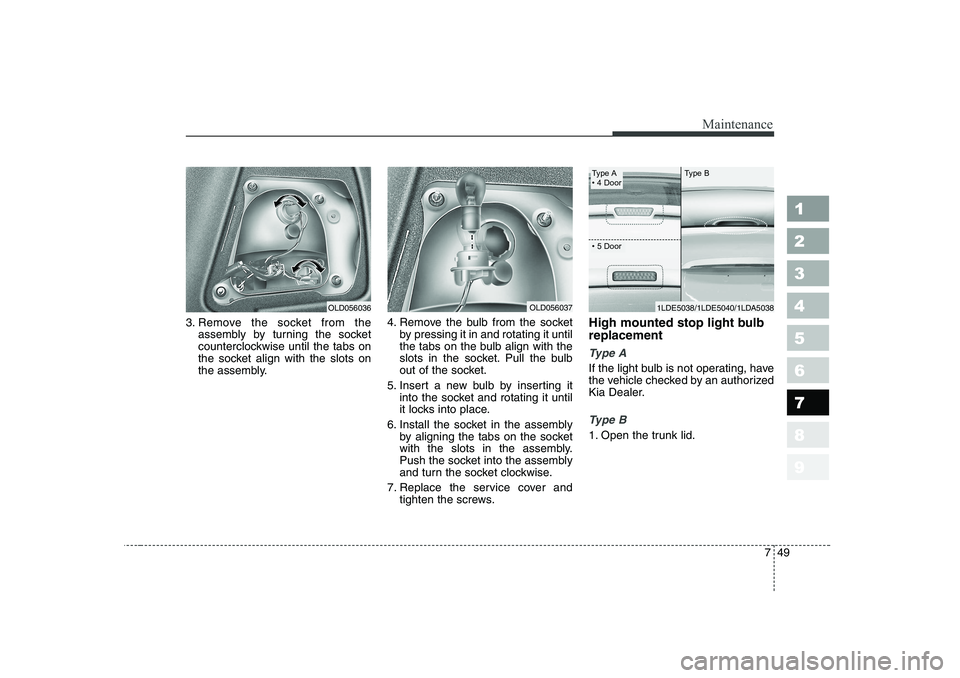
3. Remove the socket from theassembly by turning the socket
counterclockwise until the tabs on
the socket align with the slots on
the assembly. 4. Remove the bulb from the socket
by pressing it in and rotating it until
the tabs on the bulb align with the
slots in the socket. Pull the bulb
out of the socket.
5. Insert a new bulb by inserting it into the socket and rotating it until
it locks into place.
6. Install the socket in the assembly by aligning the tabs on the socket
with the slots in the assembly.
Push the socket into the assembly
and turn the socket clockwise.
7. Replace the service cover and tighten the screws. High mounted stop light bulb replacement
Type A
If the light bulb is not operating, have
the vehicle checked by an authorized
Kia Dealer.
Type B
1. Open the trunk lid.
OLD056037OLD056036
Type A
Page 324 of 329
Specifications
4
8
1 23456789
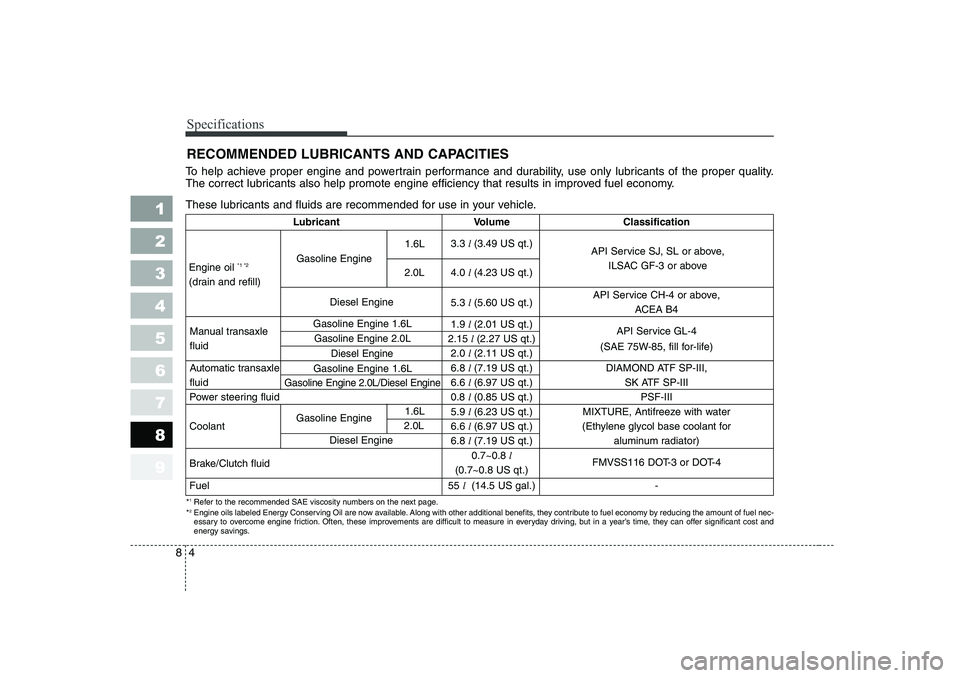
RECOMMENDED LUBRICANTS AND CAPACITIES
To help achieve proper engine and powertrain performance and durability, use only lubricants of the proper quality.
The correct lubricants also help promote engine efficiency that results in improved fuel economy.
These lubricants and fluids are recommended for use in your vehicle.
* 1
Refer to the recommended SAE viscosity numbers on the next page.
* 2
Engine oils labeled Energy Conserving Oil are now available. Along with other additional benefits, they contribute to fuel economy by reducing the amount of fuel nec-
essary to overcome engine friction. Often, these improvements are difficult to measure in everyday driving, but in a year’s time, they can offer significant cost and
energy savings.
Lubricant Volume Classification
3.3 l (3.49 US qt.)
4.0 l (4.23 US qt.)
API Service CH-4 or above,
5.3 l (5.60 US qt.)
ACEA B4
1.9 l (2.01 US qt.)
API Service GL-4
2.15 l (2.27 US qt.)
(SAE 75W-85, fill for-life)
2.0 l (2.11 US qt.)
6.8 l (7.19 US qt.) DIAMOND ATF SP-III,
6.6 l (6.97 US qt.) SK ATF SP-III
Power steering fluid 0.8 l (0.85 US qt.) PSF-III
5.9 l (6.23 US qt.) MIXTURE, Antifreeze with water
Coolant 6.6 l (6.97 US qt.) (Ethylene glycol base coolant for
6.8 l (7.19 US qt.) aluminum radiator)
Brake/Clutch fluid 0.7~0.8
l
FMVSS116 DOT-3 or DOT-4
(0.7~0.8 US qt.)
Fuel 55 l (14.5 US gal.) -
Engine oil *1 *2
(drain and refill)
Automatic transaxle fluidManual transaxlefluid Gasoline Engine
1.6L
2.0L
Gasoline Engine Diesel Engine
Diesel Engine API Service SJ, SL or above,
ILSAC GF-3 or above
1.6L
2.0L
Gasoline Engine 1.6L
Gasoline Engine 2.0L
Diesel Engine
Gasoline Engine 1.6L
Gasoline Engine 2.0L/Diesel Engine
Page 328 of 329
93
1 23456789
Index
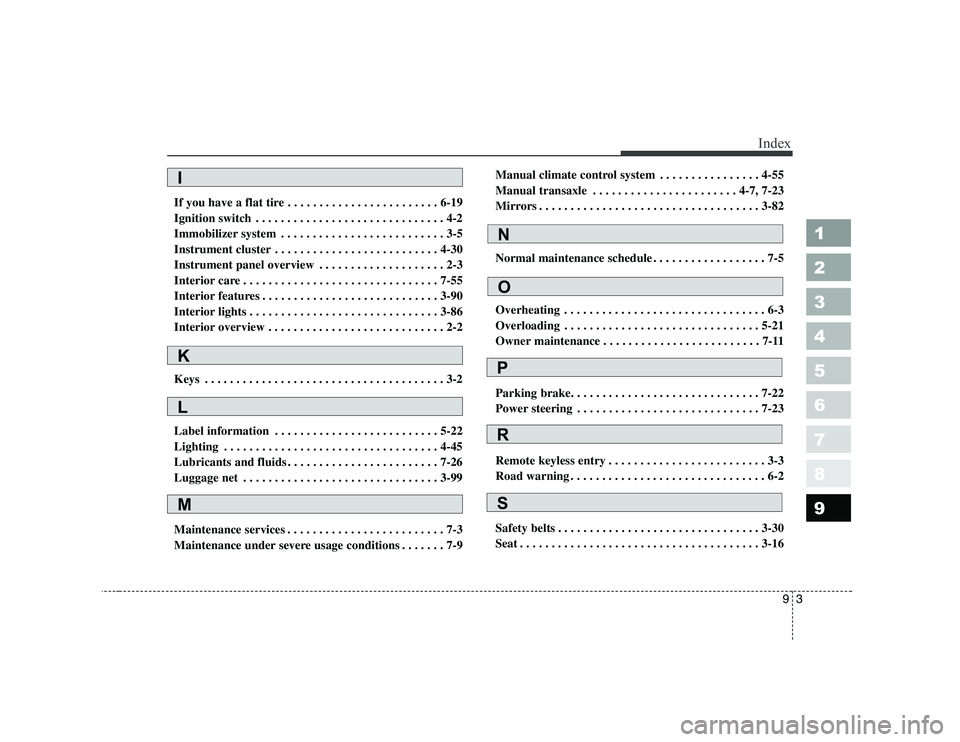
If you have a flat tire . . . . . . . . . . . . . . . . . . . . . . . . 6-19
Ignition switch . . . . . . . . . . . . . . . . . . . . . . . . . . . . . . 4-2
Immobilizer system . . . . . . . . . . . . . . . . . . . . . . . . . . 3-5
Instrument cluster . . . . . . . . . . . . . . . . . . . . . . . . . . 4-30
Instrument panel overview . . . . . . . . . . . . . . . . . . . . 2-3
Interior care . . . . . . . . . . . . . . . . . . . . . . . . . . . . . . . 7-55
Interior features . . . . . . . . . . . . . . . . . . . . . . . . . . . . 3-90
Interior lights . . . . . . . . . . . . . . . . . . . . . . . . . . . . . . 3-86
Interior overview . . . . . . . . . . . . . . . . . . . . . . . . . . . . 2-2
Keys . . . . . . . . . . . . . . . . . . . . . . . . . . . . . . . . . . . . . . 3-2
Label information . . . . . . . . . . . . . . . . . . . . . . . . . . 5-22
Lighting . . . . . . . . . . . . . . . . . . . . . . . . . . . . . . . . . . 4-45
Lubricants and fluids . . . . . . . . . . . . . . . . . . . . . . . . 7-26
Luggage net . . . . . . . . . . . . . . . . . . . . . . . . . . . . . . . 3-99
Maintenance services . . . . . . . . . . . . . . . . . . . . . . . . . 7-3
Maintenance under severe usage conditions . . . . . . . 7-9Manual climate control system . . . . . . . . . . . . . . . . 4-55
Manual transaxle . . . . . . . . . . . . . . . . . . . . . . . 4-7, 7-23
Mirrors . . . . . . . . . . . . . . . . . . . . . . . . . . . . . . . . . . . 3-82
Normal maintenance schedule . . . . . . . . . . . . . . . . . . 7-5
Overheating . . . . . . . . . . . . . . . . . . . . . . . . . . . . . . . . 6-3
Overloading . . . . . . . . . . . . . . . . . . . . . . . . . . . . . . . 5-21
Owner maintenance . . . . . . . . . . . . . . . . . . . . . . . . . 7-11
Parking brake. . . . . . . . . . . . . . . . . . . . . . . . . . . . . . 7-22
Power steering . . . . . . . . . . . . . . . . . . . . . . . . . . . . . 7-23
Remote keyless entry . . . . . . . . . . . . . . . . . . . . . . . . . 3-3
Road warning . . . . . . . . . . . . . . . . . . . . . . . . . . . . . . . 6-2
Safety belts . . . . . . . . . . . . . . . . . . . . . . . . . . . . . . . . 3-30
Seat . . . . . . . . . . . . . . . . . . . . . . . . . . . . . . . . . . . . . . 3-16
I
K
L
M
N
O
P
R
S