Front led KIA Cerato 2014 2.G Owner's Guide
[x] Cancel search | Manufacturer: KIA, Model Year: 2014, Model line: Cerato, Model: KIA Cerato 2014 2.GPages: 446, PDF Size: 7.32 MB
Page 344 of 446
621
What to do in an emergency
Do not take this vehicle through anautomatic car wash while the com-
pact spare tire is installed.
The compact spare tire should not be installed on the front axle if the
vehicle must be driven in snow or
on ice.
Do not use the compact spare tire on any other vehicle because this
tire has been designed especially
for your vehicle.
The compact spare tire’s tread life is shorter than a regular tire.
Inspect your compact spare tire
regularly and replace worn com-
pact spare tires with the same size
and design, mounted on the same
wheel.
The compact spare tire should not be used on any other wheels, nor
should standard tires, snow tires,
wheel covers or trim rings be used
with the compact spare wheel. If
such use is attempted, damage to
these items or other car compo-
nents may occur. Do not use more than one compact
spare tire at a time.
Do not tow a trailer while the com- pact spare tire is installed.
Page 348 of 446
625
What to do in an emergency
Emergency towing precautions
Turn the ignition switch to ACC sothe steering wheel isn’t locked.
Place the transaxle shift lever in N (Neutral).
Release the parking brake.
Press the brake pedal with more force than normal since you will
have reduced brake performance.
More steering effort will be required because the power steer-
ing system will be disabled.
If you are driving down a long hill, the brakes may overheat and brake
performance will be reduced. Stop
often and let the brakes cool off. If the car is being towed with all four
wheels on the ground, it can be
towed only from the front. Be sure
that the transmission is in neutral. Be
sure the steering is unlocked by plac-
ing the ignition switch in the ACC
position. A driver must be in the
towed vehicle to operate the steering
and brakes.
CAUTION - Automatic
transaxle
To avoid serious damage to
the automatic transmission,limit the vehicle speed to 15km/h (10 mph) and drive lessthan 1.5 km (1 mile) when tow-ing.
Before towing, check for an automatic transmission fluidleak under your vehicle. If theautomatic transmission fluidis leaking, a flatbed equipmentor towing dolly must be used.
Page 372 of 446
Maintenance
24
7
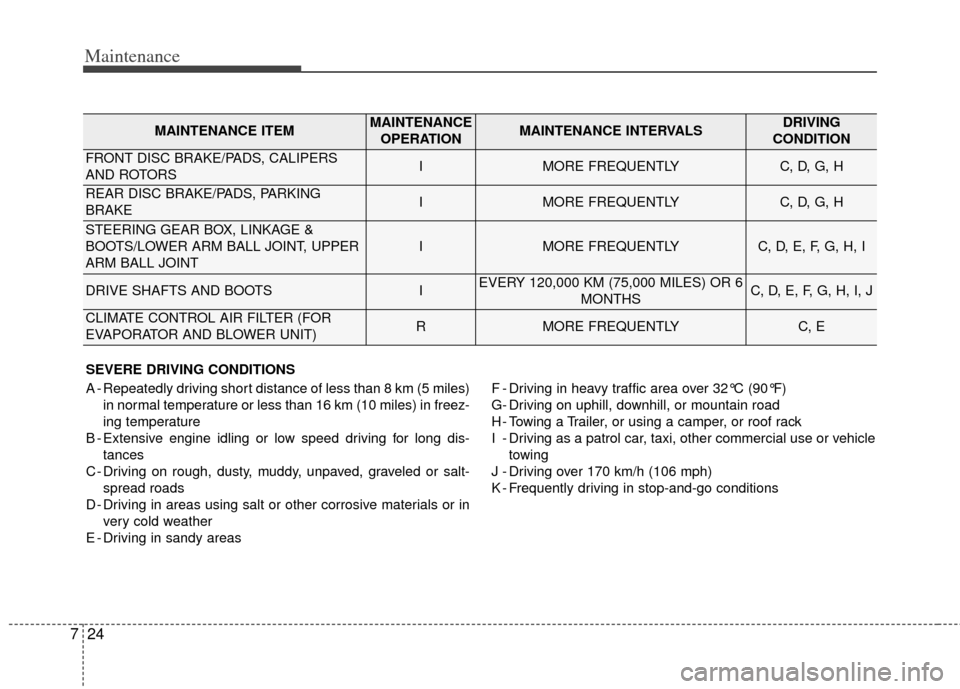
SEVERE DRIVING CONDITIONS
A - Repeatedly driving short distance of less than 8 km (5 miles)
in normal temperature or less than 16 km (10 miles) in freez-
ing temperature
B - Extensive engine idling or low speed driving for long dis- tances
C - Driving on rough, dusty, muddy, unpaved, graveled or salt- spread roads
D - Driving in areas using salt or other corrosive materials or in very cold weather
E - Driving in sandy areas F - Driving in heavy traffic area over 32°C (90°F)
G- Driving on uphill, downhill, or mountain road
H - Towing a Trailer, or using a camper, or roof rack
I - Driving as a patrol car, taxi, other commercial use or vehicle
towing
J - Driving over 170 km/h (106 mph)
K - Frequently driving in stop-and-go conditions
MAINTENANCE ITEMMAINTENANCE OPERATIONMAINTENANCE INTERVALSDRIVING
CONDITION
FRONT DISC BRAKE/PADS, CALIPERS
AND ROTORSIMORE FREQUENTLYC, D, G, H
REAR DISC BRAKE/PADS, PARKING
BRAKEIMORE FREQUENTLYC, D, G, H
STEERING GEAR BOX, LINKAGE &
BOOTS/LOWER ARM BALL JOINT, UPPER
ARM BALL JOINT
IMORE FREQUENTLYC, D, E, F, G, H, I
DRIVE SHAFTS AND BOOTSIEVERY 120,000 KM (75,000 MILES) OR 6 MONTHSC, D, E, F, G, H, I, J
CLIMATE CONTROL AIR FILTER (FOR
EVAPORATOR AND BLOWER UNIT)RMORE FREQUENTLYC, E
Page 399 of 446
751
Maintenance
3. Checking tire life (TIN : TireIdentification Number)
Any tires that are over 6 years old,
based on the manufacturing date,
(including the spare tire) should be
replaced by new ones. You can find
the manufacturing date on the tire
sidewall (possibly on the inside of the
wheel), displaying the DOT Code.
The DOT Code is a series of num-
bers on a tire consisting of numbers
and English letters. The manufactur-
ing date is designated by the last four
digits (characters) of the DOT code.
DOT : XXXX XXXX OOOO
The front part of the DOT means a
plant code number, tire size and
tread pattern and the last four num-
bers indicate week and year manu-
factured.
For example:
DOT XXXX XXXX 1613 represents
that the tire was produced in the 16th
week of 2013.
4. Tire ply composition and mate-rial
The number of layers or plies of rub-
ber-coated fabric in the tire. Tire
manufacturers also must indicate the
materials in the tire, which include
steel, nylon, polyester, and others.
The letter "R" means radial ply con-
struction; the letter "D" means diago-
nal or bias ply construction; and the
letter "B" means belted-bias ply con-
struction.
5. Maximum permissible inflationpressure
This number is the greatest amount
of air pressure that should be put in
the tire. Do not exceed the maximum
permissible inflation pressure. Refer
to the Tire and Loading Information
label for recommended inflation
pressure.
6. Maximum load rating
This number indicates the maximum
load in kilograms and pounds that
can be carried by the tire. When
replacing the tires on the vehicle,
always use a tire that has the same
load rating as the factory installed
tire.
WARNING - Tire age
Replace tires within the recom-
mended time frame. Failure to
replace tires as recommended
can result in sudden tire failure,
which could lead to a loss of
control and an accident.
Page 401 of 446
753
Maintenance
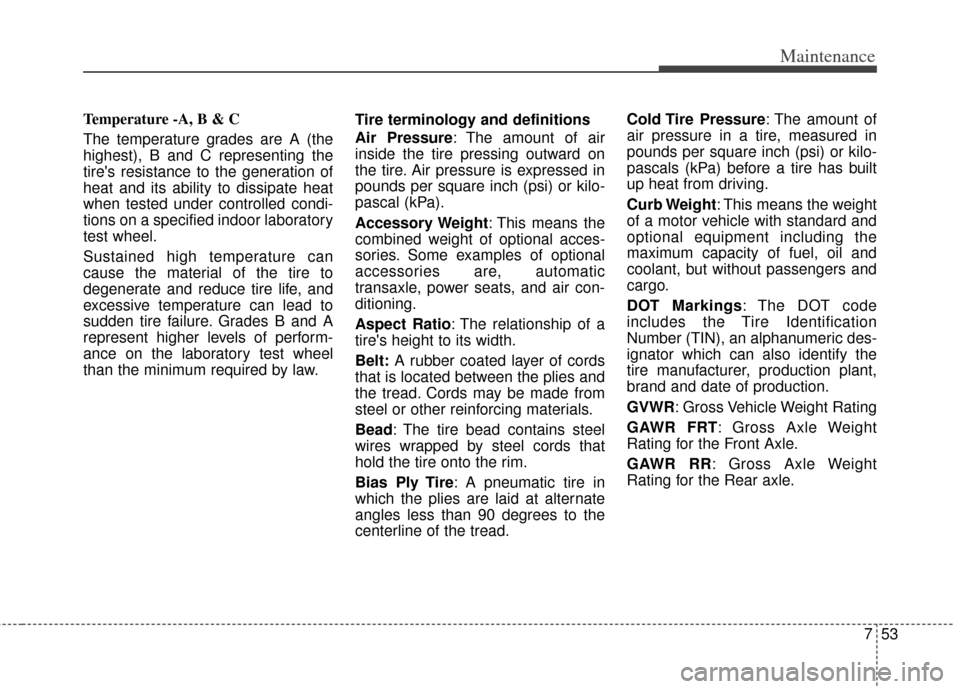
Temperature -A, B & C
The temperature grades are A (the
highest), B and C representing the
tire's resistance to the generation of
heat and its ability to dissipate heat
when tested under controlled condi-
tions on a specified indoor laboratory
test wheel.
Sustained high temperature can
cause the material of the tire to
degenerate and reduce tire life, and
excessive temperature can lead to
sudden tire failure. Grades B and A
represent higher levels of perform-
ance on the laboratory test wheel
than the minimum required by law.Tire terminology and definitions
Air Pressure: The amount of air
inside the tire pressing outward on
the tire. Air pressure is expressed in
pounds per square inch (psi) or kilo-
pascal (kPa).
Accessory Weight
: This means the
combined weight of optional acces-
sories. Some examples of optional
accessories are, automatic
transaxle, power seats, and air con-
ditioning.
Aspect Ratio : The relationship of a
tire's height to its width.
Belt: A rubber coated layer of cords
that is located between the plies and
the tread. Cords may be made from
steel or other reinforcing materials.
Bead: The tire bead contains steel
wires wrapped by steel cords that
hold the tire onto the rim.
Bias Ply Tire : A pneumatic tire in
which the plies are laid at alternate
angles less than 90 degrees to the
centerline of the tread. Cold Tire Pressure: The amount of
air pressure in a tire, measured in
pounds per square inch (psi) or kilo-
pascals (kPa) before a tire has built
up heat from driving.
Curb Weight: This means the weight
of a motor vehicle with standard and
optional equipment including the
maximum capacity of fuel, oil and
coolant, but without passengers and
cargo.
DOT Markings: The DOT code
includes the Tire Identification
Number (TIN), an alphanumeric des-
ignator which can also identify the
tire manufacturer, production plant,
brand and date of production.
GVWR: Gross Vehicle Weight Rating
GAWR FRT: Gross Axle Weight
Rating for the Front Axle.
GAWR RR: Gross Axle Weight
Rating for the Rear axle.
Page 431 of 446
83
Specifications & Consumer information
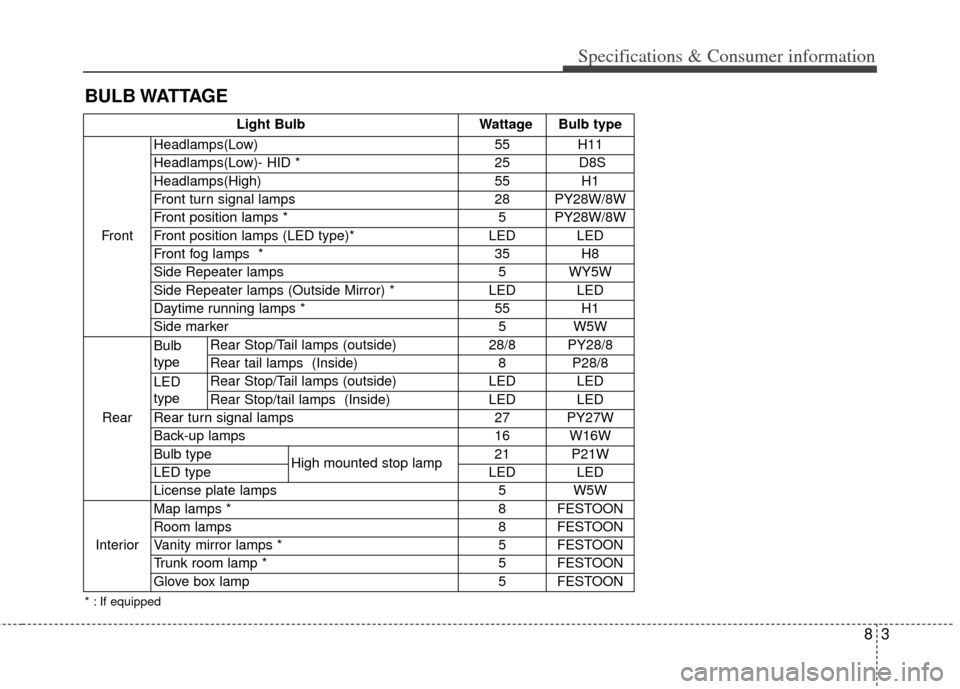
BULB WATTAGE
Light BulbWattage Bulb type
Front Headlamps(Low)
55 H11
Headlamps(Low)- HID * 25 D8S
Headlamps(High) 55H1
Front turn signal lamps 28 PY28W/8W
Front position lamps * 5 PY28W/8W
Front position lamps (LED type)* LED LED
Front fog lamps * 35H8
Side Repeater lamps 5 WY5W
Side Repeater lamps (Outside Mirror) * LED LED
Daytime running lamps * 55H1
Side marker5W5W
Rear Bulb
type
Rear Stop/Tail lamps (outside) 28/8 PY28/8
Rear tail lamps (Inside) 8 P28/8
LED
type Rear Stop/Tail lamps (outside) LED LED
Rear Stop/tail lamps (Inside) LED LED
Rear turn signal lamps 27 PY27W
Back-up lamps 16 W16W
Bulb type High mounted stop lamp 21 P21W
LED type LED LED
License plate lamps 5 W5W
Interior Map lamps * 8 FESTOON
Room lamps 8 FESTOON
Vanity mirror lamps * 5 FESTOON
Trunk room lamp * 5 FESTOON
Glove box lamp 5 FESTOON
* : If equipped
Page 441 of 446
I3
Index
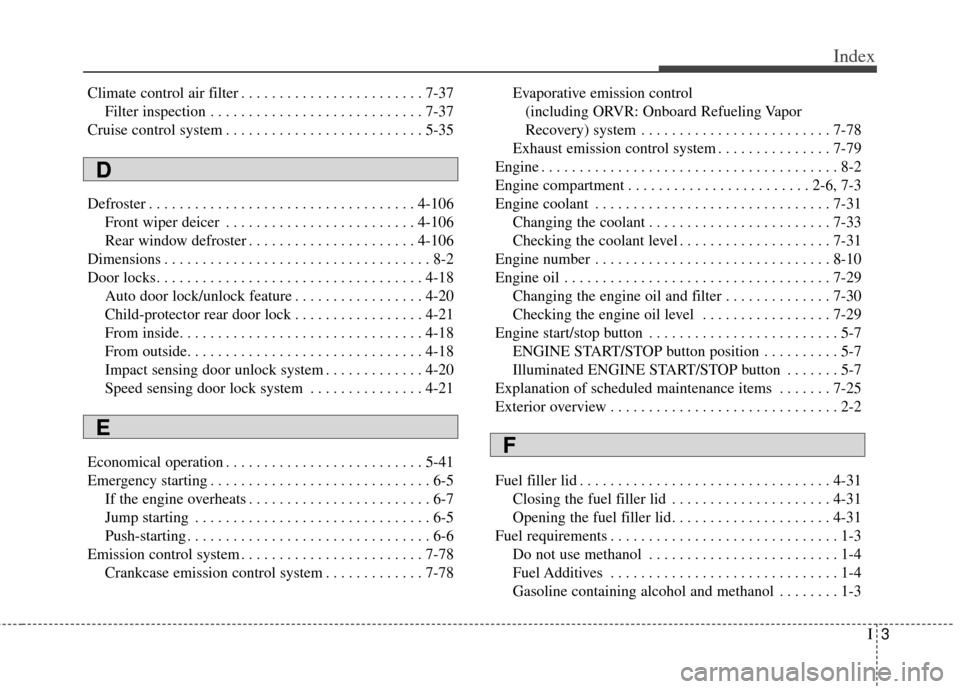
Climate control air filter . . . . . . . . . . . . . . . . . . . . . . . . 7-37Filter inspection . . . . . . . . . . . . . . . . . . . . . . . . . . . . 7-37
Cruise control system . . . . . . . . . . . . . . . . . . . . . . . . . . 5-35
Defroster . . . . . . . . . . . . . . . . . . . . . . . . . . . . . . . . . . . 4-\
106 Front wiper deicer . . . . . . . . . . . . . . . . . . . . . . . . . 4-106
Rear window defroster . . . . . . . . . . . . . . . . . . . . . . 4-106
Dimensions . . . . . . . . . . . . . . . . . . . . . . . . . . . . . . . . . . . 8-\
2
Door locks. . . . . . . . . . . . . . . . . . . . . . . . . . . . . . . . . . . 4-\
18 Auto door lock/unlock feature . . . . . . . . . . . . . . . . . 4-20
Child-protector rear door lock . . . . . . . . . . . . . . . . . 4-21
From inside. . . . . . . . . . . . . . . . . . . . . . . . . . . . . . . . 4-18
From outside. . . . . . . . . . . . . . . . . . . . . . . . . . . . . . . 4-18
Impact sensing door unlock system . . . . . . . . . . . . . 4-20
Speed sensing door lock system . . . . . . . . . . . . . . . 4-21
Economical operation . . . . . . . . . . . . . . . . . . . . . . . . . . 5-41
Emergency starting . . . . . . . . . . . . . . . . . . . . . . . . . . . . . 6-5 If the engine overheats . . . . . . . . . . . . . . . . . . . . . . . . 6-7
Jump starting . . . . . . . . . . . . . . . . . . . . . . . . . . . . . . . 6-5
Push-starting . . . . . . . . . . . . . . . . . . . . . . . . . . . . . . . . 6-6
Emission control system . . . . . . . . . . . . . . . . . . . . . . . . 7-78 Crankcase emission control system . . . . . . . . . . . . . 7-78 Evaporative emission control
(including ORVR: Onboard Refueling Vapor
Recovery) system . . . . . . . . . . . . . . . . . . . . . . . . . 7-78
Exhaust emission control system . . . . . . . . . . . . . . . 7-79
Engine . . . . . . . . . . . . . . . . . . . . . . . . . . . . . . . . . . . . \
. . . 8-2
Engine compartment . . . . . . . . . . . . . . . . . . . . . . . . 2-6, 7-3
Engine coolant . . . . . . . . . . . . . . . . . . . . . . . . . . . . . . . 7-31 Changing the coolant . . . . . . . . . . . . . . . . . . . . . . . . 7-33
Checking the coolant level . . . . . . . . . . . . . . . . . . . . 7-31
Engine number . . . . . . . . . . . . . . . . . . . . . . . . . . . . . . . 8-10
Engine oil . . . . . . . . . . . . . . . . . . . . . . . . . . . . . . . . . . . 7-\
29 Changing the engine oil and filter . . . . . . . . . . . . . . 7-30
Checking the engine oil level . . . . . . . . . . . . . . . . . 7-29
Engine start/stop button . . . . . . . . . . . . . . . . . . . . . . . . . 5-7 ENGINE START/STOP button position . . . . . . . . . . 5-7
Illuminated ENGINE START/STOP button . . . . . . . 5-7
Explanation of scheduled maintenance items . . . . . . . 7-25
Exterior overview . . . . . . . . . . . . . . . . . . . . . . . . . . . . . . 2-2
Fuel filler lid . . . . . . . . . . . . . . . . . . . . . . . . . . . . . . . . . 4-31 Closing the fuel filler lid . . . . . . . . . . . . . . . . . . . . . 4-31
Opening the fuel filler lid. . . . . . . . . . . . . . . . . . . . . 4-31
Fuel requirements . . . . . . . . . . . . . . . . . . . . . . . . . . . . . . 1-3 Do not use methanol . . . . . . . . . . . . . . . . . . . . . . . . . 1-4
Fuel Additives . . . . . . . . . . . . . . . . . . . . . . . . . . . . . . 1-4
Gasoline containing alcohol and methanol . . . . . . . . 1-3
D
E
F
Page 444 of 446
Index
6I
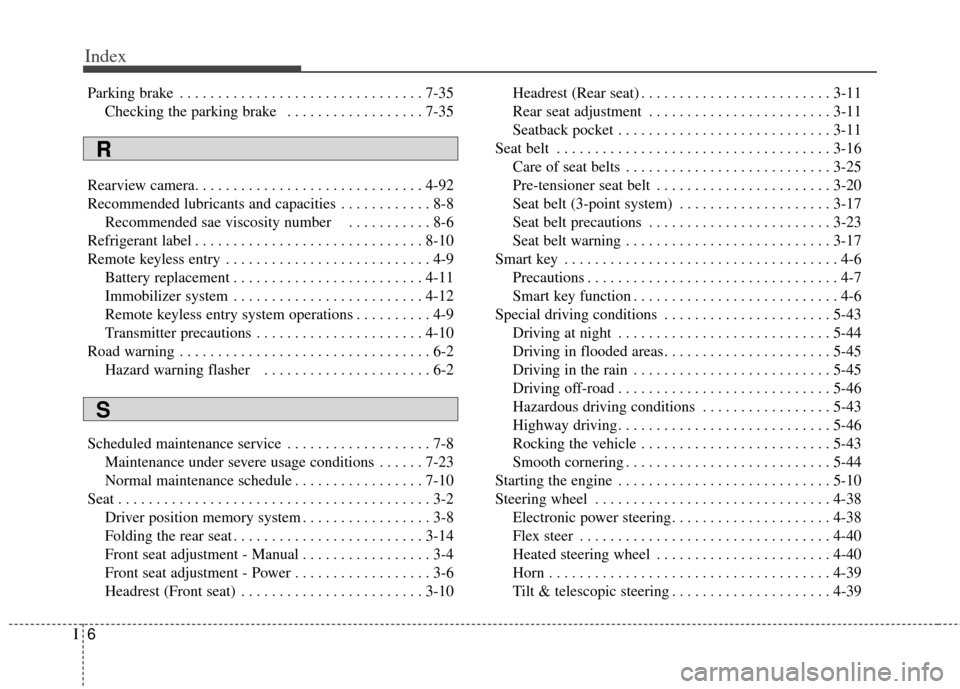
Parking brake . . . . . . . . . . . . . . . . . . . . . . . . . . . . . . . . 7-35Checking the parking brake . . . . . . . . . . . . . . . . . . 7-35
Rearview camera. . . . . . . . . . . . . . . . . . . . . . . . . . . . . . 4-92
Recommended lubricants and capacities . . . . . . . . . . . . 8-8 Recommended sae viscosity number . . . . . . . . . . . 8-6
Refrigerant label . . . . . . . . . . . . . . . . . . . . . . . . . . . . . . 8-10
Remote keyless entry . . . . . . . . . . . . . . . . . . . . . . . . . . . 4-9 Battery replacement . . . . . . . . . . . . . . . . . . . . . . . . . 4-11
Immobilizer system . . . . . . . . . . . . . . . . . . . . . . . . . 4-12
Remote keyless entry system operations . . . . . . . . . . 4-9
Transmitter precautions . . . . . . . . . . . . . . . . . . . . . . 4-10
Road warning . . . . . . . . . . . . . . . . . . . . . . . . . . . . . . . . . 6-2 Hazard warning flasher . . . . . . . . . . . . . . . . . . . . . . 6-2
Scheduled maintenance service . . . . . . . . . . . . . . . . . . . 7-8 Maintenance under severe usage conditions . . . . . . 7-23
Normal maintenance schedule . . . . . . . . . . . . . . . . . 7-10
Seat . . . . . . . . . . . . . . . . . . . . . . . . . . . . . . . . . . . . \
. . . . . 3-2 Driver position memory system . . . . . . . . . . . . . . . . . 3-8
Folding the rear seat . . . . . . . . . . . . . . . . . . . . . . . . . 3-14
Front seat adjustment - Manual . . . . . . . . . . . . . . . . . 3-4
Front seat adjustment - Power . . . . . . . . . . . . . . . . . . 3-6
Headrest (Front seat) . . . . . . . . . . . . . . . . . . . . . . . . 3-10 Headrest (Rear seat) . . . . . . . . . . . . . . . . . . . . . . . . . 3-11
Rear seat adjustment . . . . . . . . . . . . . . . . . . . . . . . . 3-11
Seatback pocket . . . . . . . . . . . . . . . . . . . . . . . . . . . . 3-11
Seat belt . . . . . . . . . . . . . . . . . . . . . . . . . . . . . . . . . . . . \
3-16 Care of seat belts . . . . . . . . . . . . . . . . . . . . . . . . . . . 3-25
Pre-tensioner seat belt . . . . . . . . . . . . . . . . . . . . . . . 3-20
Seat belt (3-point system) . . . . . . . . . . . . . . . . . . . . 3-17
Seat belt precautions . . . . . . . . . . . . . . . . . . . . . . . . 3-23
Seat belt warning . . . . . . . . . . . . . . . . . . . . . . . . . . . 3-17
Smart key . . . . . . . . . . . . . . . . . . . . . . . . . . . . . . . . . . . . \
4-6 Precautions . . . . . . . . . . . . . . . . . . . . . . . . . . . . . . . . . 4-7
Smart key function . . . . . . . . . . . . . . . . . . . . . . . . . . . 4-6
Special driving conditions . . . . . . . . . . . . . . . . . . . . . . 5-43 Driving at night . . . . . . . . . . . . . . . . . . . . . . . . . . . . 5-44
Driving in flooded areas. . . . . . . . . . . . . . . . . . . . . . 5-45
Driving in the rain . . . . . . . . . . . . . . . . . . . . . . . . . . 5-45
Driving off-road . . . . . . . . . . . . . . . . . . . . . . . . . . . . 5-46
Hazardous driving conditions . . . . . . . . . . . . . . . . . 5-43
Highway driving. . . . . . . . . . . . . . . . . . . . . . . . . . . . 5-46
Rocking the vehicle . . . . . . . . . . . . . . . . . . . . . . . . . 5-43
Smooth cornering . . . . . . . . . . . . . . . . . . . . . . . . . . . 5-44
Starting the engine . . . . . . . . . . . . . . . . . . . . . . . . . . . . 5-10
Steering wheel . . . . . . . . . . . . . . . . . . . . . . . . . . . . . . . 4-38 Electronic power steering. . . . . . . . . . . . . . . . . . . . . 4-38
Flex steer . . . . . . . . . . . . . . . . . . . . . . . . . . . . . . . . . 4-40
Heated steering wheel . . . . . . . . . . . . . . . . . . . . . . . 4-40
Horn . . . . . . . . . . . . . . . . . . . . . . . . . . . . . . . . . . . . \
. 4-39
Tilt & telescopic steering . . . . . . . . . . . . . . . . . . . . . 4-39
R
S