tires KIA FORTE 2018 User Guide
[x] Cancel search | Manufacturer: KIA, Model Year: 2018, Model line: FORTE, Model: KIA FORTE 2018Pages: 584, PDF Size: 15.14 MB
Page 438 of 584
What to do in an emergency
Road warning . . . . . . . . . . . . . . . . . . . . . . . . . . . . . . 6-2
• Hazard warning flasher . . . . . . . . . . . . . . . . . . . . . . . . 6-2
In case of an emergency while driving . . . . . . . . . . 6-3
• If the engine stalls at a crossroad or crossing. . . . . . . 6-3
• If you have a flat tire while driving . . . . . . . . . . . . . . . 6-3
• If engine stalls while driving . . . . . . . . . . . . . . . . . . . . 6-3
If the engine will not start . . . . . . . . . . . . . . . . . . . . 6-4
• If the engine doesn't turn over or turns over slowly. . 6-4
• If engine turns over normally but does not start . . . . 6-4
Emergency starting . . . . . . . . . . . . . . . . . . . . . . . . . 6-5
• Jump starting . . . . . . . . . . . . . . . . . . . . . . . . . . . . . . . . . 6-5
If the engine overheats . . . . . . . . . . . . . . . . . . . . . . . 6-6
If you have a flat tire (with tire mobility kit) . . . . 6-7
• Introduction . . . . . . . . . . . . . . . . . . . . . . . . . . . . . . . . . . 6-7
• Notes on the safe use of the Tire Mobility Kit . . . . . . 6-8
• Components of the Tire Mobility Kit . . . . . . . . . . . . . 6-9
• Using the Tire Mobility Kit . . . . . . . . . . . . . . . . . . . . 6-10
• Distributing the sealant . . . . . . . . . . . . . . . . . . . . . . . . 6-11
• Checking the tire inflation pressure . . . . . . . . . . . . . 6-11
• Technical Data . . . . . . . . . . . . . . . . . . . . . . . . . . . . . . . 6-12
If you have a flat tire . . . . . . . . . . . . . . . . . . . . . . . 6-13
• Jack and tools . . . . . . . . . . . . . . . . . . . . . . . . . . . . . . . 6-13
• Removing and storing the spare tire . . . . . . . . . . . . . 6-14
• Changing tires . . . . . . . . . . . . . . . . . . . . . . . . . . . . . . . 6-14
• Jack label . . . . . . . . . . . . . . . . . . . . . . . . . . . . . . . . . . . 6-\
21
Towing . . . . . . . . . . . . . . . . . . . . . . . . . . . . . . . . . . 6-22\
• Towing service . . . . . . . . . . . . . . . . . . . . . . . . . . . . . . . 6-22
• Removable towing hook (front) . . . . . . . . . . . . . . . . . 6-23
• Emergency towing . . . . . . . . . . . . . . . . . . . . . . . . . . . . 6-23
6
Page 444 of 584
67
What to do in an emergency
IF YOU HAVE A FLAT TIRE (WITH TIRE MOBILITY KIT, IF EQUIPPED)
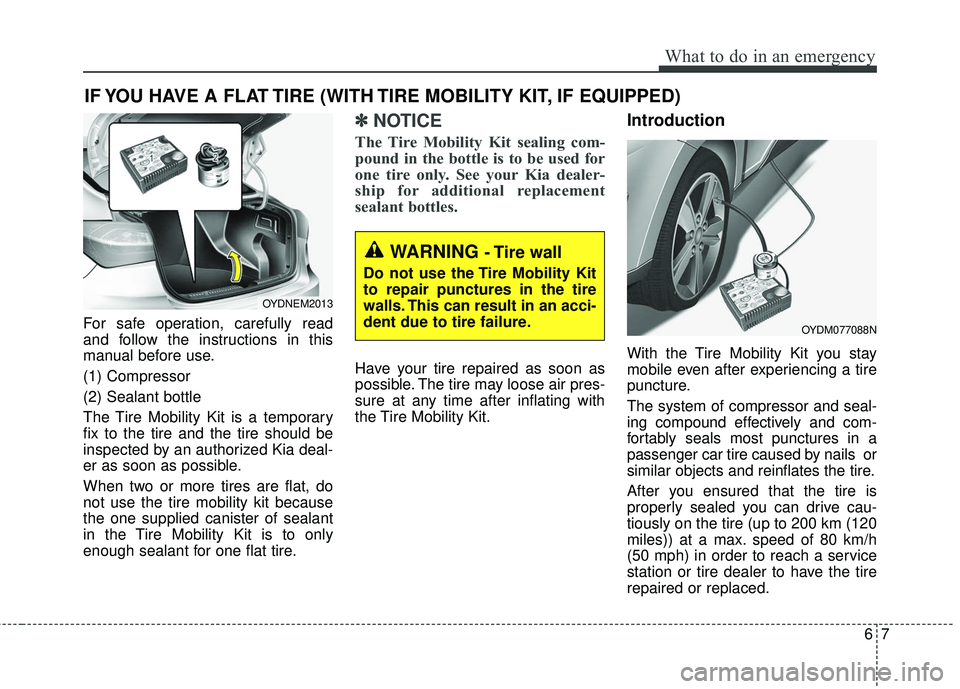
For safe operation, carefully read
and follow the instructions in this
manual before use.
(1) Compressor
(2) Sealant bottle
The Tire Mobility Kit is a temporary
fix to the tire and the tire should be
inspected by an authorized Kia deal-
er as soon as possible.
When two or more tires are flat, do
not use the tire mobility kit because
the one supplied canister of sealant
in the Tire Mobility Kit is to only
enough sealant for one flat tire.
✽ ✽NOTICE
The Tire Mobility Kit sealing com-
pound in the bottle is to be used for
one tire only. See your Kia dealer-
ship for additional replacement
sealant bottles.
Have your tire repaired as soon as
possible. The tire may loose air pres-
sure at any time after inflating with
the Tire Mobility Kit.
Introduction
With the Tire Mobility Kit you stay
mobile even after experiencing a tire
puncture.
The system of compressor and seal-
ing compound effectively and com-
fortably seals most punctures in a
passenger car tire caused by nails or
similar objects and reinflates the tire.
After you ensured that the tire is
properly sealed you can drive cau-
tiously on the tire (up to 200 km (120
miles)) at a max. speed of 80 km/h
(50 mph) in order to reach a service
station or tire dealer to have the tire
repaired or replaced.
OYDNEM2013
WARNING - Tire wall
Do not use the Tire Mobility Kit
to repair punctures in the tire
walls. This can result in an acci-
dent due to tire failure.
OYDM077088N
Page 445 of 584
What to do in an emergency
86
It is possible that some tires, espe-
cially with larger punctures or dam-
age to the sidewall, cannot be sealed
completely.
Air pressure loss in the tire may
adversely affect tire performance.
For this reason, you should avoid
abrupt steering or other driving
maneuvers, especially if the vehicle
is heavily loaded or if a trailer is in
use.
The Tire Mobility Kit is not designed
or intended as a permanent tire
repair method and is to be used for
one tire only.
This instruction shows you step by
step procedure to temporarily seal
the puncture.
Read the section "Notes on the safe
use of the Tire Mobility Kit".Notes on the safe use of the
Tire Mobility Kit
Park your car at the side of theroad so that you can work with the
Tire Mobility Kit away from moving
traffic.
To be sure your vehicle will not move, even when you're on fairly
level ground, always set your park-
ing brake.
Only use the Tire Mobility Kit for sealing/inflation passenger car
tires. Only punctured areas located
within the tread region of the tire
can be sealed using the tire mobil-
ity kit.
Do not use on motorcycles, bicy- cles or any other type of tires.
When the tire and wheel are dam- aged, do not use Tire Mobility Kit
for your safety.
Use of the Tire Mobility Kit may not be effective for tire damage larger
than approximately 6 mm (0.24 in).
Please contact the nearest Kia
dealership if the tire cannot be
made roadworthy with the Tire
Mobility Kit. Do not use the Tire Mobility Kit if a
tire is severely damaged by driving
run flat or with insufficient air pres-
sure.
Do not remove any foreign objects such as nails or screws that have
penetrated the tire.
Provided the car is outdoors, leave the engine running. Otherwise
operating the compressor may
eventually drain the car battery.
Never leave the Tire Mobility Kit unattended while it is being used.
Do not leave the compressor run- ning for more than 10 min. at a time
or it may overheat.
Do not use the Tire Mobility Kit if the ambient temperature is below -
30°C (-22°F).
Page 450 of 584
613
What to do in an emergency
IF YOU HAVE A FLAT TIRE (IF EQUIPPED)
Jack and tools
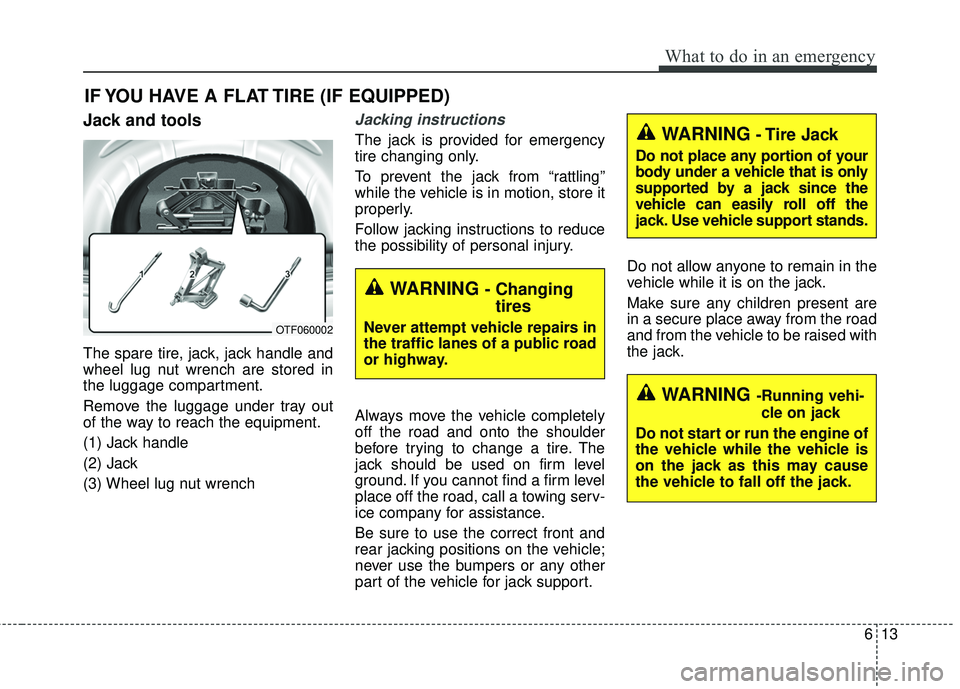
The spare tire, jack, jack handle and
wheel lug nut wrench are stored in
the luggage compartment.
Remove the luggage under tray out
of the way to reach the equipment.
(1) Jack handle
(2) Jack
(3) Wheel lug nut wrench
Jacking instructions
The jack is provided for emergency
tire changing only.
To prevent the jack from “rattling”
while the vehicle is in motion, store it
properly.
Follow jacking instructions to reduce
the possibility of personal injury.
Always move the vehicle completely
off the road and onto the shoulder
before trying to change a tire. The
jack should be used on firm level
ground. If you cannot find a firm level
place off the road, call a towing serv-
ice company for assistance.
Be sure to use the correct front and
rear jacking positions on the vehicle;
never use the bumpers or any other
part of the vehicle for jack support.Do not allow anyone to remain in the
vehicle while it is on the jack.
Make sure any children present are
in a secure place away from the road
and from the vehicle to be raised with
the jack.WARNING- Tire Jack
Do not place any portion of your
body under a vehicle that is only
supported by a jack since the
vehicle can easily roll off the
jack. Use vehicle support stands.
WARNING - Changing
tires
Never attempt vehicle repairs in
the traffic lanes of a public road
or highway.OTF060002
WARNING -Running vehi-
cle on jack
Do not start or run the engine of
the vehicle while the vehicle is
on the jack as this may cause
the vehicle to fall off the jack.
Page 451 of 584
What to do in an emergency
14
6
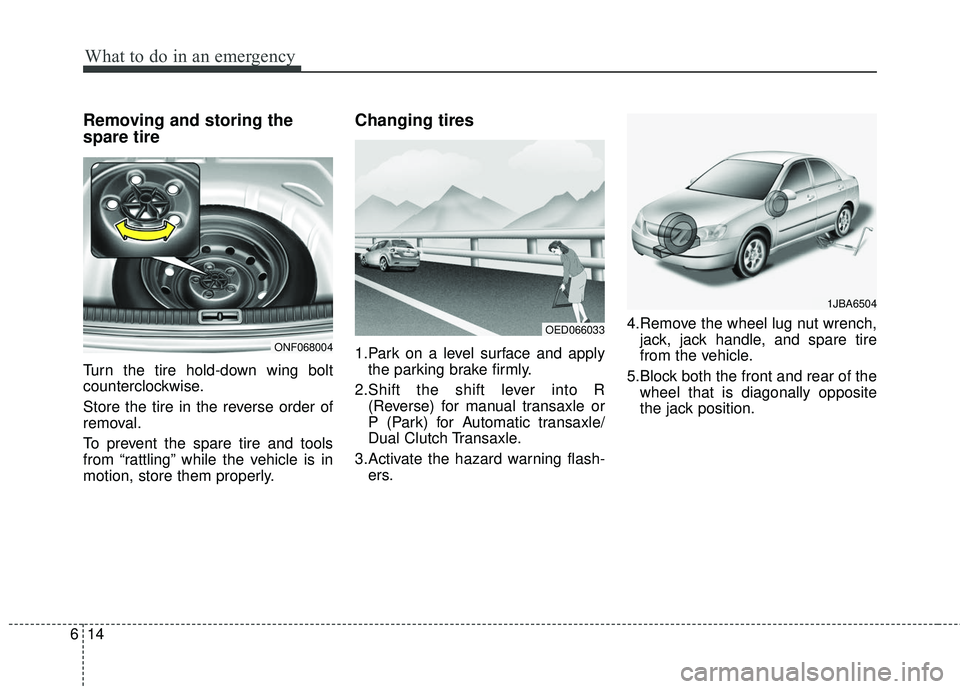
Removing and storing the
spare tire
Turn the tire hold-down wing bolt
counterclockwise.
Store the tire in the reverse order of
removal.
To prevent the spare tire and tools
from “rattling” while the vehicle is in
motion, store them properly.
Changing tires
1.Park on a level surface and apply
the parking brake firmly.
2.Shift the shift lever into R (Reverse) for manual transaxle or
P (Park) for Automatic transaxle/
Dual Clutch Transaxle.
3.Activate the hazard warning flash- ers. 4.Remove the wheel lug nut wrench,
jack, jack handle, and spare tire
from the vehicle.
5.Block both the front and rear of the wheel that is diagonally opposite
the jack position.
OED066033
ONF068004
1JBA6504
Page 455 of 584
What to do in an emergency
18
6
Note that most lug nuts do not have
metric threads. Be sure to use
extreme care in checking for thread
style before installing aftermarket lug
nuts or wheels. If in doubt, consult an
authorized Kia dealer. To prevent the jack, jack handle,
wheel lug nut wrench and spare tire
from rattling while the vehicle is in
motion, store them properly.
Check the inflation pressures as
soon as possible after installing the
spare tire. Adjust it to the specified
pressure, if necessary. Refer to
“Tires and wheels” in section 8.
Important - use of compact spare
tire (if equipped)
Your vehicle is equipped with a com-
pact spare tire. This compact spare
tire takes up less space than a regu-
lar-size tire. This tire is smaller than a
conventional tire and is designed for
temporary use only.
You should drive carefully when the
compact spare is in use. The com-
pact spare should be replaced by the
proper conventional tire and rim at
the first opportunity.
The operation of this vehicle is not
recommended with more than one
compact spare tire in use at the
same time.
CAUTION - Replacing lug nuts
Make certain during wheel
removal that the same nuts thatwere removed are reinstalled -or, if replaced, that nuts withmetric threads and the samechamfer configuration are used.Your vehicle has metric threadson the wheel studs and nuts.Installation of a non-metricthread nut on a metric stud willnot secure the wheel to the hubproperly and will damage thestud so that it must be replaced.
WARNING- Wheel studs
Do not drive your vehicle with
damaged wheel studs. If the
studs are damaged, they may
lose their ability to retain the
wheel. This could lead to the
loss of the wheel and a collision.
Page 457 of 584
What to do in an emergency
20
6
Do not use the compact spare tire
on any other vehicle because this
tire has been designed especially
for your vehicle.
The compact spare tire’s tread life is shorter than a regular tire.
Inspect your compact spare tire
regularly and replace worn com-
pact spare tires with the same size
and design, mounted on the same
wheel.
The compact spare tire should not be used on any other wheels, nor
should standard tires, snow tires,
wheel covers or trim rings be used
with the compact spare wheel. If
such use is attempted, damage to
these items or other car compo-
nents may occur.
Do not use more than one compact spare tire at a time.
Do not tow a trailer while the com- pact spare tire is installed.
Page 463 of 584
Maintenance
Engine compartment . . . . . . . . . . . . . . . . . . . . . . . . 7-3
Maintenance services . . . . . . . . . . . . . . . . . . . . . . . . 7-5
• Owner’s responsibility . . . . . . . . . . . . . . . . . . . . . . . . . 7-5
• Owner maintenance precautions . . . . . . . . . . . . . . . . . 7-6
Owner maintenance . . . . . . . . . . . . . . . . . . . . . . . . . 7-7
• Owner maintenance schedule . . . . . . . . . . . . . . . . . . . 7-7
Scheduled maintenance service. . . . . . . . . . . . . . . . 7-9
Explanation of scheduled maintenance items . . . 7-29
Checking fluid levels . . . . . . . . . . . . . . . . . . . . . . . 7-32
Engine oil. . . . . . . . . . . . . . . . . . . . . . . . . . . . . . . . . 7-33
• Checking the engine oil level . . . . . . . . . . . . . . . . . . . 7-33
• Changing the engine oil and filter . . . . . . . . . . . . . . . 7-34
Engine coolant . . . . . . . . . . . . . . . . . . . . . . . . . . . . 7-35
• Checking the coolant level . . . . . . . . . . . . . . . . . . . . . 7-35
• Changing the coolant . . . . . . . . . . . . . . . . . . . . . . . . . 7-37
Brake/clutch fluid . . . . . . . . . . . . . . . . . . . . . . . . . . 7-38
• Checking the brake/clutch* fluid level . . . . . . . . . . . 7-38
Washer fluid . . . . . . . . . . . . . . . . . . . . . . . . . . . . . . 7-39
• Checking the washer fluid level . . . . . . . . . . . . . . . . . 7-39
Parking brake . . . . . . . . . . . . . . . . . . . . . . . . . . . . . 7-39
• Checking the parking brake. . . . . . . . . . . . . . . . . . . . 7-39
Air cleaner. . . . . . . . . . . . . . . . . . . . . . . . . . . . . . . . 7-40
• Filter replacement . . . . . . . . . . . . . . . . . . . . . . . . . . . . 7-40
Climate control air filter . . . . . . . . . . . . . . . . . . . . 7-42
• Filter inspection . . . . . . . . . . . . . . . . . . . . . . . . . . . . . . 7-42
• Filter replacement . . . . . . . . . . . . . . . . . . . . . . . . . . . . 7-42
Wiper blades . . . . . . . . . . . . . . . . . . . . . . . . . . . . . . 7-44
• Blade inspection . . . . . . . . . . . . . . . . . . . . . . . . . . . . . . 7-44
• Blade replacement . . . . . . . . . . . . . . . . . . . . . . . . . . . . 7-44
Battery . . . . . . . . . . . . . . . . . . . . . . . . . . . . . . . . . . . 7-\
47
• For best battery service . . . . . . . . . . . . . . . . . . . . . . . 7-47
• Battery recharging . . . . . . . . . . . . . . . . . . . . . . . . . . 7-48
• Reset items . . . . . . . . . . . . . . . . . . . . . . . . . . . . . . . . . . 7-49\
Tires and wheels . . . . . . . . . . . . . . . . . . . . . . . . . . . 7-50
• Tire care . . . . . . . . . . . . . . . . . . . . . . . . . . . . . . . . . . . 7-\
50
• Recommended cold tire inflation pressures . . . . . . . 7-50
• Checking tire inflation pressure. . . . . . . . . . . . . . . . . 7-51
• Tire rotation . . . . . . . . . . . . . . . . . . . . . . . . . . . . . . . . 7-52
• Wheel alignment and tire balance . . . . . . . . . . . . . . . 7-53
• Tire replacement . . . . . . . . . . . . . . . . . . . . . . . . . . . . . 7-54
• Wheel replacement . . . . . . . . . . . . . . . . . . . . . . . . . . . 7-55
• Tire traction . . . . . . . . . . . . . . . . . . . . . . . . . . . . . . . . . 7-55
• Tire maintenance . . . . . . . . . . . . . . . . . . . . . . . . . . . . . 7-55
• Tire sidewall labeling . . . . . . . . . . . . . . . . . . . . . . . . . 7-55
• All season tires . . . . . . . . . . . . . . . . . . . . . . . . . . . . . . 7-61
• Summer tires . . . . . . . . . . . . . . . . . . . . . . . . . . . . . . . . 7-61
• Snow tires . . . . . . . . . . . . . . . . . . . . . . . . . . . . . . . . . . . 7-\
62
• Radial-ply tires . . . . . . . . . . . . . . . . . . . . . . . . . . . . . . 7-62
• Low aspect ratio tire . . . . . . . . . . . . . . . . . . . . . . . . . . 7-62
7
Page 469 of 584
77
Maintenance
OWNER MAINTENANCE
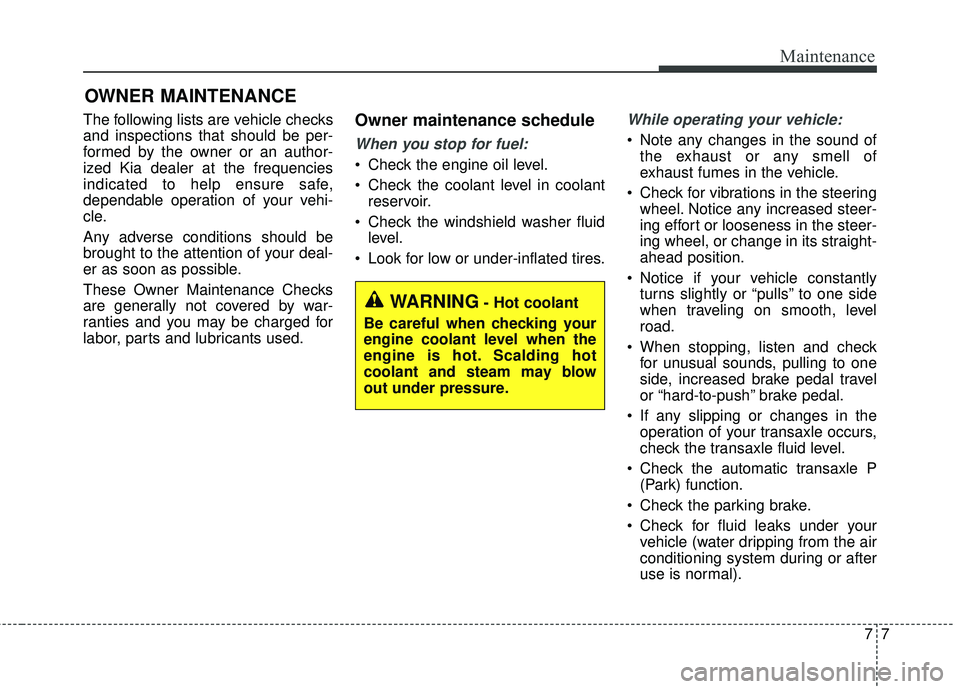
The following lists are vehicle checks
and inspections that should be per-
formed by the owner or an author-
ized Kia dealer at the frequencies
indicated to help ensure safe,
dependable operation of your vehi-
cle.
Any adverse conditions should be
brought to the attention of your deal-
er as soon as possible.
These Owner Maintenance Checks
are generally not covered by war-
ranties and you may be charged for
labor, parts and lubricants used.Owner maintenance schedule
When you stop for fuel:
Check the engine oil level.
Check the coolant level in coolantreservoir.
Check the windshield washer fluid level.
Look for low or under-inflated tires.
While operating your vehicle:
Note any changes in the sound of the exhaust or any smell of
exhaust fumes in the vehicle.
Check for vibrations in the steering wheel. Notice any increased steer-
ing effort or looseness in the steer-
ing wheel, or change in its straight-
ahead position.
Notice if your vehicle constantly turns slightly or “pulls” to one side
when traveling on smooth, level
road.
When stopping, listen and check for unusual sounds, pulling to one
side, increased brake pedal travel
or “hard-to-push” brake pedal.
If any slipping or changes in the operation of your transaxle occurs,
check the transaxle fluid level.
Check the automatic transaxle P (Park) function.
Check the parking brake.
Check for fluid leaks under your vehicle (water dripping from the air
conditioning system during or after
use is normal).
WARNING- Hot coolant
Be careful when checking your
engine coolant level when the
engine is hot. Scalding hot
coolant and steam may blow
out under pressure.
Page 470 of 584
Maintenance
87
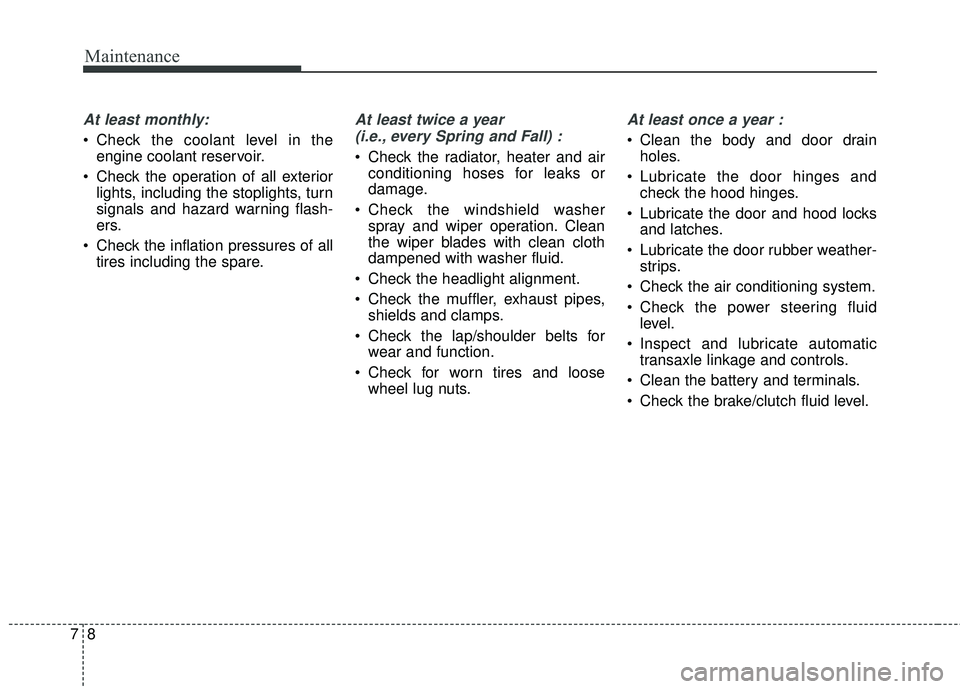
At least monthly:
Check the coolant level in theengine coolant reservoir.
Check the operation of all exterior lights, including the stoplights, turn
signals and hazard warning flash-
ers.
Check the inflation pressures of all tires including the spare.
At least twice a year
(i.e., every Spring and Fall) :
Check the radiator, heater and air conditioning hoses for leaks or
damage.
Check the windshield washer spray and wiper operation. Clean
the wiper blades with clean cloth
dampened with washer fluid.
Check the headlight alignment.
Check the muffler, exhaust pipes, shields and clamps.
Check the lap/shoulder belts for wear and function.
Check for worn tires and loose wheel lug nuts.
At least once a year :
Clean the body and door drainholes.
Lubricate the door hinges and check the hood hinges.
Lubricate the door and hood locks and latches.
Lubricate the door rubber weather- strips.
Check the air conditioning system.
Check the power steering fluid level.
Inspect and lubricate automatic transaxle linkage and controls.
Clean the battery and terminals.
Check the brake/clutch fluid level.