power steering KIA FORTE 2020 User Guide
[x] Cancel search | Manufacturer: KIA, Model Year: 2020, Model line: FORTE, Model: KIA FORTE 2020Pages: 568, PDF Size: 8.58 MB
Page 301 of 568

555
Driving your vehicle
✽ ✽NOTICE
• When operating the vehicle on a
dynamometer, ensure that the
ESC is turned off (ESC OFF light
illuminated). If the ESC is left on,
it may prevent the vehicle speed
from increasing, and result in false
diagnosis.
• Turning the ESC off does not affect ABS or brake system opera-
tion.
Vehicle stability management
(VSM)
This system provides further
enhancements to vehicle stability
and steering responses when a vehi-
cle is driving on a slippery road or a
vehicle detects changes in coeffi-
cient of friction between the right
wheels and left wheels when brak-
ing.
VSM operation
When the VSM is in operation, the
ESC indicator light ( ) blinks.
When the vehicle stability manage-
ment is operating properly, you can
feel a slight pulsation in the vehicle
and/or abnormal steering responses
(EPS- Electronic Power Steering).
This is only the effect of brake and
EPS control and indicates nothing
unusual.
The VSM does not operate when:
Driving on a sloping road such as a
gradient or incline
Driving in reverse
ESC OFF indicator light ( ) remains on the instrument cluster
EPS indicator light remains on the instrument cluster
WARNING- Tire/
Wheel size
When replacing tires and wheels,
make sure they are the same size
as the original tires and wheels
installed. Driving with varying
tire or wheel sizes may diminish
any supplemental safety benefits
of the VSM system.
Page 302 of 568

Driving your vehicle
56
5
VSM operation off
If you press the ESC OFF button to
turn off the ESC, the VSM will also
cancel and the ESC OFF indicator
light ( ) illuminates.
To turn on the VSM, press the button
again. The ESC OFF indicator light
will turn off.
Malfunction indicator
The VSM can be deactivated even if
you don’t cancel the VSM operation
by pressing the ESC OFF button. It
indicates that a malfunction has
been detected somewhere in the
Electric Power Steering system or
VSM system. If the ESC indicator
light ( ) or EPS warning light
remains on, take your vehicle to an
authorized Kia dealer and have the
system checked.
✽ ✽
NOTICE
• The VSM is designed to function
above approximately 22 km/h (13
mph) on curves.
• The VSM is designed to function above approximately 10 km/h (6
mph) when a vehicle is braking on
a split-mu surface. A split-mu sur-
face is made of two surfaces which
have different friction forces.
The Vehicle Stability Management
system is not a substitute for safe
driving practices but a supplemen-
tal function only. It is the responsi-
bility of the driver to always check
the speed and the distance to the
vehicle ahead. Always hold the
steering wheel firmly while driving.
Your vehicle is designed to activate according to the driver’s intention,
even with installed VSM. Always fol-
low all the normal precautions for
driving at safe speeds for the condi-
tions – including driving in inclement
weather and on a slippery road.
WARNING
- Vehicle stability management
Drive carefully even though your
vehicle has Vehicle stability man-
agement. It can only assist you in
maintaining control under cer-
tain circumstances.
WARNING
For maximum protection, always
wear your seat belt. No system,
no matter how advanced, can
compensate for all driver error
and/or driving conditions.
Always drive responsibly.
Page 308 of 568

Driving your vehicle
62
5
Collision Warning! (1st warning)
This warning message appears on
the LCD display with a warning
chime.
Additionally, the engine management
system intervenes to help decelerate
the vehicle.
- Your vehicle speed may decelerate
moderately.
- The FCA system limitedly controls the brakes to preemptively mitigate
impact from a collision.
Emergency braking! (2nd warning)
This warning message appears on
the LCD display with a warning
chime.
Additionally, the engine management
system intervenes to help decelerate
the vehicle.
- The FCA system limitedly controlsthe brakes to preemptively mitigate
impact from a collision. The brake
control is maximized just before a
collision.
Brake operation
In an emergency situation, the braking system enters in ready sta-
tus for prompt reaction upon the
driver depressing the brake pedal.
The FCA system provides addi- tional braking power for optimum
braking performance when the
driver depresses the brake pedal.
The braking control is automatical- ly deactivated when the driver
sharply depresses the accelerator
pedal or when the driver abruptly
operates the steering wheel.
The braking control is automatical- ly cancelled when risk factors dis-
appear.
OBDM058065NOBDM058066N
CAUTION
The driver should always exer-cise great caution during vehi-cle operation, even though thereis no warning message or warn-ing alarm.
Page 321 of 568
575
Driving your vehicle
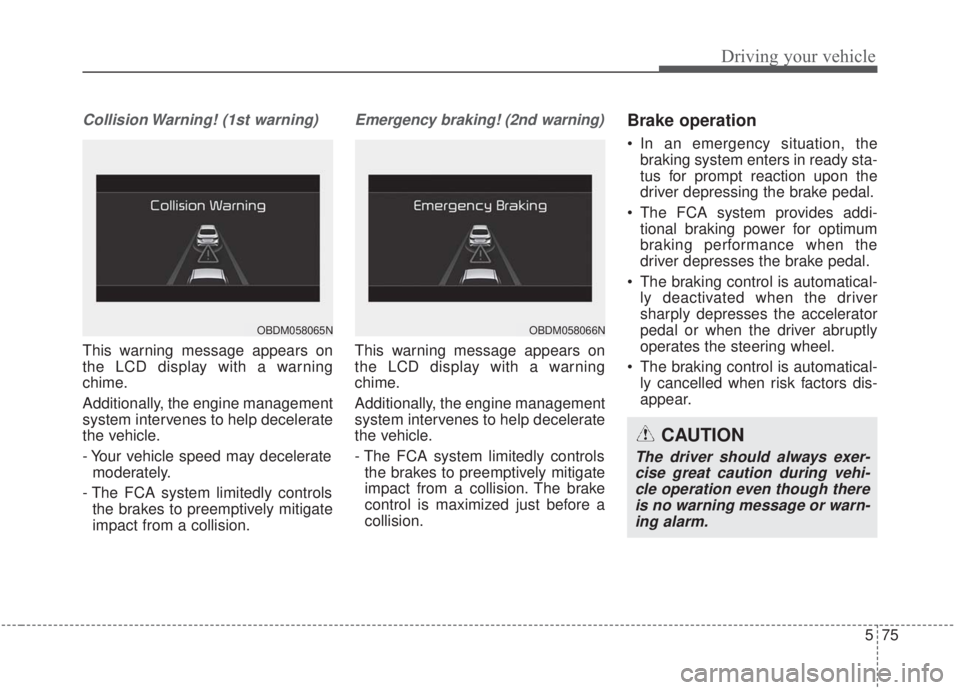
Collision Warning! (1st warning)
This warning message appears on
the LCD display with a warning
chime.
Additionally, the engine management
system intervenes to help decelerate
the vehicle.
- Your vehicle speed may deceleratemoderately.
- The FCA system limitedly controls the brakes to preemptively mitigate
impact from a collision.
Emergency braking! (2nd warning)
This warning message appears on
the LCD display with a warning
chime.
Additionally, the engine management
system intervenes to help decelerate
the vehicle.
- The FCA system limitedly controlsthe brakes to preemptively mitigate
impact from a collision. The brake
control is maximized just before a
collision.
Brake operation
In an emergency situation, the braking system enters in ready sta-
tus for prompt reaction upon the
driver depressing the brake pedal.
The FCA system provides addi- tional braking power for optimum
braking performance when the
driver depresses the brake pedal.
The braking control is automatical- ly deactivated when the driver
sharply depresses the accelerator
pedal or when the driver abruptly
operates the steering wheel.
The braking control is automatical- ly cancelled when risk factors dis-
appear.
OBDM058065NOBDM058066N
CAUTION
The driver should always exer-cise great caution during vehi-cle operation even though thereis no warning message or warn-ing alarm.
Page 386 of 568
Driving your vehicle
140
5
Remember, your vehicle does not
require extended warm-up. After
the engine has started, allow the
engine to run for 10 to 20 seconds
prior to placing the vehicle in gear.
In very cold weather, however, give
your engine a slightly longer warm-
up period.
Don't "lug" or "over-rev" the engine. Lugging is driving too slowly in a
very high gear resulting in engine
bucking. If this happens, shift to a
lower gear. Over-revving is racing
the engine beyond its safe limit.
This can be avoided by shifting at
the recommended speed. Use your air conditioning sparingly.
The air conditioning system is
operated by engine power so your
fuel economy is reduced when you
use it.
Open windows at high speeds can reduce fuel economy.
Fuel economy decreases in cross- winds and headwinds. To help off-
set some of this loss, slow down
when driving in these conditions.
Keeping a vehicle in good operating
condition is important both for econ-
omy and safety. Therefore, have an
authorized Kia dealer perform
scheduled inspections and mainte-
nance.
WARNING - Engine off
during motion
Never turn the engine off to
coast down hills or anytime the
vehicle is in motion. The power
steering and power brakes will
not function properly without
the engine running. In addition,
turning off the ignition while
driving could engage the steer-
ing wheel lock resulting in loss
of vehicle steering. Keep the
engine on and downshift to an
appropriate gear for an engine
braking effect.
Page 434 of 568
635
What to do in an emergency
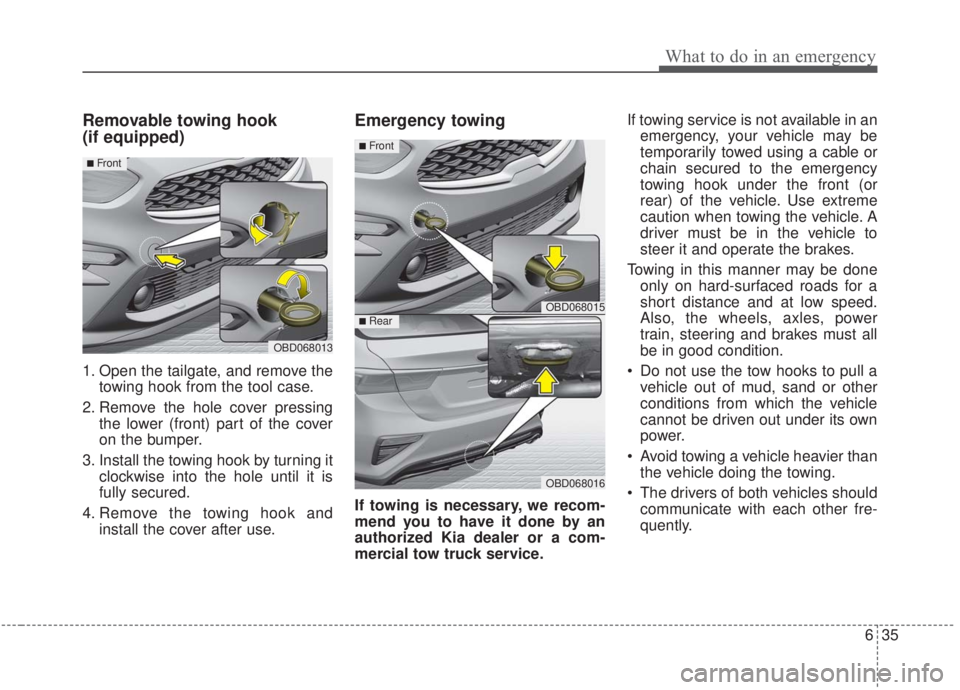
Removable towing hook
(if equipped)
1. Open the tailgate, and remove thetowing hook from the tool case.
2. Remove the hole cover pressing the lower (front) part of the cover
on the bumper.
3. Install the towing hook by turning it clockwise into the hole until it is
fully secured.
4. Remove the towing hook and install the cover after use.
Emergency towing
If towing is necessary, we recom-
mend you to have it done by an
authorized Kia dealer or a com-
mercial tow truck service. If towing service is not available in an
emergency, your vehicle may be
temporarily towed using a cable or
chain secured to the emergency
towing hook under the front (or
rear) of the vehicle. Use extreme
caution when towing the vehicle. A
driver must be in the vehicle to
steer it and operate the brakes.
Towing in this manner may be done only on hard-surfaced roads for a
short distance and at low speed.
Also, the wheels, axles, power
train, steering and brakes must all
be in good condition.
Do not use the tow hooks to pull a vehicle out of mud, sand or other
conditions from which the vehicle
cannot be driven out under its own
power.
Avoid towing a vehicle heavier than the vehicle doing the towing.
The drivers of both vehicles should communicate with each other fre-
quently.
OBD068013
■ Front
OBD068015
OBD068016
■ Front
■ Rear
Page 436 of 568
637
What to do in an emergency
The driver must be in the vehicle forsteering and braking operations
when the vehicle is towed and pas-
sengers other than the driver must
not be allowed to be on board.Emergency towing precautions
Turn the ignition switch to ACC sothe steering wheel isn’t locked.
Place the transmission shift lever in N (Neutral).
Release the parking bake.
Press the brake pedal with more force than normal since you will
have reduced brake performance.
More steering effort will be required because the power steer-
ing system will be disabled.
If you are driving down a long hill, the brakes may overheat and brake
performance will be reduced. Stop
often and let the brakes cool off.
The vehicle should be towed at a speed of 25km/h (16 mph) or less
within a distance of 20km (12.4
miles).
If the car is being towed with all four wheels on the ground, it can
be towed only from the front. Be
sure that the transmission is in
neutral. Be sure the steering is
unlocked by placing the ignition
switch in the ACC position. A driver
must be in the towed vehicle to
operate the steering and brakes.CAUTION
- Dual clutch transmission
If the car is being towed with all four wheels on the ground, itcan be towed only from thefront. Be sure that the transmis-sion is in neutral. Be sure thesteering is unlocked by placingthe ignition switch in the ACCposition. A driver must be inthe towed vehicle to operatethe steering and brakes.
To avoid serious damage to the dual clutch transmission,limit the vehicle speed to 15km/h (10 mph) and drive lessthan 1.5 km (1 mile) when tow-ing.
Before towing, check the dual clutch transmission for fluidleaks under your vehicle. If thedual clutch transmission fluidis leaking, flatbed equipmentor a towing dolly must beused.
Page 506 of 568

769
Maintenance
Fuse NameFuse ratingCircuit Protected
MODULE 510ACrash Pad Switch, Head Lamp Left Handle side/Right Handle side, Auto Transmission Shift Lever Indicator,
Electro Chromic Mirror, Audio/Video & Navigation Head Unit, Air Conditioner Control Module, Rear Seat
Warmer Control Module, Front Seat Warmer Control Module, Front Air Ventilation Seat Control Module
DOOR LOCK20ADoor Lock/Unlock Relay, ICM (Integrated Circuit Module) Relay Box (Two Turn Unlock Relay), Driver IMS
(Intergrated memory system) Module
IBU 115AIBU (Integrated Body Control Unit)
BRAKE SWITCH10AIBU (Integrated Body Control Unit), Stop Lamp Switch
IG125AEngine Room Junction Block (Fuse - ABS 3, ECU 5, SENSOR 4, TCU 2)
WIPER (LO/HI)10AEngine Room Junction Block (Front Wiper (Low) Relay), Front Wiper Motor, ECM (Engine Control
Module)/PCM (Power train Control Module), IBU (Integrated Body Control Unit)
AIR CONDITIONER17.5AEngine Room Junction Block (Blower, PTC Heater), Air Conditioner Control Module
AIR BAG 210ASRS (Supplemental Restraint System) Control Module
WASHER15AMultifunction Switch
MDPS7.5AMDPS (Motor Driven Power Steering) Unit
MODULE 77.5ARear Seat Warmer Control Module, Front Seat Warmer Control Module, Front Air Ventilation Seat Control
Module
SUNROOF 115ASunroof Motor, ESG_Unit
Page 509 of 568

Maintenance
72
7
Engine room compartment fuse panel
Fuse Name Fuse ratingCircuit Protected
MULTI
FUSE-1ALTERNATOR
200A
(NU 2.0L AKS) 150A
(GAMMA 1.6L T-GDI)
Fuse : BURGLAR ALARM, ABS1, ABS2, POWER OUTLET1, Alternator
MDPS80AMDPS (Motor Driven Power Steering) Unit
MULTI
FUSE-2
B+560AFuse : ECU 3, ECU 4, HORN, WIPER, A/C, Engine Control Relay
B+260AInstrument Panel Junction Block
B+360AInstrument Panel Junction Block
B+450AInstrument Panel Junction Block (Fuse : POWER WINDOW LH, POWER WINDOW RH,
TRUNK, SUNROOF 1, SEAT HEATER FRONT, AMP, POWER SEAT DRIVER)
COOLING FAN 160A[GAMMA 1.6L T-GDI] Cooling Fan 1 Relay
REAR HEATED40ARear Heated Relay
BLOWER40ABLOWER Relay
IG140AIgnition Switch, PDM #2 (ACC) Relay, PDM #3 (IG1) Relay
IG240AIgnition Switch, PDM #4 (IG2) Relay, START Relay
MULTI
FUSE-3PTC HEATER50APTC Heater Relay
Page 566 of 568

I9
Index
Smart key ........................................................................\
4-6Smart key functions ......................................................4-6
Smart key precautions ..................................................4-8
Smart trunk ....................................................................4-26\
Special driving conditions ..........................................5-141 Driving at night ........................................................5-142
Driving in flooded areas ..........................................5-144
Driving in the rain ....................................................5-143
Driving off-road ........................................................5-144
Hazardous driving conditions ..................................5-141
Highway driving ......................................................5-144
Rocking the vehicle ..................................................5-141
Smooth cornering ......................................................5-142
Steering wheel ..............................................................4-47 Electric Power Steering (EPS) ....................................4-47
Heated steering wheel ................................................4-49
Horn ........................................................................\
....4-49
Tilt and telescopic steering ........................................4-48
Storage compartments ................................................4-142 Center console storage ..............................................4-142
Glove box ..................................................................4-142
Sunglass holder ........................................................4-143
Sunroof ........................................................................\
..4-41 Resetting the sunroof ..................................................4-45
Sliding the sunroof ......................................................4-43
Sunroof open warning ................................................4-42
Sunshade ....................................................................4-45\
Tilting the sunroof ......................................................4-44 Theft-alarm system ........................................................4-16
Armed stage ................................................................4-16
Disarmed stage ............................................................4-18
Theft-alarm stage ........................................................4-17
Tire Pressure Monitoring System (TPMS) ......................6-8 Changing a tire with TPMS ........................................6-12
Check tire pressure.....................................................\
...6-8
Low tire pressure position telltale ..............................6-10
Low tire pressure telltale ............................................6-10
Tire specification and pressure label ............................8-11
Tires and wheels ....................................................7-46, 8-5 All season tires ............................................................7-58
Checking tire inflation pressure ..................................7-47
Low aspect ratio tire ..................................................7-60
Radial-ply tires ............................................................7-59
Recommended cold tire inflation pressures................7-46
Snow tires....................................................................7-58\
Summer tires ..............................................................7-58
Tire care ......................................................................7-\
46
Tire maintenance ........................................................7-51
Tire pressure................................................................7-47
Tire replacement ........................................................7-50
Tire rotation ................................................................7-48
Tire sidewall labeling ..................................................7-51
Tire traction ................................................................7-51T