weight KIA FORTE 2020 Owner's Manual
[x] Cancel search | Manufacturer: KIA, Model Year: 2020, Model line: FORTE, Model: KIA FORTE 2020Pages: 568, PDF Size: 8.58 MB
Page 486 of 568
749
Maintenance
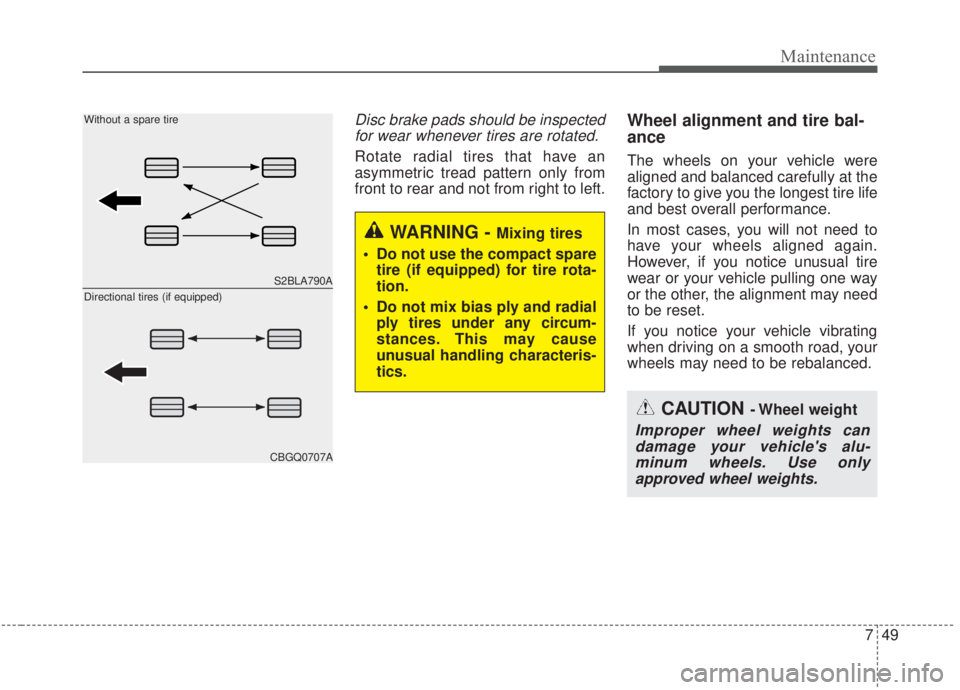
Disc brake pads should be inspectedfor wear whenever tires are rotated.
Rotate radial tires that have an
asymmetric tread pattern only from
front to rear and not from right to left.
Wheel alignment and tire bal-
ance
The wheels on your vehicle were
aligned and balanced carefully at the
factory to give you the longest tire life
and best overall performance.
In most cases, you will not need to
have your wheels aligned again.
However, if you notice unusual tire
wear or your vehicle pulling one way
or the other, the alignment may need
to be reset.
If you notice your vehicle vibrating
when driving on a smooth road, your
wheels may need to be rebalanced.
WARNING - Mixing tires
Do not use the compact spare tire (if equipped) for tire rota-
tion.
Do not mix bias ply and radial ply tires under any circum-
stances. This may cause
unusual handling characteris-
tics.
CAUTION - Wheel weight
Improper wheel weights candamage your vehicle's alu-minum wheels. Use onlyapproved wheel weights.
S2BLA790A
CBGQ0707A
Without a spare tire
Directional tires (if equipped)
Page 492 of 568

755
Maintenance
Temperature -A, B & C
The temperature grades are A (the
highest), B and C, and represent the
tire's resistance to the generation of
heat and its ability to dissipate heat
when tested under controlled condi-
tions on a specified indoor laboratory
test wheel.
Sustained high temperature can
cause the material of the tire to
degenerate and reduce tire life, and
excessive temperature can lead to
sudden tire failure. Grades B and A
represent higher levels of perform-
ance on the laboratory test wheel
than the minimum required by law.Tire terminology and definitions
Air Pressure:
The amount of air
inside the tire pressing outward on
the tire. Air pressure is expressed in
kilopascal (kPa) or pounds per
square inch (psi).
Accessory Weight: This means the
combined weight of optional acces-
sories. Some examples of optional
accessories are, intelligent variable
transmission, power seats, and air
conditioning.
Aspect Ratio: The relationship of a
tire's height to its width.
Belt: A rubber coated layer of cords
that is located between the plies and
the tread. Cords may be made from
steel or other reinforcing materials.
Bead: The tire bead contains steel
wires wrapped by steel cords that
hold the tire onto the rim.
Bias Ply Tire: A pneumatic tire in
which the plies are laid at alternate
angles less than 90 degrees to the
centerline of the tread. Cold Tire Pressure:
The amount of
air pressure in a tire, measured in
kilopascals (kPa) or pounds per
square inch (psi), before a tire has
built up heat from driving.
Curb Weight: This means the weight
of a motor vehicle with standard and
optional equipment, including the
maximum capacity of fuel, oil and
coolant, but without passengers and
cargo.
DOT Markings: The DOT code
includes the Tire Identification
Number (TIN), an alphanumeric des-
ignator which can also identify the
tire manufacturer, production plant,
brand and date of production.
Page 493 of 568
Maintenance
56
7
GVWR: Gross Vehicle Weight Rating
GAWR FRT: Gross Axle Weight
Rating for the Front Axle.
GAWR RR: Gross Axle Weight
Rating for the Rear axle.
Intended Outboard Sidewall: The
side of an asymmetrical tire, that
must always face outward when
mounted on a vehicle.
Kilopascal (kPa): The metric unit for
air pressure.
Light truck(LT) tire: A tire designat-
ed by its manufacturer as primarily
intended for use on lightweight trucks
or multipurpose passenger vehicles.
Load Index: An assigned number
ranging from 1 to 279 that corre-
sponds to the load carrying capacity
of a tire.
Load ratings: The maximum load
that a tire is rated to carry for a given
inflation pressure. Maximum Inflation Pressure:
The
maximum air pressure to which a
cold tire may be inflated. The maxi-
mum air pressure is molded onto the
sidewall.
Maximum Load Rating: The load
rating for a tire at the maximum per-
missible inflation pressure for that
tire.
Maximum Loaded Vehicle Weight:
The sum of curb weight; accessory
weight; vehicle capacity weight; and
production options weight.
Normal Occupant Weight: The
number of occupants a vehicle is
designed to seat multiplied by 68kg
(150 lbs.). Occupant Distribution:
Designated
seating positions.
Outward Facing Sidewall: The side
of a asymmetrical tire that has a par-
ticular side that faces outward when
mounted on a vehicle. The outward
facing sidewall bears white lettering
or bears manufacturer, brand, and/or
model name molding that is higher or
deeper than the same moldings on
the inner facing sidewall.
Passenger (P-Metric) Tire: A tire
used on passenger cars and some
light duty trucks and multipurpose
vehicles.
Ply: A layer of rubber-coated parallel
cords
Pneumatic tire: A mechanical
device made of rubber, chemicals,
fabric and steel or other materials,
that, when mounted on an automo-
tive wheel, provides the traction and
contains the gas or fluid that sustains
the load.
Page 494 of 568
757
Maintenance
Production options weight:The
combined weight of installed regular
production options weighing over 5
lb.(2.3 kg) in excess of the standard
items which they replace, not previ-
ously considered in curb weight or
accessory weight, including heavy
duty brakes, ride levelers, roof rack,
heavy duty battery, and special trim.
Recommended Inflation Pressure:
Vehicle manufacturer's recommend-
ed tire inflation pressure and shown
on the tire placard.
Radial Ply Tire: A pneumatic tire in
which the ply cords that extend to the
beads are laid at 90 degrees to the
centerline of the tread.
Rim: A metal support for a tire and
upon which the tire beads are seat-
ed.
Sidewall: The portion of a tire
between the tread and the bead. Speed Rating:
An alphanumeric
code assigned to a tire indicating the
maximum speed at which a tire can
operate.
Traction: The friction between the
tire and the road surface. The
amount of grip provided.
Tread: The portion of a tire that
comes into contact with the road.
Treadwear Indicators: Narrow
bands, sometimes called "wear
bars," that show across the tread of a
tire when only 1.6 mm (1/16 inch) of
tread remains.
UTQGS: Uniform Tire Quality
Grading Standards, a tire information
system that provides consumers with
ratings for a tire's traction, tempera-
ture and treadwear. Ratings are
determined by tire manufacturers
using government testing proce-
dures. The ratings are molded into
the sidewall of the tire.
Vehicle Capacity Weight: The num-
ber of designated seating positions
multiplied by 68kg (150 lbs.) plus the
rated cargo and luggage load. Vehicle Maximum Load on the
Tire:
Load on an individual tire due
to curb and accessory weight plus
maximum occupant and cargo
weight.
Vehicle Normal Load on the Tire:
Load on an individual tire that is
determined by distributing to each
axle its share of the curb weight,
accessory weight, and normal occu-
pant weight and driving by 2.
Vehicle Placard: A label permanent-
ly attached to a vehicle showing the
original equipment tire size and rec-
ommended inflation pressure.
Page 546 of 568

Specifications & Consumer information
Dimensions . . . . . . . . . . . . . . . . . . . . . . . . . . . . . . . . 8-2
Engine . . . . . . . . . . . . . . . . . . . . . . . . . . . . . . . . . . . . \
8-3
Bulb wattage . . . . . . . . . . . . . . . . . . . . . . . . . . . . . . . 8-4
Tires and wheels . . . . . . . . . . . . . . . . . . . . . . . . . . . . 8-5
Gross vehicle weight. . . . . . . . . . . . . . . . . . . . . . . . . 8-7
Luggage volume . . . . . . . . . . . . . . . . . . . . . . . . . . . . 8-7
Air conditioning system . . . . . . . . . . . . . . . . . . . . . . 8-7
Recommended lubricants and capacities . . . . . . . . 8-8
• Recommended SAE viscosity number. . . . . . . . . . . . 8-10
Vehicle identification number (VIN) . . . . . . . . . . 8-11
Vehicle certification label. . . . . . . . . . . . . . . . . . . . 8-11
Tire specification and pressure label . . . . . . . . . . 8-11
Engine number . . . . . . . . . . . . . . . . . . . . . . . . . . . . 8-12
8
Page 552 of 568
87
Specifications & Consumer information
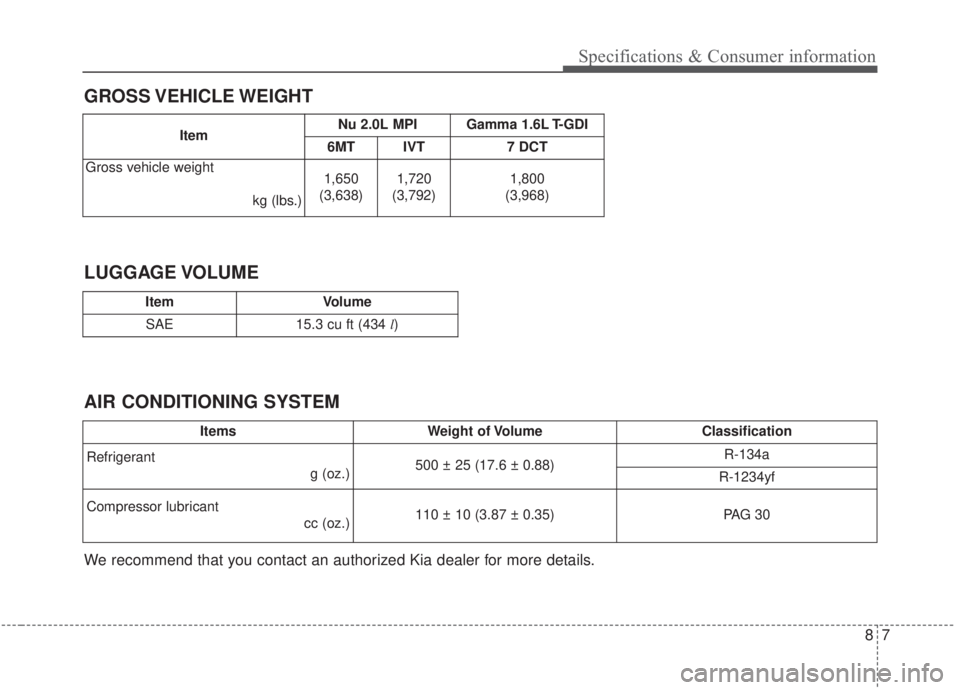
GROSS VEHICLE WEIGHT
AIR CONDITIONING SYSTEM LUGGAGE VOLUME
We recommend that you contact an authorized Kia dealer for more details.
ItemVolume
SAE15.3 cu ft (434 l)
ItemsWeight of VolumeClassification
Refrigerant g (oz.) 500 ± 25 (17.6 ± 0.88)R-134a
R-1234yf
Compressor lubricantcc (oz.) 110 ± 10 (3.87 ± 0.35)PAG 30
ItemNu 2.0L MPI Gamma 1.6L T-GDI
6MT IVT 7 DCT
Gross vehicle weight
kg (lbs.)
1,650
(3,638)1,720
(3,792)1,800
(3,968)
Page 562 of 568

I5
Index
Gross vehicle weight........................................................8-7\
Hood ........................................................................\
......4-35Closing the hood ........................................................4-36
Hood open warning ....................................................4-36
Opening the hood ........................................................4-35
How to use this manual ..................................................1-2
If the engine overheats ....................................................6-7
If the engine will not start ..............................................6-4 If engine doesn't turn over or turns over slowly ..........6-4
If engine turns over normally but does not start ..........6-4
If you have a flat tire ....................................................6-14 Changing tires ............................................................6-15
Jack and tools ..............................................................6-14
Removing and storing the spare tire ..........................6-15
If you have a flat tire (With Tire Mobility Kit) ............6-23 Checking the tire inflation pressure ............................6-31
Components of the Tire Mobility Kit (TMK) ............6-26
Components of the Tire Mobility Kit (TMK) ............6-27
Distributing the sealant ..............................................6-31
Introduction ................................................................6-24 Notes on the safe use of the Tire Mobility Kit ..........6-25
Technical data ............................................................6-32
Using the Tire Mobility Kit ........................................6-28
Important safety precautions ..........................................3-2 Air bag hazards ............................................................3-2
Always wear your seat belt ..........................................3-2
Control your speed ........................................................3-3
Driver distraction ..........................................................3-2
Keep your vehicle in safe condition ............................3-3
Restrain all children ......................................................3-2
In case of an emergency while driving ............................6-3 If the engine stalls at a crossroad or crossing ..............6-3
If the engine stalls while driving ..................................6-3
If you have a flat tire while driving ..............................6-3
Instrument cluster ..........................................................4-56 Gauges ........................................................................\
4-58
Instrument cluster control ..........................................4-57
LCD window control ..................................................4-57
Transmission shift indicator........................................4-61
Instrument panel overview ..............................................2-5
Intelligent Variable Transmission (IVT) ........................5-35 Good driving practices ................................................5-41
Intelligent Variable Transmission (IVT) operation ....5-35
Shift lock system ........................................................5-40
Interior features............................................................4-144 Air ventilation seat ....................................................4-146
Clothes hanger ..........................................................4-153
Cup holder ................................................................4-144
G
H
I
Page 567 of 568
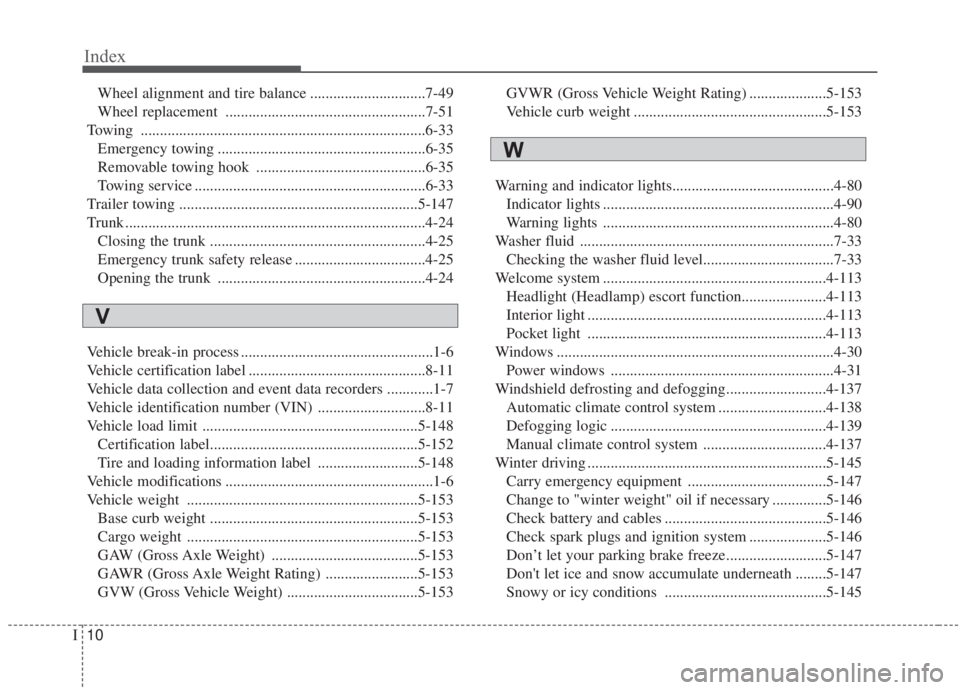
Index
10I
Wheel alignment and tire balance ..............................7-49
Wheel replacement ....................................................7-51
Towing ........................................................................\
..6-33 Emergency towing ......................................................6-35
Removable towing hook ............................................6-35
Towing service ............................................................6-33
Trailer towing ..............................................................5-147
Trunk ........................................................................\
......4-24 Closing the trunk ........................................................4-25
Emergency trunk safety release ..................................4-25
Opening the trunk ......................................................4-24
Vehicle break-in process ..................................................1-6
Vehicle certification label ..............................................8-11
Vehicle data collection and event data recorders ............1-7
Vehicle identification number (VIN) ............................8-11
Vehicle load limit ........................................................5-148 Certification label......................................................5-152
Tire and loading information label ..........................5-148
Vehicle modifications ......................................................1-6
Vehicle weight ............................................................5-153 Base curb weight ......................................................5-153
Cargo weight ............................................................5-153
GAW (Gross Axle Weight) ......................................5-153
GAWR (Gross Axle Weight Rating) ........................5-153
GVW (Gross Vehicle Weight) ..................................5-153 GVWR (Gross Vehicle Weight Rating) ....................5-153
Vehicle curb weight ..................................................5-153
Warning and indicator lights..........................................4-80 Indicator lights ............................................................4-90
Warning lights ............................................................4-80
Washer fluid ..................................................................7-33 Checking the washer fluid level..................................7-33
Welcome system ..........................................................4-113 Headlight (Headlamp) escort function......................4-113
Interior light ..............................................................4-113
Pocket light ..............................................................4-113
Windows ........................................................................\
4-30 Power windows ..........................................................4-31
Windshield defrosting and defogging..........................4-137 Automatic climate control system ............................4-138
Defogging logic ........................................................4-139
Manual climate control system ................................4-137
Winter driving ..............................................................5-145 Carry emergency equipment ....................................5-147
Change to "winter weight" oil if necessary ..............5-146
Check battery and cables ..........................................5-146
Check spark plugs and ignition system ....................5-146
Don’t let your parking brake freeze..........................5-147
Don't let ice and snow accumulate underneath ........5-147
Snowy or icy conditions ..........................................5-145
V
W