engine KIA K900 2016 Owners Manual
[x] Cancel search | Manufacturer: KIA, Model Year: 2016, Model line: K900, Model: KIA K900 2016Pages: 542, PDF Size: 38.35 MB
Page 364 of 542
Driving your vehicle
5
5-101
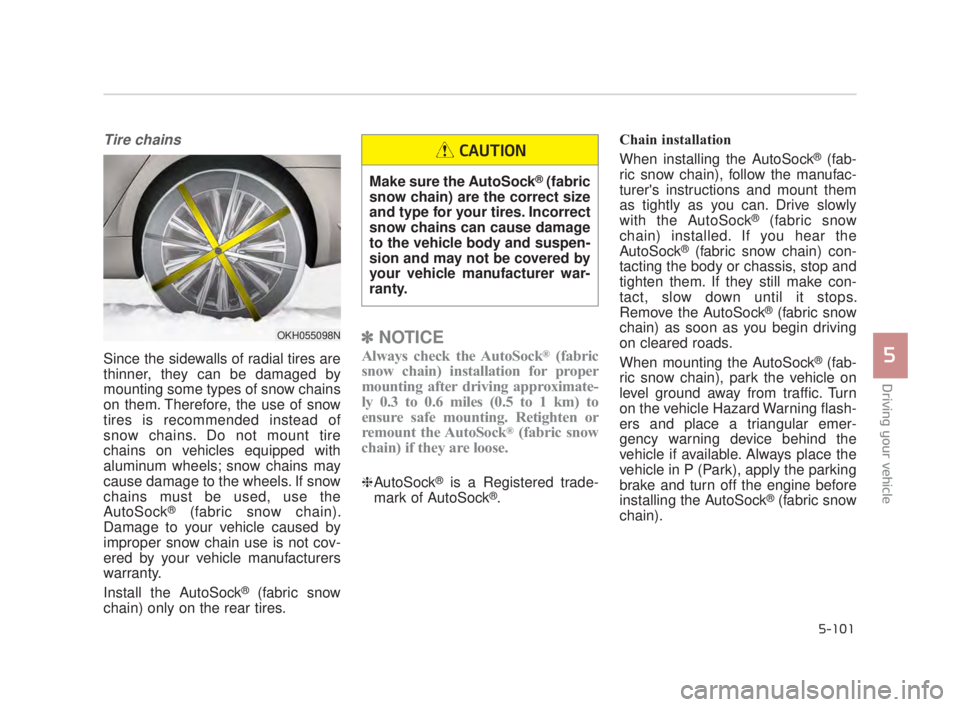
Tire chains
Since the sidewalls of radial tires are
thinner, they can be damaged by
mounting some types of snow chains
on them. Therefore, the use of snow
tires is recommended instead of
snow chains. Do not mount tire
chains on vehicles equipped with
aluminum wheels; snow chains may
cause damage to the wheels. If snow
chains must be used, use the
AutoSock
®(fabric snow chain).
Damage to your vehicle caused by
improper snow chain use is not cov-
ered by your vehicle manufacturers
warranty.
Install the AutoSock
®(fabric snow
chain) only on the rear tires.
✽ NOTICE
Always check the AutoSock®(fabric
snow chain) installation for proper
mounting after driving approximate-
ly 0.3 to 0.6 miles (0.5 to 1 km) to
ensure safe mounting. Retighten or
remount the AutoSock
®(fabric snow
chain) if they are loose.
❈ AutoSock®is a Registered trade-
mark of AutoSock®. Chain installation
When installing the AutoSock
®(fab-
ric snow chain), follow the manufac-
turer's instructions and mount them
as tightly as you can. Drive slowly
with the AutoSock
®(fabric snow
chain) installed. If you hear the
AutoSock
®(fabric snow chain) con-
tacting the body or chassis, stop and
tighten them. If they still make con-
tact, slow down until it stops.
Remove the AutoSock
®(fabric snow
chain) as soon as you begin driving
on cleared roads.
When mounting the AutoSock
®(fab-
ric snow chain), park the vehicle on
level ground away from traffic. Turn
on the vehicle Hazard Warning flash-
ers and place a triangular emer-
gency warning device behind the
vehicle if available. Always place the
vehicle in P (Park), apply the parking
brake and turn off the engine before
installing the AutoSock
®(fabric snow
chain).
OKH055098N
Make sure the AutoSock®(fabric
snow chain) are the correct size
and type for your tires. Incorrect
snow chains can cause damage
to the vehicle body and suspen-
sion and may not be covered by
your vehicle manufacturer war-
ranty.
CAUTION
KH USA 5:2015 3/25/2015 9:18 AM Page 101
Page 366 of 542
Driving your vehicle
5
5-103
Change to "winter weight" oil
if necessary
In some climates it is recommended
that a lower viscosity "winter weight"
oil be used during cold weather. See
section 8 for recommendations. If
you aren't sure what weight oil you
should use, consult an authorized
K900 Kia dealer.
Check spark plugs and igni-
tion system
Inspect your spark plugs as
described in section 7 and replace
them if necessary. Also check all
ignition wiring and components to be
sure they are not cracked, worn or
damaged in any way.
To keep locks from freezing
To keep the locks from freezing,
squirt an approved de-icer fluid or
glycerine into the key opening. If a
lock is covered with ice, squirt it with
an approved de-icing fluid to remove
the ice. If the lock is frozen internally,
you may be able to thaw it out by
using a heated key. Handle the heat-
ed key with care to avoid injury.
Use approved window washer
anti-freeze in system
To keep the water in the window
washer system from freezing, add an
approved window washer anti-freeze
solution in accordance with instruc-
tions on the container. Window wash-
er anti-freeze is available from an
authorized K900 Kia dealer and most
auto parts outlets. Do not use engine
coolant or other types of anti-freeze
as these may damage the paint fin-
ish.
Don't let your parking brake
freeze
Under some conditions your parking
brake can freeze in the engaged
position. This is most likely to hap-
pen when there is an accumulation
of snow or ice around or near the
rear brakes or if the brakes are wet. If
there is a risk the parking brake may
freeze, apply it only temporarily while
you put the shift lever in P (Park) and
block the rear wheels so the vehicle
cannot roll. Then release the parking
brake.
Don't let ice and snow accu-
mulate underneath
Under some conditions, snow and
ice can build up under the fenders
and interfere with the steering. When
driving in severe winter conditions
where this may happen, you should
periodically check underneath the
car to be sure the movement of the
front wheels and the steering com-
ponents is not obstructed.
KH USA 5:2015 3/25/2015 9:18 AM Page 103
Page 374 of 542
What to do in an emergency
Road warning......................................................6-2
...........................................6-2
In case of an emergency while driving ...............6-3
........6-3
....................................6-3
If the engine will not start ...................................6-4
......6-4
.....6-4
Emergency starting .............................................6-5
...........................................................6-8
If the engine overheats .......................................6-9
Tire Pressure Monitoring System (TPMS) ........6-11
.......................................6-13
malfunction indicator ...........................................6-14
...................................6-15
If you have a flat tire .........................................6-17
.......................................................6-17
.....................6-18
.......................................................6-19
..............................................................6-27
Towing ...............................................................6-28
........................................6-30
.................................................6-31
6
KH USA 6:2015 3/25/2015 3:12 PM Page 1
Page 375 of 542
ROAD WARNING
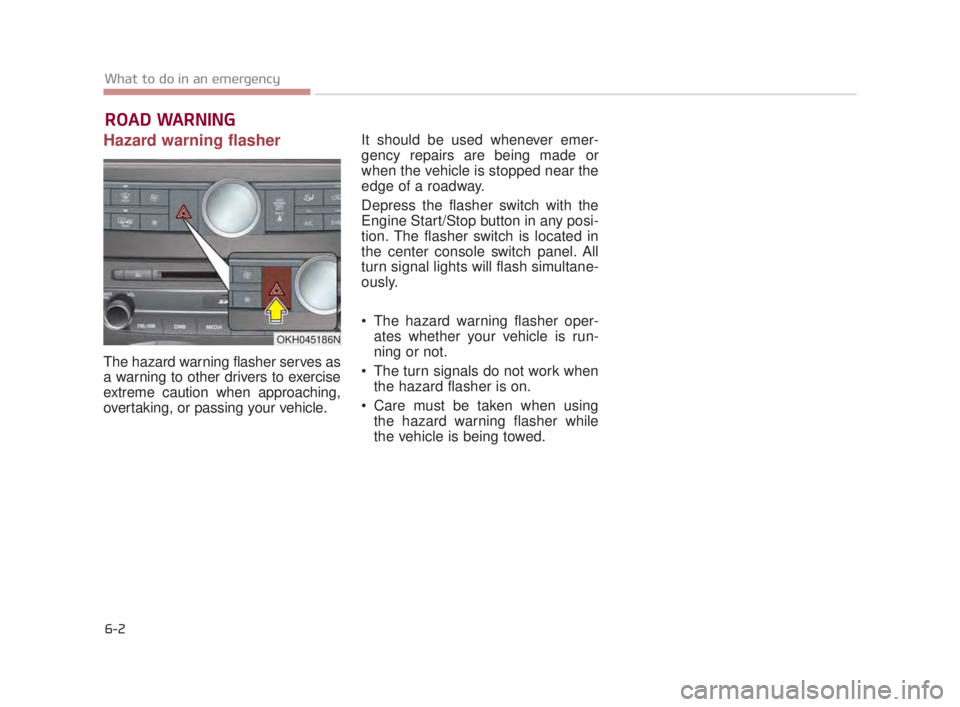
Hazard warning flasher
The hazard warning flasher serves as
a warning to other drivers to exercise
extreme caution when approaching,
overtaking, or passing your vehicle. It should be used whenever emer-
gency repairs are being made or
when the vehicle is stopped near the
edge of a roadway.
Depress the flasher switch with the
Engine Start/Stop button in any posi-
tion. The flasher switch is located in
the center console switch panel. All
turn signal lights will flash simultane-
ously.
The hazard warning flasher oper-
ates whether your vehicle is run-
ning or not.
The turn signals do not work when the hazard flasher is on.
Care must be taken when using the hazard warning flasher while
the vehicle is being towed.
6-2
What to do in an emergency
OKH045186N
KH USA 6:2015 3/25/2015 3:12 PM Page 2
Page 376 of 542
What to do in an emergency
6
6-3
IN CASE OF AN EMERGENCY WHILE DRIVING
If the engine stalls at a cross-
road or crossing
If the engine stalls at a crossroad or
crossing, set the shift lever in the N
(Neutral) position and then push the
vehicle to a safe place.
If you have a flat tire while
driving
If a tire goes flat while you are driving:
1.Take your foot off the acceleratorpedal and let the car slow down
while driving straight ahead. Do not
apply the brakes immediately or
attempt to pull off the road as this
may cause a loss of control. When
the car has slowed to such a speed
that it is safe to do so, brake care-
fully and pull off the road. Drive off
the road as far as possible and
park on firm, level ground. If you
are on a divided highway, do not
park in the median area between
the two traffic lanes.
2.When the car is stopped, turn on your emergency hazard flashers,
set the parking brake and put the
shift lever in P.
3.Have all passengers get out of the car. Be sure they all get out on the
side of the car that is away from
traffic.
4.When changing a flat tire, follow the instruction provided later in this
section.
If engine stalls while driving
1.Reduce your speed gradually,keeping a straight line. Move cau-
tiously off the road to a safe place.
2.Turn on your emergency flashers.
3.Try to start the engine again. If your vehicle will not start, contact an
authorized K900 Kia dealer or Kia
Roadside Assistance.
KH USA 6:2015 3/25/2015 3:12 PM Page 3
Page 377 of 542
IF THE ENGINE WILL NOT START
If engine doesn't turn over or
turns over slowly
1.Be sure the shift lever is in N(Neutral) or P (Park) and the emer-
gency brake is set.
2.Check the battery connections to be sure they are clean and tight.
3.Turn on the interior light. If the light dims or goes out when you operate
the starter, the battery is dis-
charged.
4.Check the starter connections to be sure they are securely tight-
ened.
5.Do not push or pull the vehicle to start it. See instructions for "Jump
starting".
If engine turns over normally
but does not start
1.Check fuel level.
2.With the Engine Start/Stop Buttonin the OFF position, check all con-
nectors at ignition coils and spark
plugs. Reconnect any that may be
disconnected or loose.
3.If the engine still does not start, call an authorized K900 Kia dealer or
Kia Roadside Assistance.
6-4
What to do in an emergency
Push/Pull start
Do not push or pull the vehicle
to start it. Push or pull starting
may cause the catalytic con-
verter to overload and create a
fire hazard.
WARNING
KH USA 6:2015 3/25/2015 3:12 PM Page 4
Page 378 of 542
EMERGENCY STARTING
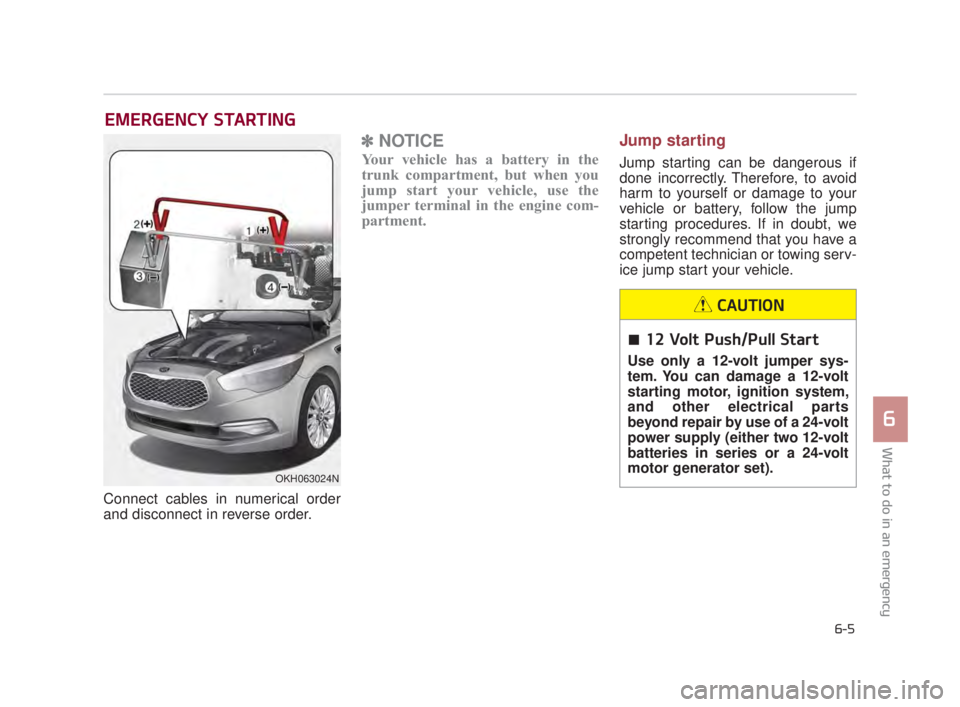
Connect cables in numerical order
and disconnect in reverse order.
✽ NOTICE
Your vehicle has a battery in the
trunk compartment, but when you
jump start your vehicle, use the
jumper terminal in the engine com-
partment.
Jump starting
Jump starting can be dangerous if
done incorrectly. Therefore, to avoid
harm to yourself or damage to your
vehicle or battery, follow the jump
starting procedures. If in doubt, we
strongly recommend that you have a
competent technician or towing serv-
ice jump start your vehicle.
What to do in an emergency
6
6-5
OKH063024N
12 Volt Push/Pull Start
Use only a 12-volt jumper sys-
tem. You can damage a 12-volt
starting motor, ignition system,
and other electrical parts
beyond repair by use of a 24-volt
power supply (either two 12-volt
batteries in series or a 24-volt
motor generator set).
CAUTION
KH USA 6:2015 3/25/2015 3:12 PM Page 5
Page 379 of 542
6-6
What to do in an emergency
Jump starting procedure
✽NOTICE
Your vehicle has a battery in the
trunk compartment, but when you
jump start your vehicle, use the
jumper terminal in the engine com-
partment.
1.Make sure the booster battery is
12-volt and that its negative termi-
nal is grounded.
2.If the booster battery is in another vehicle, do not allow the vehicles to
touch.
3.Turn off all unnecessary electrical loads.
4.Open the engine hood.
Battery
Never attempt to check the elec-
trolyte level of the battery as
this may cause the battery to
rupture or explode causing seri-
ous injury.
WARNING
Battery
Keep all flames or sparks away
from the battery. The battery
produces hydrogen gas which
will explode if exposed to flame
or sparks.
WARNING
Frozen batteries
Do not attempt to jump start the
vehicle if the discharged battery
is frozen or if the electrolyte
level is low as the battery may
rupture or explode.
WARNING
Sulfuric acid risk
When jump starting your vehi-
cle be careful not to get acid on
yourself, your clothing or on the
vehicle. Automobile batteries
contain sulfuric acid. This is
poisonous and highly corro-
sive.
WARNING
KH USA 6:2015 3/25/2015 3:12 PM Page 6
Page 380 of 542
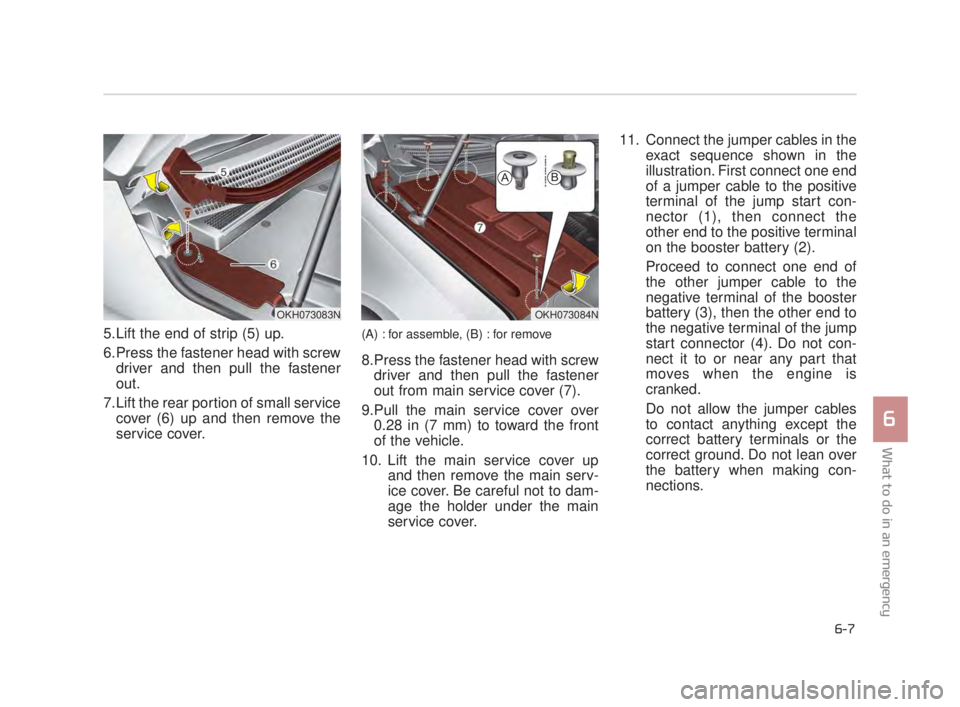
5.Lift the end of strip (5) up.
6.Press the fastener head with screwdriver and then pull the fastener
out.
7.Lift the rear portion of small service cover (6) up and then remove the
service cover.(A) : for assemble, (B) : for remove
8.Press the fastener head with screwdriver and then pull the fastener
out from main service cover (7).
9.Pull the main service cover over 0.28 in (7 mm) to toward the front
of the vehicle.
10. Lift the main service cover up and then remove the main serv-
ice cover. Be careful not to dam-
age the holder under the main
service cover. 11. Connect the jumper cables in the
exact sequence shown in the
illustration. First connect one end
of a jumper cable to the positive
terminal of the jump start con-
nector (1), then connect the
other end to the positive terminal
on the booster battery (2).
Proceed to connect one end of
the other jumper cable to the
negative terminal of the booster
battery (3), then the other end to
the negative terminal of the jump
start connector (4). Do not con-
nect it to or near any part that
moves when the engine is
cranked.
Do not allow the jumper cables
to contact anything except the
correct battery terminals or the
correct ground. Do not lean over
the battery when making con-
nections.
What to do in an emergency
6
6-7
OKH073083NOKH073084N
AB
KH USA 6:2015 3/25/2015 3:12 PM Page 7
Page 381 of 542
12. Start the engine of the vehiclewith the booster battery and let it
run at 2,000 rpm, then start the
engine of the vehicle with the
discharged battery.
If the cause of your battery discharg-ing is not apparent, have the systemchecked by an authorized K900 Kiadealer.
Push-starting
Vehicles equipped with automatic
transmission cannot be push-started.
Follow the directions in this section
for jump-starting.
6-8
What to do in an emergency
Tow Starting Vehicle
Never tow a vehicle to start it
because the sudden surge for-
ward when the engine starts
could cause a collision with the
tow vehicle.
WARNING
Battery cables
Do not connect the jumper
cable from the negative terminal
of the booster battery to the
negative terminal of the dis-
charged battery. This can cause
the discharged battery to over-
heat and crack, releasing bat-
tery acid.
WARNING
KH USA 6:2015 3/25/2015 3:12 PM Page 8