automatic transmission KIA K900 2016 User Guide
[x] Cancel search | Manufacturer: KIA, Model Year: 2016, Model line: K900, Model: KIA K900 2016Pages: 542, PDF Size: 38.35 MB
Page 293 of 542
5-30
Driving your vehicle
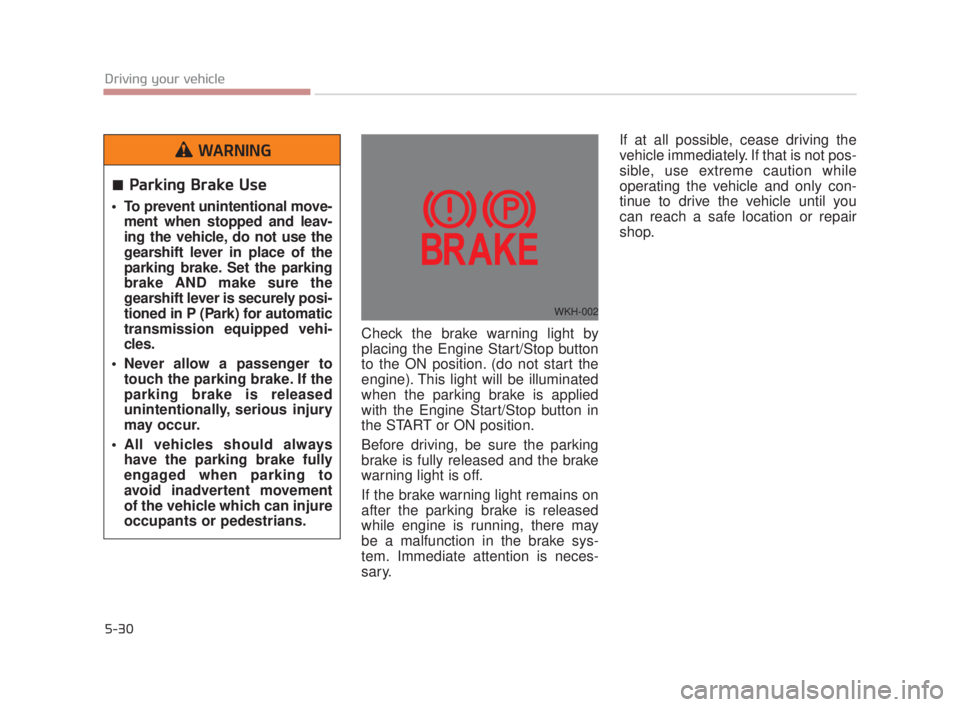
Check the brake warning light by
placing the Engine Start/Stop button
to the ON position. (do not start the
engine). This light will be illuminated
when the parking brake is applied
with the Engine Start/Stop button in
the START or ON position.
Before driving, be sure the parking
brake is fully released and the brake
warning light is off.
If the brake warning light remains on
after the parking brake is released
while engine is running, there may
be a malfunction in the brake sys-
tem. Immediate attention is neces-
sary.If at all possible, cease driving the
vehicle immediately. If that is not pos-
sible, use extreme caution while
operating the vehicle and only con-
tinue to drive the vehicle until you
can reach a safe location or repair
shop.
WKH-002
Parking Brake Use
To prevent unintentional move-
ment when stopped and leav-
ing the vehicle, do not use the
gearshift lever in place of the
parking brake. Set the parking
brake AND make sure the
gearshift lever is securely posi-
tioned in P (Park) for automatic
transmission equipped vehi-
cles.
Never allow a passenger to touch the parking brake. If the
parking brake is released
unintentionally, serious injury
may occur.
All vehicles should always have the parking brake fully
engaged when parking to
avoid inadvertent movement
of the vehicle which can injure
occupants or pedestrians.
WARNING
KH USA 5:2015 3/25/2015 9:14 AM Page 30
Page 318 of 542
Driving your vehicle
5
5-55
ECO (ACTIVE ECO) MODE
ACTIVE ECO systemenhances fuel efficiency
through eco control of
the engine and trans-
mission. The actual fuel
efficiency will depend on
personal driving style
and habits.
By pressing the DRIVE MODE button and
selecting ECO MODE,
green ECO indicator
light will illuminate.
ECO MODE Driving:
The vehicle engine and transmission
will operate in fuel economy oriented
mode.
ACTIVE ECO MODE system will
restrain fuel economy worsening
driving habits, such as sudden starts
and accelerations, compared to the
NORMAL MODE.
Conditions that limit Active
ECO MODE:
Below are a list of conditions in which
when in ACTIVE ECO MODE, the
indicator light will not change, but the
internal system may operate differ-
ently.
When engine coolant temperatureis low:
When temperature of the transaxle
oil is below the normal range, the
ACTIVE ECO MODE may become
temporarily unavailable until the
transaxle oil heats up after vehicle
ignition.
When in an uphill gradient: Since the ACTIVE ECO MODE
partially limits the engine torque,
ACTIVE ECO MODE may become
temporarily unavailable when more
torque is essential for going uphill.
When using the manual transmis- sion operation mode:
If transmission operation is
changed from automatic to manual,
vehicle will reflect it and automati-
cally stop the ACTIVE ECO MODE.
KH USA 5:2015 3/25/2015 9:15 AM Page 55
Page 321 of 542
5-58
Driving your vehicle
DRIVE MODE Indicator Screen
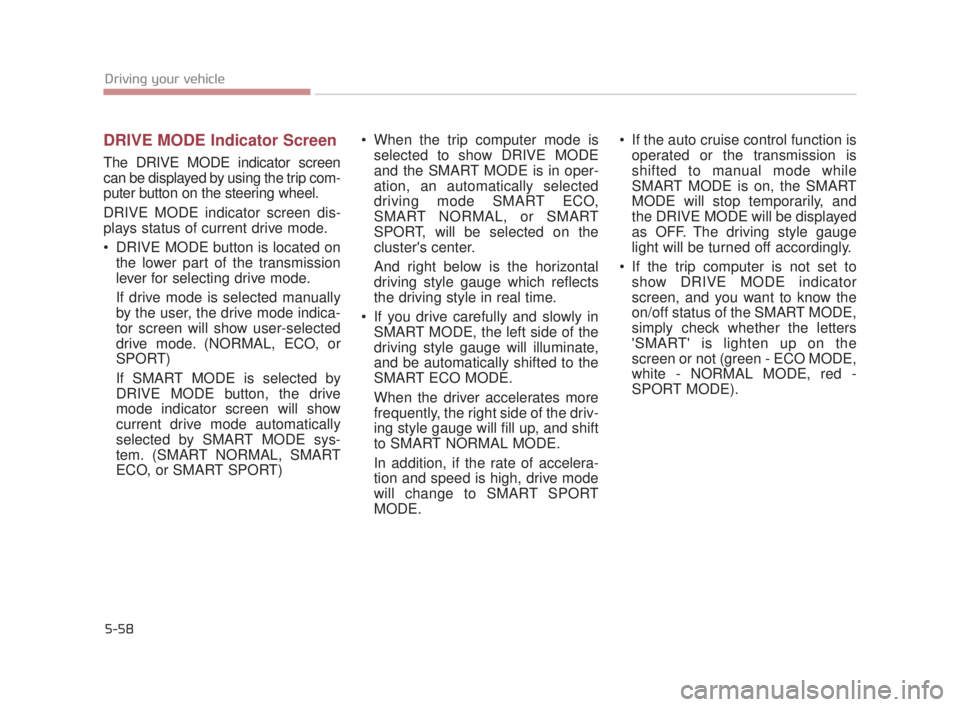
The DRIVE MODE indicator screen
can be displayed by using the trip com-
puter button on the steering wheel.
DRIVE MODE indicator screen dis-
plays status of current drive mode.
DRIVE MODE button is located onthe lower part of the transmission
lever for selecting drive mode.
If drive mode is selected manually
by the user, the drive mode indica-
tor screen will show user-selected
drive mode. (NORMAL, ECO, or
SPORT)
If SMART MODE is selected by
DRIVE MODE button, the drive
mode indicator screen will show
current drive mode automatically
selected by SMART MODE sys-
tem. (SMART NORMAL, SMART
ECO, or SMART SPORT) When the trip computer mode is
selected to show DRIVE MODE
and the SMART MODE is in oper-
ation, an automatically selected
driving mode SMART ECO,
SMART NORMAL, or SMART
SPORT, will be selected on the
cluster's center.
And right below is the horizontal
driving style gauge which reflects
the driving style in real time.
If you drive carefully and slowly in SMART MODE, the left side of the
driving style gauge will illuminate,
and be automatically shifted to the
SMART ECO MODE.
When the driver accelerates more
frequently, the right side of the driv-
ing style gauge will fill up, and shift
to SMART NORMAL MODE.
In addition, if the rate of accelera-
tion and speed is high, drive mode
will change to SMART SPORT
MODE. If the auto cruise control function is
operated or the transmission is
shifted to manual mode while
SMART MODE is on, the SMART
MODE will stop temporarily, and
the DRIVE MODE will be displayed
as OFF. The driving style gauge
light will be turned off accordingly.
If the trip computer is not set to show DRIVE MODE indicator
screen, and you want to know the
on/off status of the SMART MODE,
simply check whether the letters
'SMART' is lighten up on the
screen or not (green - ECO MODE,
white - NORMAL MODE, red -
SPORT MODE).
KH USA 5:2015 3/25/2015 9:16 AM Page 58
Page 324 of 542
Driving your vehicle
5
5-61
Conditions which Limit SMARTMODE
In following conditions your vehicle will
temporarily stop the SMART Mode
and the indicator light will turn off.
When using the manual transmis- sion operation mode: If the
transaxle system is changed from
automatic to manual, your vehicle
will automatically stop the SMART
MODE.
If transmission operation is
changed from automatic to manu-
al, vehicle will reflect it and auto-
matically stop the SMART MODE.
When the Cruise Control system is turned on:
When the driver sets a target
cruise control speed, your vehicle
will automatically stop the SMART
MODE. (The SMART MODE will
not stop immediately after you
press the cruise control button, but
when the cruise control system
takes control of the vehicle speed.) If the temperature of the transaxle
oil is very high or low:
The SMART MODE control system
will operate in nearly all driving
conditions. But when the tempera-
ture of the transaxle oil is out of the
normal range, the SMART MODE
system may become temporarily
unavailable.
KH USA 5:2015 3/25/2015 9:16 AM Page 61
Page 381 of 542
12. Start the engine of the vehiclewith the booster battery and let it
run at 2,000 rpm, then start the
engine of the vehicle with the
discharged battery.
If the cause of your battery discharg-ing is not apparent, have the systemchecked by an authorized K900 Kiadealer.
Push-starting
Vehicles equipped with automatic
transmission cannot be push-started.
Follow the directions in this section
for jump-starting.
6-8
What to do in an emergency
Tow Starting Vehicle
Never tow a vehicle to start it
because the sudden surge for-
ward when the engine starts
could cause a collision with the
tow vehicle.
WARNING
Battery cables
Do not connect the jumper
cable from the negative terminal
of the booster battery to the
negative terminal of the dis-
charged battery. This can cause
the discharged battery to over-
heat and crack, releasing bat-
tery acid.
WARNING
KH USA 6:2015 3/25/2015 3:12 PM Page 8
Page 400 of 542
What to do in an emergency
6
6-27
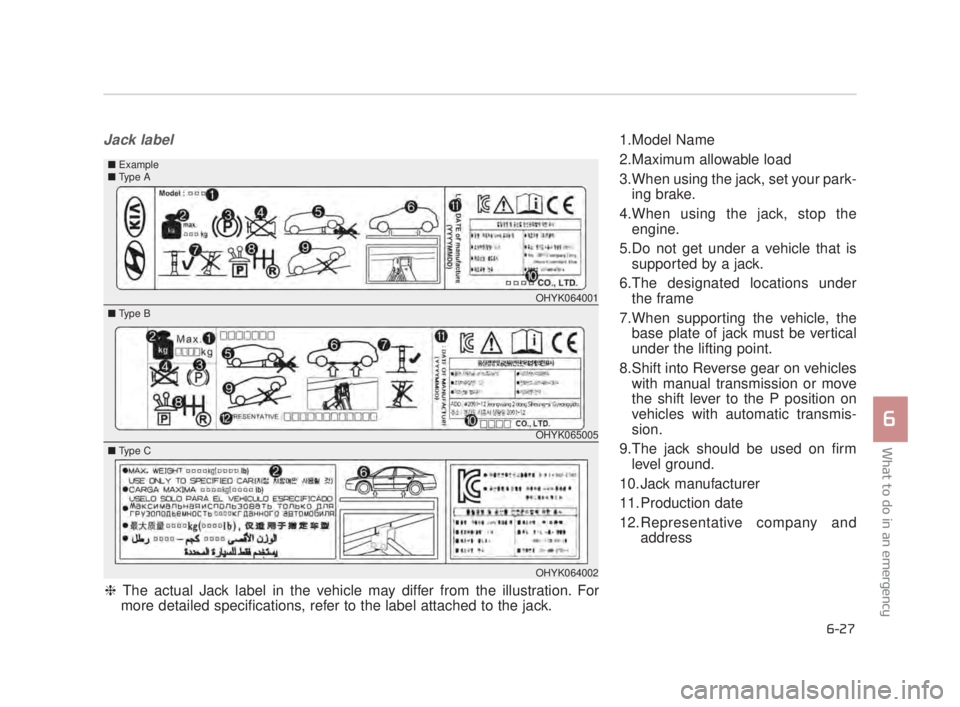
Jack label1.Model Name
2.Maximum allowable load
3.When using the jack, set your park-ing brake.
4.When using the jack, stop the engine.
5.Do not get under a vehicle that is supported by a jack.
6.The designated locations under the frame
7.When supporting the vehicle, the base plate of jack must be vertical
under the lifting point.
8.Shift into Reverse gear on vehicles with manual transmission or move
the shift lever to the P position on
vehicles with automatic transmis-
sion.
9.The jack should be used on firm level ground.
10. Jack manufacturer
11. Production date
12.Representative company and address
OHYK064001
OHYK065005
■ Type A■Example
■ Type B
OHYK064002
■ Type C
❈ The actual Jack label in the vehicle may differ from the illustration. For
more detailed specifications, refer to the label attached to the jack.
KH USA 6:2015 3/25/2015 3:13 PM Page 27
Page 406 of 542
What to do in an emergency
6
6-33
Automatic transmission
To avoid serious damage tothe automatic transmission,
limit the vehicle speed to 10
mph (15 km/h) and drive less
than 1 mile (1.5 km) when tow-
ing.
Before towing, check the auto- matic transmission for fluid
leaks under your vehicle. If
the automatic transmission
fluid is leaking, flatbed equip-
ment or a towing dolly must
be used.
CAUTION
KH USA 6:2015 3/25/2015 3:14 PM Page 33
Page 414 of 542
7-8
Maintenance
OWNER MAINTENANCE
The following lists are vehicle checks
and inspections that should be per-
formed by the owner or an author-
ized K900 Kia dealer at the frequen-
cies indicated to help ensure safe,
dependable operation of your vehi-
cle.
Any adverse conditions should be
brought to the attention of your deal-
er as soon as possible.
These Owner Maintenance Checks
are generally not covered by war-
ranties and you may be charged for
labor, parts and lubricants used. Owner maintenance schedule
When you stop for fuel:
Check the engine oil level.
Check coolant level in coolantreservoir.
Check the windshield washer fluid level.
Look for low or under-inflated tires.
While operating your vehicle:
Note any changes in the sound of the exhaust or any smell of
exhaust fumes in the vehicle.
Check for vibrations in the steering wheel. Notice any increased steer-
ing effort or looseness in the steer-
ing wheel, or change in its straight-
ahead position.
Notice if your vehicle constantly turns slightly or “pulls” to one side
when traveling on smooth, level
road.
When stopping, listen and check for unusual sounds, pulling to one
side, increased brake pedal travel
or “hard-to-push” brake pedal.
If any slipping or changes in the operation of your transmission
occurs, check the transmission
fluid level.
Check automatic transmission P (Park) function.
Check parking brake.
Check for fluid leaks under your vehicle (water dripping from the air
conditioning system during or after
use is normal).
Hot Coolant
Be careful when checking your
engine coolant level when the
engine is hot. Scalding hot
coolant and steam may blow
out under pressure. This could
cause burns or other serious
injury.
WARNING
KH USA 7:2015 3/25/2015 11:34 AM Page 8
Page 415 of 542
Maintenance
7
7-9
At least monthly:
Check coolant level in the enginecoolant reservoir.
Check the operation of all exterior lights, including the stoplights, turn
signals and hazard warning flash-
ers.
Check the inflation pressures of all tires including the spare.
At least twice a year
(i.e., every Spring and Fall):
Check radiator, heater and air con- ditioning hoses for leaks or dam-
age.
Check windshield washer spray and wiper operation. Clean wiper
blades with clean cloth dampened
with washer fluid.
Check headlight alignment.
Check muffler, exhaust pipes, shields and clamps.
Check the lap/shoulder belts for wear and function.
Check for worn tires and loose wheel lug nuts.
At least once a year:
Clean body and door drain holes.
Lubricate door hinges and checks,and hood hinges.
Lubricate door and hood locks and latches.
Lubricate door rubber weather- strips.
Check the air conditioning system.
Check the power steering fluid level.
Inspect and lubricate automatic transmission linkage and controls.
Clean battery and terminals.
Check the brake fluid level.
KH USA 7:2015 3/25/2015 11:34 AM Page 9
Page 417 of 542
Maintenance
7
7-11
NORMAL MAINTENANCE SCHEDULE
The following maintenance services must be performed to ensure good emission control and performance. Keep
receipts for all vehicle emission services to protect your warranty. Where both mileage and time are shown, the fre-
quency of service is determined by whichever occurs first.
*
1: If TOP TIER Detergent Gasoline is not available, one bottle of additive is recommended. Additives are avail-
able from your authorized K900 Kia dealer along with
information on how to use them. Do not mix other
additives.
*
2: Fuel filter & Fuel tank air filter are considered to be maintenance free but periodic inspection is recom-
mended for this maintenance schedule depends on
fuel quality. If there are some important safety matters
like fuel flow restriction, surging, loss of power, hard
starting problem etc, replace the fuel filter immediate-
ly regardless of maintenance schedule and consult
an authorized K900 Kia dealer for details.
*
3: Rear differential oil should be changed anytime rear differential have been submerged in water. *
4: The drive belt should be replaced when cracks occur
or tension is reduced excessively.
*
5: Use only the specified automatic transmission fluid. (Refer to "Recommended lubricants and capacities"
in section 8 or the label in the engine room.)
*
6: Inspect for excessive tappet noise and/or engine vibration and adjust if necessary.
KH USA 7:2015 3/25/2015 11:34 AM Page 11