heating KIA K900 2016 User Guide
[x] Cancel search | Manufacturer: KIA, Model Year: 2016, Model line: K900, Model: KIA K900 2016Pages: 542, PDF Size: 38.35 MB
Page 251 of 542
Features of your vehicle
4
4-171
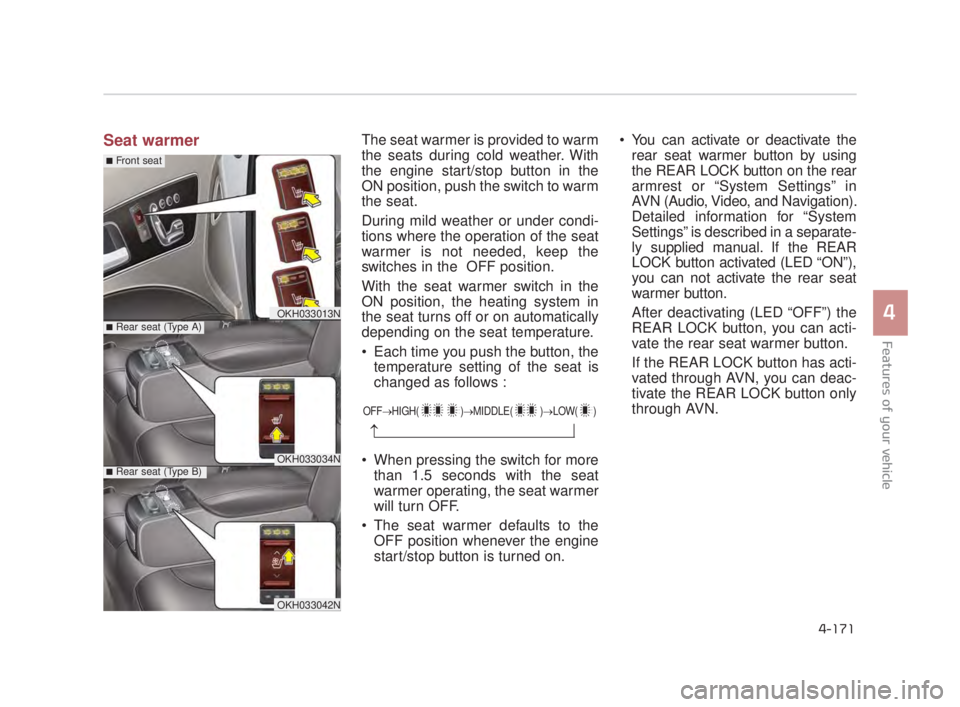
Seat warmerThe seat warmer is provided to warm
the seats during cold weather. With
the engine start/stop button in the
ON position, push the switch to warm
the seat.
During mild weather or under condi-
tions where the operation of the seat
warmer is not needed, keep the
switches in the OFF position.
With the seat warmer switch in the
ON position, the heating system in
the seat turns off or on automatically
depending on the seat temperature.
Each time you push the button, thetemperature setting of the seat is
changed as follows :
When pressing the switch for more than 1.5 seconds with the seat
warmer operating, the seat warmer
will turn OFF.
The seat warmer defaults to the OFF position whenever the engine
start/stop button is turned on. You can activate or deactivate the
rear seat warmer button by using
the REAR LOCK button on the rear
armrest or “System Settings” in
AVN (Audio, Video, and Navigation).
Detailed information for “System
Settings” is described in a separate-
ly supplied manual. If the REAR
LOCK button activated (LED “ON”),
you can not activate the rear seat
warmer button.
After deactivating (LED “OFF”) the
REAR LOCK button, you can acti-
vate the rear seat warmer button.
If the REAR LOCK button has acti-
vated through AVN, you can deac-
tivate the REAR LOCK button only
through AVN.
OFF→ HIGH( )→ MIDDLE( )→LOW( )
→
OKH033013N
OKH033034N
■Rear seat (Type A)
■Rear seat (Type B)
■Front seat
OKH033042N
KH USA 4:2015 3/24/2015 4:44 PM Page 171
Page 252 of 542

Features of your vehicle
4-172
Air ventilation seat (if equipped)
The air ventilation is provided to cool
the seats during hot weather by
blowing air through small vent holes
on the surface of the seats and seat-
backs. While the engine is running,
press the switch to cool the seat.
OKH033014N
OKH033043N
■Front seat
■Rear seat
Seat damage
When cleaning the seats, donot use an organic solvent
such as paint thinner, ben-
zene, alcohol and gasoline.
Doing so may damage the
surface of the heater or seats.
To prevent overheating the seat warmer, do not place any-
thing on the seats that insu-
lates against heat, such as
blankets, cushions or seat
covers on the seats while the
seat warmer is in operation.
Do not place heavy or sharp objects on the seat. Those
things may damage the seat
warmer system.
CAUTION
Seat warmer burns
The seat warmer may cause
burns, even at low tempera-
tures, if used over a long period
of time. Never allow passen-
gers who may not be able to
take care of themselves to be
exposed to the risk of seat
heater burns. These include:
1. Infants, children, elderly or disabled persons, or hospital
outpatients
2. Persons with sensitive skin or those that burn easily
3. Fatigued individuals
4. Intoxicated individuals
5. Individuals taking medica- tion that can cause drowsi-
ness or sleepiness (sleeping
pills, cold tablets, etc.)
WARNING
KH USA 4:2015 3/24/2015 4:44 PM Page 172
Page 253 of 542
Features of your vehicle
4
4-173
When the operation of the air ventila-
tion is not needed, keep the switches
in the OFF position.
Each time you press the switch,the airflow will change as follows:
When pressing the switch for more than 1.5 seconds with the seat
cooler operating, the seat cooler
will turn OFF.
When the air ventilation seat is turned on, the seat may get cooler
after about 5 minutes.
Because the air ventilation uses the air in the vehicle, cooling effi-
ciency depends on the tempera-
ture of the air. In order to improve
cooling efficiency, use the air con-
ditioning system together.
The air ventilation seat defaults to the OFF position whenever the
Engine Start/Stop Button is turned
to the ON position. You can activate or deactivate the
rear air ventilation button by using
the REAR LOCK button on the rear
armrest or “System Settings” in
AVN (Audio, Video, and
Navigation). Detailed information
for “System Settings” is described
in a separately supplied manual. If
the REAR LOCK button activated
(LED “ON”), you can not activate
the rear air ventilation button.
After deactivating (LED “OFF”) the
REAR LOCK button, you can acti-
vate the rear air ventilation button.
If the REAR LOCK button has acti-
vated through AVN, you can deacti-
vate the REAR LOCK button only
through AVN.
The air ventilation seat is a supple- mentary cooling/heating system.
Use the air ventilation seat when
the climate control system is on.
Using the air ventilation seat for
prolonged periods of time with the
climate control system off could
cause the air ventilation seat per-
formance to impair. Do not place materials such as
plastic bags or newspapers under
the seats. The air vent may not
work properly as the air intake can
be blocked.
OFF→ HIGH( )→ MIDDLE( )→LOW( )
→ When cleaning the seats, do
not use an organic solvent
such as paint thinner, ben-
zene, alcohol and gasoline.
Doing so may damage the
surface of the seats.
Do not spill liquid such as water or beverages on the
surface of the front seats and
seatbacks, or the air vent
holes may be blocked and
prevented from working prop-
erly.
When the air vent does not operate, restart the vehicle. If
there is no change, have your
vehicle inspected by an
authorized K900 Kia dealer.
CAUTION
KH USA 4:2015 3/24/2015 4:44 PM Page 173
Page 359 of 542
5-96
Driving your vehicle
Hazardous driving conditions
When hazardous driving conditions
are encountered such as water,
snow, ice, mud, sand, or similar haz-
ards, follow these suggestions:
Drive cautiously and allow extradistance for braking.
Avoid sudden braking or steering.
When braking with non-ABS brakes pump the brake pedal with
a light up-and-down motion until
the vehicle is stopped. Do not pump the brake pedal on a
vehicle equipped with ABS.
If stalled in snow, mud, or sand,
use second gear. Accelerate slow-
ly to avoid spinning the drive
wheels.
Use sand, rock salt, tire chains, or other non-slip material under the
drive wheels to provide traction
when stalled in ice, snow, or mud.
Rocking the vehicle
If it is necessary to rock the vehicle
to free it from snow, sand, or mud,
first turn the steering wheel right and
left to clear the area around your
front wheels. Then, shift back and
forth between R (Reverse) and any
forward gear in vehicles equipped
with an automatic transaxle. Do not
race the engine, and spin the wheels
as little as possible. If you are still
stuck after a few tries, have the vehi-
cle pulled out by a tow vehicle to
avoid engine overheating and possi-
ble damage to the transaxle.
The ESC system should be turned
OFF prior to rocking the vehicle.
SPECIAL DRIVING CONDITIONS
Downshifting
Do not downshift with an auto-
matic transaxle while driving on
slippery surfaces. The sudden
change in tire speed could
cause the tires to skid and
result in an accident.
WARNING
Vehicle rocking
Prolonged rocking may cause
engine overheating, transaxle
damage or failure, and tire dam-
age.
CAUTION
KH USA 5:2015 3/25/2015 9:17 AM Page 96
Page 362 of 542
Driving your vehicle
5
5-99
Driving off-road
Drive carefully off-road because your
vehicle may be damaged by rocks or
roots of trees. Become familiar with
the off-road conditions where you
are going to drive before you begin
driving.
Highway driving
Tires
Adjust the tire inflation pressures to
specification. Low tire inflation pres-
sures will result in overheating and
possible failure of the tires.
Avoid using worn or damaged tires
which may result in reduced traction
or tire failure.
Never exceed the maximum tire
inflation pressure shown on the tires.
Fuel, engine coolant and engineoil
High speed travel consumes more
fuel than urban motoring. Do not for-
get to check both the engine coolant
and engine oil.
Drive belt
A loose or damaged drive belt may
overheat the engine.
Tire tread
Always check the tire tread
before driving your vehicle.
Worn-out tires can result in loss
of vehicle control. Worn-out tires
should be replaced as soon as
possible. For further informa-
tion and tread limits, refer to
"Tires and wheels" in section 7.
WARNING
Under/Over Inflated Tires
Always check the tires for prop-
er inflation before driving.
Underinflated or overinflated
tires can cause poor handling,
loss of vehicle control, and sud-
den tire failure leading to acci-
dents, injuries, and even death.
WARNING
KH USA 5:2015 3/25/2015 9:18 AM Page 99
Page 382 of 542
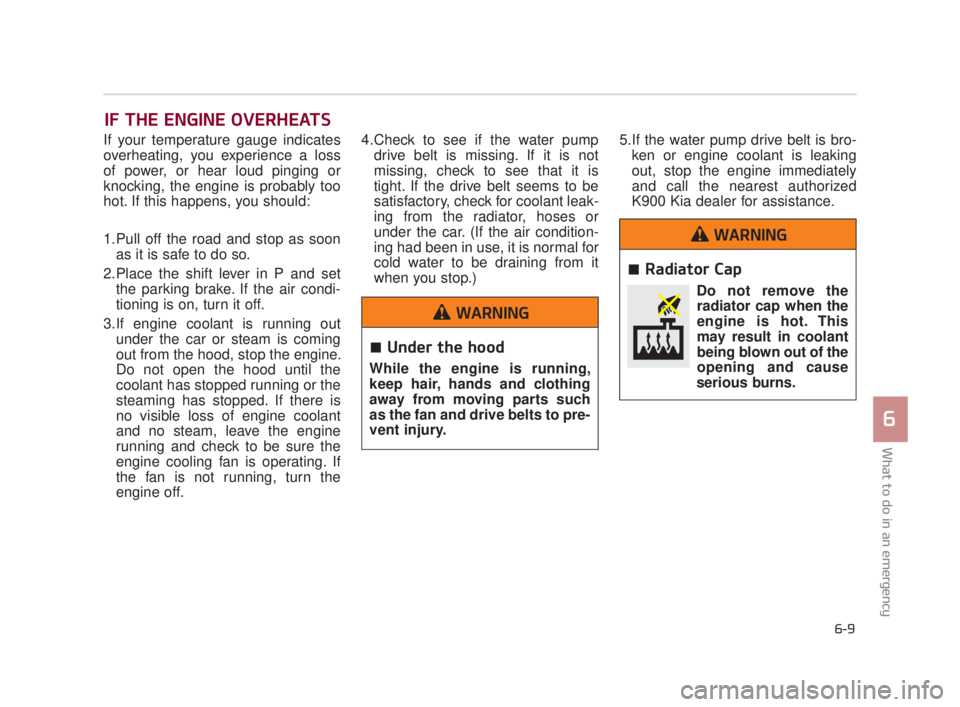
IF THE ENGINE OVERHEATS
If your temperature gauge indicates
overheating, you experience a loss
of power, or hear loud pinging or
knocking, the engine is probably too
hot. If this happens, you should:
1.Pull off the road and stop as soonas it is safe to do so.
2.Place the shift lever in P and set the parking brake. If the air condi-
tioning is on, turn it off.
3.If engine coolant is running out under the car or steam is coming
out from the hood, stop the engine.
Do not open the hood until the
coolant has stopped running or the
steaming has stopped. If there is
no visible loss of engine coolant
and no steam, leave the engine
running and check to be sure the
engine cooling fan is operating. If
the fan is not running, turn the
engine off. 4.Check to see if the water pump
drive belt is missing. If it is not
missing, check to see that it is
tight. If the drive belt seems to be
satisfactory, check for coolant leak-
ing from the radiator, hoses or
under the car. (If the air condition-
ing had been in use, it is normal for
cold water to be draining from it
when you stop.) 5.If the water pump drive belt is bro-
ken or engine coolant is leaking
out, stop the engine immediately
and call the nearest authorized
K900 Kia dealer for assistance.
What to do in an emergency
6
6-9
Under the hood
While the engine is running,
keep hair, hands and clothing
away from moving parts such
as the fan and drive belts to pre-
vent injury.
WARNING
Radiator Cap
Do not remove theradiator cap when the
engine is hot. This
may result in coolant
being blown out of the
opening and cause
serious burns.
WARNING
KH USA 6:2015 3/25/2015 3:12 PM Page 9
Page 383 of 542
6-10
What to do in an emergency
6.If you cannot find the cause of theoverheating, wait until the engine
temperature has returned to nor-
mal. Then, if coolant has been lost,
carefully add coolant to the reser-
voir to bring the fluid level in the
reservoir up to the halfway mark.
7.Proceed with caution, keeping alert for further signs of overheat-
ing. If overheating happens again,
call an authorized K900 Kia dealer
for assistance.
Serious loss of coolant indicates there is a leak in the cooling sys-
tem and this should be checked as
soon as possible by an authorized
K900 Kia dealer.
When the engine overheats
from low engine coolant, sud-
denly adding engine coolant
may cause cracks in the engine.
To prevent damage, add engine
coolant slowly in small quanti-
ties.
CAUTION
KH USA 6:2015 3/25/2015 3:12 PM Page 10
Page 531 of 542
.........5-67Speed setting (ASCC) .....................................")
A/V mode.......................................................................4\
-75
Advanced Smart Cruise Control System (ASCC).........5-67Speed setting (ASCC) ...............................................5-68
To convert to cruise control mode.............................5-76
Vehicle to vehicle distance setting (ASCC) .............5-72
AFLS (Adaptive Front Lighting System) ....................4-132
Air bag warning label ....................................................3-62
Air bag warning light.....................................................3-42
Air bags........................................................................\
..3-39 Air bag warning label................................................3-62
Air bag warning light ................................................3-42
Curtain air bag...........................................................3-55
Driver's and passenger's front air bag .......................3-51
Inflation and non-inflation conditions .....................3-56
Occupant detection system........................................3-45
Side air bag................................................................3-53
SRS Care ...................................................................3-61
SRS components and functions ................................3-43
Air cleaner .....................................................................7-4\
1
Air ventilation seat ......................................................4-\
172
Airconditioning system Automatic climate control system ..........................4-144
Alarm system .................................................................4-14
Antenna ........................................................................\
4-181
Anti-lock brake system (ABS) ......................................5-41
Appearance care.............................................................7-95 Exterior care ..............................................................7-95
Interior care .............................................................7-102
Armrest (rear) ................................................................3-18
ASCC/LDWS mode.......................................................4-75
Audio / Video / Navigation system (AVN)..................4-180
Auto door lock/unlock feature .......................................4-20
Auto Hold ......................................................................5-\
36
Auto light/AFLS position ............................................4-131
Automatic climate control system ...............................4-144 Air conditioning ......................................................4-153
Automatic heating and air conditioning..................4-145
Manual heating and air conditioning ......................4-146
Automatic transmission (Shift by cable) .......................5-11 Manual mode.............................................................5-13
Shift-lock override.....................................................5-15
Automatic transmission (Shift by wire) ........................5-16 Manual mode.............................................................5-20
When the battery is discharged .................................5-22
Automatic turn off function ........................................4-139
Autonomus Emergency Braking (AEB) ........................5-49 AEB Operation ..........................................................5-49
To cancel the AEB.....................................................5-51
Warning light and message .......................................5-52
Aux, USB and iPod® port ...........................................4-179
Bag hanger ...................................................................4-176\
I-2
Index
A
B
KH USA Index:2015 3/24/2015 10:12 AM Page 2