warning KIA K900 2016 Owners Manual
[x] Cancel search | Manufacturer: KIA, Model Year: 2016, Model line: K900, Model: KIA K900 2016Pages: 542, PDF Size: 38.35 MB
Page 439 of 542
Maintenance
7
7-33
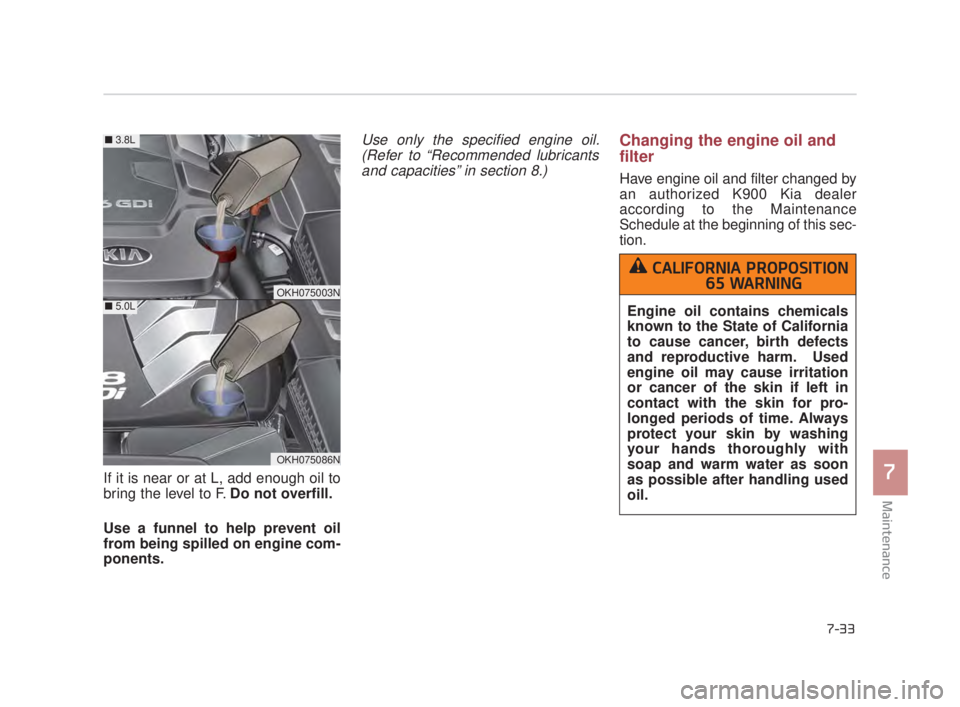
If it is near or at L, add enough oil to
bring the level to F. Do not overfill.
Use a funnel to help prevent oil
from being spilled on engine com-
ponents.
Use only the specified engine oil.(Refer to “Recommended lubricantsand capacities” in section 8.)Changing the engine oil and
filter
Have engine oil and filter changed by
an authorized K900 Kia dealer
according to the Maintenance
Schedule at the beginning of this sec-
tion.
Engine oil contains chemicals
known to the State of California
to cause cancer, birth defects
and reproductive harm. Used
engine oil may cause irritation
or cancer of the skin if left in
contact with the skin for pro-
longed periods of time. Always
protect your skin by washing
your hands thoroughly with
soap and warm water as soon
as possible after handling used
oil.
CALIFORNIA PROPOSITION 65 WARNING
OKH075003N
OKH075086N
■ 3.8L
■ 5.0L
KH USA 7:2015 3/25/2015 11:34 AM Page 33
Page 440 of 542
7-34
Maintenance
ENGINE COOLANT
The high-pressure cooling system
has a reservoir filled with year-round
antifreeze coolant. The reservoir is
filled at the factory.
Check the antifreeze protection and
coolant level at least once a year, at
the beginning of the winter season,
and before traveling to a colder cli-
mate. Checking the coolant level Turn the engine off and wait until itcools down. Use extreme care
when removing the radiator cap.
Wrap a thick towel around it, and
turn it counterclockwise slowly to
the first stop. Step back while the
pressure is released from the cool-
ing system.
When you are sure all the pressure
has been released, press down on
the cap, using a thick towel, and
continue turning counterclockwise
to remove it.
Even if the engine is not operating, do not remove the radiator cap or
the drain plug while the engine and
radiator are hot. Hot coolant and
steam may still blow out under
pressure, causing serious injury.
Removing radia-
tor cap
Never attempt to remove the
radiator cap while the engine is
operating or hot. Doing so
might lead to cooling system
and engine damage and could
result in serious personal injury
from escaping hot coolant or
steam.
WARNING
KH USA 7:2015 3/25/2015 11:34 AM Page 34
Page 441 of 542
Maintenance
7
7-35
Check the condition and connections
of all cooling system hoses and
heater hoses. Replace any swollen
or deteriorated hoses.
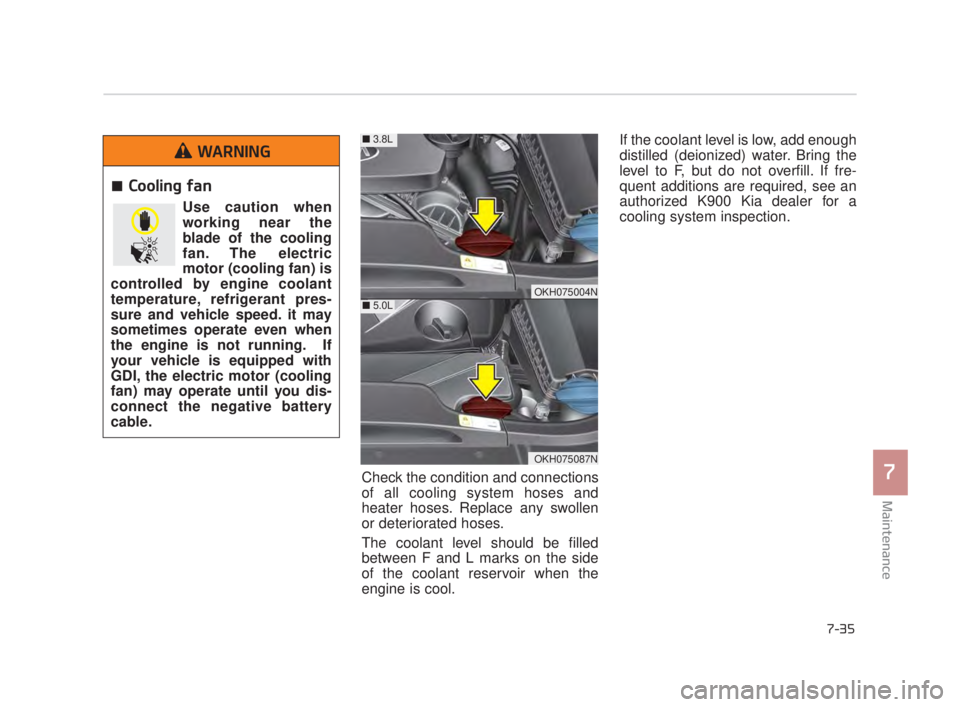
The coolant level should be filled
between F and L marks on the side
of the coolant reservoir when the
engine is cool.If the coolant level is low, add enough
distilled (deionized) water. Bring the
level to F, but do not overfill. If fre-
quent additions are required, see an
authorized K900 Kia dealer for a
cooling system inspection.
Cooling fan
Use caution when
working near the
blade of the cooling
fan. The electric
motor (cooling fan) is
controlled by engine coolant
temperature, refrigerant pres-
sure and vehicle speed. it may
sometimes operate even when
the engine is not running. If
your vehicle is equipped with
GDI, the electric motor (cooling
fan) may operate until you dis-
connect the negative battery
cable.
WARNING
OKH075004N
OKH075087N
■ 3.8L
■ 5.0L
KH USA 7:2015 3/25/2015 11:35 AM Page 35
Page 443 of 542
Maintenance
7
7-37
Changing the coolant
Have coolant changed by an author-
ized K900 Kia dealer according to
the Maintenance Schedule at the
beginning of this section.
Put a thick cloth around the radiator
cap before refilling the coolant in
order to prevent the coolant from
overflowing into engine parts such as
the generator.
Radiator cap
Do not remove the radiator cap
when the engine and radiator
are hot. Scalding hot coolant
and steam may blow out under
pressure causing serious injury.
WARNING
Coolant
Do not use radiator coolant orantifreeze in the washer fluid
reservoir.
Radiator coolant can severely obscure visibility when
sprayed on the windshield
and may cause loss of vehicle
control or damage to paint
and body trim.
WARNING
KH USA 7:2015 3/25/2015 11:35 AM Page 37
Page 446 of 542
7-40
Maintenance
WASHER FLUID
Checking the washer fluid
level
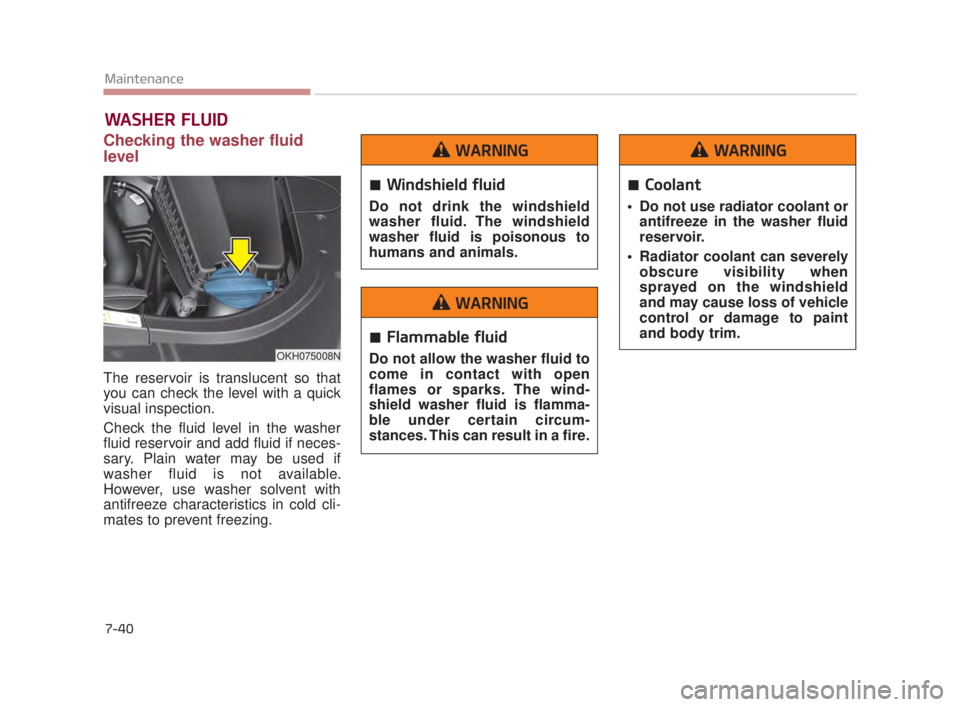
The reservoir is translucent so that
you can check the level with a quick
visual inspection.
Check the fluid level in the washer
fluid reservoir and add fluid if neces-
sary. Plain water may be used if
washer fluid is not available.
However, use washer solvent with
antifreeze characteristics in cold cli-
mates to prevent freezing.
OKH075008N
Windshield fluid
Do not drink the windshield
washer fluid. The windshield
washer fluid is poisonous to
humans and animals.
WARNING
Flammable fluid
Do not allow the washer fluid to
come in contact with open
flames or sparks. The wind-
shield washer fluid is flamma-
ble under certain circum-
stances. This can result in a fire.
WARNING
Coolant
Do not use radiator coolant orantifreeze in the washer fluid
reservoir.
Radiator coolant can severely obscure visibility when
sprayed on the windshield
and may cause loss of vehicle
control or damage to paint
and body trim.
WARNING
KH USA 7:2015 3/25/2015 11:35 AM Page 40
Page 456 of 542
7-50
Maintenance
Always read the following
instructions carefully when
handling a battery.
If any electrolyte gets into your eyes, flush your eyes
with clean water for at least
15 minutes and get immedi-
ate medical attention. If elec-
trolyte gets on your skin,
thoroughly wash the contact-
ed area. If you feel a pain or
a burning sensation, get
medical attention immediate-
ly.
An inappropriately disposed battery can be harmful to the
environment and human
health. Dispose the battery
according to your local law(s)
or regulation.
Never attempt to recharge the bat- tery when the battery cables are
connected.
Risk of Explosion
Keep lit cigarettes and
other flames or sparks
away from battery.
Hydrogen, a highly com-
bustible gas, is always
present in battery cells
and may explode if ignit-
ed.
WARNING
Sulfuric acid in batteries
Keep batteries out of the
reach of children
because batteries con-
tain highly corrosive
SULFURIC ACID. Do not
allow battery acid to
contact your skin, eyes,
clothing or paint finish. Wear eye protection
when charging or work-
ing near a battery.
Always provide ventila-
tion when working in an
enclosed space.
WARNING
KH USA 7:2015 3/25/2015 11:36 AM Page 50
Page 457 of 542
Maintenance
7
7-51
When you don’t use the vehicle fora long time in a low temperature
area, disconnect the battery and
keep it indoors.
The power trunk is not closed com-
pletely when the battery is
removed. When you remove the
battery from the vehicle, refer to
"Power trunk" in section 4.
Always charge the battery fully to prevent battery case from being
damaged in a low temperature
area.
If you connect unauthorized elec- tronic devices to the battery, the
battery may be discharged. Never
use unauthorized devices.
✽ NOTICE
Removing the battery from the vehi-
cle should be done at an authorized
K900 Kia dealer.
Battery posts, terminals, and
related accessories contain
lead and lead compounds,
chemicals known to the State of
California to cause cancer, birth
defects and reproductive harm.
Batteries also contain other
chemicals known to the State of
California to cause cancer.
Wash hands after handling.
CALIFORNIA PROPOSITION
65 WARNING
Risk of electrocution
Never touch the electrical igni-
tion system while the vehicle is
running. This system works
with high voltage which can
"zap" you.
WARNING
Recharging battery
Never attempt to recharge the
battery when the battery cables
are connected. You can get
shocked by the battery.
WARNING
KH USA 7:2015 3/25/2015 11:36 AM Page 51
Page 459 of 542
Maintenance
7
7-53
Reset items
Items should be reset after the bat-
tery has been discharged or the bat-
tery has been disconnected.
Auto up/down window (See section 4)
Sunroof (See section 4)
Driver position memory system (See section 4)
Trip computer (See section 4)
Climate control system (See section 4)
Clock (See section 4)
Audio (See section 4)
Power trunk (See section 4)
Battery in trunk
Your vehicle is equipped with a
battery in the trunk. For your
safety, avoid storing containers
with liquid in the trunk of the
vehicle. If the liquid leaks, this
could contact the battery and
create a risk of electrocution.
WARNING
KH USA 7:2015 3/25/2015 11:36 AM Page 53
Page 460 of 542
7-54
Maintenance
TIRES AND WHEELS
Tire care
For proper maintenance, safety, and
maximum fuel economy, you must
always maintain recommended tire
inflation pressures and stay within
the load limits and weight distribution
recommended for your vehicle.
Recommended cold tire infla-
tion pressures
All tire pressures (including the
spare) should be checked when the
tires are cold. “Cold Tires” means the
vehicle has not been driven for at
least three hours or driven less than
one mile (1.6 km).
Recommended pressures must be
maintained for the best ride, vehicle
handling, and minimum tire wear.
For recommended inflation pressure,
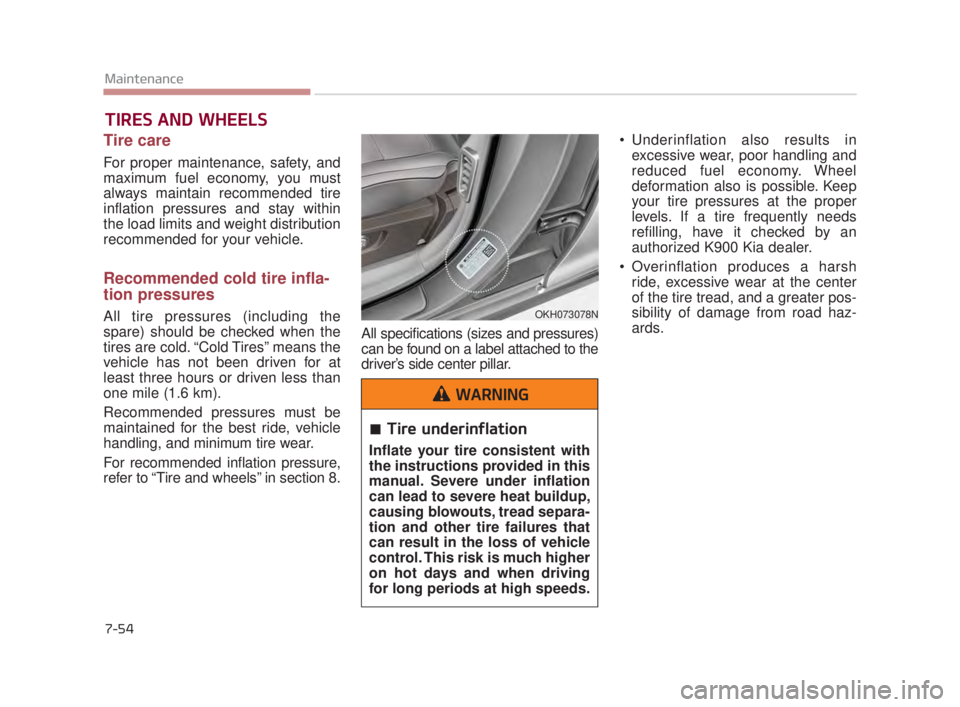
refer to “Tire and wheels” in section 8.All specifications (sizes and pressures)
can be found on a label attached to the
driver’s side center pillar. Underinflation also results in
excessive wear, poor handling and
reduced fuel economy. Wheel
deformation also is possible. Keep
your tire pressures at the proper
levels. If a tire frequently needs
refilling, have it checked by an
authorized K900 Kia dealer.
Overinflation produces a harsh ride, excessive wear at the center
of the tire tread, and a greater pos-
sibility of damage from road haz-
ards. OKH073078N
Tire underinflation
Inflate your tire consistent with
the instructions provided in this
manual. Severe under inflation
can lead to severe heat buildup,
causing blowouts, tread separa-
tion and other tire failures that
can result in the loss of vehicle
control. This risk is much higher
on hot days and when driving
for long periods at high speeds.
WARNING
KH USA 7:2015 3/25/2015 11:36 AM Page 54
Page 461 of 542
Maintenance
7
7-55
Warm tires normally exceed rec-ommended cold tire pressures by 4
to 6 psi (28 to 41 kPa). Do not
release air from warm tires to
adjust the pressure or the tires will
be underinflated.
Be sure to reinstall the tire inflation valve caps. Without the valve cap,
dirt or moisture could get into the
valve core and cause air leakage. If
a valve cap is missing, install a
new one as soon as possible. Always observe the following:
Check tire pressure when the tires
are cold. (After vehicle has been
parked for at least three hours or
hasn't been driven more than one
mile (1.6 km) since startup.)
Check the pressure of your spare tire each time you check the pres-
sure of other tires.
Never overload your vehicle. Be careful not to overload a vehicle
luggage rack if your vehicle is
equipped with one.
Worn, old tires can cause acci- dents. If your tread is badly worn,
or if your tires have been dam-
aged, replace them.Checking tire inflation pres-
sure
Check your tires once a month or
more.
Also, check the tire pressure of the
spare tire.
How to check
Use a good quality gage to check tire
pressure. You can not tell if your tires
are properly inflated simply by look-
ing at them. Radial tires may look
properly inflated even when they're
underinflated.
Check the tire's inflation pressure
when the tires are cold. - "Cold"
means your vehicle has been sitting
for at least three hours or driven no
more than 1 mile (1.6 km).
Tire Inflation
Overinflation or underinflation
can reduce tire life, adversely
affect vehicle handling, and
lead to sudden tire failure. This
could result in loss of vehicle
control and potential injury.
WARNING
KH USA 7:2015 3/25/2015 11:36 AM Page 55