height KIA K900 2016 Owner's Manual
[x] Cancel search | Manufacturer: KIA, Model Year: 2016, Model line: K900, Model: KIA K900 2016Pages: 542, PDF Size: 38.35 MB
Page 402 of 542
What to do in an emergency
6
6-29
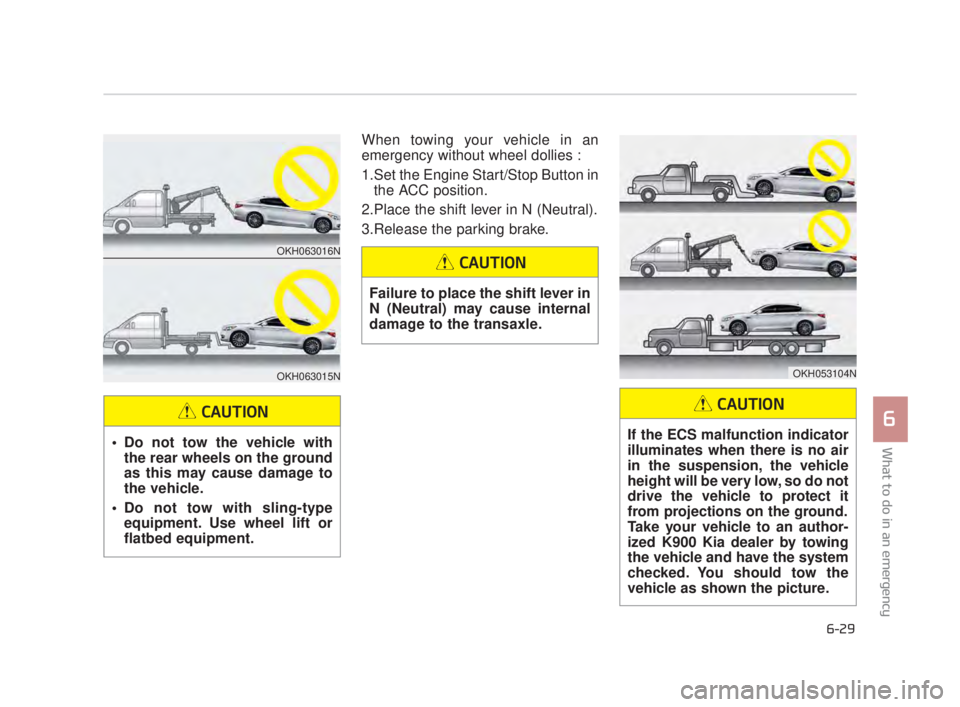
When towing your vehicle in an
emergency without wheel dollies :
1.Set the Engine Start/Stop Button inthe ACC position.
2.Place the shift lever in N (Neutral).
3.Release the parking brake.
OKH063016N
OKH063015N
Do not tow the vehicle with the rear wheels on the ground
as this may cause damage to
the vehicle.
Do not tow with sling-type equipment. Use wheel lift or
flatbed equipment.
CAUTION
OKH053104N
Failure to place the shift lever in
N (Neutral) may cause internal
damage to the transaxle.
CAUTION
If the ECS malfunction indicator
illuminates when there is no air
in the suspension, the vehicle
height will be very low, so do not
drive the vehicle to protect it
from projections on the ground.
Take your vehicle to an author-
ized K900 Kia dealer by towing
the vehicle and have the system
checked. You should tow the
vehicle as shown the picture.
CAUTION
KH USA 6:2015 3/25/2015 3:14 PM Page 29
Page 465 of 542
Maintenance
7
7-59
Compact spare tire replacement
A compact spare tire has a shorter
tread life than a regular size tire.
Replace it when you can see the
tread wear indicator bars on the tire.
The replacement compact spare tire
should be the same size and design
tire as the one provided with your
new vehicle and should be mounted
on the same compact spare tire
wheel. The compact spare tire is not
designed to be mounted on a regular
size wheel, and the compact spare
tire wheel is not designed for mount-
ing a regular size tire.
Wheel replacement
When replacing the metal wheels for
any reason, make sure the new
wheels are equivalent to the original
factory units in diameter, rim width
and offset.
✽NOTICE
The front tire size is different from
the rear tire size. So when you rotate
tires, check the tire and wheel size.
A wheel that is not the correct size
may adversely affect wheel and
bearing life, braking and stopping
abilities, handling characteristics,
ground clearance, body-to-tire clear-
ance, snow chain clearance,
speedometer and odometer calibra-
tion, headlight aim and bumper
height.
Tire traction
Tire traction can be reduced if you
drive on worn tires, tires that are
improperly inflated or on slippery
road surfaces. Tires should be
replaced when tread wear indicators
appear. To reduce the possibility of
losing control, slow down whenever
there is rain, snow or ice on the road.
Tire maintenance
In addition to proper inflation, correct
wheel alignment helps to decrease
tire wear. If you find a tire is worn
unevenly, have your dealer check the
wheel alignment.
When you have new tires installed,
make sure they are balanced. This
will increase vehicle ride comfort and
tire life. Additionally, a tire should
always be rebalanced if it is removed
from the wheel.
The compact spare tire is for
emergency use only. Do not
operate your vehicle on this
compact spare at speeds over
50 mph (80 km/h). The original
tire should be repaired or
replaced as soon as possible to
avoid failure of the spare possi-
bly leading to personal injury or
death.
WARNING
KH USA 7:2015 3/25/2015 11:36 AM Page 59
Page 466 of 542
7-60
Maintenance
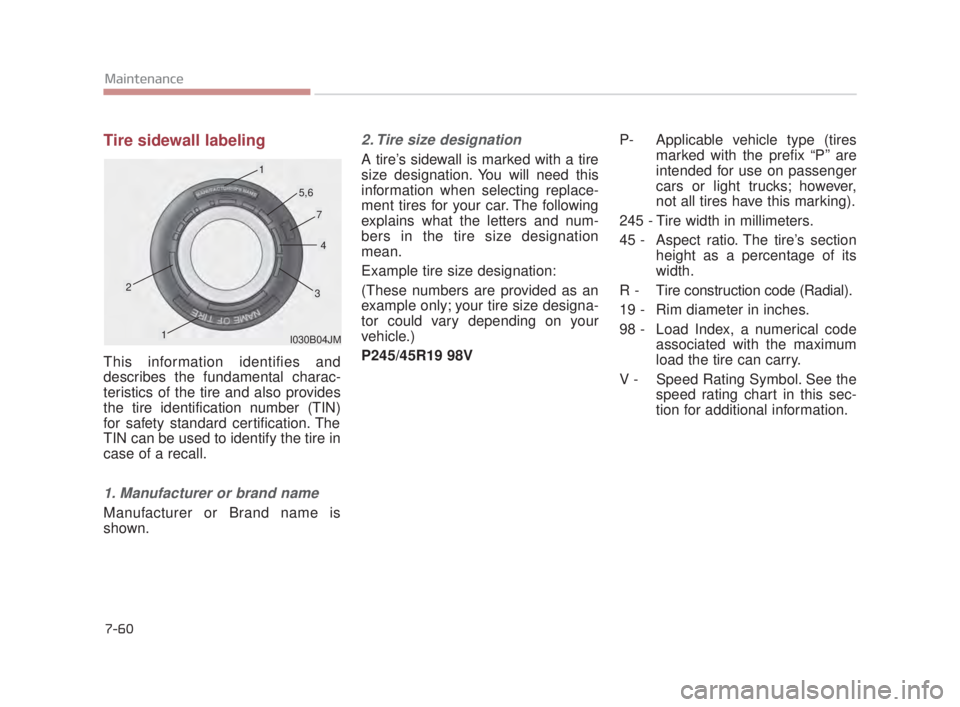
Tire sidewall labeling
This information identifies and
describes the fundamental charac-
teristics of the tire and also provides
the tire identification number (TIN)
for safety standard certification. The
TIN can be used to identify the tire in
case of a recall.
1. Manufacturer or brand name
Manufacturer or Brand name is
shown.
2. Tire size designation
A tire’s sidewall is marked with a tire
size designation. You will need this
information when selecting replace-
ment tires for your car. The following
explains what the letters and num-
bers in the tire size designation
mean.
Example tire size designation:
(These numbers are provided as an
example only; your tire size designa-
tor could vary depending on your
vehicle.)
P245/45R19 98VP- Applicable vehicle type (tires
marked with the prefix “P’’ are
intended for use on passenger
cars or light trucks; however,
not all tires have this marking).
245 - Tire width in millimeters.
45 - Aspect ratio. The tire’s section height as a percentage of its
width.
R - Tire construction code (Radial).
19 - Rim diameter in inches.
98 - Load Index, a numerical code associated with the maximum
load the tire can carry.
V - Speed Rating Symbol. See the speed rating chart in this sec-
tion for additional information.
I030B04JM
1
1
23
4
5,6
7
KH USA 7:2015 3/25/2015 11:36 AM Page 60
Page 471 of 542
Maintenance
7
7-65
It is not easy to recognize the tiredamage with your own eyes. But if
there is the slightest hint of tire
damage, even though you cannot
see the tire damage with your own
eyes, have the tire checked or
replaced because the tire damage
may cause air leakage from the
tire.
If the tire is damaged by driving on a rough road, off road, pothole,
manhole, or curb stone, it will not
be covered by the warranty.
You can find out the tire information on the tire sidewall.Tire terminology and defini-
tions
Air Pressure: The amount of air
inside the tire pressing outward on
the tire. Air pressure is expressed in
pounds per square inch (psi) or kilo-
pascal (kPa).
Accessory Weight: This means the
combined weight of optional acces-
sories. Some examples of optional
accessories are, automatic transmis-
sion, power seats, and air condition-
ing.
Aspect Ratio: The relationship of a
tire's height to its width.
Belt: A rubber coated layer of cords
that is located between the plies and
the tread. Cords may be made from
steel or other reinforcing materials.
Bead: The tire bead contains steel
wires wrapped by steel cords that
hold the tire onto the rim.
Bias Ply Tire: A pneumatic tire in
which the plies are laid at alternate
angles less than 90 degrees to the
centerline of the tread. Cold Tire Pressure:
The amount of
air pressure in a tire, measured in
pounds per square inch (psi) or kilo-
pascals (kPa) before a tire has built
up heat from driving.
Curb Weight: This means the weight
of a motor vehicle with standard and
optional equipment including the
maximum capacity of fuel, oil and
coolant, but without passengers and
cargo.
DOT Markings: A code molded into
the sidewall of a tire signifying that
the tire is in compliance with the U.S.
Department of Transportation motor
vehicle safety standards. The DOT
code includes the Tire Identification
Number (TIN), an alphanumeric des-
ignator which can also identify the
tire manufacturer, production plant,
brand and date of production.
GVWR: Gross Vehicle Weight Rating
GAWR FRT: Gross Axle Weight
Rating for the Front Axle.
GAWR RR: Gross Axle Weight
Rating for the Rear axle.
KH USA 7:2015 3/25/2015 11:36 AM Page 65
Page 516 of 542
8-2
Specifications, Consumer information and Reporting safety defects
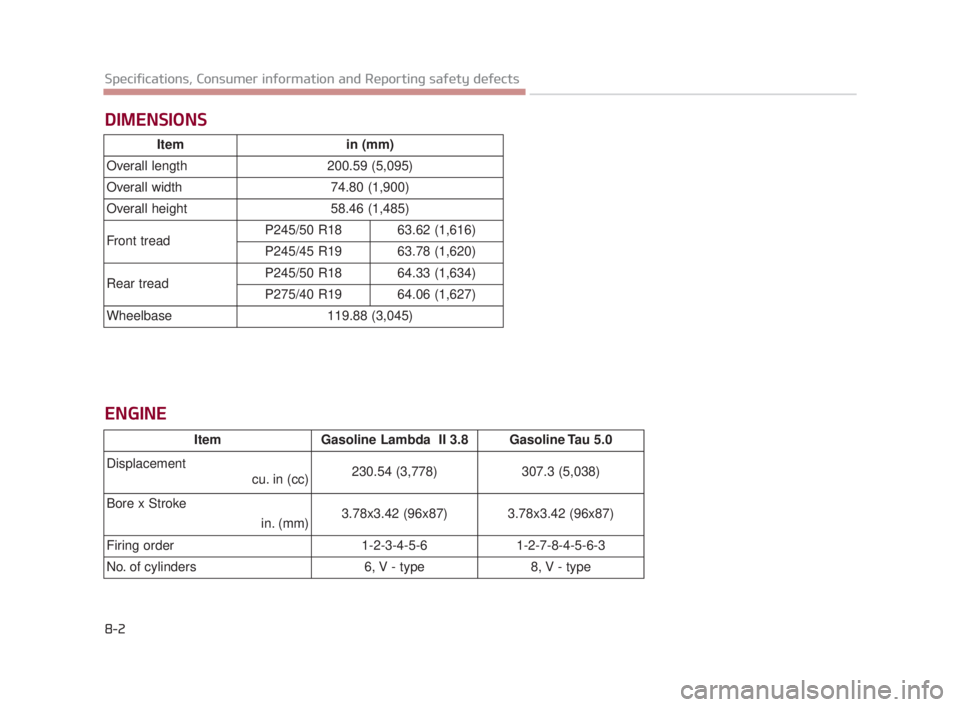
DIMENSIONS
Itemin (mm)
Overall length 200.59 (5,095)
Overall width 74.80 (1,900)
Overall height 58.46 (1,485)
Front tread P245/50 R18 63.62 (1,616)
P245/45 R1963.78 (1,620)
Rear tread P245/50 R18 64.33 (1,634)
P275/40 R1964.06 (1,627)
Wheelbase 119.88 (3,045)
ItemGasoline Lambda II 3.8Gasoline Tau 5.0
Displacement cu. in (cc) 230.54 (3,778)
307.3 (5,038)
Bore x Stroke in. (mm)3.78x3.42 (96x87)
3.78x3.42 (96x87)
Firing order 1-2-3-4-5-6
1-2-7-8-4-5-6-3
No. of cylinders 6, V - type
8, V - type
ENGINE
KH USA 8:2015 3/25/2015 3:17 PM Page 2