display KIA K900 2019 Manual PDF
[x] Cancel search | Manufacturer: KIA, Model Year: 2019, Model line: K900, Model: KIA K900 2019Pages: 580, PDF Size: 15.11 MB
Page 434 of 580
What to do in an emergency
86
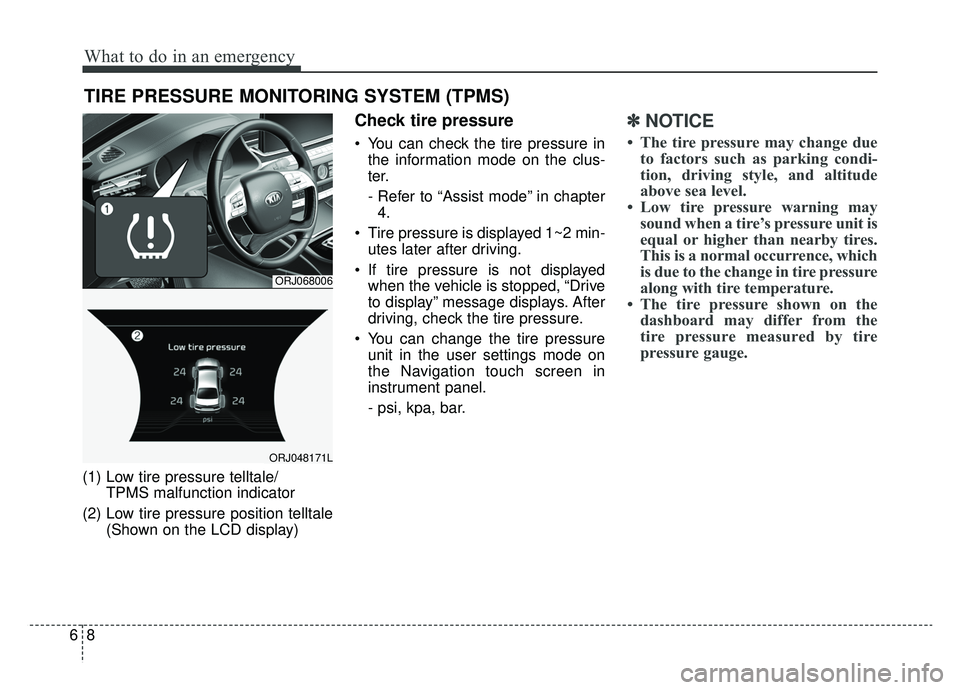
TIRE PRESSURE MONITORING SYSTEM (TPMS)
(1) Low tire pressure telltale/TPMS malfunction indicator
(2) Low tire pressure position telltale (Shown on the LCD display)
Check tire pressure
You can check the tire pressure inthe information mode on the clus-
ter.
- Refer to “Assist mode” in chapter4.
Tire pressure is displayed 1~2 min- utes later after driving.
If tire pressure is not displayed when the vehicle is stopped, “Drive
to display” message displays. After
driving, check the tire pressure.
You can change the tire pressure unit in the user settings mode on
the Navigation touch screen in
instrument panel.
- psi, kpa, bar.
✽ ✽ NOTICE
• The tire pressure may change due
to factors such as parking condi-
tion, driving style, and altitude
above sea level.
• Low tire pressure warning may sound when a tire’s pressure unit is
equal or higher than nearby tires.
This is a normal occurrence, which
is due to the change in tire pressure
along with tire temperature.
• The tire pressure shown on the dashboard may differ from the
tire pressure measured by tire
pressure gauge.
ORJ068006
ORJ048171L
Page 499 of 580
745
Maintenance
3. Checking tire life (TIN : TireIdentification Number)
Any tires that are over 6 years old,
based on the manufacturing date,
(including the spare tire) should be
replaced by new ones. You can find
the manufacturing date on the tire
sidewall (possibly on the inside of the
wheel), displaying the DOT Code.
The DOT Code is a series of num-
bers on a tire consisting of numbers
and English letters. The manufactur-
ing date is designated by the last four
digits (characters) of the DOT code.
DOT : XXXX XXXX OOOO
The front part of the DOT means a
plant code number, tire size and
tread pattern and the last four num-
bers indicate week and year manu-
factured.
For example:
DOT XXXX XXXX 1618 represents
that the tire was produced in the 16th
week of 2018.
4. Tire ply composition and mate-rial
The number of layers or plies of rub-
ber-coated fabric in the tire. Tire
manufacturers also must indicate the
materials in the tire, which include
steel, nylon, polyester, and others.
The letter "R" means radial ply con-
struction; the letter "D" means diago-
nal or bias ply construction; and the
letter "B" means belted-bias ply con-
struction.
5. Maximum permissible inflationpressure
This number is the greatest amount of
air pressure that should be put in the
tire. Do not exceed the maximum per-
missible inflation pressure. Refer to
the Tire and Loading Information label
for recommended inflation pressure.
6. Maximum load rating
This number indicates the maximum
load in kilograms and pounds that can
be carried by the tire. When replacing
the tires on the vehicle, always use a
tire that has the same load rating as
the factory installed tire.
7. Uniform tire quality grading
Quality grades can be found where
applicable on the tire sidewall
between tread shoulder and maxi-
mum section width.
For example:
TREADWEAR 440
TRACTION A
TEMPERATURE A
WARNING - Tire age
Replace tires within the recom-
mended time frame. Failure to
replace tires as recommended
can result in sudden tire failure,
which could lead to a loss of
control and an accident.
Page 509 of 580
755
Maintenance
✽ ✽NOTICE- Remodeling
Prohibited
Do not rewire your vehicle in any
way as doing so may affect the per-
formance of several safety features
in your vehicle. Rewiring your vehi-
cle may also void your warranty and
cause you to be responsible for any
subsequent vehicle damage which
may result.
✽ ✽ NOTICE- Window tinting pre-
caution
Window tint (especially metallic
film) might cause communication
errors or poor radio reception, and
malfunctioning automatic lighting
system due to reflections from the
mirror tint inside the vehicle. The
solution used might also leak into
the electronic components, causing
malfunctions or damage.
Inner panel fuse replacement
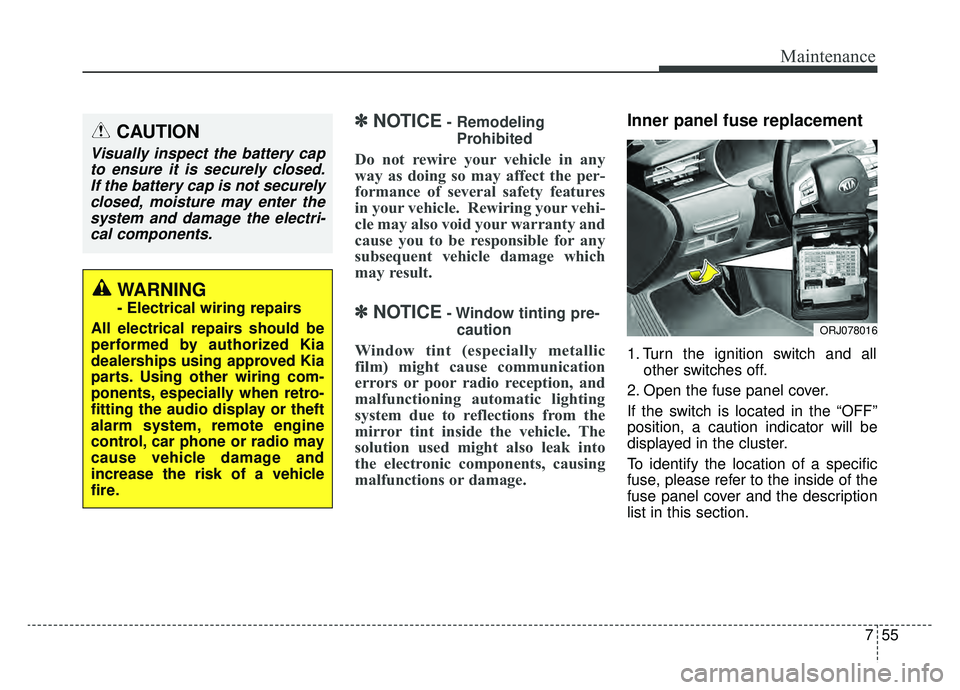
1. Turn the ignition switch and all other switches off.
2. Open the fuse panel cover.
If the switch is located in the “OFF”
position, a caution indicator will be
displayed in the cluster.
To identify the location of a specific
fuse, please refer to the inside of the
fuse panel cover and the description
list in this section.
CAUTION
Visually inspect the battery cap to ensure it is securely closed.If the battery cap is not securelyclosed, moisture may enter thesystem and damage the electri-cal components.
WARNING
- Electrical wiring repairs
All electrical repairs should be
performed by authorized Kia
dealerships using approved Kia
parts. Using other wiring com-
ponents, especially when retro-
fitting the audio display or theft
alarm system, remote engine
control, car phone or radio may
cause vehicle damage and
increase the risk of a vehicle
fire.
ORJ078016
Page 516 of 580
Maintenance
62
7
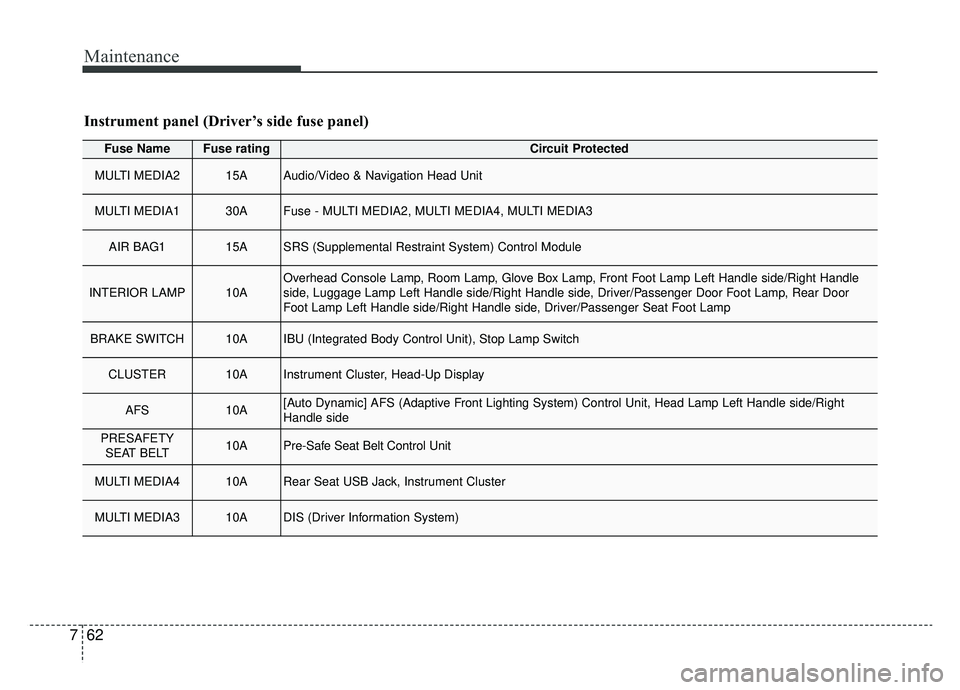
Fuse NameFuse ratingCircuit Protected
MULTI MEDIA215AAudio/Video & Navigation Head Unit
MULTI MEDIA130AFuse - MULTI MEDIA2, MULTI MEDIA4, MULTI MEDIA3
AIR BAG115ASRS (Supplemental Restraint System) Control Module
INTERIOR LAMP10AOverhead Console Lamp, Room Lamp, Glove Box Lamp, Front Foot Lamp Left Handle side/Right Handle
side, Luggage Lamp Left Handle side/Right Handle side, Driver/Passenger Door Foot Lamp, Rear Door
Foot Lamp Left Handle side/Right Handle side, Driver/Passenger Seat Foot Lamp
BRAKE SWITCH10AIBU (Integrated Body Control Unit), Stop Lamp Switch
CLUSTER10AInstrument Cluster, Head-Up Display
AFS10A[Auto Dynamic] AFS (Adaptive Front Lighting System) Control Unit, Head Lamp Left Handle side/Right
Handle side
PRESAFETY
SEAT BELT10APre-Safe Seat Belt Control Unit
MULTI MEDIA410ARear Seat USB Jack, Instrument Cluster
MULTI MEDIA310ADIS (Driver Information System)
Instrument panel (Driver’s side fuse panel)
Page 517 of 580
763
Maintenance
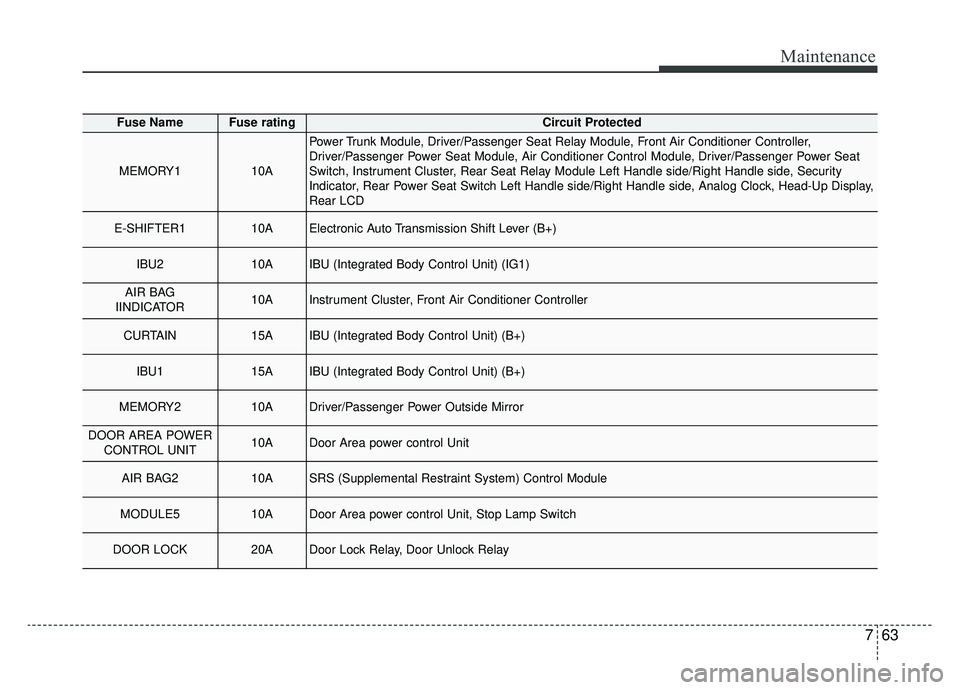
Fuse NameFuse ratingCircuit Protected
MEMORY110A
Power Trunk Module, Driver/Passenger Seat Relay Module, Front Air Conditioner Controller,
Driver/Passenger Power Seat Module, Air Conditioner Control Module, Driver/Passenger Power Seat
Switch, Instrument Cluster, Rear Seat Relay Module Left Handle side/Right Handle side, Security
Indicator, Rear Power Seat Switch Left Handle side/Right Handle side, Analog Clock, Head-Up Display,
Rear LCD
E-SHIFTER110AElectronic Auto Transmission Shift Lever (B+)
IBU210AIBU (Integrated Body Control Unit) (IG1)
AIR BAG
IINDICATOR10AInstrument Cluster, Front Air Conditioner Controller
CURTAIN15AIBU (Integrated Body Control Unit) (B+)
IBU115AIBU (Integrated Body Control Unit) (B+)
MEMORY210ADriver/Passenger Power Outside Mirror
DOOR AREA POWER CONTROL UNIT10ADoor Area power control Unit
AIR BAG210ASRS (Supplemental Restraint System) Control Module
MODULE510ADoor Area power control Unit, Stop Lamp Switch
DOOR LOCK20ADoor Lock Relay, Door Unlock Relay
Page 558 of 580
89
Specifications, Consumer information, Reporting safety defects
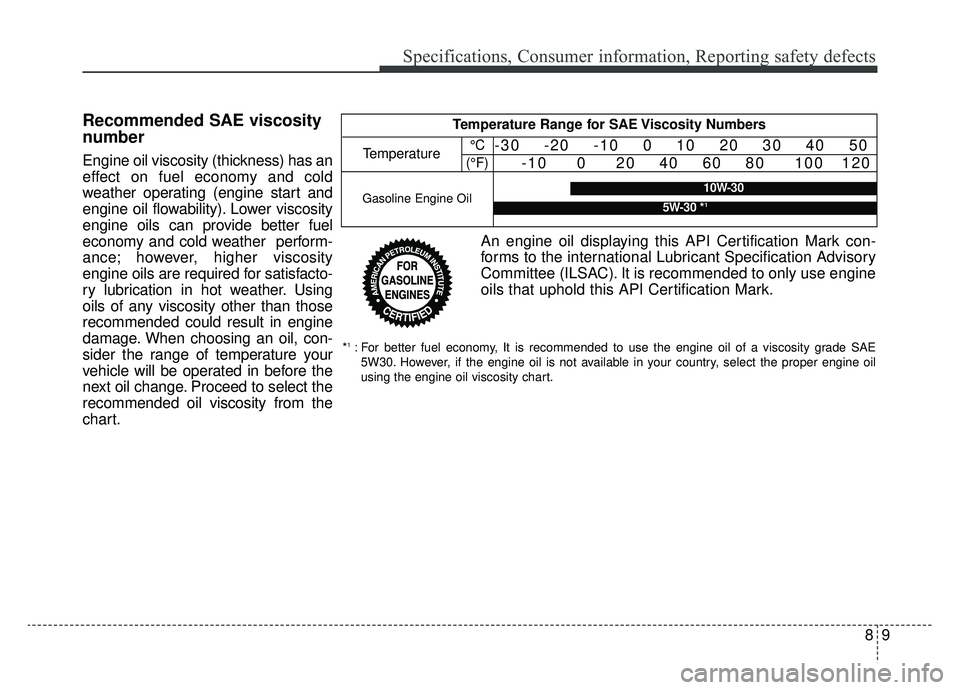
Recommended SAE viscosity
number
Engine oil viscosity (thickness) has an
effect on fuel economy and cold
weather operating (engine start and
engine oil flowability). Lower viscosity
engine oils can provide better fuel
economy and cold weather perform-
ance; however, higher viscosity
engine oils are required for satisfacto-
ry lubrication in hot weather. Using
oils of any viscosity other than those
recommended could result in engine
damage. When choosing an oil, con-
sider the range of temperature your
vehicle will be operated in before the
next oil change. Proceed to select the
recommended oil viscosity from the
chart.
An engine oil displaying this API Certification Mark con-
forms to the international Lubricant Specification Advisory
Committee (ILSAC). It is recommended to only use engine
oils that uphold this API Certification Mark.
Temperature Range for SAE Viscosity Numbers
Temperature°C
(°F)-30 -20 -10 0 10 20 30 40 50 -10 0 20 40 60 80 100 120
Gasoline Engine Oil10W-30
5W-30 *1
*1: For better fuel economy, It is recommended to use the engine oil of a viscosity grade SAE
5W30. However, if the engine oil is not available in your country, select the proper engine oil
using the engine oil viscosity chart.
Page 569 of 580
Index
4I
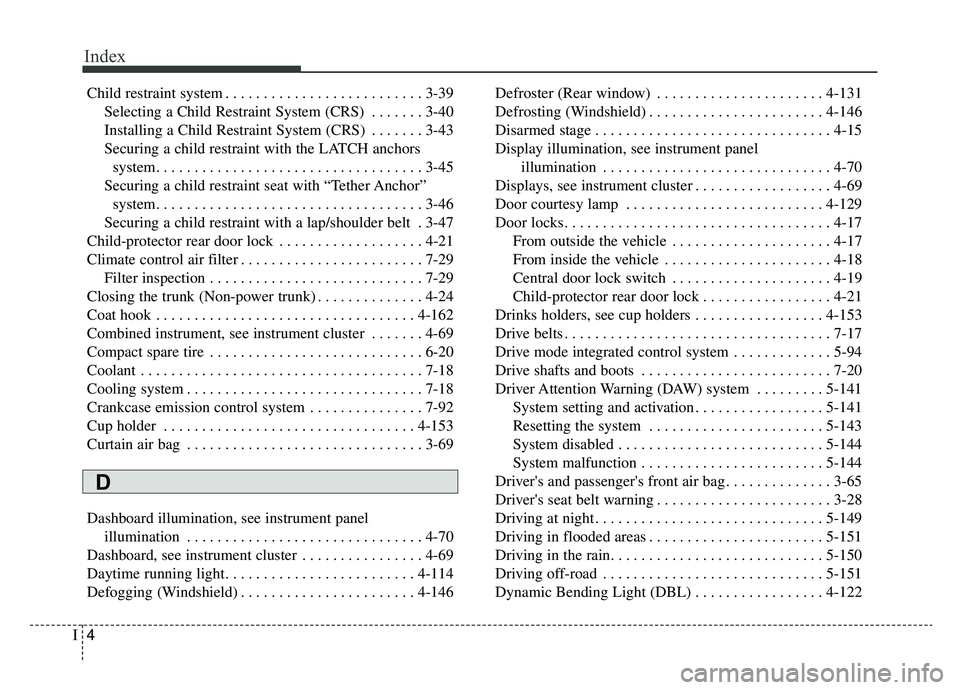
Child restraint system . . . . . . . . . . . . . . . . . . . . . . . . . . 3-39Selecting a Child Restraint System (CRS) . . . . . . . 3-40
Installing a Child Restraint System (CRS) . . . . . . . 3-43
Securing a child restraint with the LATCH anchors system. . . . . . . . . . . . . . . . . . . . . . . . . . . . . . . . . . . 3-\
45
Securing a child restraint seat with “Tether Anchor” system. . . . . . . . . . . . . . . . . . . . . . . . . . . . . . . . . . . 3-\
46
Securing a child restraint with a lap/shoulder belt . 3-47
Child-protector rear door lock . . . . . . . . . . . . . . . . . . . 4-21
Climate control air filter . . . . . . . . . . . . . . . . . . . . . . . . 7-29 Filter inspection . . . . . . . . . . . . . . . . . . . . . . . . . . . . 7-29
Closing the trunk (Non-power trunk) . . . . . . . . . . . . . . 4-24
Coat hook . . . . . . . . . . . . . . . . . . . . . . . . . . . . . . . . . . 4-16\
2
Combined instrument, see instrument cluster . . . . . . . 4-69
Compact spare tire . . . . . . . . . . . . . . . . . . . . . . . . . . . . 6-20
Coolant . . . . . . . . . . . . . . . . . . . . . . . . . . . . . . . . . . . . \
. 7-18
Cooling system . . . . . . . . . . . . . . . . . . . . . . . . . . . . . . . 7-18
Crankcase emission control system . . . . . . . . . . . . . . . 7-92
Cup holder . . . . . . . . . . . . . . . . . . . . . . . . . . . . . . . . . 4-153
Curtain air bag . . . . . . . . . . . . . . . . . . . . . . . . . . . . . . . 3-69
Dashboard illumination, see instrument panel illumination . . . . . . . . . . . . . . . . . . . . . . . . . . . . . . . 4-70
Dashboard, see instrument cluster . . . . . . . . . . . . . . . . 4-69
Daytime running light. . . . . . . . . . . . . . . . . . . . . . . . . 4-114
Defogging (Windshield) . . . . . . . . . . . . . . . . . . . . . . . 4-146 Defroster (Rear window) . . . . . . . . . . . . . . . . . . . . . . 4-131
Defrosting (Windshield) . . . . . . . . . . . . . . . . . . . . . . . 4-146
Disarmed stage . . . . . . . . . . . . . . . . . . . . . . . . . . . . . . . 4-15
Display illumination, see instrument panel
illumination . . . . . . . . . . . . . . . . . . . . . . . . . . . . . . 4-70
Displays, see instrument cluster . . . . . . . . . . . . . . . . . . 4-69
Door courtesy lamp . . . . . . . . . . . . . . . . . . . . . . . . . . 4-129
Door locks. . . . . . . . . . . . . . . . . . . . . . . . . . . . . . . . . . . 4-\
17 From outside the vehicle . . . . . . . . . . . . . . . . . . . . . 4-17
From inside the vehicle . . . . . . . . . . . . . . . . . . . . . . 4-18
Central door lock switch . . . . . . . . . . . . . . . . . . . . . 4-19
Child-protector rear door lock . . . . . . . . . . . . . . . . . 4-21
Drinks holders, see cup holders . . . . . . . . . . . . . . . . . 4-153
Drive belts . . . . . . . . . . . . . . . . . . . . . . . . . . . . . . . . . . . 7-\
17
Drive mode integrated control system . . . . . . . . . . . . . 5-94
Drive shafts and boots . . . . . . . . . . . . . . . . . . . . . . . . . 7-20
Driver Attention Warning (DAW) system . . . . . . . . . 5-141 System setting and activation . . . . . . . . . . . . . . . . . 5-141
Resetting the system . . . . . . . . . . . . . . . . . . . . . . . 5-143
System disabled . . . . . . . . . . . . . . . . . . . . . . . . . . . 5-144
System malfunction . . . . . . . . . . . . . . . . . . . . . . . . 5-144
Driver's and passenger's front air bag . . . . . . . . . . . . . . 3-65
Driver's seat belt warning . . . . . . . . . . . . . . . . . . . . . . . 3-28
Driving at night . . . . . . . . . . . . . . . . . . . . . . . . . . . . . . 5-149
Driving in flooded areas . . . . . . . . . . . . . . . . . . . . . . . 5-151
Driving in the rain. . . . . . . . . . . . . . . . . . . . . . . . . . . . 5-150
Driving off-road . . . . . . . . . . . . . . . . . . . . . . . . . . . . . 5-151
Dynamic Bending Light (DBL) . . . . . . . . . . . . . . . . . 4-122
D