warning lights KIA NIRO 2017 Owner's Manual
[x] Cancel search | Manufacturer: KIA, Model Year: 2017, Model line: NIRO, Model: KIA NIRO 2017Pages: 552, PDF Size: 14.92 MB
Page 294 of 552
Driving your vehicle
66
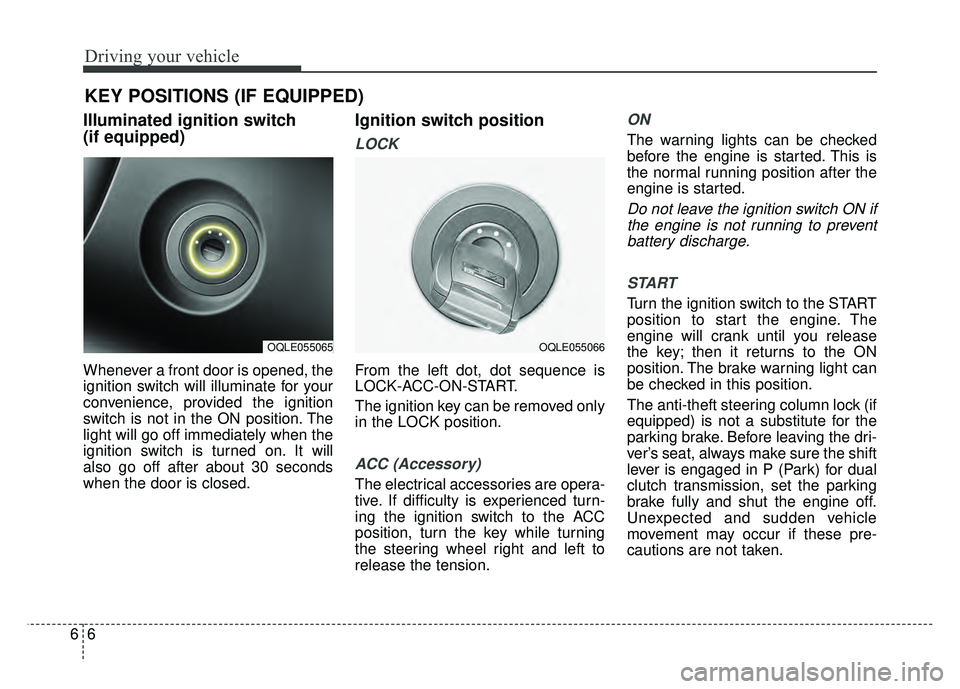
Illuminated ignition switch
(if equipped)
Whenever a front door is opened, the
ignition switch will illuminate for your
convenience, provided the ignition
switch is not in the ON position. The
light will go off immediately when the
ignition switch is turned on. It will
also go off after about 30 seconds
when the door is closed.
Ignition switch position
LOCK
From the left dot, dot sequence is
LOCK-ACC-ON-START.
The ignition key can be removed only
in the LOCK position.
ACC (Accessory)
The electrical accessories are opera-
tive. If difficulty is experienced turn-
ing the ignition switch to the ACC
position, turn the key while turning
the steering wheel right and left to
release the tension.
ON
The warning lights can be checked
before the engine is started. This is
the normal running position after the
engine is started.
Do not leave the ignition switch ON ifthe engine is not running to preventbattery discharge.
START
Turn the ignition switch to the START
position to start the engine. The
engine will crank until you release
the key; then it returns to the ON
position. The brake warning light can
be checked in this position.
The anti-theft steering column lock (if
equipped) is not a substitute for the
parking brake. Before leaving the dri-
ver’s seat, always make sure the shift
lever is engaged in P (Park) for dual
clutch transmission, set the parking
brake fully and shut the engine off.
Unexpected and sudden vehicle
movement may occur if these pre-
cautions are not taken.
KEY POSITIONS (IF EQUIPPED)
OQLE055065OQLE055066
Page 298 of 552
Driving your vehicle
10
6
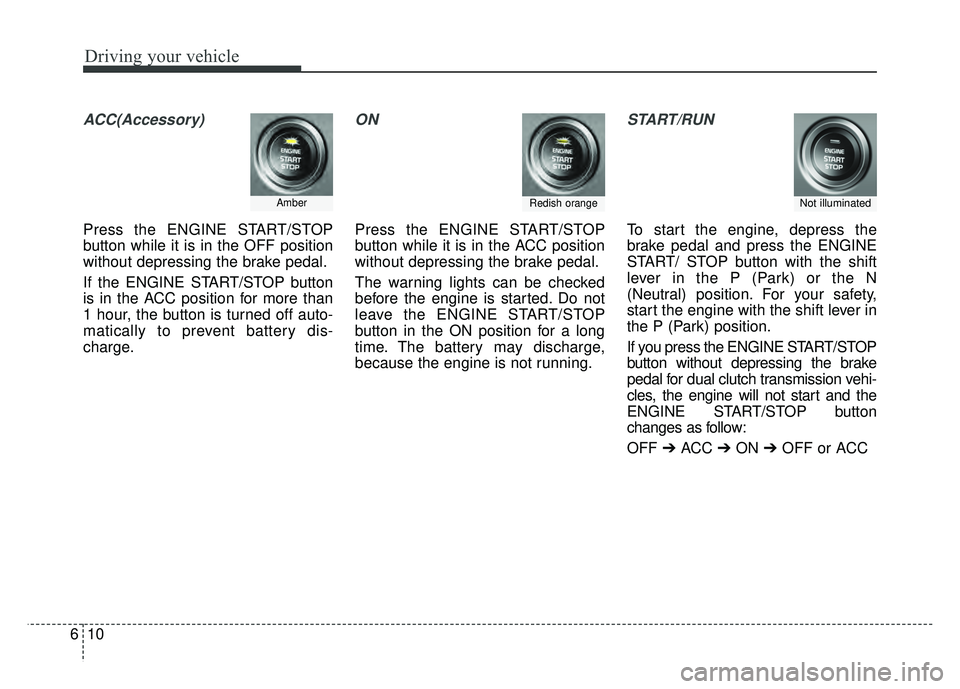
ACC(Accessory)
Press the ENGINE START/STOP
button while it is in the OFF position
without depressing the brake pedal.
If the ENGINE START/STOP button
is in the ACC position for more than
1 hour, the button is turned off auto-
matically to prevent battery dis-
charge.
ON
Press the ENGINE START/STOP
button while it is in the ACC position
without depressing the brake pedal.
The warning lights can be checked
before the engine is started. Do not
leave the ENGINE START/STOP
button in the ON position for a long
time. The battery may discharge,
because the engine is not running.
START/RUN
To start the engine, depress the
brake pedal and press the ENGINE
START/ STOP button with the shift
lever in the P (Park) or the N
(Neutral) position. For your safety,
start the engine with the shift lever in
the P (Park) position.
If you press the ENGINE START/STOP
button without depressing the brake
pedal for dual clutch transmission vehi-
cles, the engine will not start and the
ENGINE START/STOP button
changes as follow:
OFF ➔ACC ➔ON ➔OFF or ACC
Not illuminated AmberRedish orange
Page 365 of 552
677
Driving your vehicle
Conditions that cause missed
warnings and false warnings:
The lane is not visible due to snow,rain, debris, puddles or other envi-
ronmental conditions.
The brightness outside changes suddenly such as when
entering/exiting a tunnel.
The headlights are off at night or in a tunnel.
The color of the lane marking from the road is difficult to distinguish.
Driving on a steep grade or a curve.
Light such as street lights, sunlight or oncoming vehicle lights reflect
off of water on the road.
The lens or windshield is stained with foreign matters.
The sensor cannot detect the lane because of fog, heavy rain or
heavy snow.
The surrounding of the inside rear view mirror temperature is high
due to a direct ray of light. The lane is very wide or narrow.
The lane line is damaged or indis-
tinct.
Objects in the median or along the side of the road cast shadows over
the lane markings
The sensor cannot distinguish the lane from the road due to the
dust/dirt.
There are other markings similar to lane lines.
There are lane boundaries instead of markings.
The vehicle ahead is very close, obscuring the view of the lane
markings, or the vehicle ahead is
driving over the lane markings.
The vehicle vibrates heavily due to poor road conditions.
The lane number increases or decreases or the lane line are
crossing.
Putting something on the dash- board. Driving with the sun in front of you.
Driving in areas under construc-
tion.
Lanes are marked by more than two sets of lines.
The windshield is fogged by humid air in the vehicle.
This device complies with Part 15
of the FCC rules.
Operation is subject to the following
two conditions:
1. This device may not cause harm- ful interference, and
2. This device must accept any inter- ference received, including inter-
ference that may cause undesired
operation.
Page 383 of 552
What to do in an emergency
27
ROAD WARNING
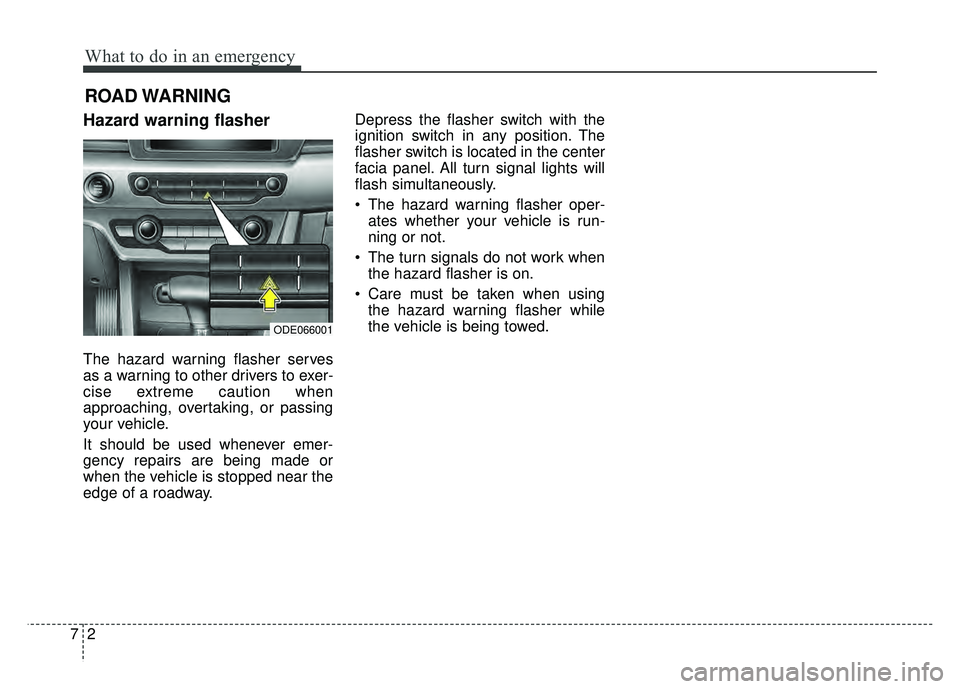
Hazard warning flasher
The hazard warning flasher serves
as a warning to other drivers to exer-
cise extreme caution when
approaching, overtaking, or passing
your vehicle.
It should be used whenever emer-
gency repairs are being made or
when the vehicle is stopped near the
edge of a roadway.Depress the flasher switch with the
ignition switch in any position. The
flasher switch is located in the center
facia panel. All turn signal lights will
flash simultaneously.
• The hazard warning flasher oper-
ates whether your vehicle is run-
ning or not.
The turn signals do not work when the hazard flasher is on.
Care must be taken when using the hazard warning flasher while
the vehicle is being towed.
ODE066001
Page 430 of 552
87
Maintenance
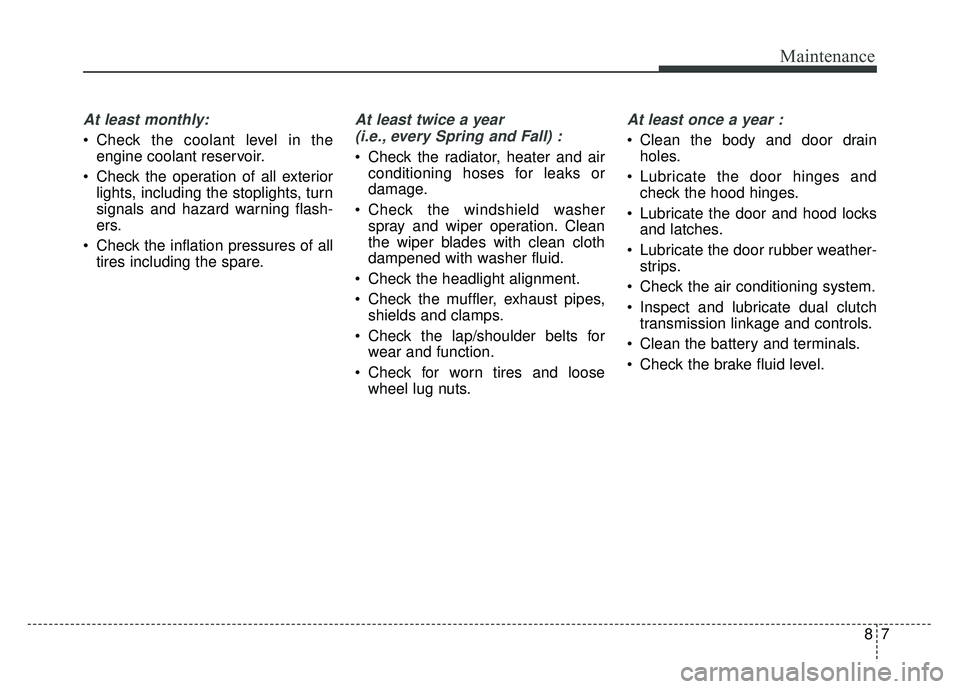
At least monthly:
Check the coolant level in theengine coolant reservoir.
Check the operation of all exterior lights, including the stoplights, turn
signals and hazard warning flash-
ers.
Check the inflation pressures of all tires including the spare.
At least twice a year
(i.e., every Spring and Fall) :
Check the radiator, heater and air conditioning hoses for leaks or
damage.
Check the windshield washer spray and wiper operation. Clean
the wiper blades with clean cloth
dampened with washer fluid.
Check the headlight alignment.
Check the muffler, exhaust pipes, shields and clamps.
Check the lap/shoulder belts for wear and function.
Check for worn tires and loose wheel lug nuts.
At least once a year :
Clean the body and door drainholes.
Lubricate the door hinges and check the hood hinges.
Lubricate the door and hood locks and latches.
Lubricate the door rubber weather- strips.
Check the air conditioning system.
Inspect and lubricate dual clutch transmission linkage and controls.
Clean the battery and terminals.
Check the brake fluid level.
Page 481 of 552
Maintenance
58
8
FUSES
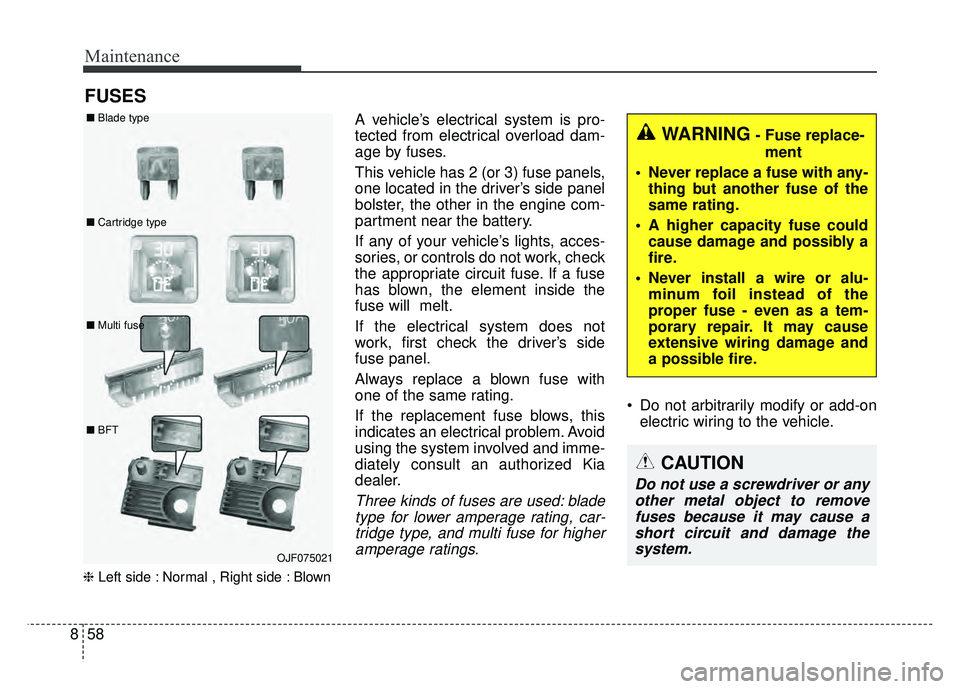
❈ Left side : Normal , Right side : Blown
A vehicle’s electrical system is pro-
tected from electrical overload dam-
age by fuses.
This vehicle has 2 (or 3) fuse panels,
one located in the driver’s side panel
bolster, the other in the engine com-
partment near the battery.
If any of your vehicle’s lights, acces-
sories, or controls do not work, check
the appropriate circuit fuse. If a fuse
has blown, the element inside the
fuse will melt.
If the electrical system does not
work, first check the driver’s side
fuse panel.
Always replace a blown fuse with
one of the same rating.
If the replacement fuse blows, this
indicates an electrical problem. Avoid
using the system involved and imme-
diately consult an authorized Kia
dealer.
Three kinds of fuses are used: blade
type for lower amperage rating, car-tridge type, and multi fuse for higheramperage ratings.
Do not arbitrarily modify or add-on electric wiring to the vehicle.
WARNING- Fuse replace-
ment
Never replace a fuse with any- thing but another fuse of the
same rating.
A higher capacity fuse could cause damage and possibly a
fire.
Never install a wire or alu- minum foil instead of the
proper fuse - even as a tem-
porary repair. It may cause
extensive wiring damage and
a possible fire.
CAUTION
Do not use a screwdriver or anyother metal object to removefuses because it may cause ashort circuit and damage thesystem.
OJF075021
■
Blade type
■ Cartridge type
■ Multi fuse
■ BFT
Page 498 of 552

875
Maintenance
LIGHT BULBS
Bulb replacement precaution
Please keep extra bulbs on hand
with appropriate wattage ratings in
case of emergencies.
Refer to “Bulb Wattage” in chapter 9.
When changing lamps, first turn off
the engine at a safe place, firmly
apply the parking brake and detach
the battery’s negative (-) terminal.
Use only bulbs of the specifiedwattage.✽ ✽ NOTICE
• If the light bulb or lamp connector
is removed while the lamp is still
on, the fuse box's electronic sys-
tem may log it as a malfunction.
Therefore, a lamp malfunction
incident may be recorded as a
Diagnostic Trouble Code (DTC) in
the fuse box.
• It is normal for an operating lamp to flicker momentarily. This is due
to a stabilization function of the
vehicle’s electronic control device.
If the lamp lights up normally
after momentarily blinking, then
it is functioning as normal.
However, if the lamp continues to
flicker several times or turns off
completely, there may be an error
in the vehicle’s electronic control
device. Please have the vehicle
checked by an authorized Kia
dealer immediately.
WARNING- Working on
the lights
Prior to working on the light,
firmly apply the parking brake,
ensure that the engine
start/stop button is in OFF posi-
tion and turn off the lights to
avoid sudden movement of the
vehicle and burning your fingers
or receiving an electric shock.
CAUTION -Light replace-
ment
Be sure to replace the burned- out bulb with one of the samewattage rating. Otherwise, itmay cause damage to the fuseor electric wiring system.
CAUTION -Headlamp
Lens
To prevent damage, do notclean the headlamp lens withchemical solvents or strongdetergents.
Page 544 of 552

I7
Index
Gauges . . . . . . . . . . . . . . . . . . . . . . . . . . . . . . . . . . . . \
. 4-53Distance to empty. . . . . . . . . . . . . . . . . . . . . . . . . . . 4-56
Fuel Gauge . . . . . . . . . . . . . . . . . . . . . . . . . . . . . . . . 4-55
Hybrid Battery SOC (State of Charge) Gauge . . . . 4-54
Hybrid System Gauge . . . . . . . . . . . . . . . . . . . . . . . 4-53
Odometer . . . . . . . . . . . . . . . . . . . . . . . . . . . . . . . . . 4-57
Outside Temperature Gauge . . . . . . . . . . . . . . . . . . . 4-57
Speedometer . . . . . . . . . . . . . . . . . . . . . . . . . . . . . . . 4-53
Glove box . . . . . . . . . . . . . . . . . . . . . . . . . . . . . . . . . . 4-13\
3
Gross vehicle weight. . . . . . . . . . . . . . . . . . . . . . . . . . . . 9-5
Hazard warning flasher . . . . . . . . . . . . . . . . . . . . . . . . . . 7-2
Hazardous driving conditions . . . . . . . . . . . . . . . . . . . . 6-80
Headlamp (HID type) bulb replacement . . . . . . . . . . . 8-77
Headlamp (High/Low beam) bulb replacement . . . . . . 8-78
Headlight (Headlamp) escort function . . . . . . . . . . . . 4-100
Headlight position. . . . . . . . . . . . . . . . . . . . . . . . . . . . 4-101
Headrest (rear) . . . . . . . . . . . . . . . . . . . . . . . . . . . . . . . 3-14
Headrest(front) . . . . . . . . . . . . . . . . . . . . . . . . . . . . . . . 3-11
Heated steering wheel. . . . . . . . . . . . . . . . . . . . . . . . . . 4-44
HEV power train . . . . . . . . . . . . . . . . . . . . . . . . . . . . . . . 1-5
High - beam operation . . . . . . . . . . . . . . . . . . . . . . . . 4-102
High mounted stop lamp bulb replacement . . . . . . . . . 8-84
Highway driving . . . . . . . . . . . . . . . . . . . . . . . . . . . . . . 6-84 Hill-start assist control (HAC) . . . . . . . . . . . . . . . . . . . 6-34
Hood . . . . . . . . . . . . . . . . . . . . . . . . . . . . . . . . . . . . \
. . . 4-32
Horn . . . . . . . . . . . . . . . . . . . . . . . . . . . . . . . . . . . . \
. . . 4-45
Hybrid Battery SOC (State of Charge) Gauge . . . . . . . 4-54
Hybrid System Gauge. . . . . . . . . . . . . . . . . . . . . . . . . . 4-53
If an accident occurs . . . . . . . . . . . . . . . . . . . . . . . . . . . 7-42
Ignition switch illumination . . . . . . . . . . . . . . . . . . . . . . 6-6
Ignition switch position . . . . . . . . . . . . . . . . . . . . . . . . . 6-6
Indicator Lights. . . . . . . . . . . . . . . . . . . . . . . . . . . . . . . 4-85
Inflation conditions(Air bags) . . . . . . . . . . . . . . . . . . . 3-64
Inside rearview mirror . . . . . . . . . . . . . . . . . . . . . . . . . 4-46
Instrument cluster . . . . . . . . . . . . . . . . . . . . . . . . . . . . . 4-51
Coasting guide . . . . . . . . . . . . . . . . . . . . . . . . . . . . . 4-70
Indicator Lights . . . . . . . . . . . . . . . . . . . . . . . . . . . . 4-85
Instrument Cluster Control. . . . . . . . . . . . . . . . . . . . 4-52
LCD Modes . . . . . . . . . . . . . . . . . . . . . . . . . . . . . . . 4-65
LCD window . . . . . . . . . . . . . . . . . . . . . . . . . . . . . . 4-59
LCD window Control. . . . . . . . . . . . . . . . . . . . . . . . 4-52
Service Mode . . . . . . . . . . . . . . . . . . . . . . . . . . . . . . 4-66
User settings mode . . . . . . . . . . . . . . . . . . . . . . . . . . 4-67
Warning and Indicator lights . . . . . . . . . . . . . . . . . . 4-78
Warning lights . . . . . . . . . . . . . . . . . . . . . . . . . . . . . 4-78
Instrument panel overview . . . . . . . . . . . . . . . . . . . . . . . 2-5
Interior care. . . . . . . . . . . . . . . . . . . . . . . . . . . . . . . . . . 8-93\
Interior features. . . . . . . . . . . . . . . . . . . . . . . . . . . . . . 4-136
H
I
G
Page 551 of 552
Index
14I
Tire and loading information label. . . . . . . . . . . . . . 6-89
Vehicle stability management (VSM) . . . . . . . . . . . . . 6-32
Vehicle weight . . . . . . . . . . . . . . . . . . . . . . . . . . . . . . . 6-93
Warning and Indicator lights . . . . . . . . . . . . . . . . . . . . 4-78
Warning lights . . . . . . . . . . . . . . . . . . . . . . . . . . . . . . . . 4-78
Warning Messages . . . . . . . . . . . . . . . . . . . . . . . . . . . . 4-71
Washer fluid . . . . . . . . . . . . . . . . . . . . . . . . . . . . . . . . . 8-34 Checking the washer fluid level . . . . . . . . . . . . . . . 8-34
Welcome system . . . . . . . . . . . . . . . . . . . . . . . . . . . . . 4-112
Wheel alignment and tire balance . . . . . . . . . . . . . . . . 8-46
Wheel replacement . . . . . . . . . . . . . . . . . . . . . . . . . . . . 8-47
Windows . . . . . . . . . . . . . . . . . . . . . . . . . . . . . . . . . . . . \
4-27 Power window lock button. . . . . . . . . . . . . . . . . . . . 4-30
Windshield defrosting and defogging. . . . . . . . . . . . . 4-129
Windshield washers . . . . . . . . . . . . . . . . . . . . . . . . . . 4-106
Windshield wipers . . . . . . . . . . . . . . . . . . . . . . . . . . . 4-105
Winter driving . . . . . . . . . . . . . . . . . . . . . . . . . . . . . . . . 6-85 Snow tires . . . . . . . . . . . . . . . . . . . . . . . . . . . . . . . . . 6-85
Tire chains . . . . . . . . . . . . . . . . . . . . . . . . . . . . . . . . 6-86
Wiper blades . . . . . . . . . . . . . . . . . . . . . . . . . . . . . . . . . 8-40 Blade inspection . . . . . . . . . . . . . . . . . . . . . . . . . . . . 8-40
Blade replacement . . . . . . . . . . . . . . . . . . . . . . . . . . 8-40
Wipers and washers . . . . . . . . . . . . . . . . . . . . . . . . . . 4-105 Rear window wiper and washer . . . . . . . . . . . . . . . 4-107
Windshield washers . . . . . . . . . . . . . . . . . . . . . . . . 4-106 Windshield wipers . . . . . . . . . . . . . . . . . . . . . . . . . 4-105
Wireless smart phone charging system . . . . . . . . . . . 4-142
W