climate control KIA NIRO 2018 User Guide
[x] Cancel search | Manufacturer: KIA, Model Year: 2018, Model line: NIRO, Model: KIA NIRO 2018Pages: 616, PDF Size: 18.3 MB
Page 278 of 616
4145
Features of your vehicle
For maximum defrosting, set thetemperature control to the extreme
right/hot position and the fan speed
control to the highest speed.
If warm air to the floor is desired while defrosting or defogging, set
the mode to the floor-defrost posi-
tion.
Before driving, clear all snow and ice from the windshield, rear win-
dow, outside rear view mirrors, and
all side windows.
Clear all snow and ice from the hood and air inlet in the cowl grill to
improve heater and defroster effi-
ciency and to reduce the probabili-
ty of fogging up the inside of the
windshield.Automatic climate control
system
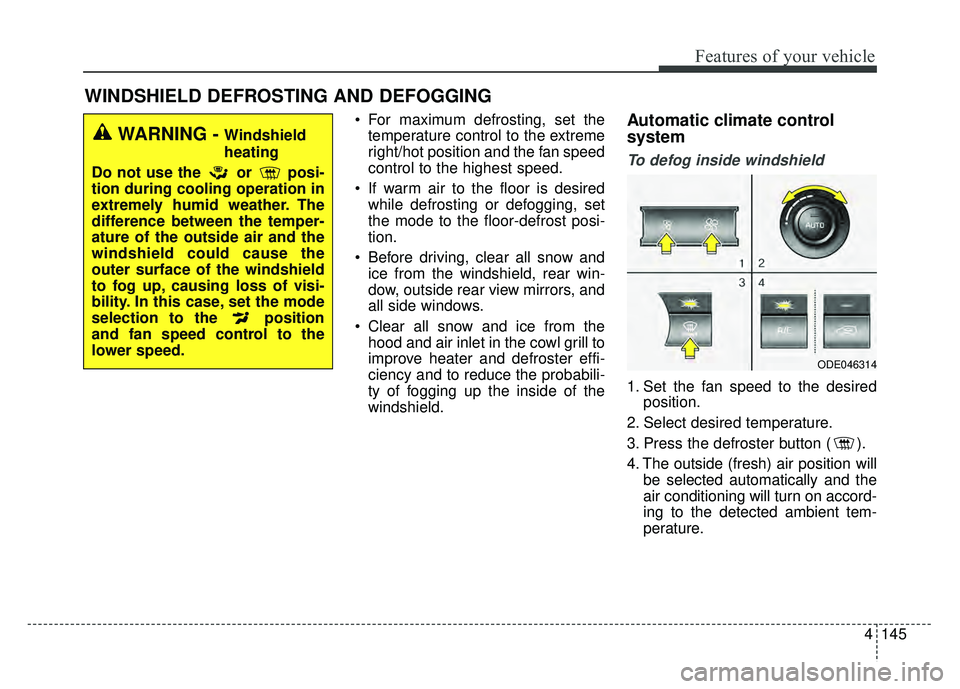
To defog inside windshield
1. Set the fan speed to the desired position.
2. Select desired temperature.
3. Press the defroster button ( ).
4. The outside (fresh) air position will be selected automatically and the
air conditioning will turn on accord-
ing to the detected ambient tem-
perature.
WINDSHIELD DEFROSTING AND DEFOGGING
WARNING - Windshield
heating
Do not use the or posi-
tion during cooling operation in
extremely humid weather. The
difference between the temper-
ature of the outside air and the
windshield could cause the
outer surface of the windshield
to fog up, causing loss of visi-
bility. In this case, set the mode
selection to the position
and fan speed control to the
lower speed.
ODE046314
Page 280 of 616
4147
Features of your vehicle
Automatic climate control system
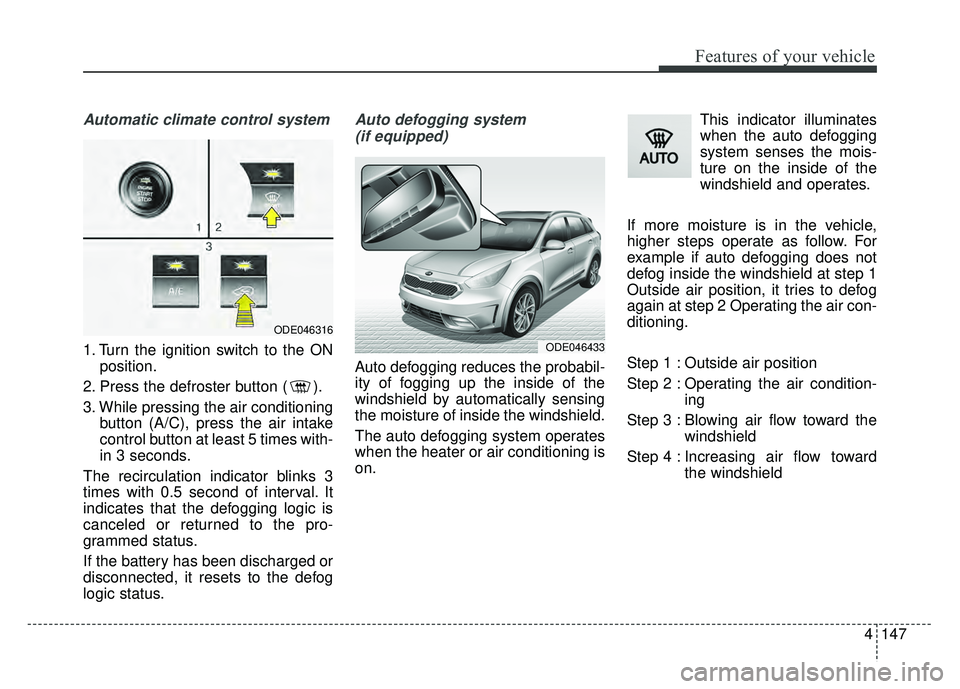
1. Turn the ignition switch to the ONposition.
2. Press the defroster button ( ).
3. While pressing the air conditioning button (A/C), press the air intake
control button at least 5 times with-
in 3 seconds.
The recirculation indicator blinks 3
times with 0.5 second of interval. It
indicates that the defogging logic is
canceled or returned to the pro-
grammed status.
If the battery has been discharged or
disconnected, it resets to the defog
logic status.
Auto defogging system (if equipped)
Auto defogging reduces the probabil-
ity of fogging up the inside of the
windshield by automatically sensing
the moisture of inside the windshield.
The auto defogging system operates
when the heater or air conditioning is
on. This indicator illuminates
when the auto defogging
system senses the mois-
ture on the inside of the
windshield and operates.
If more moisture is in the vehicle,
higher steps operate as follow. For
example if auto defogging does not
defog inside the windshield at step 1
Outside air position, it tries to defog
again at step 2 Operating the air con-
ditioning.
Step 1 : Outside air position
Step 2 : Operating the air condition- ing
Step 3 : Blowing air flow toward the windshield
Step 4 : Increasing air flow toward the windshield
ODE046433
ODE046316
Page 281 of 616

Features of your vehicle
148
4
To cancel or reset the Auto Defogging
System
Press the front windshield defroster
button for 3 seconds when the igni-
tion switch is in the ON position.
- A Type
When the ADS system is canceled,
ADS OFF symbol will blink 3 times
per 0.5 sec and the position ADS
OFF will be displayed on the climate
control information screen.
When the ADS system is reset, ADS
OFF symbol will blink 6 times per
0.25 sec and the position ADS OFF
will be disappeared on the climate
control information screen.
- B Type
When the ADS system is canceled,
Indicator on the button will blink 3
times per 0.5 sec.
When the ADS system is reset,
Indicator on the button will blink 6
times per 0.25 sec. Do not remove the sensor cover
located on the upper end of the pas-
senger side windshield glass.
Damage to the system parts could
occur and may not be covered by
your vehicle warranty.
When the ignition switch is in the ON
position, the clean air function turns
on automatically.
Also, the clean air function turns off
automatically, when the ignition
switch turns to the OFF position.
ODE046321L
CLEAN AIR (IF EQUIPPED)
Page 358 of 616
Driving your vehicle
24
6
Wet brakes may impair the vehicle’s
ability to safely slow down; the vehi-
cle may also pull to one side when
the brakes are applied. Applying the
brakes lightly will indicate whether
they have been affected in this way.
Always test your brakes in this fash-
ion after driving through deep water.
To dry the brakes, apply them lightly
while maintaining a safe forward
speed until brake performance
returns to normal.
✽ ✽
NOTICE
Do not depress the brake pedal con-
tinuously without the “ ” indica-
tor ON. The battery may be dis-
charged.
In the event of brake failure
If service brakes fail to operate while
the vehicle is in motion, you can
make an emergency stop with the
parking brake. The stopping dis-
tance, however, will be much greater
than normal.
Disc brakes wear indicator
When your brake pads are worn and
new pads are required, you will hear
a high-pitched warning sound from
your front brakes or rear brakes. You
may hear this sound come and go or
it may occur whenever you depress
the brake pedal.
Please remember that some driving
conditions or climates may cause a
brake squeal when you first apply (or
lightly apply) the brakes. This is nor-
mal and does not indicate a problem
with your brakes.
Always replace the front or rear
brake pads as pairs.
WARNING- Parking
brake
Avoid applying the parking
brake to stop the vehicle while it
is moving except in an emer-
gency situation. Applying the
parking brake while the vehicle
is moving at normal speeds can
cause a sudden loss of control
of the vehicle. If you must use
the parking brake to stop the
vehicle, use great caution in
applying the brake.
CAUTION- Replace brake pads
Do not continue to drive withworn brake pads. Continuing todrive with worn brake pads candamage the braking system andresult in costly brake repairs.
Page 441 of 616
75
What to do in an emergency
EMERGENCY STARTING
Before Jump Starting
(For Hybrid)
Over discharge of 12V battery
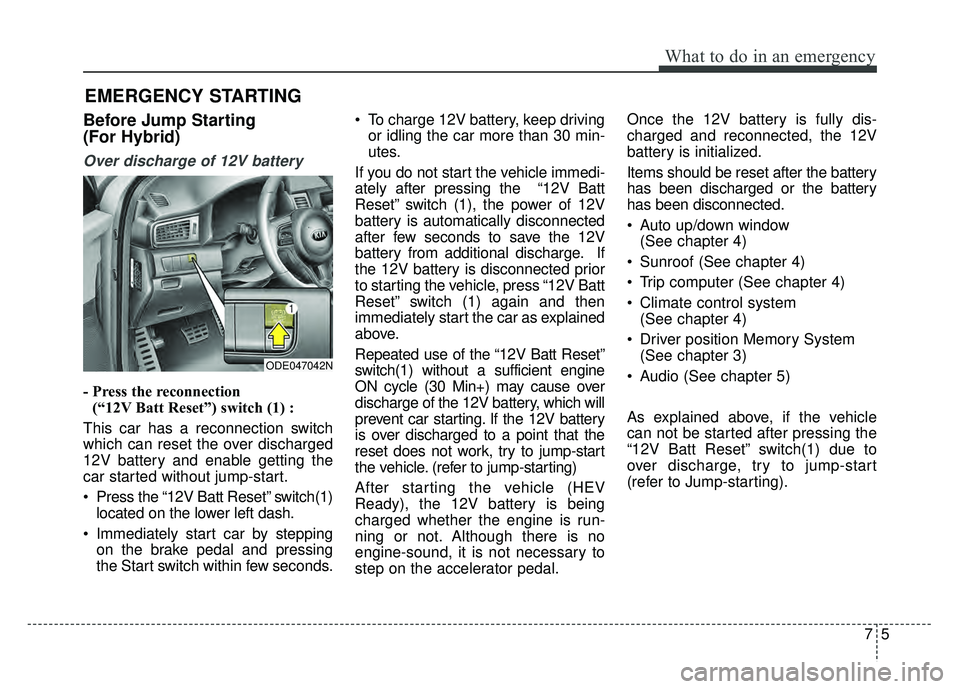
- Press the reconnection(“12V Batt Reset”) switch (1) :
This car has a reconnection switch
which can reset the over discharged
12V battery and enable getting the
car started without jump-start.
Press the “12V Batt Reset” switch(1) located on the lower left dash.
Immediately start car by stepping on the brake pedal and pressing
the Start switch within few seconds. To charge 12V battery, keep driving
or idling the car more than 30 min-
utes.
If you do not start the vehicle immedi-
ately after pressing the “12V Batt
Reset” switch (1), the power of 12V
battery is automatically disconnected
after few seconds to save the 12V
battery from additional discharge. If
the 12V battery is disconnected prior
to starting the vehicle, press “12V Batt
Reset” switch (1) again and then
immediately start the car as explained
above.
Repeated use of the “12V Batt Reset”
switch(1) without a sufficient engine
ON cycle (30 Min+) may cause over
discharge of the 12V battery, which will
prevent car starting. If the 12V battery
is over discharged to a point that the
reset does not work, try to jump-start
the vehicle. (refer to jump-starting)
After starting the vehicle (HEV
Ready), the 12V battery is being
charged whether the engine is run-
ning or not. Although there is no
engine-sound, it is not necessary to
step on the accelerator pedal. Once the 12V battery is fully dis-
charged and reconnected, the 12V
battery is initialized.
Items should be reset after the battery
has been discharged or the battery
has been disconnected.
Auto up/down window
(See chapter 4)
Sunroof (See chapter 4)
Trip computer (See chapter 4)
Climate control system (See chapter 4)
Driver position Memory System (See chapter 3)
Audio (See chapter 5)
As explained above, if the vehicle
can not be started after pressing the
“12V Batt Reset” switch(1) due to
over discharge, try to jump-start
(refer to Jump-starting).
ODE047042N
Page 470 of 616
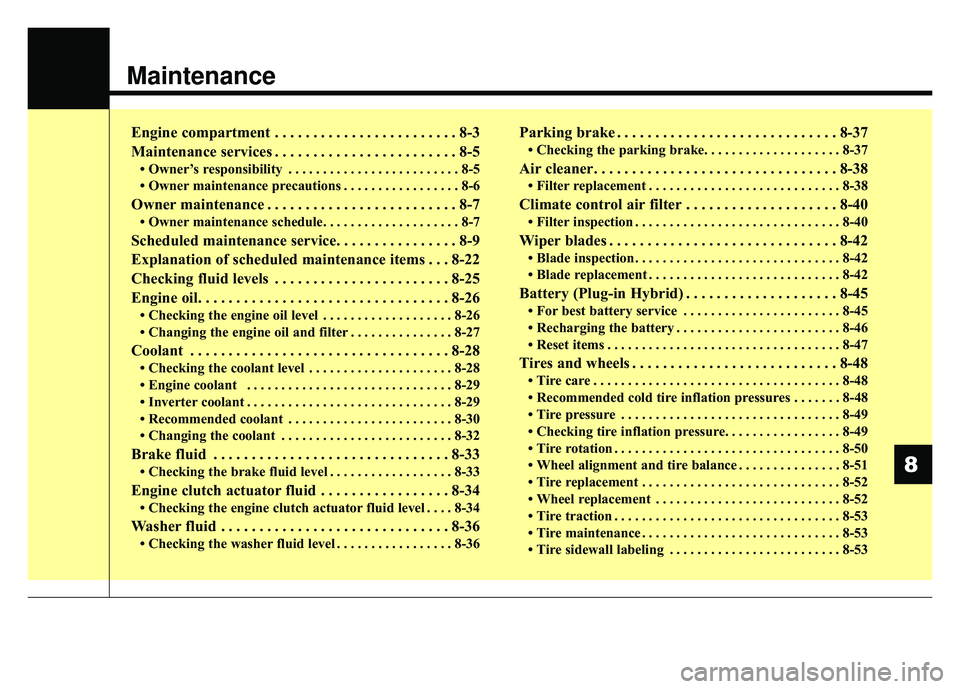
Maintenance
Engine compartment . . . . . . . . . . . . . . . . . . . . . . . . 8-3
Maintenance services . . . . . . . . . . . . . . . . . . . . . . . . 8-5
• Owner’s responsibility . . . . . . . . . . . . . . . . . . . . . . . . . 8-5
• Owner maintenance precautions . . . . . . . . . . . . . . . . . 8-6
Owner maintenance . . . . . . . . . . . . . . . . . . . . . . . . . 8-7
• Owner maintenance schedule. . . . . . . . . . . . . . . . . . . . 8-7
Scheduled maintenance service. . . . . . . . . . . . . . . . 8-9
Explanation of scheduled maintenance items . . . 8-22
Checking fluid levels . . . . . . . . . . . . . . . . . . . . . . . 8-25
Engine oil. . . . . . . . . . . . . . . . . . . . . . . . . . . . . . . . . 8-26
• Checking the engine oil level . . . . . . . . . . . . . . . . . . . 8-26
• Changing the engine oil and filter . . . . . . . . . . . . . . . 8-27
Coolant . . . . . . . . . . . . . . . . . . . . . . . . . . . . . . . . . . 8-28\
• Checking the coolant level . . . . . . . . . . . . . . . . . . . . . 8-28
• Engine coolant . . . . . . . . . . . . . . . . . . . . . . . . . . . . . . 8-29
• Inverter coolant . . . . . . . . . . . . . . . . . . . . . . . . . . . . . . 8-29
• Recommended coolant . . . . . . . . . . . . . . . . . . . . . . . . 8-30
• Changing the coolant . . . . . . . . . . . . . . . . . . . . . . . . . 8-32
Brake fluid . . . . . . . . . . . . . . . . . . . . . . . . . . . . . . . 8-33
• Checking the brake fluid level . . . . . . . . . . . . . . . . . . 8-33
Engine clutch actuator fluid . . . . . . . . . . . . . . . . . 8-34
• Checking the engine clutch actuator fluid level . . . . 8-34
Washer fluid . . . . . . . . . . . . . . . . . . . . . . . . . . . . . . 8-36
• Checking the washer fluid level . . . . . . . . . . . . . . . . . 8-36
Parking brake . . . . . . . . . . . . . . . . . . . . . . . . . . . . . 8-37
• Checking the parking brake. . . . . . . . . . . . . . . . . . . . 8-37
Air cleaner. . . . . . . . . . . . . . . . . . . . . . . . . . . . . . . . 8-38
• Filter replacement . . . . . . . . . . . . . . . . . . . . . . . . . . . . 8-38
Climate control air filter . . . . . . . . . . . . . . . . . . . . 8-40
• Filter inspection . . . . . . . . . . . . . . . . . . . . . . . . . . . . . . 8-40
Wiper blades . . . . . . . . . . . . . . . . . . . . . . . . . . . . . . 8-42
• Blade inspection . . . . . . . . . . . . . . . . . . . . . . . . . . . . . . 8-42
• Blade replacement . . . . . . . . . . . . . . . . . . . . . . . . . . . . 8-42
Battery (Plug-in Hybrid) . . . . . . . . . . . . . . . . . . . . 8-45
• For best battery service . . . . . . . . . . . . . . . . . . . . . . . 8-45
• Recharging the battery . . . . . . . . . . . . . . . . . . . . . . . . 8-46
• Reset items . . . . . . . . . . . . . . . . . . . . . . . . . . . . . . . . . . 8-47\
Tires and wheels . . . . . . . . . . . . . . . . . . . . . . . . . . . 8-48
• Tire care . . . . . . . . . . . . . . . . . . . . . . . . . . . . . . . . . . . . \
8-48
• Recommended cold tire inflation pressures . . . . . . . 8-48
• Tire pressure . . . . . . . . . . . . . . . . . . . . . . . . . . . . . . . . 8-49
• Checking tire inflation pressure. . . . . . . . . . . . . . . . . 8-49
• Tire rotation . . . . . . . . . . . . . . . . . . . . . . . . . . . . . . . . . 8-50
• Wheel alignment and tire balance . . . . . . . . . . . . . . . 8-51
• Tire replacement . . . . . . . . . . . . . . . . . . . . . . . . . . . . . 8-52
• Wheel replacement . . . . . . . . . . . . . . . . . . . . . . . . . . . 8-52
• Tire traction . . . . . . . . . . . . . . . . . . . . . . . . . . . . . . . . . 8-53
• Tire maintenance . . . . . . . . . . . . . . . . . . . . . . . . . . . . . 8-53
• Tire sidewall labeling . . . . . . . . . . . . . . . . . . . . . . . . . 8-53
8
Page 479 of 616
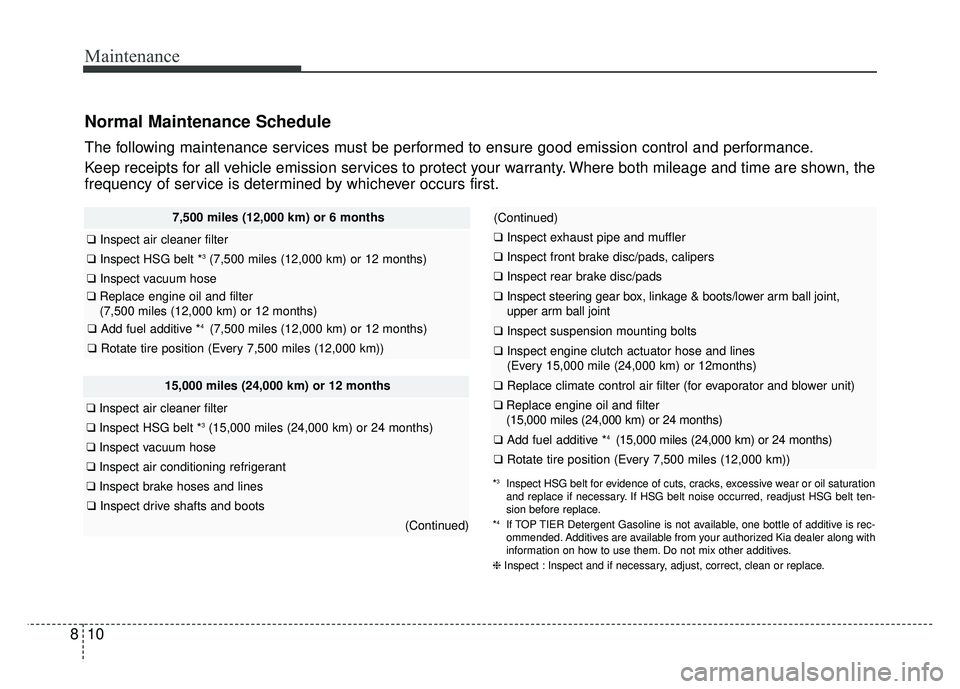
Maintenance
10
8
Normal Maintenance Schedule
The following maintenance services must be performed to ensure good emission control and performance.
Keep receipts for all vehicle emission services to protect your warranty. Where both mileage and time are shown, the
frequency of service is determined by whichever occurs first.
7,500 miles (12,000 km) or 6 months
❑ Inspect air cleaner filter
❑Inspect HSG belt *3(7,500 miles (12,000 km) or 12 months)
❑Inspect vacuum hose
❑Replace engine oil and filter
(7,500 miles (12,000 km) or 12 months)
❑ Add fuel additive *4 (7,500 miles (12,000 km) or 12 months)
❑Rotate tire position (Every 7,500 miles (12,000 km))
15,000 miles (24,000 km) or 12 months
❑Inspect air cleaner filter
❑Inspect HSG belt *3(15,000 miles (24,000 km) or 24 months)
❑Inspect vacuum hose
❑Inspect air conditioning refrigerant
❑Inspect brake hoses and lines
❑Inspect drive shafts and boots
(Continued)
(Continued)
❑Inspect exhaust pipe and muffler
❑Inspect front brake disc/pads, calipers
❑Inspect rear brake disc/pads
❑Inspect steering gear box, linkage & boots/lower arm ball joint,
upper arm ball joint
❑ Inspect suspension mounting bolts
❑Inspect engine clutch actuator hose and lines
(Every 15,000 mile (24,000 km) or 12months)
❑ Replace climate control air filter (for evaporator and blower unit)
❑Replace engine oil and filter
(15,000 miles (24,000 km) or 24 months)
❑ Add fuel additive *4 (15,000 miles (24,000 km) or 24 months)
❑Rotate tire position (Every 7,500 miles (12,000 km))
*3Inspect HSG belt for evidence of cuts, cracks, excessive wear or oil saturation
and replace if necessary. If HSG belt noise occurred, readjust HSG belt ten-
sion before replace.
*
4If TOP TIER Detergent Gasoline is not available, one bottle of additive is rec-
ommended. Additives are available from your authorized Kia dealer along with
information on how to use them. Do not mix other additives.
❈ Inspect : Inspect and if necessary, adjust, correct, clean or replace.
Page 481 of 616
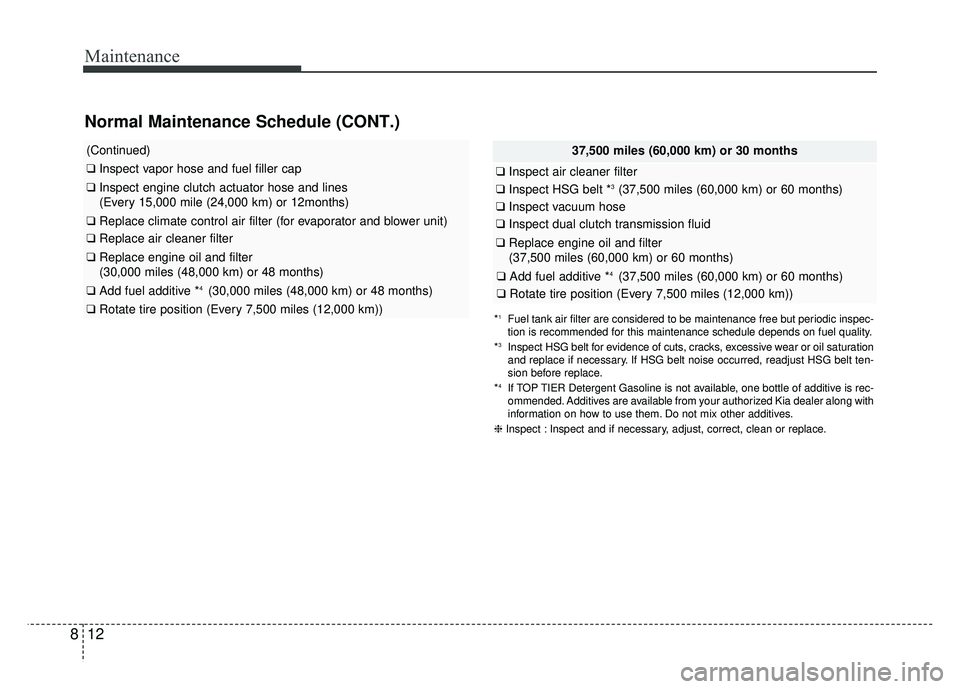
Maintenance
12
8
Normal Maintenance Schedule (CONT.)
37,500 miles (60,000 km) or 30 months
❑ Inspect air cleaner filter
❑Inspect HSG belt *3(37,500 miles (60,000 km) or 60 months)
❑Inspect vacuum hose
❑Inspect dual clutch transmission fluid
❑Replace engine oil and filter
(37,500 miles (60,000 km) or 60 months)
❑ Add fuel additive *4 (37,500 miles (60,000 km) or 60 months)
❑Rotate tire position (Every 7,500 miles (12,000 km))
*1Fuel tank air filter are considered to be maintenance free but periodic inspec-
tion is recommended for this maintenance schedule depends on fuel quality.
*
3Inspect HSG belt for evidence of cuts, cracks, excessive wear or oil saturation
and replace if necessary. If HSG belt noise occurred, readjust HSG belt ten-
sion before replace.
*
4If TOP TIER Detergent Gasoline is not available, one bottle of additive is rec-
ommended. Additives are available from your authorized Kia dealer along with
information on how to use them. Do not mix other additives.
❈ Inspect : Inspect and if necessary, adjust, correct, clean or replace.
(Continued)
❑Inspect vapor hose and fuel filler cap
❑Inspect engine clutch actuator hose and lines
(Every 15,000 mile (24,000 km) or 12months)
❑ Replace climate control air filter (for evaporator and blower unit)
❑Replace air cleaner filter
❑Replace engine oil and filter
(30,000 miles (48,000 km) or 48 months)
❑ Add fuel additive *4 (30,000 miles (48,000 km) or 48 months)
❑Rotate tire position (Every 7,500 miles (12,000 km))
Page 482 of 616
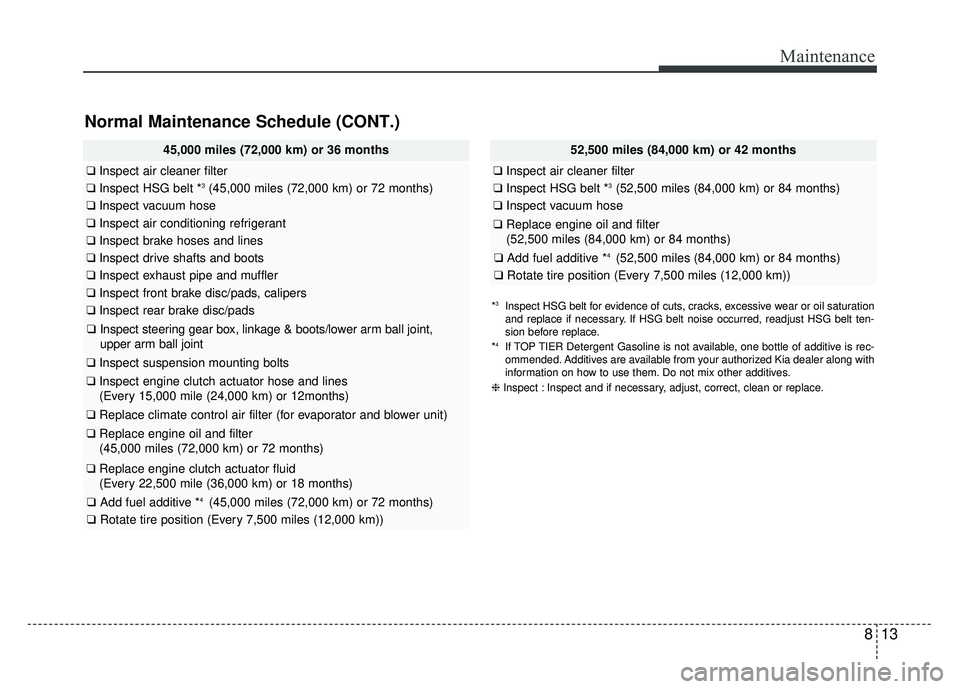
813
Maintenance
Normal Maintenance Schedule (CONT.)
45,000 miles (72,000 km) or 36 months
❑Inspect air cleaner filter
❑Inspect HSG belt *3(45,000 miles (72,000 km) or 72 months)
❑Inspect vacuum hose
❑Inspect air conditioning refrigerant
❑Inspect brake hoses and lines
❑Inspect drive shafts and boots
❑Inspect exhaust pipe and muffler
❑Inspect front brake disc/pads, calipers
❑Inspect rear brake disc/pads
❑Inspect steering gear box, linkage & boots/lower arm ball joint,
upper arm ball joint
❑ Inspect suspension mounting bolts
❑Inspect engine clutch actuator hose and lines
(Every 15,000 mile (24,000 km) or 12months)
❑ Replace climate control air filter (for evaporator and blower unit)
❑Replace engine oil and filter
(45,000 miles (72,000 km) or 72 months)
❑Replace engine clutch actuator fluid
(Every 22,500 mile (36,000 km) or 18 months)
❑ Add fuel additive *4 (45,000 miles (72,000 km) or 72 months)
❑Rotate tire position (Every 7,500 miles (12,000 km))
52,500 miles (84,000 km) or 42 months
❑Inspect air cleaner filter
❑Inspect HSG belt *3(52,500 miles (84,000 km) or 84 months)
❑Inspect vacuum hose
❑Replace engine oil and filter
(52,500 miles (84,000 km) or 84 months)
❑ Add fuel additive *4 (52,500 miles (84,000 km) or 84 months)
❑Rotate tire position (Every 7,500 miles (12,000 km))
*3Inspect HSG belt for evidence of cuts, cracks, excessive wear or oil saturation
and replace if necessary. If HSG belt noise occurred, readjust HSG belt ten-
sion before replace.
*
4If TOP TIER Detergent Gasoline is not available, one bottle of additive is rec-
ommended. Additives are available from your authorized Kia dealer along with
information on how to use them. Do not mix other additives.
❈ Inspect : Inspect and if necessary, adjust, correct, clean or replace.
Page 483 of 616
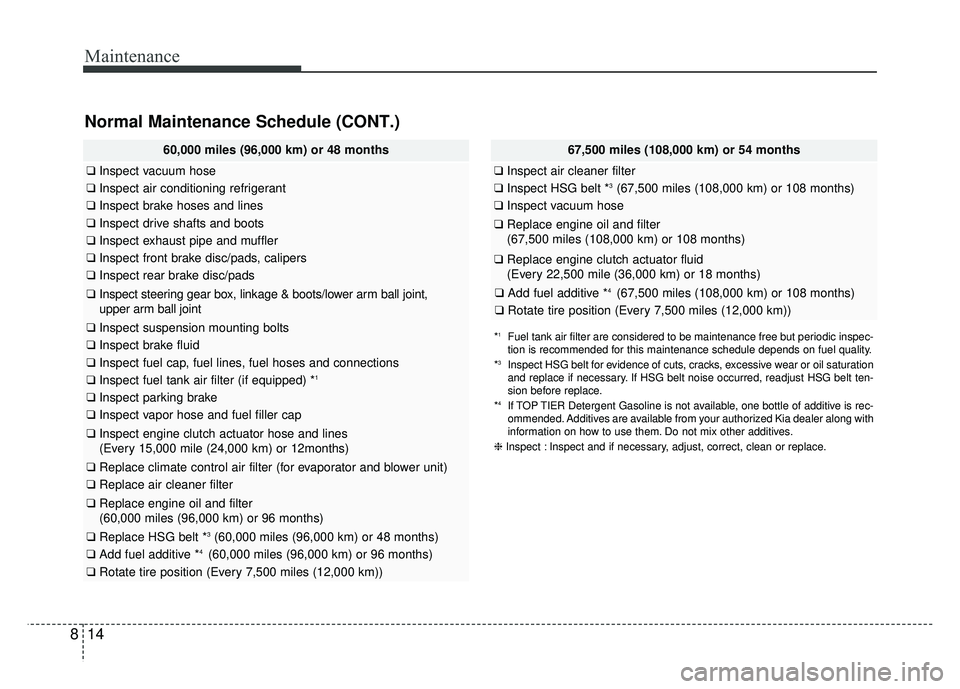
Maintenance
14
8
60,000 miles (96,000 km) or 48 months
❑ Inspect vacuum hose
❑Inspect air conditioning refrigerant
❑Inspect brake hoses and lines
❑Inspect drive shafts and boots
❑Inspect exhaust pipe and muffler
❑Inspect front brake disc/pads, calipers
❑Inspect rear brake disc/pads
❑Inspect steering gear box, linkage & boots/lower arm ball joint,
upper arm ball joint
❑ Inspect suspension mounting bolts
❑Inspect brake fluid
❑Inspect fuel cap, fuel lines, fuel hoses and connections
❑Inspect fuel tank air filter (if equipped) *1
❑Inspect parking brake
❑Inspect vapor hose and fuel filler cap
❑Inspect engine clutch actuator hose and lines
(Every 15,000 mile (24,000 km) or 12months)
❑ Replace climate control air filter (for evaporator and blower unit)
❑Replace air cleaner filter
❑Replace engine oil and filter
(60,000 miles (96,000 km) or 96 months)
❑Replace HSG belt *3(60,000 miles (96,000 km) or 48 months)
❑ Add fuel additive *4 (60,000 miles (96,000 km) or 96 months)
❑Rotate tire position (Every 7,500 miles (12,000 km))
67,500 miles (108,000 km) or 54 months
❑Inspect air cleaner filter
❑Inspect HSG belt *3(67,500 miles (108,000 km) or 108 months)
❑Inspect vacuum hose
❑Replace engine oil and filter
(67,500 miles (108,000 km) or 108 months)
❑Replace engine clutch actuator fluid
(Every 22,500 mile (36,000 km) or 18 months)
❑ Add fuel additive *4 (67,500 miles (108,000 km) or 108 months)
❑Rotate tire position (Every 7,500 miles (12,000 km))
*1Fuel tank air filter are considered to be maintenance free but periodic inspec-
tion is recommended for this maintenance schedule depends on fuel quality.
*
3Inspect HSG belt for evidence of cuts, cracks, excessive wear or oil saturation
and replace if necessary. If HSG belt noise occurred, readjust HSG belt ten-
sion before replace.
*
4If TOP TIER Detergent Gasoline is not available, one bottle of additive is rec-
ommended. Additives are available from your authorized Kia dealer along with
information on how to use them. Do not mix other additives.
❈ Inspect : Inspect and if necessary, adjust, correct, clean or replace.
Normal Maintenance Schedule (CONT.)