brake light KIA NIRO 2020 Workshop Manual
[x] Cancel search | Manufacturer: KIA, Model Year: 2020, Model line: NIRO, Model: KIA NIRO 2020Pages: 687, PDF Size: 11.43 MB
Page 582 of 687
Maintenance
46
7
Tire replacement
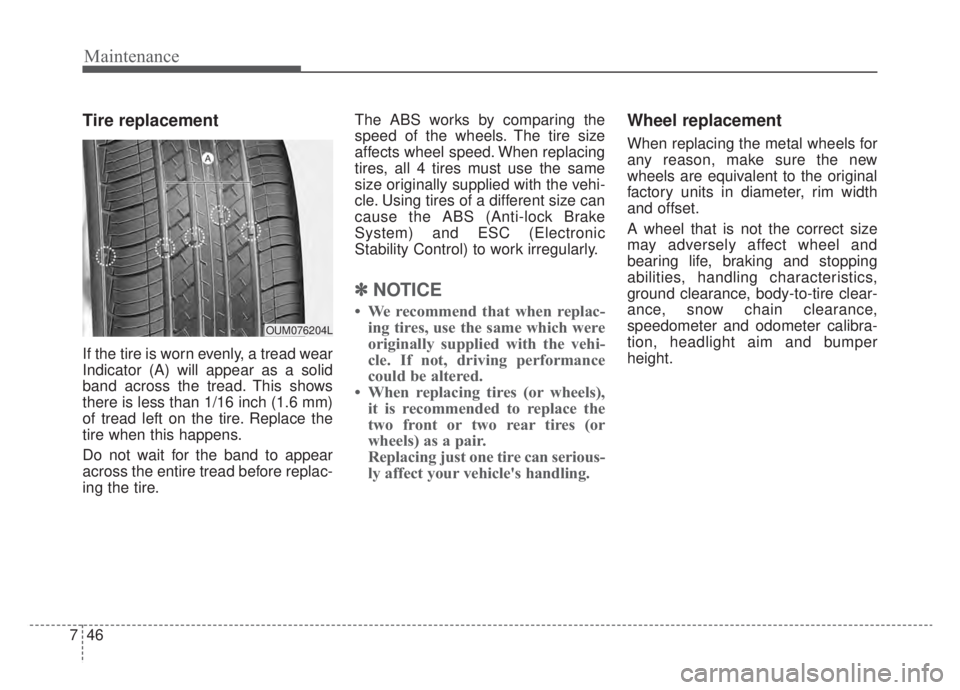
If the tire is worn evenly, a tread wear
Indicator (A) will appear as a solid
band across the tread. This shows
there is less than 1/16 inch (1.6 mm)
of tread left on the tire. Replace the
tire when this happens.
Do not wait for the band to appear
across the entire tread before replac-
ing the tire. The ABS works by comparing the
speed of the wheels. The tire size
affects wheel speed. When replacing
tires, all 4 tires must use the same
size originally supplied with the vehi-
cle. Using tires of a different size can
cause the ABS (Anti-lock Brake
System) and ESC (Electronic
Stability Control) to work irregularly.
✽ ✽
NOTICE
• We recommend that when replac-
ing tires, use the same which were
originally supplied with the vehi-
cle. If not, driving performance
could be altered.
• When replacing tires (or wheels), it is recommended to replace the
two front or two rear tires (or
wheels) as a pair.
Replacing just one tire can serious-
ly affect your vehicle's handling.
Wheel replacement
When replacing the metal wheels for
any reason, make sure the new
wheels are equivalent to the original
factory units in diameter, rim width
and offset.
A wheel that is not the correct size
may adversely affect wheel and
bearing life, braking and stopping
abilities, handling characteristics,
ground clearance, body-to-tire clear-
ance, snow chain clearance,
speedometer and odometer calibra-
tion, headlight aim and bumper
height.
OUM076204L
Page 589 of 687
753
Maintenance
Occupant Distribution:Designated
seating positions.
Outward Facing Sidewall: The side
of a asymmetrical tire that has a par-
ticular side that faces outward when
mounted on a vehicle. The outward
facing sidewall bears white lettering
or bears manufacturer, brand, and/or
model name molding that is higher or
deeper than the same moldings on
the inner facing sidewall.
Passenger (P-Metric) Tire: A tire
used on passenger cars and some
light duty trucks and multipurpose
vehicles.
Ply: A layer of rubber-coated parallel
cords
Pneumatic tire: A mechanical
device made of rubber, chemicals,
fabric and steel or other materials,
that, when mounted on an automo-
tive wheel, provides the traction and
contains the gas or fluid that sustains
the load. Production options weight:
The
combined weight of installed regular
production options weighing over 5
lb.(2.3 kg) in excess of the standard
items which they replace, not previ-
ously considered in curb weight or
accessory weight, including heavy
duty brakes, ride levelers, roof rack,
heavy duty battery, and special trim.
Recommended Inflation Pressure:
Vehicle manufacturer's recommend-
ed tire inflation pressure and shown
on the tire placard.
Radial Ply Tire: A pneumatic tire in
which the ply cords that extend to the
beads are laid at 90 degrees to the
centerline of the tread.
Rim: A metal support for a tire and
upon which the tire beads are seat-
ed.
Sidewall: The portion of a tire
between the tread and the bead. Speed Rating:
An alphanumeric
code assigned to a tire indicating the
maximum speed at which a tire can
operate.
Traction: The friction between the
tire and the road surface. The
amount of grip provided.
Tread: The portion of a tire that
comes into contact with the road.
Treadwear Indicators: Narrow
bands, sometimes called "wear
bars," that show across the tread of a
tire when only 1/16 inch of tread
remains.
UTQGS: Uniform Tire Quality
Grading Standards, a tire information
system that provides consumers with
ratings for a tire's traction, tempera-
ture and treadwear. Ratings are
determined by tire manufacturers
using government testing proce-
dures. The ratings are molded into
the sidewall of the tire.
Vehicle Capacity Weight: The num-
ber of designated seating positions
multiplied by 150 lbs. (68kg) plus the
rated cargo and luggage load.
Page 622 of 687
Maintenance
86
7
LIGHT BULBS
Bulb replacement precaution
Please keep extra bulbs on hand
with appropriate wattage ratings in
case of emergencies.
Refer to “Bulb Wattage” in chapter 8.
When changing lamps, first turn off
the engine at a safe place, firmly
apply the parking brake and detach
the battery’s negative (-) terminal.
Use only bulbs of the specified
wattage.✽ ✽ NOTICE
• If the light bulb or lamp connector
is removed while the lamp is still
on, the fuse box's electronic sys-
tem may log it as a malfunction.
Therefore, a lamp malfunction
incident may be recorded as a
Diagnostic Trouble Code (DTC) in
the fuse box.
• It is normal for an operating lamp to flicker momentarily. This is due
to a stabilization function of the
vehicle’s electronic control device.
If the lamp lights up normally
after momentarily blinking, then
it is functioning as normal.
However, if the lamp continues to
flicker several times or turns off
completely, there may be an error
in the vehicle’s electronic control
device. Please have the vehicle
checked by an authorized Kia
dealer immediately.
✽ ✽ NOTICE
We recommend that the headlight
aiming be adjusted by an authorized
Kia dealer after an accident or after
the headlight assembly is reinstalled.
WARNING- Working on
the lights
Prior to working on the light,
firmly apply the parking brake,
ensure that the engine
start/stop button is in OFF posi-
tion and turn off the lights to
avoid sudden movement of the
vehicle and burning your fingers
or receiving an electric shock.
CAUTION -Light replace-
ment
Be sure to replace the burned- out bulb with one of the samewattage rating. Otherwise, itmay cause damage to the fuseor electric wiring system.
CAUTION -Headlamp
Lens
To prevent damage, do notclean the headlamp lens withchemical solvents or strongdetergents.
Page 640 of 687
Maintenance
104
7
APPEARANCE CARE
Exterior care
Exterior general caution
It is very important to follow the label
directions when using any chemical
cleaner or polish. Read all warning
and caution statements that appear
on the label.
Finish maintenance
Washing
To help protect your vehicle’s finish
from rust and deterioration, wash it
thoroughly and frequently at least
once a month with lukewarm or cold
water.
If you use your vehicle for off-road
driving, you should wash it after each
off-road trip. Pay special attention to
the removal of any accumulation of
salt, dirt, mud, and other foreign mate-
rials. Make sure the drain holes in the
lower edges of the doors and rocker
panels are kept clear and clean.
Insects, tar, tree sap, bird droppings,
industrial pollution and similar
deposits can damage your vehicle’s
finish if not removed immediately.
Even prompt washing with plain water
may not completely remove all these
deposits. A mild soap, safe for use on
painted surfaces, may be used.
After washing, rinse the vehicle thor-
oughly with lukewarm or cold water.
Do not allow soap to dry on the finish. After washing the vehicle, test the
brakes while driving slowly to see if
they have been affected by water. If
braking performance is impaired, dry
the brakes by applying them lightly
while maintaining a slow forward
speed.
Page 644 of 687
Maintenance
108
7
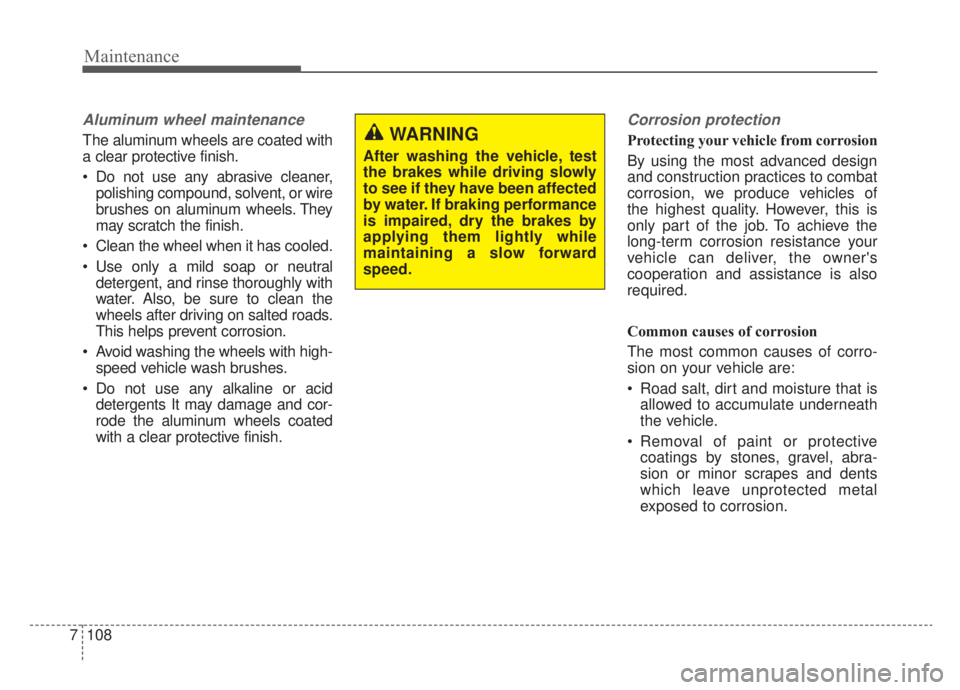
Aluminum wheel maintenance
The aluminum wheels are coated with
a clear protective finish.
Do not use any abrasive cleaner,
polishing compound, solvent, or wire
brushes on aluminum wheels. They
may scratch the finish.
Clean the wheel when it has cooled.
Use only a mild soap or neutral detergent, and rinse thoroughly with
water. Also, be sure to clean the
wheels after driving on salted roads.
This helps prevent corrosion.
Avoid washing the wheels with high- speed vehicle wash brushes.
Do not use any alkaline or acid detergents It may damage and cor-
rode the aluminum wheels coated
with a clear protective finish.
Corrosion protection
Protecting your vehicle from corrosion
By using the most advanced design
and construction practices to combat
corrosion, we produce vehicles of
the highest quality. However, this is
only part of the job. To achieve the
long-term corrosion resistance your
vehicle can deliver, the owner's
cooperation and assistance is also
required.
Common causes of corrosion
The most common causes of corro-
sion on your vehicle are:
Road salt, dirt and moisture that isallowed to accumulate underneath
the vehicle.
Removal of paint or protective coatings by stones, gravel, abra-
sion or minor scrapes and dents
which leave unprotected metal
exposed to corrosion.WARNING
After washing the vehicle, test
the brakes while driving slowly
to see if they have been affected
by water. If braking performance
is impaired, dry the brakes by
applying them lightly while
maintaining a slow forward
speed.
Page 677 of 687
Index
2I
Air bag - advanced supplemental restraint system . . . . 3-47Adding equipment to or modifying your air bag-equipped vehicle . . . . . . . . . . . . . . . . . . . . 3-73
Air bag warning label. . . . . . . . . . . . . . . . . . . . . . . . 3-73
Air bag warning light . . . . . . . . . . . . . . . . . . . . . . . . 3-50
Curtain air bag . . . . . . . . . . . . . . . . . . . . . . . . . . . . . 3-67
Driver's and passenger's front air bag . . . . . . . . . . . 3-62
How does the air bag system operate? . . . . . . . . . . . 3-48
Occupant Detection System (ODS) . . . . . . . . . . . . . 3-54
Side air bag. . . . . . . . . . . . . . . . . . . . . . . . . . . . . . . . 3-65
SRS Care . . . . . . . . . . . . . . . . . . . . . . . . . . . . . . . . . 3-72
SRS components and functions . . . . . . . . . . . . . . . . 3-51
Air cleaner . . . . . . . . . . . . . . . . . . . . . . . . . . . . . . . . . . 7-32\
Filter replacement. . . . . . . . . . . . . . . . . . . . . . . . . . . 7-32
Air conditioner compressor label . . . . . . . . . . . . . . . . . 8-12
Air conditioning system . . . . . . . . . . . . . . . . . . . . . . . . . 8-7
Appearance care . . . . . . . . . . . . . . . . . . . . . . . . . . . . . 7-104 Exterior care . . . . . . . . . . . . . . . . . . . . . . . . . . . . . . 7-104
Interior care . . . . . . . . . . . . . . . . . . . . . . . . . . . . . . 7-110
Automatic climate control system . . . . . . . . . . . . . . . 4-131 Air Conditioning refrigerant label . . . . . . . . . . . . . 4-144
Automatic heating and air conditioning. . . . . . . . . 4-132
Automatic ventilation . . . . . . . . . . . . . . . . . . . . . . . 4-142
Checking the amount of air conditioner refrigerant and compressor lubricant . . . . . . . . . . 4-145
Climate control air filter. . . . . . . . . . . . . . . . . . . . . 4-144 Manual heating and air conditioning . . . . . . . . . . . 4-134
Recirculated air at washer fluid spray . . . . . . . . . . 4-143
Sunroof inside air recirculation . . . . . . . . . . . . . . . 4-143
System operation . . . . . . . . . . . . . . . . . . . . . . . . . . 4-140
Battery (Plug-in Hybrid). . . . . . . . . . . . . . . . . . . . . . . . 7-39 For best battery service . . . . . . . . . . . . . . . . . . . . . . 7-39
Recharging the battery . . . . . . . . . . . . . . . . . . . . . . . 7-40
Reset items . . . . . . . . . . . . . . . . . . . . . . . . . . . . . . . . 7-41
Before driving . . . . . . . . . . . . . . . . . . . . . . . . . . . . . . . . . 5-5 Before entering vehicle . . . . . . . . . . . . . . . . . . . . . . . 5-5
Before starting . . . . . . . . . . . . . . . . . . . . . . . . . . . . . . 5-5
Necessary inspections . . . . . . . . . . . . . . . . . . . . . . . . 5-5
Blind-Spot Collision Warning (BCW) . . . . . . . . . . . . . 5-96 System description . . . . . . . . . . . . . . . . . . . . . . . . . . 5-96
System setting and activation . . . . . . . . . . . . . . . . . . 5-97
Warning message and system control . . . . . . . . . . . 5-99
Brake fluid . . . . . . . . . . . . . . . . . . . . . . . . . . . . . . . . . . 7-26\
Checking the brake fluid level . . . . . . . . . . . . . . . . . 7-26
Brake system. . . . . . . . . . . . . . . . . . . . . . . . . . . . . . . . . 5-30 Anti-lock Brake System (ABS) . . . . . . . . . . . . . . . . 5-44
Auto hold . . . . . . . . . . . . . . . . . . . . . . . . . . . . . . . . . 5-40
Electronic Parking Brake (EPB) . . . . . . . . . . . . . . . 5-34
Electronic Stability Control (ESC) . . . . . . . . . . . . . 5-46
Good braking practices . . . . . . . . . . . . . . . . . . . . . . 5-52
Hill-start Assist Control (HAC) . . . . . . . . . . . . . . . . 5-51
A
B
Page 683 of 687
Index
8I
High Beam Assist (HBA) . . . . . . . . . . . . . . . . . . . . 4-118
High beam operation . . . . . . . . . . . . . . . . . . . . . . . 4-117
Lighting control . . . . . . . . . . . . . . . . . . . . . . . . . . . 4-116
Turn signals and lane change signals . . . . . . . . . . . 4-120
Luggage volume . . . . . . . . . . . . . . . . . . . . . . . . . . . . . . . 8-7
Maintenance services . . . . . . . . . . . . . . . . . . . . . . . . . . . 7-5 Owner maintenance precautions . . . . . . . . . . . . . . . . 7-6
Owner’s responsibility . . . . . . . . . . . . . . . . . . . . . . . . 7-5
Mirrors . . . . . . . . . . . . . . . . . . . . . . . . . . . . . . . . . . . . \
. 4-51 Inside rearview mirror . . . . . . . . . . . . . . . . . . . . . . . 4-51
Outside rearview mirror . . . . . . . . . . . . . . . . . . . . . . 4-53
Online factory authorized manuals (U.S. only) . . . . . . 8-17 Electrical troubleshooting manual . . . . . . . . . . . . . . 8-17
Owner's manual . . . . . . . . . . . . . . . . . . . . . . . . . . . . 8-17
Service manual . . . . . . . . . . . . . . . . . . . . . . . . . . . . . 8-17
Owner maintenance . . . . . . . . . . . . . . . . . . . . . . . . . . . . 7-7 Owner maintenance schedule. . . . . . . . . . . . . . . . . . . 7-7
Parking brake . . . . . . . . . . . . . . . . . . . . . . . . . . . . . . . . 7-31 Checking the parking brake . . . . . . . . . . . . . . . . . . . 7-31 Rear Cross-Traffic Collision Warning (RCCW). . . . . 5-157
System description . . . . . . . . . . . . . . . . . . . . . . . . . 5-157
System setting and activation . . . . . . . . . . . . . . . . . 5-157
Warning message and system control . . . . . . . . . . 5-159
Rear View Monitor (RVM) . . . . . . . . . . . . . . . . . . . . . 4-111
Recommended lubricants and capacities . . . . . . . . . . . . 8-8 Recommended SAE viscosity number. . . . . . . . . . . . 8-9
Refrigerant label . . . . . . . . . . . . . . . . . . . . . . . . . . . . . . 8-12 Regenerative Braking (Paddle Shifter) . . . . . . . . . . 5-27
Regenerative braking system . . . . . . . . . . . . . . . . . . . . 5-27
Reporting Safety Defects (U.S. only) . . . . . . . . . . . . . . 8-17
Reverse Parking Distance Warning (PDW) . . . . . . . . 4-112 Non-operational conditions of Reverse Parking Distance Warning system . . . . . . . . . . . . . . . . . . . 4-113
Operation of Reverse Parking Distance Warning system . . . . . . . . . . . . . . . . . . . . . . . . . . 4-112
Reverse Parking Distance Warning system precautions . . . . . . . . . . . . . . . . . . . . . . . . . . . . . . 4-114
Self-diagnosis . . . . . . . . . . . . . . . . . . . . . . . . . . . . . 4-114
Road warning . . . . . . . . . . . . . . . . . . . . . . . . . . . . . . . . . 6-2 Hazard warning flasher . . . . . . . . . . . . . . . . . . . . . . . 6-2
M
P
O
R
Page 686 of 687

I11
Index
GVW (Gross Vehicle Weight) . . . . . . . . . . . . . . . . 5-182
GVWR (Gross Vehicle Weight Rating) . . . . . . . . . 5-182
Vehicle curb weight . . . . . . . . . . . . . . . . . . . . . . . . 5-182
Warning and indicator lights. . . . . . . . . . . . . . . . . . . . . 4-96 Indicator lights . . . . . . . . . . . . . . . . . . . . . . . . . . . . 4-105
Warning lights . . . . . . . . . . . . . . . . . . . . . . . . . . . . . 4-96
Washer fluid . . . . . . . . . . . . . . . . . . . . . . . . . . . . . . . . . 7-30 Checking the washer fluid level . . . . . . . . . . . . . . . . 7-30
Welcome system . . . . . . . . . . . . . . . . . . . . . . . . . . . . . 4-129 Headlight (Headlamp) escort function . . . . . . . . . . 4-129
Interior light . . . . . . . . . . . . . . . . . . . . . . . . . . . . . . 4-129
Pocket lamp . . . . . . . . . . . . . . . . . . . . . . . . . . . . . . 4-129
Windows . . . . . . . . . . . . . . . . . . . . . . . . . . . . . . . . . . . . \
4-29 Power windows . . . . . . . . . . . . . . . . . . . . . . . . . . . . 4-30
Windshield defrosting and defogging. . . . . . . . . . . . . 4-147 Automatic climate control system . . . . . . . . . . . . . 4-147
Defogging logic . . . . . . . . . . . . . . . . . . . . . . . . . . . 4-148
Winter driving . . . . . . . . . . . . . . . . . . . . . . . . . . . . . . . 5-174 Carry emergency equipment . . . . . . . . . . . . . . . . . 5-177
Change to "winter weight" oil if necessary . . . . . . 5-176
Check battery and cables . . . . . . . . . . . . . . . . . . . . 5-176
Check spark plugs and ignition system . . . . . . . . . 5-176
Don't let ice and snow accumulate underneath . . . 5-177
Don't let your parking brake freeze . . . . . . . . . . . . 5-177
Snowy or icy conditions . . . . . . . . . . . . . . . . . . . . . 5-174 To keep locks from freezing. . . . . . . . . . . . . . . . . . 5-177
Use approved window washer anti-freeze in
system. . . . . . . . . . . . . . . . . . . . . . . . . . . . . . . . . . 5-17\
7
Use high quality ethylene glycol coolant. . . . . . . . 5-176
Wiper blades . . . . . . . . . . . . . . . . . . . . . . . . . . . . . . . . . 7-36 Blade inspection . . . . . . . . . . . . . . . . . . . . . . . . . . . . 7-36
Blade replacement . . . . . . . . . . . . . . . . . . . . . . . . . . 7-36
Wipers and washers . . . . . . . . . . . . . . . . . . . . . . . . . . 4-122 Front windshield washers. . . . . . . . . . . . . . . . . . . . 4-123
Rear window wiper and washer switch . . . . . . . . . 4-124
Windshield wipers . . . . . . . . . . . . . . . . . . . . . . . . . 4-122
W