air KIA NIRO 2020 Owners Manual
[x] Cancel search | Manufacturer: KIA, Model Year: 2020, Model line: NIRO, Model: KIA NIRO 2020Pages: 687, PDF Size: 11.43 MB
Page 13 of 687
H11
Always keep the charging connec-tor and charging plug clean and
dry. Be sure to keep the charging
cable in a condition where there is
no water or moisture.
Before charging the battery, turn the vehicle OFF.
Be careful not to drop the charging connector. The charging connector
can be damaged.
Always inspect the charging con- nector terminals for damage or
overheating. Do not use if dam-
aged, as this may damage the
vehicle side charge connector and
is not a warrantable repair.AC Charge
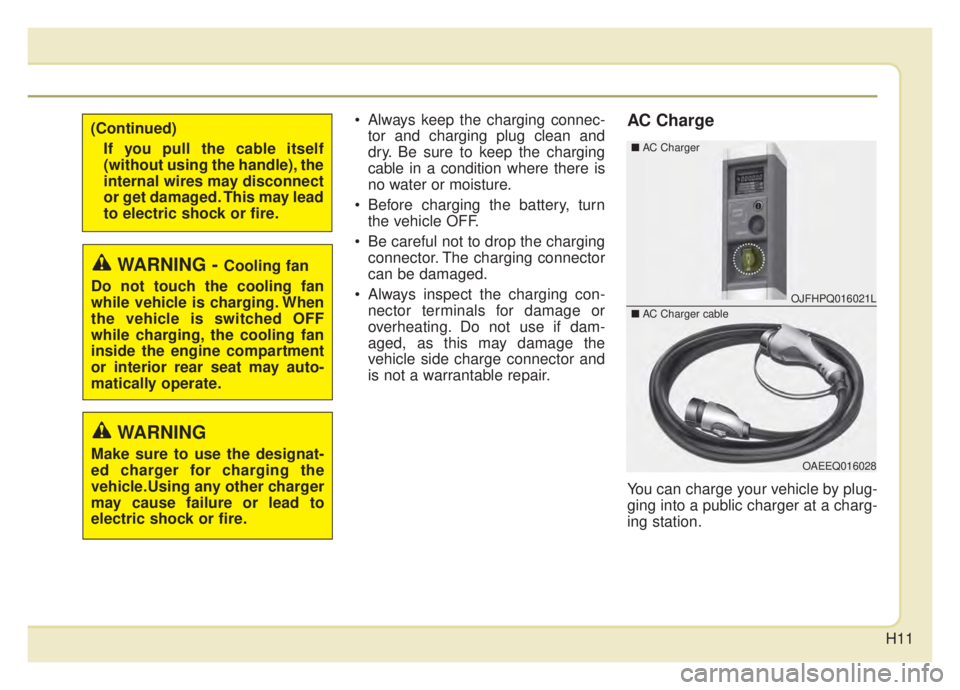
You can charge your vehicle by plug-
ging into a public charger at a charg-
ing station.
WARNING - Cooling fan
Do not touch the cooling fan
while vehicle is charging. When
the vehicle is switched OFF
while charging, the cooling fan
inside the engine compartment
or interior rear seat may auto-
matically operate.
OJFHPQ016021L
OAEEQ016028
\b AC Charger
\bAC Charger cable
WARNING
Make sure to use the designat-
ed charger for charging the
vehicle.Using any other charger
may cause failure or lead to
electric shock or fire.
(Continued)
If you pull the cable itself
(without using the handle), the
internal wires may disconnect
or get damaged. This may lead
to electric shock or fire.
Page 18 of 687
H16
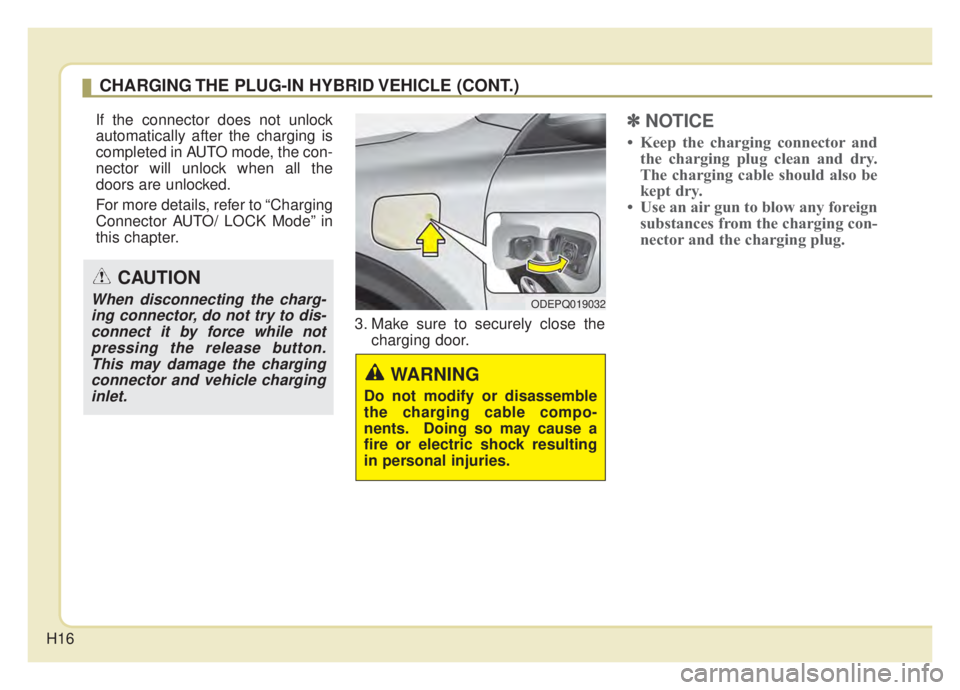
If the connector does not unlock
automatically after the charging is
completed in AUTO mode, the con-
nector will unlock when all the
doors are unlocked.
For more details, refer to “Charging
Connector AUTO/ LOCK Mode” in
this chapter.3. Make sure to securely close thecharging door.✽ ✽NOTICE
• Keep the charging connector and
the charging plug clean and dry.
The charging cable should also be
kept dry.
• Use an air gun to blow any foreign substances from the charging con-
nector and the charging plug.
ODEPQ019032
WARNING
Do not modify or disassemble
the charging cable compo-
nents. Doing so may cause a
fire or electric shock resulting
in personal injuries.
CAUTION
When disconnecting the charg-
ing connector, do not try to dis-connect it by force while notpressing the release button.This may damage the chargingconnector and vehicle charginginlet.
CHARGING THE PLUG-IN HYBRID VEHICLE (CONT.)
Page 28 of 687
H26
Precautions for PortableCharging Cable (ICCB: In-Cable Control Box)
Use a portable charging cable that is certified by Kia.
Do not try to repair, disassemble, or adjust the portable charging cable.
Do not use an extension cord or adapter.
Stop using immediately if failure warning light occurs.
Do not touch the plug and charging connector with wet hands.
Do not touch the terminal part of the AC Charging connector and the AC
Charging inlet on the vehicle.
Do not connect the charging con- nector to voltage that does not
comply with regulations.
Do not use the portable charging cable if it is worn out, exposed, or
there exists any type of damage on
the portable charging cable. If the ICCB case and AC
Charging
connector is damaged, cracked, or
the wires are exposed in any way,
do not use the portable charging
cable.
Do not let children operate or touch the portable charging cable.
Keep the control box free of water.
Keep the AC Chargingconnector or
plug terminal free of foreign sub-
stances.
Do not step on the cable or cord. Do not pull the cable or cord and
do not twist or bend it.
Do not charge when there is light- ning.
Do not drop the control box, charg- ing connector, or place a heavy
object on the control box.
Do not place an object that can generate high temperatures near
the charger when charging. Charging with a worn out or dam-
aged household electric outlet can
result in a risk of electric shock. If
you are unsure about the condition
of a household electric outlet, have
it checked by a licensed electri-
cian.
Stop using the portable charging cable immediately if the household
electric outlet or any components
are overheating or you smell burn-
ing.
CHARGING THE PLUG-IN HYBRID VEHICLE (CONT.)
Page 50 of 687
H48
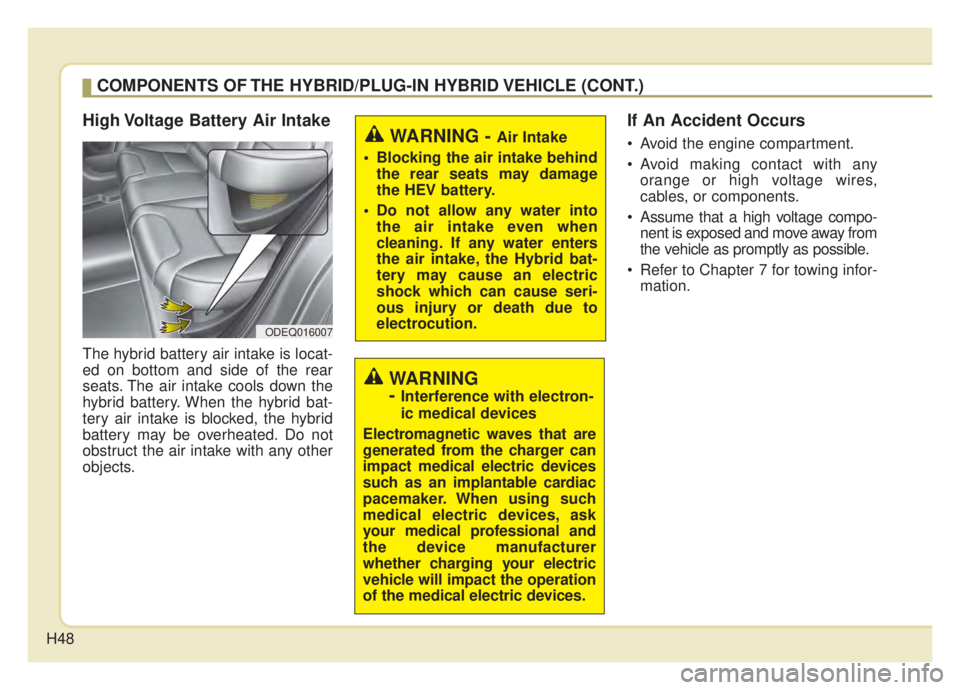
High Voltage Battery Air Intake
The hybrid battery air intake is locat-
ed on bottom and side of the rear
seats. The air intake cools down the
hybrid battery. When the hybrid bat-
tery air intake is blocked, the hybrid
battery may be overheated. Do not
obstruct the air intake with any other
objects.
If An Accident Occurs
Avoid the engine compartment.
Avoid making contact with anyorange or high voltage wires,
cables, or components.
Assume that a high voltage compo- nent is exposed and move away from
the vehicle as promptly as possible.
Refer to Chapter 7 for towing infor- mation.WARNING - Air Intake
Blocking the air intake behind the rear seats may damage
the HEV battery.
Do not allow any water into the air intake even when
cleaning. If any water enters
the air intake, the Hybrid bat-
tery may cause an electric
shock which can cause seri-
ous injury or death due to
electrocution.
ODEQ016007
WARNING
-
Interference with electron-
ic medical devices
Electromagnetic waves that are
generated from the charger can
impact medical electric devices
such as an implantable cardiac
pacemaker. When using such
medical electric devices, ask
your medical professional and
the device manufacturer
whether charging your electric
vehicle will impact the operation
of the medical electric devices.
COMPONENTS OF THE HYBRID/PLUG-IN HYBRID VEHICLE (CONT.)
Page 58 of 687
Introduction
61
This vehicle is equipped with an
event data recorder (EDR). The
main purpose of an EDR is to
record, in certain crash or near
crash-like situations, such as an
air bag deployment or hitting a
road obstacle, data that will assist
in understanding how a vehicle's
systems performed. The EDR is
designed to record data related to
vehicle dynamics and safety sys-
tems for a short period of time,
typically 30 seconds or less. The
EDR in this vehicle is designed to
record such data as:
How various systems in yourvehicle were operating;
Whether or not the driver and passenger safety belts were
buckled/ fastened;
How far (if at all) the driver was depressing the accelerator
and/or brake pedal; and,
How fast the vehicle was travel- ing. These data can help provide a bet-
ter understanding of the circum-
stances in which crashes and
injuries occur. NOTE: EDR data
are recorded by your vehicle only
if a non-trivial crash situation
occurs; no data are recorded by
the EDR under normal driving
conditions and no personal data
(e.g., name, gender, age, and
crash location) are recorded.
However, other parties, such as
law enforcement, could combine
the EDR data with the type of per-
sonally identifying data routinely
acquired during a crash investiga-
tion.
To read data recorded by an EDR,
special equipment is required, and
access to the vehicle or the EDR is
needed. In addition to the vehicle
manufacturer, other parties, such
as law enforcement, that have the
special equipment, can read the
information if they have access to
the vehicle or the EDR.
VEHICLE DATA COLLECTION AND EVENT DATA RECORDERS
Page 63 of 687
25
Your vehicle at a glance
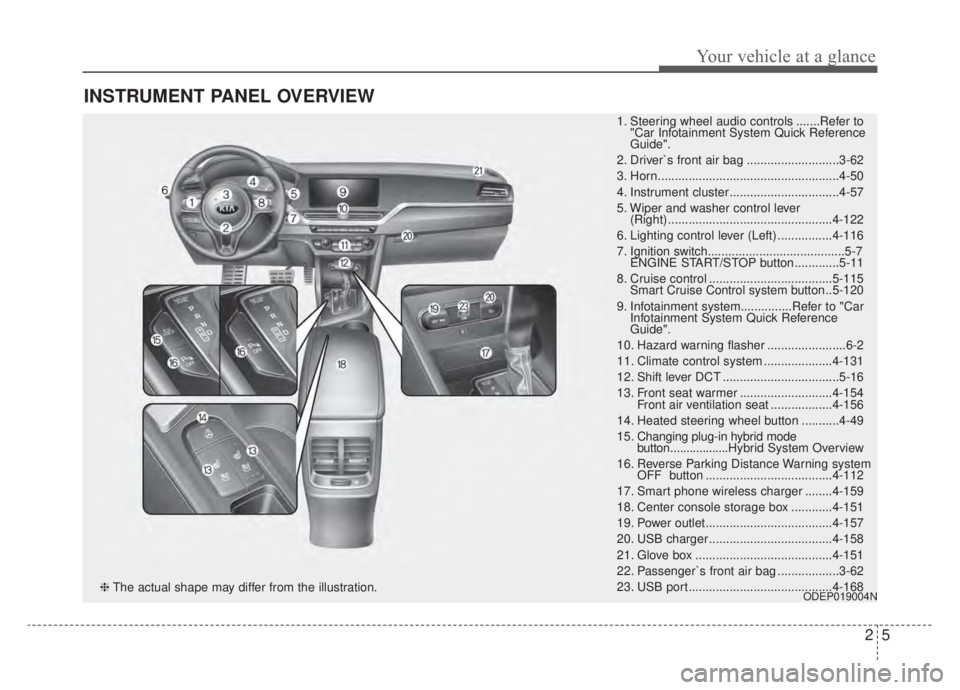
INSTRUMENT PANEL OVERVIEW
1. Steering wheel audio controls .......Refer to"Car Infotainment System Quick Reference
Guide".
2. Driver`s front air bag ...........................3-62
3. Horn.....................................................4-50
4. Instrument cluster ................................4-57
5. Wiper and washer control lever (Right) ................................................4-122
6. Lighting control lever (Left) ................4-116
7. Ignition switch........................................5-7 ENGINE START/STOP button .............5-11
8. Cruise control ....................................5-115 Smart Cruise Control system button ..5-120
9. Infotainment system...............Refer to "Car Infotainment System Quick Reference
Guide".
10. Hazard warning flasher .......................6-2
11. Climate control system ....................4-131
12. Shift lever DCT ..................................5-16
13. Front seat warmer ...........................4-154 Front air ventilation seat ..................4-156
14. Heated steering wheel button ...........4-49
15. Changing plug-in hybrid mode button.................. Hybrid System Overview
16. Reverse Parking Distance Warning system OFF button .....................................4-112
17. Smart phone wireless charger ........4-159
18. Center console storage box ............4-151
19. Power outlet.....................................4-157
20. USB charger ....................................4-158
21. Glove box ........................................4-151
22. Passenger`s front air bag ..................3-62
23. USB port..........................................4-168
ODEP019004N❈ The actual shape may differ from the illustration.
Page 64 of 687
Your vehicle at a glance
62
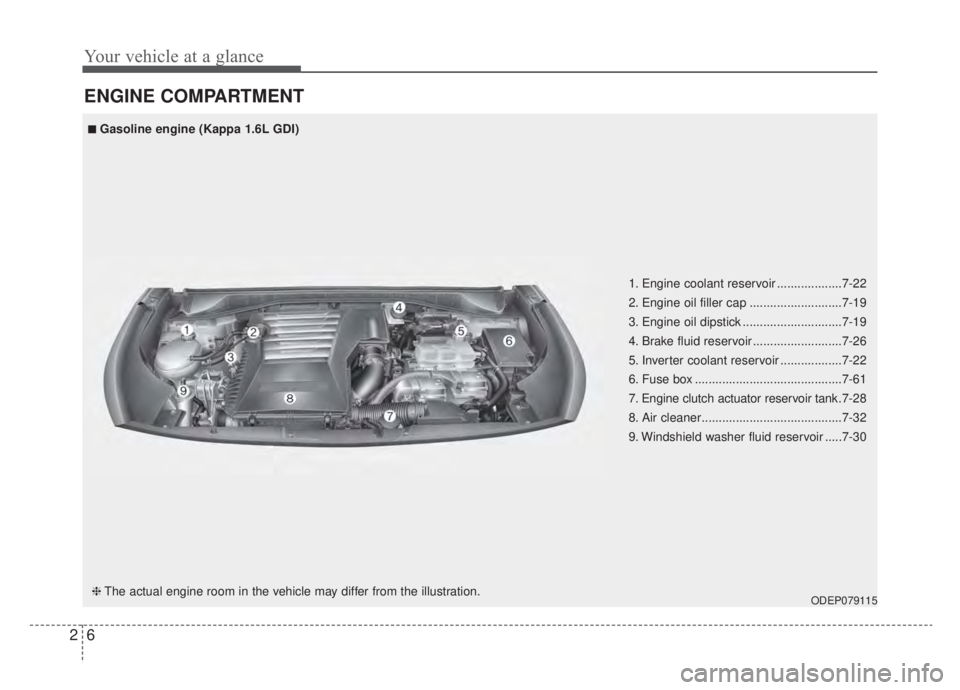
ENGINE COMPARTMENT
ODEP079115
■ ■Gasoline engine (Kappa 1.6L GDI)
❈ The actual engine room in the vehicle may differ from the illustration. 1. Engine coolant reservoir ...................7-22
2. Engine oil filler cap ...........................7-19
3. Engine oil dipstick .............................7-19
4. Brake fluid reservoir ..........................7-26
5. Inverter coolant reservoir ..................7-22
6. Fuse box ...........................................7-61
7. Engine clutch actuator reservoir tank
.7-28
8. Air cleaner.........................................7-32
9. Windshield washer fluid reservoir .....7-30
Page 65 of 687
Safety features of your vehicle
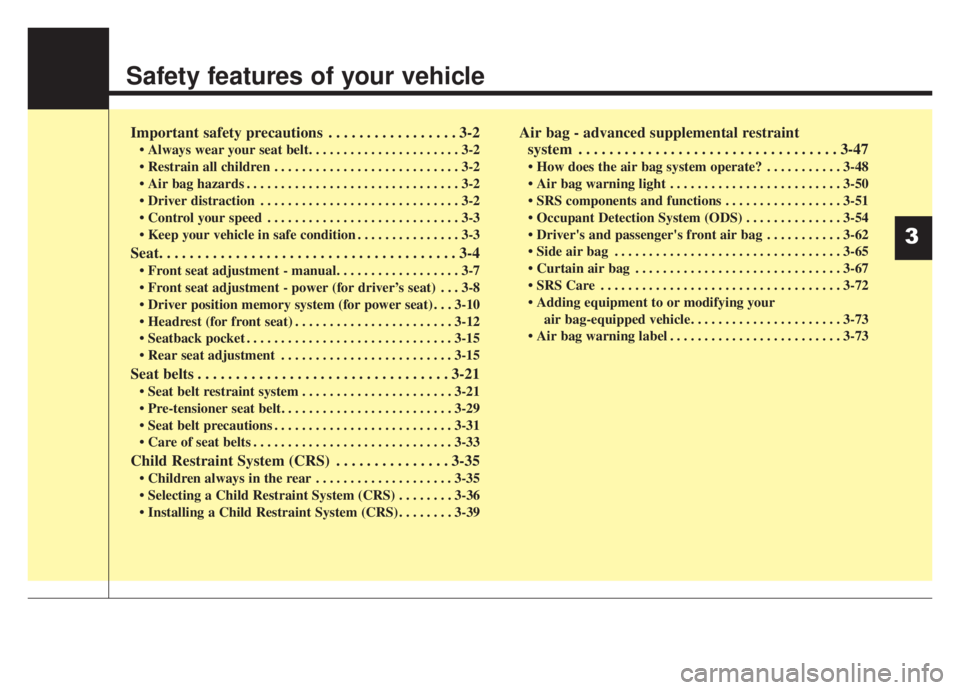
Important safety precautions . . . . . . . . . . . . . . . . . 3-2
• Always wear your seat belt. . . . . . . . . . . . . . . . . . . . . . 3-2
. . . . . . . . . . . . . . . . . . . . . . . . . . . 3-2
. . . . . . . . . . . . . . . . . . . . . . . . . . . . . . . 3-2
. . . . . . . . . . . . . . . . . . . . . . . . . . . . . 3-2
. . . . . . . . . . . . . . . . . . . . . . . . . . . . 3-3
. . . . . . . . . . . . . . . 3-3
Seat. . . . . . . . . . . . . . . . . . . . . . . . . . . . . . . . . . . . \
. . . 3-4
. . . 3-8
. . . 3-10
. . . . . . . . . . . . . . . . . . . . . . . 3-12
. . . . . . . . . . . . . . . . . . . . . . . . . . . . . . 3-15
. . . . . . . . . . . . . . . . . . . . . . . . . 3-15
Seat belts . . . . . . . . . . . . . . . . . . . . . . . . . . . . . . . . . 3-21
. . . . . . . . . . . . . . . . . . . . . . 3-21
. . . . . . . . . . . . . . . . . . . . . . . . . . 3-31
. . . . . . . . . . . . . . . . . . . . . . . . . . . . . 3-33
Child Restraint System (CRS) . . . . . . . . . . . . . . . 3-35
. . . . . . . . . . . . . . . . . . . . 3-35
. . . . . . . . 3-39
Air bag - advanced supplemental restraint system . . . . . . . . . . . . . . . . . . . . . . . . . . . . . . . . . . 3-47\
. . . . . . . . . . . 3-48
. . . . . . . . . . . . . . . . . . . . . . . . . 3-50
. . . . . . . . . . . . . . . . . 3-51
. . . . . . . . . . . . . . 3-54
. . . . . . . . . . . 3-62
. . . . . . . . . . . . . . . . . . . . . . . . . . . . . . . . . 3-65
. . . . . . . . . . . . . . . . . . . . . . . . . . . . . . 3-67
. . . . . . . . . . . . . . . . . . . . . . . . . . . . . . . . . . . 3-\
72
air bag-equipped vehicle. . . . . . . . . . . . . . . . . . . . . . 3-73
. . . . . . . . . . . . . . . . . . . . . . . . . 3-73
3
Page 66 of 687
Safety features of your vehicle
23
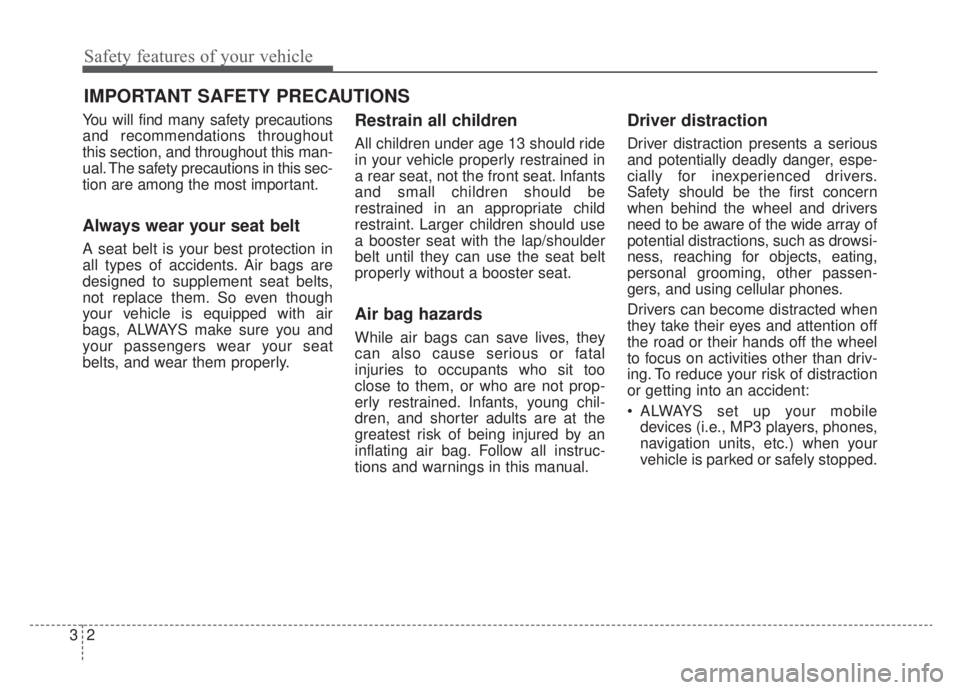
You will find many safety precautions
and recommendations throughout
this section, and throughout this man-
ual. The safety precautions in this sec-
tion are among the most important.
Always wear your seat belt
A seat belt is your best protection in
all types of accidents. Air bags are
designed to supplement seat belts,
not replace them. So even though
your vehicle is equipped with air
bags, ALWAYS make sure you and
your passengers wear your seat
belts, and wear them properly.
Restrain all children
All children under age 13 should ride
in your vehicle properly restrained in
a rear seat, not the front seat. Infants
and small children should be
restrained in an appropriate child
restraint. Larger children should use
a booster seat with the lap/shoulder
belt until they can use the seat belt
properly without a booster seat.
Air bag hazards
While air bags can save lives, they
can also cause serious or fatal
injuries to occupants who sit too
close to them, or who are not prop-
erly restrained. Infants, young chil-
dren, and shorter adults are at the
greatest risk of being injured by an
inflating air bag. Follow all instruc-
tions and warnings in this manual.
Driver distraction
Driver distraction presents a serious
and potentially deadly danger, espe-
cially for inexperienced drivers.
Safety should be the first concern
when behind the wheel and drivers
need to be aware of the wide array of
potential distractions, such as drowsi-
ness, reaching for objects, eating,
personal grooming, other passen-
gers, and using cellular phones.
Drivers can become distracted when
they take their eyes and attention off
the road or their hands off the wheel
to focus on activities other than driv-
ing. To reduce your risk of distraction
or getting into an accident:
• ALWAYS set up your mobiledevices (i.e., MP3 players, phones,
navigation units, etc.) when your
vehicle is parked or safely stopped.
IMPORTANT SAFETY PRECAUTIONS
Page 69 of 687
35
Safety features of your vehicle
WARNING- Uprightingseat
Do not press the release lever on
a manual seatback without hold-
ing and controlling the seatback.
The seatback will spring upright,
possibly impacting you or other
passengers.
WARNING- Loose objects
Do not place anything in the dri-
ver's foot well or under the front
seats. Loose objects in the dri-
ver's foot area could interfere
with the operation of the foot
pedals.WARNING- Driver respon-
sibility for passengers
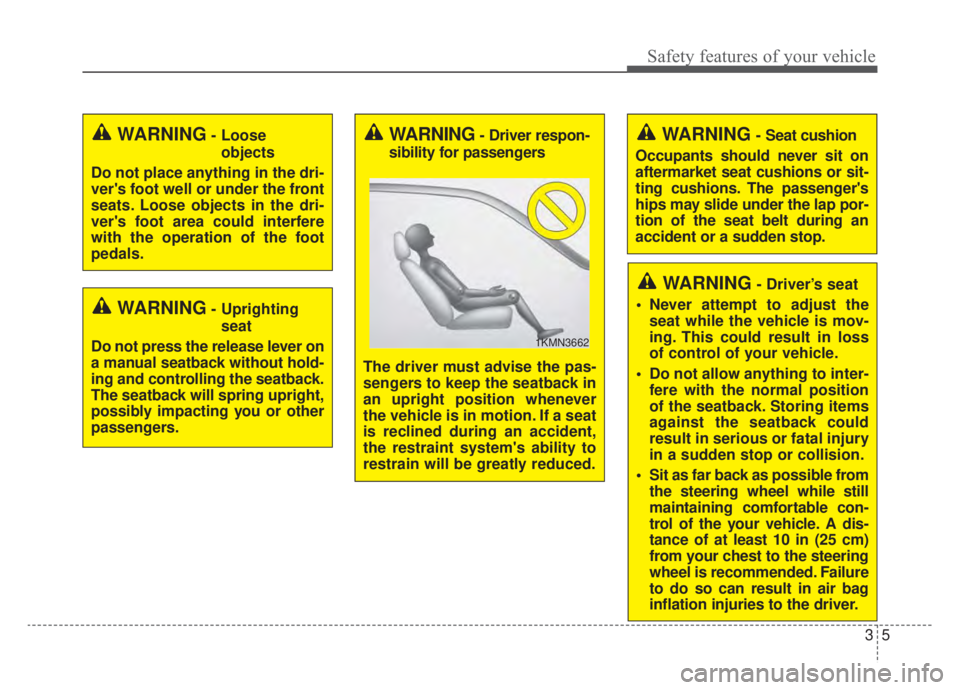
The driver must advise the pas-
sengers to keep the seatback in
an upright position whenever
the vehicle is in motion. If a seat
is reclined during an accident,
the restraint system's ability to
restrain will be greatly reduced.
1KMN3662
WARNING- Seat cushion
Occupants should never sit on
aftermarket seat cushions or sit-
ting cushions. The passenger's
hips may slide under the lap por-
tion of the seat belt during an
accident or a sudden stop.
WARNING- Driver’s seat
Never attempt to adjust the seat while the vehicle is mov-
ing. This could result in loss
of control of your vehicle.
Do not allow anything to inter- fere with the normal position
of the seatback. Storing items
against the seatback could
result in serious or fatal injury
in a sudden stop or collision.
Sit as far back as possible from the steering wheel while still
maintaining comfortable con-
trol of the your vehicle. A dis-
tance of at least 10 in (25 cm)
from your chest to the steering
wheel is recommended. Failure
to do so can result in air bag
inflation injuries to the driver.