towing KIA NIRO 2021 Owner's Manual
[x] Cancel search | Manufacturer: KIA, Model Year: 2021, Model line: NIRO, Model: KIA NIRO 2021Pages: 710, PDF Size: 14.77 MB
Page 559 of 710
TOWING
Towing service
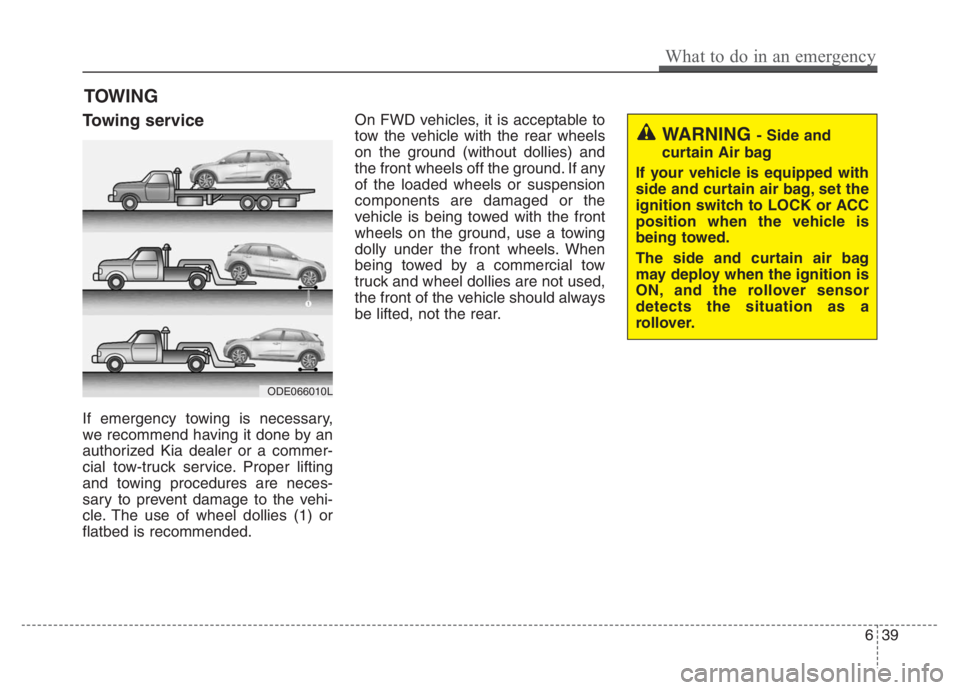
If emergency towing is necessary,
we recommend having it done by an
authorized Kia dealer or a commer-
cial tow-truck service. Proper lifting
and towing procedures are neces-
sary to prevent damage to the vehi-
cle. The use of wheel dollies (1) or
flatbed is recommended.On FWD vehicles, it is acceptable to
tow the vehicle with the rear wheels
on the ground (without dollies) and
the front wheels off the ground. If any
of the loaded wheels or suspension
components are damaged or the
vehicle is being towed with the front
wheels on the ground, use a towing
dolly under the front wheels. When
being towed by a commercial tow
truck and wheel dollies are not used,
the front of the vehicle should always
be lifted, not the rear.
WARNING - Side and
curtain Air bag
If your vehicle is equipped with
side and curtain air bag, set the
ignition switch to LOCK or ACC
position when the vehicle is
being towed.
The side and curtain air bag
may deploy when the ignition is
ON, and the rollover sensor
detects the situation as a
rollover.
ODE066010L
What to do in an emergency
39 6
Page 560 of 710
When towing your vehicle in an
emergency without wheel dollies :
1. Set the ignition switch in the ACC
position.
2. Place the transmission shift lever
in N (Neutral).
3. Release the parking brake.Removable towing hook
(if equipped)
1. Open the liftgate, and remove the
towing hook from the tool case.
2. Remove the hole cover pressing
the lower part of the cover on the
bumper.
CAUTION - Towing gear
position
Failure to place the transmis-
sion shift lever in N (Neutral)
may cause internal damage to
the transmission.
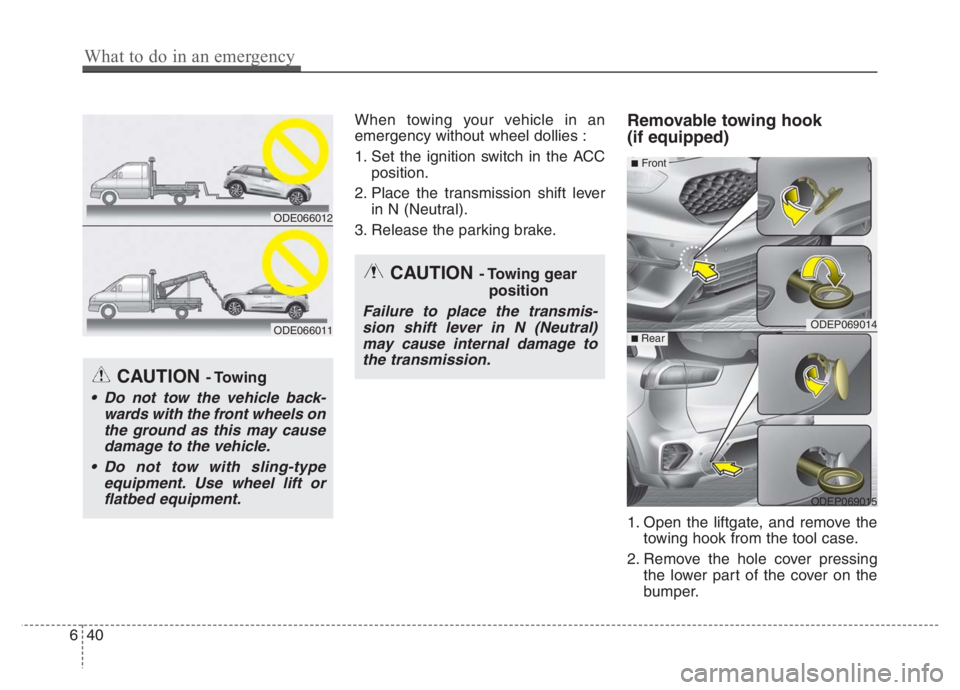
CAUTION - Towing
Do not tow the vehicle back-
wards with the front wheels on
the ground as this may cause
damage to the vehicle.
Do not tow with sling-type
equipment. Use wheel lift or
flatbed equipment.
ODE066012
ODE066011ODEP069014
ODEP069015
■Front
■ Rear
640
What to do in an emergency
Page 561 of 710
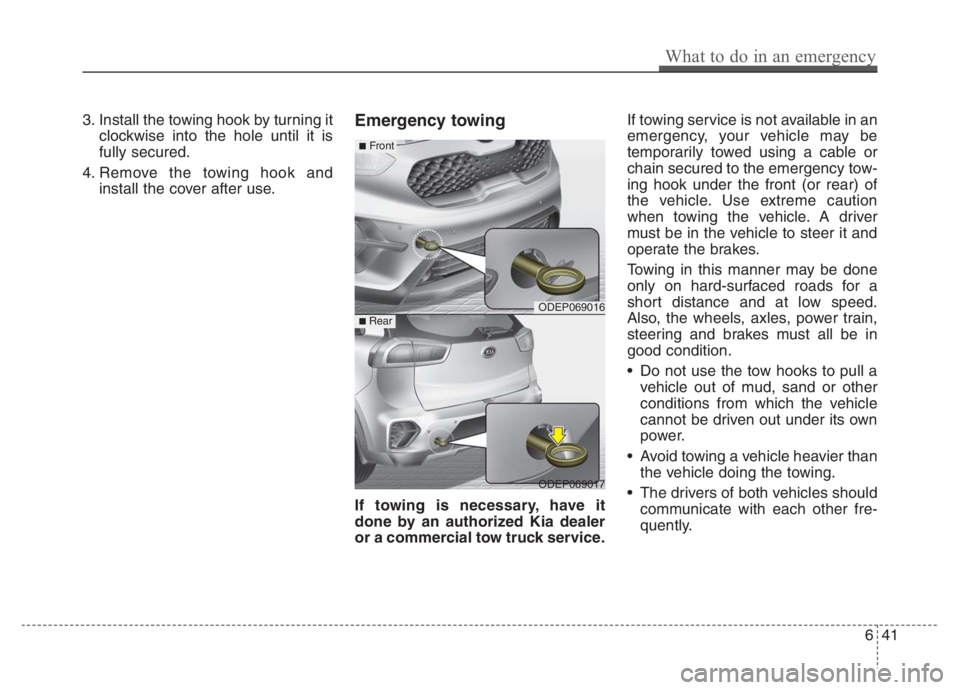
3. Install the towing hook by turning it
clockwise into the hole until it is
fully secured.
4. Remove the towing hook and
install the cover after use.Emergency towing
If towing is necessary, have it
done by an authorized Kia dealer
or a commercial tow truck service.If towing service is not available in an
emergency, your vehicle may be
temporarily towed using a cable or
chain secured to the emergency tow-
ing hook under the front (or rear) of
the vehicle. Use extreme caution
when towing the vehicle. A driver
must be in the vehicle to steer it and
operate the brakes.
Towing in this manner may be done
only on hard-surfaced roads for a
short distance and at low speed.
Also, the wheels, axles, power train,
steering and brakes must all be in
good condition.
Do not use the tow hooks to pull a
vehicle out of mud, sand or other
conditions from which the vehicle
cannot be driven out under its own
power.
Avoid towing a vehicle heavier than
the vehicle doing the towing.
The drivers of both vehicles should
communicate with each other fre-
quently.
ODEP069016
ODEP069017
■Front
■ Rear
What to do in an emergency
41 6
Page 562 of 710
Attach a towing strap to the tow
hook.
Use only a cable or chain specifical-
ly intended for use in towing vehi-
cles. Securely fasten the cable or
chain to the towing hook provided.
Accelerate or decelerate the vehicle
in a slow and gradual manner while
maintaining tension on the tow rope
or chain to start or drive the vehicle,
otherwise tow hooks and the vehi-
cle may be damaged.
Before emergency towing, check if
the hook is not broken or damaged.
Fasten the towing cable or chain
securely to the hook.
Do not jerk the hook. Apply it
steadily and with even force.
To avoid damaging the hook, do not
pull from the side or at a vertical
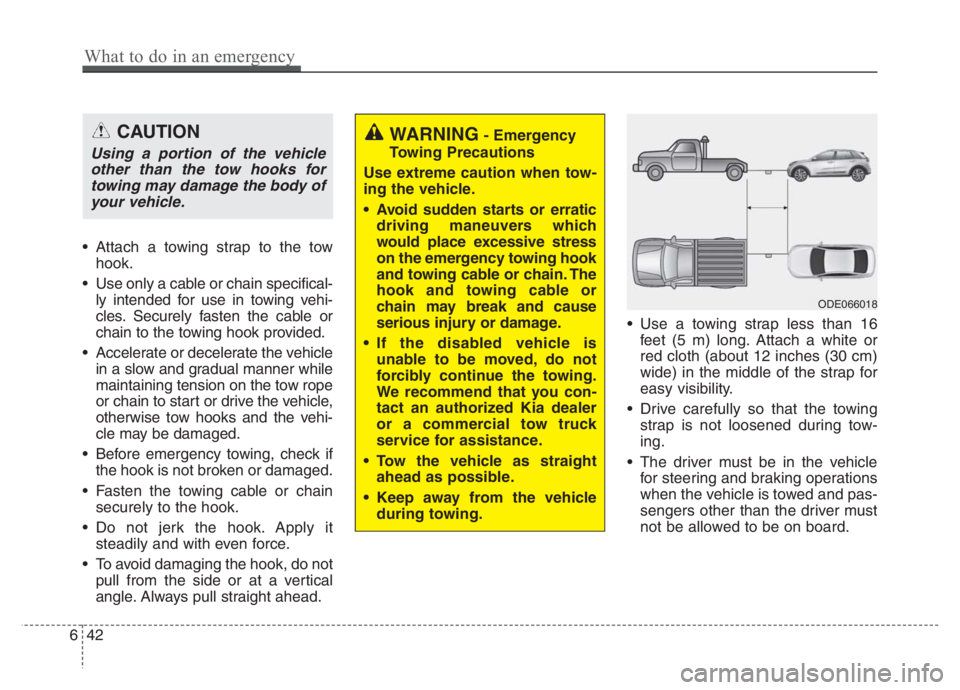
angle. Always pull straight ahead. Use a towing strap less than 16
feet (5 m) long. Attach a white or
red cloth (about 12 inches (30 cm)
wide) in the middle of the strap for
easy visibility.
Drive carefully so that the towing
strap is not loosened during tow-
ing.
The driver must be in the vehicle
for steering and braking operations
when the vehicle is towed and pas-
sengers other than the driver must
not be allowed to be on board.
CAUTION
Using a portion of the vehicle
other than the tow hooks for
towing may damage the body of
your vehicle.
WARNING- Emergency
Towing Precautions
Use extreme caution when tow-
ing the vehicle.
Avoid sudden starts or erratic
driving maneuvers which
would place excessive stress
on the emergency towing hook
and towing cable or chain. The
hook and towing cable or
chain may break and cause
serious injury or damage.
If the disabled vehicle is
unable to be moved, do not
forcibly continue the towing.
We recommend that you con-
tact an authorized Kia dealer
or a commercial tow truck
service for assistance.
Tow the vehicle as straight
ahead as possible.
Keep away from the vehicle
during towing.
ODE066018
642
What to do in an emergency
Page 563 of 710
Emergency towing precautions
• Turn the ignition switch to ACC sothe steering wheel isn’t locked.
Place the transmission shift lever in N (Neutral).
Release the parking bake.
Press the brake pedal with more force than normal since you will
have reduced brake performance.
More steering effort will be required because the power steer-
ing system will be disabled.
If you are driving down a long hill, the brakes may overheat and brake
performance will be reduced. Stop
often and let the brakes cool off.
To avoid serious damage to the dual clutch transmission, limit the
vehicle speed to 10 mph (15 km/h)
and drive less than 1 mile (1.5 km)
when towing. (for Dual clutch trans-
mission vehicle.) If the car is being towed with all
four wheels on the ground, it can
be towed only from the front. Be
sure that the transmission is in N
(Neutral). Be sure the steering is
unlocked by placing the ignition
switch in the ACC position. A driver
must be in the towed vehicle to
operate the steering and brakes.
CAUTION - Dual clutchtransmission
Before towing, check the dual
clutch transmission for fluidleaks under your vehicle. If thedual clutch transmission fluid isleaking, flatbed equipment or atowing dolly must be used.
What to do in an emergency
43
6
Page 564 of 710
IF AN ACCIDENT OCCURS
✽ ✽
NOTICE
Any gas or electrolyte leakage from
your vehicle is not only poisonous but
also flammable. Upon witnessing one
of those, make sure your car is parked
in a safe area away from any roads,
open the windows, and maintain a
safe distance away from the vehicle.
Immediately contact an authorized
Kia dealer and advise them that a
hybrid vehicle is involved.
If you need towing, refer to
"Towing" in the previous pages.
When the vehicle is severely dam-
aged, remain a safe distance of 50
feet (15 meter) or more between
your vehicle and other
vehicles/flammables.
If a fire occurs :
Immediately call emergency services
(911) and advise the emergency
responders that a hybrid vehicle is
involved.
WARNING - High voltage
components
For your safety, do not touch
high voltage cables, connec-
tors and package modules.
High voltage components are
orange in color.
Exposed cables or wires may
be visible inside or outside of
the vehicle. Never touch the
wires or cables, because an
electric shock, serious injury,
or death may occur.WARNING- Submersion
in water
Do not touch your vehicle if it
has been submerged in water.
The high-voltage battery may
cause shock or may catch fire.
Immediately contact the author-
ities and advise them of the
condition of your vehicle and
that a hybrid vehicle is involved.
644
What to do in an emergency
Page 573 of 710
79
Maintenance
SCHEDULED MAINTENANCE SERVICE
Follow the Normal Maintenance
Schedule if the vehicle is usually
operated where none of the following
conditions apply. If any of the following
conditions apply, follow the
Maintenance Under Severe Usage
Conditions.
Repeatedly driving short distance
of less than 5 miles (8 km) in nor-
mal temperature or less than 10
miles (16 km) in freezing tempera-
ture.
Extensive engine idling or low
speed driving for long distances.
Driving on rough, dusty, muddy,
unpaved, graveled or salt-spread
roads.
Driving in areas using salt or other
corrosive materials or in very cold
weather.
Driving in heavy dust condition.
Driving in heavy traffic area. Driving on uphill, downhill, or
mountain roads repeatedly.
Using for towing or camping, and
driving with loading on the roof.
Driving for patrol car, taxi, other
commercial use of vehicle towing.
Frequently driving under high
speed or rapid acceleration.
Frequently driving in stop-and-go
conditions.
Engine oil usage which is not rec-
ommended (Mineral type,
Semisynthetic, Lower grade spec,
etc.)If your vehicle is operated under the
above conditions, you should
inspect, replace or refill more fre-
quently than the following Normal
Maintenance Schedule. After 120
months or 150,000 miles continue to
follow the prescribed maintenance
intervals.
Page 578 of 710
Maintenance
14 7
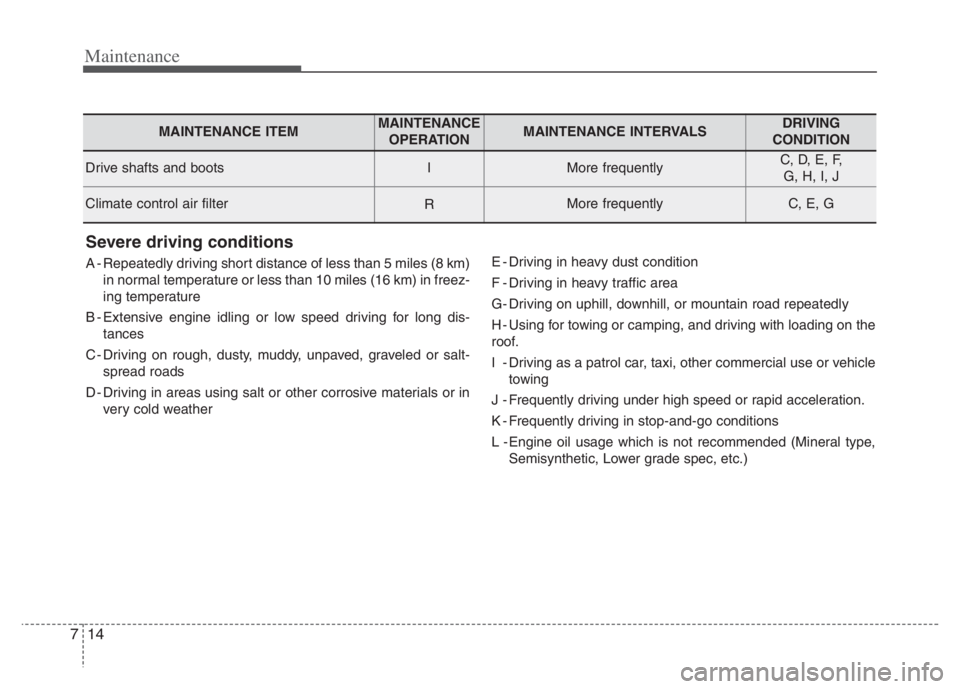
Severe driving conditions
A - Repeatedly driving short distance of less than 5 miles (8 km)
in normal temperature or less than 10 miles (16 km) in freez-
ing temperature
B - Extensive engine idling or low speed driving for long dis-
tances
C - Driving on rough, dusty, muddy, unpaved, graveled or salt-
spread roads
D - Driving in areas using salt or other corrosive materials or in
very cold weatherE - Driving in heavy dust condition
F - Driving in heavy traffic area
G- Driving on uphill, downhill, or mountain road repeatedly
H - Using for towing or camping, and driving with loading on the
roof.
I - Driving as a patrol car, taxi, other commercial use or vehicle
towing
J - Frequently driving under high speed or rapid acceleration.
K - Frequently driving in stop-and-go conditions
L - Engine oil usage which is not recommended (Mineral type,
Semisynthetic, Lower grade spec, etc.)
MAINTENANCE ITEMMAINTENANCE
OPERATIONMAINTENANCE INTERVALSDRIVING
CONDITION
Drive shafts and bootsIMore frequentlyC, D, E, F,
G, H, I, J
Climate control air filterRMore frequentlyC, E, G
Page 708 of 710

Index
10I
Storage compartments . . . . . . . . . . . . . . . . . . . . . . . . 4-161
Center console storage . . . . . . . . . . . . . . . . . . . . . 4-161
Glove box . . . . . . . . . . . . . . . . . . . . . . . . . . . . . . . . 4-161
Luggage box . . . . . . . . . . . . . . . . . . . . . . . . . . . . . . 4-163
Sunglass holder . . . . . . . . . . . . . . . . . . . . . . . . . . . 4-162
Sunroof . . . . . . . . . . . . . . . . . . . . . . . . . . . . . . . . . . . . . 4-44
Resetting the sunroof . . . . . . . . . . . . . . . . . . . . . . . . 4-47
Sliding the sunroof . . . . . . . . . . . . . . . . . . . . . . . . . 4-45
Sunroof open warning . . . . . . . . . . . . . . . . . . . . . . . 4-48
Sunshade. . . . . . . . . . . . . . . . . . . . . . . . . . . . . . . . . . 4-47
Tilting the sunroof . . . . . . . . . . . . . . . . . . . . . . . . . . 4-46
Theft-alarm system . . . . . . . . . . . . . . . . . . . . . . . . . . . . 4-19
Armed stage . . . . . . . . . . . . . . . . . . . . . . . . . . . . . . . 4-19
Disarmed stage . . . . . . . . . . . . . . . . . . . . . . . . . . . . . 4-21
Theft-alarm stage . . . . . . . . . . . . . . . . . . . . . . . . . . . 4-20
Tire Pressure Monitoring System (TPMS) . . . . . . . . . . 6-13
Changing a tire with TPMS . . . . . . . . . . . . . . . . . . . 6-17
Check tire pressure . . . . . . . . . . . . . . . . . . . . . . . . . . 6-13
Low tire pressure position telltale . . . . . . . . . . . . . . 6-15
Low tire pressure telltale . . . . . . . . . . . . . . . . . . . . . 6-15
Tire specification and pressure label . . . . . . . . . . . . . . 8-11
Tires and wheels . . . . . . . . . . . . . . . . . . . . . . . . . . 7-42, 8-5
All season tires . . . . . . . . . . . . . . . . . . . . . . . . . . . . 7-54
Checking tire inflation pressure . . . . . . . . . . . . . . . . 7-43
Low aspect ratio tire. . . . . . . . . . . . . . . . . . . . . . . . . 7-56Radial-ply tires . . . . . . . . . . . . . . . . . . . . . . . . . . . . . 7-55
Recommended cold tire inflation pressures . . . . . . . 7-42
Snow tires . . . . . . . . . . . . . . . . . . . . . . . . . . . . . . . . . 7-55
Summer tires . . . . . . . . . . . . . . . . . . . . . . . . . . . . . . 7-54
Tire care . . . . . . . . . . . . . . . . . . . . . . . . . . . . . . . . . . 7-42
Tire chains . . . . . . . . . . . . . . . . . . . . . . . . . . . . . . . . 7-55
Tire maintenance . . . . . . . . . . . . . . . . . . . . . . . . . . . 7-47
Tire pressure . . . . . . . . . . . . . . . . . . . . . . . . . . . . . . . 7-43
Tire replacement . . . . . . . . . . . . . . . . . . . . . . . . . . . . 7-46
Tire rotation . . . . . . . . . . . . . . . . . . . . . . . . . . . . . . . 7-44
Tire sidewall labeling . . . . . . . . . . . . . . . . . . . . . . . . 7-47
Tire terminology and definitions . . . . . . . . . . . . . . . 7-51
Tire traction . . . . . . . . . . . . . . . . . . . . . . . . . . . . . . . 7-47
Wheel alignment and tire balance . . . . . . . . . . . . . . 7-45
Wheel replacement . . . . . . . . . . . . . . . . . . . . . . . . . . 7-46
Towing . . . . . . . . . . . . . . . . . . . . . . . . . . . . . . . . . . . . . 6-39
Emergency towing . . . . . . . . . . . . . . . . . . . . . . . . . . 6-41
Removable towing hook. . . . . . . . . . . . . . . . . . . . . . 6-40
Towing service . . . . . . . . . . . . . . . . . . . . . . . . . . . . . 6-39
Trailer Towing. . . . . . . . . . . . . . . . . . . . . . . . . . . . . . . 5-192
Vehicle break-in process . . . . . . . . . . . . . . . . . . . . . . . . . 1-5
Vehicle certification label . . . . . . . . . . . . . . . . . . . . . . . 8-11
Vehicle data collection and event data recorders . . . . . . 1-6
Vehicle identification number (VIN) . . . . . . . . . . . . . . 8-10
T
V