warning KIA NIRO PHEV 2021 Owners Manual
[x] Cancel search | Manufacturer: KIA, Model Year: 2021, Model line: NIRO PHEV, Model: KIA NIRO PHEV 2021Pages: 710, PDF Size: 14.77 MB
Page 424 of 710
5101
Driving your vehicle
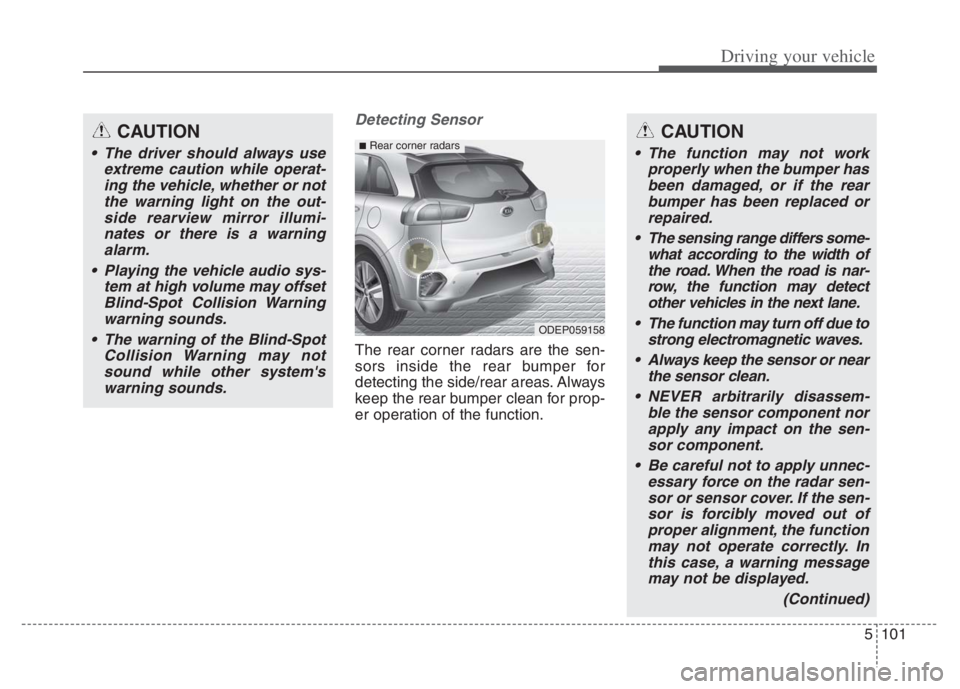
Detecting Sensor
The rear corner radars are the sen-
sors inside the rear bumper for
detecting the side/rear areas. Always
keep the rear bumper clean for prop-
er operation of the function.
CAUTION
The driver should always use
extreme caution while operat-
ing the vehicle, whether or not
the warning light on the out-
side rearview mirror illumi-
nates or there is a warning
alarm.
Playing the vehicle audio sys-
tem at high volume may offset
Blind-Spot Collision Warning
warning sounds.
The warning of the Blind-Spot
Collision Warning may not
sound while other system's
warning sounds.
ODEP059158
■Rear corner radarsCAUTION
The function may not work
properly when the bumper has
been damaged, or if the rear
bumper has been replaced or
repaired.
The sensing range differs some-
what according to the width of
the road. When the road is nar-
row, the function may detect
other vehicles in the next lane.
The function may turn off due to
strong electromagnetic waves.
Always keep the sensor or near
the sensor clean.
NEVER arbitrarily disassem-
ble the sensor component nor
apply any impact on the sen-
sor component.
Be careful not to apply unnec-
essary force on the radar sen-
sor or sensor cover. If the sen-
sor is forcibly moved out of
proper alignment, the function
may not operate correctly. In
this case, a warning message
may not be displayed.
(Continued)
Page 425 of 710
Driving your vehicle
102 5
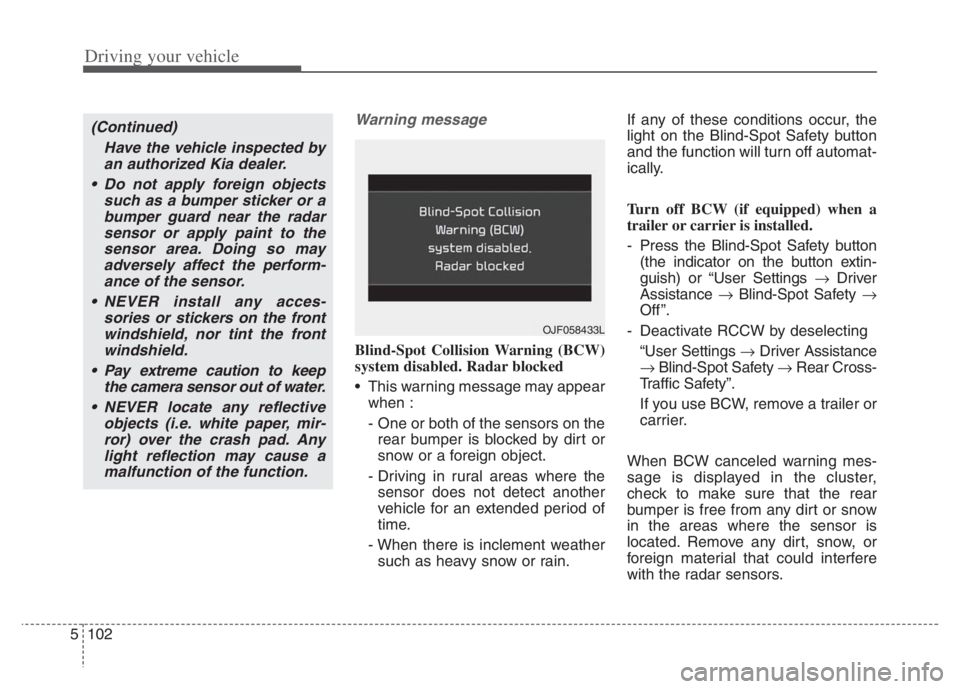
Warning message
Blind-Spot Collision Warning (BCW)
system disabled. Radar blocked
This warning message may appear
when :
- One or both of the sensors on the
rear bumper is blocked by dirt or
snow or a foreign object.
- Driving in rural areas where the
sensor does not detect another
vehicle for an extended period of
time.
- When there is inclement weather
such as heavy snow or rain.If any of these conditions occur, the
light on the Blind-Spot Safety button
and the function will turn off automat-
ically.
Turn off BCW (if equipped) when a
trailer or carrier is installed.
- Press the Blind-Spot Safety button
(the indicator on the button extin-
guish) or “User Settings Driver
Assistance Blind-Spot Safety
Off ”.
- Deactivate RCCW by deselecting
“User Settings Driver Assistance
Blind-Spot Safety Rear Cross-
Traffic Safety”.
If you use BCW, remove a trailer or
carrier.
When BCW canceled warning mes-
sage is displayed in the cluster,
check to make sure that the rear
bumper is free from any dirt or snow
in the areas where the sensor is
located. Remove any dirt, snow, or
foreign material that could interfere
with the radar sensors.
(Continued)
Have the vehicle inspected by
an authorized Kia dealer.
Do not apply foreign objects
such as a bumper sticker or a
bumper guard near the radar
sensor or apply paint to the
sensor area. Doing so may
adversely affect the perform-
ance of the sensor.
NEVER install any acces-
sories or stickers on the front
windshield, nor tint the front
windshield.
Pay extreme caution to keep
the camera sensor out of water.
NEVER locate any reflective
objects (i.e. white paper, mir-
ror) over the crash pad. Any
light reflection may cause a
malfunction of the function.
OJF058433L
Page 426 of 710
5103
Driving your vehicle
After any dirt or debris is removed,
BCW should operate normally after
about 10 minutes of driving the vehi-
cle.
If the function still does not operate
normally, have your vehicle inspect-
ed by an authorized Kia dealer.
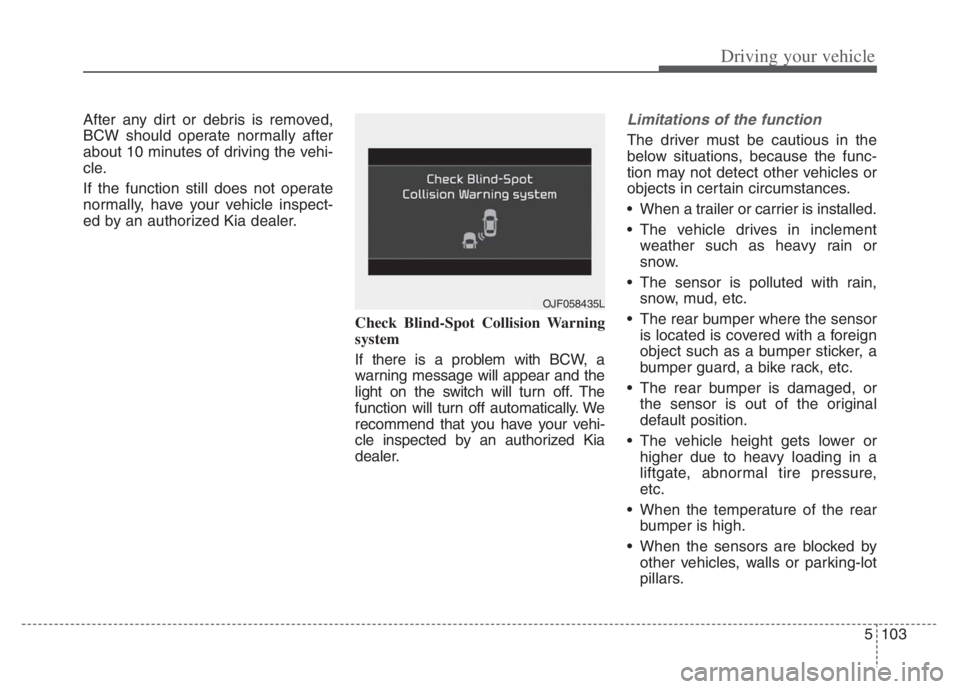
Check Blind-Spot Collision Warning
system
If there is a problem with BCW, a
warning message will appear and the
light on the switch will turn off. The
function will turn off automatically. We
recommend that you have your vehi-
cle inspected by an authorized Kia
dealer.Limitations of the function
The driver must be cautious in the
below situations, because the func-
tion may not detect other vehicles or
objects in certain circumstances.
When a trailer or carrier is installed.
The vehicle drives in inclement
weather such as heavy rain or
snow.
The sensor is polluted with rain,
snow, mud, etc.
The rear bumper where the sensor
is located is covered with a foreign
object such as a bumper sticker, a
bumper guard, a bike rack, etc.
The rear bumper is damaged, or
the sensor is out of the original
default position.
The vehicle height gets lower or
higher due to heavy loading in a
liftgate, abnormal tire pressure,
etc.
When the temperature of the rear
bumper is high.
When the sensors are blocked by
other vehicles, walls or parking-lot
pillars.
OJF058435L
Page 427 of 710
Driving your vehicle
104 5
The vehicle drives on a curved road.
The vehicle drives through a tollgate.
The road pavement (or the periph-
eral ground) abnormally contains
metallic components (i.e. possibly
due to subway construction).
There is a fixed object near the
vehicle, such as a guardrail.
While going down or up a steep
road where the height of the lane is
different.
Driving on a narrow road where
trees or grass or overgrown.
Driving in rural areas where the
sensor does not detect another
vehicle or structure for an extended
period of time.
Driving on a wet road.
Driving on a road where the guardrail
or wall is in double structure.
A big vehicle is near such as a bus
or truck.
When the other vehicle approach-
es very close.
When the other vehicle passes at a
very fast speed. While changing lanes.
If the vehicle has started at the
same time as the vehicle next to
you and has accelerated.
When the vehicle in the next lane
moves two lanes away from you
OR when the vehicle two lanes
away moves to the next lane from
you.
A motorcycle or bicycle is near.
A flat trailer is near.
If there are small objects in the
detecting area such as a shopping
cart or a baby stroller.
If there is a low height vehicle such
as a sports car.
The brake pedal is depressed.
ESC (Electronic Stability Control)
is activated.
ESC (Electronic Stability Control)
malfunctions.
The tire pressure is low or a tire is
damaged.
The brake is reworked. The vehicle abruptly changes driv-
ing direction.
The vehicle makes sharp lane
changes.
The vehicle sharply stops.
Temperature is extremely low
around the vehicle.
The vehicle severely vibrates while
driving over a bumpy road,
uneven/bumpy road, or concrete
patch.
The vehicle drives on a slippery
surface due to snow, water puddle,
or ice.
Lane Departure Warning or Lane
Keeping Assist do not operate nor-
mally.
For more information refer to “Lane
Keeping Assist (LKA)” in this chap-
ter.
Page 430 of 710
5107
Driving your vehicle
DAW displays the driver’s attention
level by integrating driving pattern
and informs the driver when the vehi-
cle ahead depart while stoppingLow Activity Warning
Display the driver's attention level
and advise taking a break if the
attention level is below a certain
level.
Function setting
To turn ON Driver Attention
Warning, turn on the engine, and
then selecting “User Settings
Driver Assistance Driver
Attention Warning Low Activity
Warning” on the LCD display.
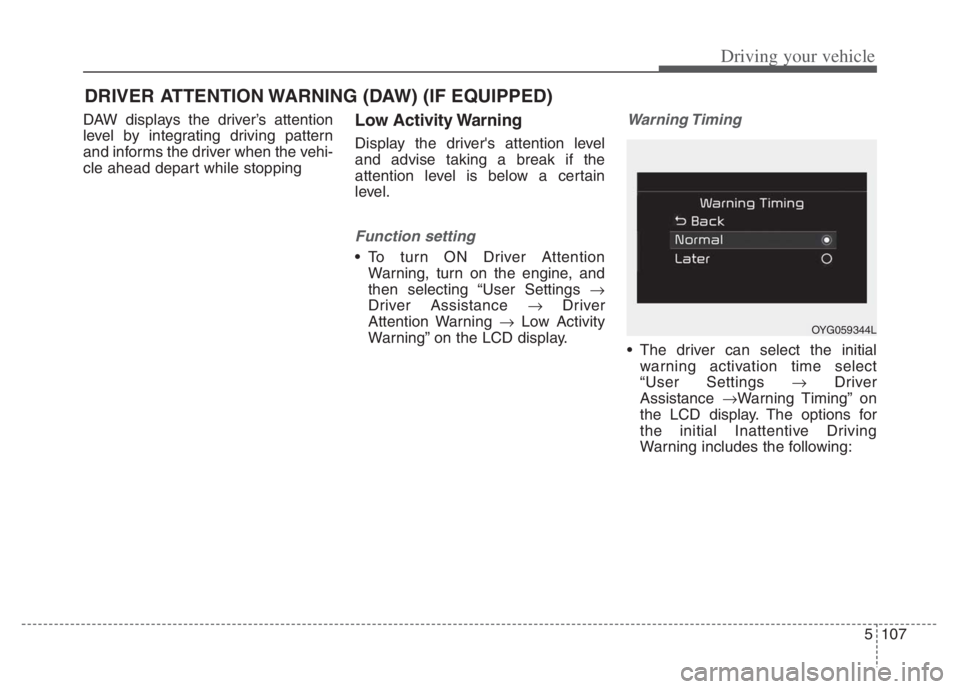
Warning Timing
The driver can select the initial
warning activation time select
“User Settings Driver
Assistance Warning Timing” on
the LCD display. The options for
the initial Inattentive Driving
Warning includes the following:
DRIVER ATTENTION WARNING (DAW) (IF EQUIPPED)
OYG059344L
Page 431 of 710
Driving your vehicle
108 5
- Normal :
Driver Attention Warning helps
warn the driver of his/her fatigue
level or inattentive driving practices
faster than ‘Later’ mode.
- Later :
Driver Attention Warning helps
warn the driver of his/her fatigue
level or inattentive driving practices
later than Normal mode.
The set-up of Driver Attention
Warning will be maintained, as
selected, when the engine is re-
started.
✽ ✽
NOTICE
Other driver assistance systems like
Forward Collision-Avoidance Assist,
etc. can be changed when warning
time setting is changed.
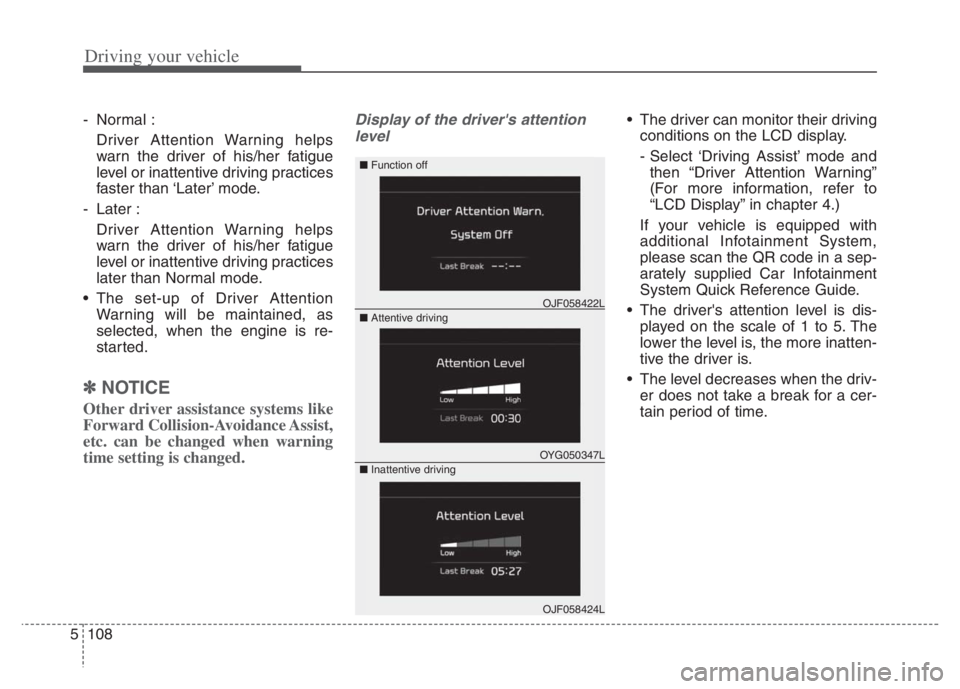
Display of the driver's attention
level The driver can monitor their driving
conditions on the LCD display.
- Select ‘Driving Assist’ mode and
then “Driver Attention Warning”
(For more information, refer to
“LCD Display” in chapter 4.)
If your vehicle is equipped with
additional Infotainment System,
please scan the QR code in a sep-
arately supplied Car Infotainment
System Quick Reference Guide.
The driver's attention level is dis-
played on the scale of 1 to 5. The
lower the level is, the more inatten-
tive the driver is.
The level decreases when the driv-
er does not take a break for a cer-
tain period of time.
OYG050347L
OJF058422L
OJF058424L
■ Function off
■ Attentive driving
■ Inattentive driving
Page 432 of 710
5109
Driving your vehicle
Take a break
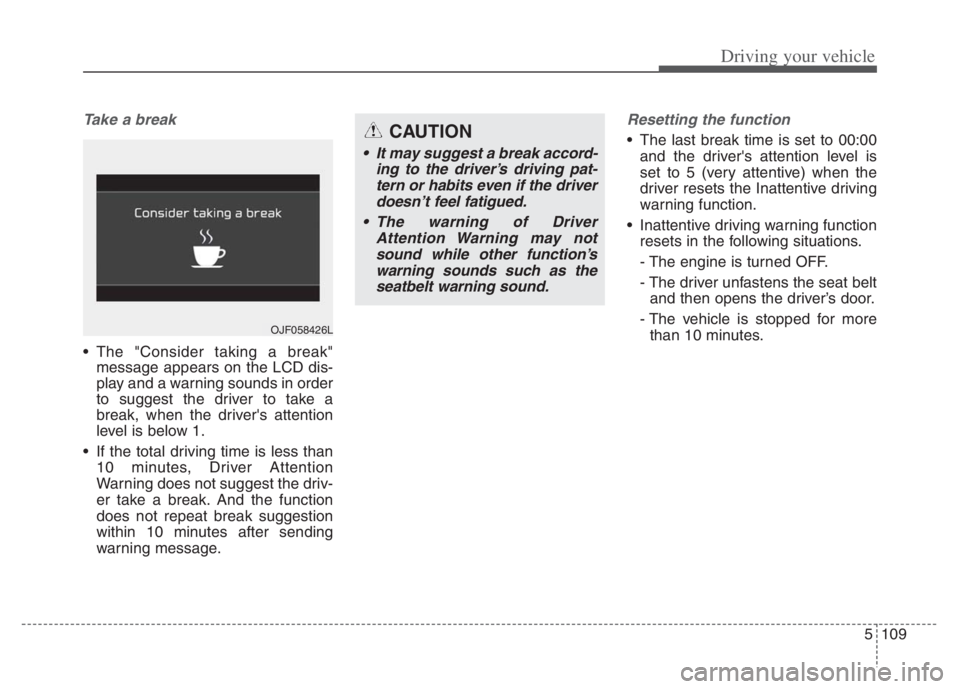
The "Consider taking a break"
message appears on the LCD dis-
play and a warning sounds in order
to suggest the driver to take a
break, when the driver's attention
level is below 1.
If the total driving time is less than
10 minutes, Driver Attention
Warning does not suggest the driv-
er take a break. And the function
does not repeat break suggestion
within 10 minutes after sending
warning message.
Resetting the function
The last break time is set to 00:00
and the driver's attention level is
set to 5 (very attentive) when the
driver resets the Inattentive driving
warning function.
Inattentive driving warning function
resets in the following situations.
- The engine is turned OFF.
- The driver unfastens the seat belt
and then opens the driver’s door.
- The vehicle is stopped for more
than 10 minutes.
OJF058426L
CAUTION
It may suggest a break accord-
ing to the driver’s driving pat-
tern or habits even if the driver
doesn’t feel fatigued.
The warning of Driver
Attention Warning may not
sound while other function’s
warning sounds such as the
seatbelt warning sound.
Page 433 of 710
Driving your vehicle
110 5
WARNING
Driver Attention Warning is
not a substitute for safe driv-
ing practices, but a conven-
ience function only. It is the
driver's responsibility to
always drive cautiously and
safely.
A fatigued driver should take
a break, even if there is no
suggestion to do so by Driver
Attention Warning.
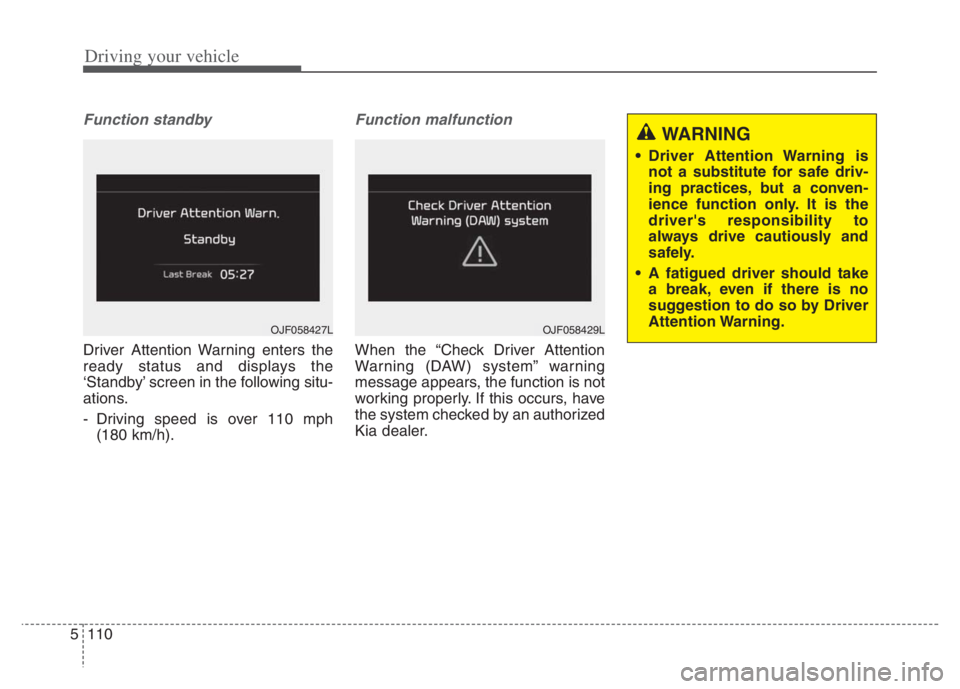
Function standby
Driver Attention Warning enters the
ready status and displays the
‘Standby’ screen in the following situ-
ations.
- Driving speed is over 110 mph
(180 km/h).
Function malfunction
When the “Check Driver Attention
Warning (DAW) system” warning
message appears, the function is not
working properly. If this occurs, have
the system checked by an authorized
Kia dealer.
OJF058429LOJF058427L
Page 434 of 710
5111
Driving your vehicle
✽ ✽
NOTICE
Driver Attention Warning utilizes
the front view camera sensor on the
front windshield for its operation.
To keep the front view camera
sensor in the best condition, you
should observe the followings:
- Do not disassemble camera tem-
porarily for tinted window or
attaching any types of coatings and
accessories. If you disassemble a
camera and assemble it again, take
your vehicle to an authorized Kia
dealer and have the system
checked.
- Do not locate any reflective
objects (i.e. white paper, mirror)
over the dashboard. Any light
reflection may cause a mal-func-
tion of Driver Attention Warning.
(Continued)(Continued)
- Pay extreme caution to keep the
front view camera out of water.
- Do not arbitrarily disassemble the
camera assembly, nor apply any
impact on the camera assembly.
• Playing the vehicle audio system
at high volume may offset Driver
Attention Warning warning
sounds.
For more information of front
view camera, refer to “Lane
Keeping Assist (LKA)”.CAUTION
Driver Attention Warning may
not properly operate with limit-
ed alerting in the following situ-
ations:
The function will not operate
for about 15 seconds when
restarting the engine or initial-
izing the front view camera
such as rebooting, etc.
The lane detection perform-
ance is limited. (For more
information, refer to "Lane
Keeping Assist (LKA)" in this
chapter.)
The vehicle is violently driven
or is abruptly turned for obsta-
cle avoidance (e.g. construc-
tion area, other vehicles, fallen
objects, bumpy road).
Intentionally frequent lane
cut-in
(Continued)
Page 435 of 710
Driving your vehicle
112 5
Leading Vehicle Departure
Alert
This function reminds the driver the
leading vehicle’s driving departure
after stopping.
Function setting
With the vehicle ON, Leading Vehicle
Departure Alert function turns on and
gets ready to be activated when the
“User Settings Driver Assistance
Driver Attention Warning Leading
Vehicle Departure Alert” is selected on
the cluster. The function stops opera-
tion when the setting is deactivated.
However, if the vehicle is turned off
then onagain, the function maintains
the previous state.
Operating conditions
If the driver does not take action for a
certain period of time after the vehi-
cle in front departs, the “Leading
vehicle is driving away” message is
displayed on the cluster.
(Continued)
The vehicle drives on a curvy
road.
The vehicle drives on a bumpy
road.
The vehicle drives through a
windy area.
The vehicle is controlled by
the other driver assistance
systems such as Lane
Keeping Assist.