lock KIA Opirus 2007 1.G Manual PDF
[x] Cancel search | Manufacturer: KIA, Model Year: 2007, Model line: Opirus, Model: KIA Opirus 2007 1.GPages: 283, PDF Size: 18.42 MB
Page 240 of 283
75
Maintenance
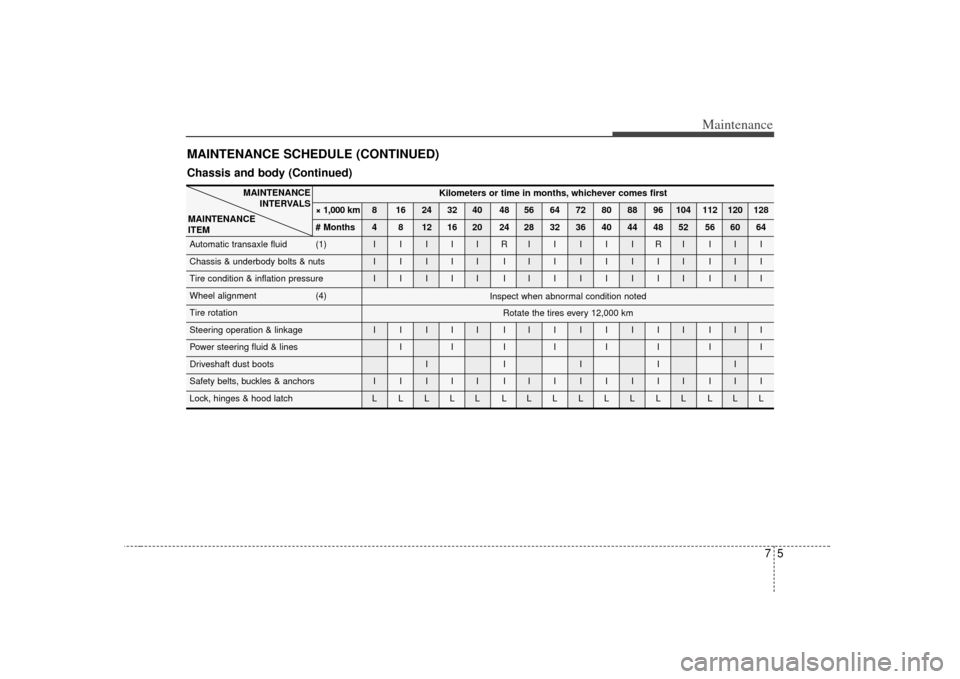
MAINTENANCE SCHEDULE (CONTINUED)
Kilometers or time in months, whichever comes first
× 1,000 km 8 16 24 32 40 48 56 64 72 80 88 96 104 112 120 128
# Months 4 8 12 16 20 24 28 32 36 40 44 48 52 56 60 64
Automatic transaxle fluid (1) I I I I I R IIIIIRI III
Chassis & underbody bolts & nuts I I I I I I IIIIIII III
Tire condition & inflation pressure I I I I I I IIIIIII III
Wheel alignment (4)
Tire rotation
Steering operation & linkage I I I I I I IIIIIII III
Power steering fluid & lines I I I IIIII
Driveshaft dust boots I I I I I
Safety belts, buckles & anchors I I I I I I IIIIIII III
Lock, hinges & hood latch L L L L L L LLLLLLL LLL
MAINTENANCE
INTERVALS
MAINTENANCE
ITEM
Inspect when abnormal condition noted
Rotate the tires every 12,000 km
Chassis and body (Continued)
Page 243 of 283
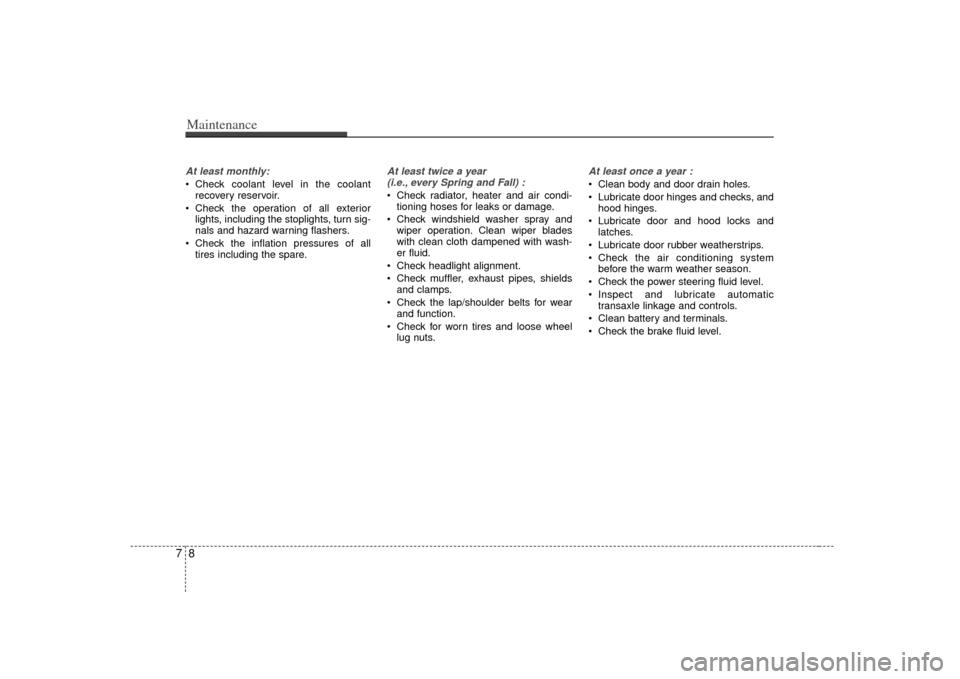
Maintenance87At least monthly: Check coolant level in the coolantrecovery reservoir.
Check the operation of all exterior lights, including the stoplights, turn sig-
nals and hazard warning flashers.
Check the inflation pressures of all tires including the spare.
At least twice a year (i.e., every Spring and Fall) : Check radiator, heater and air condi- tioning hoses for leaks or damage.
Check windshield washer spray and wiper operation. Clean wiper blades
with clean cloth dampened with wash-
er fluid.
Check headlight alignment.
Check muffler, exhaust pipes, shields and clamps.
Check the lap/shoulder belts for wear and function.
Check for worn tires and loose wheel lug nuts.
At least once a year : Clean body and door drain holes.
Lubricate door hinges and checks, andhood hinges.
Lubricate door and hood locks and latches.
Lubricate door rubber weatherstrips.
Check the air conditioning system before the warm weather season.
Check the power steering fluid level.
Inspect and lubricate automatic transaxle linkage and controls.
Clean battery and terminals.
Check the brake fluid level.
Page 247 of 283
Maintenance12
7ENGINE COOLING SYSTEM The high-pressure cooling system has a
reservoir filled with year-round antifreeze
coolant. The reservoir is filled at the fac-
tory.
Check the antifreeze protection and
coolant level at least once a year, at the
beginning of the winter season, and
before traveling to a colder climate.Checking the coolant level
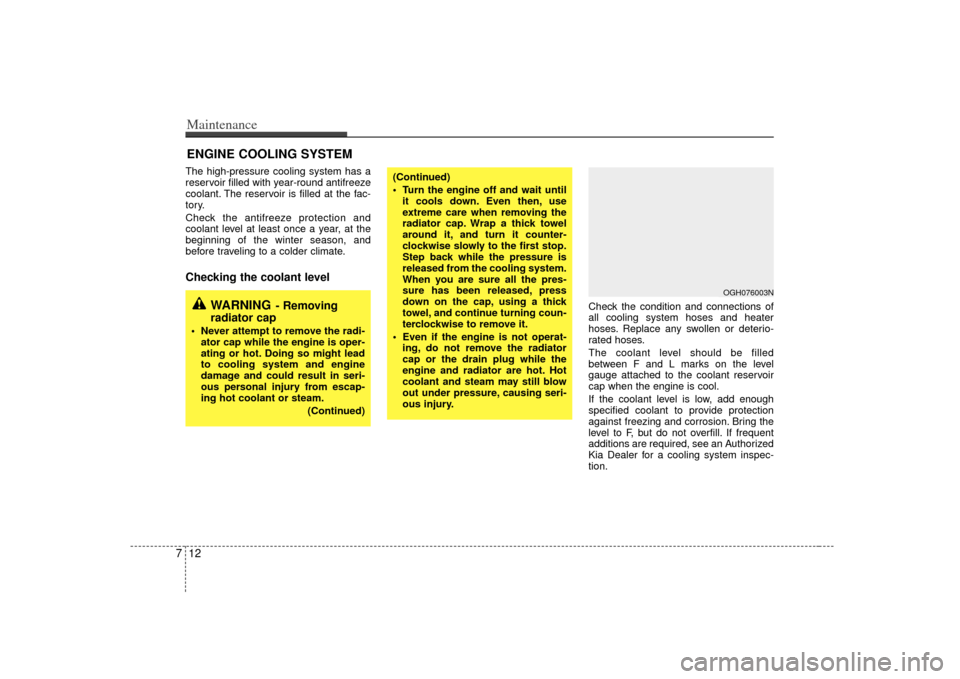
Check the condition and connections of
all cooling system hoses and heater
hoses. Replace any swollen or deterio-
rated hoses.
The coolant level should be filled
between F and L marks on the level
gauge attached to the coolant reservoir
cap when the engine is cool.
If the coolant level is low, add enough
specified coolant to provide protection
against freezing and corrosion. Bring the
level to F, but do not overfill. If frequent
additions are required, see an Authorized
Kia Dealer for a cooling system inspec-
tion.
WARNING
- Removing
radiator cap
Never attempt to remove the radi-
ator cap while the engine is oper-
ating or hot. Doing so might lead
to cooling system and engine
damage and could result in seri-
ous personal injury from escap-
ing hot coolant or steam.
(Continued)
(Continued)
Turn the engine off and wait untilit cools down. Even then, use
extreme care when removing the
radiator cap. Wrap a thick towel
around it, and turn it counter-
clockwise slowly to the first stop.
Step back while the pressure is
released from the cooling system.
When you are sure all the pres-
sure has been released, press
down on the cap, using a thick
towel, and continue turning coun-
terclockwise to remove it.
Even if the engine is not operat- ing, do not remove the radiator
cap or the drain plug while the
engine and radiator are hot. Hot
coolant and steam may still blow
out under pressure, causing seri-
ous injury.
OGH076003N
Page 253 of 283
Maintenance18
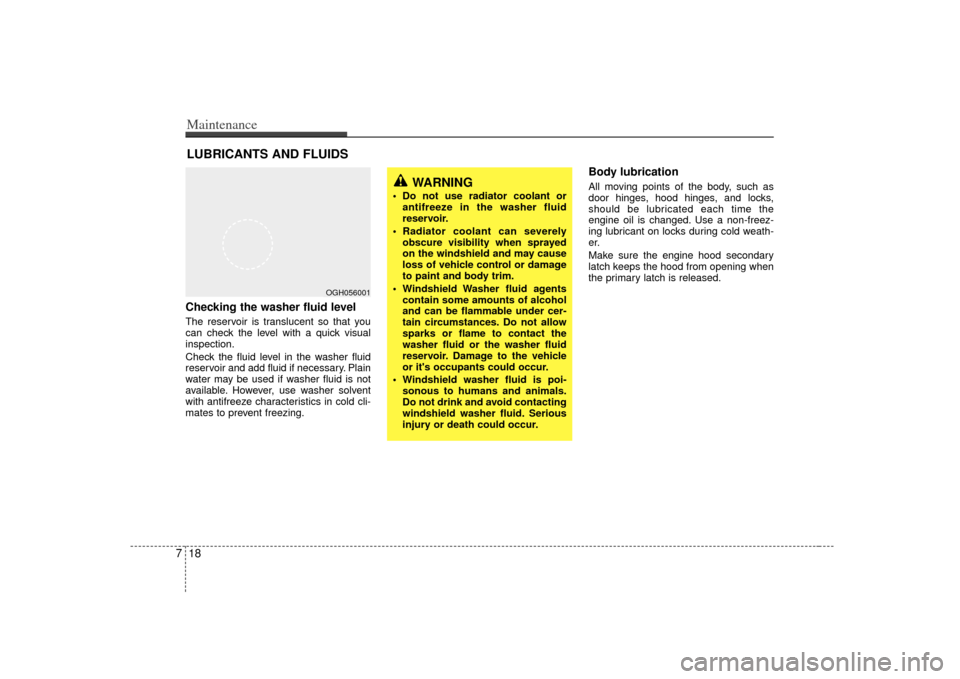
7LUBRICANTS AND FLUIDS Checking the washer fluid level The reservoir is translucent so that you
can check the level with a quick visual
inspection.
Check the fluid level in the washer fluid
reservoir and add fluid if necessary. Plain
water may be used if washer fluid is not
available. However, use washer solvent
with antifreeze characteristics in cold cli-
mates to prevent freezing.
Body lubrication All moving points of the body, such as
door hinges, hood hinges, and locks,
should be lubricated each time the
engine oil is changed. Use a non-freez-
ing lubricant on locks during cold weath-
er.
Make sure the engine hood secondary
latch keeps the hood from opening when
the primary latch is released.
OGH056001
WARNING
Do not use radiator coolant or
antifreeze in the washer fluid
reservoir.
Radiator coolant can severely obscure visibility when sprayed
on the windshield and may cause
loss of vehicle control or damage
to paint and body trim.
Windshield Washer fluid agents contain some amounts of alcohol
and can be flammable under cer-
tain circumstances. Do not allow
sparks or flame to contact the
washer fluid or the washer fluid
reservoir. Damage to the vehicle
or it's occupants could occur.
Windshield washer fluid is poi- sonous to humans and animals.
Do not drink and avoid contacting
windshield washer fluid. Serious
injury or death could occur.
Page 256 of 283
721
Maintenance
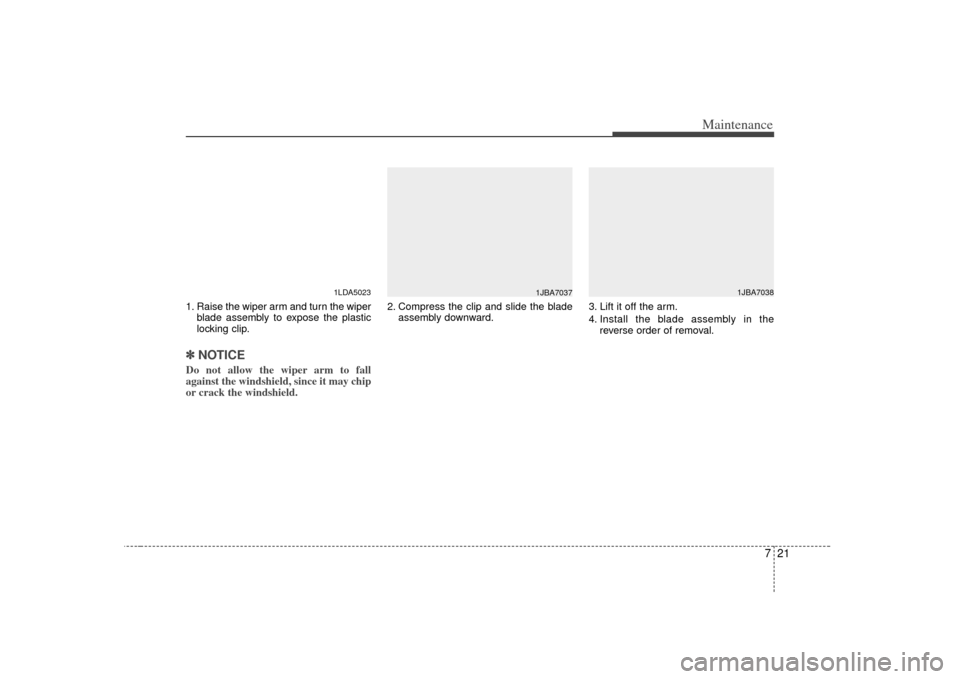
1. Raise the wiper arm and turn the wiperblade assembly to expose the plastic
locking clip.✽ ✽NOTICEDo not allow the wiper arm to fall
against the windshield, since it may chip
or crack the windshield.
2. Compress the clip and slide the blade
assembly downward. 3. Lift it off the arm.
4. Install the blade assembly in the
reverse order of removal.
1JBA7037
1JBA7038
1LDA5023
Page 258 of 283
723
Maintenance
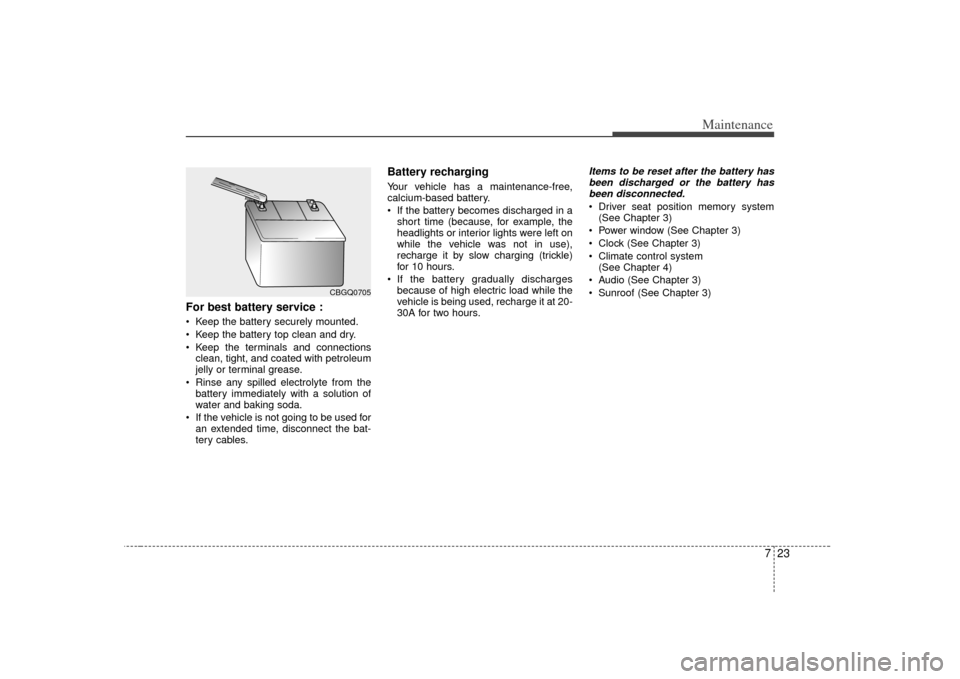
For best battery service : Keep the battery securely mounted.
Keep the battery top clean and dry.
Keep the terminals and connectionsclean, tight, and coated with petroleum
jelly or terminal grease.
Rinse any spilled electrolyte from the battery immediately with a solution of
water and baking soda.
If the vehicle is not going to be used for an extended time, disconnect the bat-
tery cables.
Battery recharging Your vehicle has a maintenance-free,
calcium-based battery.
If the battery becomes discharged in ashort time (because, for example, the
headlights or interior lights were left on
while the vehicle was not in use),
recharge it by slow charging (trickle)
for 10 hours.
If the battery gradually discharges because of high electric load while the
vehicle is being used, recharge it at 20-
30A for two hours.
Items to be reset after the battery hasbeen discharged or the battery has been disconnected. Driver seat position memory system (See Chapter 3)
Power window (See Chapter 3)
Clock (See Chapter 3)
Climate control system (See Chapter 4)
Audio (See Chapter 3)
Sunroof (See Chapter 3)
CBGQ0705
Page 281 of 283

Index29Air bags-advanced supplemental restraint system ···3-52
Air cleaner ··················\
··················\
··················\
··············7-19
Antenna ··················\
··················\
··················\
··················\
·3-98
Audio remote control··················\
··················\
···············3-99
Audio systems ··················\
··················\
··················\
·······3-100
Automatic climate control system ··················\
············4-43
Automatic transaxle ··················\
··················\
·········4-5, 7-16
Battery··················\
··················\
··················\
··················\
···7-22
Before driving··················\
··················\
··················\
···········5-5
Brake system ··················\
··················\
··················\
··········4-10
Brakes ··················\
··················\
··················\
··················\
···7-14
Climate control air filter ··················\
··················\
·········7-19
Cruise control system ··················\
··················\
··············4-19
Defroster ··················\
··················\
··················\
·················4-41\
Door locks ··················\
··················\
··················\
·················3-9
Driver position memory system··················\
················3-28Electrical circuit protection ··················\
··················\
······6-5
Electronic stability control ··················\
··················\
······4-22
Emergency starting··················\
··················\
··················\
··6-3
Emission control system ··················\
··················\
············5-3
Engine compartment ··················\
··················\
········2-4, 7-10
Engine cooling system ··················\
··················\
·············7-12
Engine oil and oil filter ··················\
··················\
············7-11
Exterior care··················\
··················\
··················\
···········7-38
Fuel filler lid ··················\
··················\
··················\
···········3-81
Fuel requirements ··················\
··················\
··················\
····5-2
Gauges ··················\
··················\
··················\
··················\
···4-26
Hazard warning flasher ··················\
··················\
··········4-42
Homelink® wireless control system ··················\
·········5-25
Hood ··················\
··················\
··················\
··················\
······3-80
How to use this manual ··················\
··················\
·············1-2
If you have a flat tire ··················\
··················\
···············6-17ABCD
EFGHI