brake KIA Optima 2006 2.G Owner's Guide
[x] Cancel search | Manufacturer: KIA, Model Year: 2006, Model line: Optima, Model: KIA Optima 2006 2.GPages: 225, PDF Size: 3.77 MB
Page 140 of 225
DRIVING TIPS
5-4 Do not operate the vehicle when
there are signs of engine malfunction,
such as misfire or a noticeable loss of
performance.
Do not misuse or abuse the engine.
Examples of misuse are coasting
with the ignition off and descending
steep grades in gear with the ignition
off.
Do not operate the engine at high idle
speed for extended periods (5
minutes or more).
Do not modify or tamper with any
part of the engine or emission control
system. All inspections and
adjustments must be made by a
qualified technician.
Failure to observe the above precautions
could result in damage to the catalytic
converter and to your vehicle and could
void your warranties.
BEFORE DRIVINGBefore entering vehicle:
Be sure that all windows, outside
mirror(s), and outside lights are clean.
Check the condition of the tires.
Check under the vehicle for any sign
of leaks.
Be sure there are no obstacles behind
you if you intend to back up.NECESSARY
INSPECTIONSFluid levels, such as engine oil, engine
coolant, brake/clutch fluid, and washer
fluid should be checked on a regular
basis, with the exact interval depending
on the fluid. Further details are provided
in Maintenance, Section 7.
BEFORE STARTING Close and lock all doors.
Position the seat so that all controls
are easily reached.
Adjust the inside and outside
rearview mirrors.
Be sure that all lights work.
Check all gauges.
Check the operation of warning
lights when the ignition switch is
turned to the ON position.
Release the parking brake and make
sure the brake warning light goes out.
For safe operation, be sure you are
familiar with your vehicle and its
equipment.
MS-CNA-Eng 5 New.qxd 7/25/2005 5:21 PM Page 4
Page 142 of 225
Keep the engine in tune and follow the
recommended periodic maintenance
schedule.
This will increase the life of all parts
and lower your operating costs.
Do not use the air conditioner
unnecessarily.
Slow down when driving on rough
roads.
For longer tire life and better fuel
economy, always keep the tires
inflated to the recommended
pressures.
Maintain a safe distance from other
vehicles to avoid sudden stops. This
will reduce wear on brake linings and
pads and save fuel because extra fuel
is required to accelerate back to
driving speed.
Do not carry unnecessary weight in
the vehicle. Do not rest your foot on the brake
pedal while driving. This can cause
needless wear, possible damage to
the brakes, and poor fuel economy.
Improper wheel alignment causes the
tires to roll at excessive angles,
which results in faster tire wear. It
takes more power to overcome this
improper alignment, which wastes
fuel.
Open windows at high speeds can
reduce fuel economy.
Crosswinds and headwinds reduce
fuel economy. To help offset some of
this loss, slow down when driving in
these conditions.
Keeping a vehicle in good operating
condition is important both for
economy and safety.
Therefore, have an Authorized Kia
Dealer perform scheduled inspections
and maintenance.
DRIVING TIPS
5-6
WARNING - Engine OFF
Motion
Never turn the engine off to
coast down hills or anytime the
vehicle is in motion. The power
steering and power brakes will
not function without the engine
running. Instead, downshift to
any appropriate gear for engine
braking effect.
MS-CNA-Eng 5 New.qxd 7/25/2005 5:21 PM Page 6
Page 143 of 225
SPECIAL DRIVING
CONDITIONSHAZARDOUS DRIVINGWhen hazardous driving is encountered
because of water, snow, ice, mud, sand, or
similar hazard, follow these suggestions:
Drive cautiously and allow extra
distance for braking.
Avoid sudden movements in braking
or steering.
When braking in vehicles without
anti-lock brakes, depress the brake
pedal with a controlled up-and- down
motion until the vehicle is stopped.
When starting from a stop in snow,
mud, or sand, use second gear and
accelerate slowly to avoid spinning
the front wheels. Low gear may be
used, if necessary.
Use sand, rock salt, tire chains, or
other non-slip material under the
front wheels to provide traction when
stalled on ice, snow, or mud.
ROCKING THE VEHICLEIf it is necessary to rock the vehicle to
free it from snow, sand, or mud, move
the shift lever of an automatic transaxle
from D (Drive) to R (Reverse) in a
repeat pattern while depressing the
accelerator gently. With a manual
transaxle, move the shift lever back and
forth from 1 (First) to R (Reverse).
Do not race the engine. If you are still
stuck after a couple minutes of rocking,
have the vehicle pulled out by a tow
vehicle to avoid engine overheating and
possible damage to the transaxle.
5-7
WARNING -
Downshifting
Downshifting into first gear with
a manual transaxle or into low
with an automatic transaxle
while driving on slippery
surfaces can cause an
accident. The sudden change in
tire speed could cause the tires
to skid. Be careful when
downshifting on slippery
surfaces.
✻
NOTICE
Prolonged rocking may cause
engine overheating, transaxle
damage or failure, and tire
damage.
MS-CNA-Eng 5 New.qxd 7/25/2005 5:21 PM Page 7
Page 144 of 225
DRIVING TIPS
5-8
DRIVING AT NIGHTBecause night driving presents many
more hazards than driving in the
daylight, here are some important tips to
remember:
Slow down and keep more distance
between you and other vehicles as it
may be more difficult to see at night,
especially in rural areas where there
may not be any street lights.
Adjust your mirrors to reduce the
glare from other driver’s headlights.
Keep your headlights clean and
properly aimed. Dirty or misaimed
headlights will make it much more
difficult to see at night.
Avoid staring directly at the
headlights of oncoming vehicles.
You could be temporarily blinded
and it will take several seconds for
your eyes to readjust to the darkness.
DRIVING IN THE RAINRain and wet roads can make driving
dangerous, especially if you’re not
prepared for the slick pavement. Here are
a few things to consider when driving in
the rain:
Be sure your windshield wipers are
in good condition.
A heavy rainfall will make it harder
to see and will increase the distance
needed to stop your vehicle, so slow
down.
If your tires aren’t in good condition,
making a quick stop on wet
pavement can cause a skid and
possibly lead to an accident. Be sure
your tires and windshield wipers are
in good shape.
Turn on your headlights to make it
easier for others to see you.
Driving too fast through large
puddles can affect your brakes. If
you must go through puddles, try to
drive through them slowly.
WARNING -
Spinning
Tires
Do not spin the wheels
especially at speeds more than
35 mph (56 km/h). Spinning the
wheels at high speeds when the
vehicle is stationary could
cause a tire to overheat,
explode and injure by standers.
MS-CNA-Eng 5 New.qxd 7/25/2005 5:21 PM Page 8
Page 145 of 225
5-9
If you believe you may have gottenyour brakes wet, apply them lightly
while driving until normal braking
operation returns.WINTER DRIVING We recommend that you carryemergency equipment. Some things
you might include are tire chains, a
window scraper, windshield de-icer,
a bag of sand or salt, flares, a small
shovel and jumper cables.
Make sure you have sufficient ethylene glycol coolant in the
radiator.
Check the battery condition and cables. Cold temperatures reduce the
capacity of any battery, so it must be
in top shape to provide enough
winter starting power.
Make sure the engine oil viscosity is suitable for cold weather.
Check the ignition system for loose connections and damage. Use antifreeze-formulated windshield
washer fluid and make sure you have
sufficient fluid for your trip. (Do not
use engine coolant antifreeze.)
Do not use the parking brake if it might freeze. This is most likely to
happen after driving in slushy or wet
conditions and temperatures drop into
the freezing range. When parking,
shift to P (Park) with automatic
transaxle, or to 1 (First) or R
(Reverse) with a manual transaxle
and block the rear wheels.
SNOW TIRESWhen snow tires are used, select the size
and construction specified on the Tire
Pressure Label. It is strongly
recommended that snow tires be used on
all four wheels, or poor handling may
result. Snow tires should not be operated
at speeds exceeding 120 km/h (75 mph).
These tires should be inflated 4 psi (28
kPa, 0.3 kg/cm
2) above the recommended pressures shown on the Tire
Specification/Pressure Label, but inflation
should never exceed the maximum cold-
tire pressure shown on the tire sidewalls.
Do not install studded tires without first
checking local, provincial and municipal
regulations for possible restrictions
against their use.
WARNING - Snow Tire
Size
Snow tires should be
equivalent in size and type to
the vehicle’s standard tires.
Otherwise, the safety and
handling of your vehicle may be
adversely affected.
MS-CNA-Eng 5 New.qxd 7/25/2005 5:21 PM Page 9
Page 146 of 225

DRIVING TIPS
5-10TIRE CHAINSTire Chain SelectionRegulations regarding the use of tire
chains vary according to location or type
of road, so always check them before
installing chains.
Use only SAE Class “S” tire chains.
Chains must be the proper size for the
vehicle, as recommended by the chain
manufacturer.CHAIN INSTALLATIONWhen installing chains on your tires,
carefully follow the instructions of the
chain manufacturer.
The chain bands will scratch the wheel
covers. Remove the covers before
installing the chains.Install the chains on the front tires as
tightly as possible. The use of chains on
the rear tires is not recommended.
Retighten the chains after driving 0.5-1.0
km (1/4-1/2 mile).
Driving in Flooded AreasAvoid driving through flooded areas
unless you are sure the water is no higher
than the bottom of the wheel rims. Drive
through any water slowly. Allow
adequate stopping distance because
brake performance may be affected.
After driving through water, dry the
brakes by gently applying them several
times while the vehicle is moving slowly.
WARNING - Tire Chains
The use of chains may
adversely affect vehicle
handling.
Do not exceed 30 mph (50 km/
h) or the chain manufacturer’s
recommended speed limit,
whichever is lower.
Drive carefully and avoid
bumps, holes, sharp turns
and other road hazards,
which may cause the vehicle
to bounce.
Avoid sharp turns or locked
wheel braking.
Do not attempt to use a tire
chain on the temporary spare
tire because it may impair
vehicle handling and result in
damage to the vehicle and the
tire.
MS-CNA-Eng 5 New.qxd 7/25/2005 5:21 PM Page 10
Page 153 of 225
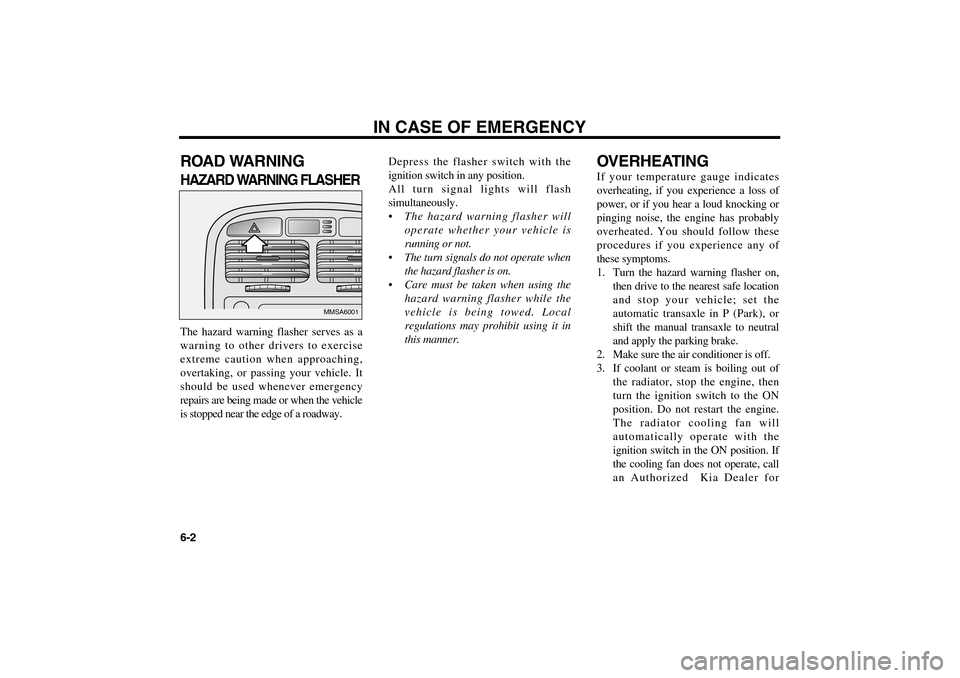
ROAD WARNINGHAZARD WARNING FLASHERThe hazard warning flasher serves as a
warning to other drivers to exercise
extreme caution when approaching,
overtaking, or passing your vehicle. It
should be used whenever emergency
repairs are being made or when the vehicle
is stopped near the edge of a roadway.Depress the flasher switch with the
ignition switch in any position.
All turn signal lights will flash
simultaneously.
• The hazard warning flasher will
operate whether your vehicle is
running or not.
The turn signals do not operate when
the hazard flasher is on.
Care must be taken when using the
hazard warning flasher while the
vehicle is being towed. Local
regulations may prohibit using it in
this manner.
OVERHEATINGIf your temperature gauge indicates
overheating, if you experience a loss of
power, or if you hear a loud knocking or
pinging noise, the engine has probably
overheated. You should follow these
procedures if you experience any of
these symptoms.
1. Turn the hazard warning flasher on,
then drive to the nearest safe location
and stop your vehicle; set the
automatic transaxle in P (Park), or
shift the manual transaxle to neutral
and apply the parking brake.
2. Make sure the air conditioner is off.
3. If coolant or steam is boiling out of
the radiator, stop the engine, then
turn the ignition switch to the ON
position. Do not restart the engine.
The radiator cooling fan will
automatically operate with the
ignition switch in the ON position. If
the cooling fan does not operate, call
an Authorized Kia Dealer for
IN CASE OF EMERGENCY
6-2
MMSA6001
MS-CNA-Eng 6.QXD 7/25/2005 5:13 PM Page 2
Page 166 of 225
As a general rule, towed vehicles should
be pulled with the driving wheels off the
ground. If excessive damage or other
conditions prevent towing the vehicle
with the driving wheels off the ground,
use wheel dollies.
With either an automatic or manual
transaxle:
1. Set the ignition switch in the ACC
position;
2. Place the shift lever in N (Neutral);
3. Release the parking brake.
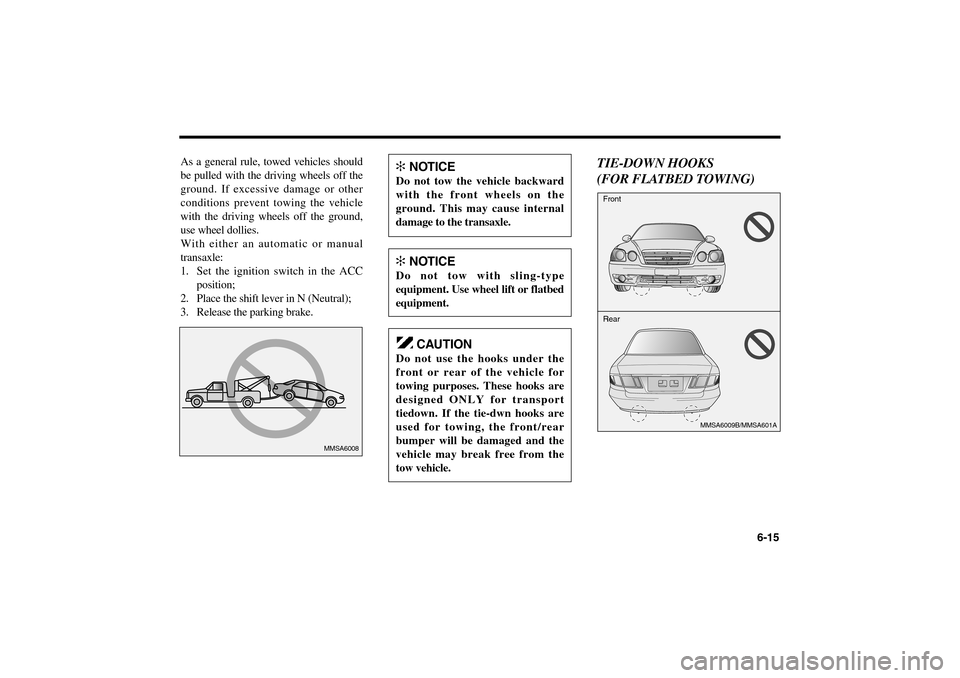
TIE-DOWN HOOKS
(FOR FLATBED TOWING)
6-15
MMSA6008
✻
NOTICE
Do not tow the vehicle backward
with the front wheels on the
ground. This may cause internal
damage to the transaxle.✻
NOTICE
Do not tow with sling-type
equipment. Use wheel lift or flatbed
equipment.
Front
MMSA6009B/MMSA601A
Rear
CAUTION
Do not use the hooks under the
front or rear of the vehicle for
towing purposes. These hooks are
designed ONLY for transport
tiedown. If the tie-dwn hooks are
used for towing, the front/rear
bumper will be damaged and the
vehicle may break free from the
tow vehicle.
MS-CNA-Eng 6.QXD 7/25/2005 5:13 PM Page 15
Page 167 of 225
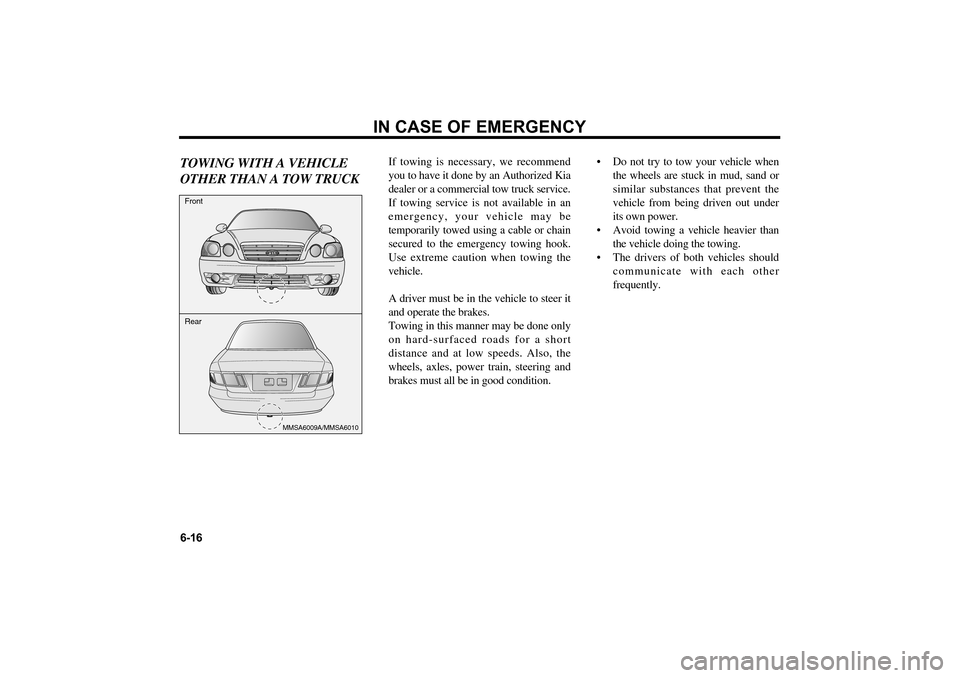
TOWING WITH A VEHICLE
OTHER THAN A TOW TRUCK
If towing is necessary, we recommend
you to have it done by an Authorized Kia
dealer or a commercial tow truck service.
If towing service is not available in an
emergency, your vehicle may be
temporarily towed using a cable or chain
secured to the emergency towing hook.
Use extreme caution when towing the
vehicle.
A driver must be in the vehicle to steer it
and operate the brakes.
Towing in this manner may be done only
on hard-surfaced roads for a short
distance and at low speeds. Also, the
wheels, axles, power train, steering and
brakes must all be in good condition. Do not try to tow your vehicle when
the wheels are stuck in mud, sand or
similar substances that prevent the
vehicle from being driven out under
its own power.
Avoid towing a vehicle heavier than
the vehicle doing the towing.
The drivers of both vehicles should
communicate with each other
frequently.
IN CASE OF EMERGENCY
6-16Front
MMSA6009A/MMSA6010
Rear
MS-CNA-Eng 6.QXD 7/25/2005 5:13 PM Page 16
Page 169 of 225
WHEN YOUR VEHICLE IS
BEING TOWED BY ANOTHER
VEHICLE OTHER THAN A
TOW TRUCK (IN CASE OF AN
EMERGENCY) Turn the ignition switch to ACC so
the steering wheel isn’t locked.
Place the transaxle shift lever in N
(Neutral).
Release the parking bake.
Vehicle equipped with automatic
transaxle should not exceed 45km/h
(28 mph) and should not be towed
more than 80km (50 miles). Press the brake pedal with more force
than normal since you will have
reduced brake performance.
More steering effort will be required
because the power steering system
will be disabled.
If you are driving down a long hill,
the brakes may overheat and brake
performance will be reduced. Stop
often and let the brakes cool off.
TIPS FOR TOWING A STUCK
VEHICLEThe following methods are effective
when your vehicle is stuck in mud, sand
or similar substances that prevent the
vehicle from being driven out under its
own power.
Remove the soil and sand, etc. from
the front and the back of the tires.
Place a stone or wood under the tires.
IN CASE OF EMERGENCY
6-18
✻
NOTICE
To prevent internal damage to the
transaxle, never tow your vehicle
from the rear (backwards) with all
four tires in contact with the
surface.
MS-CNA-Eng 6.QXD 7/25/2005 5:13 PM Page 18