trunk KIA Optima 2016 4.G Owner's Guide
[x] Cancel search | Manufacturer: KIA, Model Year: 2016, Model line: Optima, Model: KIA Optima 2016 4.GPages: 623, PDF Size: 15.4 MB
Page 188 of 623
Features of your vehicle
102
4
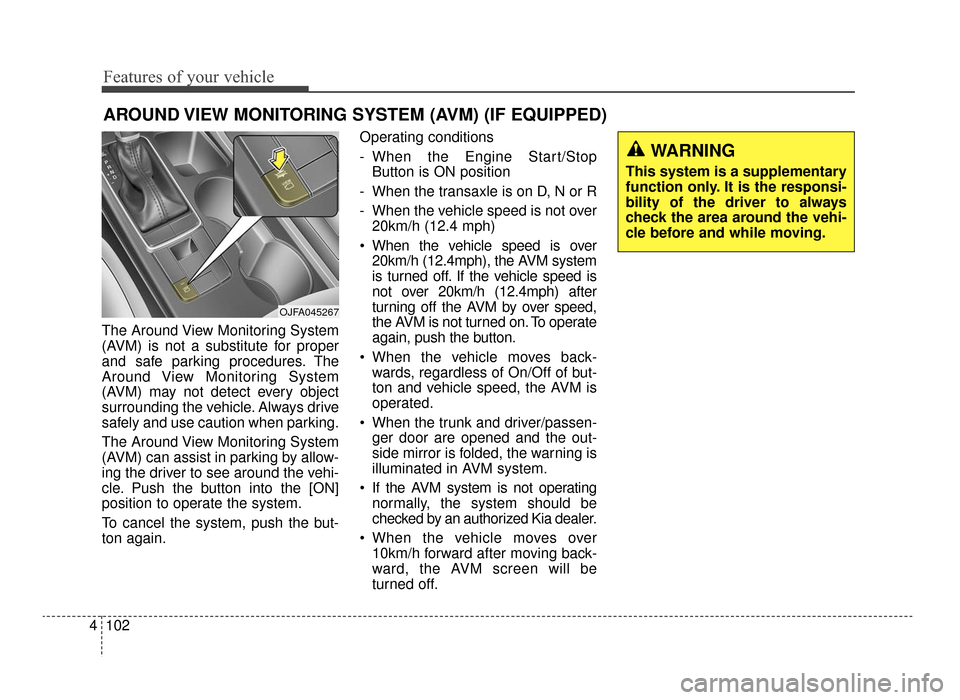
The Around View Monitoring System
(AVM) is not a substitute for proper
and safe parking procedures. The
Around View Monitoring System
(AVM) may not detect every object
surrounding the vehicle. Always drive
safely and use caution when parking.
The Around View Monitoring System
(AVM) can assist in parking by allow-
ing the driver to see around the vehi-
cle. Push the button into the [ON]
position to operate the system.
To cancel the system, push the but-
ton again. Operating conditions
- When the Engine Start/Stop
Button is ON position
- When the transaxle is on D, N or R
- When the vehicle speed is not over 20km/h (12.4 mph)
When the vehicle speed is over 20km/h (12.4mph), the AVM system
is turned off. If the vehicle speed is
not over 20km/h (12.4mph) after
turning off the AVM by over speed,
the AVM is not turned on. To operate
again, push the button.
When the vehicle moves back- wards, regardless of On/Off of but-
ton and vehicle speed, the AVM is
operated.
When the trunk and driver/passen- ger door are opened and the out-
side mirror is folded, the warning is
illuminated in AVM system.
If the AVM system is not operating normally, the system should be
checked by an authorized Kia dealer.
When the vehicle moves over 10km/h forward after moving back-
ward, the AVM screen will be
turned off.
AROUND VIEW MONITORING SYSTEM (AVM) (IF EQUIPPED)
OJFA045267
WARNING
This system is a supplementary
function only. It is the responsi-
bility of the driver to always
check the area around the vehi-
cle before and while moving.
JF CAN (ENG) 4.qxp 11/5/2015 3:51 PM Page 102
Page 195 of 623

4109
Features of your vehicle
Headlight leveling device
(if equipped)
Automatic type
To ensure the proper headlight beam
is used under various conditions, the
headlight beam levels are automati-
cally adjusted depending on the
number of passengers, the weight in
the trunk, and other driving condi-
tions.
✽ ✽NOTICE
If it does not work properly even
though your car is inclined backward
according to passenger's posture, or
the headlight beam is irradiated to
the high or low position, have the sys-
tem be inspected by an authorized
Kia dealer.
Do not attempt to inspect or replace
the wiring yourself.
AFLS (Adaptive Front Lighting
System) (if equipped)
Adaptive front lighting system uses
the steering angle and vehicle
speed, to keep your field of vision
wide by swiveling and leveling the
headlamp.
Change the switch to the AUTO posi-
tion when the engine is running. The
adaptive front lighting system will
operate when the headlamp is ON.
To turn off the AFLS, change the
switch to other positions. After turn-
ing the AFLS off, headlamp swiveling
no longer occurs, but leveling oper-
ates continuously. If the AFLS malfunction indicator
comes on, the AFLS is not working
properly. Drive to the nearest safe
location and restart the engine. If the
indicator continuously remains on,
have the system be checked by an
authorized Kia dealer.
OJF045051
JF CAN (ENG) 4.qxp 11/5/2015 3:51 PM Page 109
Page 201 of 623
4115
Features of your vehicle
Trunk room lamp (if equipped)
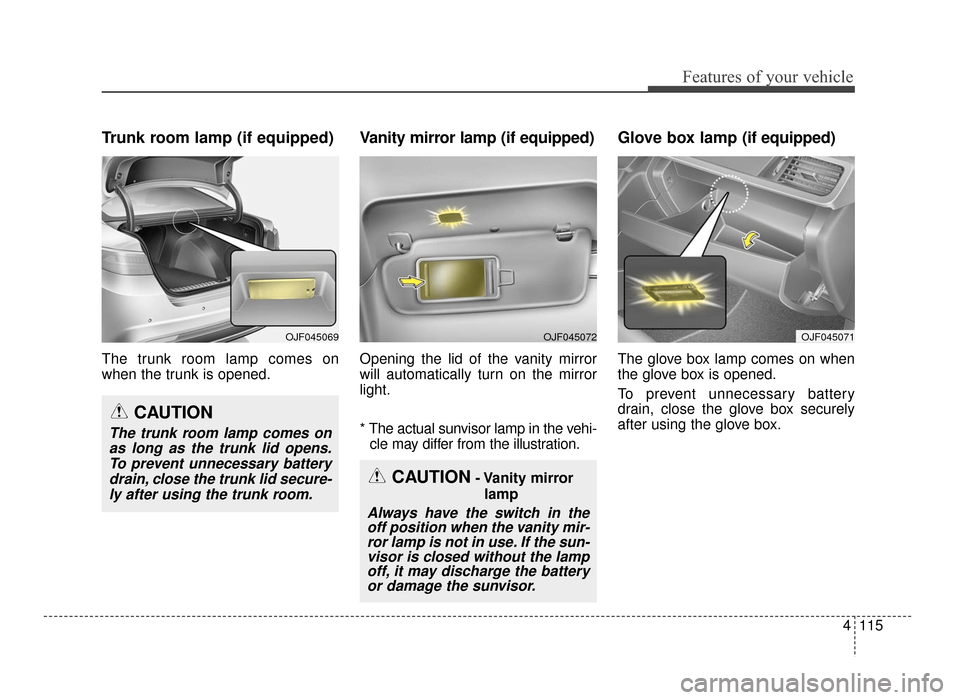
The trunk room lamp comes on
when the trunk is opened.
Vanity mirror lamp (if equipped)
Opening the lid of the vanity mirror
will automatically turn on the mirror
light.
* The actual sunvisor lamp in the vehi-cle may differ from the illustration.
Glove box lamp (if equipped)
The glove box lamp comes on when
the glove box is opened.
To prevent unnecessary battery
drain, close the glove box securely
after using the glove box.
CAUTION- Vanity mirror
lamp
Always have the switch in theoff position when the vanity mir-ror lamp is not in use. If the sun-visor is closed without the lampoff, it may discharge the batteryor damage the sunvisor.
OJF045069
CAUTION
The trunk room lamp comes on
as long as the trunk lid opens.To prevent unnecessary batterydrain, close the trunk lid secure-ly after using the trunk room.
OJF045072OJF045071
JF CAN (ENG) 4.qxp 11/5/2015 3:51 PM Page 115
Page 202 of 623
Features of your vehicle
116
4
WELCOME SYSTEM (IF EQUIPPED)
Headlight (Headlamp) escort
function
The headlights (and/or taillights)
remain on for approximately 5 min-
utes after the ignition key is removed
or turned to the ACC or LOCK posi-
tion. However, if the driver’s door is
opened and closed, the headlights
are turned off after 15 seconds.
The headlights can be turned off by
pressing the lock button on the trans-
mitter or smart key twice or turning
off the light switch from the headlight
or Auto light position.
Interior light
When the interior light switch is in the
DOOR position and all doors (and
trunk) are locked and closed, the
room lamp will come on for 30 sec-
onds if any of the below is performed.
Without smart key system
- When the door unlock button ispressed on the transmitter.
With the smart key system - When the door unlock button ispressed on the smart key.
- When the button of the outside door handle is pressed.
At this time, if you press the door lock
button, the lamps will turn off imme-
diately.
Pocket lamp (if equipped)
When all doors are locked and
closed, the pocket lamp will come on
for 15 seconds if any of the below is
performed.
With the smart key system - When the door unlock button ispressed on the smart key.
- When the button of the outside door handle is pressed.
At this time, if you press the door lock
button, the lamps will turn off imme-
diately.
JF CAN (ENG) 4.qxp 11/5/2015 3:51 PM Page 116
Page 389 of 623
633
Driving your vehicle
To release EPB (electronic parking
brake) automatically:
Shift lever in P (Park)With the engine running depress
the brake pedal and shift out of P
(Park) to R (Reverse) or D (Drive).
Shift lever in N (Neutral) With the engine running depress
the brake pedal and shift out of N
(Neutral) to R (Reverse) or D
(Drive).
Automatic Transaxle / Dual clutch transmission vehicle
1. Start the engine.
2. Fasten the driver's seat belt.
3. Close the driver's door, engine hood and trunk.
4. Depress the accelerator pedal while the shift lever is in R (Rear),
D (Drive) or Sports mode.
Make sure the brake warning light
goes off.✽ ✽ NOTICE
• For your safety, you can engage
the EPB even though the ignition
switch or engine stop/start button
is in the OFF position, but you
cannot release it.
• For your safety, depress the brake pedal and release the parking
brake manually with the EPB
switch when you drive downhill or
when backing up the vehicle.
Do not follow the above procedure
when driving on a flat level ground.
The vehicle may suddenly move for-
ward.
✽ ✽ NOTICE
If the parking brake warning light is
still on even though the EPB has
been released, have the system
checked by an authorized Kia dealer.
EPB (electronic parking brake) may
be automatically applied when:
The EPB is overheated
Requested by other systems
✽ ✽NOTICE
If the driver turns the engine off by
mistake while Auto Hold is operat-
ing, EPB will be automatically
applied. (Vehicles equipped with
Auto Hold)
CAUTION
Do not drive your vehicle with
the EPB applied. It may causeexcessive brake pad and brakerotor wear.
JF CAN (ENG) 6.qxp 11/5/2015 6:38 PM Page 33
Page 390 of 623
Driving your vehicle
34
6
System warning
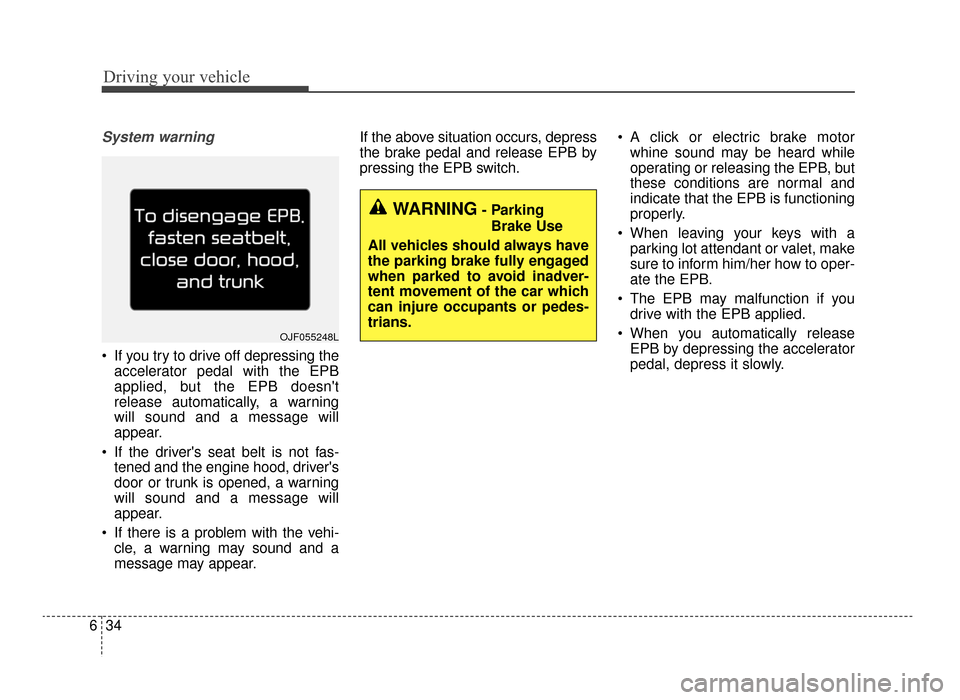
If you try to drive off depressing the
accelerator pedal with the EPB
applied, but the EPB doesn't
release automatically, a warning
will sound and a message will
appear.
If the driver's seat belt is not fas- tened and the engine hood, driver's
door or trunk is opened, a warning
will sound and a message will
appear.
If there is a problem with the vehi- cle, a warning may sound and a
message may appear. If the above situation occurs, depress
the brake pedal and release EPB by
pressing the EPB switch.
A click or electric brake motor
whine sound may be heard while
operating or releasing the EPB, but
these conditions are normal and
indicate that the EPB is functioning
properly.
When leaving your keys with a parking lot attendant or valet, make
sure to inform him/her how to oper-
ate the EPB.
The EPB may malfunction if you drive with the EPB applied.
When you automatically release EPB by depressing the accelerator
pedal, depress it slowly.
OJF055248L
WARNING- Parking
Brake Use
All vehicles should always have
the parking brake fully engaged
when parked to avoid inadver-
tent movement of the car which
can injure occupants or pedes-
trians.
JF CAN (ENG) 6.qxp 11/5/2015 6:38 PM Page 34
Page 435 of 623
679
Driving your vehicle
Vehicle recognition
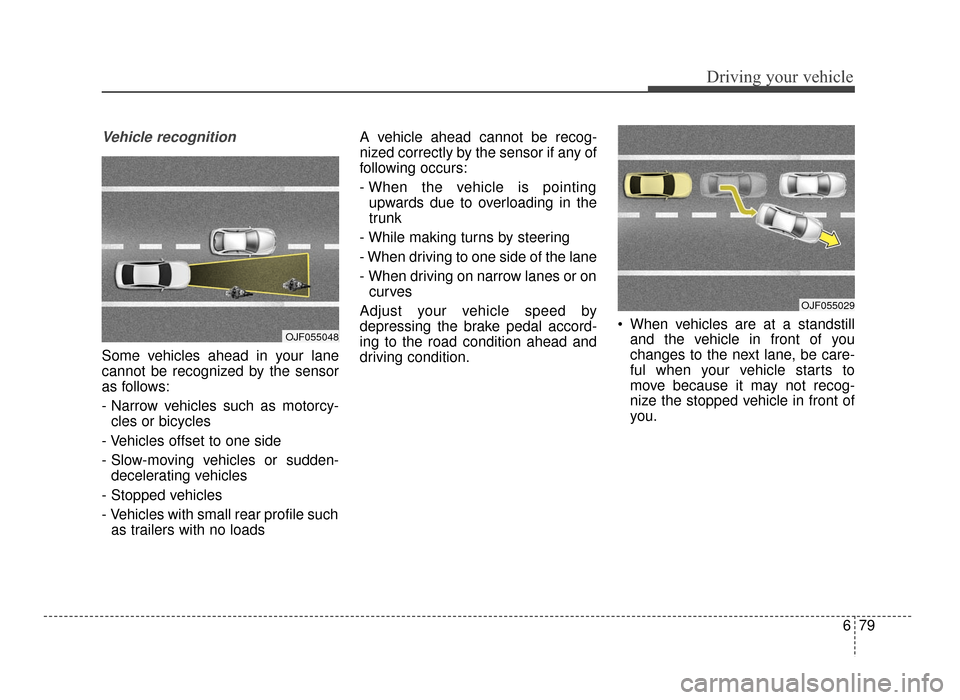
Some vehicles ahead in your lane
cannot be recognized by the sensor
as follows:
- Narrow vehicles such as motorcy-cles or bicycles
- Vehicles offset to one side
- Slow-moving vehicles or sudden- decelerating vehicles
- Stopped vehicles
- Vehicles with small rear profile such as trailers with no loads A vehicle ahead cannot be recog-
nized correctly by the sensor if any of
following occurs:
- When the vehicle is pointing
upwards due to overloading in the
trunk
- While making turns by steering
- When driving to one side of the lane
- When driving on narrow lanes or on curves
Adjust your vehicle speed by
depressing the brake pedal accord-
ing to the road condition ahead and
driving condition. When vehicles are at a standstill
and the vehicle in front of you
changes to the next lane, be care-
ful when your vehicle starts to
move because it may not recog-
nize the stopped vehicle in front of
you.
OJF055048
OJF055029
JF CAN (ENG) 6.qxp 11/5/2015 6:39 PM Page 79
Page 437 of 623
681
Driving your vehicle
- After an engine start, please stopfor several seconds. If system ini-
tialization is not completed, the
ASCC does not normally operate.
- After an engine start, if any objects are not detected or the sensor
cover is obscured with foreign sub-
stances, there is a possibility that
the ASCC system may not work.
- The following conditions may cause a malfunction: over-loading
the trunk, suspension modification,
tire replacement with unauthorized
tires or tires with different tread
wear and pressure levels. This device complies with
Industry Canada licence-exempt
RSS standard(s).
Operation is subject to the following
three conditions:
(1) This device may not cause inter-
ference, and
(2) This device must accept any
interference, including interfer-
ence that may cause undesired
operation of the device.
(3) Changes or modifications not
expressly approved by the party
responsible for compliance could
void the user’s authority to oper-
ate the device.
WARNING - Inclines &
Towing
Do not use ASCC on steep
inclines or when towing another
vehicle or trailer since such
extreme loading can interfere
with your vehicle's ability to
maintain the selected speed.
JF CAN (ENG) 6.qxp 11/5/2015 6:39 PM Page 81
Page 447 of 623
691
Driving your vehicle
✽
✽
NOTICE
• The system may not work proper-
ly if the bumper has been replaced
or if repair work has been done
near the sensor.
• The detection area differs according to the roads road's width. If the road
is narrow the system may detect
other vehicles in the next lane.
• If the road is very wide the system may not detect other vehicles.
• The system may turn off due to strong electromagnetic interfer-
ence.
Limitations condition
Driver's Attention
The driver must be cautious in the
below situations for the system may
not assist the driver and may not
work properly.
- Curved roads, tollgates, etc.
- The surrounding of the sensor
cover is dirty with rain, snow, mud,
etc.
- The rear bumper near the sensor is covered or obstructed with foreign
matter such as a sticker, bumper
guard, bicycle racks etc.
- The rear bumper is damaged or the sensor is out of place.
- The height of the vehicle has signif- icantly changed such as when the
trunk is loaded with heavy objects,
abnormal tire pressure etc.
- Due to bad weather such as heavy rain or snow. - A fixed object is near such as a
guardrail, etc.
- A substantial amount of metallic objects such as a construction
area.
- A large vehicle is nearby such as a bus or truck.
- A motorcycle or bicycle is near.
- A flat trailer is near.
- If two vehicles near each other accelerate together.
- When another vehicle passes by at a high rate of speed.
- When changing lanes.
- When going down or up a steep road where the height of the lane is
different.
- When another vehicle drives very close the back bumper/trunk.
- When a trailer or carrier is installed.
WARNING
The Blind Spot Detection
System with Lane Change
Assist and Rear Cross Traffic
Alert is not a substitute for
proper and safe lane changing
procedures. Always drive safely
and use caution when changing
lanes. The Blind Spot Detection
System may not detect every
object alongside the vehicle.
JF CAN (ENG) 6.qxp 11/5/2015 6:39 PM Page 91
Page 501 of 623

Fuses . . . . . . . . . . . . . . . . . . . . . . . . . . . . . . . . . . . . \
8-61
• Inner panel fuse replacement . . . . . . . . . . . . . . . . . . . 8-62
• Engine compartment fuse replacement. . . . . . . . . . . 8-64
• Fuse/relay panel description. . . . . . . . . . . . . . . . . . . . 8-66
Light bulbs . . . . . . . . . . . . . . . . . . . . . . . . . . . . . . . 8-76
• Bulb replacement precaution . . . . . . . . . . . . . . . . . . . 8-76
• Light bulb position (Front). . . . . . . . . . . . . . . . . . . . . 8-77
• Light bulb position (Rear) . . . . . . . . . . . . . . . . . . . . . 8-78
• Light bulb position (Side) . . . . . . . . . . . . . . . . . . . . . . 8-79
• Headlamp (HID type) bulb replacement . . . . . . . . . 8-79
• Headlamp (Low beam) bulb replacement . . . . . . . . 8-80
• Headlamp (High beam) bulb replacement . . . . . . . . 8-81
• Front turn signal lamp bulb replacement. . . . . . . . . 8-82
• Position lamp + DRL (LED type) bulb replacement . . 8-82
• Side repeater lamp bulb replacement . . . . . . . . . . . . 8-83
• Rear turn signal lamp bulb replacement . . . . . . . . . 8-83
• Stop and tail lamp bulb replacement . . . . . . . . . . . . 8-84
• Stop and tail lamp (LED type) bulb replacement . . 8-86
• Back-up lamp bulb replacement . . . . . . . . . . . . . . . . 8-86
• Tail lamp bulb replacement . . . . . . . . . . . . . . . . . . . . 8-87
• License plate lamp bulb replacement . . . . . . . . . . . . 8-88
• High mounted stop lamp bulb replacement . . . . . . . 8-89
• Map lamp bulb replacement . . . . . . . . . . . . . . . . . . . 8-89
• Vanity mirror lamp bulb replacement . . . . . . . . . . . 8-89
• Room lamp bulb replacement . . . . . . . . . . . . . . . . . . 8-90 • Personal lamp bulb replacement . . . . . . . . . . . . . . . . 8-91
• Glove box lamp bulb replacement . . . . . . . . . . . . . . . 8-91
• Trunk lamp bulb replacement . . . . . . . . . . . . . . . . . . 8-92
Appearance care . . . . . . . . . . . . . . . . . . . . . . . . . . . 8-93
• Exterior care . . . . . . . . . . . . . . . . . . . . . . . . . . . . . . . . 8-93
• Interior care . . . . . . . . . . . . . . . . . . . . . . . . . . . . . . . . . 8-98
Emission control system . . . . . . . . . . . . . . . . . . . 8-100
• Crankcase emission control system . . . . . . . . . . . . . 8-100
• Evaporative emission control (including ORVR:
Onboard Refueling Vapor Recovery) system . . . . 8-100
• Exhaust emission control system . . . . . . . . . . . . . . . 8-101
8
JF CAN (ENG) 8.qxp 11/5/2015 6:40 PM Page 2