transmission KIA OPTIMA 2020 Owner's Guide
[x] Cancel search | Manufacturer: KIA, Model Year: 2020, Model line: OPTIMA, Model: KIA OPTIMA 2020Pages: 589, PDF Size: 11.37 MB
Page 473 of 589
77
Maintenance
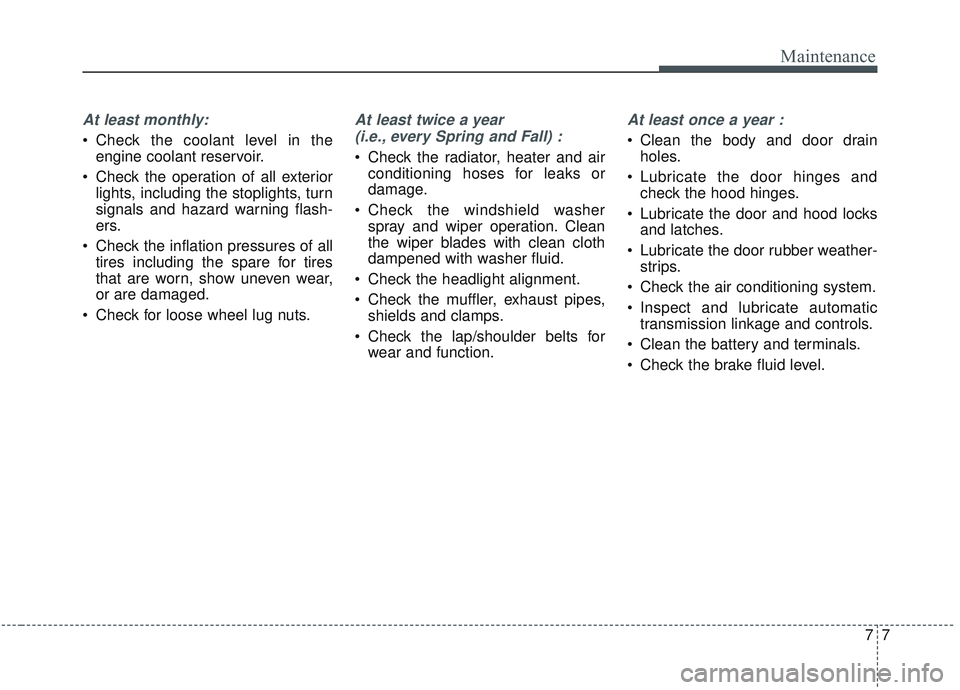
At least monthly:
Check the coolant level in theengine coolant reservoir.
Check the operation of all exterior lights, including the stoplights, turn
signals and hazard warning flash-
ers.
Check the inflation pressures of all tires including the spare for tires
that are worn, show uneven wear,
or are damaged.
Check for loose wheel lug nuts.
At least twice a year (i.e., every Spring and Fall) :
Check the radiator, heater and air conditioning hoses for leaks or
damage.
Check the windshield washer spray and wiper operation. Clean
the wiper blades with clean cloth
dampened with washer fluid.
Check the headlight alignment.
Check the muffler, exhaust pipes, shields and clamps.
Check the lap/shoulder belts for wear and function.
At least once a year :
Clean the body and door drainholes.
Lubricate the door hinges and check the hood hinges.
Lubricate the door and hood locks and latches.
Lubricate the door rubber weather- strips.
Check the air conditioning system.
Inspect and lubricate automatic transmission linkage and controls.
Clean the battery and terminals.
Check the brake fluid level.
Page 476 of 589
Maintenance
10
7
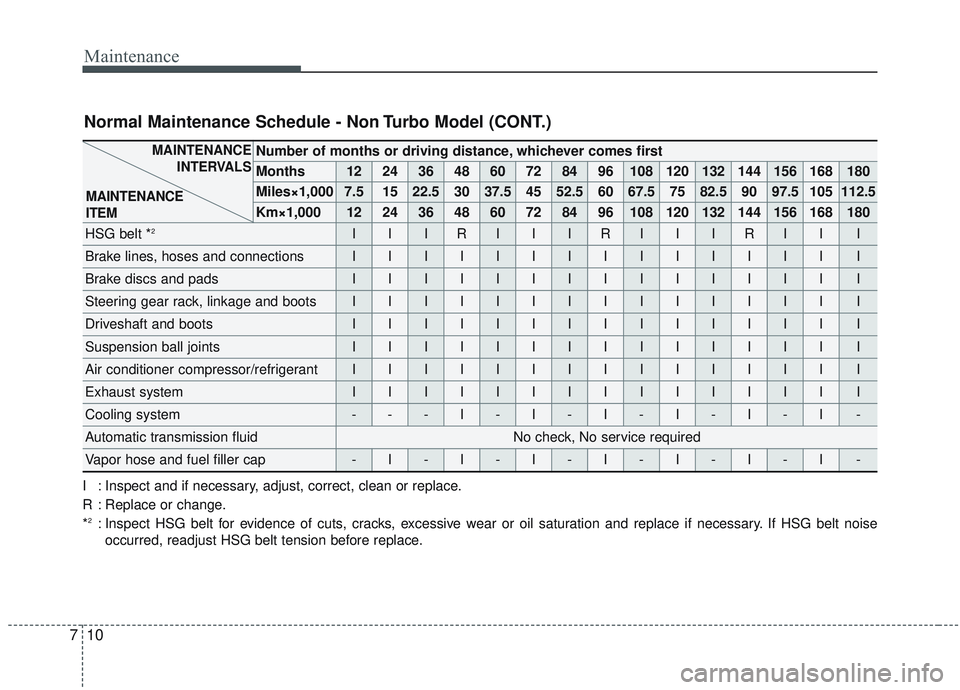
Number of months or driving distance, whichever comes first
Months1224364860728496108120132144156168180
Miles×1,0007.51522.530 37.5 45 52.5 60 67.5 75 82.5 90 97.5 105 112.5
Km×1,00012 24 36 48 60 72 84 96 108 120 132 144 156 168 180
HSG belt *2IIIRIIIRIIIRIII
Brake lines, hoses and connectionsIIIIIIIIIIIIIII
Brake discs and padsIIIIIIIIIIIIIII
Steering gear rack, linkage and bootsIIIIIIIIIIIIIII
Driveshaft and bootsIIIIIIIIIIIIIII
Suspension ball jointsIIIIIIIIIIIIIII
Air conditioner compressor/refrigerantIIIIIIIIIIIIIII
Exhaust systemIIIIIIIIIIIIIII
Cooling system---I-I-I-I-I-I-
Automatic transmission fluidNo check, No service required
Vapor hose and fuel filler cap-I-I-I-I-I-I-I-
MAINTENANCE
INTERVALS
MAINTENANCE
ITEM
Normal Maintenance Schedule - Non Turbo Model (CONT.)
I : Inspect and if necessary, adjust, correct, clean or replace.
R : Replace or change.
*
2: Inspect HSG belt for evidence of cuts, cracks, excessive wear or oil saturation and replace if necessary. If HSG belt noise occurred, readjust HSG belt tension before replace.
Page 478 of 589
Maintenance
12
7
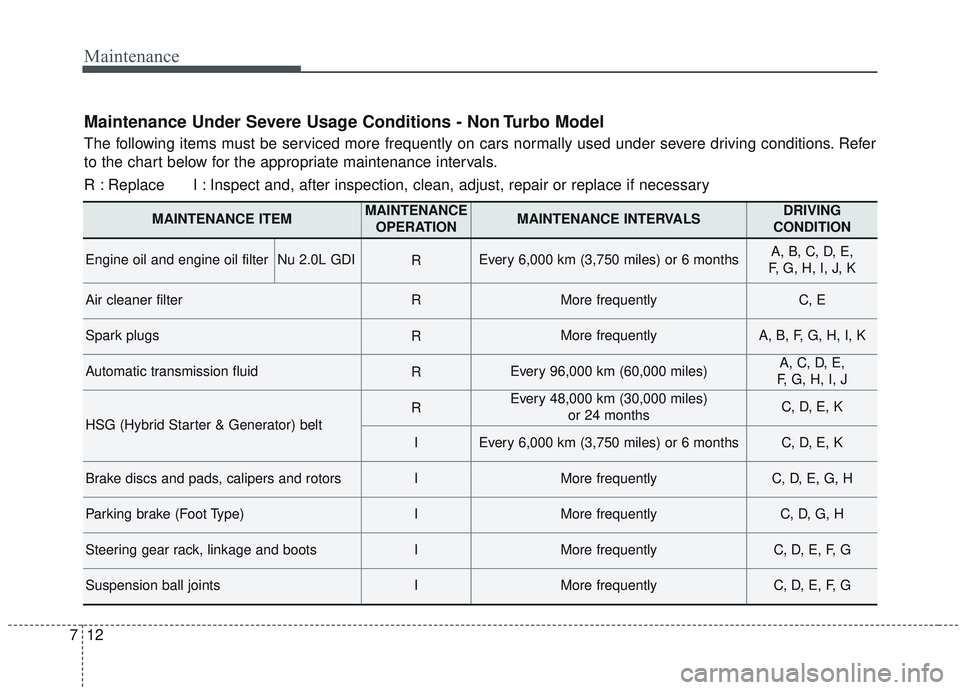
Maintenance Under Severe Usage Conditions - Non Turbo Model
The following items must be serviced more frequently on cars normally used under severe driving conditions. Refer
to the chart below for the appropriate maintenance intervals.
R : Replace I : Inspect and, after inspection, clean, adjust, repair or replace if neces\
sary
MAINTENANCE ITEMMAINTENANCE
OPERATIONMAINTENANCE INTERVALSDRIVING
CONDITION
Engine oil and engine oil filterNu 2.0L GDIREvery 6,000 km (3,750 miles) or 6 monthsA, B, C, D, E,
F, G, H, I, J, K
Air cleaner filterRMore frequentlyC, E
Spark plugs RMore frequentlyA, B, F, G, H, I, K
Automatic transmission fluidREvery 96,000 km (60,000 miles)A, C, D, E,
F, G, H, I, J
HSG (Hybrid Starter & Generator) belt
REvery 48,000 km (30,000 miles) or 24 monthsC, D, E, K
IEvery 6,000 km (3,750 miles) or 6 monthsC, D, E, K
Brake discs and pads, calipers and rotorsIMore frequentlyC, D, E, G, H
Parking brake (Foot Type)IMore frequentlyC, D, G, H
Steering gear rack, linkage and bootsIMore frequentlyC, D, E, F, G
Suspension ball jointsIMore frequentlyC, D, E, F, G
Page 482 of 589
Maintenance
16
7
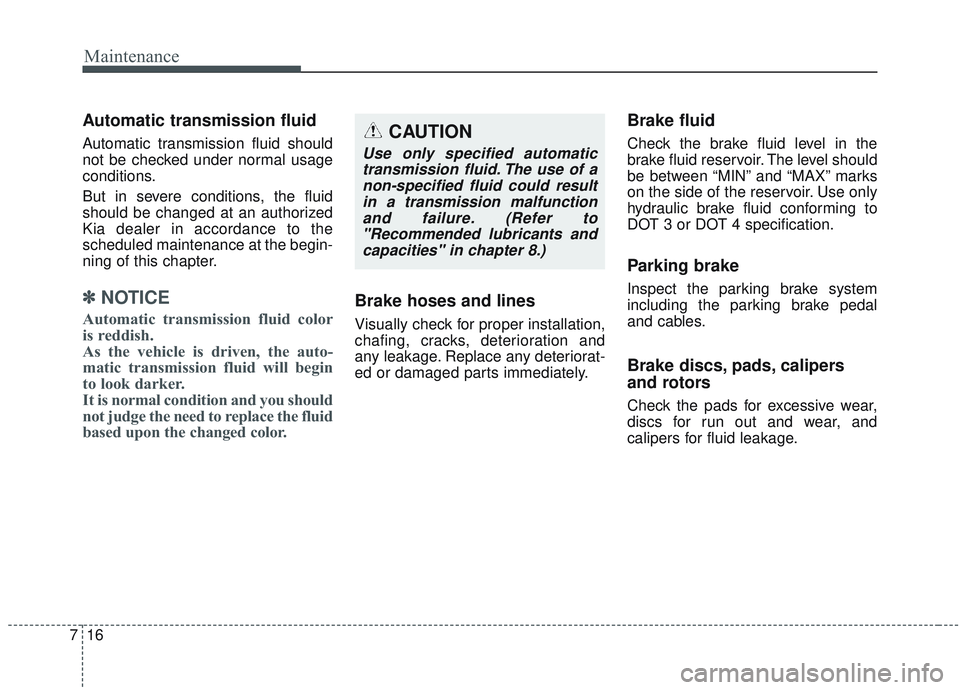
Automatic transmission fluid
Automatic transmission fluid should
not be checked under normal usage
conditions.
But in severe conditions, the fluid
should be changed at an authorized
Kia dealer in accordance to the
scheduled maintenance at the begin-
ning of this chapter.
✽ ✽
NOTICE
Automatic transmission fluid color
is reddish.
As the vehicle is driven, the auto-
matic transmission fluid will begin
to look darker.
It is normal condition and you should
not judge the need to replace the fluid
based upon the changed color.
Brake hoses and lines
Visually check for proper installation,
chafing, cracks, deterioration and
any leakage. Replace any deteriorat-
ed or damaged parts immediately.
Brake fluid
Check the brake fluid level in the
brake fluid reservoir. The level should
be between “MIN” and “MAX” marks
on the side of the reservoir. Use only
hydraulic brake fluid conforming to
DOT 3 or DOT 4 specification.
Parking brake
Inspect the parking brake system
including the parking brake pedal
and cables.
Brake discs, pads, calipers
and rotors
Check the pads for excessive wear,
discs for run out and wear, and
calipers for fluid leakage.
CAUTION
Use only specified automatic
transmission fluid. The use of anon-specified fluid could resultin a transmission malfunctionand failure. (Refer to"Recommended lubricants andcapacities" in chapter 8.)
Page 526 of 589
Maintenance
60
7
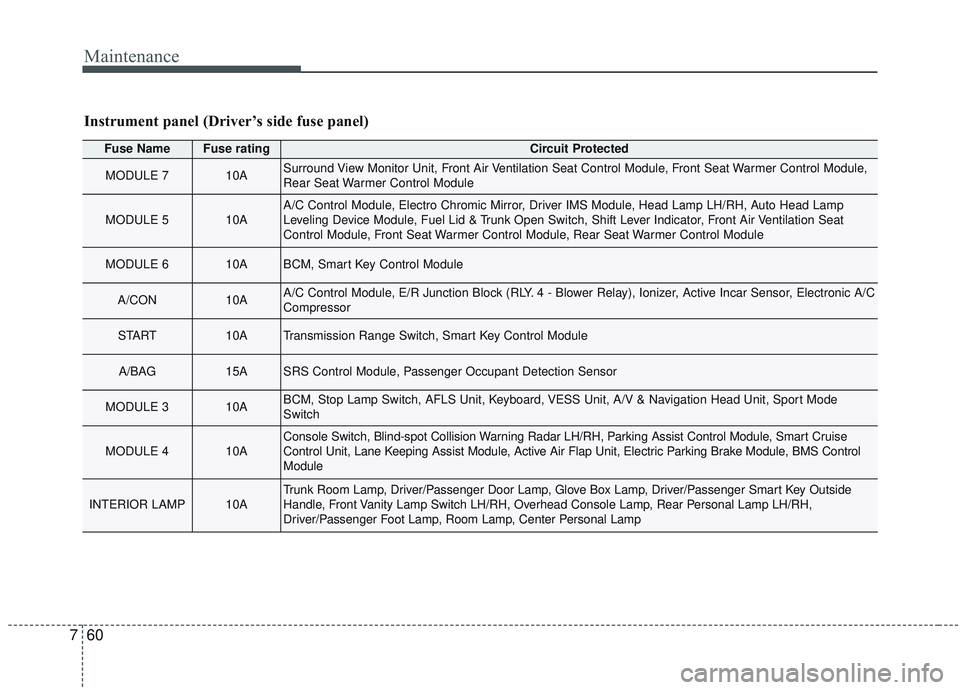
Instrument panel (Driver’s side fuse panel)
Fuse NameFuse ratingCircuit Protected
MODULE 710ASurround View Monitor Unit, Front Air Ventilation Seat Control Module, Front Seat Warmer Control Module,
Rear Seat Warmer Control Module
MODULE 510AA/C Control Module, Electro Chromic Mirror, Driver IMS Module, Head Lamp LH/RH, Auto Head Lamp
Leveling Device Module, Fuel Lid & Trunk Open Switch, Shift Lever Indicator, Front Air Ventilation Seat
Control Module, Front Seat Warmer Control Module, Rear Seat Warmer Control Module
MODULE 610ABCM, Smart Key Control Module
A/CON10AA/C Control Module, E/R Junction Block (RLY. 4 - Blower Relay), Ionizer, Active Incar Sensor, Electronic A/C
Compressor
START10ATransmission Range Switch, Smart Key Control Module
A/BAG15ASRS Control Module, Passenger Occupant Detection Sensor
MODULE 310ABCM, Stop Lamp Switch, AFLS Unit, Keyboard, VESS Unit, A/V & Navigation Head Unit, Sport Mode
Switch
MODULE 410AConsole Switch, Blind-spot Collision Warning Radar LH/RH, Parking Assist Control Module, Smart Cruise
Control Unit, Lane Keeping Assist Module, Active Air Flap Unit, Electric Parking Brake Module, BMS Control
Module
INTERIOR LAMP10ATrunk Room Lamp, Driver/Passenger Door Lamp, Glove Box Lamp, Driver/Passenger Smart Key Outside
Handle, Front Vanity Lamp Switch LH/RH, Overhead Console Lamp, Rear Personal Lamp LH/RH,
Driver/Passenger Foot Lamp, Room Lamp, Center Personal Lamp
Page 535 of 589

769
Maintenance
Fuse NameFuse ratingCircuit Protected
FUSE
FUEL PUMP20AFuel Pump Relay
ECU 120APCM
SENSORS 210AMass Air Flow Sensor, Fuel Pump Relay, Oil Control Valve #1/#2, Canister Close Valve, Camshaft
Position Sensor #1/#2, Purge Control Solenoid Valve
TCU 2 15ATransmission Range Switch
ACTIVE
HYDRAULIC BOOTER 310AMultipurpose Check Connector, Integrated Brake Actuation Unit
POWER
OUTLET 320ARear Power Outlet
B/UP LAMP10APCM, Transmission Range Switch, Electro Chromic Mirror, Rear Combination Lamp (IN) LH/RH
OBC10AHEV OBC SIG, INLET
IG3 420AIG3 1 RLY
IG3 110AHEV WATER PUMP
IG3 215AHEV OBC SIG
IG3 310APCU, HPCU, POSITION SW, CLUSTER, BMS EXTN, AVN, IGPM, CHARGER IND
Page 574 of 589
68
Specification & Consumer information
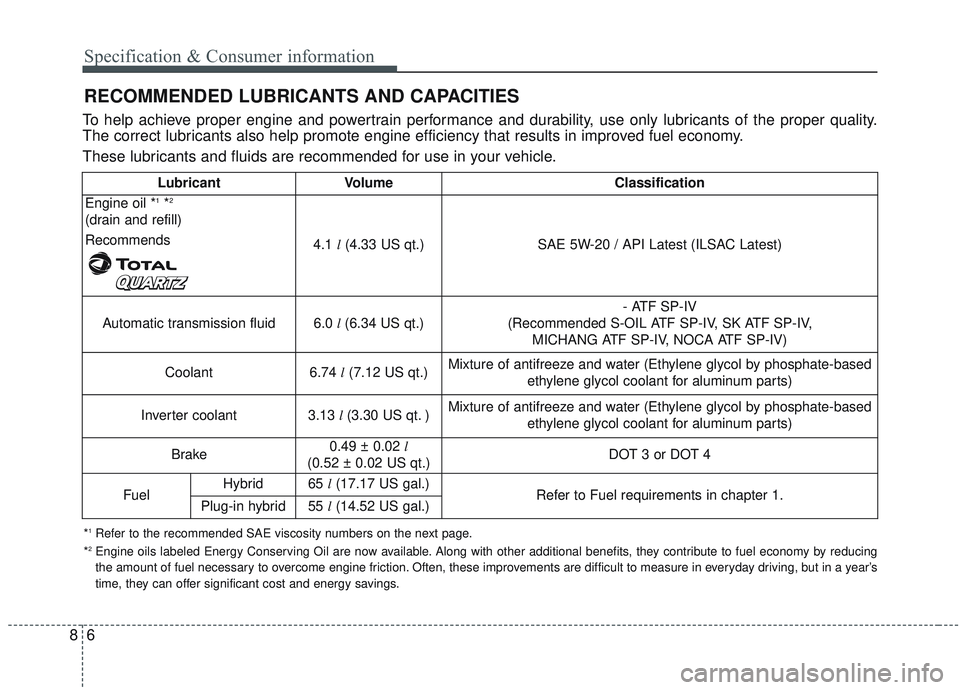
RECOMMENDED LUBRICANTS AND CAPACITIES
To help achieve proper engine and powertrain performance and durability, use only lubricants of the proper quality.
The correct lubricants also help promote engine efficiency that results in improved fuel economy.
These lubricants and fluids are recommended for use in your vehicle.
*1Refer to the recommended SAE viscosity numbers on the next page.
*2Engine oils labeled Energy Conserving Oil are now available. Along with other additional benefits, they contribute to fuel econo my by reducing
the amount of fuel necessary to overcome engine friction. Often, these improvements are difficult to measure in everyday driving, but in a year’s
time, they can offer significant cost and energy savings.
Lubricant VolumeClassification
Engine oil *1*2
(drain and refill)
Recommends
4.1 l(4.33 US qt.)SAE 5W-20 / API Latest (ILSAC Latest)
Automatic transmission fluid6.0 l (6.34 US qt.)
- ATF SP-IV
(Recommended S-OIL ATF SP-IV, SK ATF SP-IV, MICHANG ATF SP-IV, NOCA ATF SP-IV)
Coolant6.74 l(7.12 US qt.)Mixture of antifreeze and water (Ethylene glycol by phosphate-based
ethylene glycol coolant for aluminum parts)
Inverter coolant3.13 l (3.30 US qt. )Mixture of antifreeze and water (Ethylene glycol by phosphate-based
ethylene glycol coolant for aluminum parts)
Brake0.49 ± 0.02 l
(0.52 ± 0.02 US qt.)DOT 3 or DOT 4
FuelHybrid65 l(17.17 US gal.)Refer to Fuel requirements in chapter 1.Plug-in hybrid55 l(14.52 US gal.)
Page 580 of 589
Index
2I
Air bag - advanced supplemental restraint system ........3-44Adding equipment to or modifying your air bag-equipped vehicle ..........................................3-71
Air bag warning label ................................................3-71
Air bag warning light ..................................................3-47
Curtain air bag ............................................................3-64
Driver's and passenger's front air bag ........................3-59
How does the air bag system operate? ......................3-45
Inflation and non-inflation conditions of the air bag..3-65
Occupant Detection System (ODS) ............................3-51
Side air bag ................................................................3-62
SRS Care ....................................................................3-70\
SRS components and functions ..................................3-48
Air cleaner ....................................................................7-28\
Filter replacement ......................................................7-28
Air conditioner compressor label ....................................8-9
Air conditioning system ..................................................8-5
Appearance care ............................................................7-90 Exterior care ................................................................7-90
Interior care ................................................................7-96
Audio system ..............................................................4-154 Antenna ....................................................................4-15\
4
How vehicle radio works ..........................................4-155
Automatic climate control system ..............................4-121 Air Conditioning refrigerant label ............................4-135
Automatic heating and air conditioning ..................4-122 Checking the amount of air conditioner refrigerant and
compressor lubricant ..............................................4-134
Climate control air filter ..........................................4-133
Manual heating and air conditioning ........................4-123
System operation ......................................................4-131
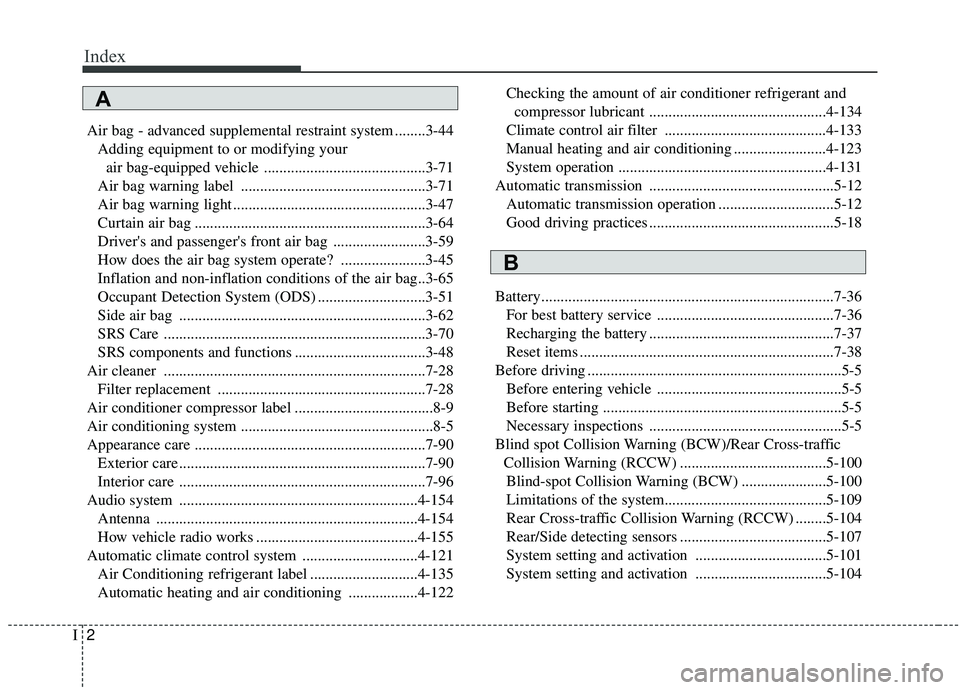
Automatic transmission ................................................5-12 Automatic transmission operation ..............................5-12
Good driving practices ................................................5-18
Battery........................................................................\
....7-36 For best battery service ..............................................7-36
Recharging the battery ................................................7-37
Reset items ..................................................................7-38
Before driving ..................................................................5-5 Before entering vehicle ................................................5-5
Before starting ........................................................\
......5-5
Necessary inspections ..................................................5-5
Blind spot Collision Warning (BCW)/Rear Cross-traffic Collision Warning (RCCW) ......................................5-100Blind-spot Collision Warning (BCW) ......................5-100
Limitations of the system..........................................5-109\
Rear Cross-traffic Collision Warning (RCCW) ........5-104
Rear/Side detecting sensors ......................................5-107
System setting and activation ..................................5-101
System setting and activation ..................................5-104
A
B