belt KIA OPTIMA 2020 Repair Manual
[x] Cancel search | Manufacturer: KIA, Model Year: 2020, Model line: OPTIMA, Model: KIA OPTIMA 2020Pages: 589, PDF Size: 11.37 MB
Page 476 of 589
Maintenance
10
7
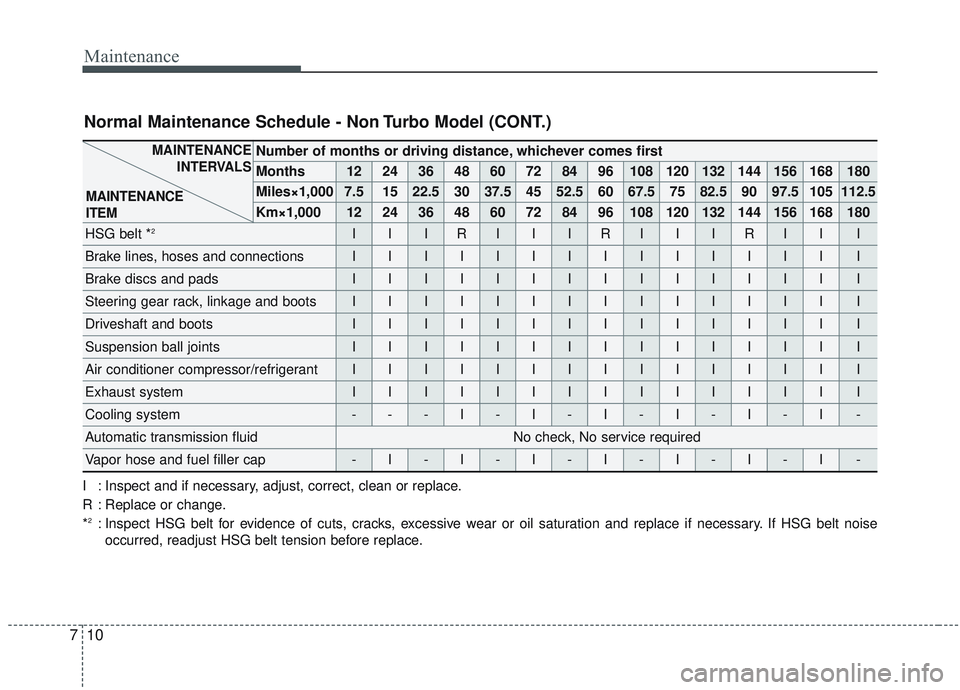
Number of months or driving distance, whichever comes first
Months1224364860728496108120132144156168180
Miles×1,0007.51522.530 37.5 45 52.5 60 67.5 75 82.5 90 97.5 105 112.5
Km×1,00012 24 36 48 60 72 84 96 108 120 132 144 156 168 180
HSG belt *2IIIRIIIRIIIRIII
Brake lines, hoses and connectionsIIIIIIIIIIIIIII
Brake discs and padsIIIIIIIIIIIIIII
Steering gear rack, linkage and bootsIIIIIIIIIIIIIII
Driveshaft and bootsIIIIIIIIIIIIIII
Suspension ball jointsIIIIIIIIIIIIIII
Air conditioner compressor/refrigerantIIIIIIIIIIIIIII
Exhaust systemIIIIIIIIIIIIIII
Cooling system---I-I-I-I-I-I-
Automatic transmission fluidNo check, No service required
Vapor hose and fuel filler cap-I-I-I-I-I-I-I-
MAINTENANCE
INTERVALS
MAINTENANCE
ITEM
Normal Maintenance Schedule - Non Turbo Model (CONT.)
I : Inspect and if necessary, adjust, correct, clean or replace.
R : Replace or change.
*
2: Inspect HSG belt for evidence of cuts, cracks, excessive wear or oil saturation and replace if necessary. If HSG belt noise occurred, readjust HSG belt tension before replace.
Page 478 of 589
Maintenance
12
7
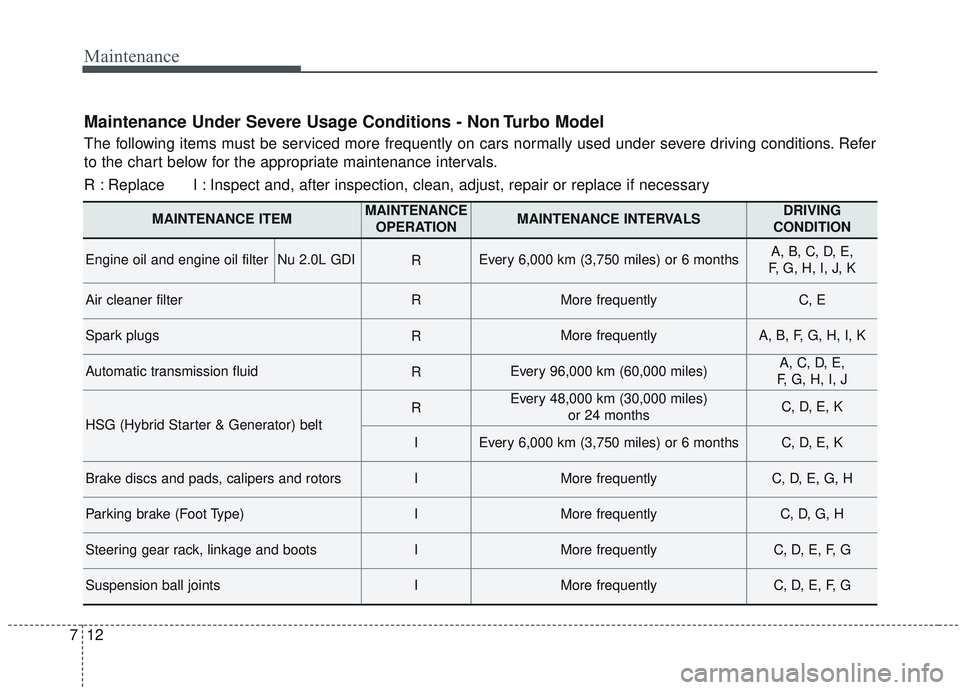
Maintenance Under Severe Usage Conditions - Non Turbo Model
The following items must be serviced more frequently on cars normally used under severe driving conditions. Refer
to the chart below for the appropriate maintenance intervals.
R : Replace I : Inspect and, after inspection, clean, adjust, repair or replace if neces\
sary
MAINTENANCE ITEMMAINTENANCE
OPERATIONMAINTENANCE INTERVALSDRIVING
CONDITION
Engine oil and engine oil filterNu 2.0L GDIREvery 6,000 km (3,750 miles) or 6 monthsA, B, C, D, E,
F, G, H, I, J, K
Air cleaner filterRMore frequentlyC, E
Spark plugs RMore frequentlyA, B, F, G, H, I, K
Automatic transmission fluidREvery 96,000 km (60,000 miles)A, C, D, E,
F, G, H, I, J
HSG (Hybrid Starter & Generator) belt
REvery 48,000 km (30,000 miles) or 24 monthsC, D, E, K
IEvery 6,000 km (3,750 miles) or 6 monthsC, D, E, K
Brake discs and pads, calipers and rotorsIMore frequentlyC, D, E, G, H
Parking brake (Foot Type)IMore frequentlyC, D, G, H
Steering gear rack, linkage and bootsIMore frequentlyC, D, E, F, G
Suspension ball jointsIMore frequentlyC, D, E, F, G
Page 480 of 589
Maintenance
14
7
EXPLANATION OF SCHEDULED MAINTENANCE ITEMS
Engine oil and filter
The engine oil and filter should be
changed at the intervals specified in
the maintenance schedule. If the
vehicle is being driven in severe con-
ditions, more frequent oil and filter
changes are required.
HSG (Hybrid starter & genera-
tor) belt
The HSG belt should be changed at
the intervals specified in the mainte-
nance schedule.
Fuel filter (for gasoline)
Kia gasoline vehicles are equipped a
lifetime fuel filter that is integrated
with the fuel tank. Regular mainte-
nance or replacement is generally
not needed but depends on fuel
quality. If there are some important
fuel related problems like fuel flow
restriction, surging, loss of power,
hard starting problem etc, fuel filter
inspection or replace is needed.
The fuel filter should be inspected or
replaced by an authorized Kia dealer.
Fuel lines, fuel hoses and con-
nections
Check the fuel lines, fuel hoses and
connections for leakage and dam-
age. Have an authorized Kia dealer
replace any damaged or leaking
parts immediately.
Vapor hose and fuel filler cap
The vapor hose and fuel filler cap
should be inspected at those inter-
vals specified in the maintenance
schedule. Make sure that a new
vapor hose or fuel filler cap is cor-
rectly replaced.
Page 512 of 589
Maintenance
46
7
3. Checking tire life (TIN : Tire
Identification Number)
Any tires that are over 6 years old,
based on the manufacturing date,
(including the spare tire) should be
replaced by new ones. You can find
the manufacturing date on the tire
sidewall (possibly on the inside of the
wheel), displaying the DOT Code.
The DOT Code is a series of num-
bers on a tire consisting of numbers
and English letters. The manufactur-
ing date is designated by the last four
digits (characters) of the DOT code.
DOT : XXXX XXXX OOOO
The front part of the DOT means a
plant code number, tire size and
tread pattern and the last four num-
bers indicate week and year manu-
factured.
For example:
DOT XXXX XXXX 1619 represents
that the tire was produced in the 16th
week of 2019.
4. Tire ply composition and mate-rial
The number of layers or plies of rub-
ber-coated fabric in the tire. Tire
manufacturers also must indicate the
materials in the tire, which include
steel, nylon, polyester, and others.
The letter "R" means radial ply con-
struction; the letter "D" means diago-
nal or bias ply construction; and the
letter "B" means belted-bias ply con-
struction.
5. Maximum permissible inflationpressure
This number is the greatest amount of
air pressure that should be put in the
tire. Do not exceed the maximum per-
missible inflation pressure. Refer to
the Tire and Loading Information label
for recommended inflation pressure.
6. Maximum load rating
This number indicates the maximum
load in kilograms and pounds that can
be carried by the tire. When replacing
the tires on the vehicle, always use a
tire that has the same load rating as
the factory installed tire.
7. Uniform tire quality grading
Quality grades can be found where
applicable on the tire sidewall
between tread shoulder and maxi-
mum section width.
For example:
TREADWEAR 440
TRACTION A
TEMPERATURE A
WARNING - Tire age
Replace tires within the recom-
mended time frame. Failure to
replace tires as recommended
can result in sudden tire failure,
which could lead to a loss of
control and an accident.
Page 514 of 589
Maintenance
48
7
Temperature -A, B & C
The temperature grades are A (the
highest), B and C representing the
tire’s resistance to the generation of
heat and its ability to dissipate heat
when tested under controlled condi-
tions on a specified indoor laboratory
test wheel.
Sustained high temperature can
cause the material of the tire to
degenerate and reduce tire life, and
excessive temperature can lead to
sudden tire failure. Grades B and A
represent higher levels of perform-
ance on the laboratory test wheel
than the minimum required by law. Tire terminology and definitions
Air Pressure:
The amount of air
inside the tire pressing outward on
the tire. Air pressure is expressed in
kilopascal (kPa) or pounds per
square inch (psi).
Accessory Weight: This means the
combined weight of optional acces-
sories. Some examples of optional
accessories are, automatic transmis-
sion, power seats, and air condition-
ing.
Aspect Ratio: The relationship of a
tire's height to its width.
Belt: A rubber coated layer of cords
that is located between the plies and
the tread. Cords may be made from
steel or other reinforcing materials.
Bead: The tire bead contains steel
wires wrapped by steel cords that
hold the tire onto the rim.
Bias Ply Tire: A pneumatic tire in
which the plies are laid at alternate
angles less than 90 degrees to the
centerline of the tread. Cold Tire Pressure:
The amount of
air pressure in a tire, measured in
kilopascals (kPa) or pounds per
square inch (psi) before a tire has
built up heat from driving.
Curb Weight: This means the weight
of a motor vehicle with standard and
optional equipment including the
maximum capacity of fuel, oil and
coolant, but without passengers and
cargo.
DOT Markings: The DOT code
includes the Tire Identification
Number (TIN), an alphanumeric des-
ignator which can also identify the
tire manufacturer, production plant,
brand and date of production.
Page 518 of 589
Maintenance
52
7
Radial-ply tires
Radial-ply tires provide improved
tread life, road hazard resistance and
smoother high speed ride. The radi-
al-ply tires used on this vehicle are
of belted construction and are select-
ed to complement the ride and han-
dling characteristics of your vehicle.
Radial-ply tires have the same load
carrying capacity as bias-ply or bias
belted tires of the same size and use
the same recommended inflation
pressure. Mixing of radial-ply tires
with bias-ply or bias belted tires is
not recommended. Any combina-
tions of radial-ply and bias-ply or bias
belted tires when used on the same
vehicle will seriously deteriorate
vehicle handling. The best rule to fol-
low is: identical radial-ply tires should
always be used as a set of four. Longer wearing tires can be more
susceptible to irregular tread wear. It
is very important to follow the tire
rotation interval shown in this section
to achieve the tread life potential of
these tires. Cuts and punctures in
radial-ply tires are repairable only in
the tread area, because of sidewall
flexing. Consult your tire dealer for
radial-ply tire repairs.
Page 564 of 589
Maintenance
98
7
Cleaning the upholstery and inte-
rior trim
Vinyl
Remove dust and loose dirt from
vinyl with a whisk broom or vacuum
cleaner. Clean vinyl surfaces with a
vinyl cleaner.
Fabric
Remove dust and loose dirt from fab-
ric with a whisk broom or vacuum
cleaner. Clean with a mild soap solu-
tion recommended for upholstery or
carpets. Remove fresh spots imme-
diately with a fabric spot cleaner. If
fresh spots do not receive immediate
attention, the fabric can be stained
and its color can be affected. Also, its
fire-resistant properties can be
reduced if the material is not proper-
ly maintained.
Using anything but recommended
cleaners and procedures may affect
the fabric’s appearance and fire-
resistant properties.
Cleaning the lap/shoulder beltwebbing
Clean the belt webbing with any mild
soap solution recommended for
cleaning upholstery or carpet. Follow
the instructions provided with the
soap. Do not bleach or re-dye the
webbing because this may weaken it.
Cleaning the interior windowglass
If the interior glass surfaces of the
vehicle become fogged (that is, cov-
ered with an oily, greasy or waxy
film), they should be cleaned with a
glass cleaner. Follow the directions
on the glass cleaner container.
Window tinting precaution
Window tint(especially metallic film)
might cause communication disorder
or poor radio reception, and malfunc-
tion of the automatic lighting system
due to excessive change of illumina-
tion inside the vehicle. The solution
used might also flow into electric,
electronic devices causing disorder
and failure.
CAUTION- Rear window
Do not scrape or scratch theinside of the rear window. Thismay result in damage of the rearwindow defroster grid.
Page 584 of 589
Index
6I
Important safety precautions ..........................................3-2Air bag hazards ............................................................3-2
Always wear your seat belt ..........................................3-2
Control your speed ........................................................3-3
Driver distraction ..........................................................3-2
Keep your vehicle in safe condition ............................3-3
Restrain all children ......................................................3-2
In case of an emergency while driving ............................6-3 If the engine stalls at a crossroad or crossing ..............6-3
If the engine stalls while driving ..................................6-3
If you have a flat tire while driving ..............................6-3
Instrument cluster ..........................................................4-53 Gauges ........................................................................\
4-55
Instrument cluster control ..........................................4-54
LCD display control ..................................................4-54
Transaxle shift indicator ............................................4-60
Instrument panel overview ..............................................2-5
Interior features............................................................4-142 Air ventilation seat ....................................................4-145
Bottle holder ............................................................4-143
Coat hook ..................................................................4-151
Cup holder ................................................................4-142
Floor mat anchor(s) ..................................................4-152
Power outlet ..............................................................4-146
Seat warmer ..............................................................4-143
Side curtain ..............................................................4-153
Sunvisor ....................................................................4-14\
5 USB charger ..............................................................4-147
Wireless smart phone charging system ....................4-148
Interior lights ..............................................................4-116 Automatic turn off function ......................................4-116
Glove box lamp ........................................................4-118
Map lamp ..................................................................4-117
Room lamp ................................................................4-116
Trunk room lamp ......................................................4-118
Vanity mirror lamp ....................................................4-118
Interior overview..............................................................2-4
Lane Keeping Assist (LKA) system ............................5-116 LKA function change ..............................................5-124
LKA operation ..........................................................5-117
LKA system malfunction ..........................................5-123
LCD display ..................................................................4-61 LCD modes ................................................................4-61
Trip modes ..................................................................4-69
Trip modes (Trip computer)........................................4-69
User settings mode ......................................................4-64
Warning messages ......................................................4-73
Light bulbs ....................................................................7-73\
Back-up lamp (Bulb type) bulb replacement..............7-84
Bulb replacement precaution ....................................7-73
L
Page 586 of 589
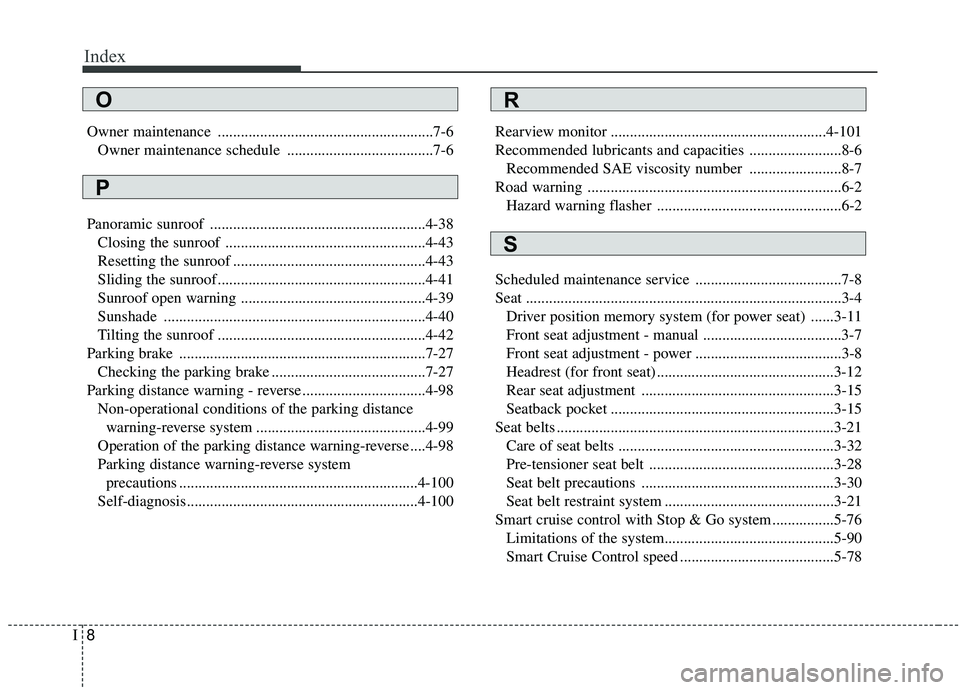
Index
8I
Owner maintenance ........................................................7-6Owner maintenance schedule ......................................7-6
Panoramic sunroof ........................................................4-38 Closing the sunroof ....................................................4-43
Resetting the sunroof ..................................................4-43
Sliding the sunroof ......................................................4-41
Sunroof open warning ................................................4-39
Sunshade ....................................................................4-40\
Tilting the sunroof ......................................................4-42
Parking brake ................................................................7-27 Checking the parking brake ........................................7-27
Parking distance warning - reverse ................................4-98 Non-operational conditions of the parking distance warning-reverse system ............................................4-99
Operation of the parking distance warning-reverse ....4-98
Parking distance warning-reverse system precautions ..............................................................4-100
Self-diagnosis............................................................4-100 Rearview monitor ........................................................4-101
Recommended lubricants and capacities ........................8-6
Recommended SAE viscosity number ........................8-7
Road warning ..................................................................6-2 Hazard warning flasher ................................................6-2
Scheduled maintenance service ......................................7-8
Seat ........................................................................\
..........3-4 Driver position memory system (for power seat) ......3-11
Front seat adjustment - manual ....................................3-7
Front seat adjustment - power ......................................3-8
Headrest (for front seat) ..............................................3-12
Rear seat adjustment ..................................................3-15
Seatback pocket ..........................................................3-15
Seat belts ........................................................................\
3-21 Care of seat belts ........................................................3-32
Pre-tensioner seat belt ................................................3-28
Seat belt precautions ..................................................3-30
Seat belt restraint system ............................................3-21
Smart cruise control with Stop & Go system ................5-76 Limitations of the system............................................5-9\
0
Smart Cruise Control speed ........................................5-78
R
S
O
P