battery service KIA OPTIMA 2020 Owners Manual
[x] Cancel search | Manufacturer: KIA, Model Year: 2020, Model line: OPTIMA, Model: KIA OPTIMA 2020Pages: 589, PDF Size: 11.37 MB
Page 37 of 589

H37
System setting
The driver can activate the Aux.
Battery Saver+ function by placing
the engine start/stop button to the
ON position and by selecting:
"User Settings \bOther \b Aux.
Battery Saver+"
LCD message
This message is displayed when the
Aux. Battery Saver+ function has
been completed when the vehicle is
turned ON.
However, if the LCD message pops
up frequently, have your vehicle`s
auxiliary battery or electric/electronic
components serviced by an author-
ized Kia dealer.
OJFHP048632L
WARNING
The Aux. Battery Saver+ relies
on the high voltage battery to
charge the 12V battery. The
charging indicator lamp will blink
rapidly when this is occurring.
To reduce the risk of electrical
shock, do not touch any high
voltage components (orange) or
other electrical devices while
charging is occurring.
OJFHPQ017009L
Page 44 of 589
H44
COMPONENTS OF THE HYBRID/PLUG-IN HYBRID VEHICLE (CONT.)
Safety plugSome Special Features of the
Hybrid Vehicle.
Hybrid vehicles sound different than
gasoline engine vehicles. When the
hybrid system operates, you may
hear a sound from the hybrid battery
system behind the rear seat. If you
apply the accelerator pedal rapidly,
you may hear a sound. When you
apply the brake pedal, you may hear
a sound from the regenerative brake
system. When the hybrid system is
turned off or on, you may hear a
sound in the engine compartment. If
you depress the brake pedal repeat-
edly when the hybrid system is
turned on, you may hear a sound in
the engine compartment. None of
these sounds indicate a problem.
They are characteristics of hybrid
vehicles.
When the hybrid system is turned on,
the engine may run. This does not
indicate a malfunction. If the “ ”
symbol is on, the hybrid system is
operating. Even if the gasoline engine
is off, you can operate the vehicle.The HEV system may emit electromag-
netic waves which can affect the per-
formance of electronic devices appli-
ances, such as laptop computers,
which are not part of the vehicle design.
If you park the vehicle for a long time,
the hybrid system will discharge. You
need to drive the vehicle several times
per month to maintain a charge.
When you start the hybrid system in
the "P" transmission position, the
“ ” symbol is illuminated in the
cluster. The driver can drive the vehi-
cle even if the engine is stopped.
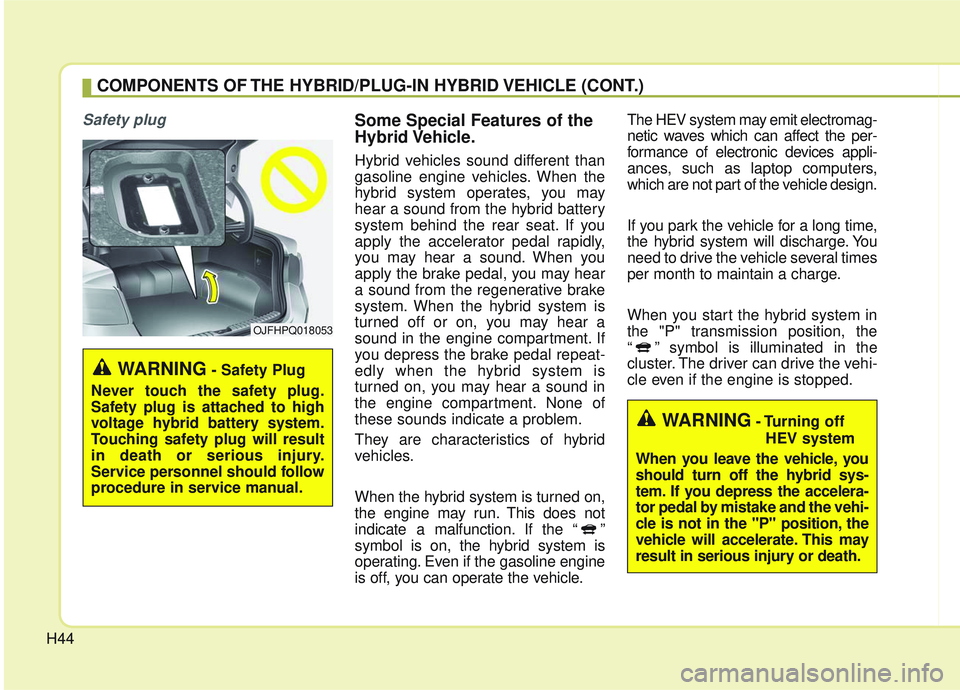
OJFHPQ018053
WARNING- Safety Plug
Never touch the safety plug.
Safety plug is attached to high
voltage hybrid battery system.
Touching safety plug will result
in death or serious injury.
Service personnel should follow
procedure in service manual.
WARNING- Turning off HEV system
When you leave the vehicle, you
should turn off the hybrid sys-
tem. If you depress the accelera-
tor pedal by mistake and the vehi-
cle is not in the "P" position, the
vehicle will accelerate. This may
result in serious injury or death.
Page 47 of 589
H47
If a vehicle accident occurs:
1. Stop the vehicle and shift thetransmission into "P" position. And
then depress the parking brake.
2. Turn off the Hybrid system by pushing the Engine Start/Stop
Button.
3. Step away from the vehicle to a safe place.
4. Call emergency services for help and let them know the vehicle is a
Hybrid vehicle. If an immersion in water occurs:
If your vehicle was flooded and has
soaked carpeting or water on the
flooring, you should not try to start
the Hybrid system. Have the car
towed to an authorized Kia dealer.When the hybrid vehicle shuts
off
When the high voltage battery or 12-
volt battery discharges, or fuel tank is
empty, the hybrid system may not
operate.
If the Hybrid system stops operating
while the vehicle is moving, reduce
the vehicle speed gradually. Pull
your vehicle off the road to a safe
area, and shift the transmission in to
Park (P) position and;
1. Turn on the hazard warning flashers.
2. Set the start button at OFF, and try
to start the Hybrid system by
applying the brake pedal and
pushing the start button.
3. If the Hybrid system will not oper- ate, refer to “EMERGENCY
STARTING” in chapter 6.
Before you try to jump start the vehi-
cle, confirm the fuel level. If the fuel
level is low, add more fuel before
attempting an emergency start.
WARNING
If a submersion in water occurs:
If your vehicle was flooded and
has soaked carpeting or water
on the flooring, you should not
try to start the Hybrid system.
Never touch the high voltage
cables, connectors and pack-
age modules, because an elec-
trical shock may occur causing
injury or death. High Voltage
cables are orange in color.
In this case, have the vehicle be
towed to and inspected by an
authorized Kia dealer.
Page 192 of 589
457
Features of your vehicle
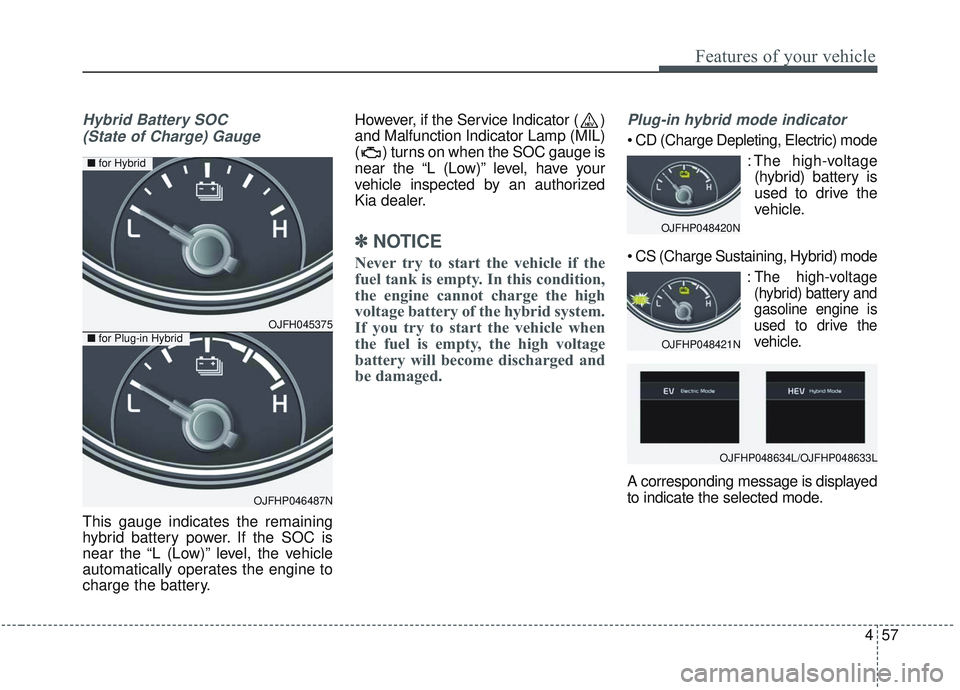
Hybrid Battery SOC (State of Charge) Gauge
This gauge indicates the remaining
hybrid battery power. If the SOC is
near the “L (Low)” level, the vehicle
automatically operates the engine to
charge the battery. However, if the Service Indicator ( )
and Malfunction Indicator Lamp (MIL)
( ) turns on when the SOC gauge is
near the “L (Low)” level, have your
vehicle inspected by an authorized
Kia dealer.
✽ ✽
NOTICE
Never try to start the vehicle if the
fuel tank is empty. In this condition,
the engine cannot charge the high
voltage battery of the hybrid system.
If you try to start the vehicle when
the fuel is empty, the high voltage
battery will become discharged and
be damaged.
Plug-in hybrid mode indicator
: The high-voltage(hybrid) battery is
used to drive the
vehicle.
:The high-voltage
(hybrid) battery and
gasoline engine is
used to drive the
vehicle.
A corresponding message is displayed
to indicate the selected mode.
OJFHP048420N
OJFHP048421N
OJFH045375
OJFHP046487N
■ for Hybrid
■for Plug-in Hybrid
OJFHP048634L/OJFHP048633L
Page 198 of 589

463
Features of your vehicle
Assist mode displays the state of
below systems.
- SCC with S&G
- Lane Keeping Assist
- Driver Attention Warning
- Tire Pressure
Service mode
When Service Required is set, the
remaining distance/time before serv-
ice is required appears on the LCD
screen.
From the point at which the remain-
ing distance to drive amounts to
1,500 km (900 mi) or the remaining
time amounts to 30 days, the Service
Required message automatically
displays and remains on the LCD
screen for a number of seconds
every time the ignition switch or
Engine Start/Stop Button is ON.To reset the service interval, in the
Service Required mode, press OK
button for more than 1 sec. The val-
ues will return to initial setting values.
❈
For more details about Service
Required Setting refer to user
Settings Mode in this chapter.
❈ Service Required Setting
In the event of Battery Cable
Disconnection or Fuse Switch
turned OFF, the Service Required
Setting values (an amount of
miles/time driven) may change. In
such cases, re-enter Service
Required Setting values.
OJFA048529C
OJF048552L
OJF068263L
■DAW
■TPMS
Page 430 of 589
5137
Driving your vehicle
Use high quality ethylene gly-
col coolant
Your vehicle is delivered with high
quality ethylene glycol coolant in the
cooling system. It is the only type of
coolant that should be used because
it helps prevent corrosion in the cool-
ing system, lubricates the water
pump and prevents freezing. Be sure
to replace or replenish your coolant
in accordance with the maintenance
schedule in chapter 8. Before winter,
have your coolant tested to assure
that its freezing point is sufficient for
the temperatures anticipated during
the winter.
Check battery and cables
Winter puts additional burdens on
the battery system. Visually inspect
the battery and cables as described
in chapter 8. The level of charge in
your battery can be checked by an
authorized Kia dealer or a service
station.
Change to "winter weight" oil
if necessary
In some climates it is recommended
that a lower viscosity "winter weight"
oil be used during cold weather. See
chapter 9 for recommendations. If
you aren't sure what weight oil you
should use, consult an authorized
Kia dealer.
Page 467 of 589
Maintenance
7
Engine compartment . . . . . . . . . . . . . . . . . . . . . . . . 7-3
Maintenance services . . . . . . . . . . . . . . . . . . . . . . . . 7-4
• Owner’s responsibility . . . . . . . . . . . . . . . . . . . . . . . . . 7-4
• Owner maintenance precautions . . . . . . . . . . . . . . . . . 7-5
Owner maintenance . . . . . . . . . . . . . . . . . . . . . . . . . 7-6
• Owner maintenance schedule . . . . . . . . . . . . . . . . . . . 7-6
Scheduled maintenance service. . . . . . . . . . . . . . . . 7-8
Explanation of scheduled maintenance items . . . 7-14
Checking fluid levels . . . . . . . . . . . . . . . . . . . . . . . 7-17
Engine oil. . . . . . . . . . . . . . . . . . . . . . . . . . . . . . . . . 7-18
• Checking the engine oil level . . . . . . . . . . . . . . . . . . . 7-18
• Changing the engine oil and filter . . . . . . . . . . . . . . . 7-19
Engine maintenance mode (for plug-in Hybrid). . 7-20
• Starting Engine Maintenance Mode . . . . . . . . . . . . . 7-20
• Stopping Engine Maintenance Mode. . . . . . . . . . . . . 7-20
Coolant . . . . . . . . . . . . . . . . . . . . . . . . . . . . . . . . . . 7-21\
• Checking the coolant level . . . . . . . . . . . . . . . . . . . . . 7-21
• Engine coolant . . . . . . . . . . . . . . . . . . . . . . . . . . . . . . . 7-22
• Inverter coolant . . . . . . . . . . . . . . . . . . . . . . . . . . . . . . 7-22
• Recommended coolant . . . . . . . . . . . . . . . . . . . . . . . . 7-23
• Changing the coolant . . . . . . . . . . . . . . . . . . . . . . . . . 7-24
Brake fluid . . . . . . . . . . . . . . . . . . . . . . . . . . . . . . . 7-25
• Checking the brake fluid level . . . . . . . . . . . . . . . . . . 7-25
Washer fluid . . . . . . . . . . . . . . . . . . . . . . . . . . . . . . 7-26
• Checking the washer fluid level . . . . . . . . . . . . . . . . . 7-26
Parking brake . . . . . . . . . . . . . . . . . . . . . . . . . . . . . 7-27
• Checking the parking brake. . . . . . . . . . . . . . . . . . . . 7-27
Air cleaner. . . . . . . . . . . . . . . . . . . . . . . . . . . . . . . . 7-28
• Filter replacement . . . . . . . . . . . . . . . . . . . . . . . . . . . 7-28
Climate control air filter . . . . . . . . . . . . . . . . . . . . 7-30
• Filter inspection . . . . . . . . . . . . . . . . . . . . . . . . . . . . . . 7-30
Wiper blades . . . . . . . . . . . . . . . . . . . . . . . . . . . . . . 7-32
• Blade inspection . . . . . . . . . . . . . . . . . . . . . . . . . . . . . . 7-32
• Blade replacement . . . . . . . . . . . . . . . . . . . . . . . . . . . . 7-32
Battery . . . . . . . . . . . . . . . . . . . . . . . . . . . . . . . . . . . 7-\
36
• For best battery service . . . . . . . . . . . . . . . . . . . . . . . 7-36
• Recharging the battery . . . . . . . . . . . . . . . . . . . . . . . . 7-37
• Reset items . . . . . . . . . . . . . . . . . . . . . . . . . . . . . . . . . . 7-38\
Tires and wheels . . . . . . . . . . . . . . . . . . . . . . . . . . . 7-39
• Tire care . . . . . . . . . . . . . . . . . . . . . . . . . . . . . . . . . . . . \
7-39
• Recommended cold tire inflation pressures . . . . . . . 7-39
• Tire pressure . . . . . . . . . . . . . . . . . . . . . . . . . . . . . . . . 7-40
• Checking tire inflation pressure. . . . . . . . . . . . . . . . . 7-40
• Tire rotation . . . . . . . . . . . . . . . . . . . . . . . . . . . . . . . . 7-41
• Wheel alignment and tire balance . . . . . . . . . . . . . . . 7-42
• Tire replacement . . . . . . . . . . . . . . . . . . . . . . . . . . . . . 7-43
• Wheel replacement . . . . . . . . . . . . . . . . . . . . . . . . . . . 7-43
• Tire traction . . . . . . . . . . . . . . . . . . . . . . . . . . . . . . . . . 7-44
• Tire maintenance . . . . . . . . . . . . . . . . . . . . . . . . . . . . 7-44
• Tire sidewall labeling . . . . . . . . . . . . . . . . . . . . . . . . . 7-44
Page 502 of 589
Maintenance
36
7
BATTERY
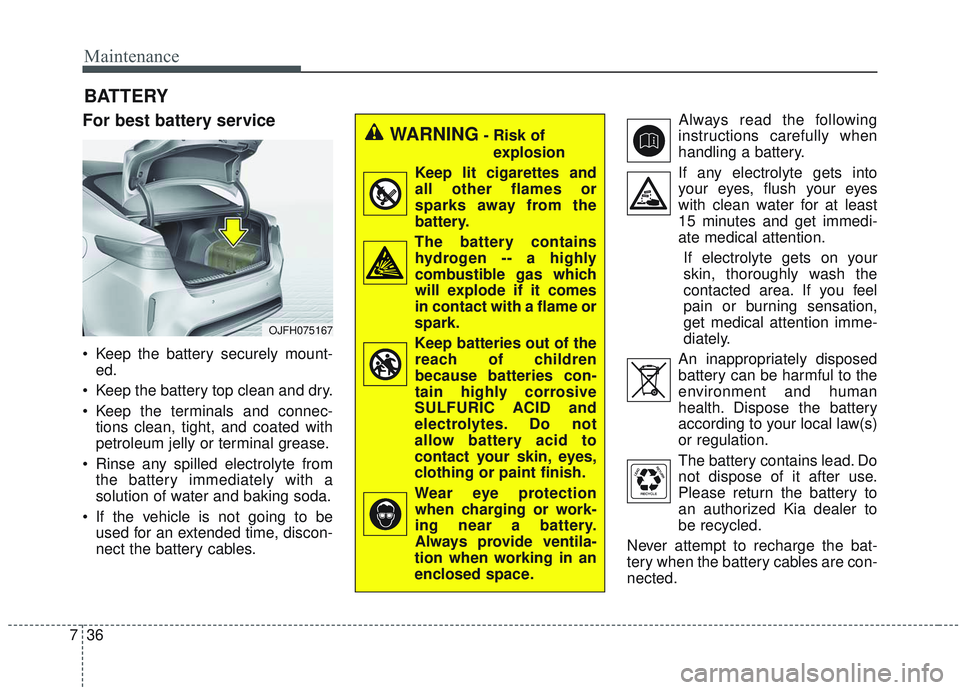
For best battery service
Keep the battery securely mount-
ed.
Keep the battery top clean and dry.
Keep the terminals and connec- tions clean, tight, and coated with
petroleum jelly or terminal grease.
Rinse any spilled electrolyte from the battery immediately with a
solution of water and baking soda.
If the vehicle is not going to be used for an extended time, discon-
nect the battery cables. Always read the following
instructions carefully when
handling a battery.
If any electrolyte gets into your eyes, flush your eyes
with clean water for at least
15 minutes and get immedi-
ate medical attention.
If electrolyte gets on your
skin, thoroughly wash the
contacted area. If you feel
pain or burning sensation,
get medical attention imme-
diately.
An inappropriately disposed battery can be harmful to the
environment and human
health. Dispose the battery
according to your local law(s)
or regulation.
The battery contains lead. Do
not dispose of it after use.
Please return the battery to
an authorized Kia dealer to
be recycled.
Never attempt to recharge the bat-
tery when the battery cables are con-
nected.
WARNING- Risk of explosion
Keep lit cigarettes and
all other flames or
sparks away from the
battery.
The battery contains hydrogen -- a highly
combustible gas which
will explode if it comes
in contact with a flame or
spark.
Keep batteries out of the reach of children
because batteries con-
tain highly corrosive
SULFURIC ACID and
electrolytes. Do not
allow battery acid to
contact your skin, eyes,
clothing or paint finish.
Wear eye protection when charging or work-
ing near a battery.
Always provide ventila-
tion when working in an
enclosed space.
OJFH075167
Page 539 of 589
773
Maintenance
LIGHT BULBS
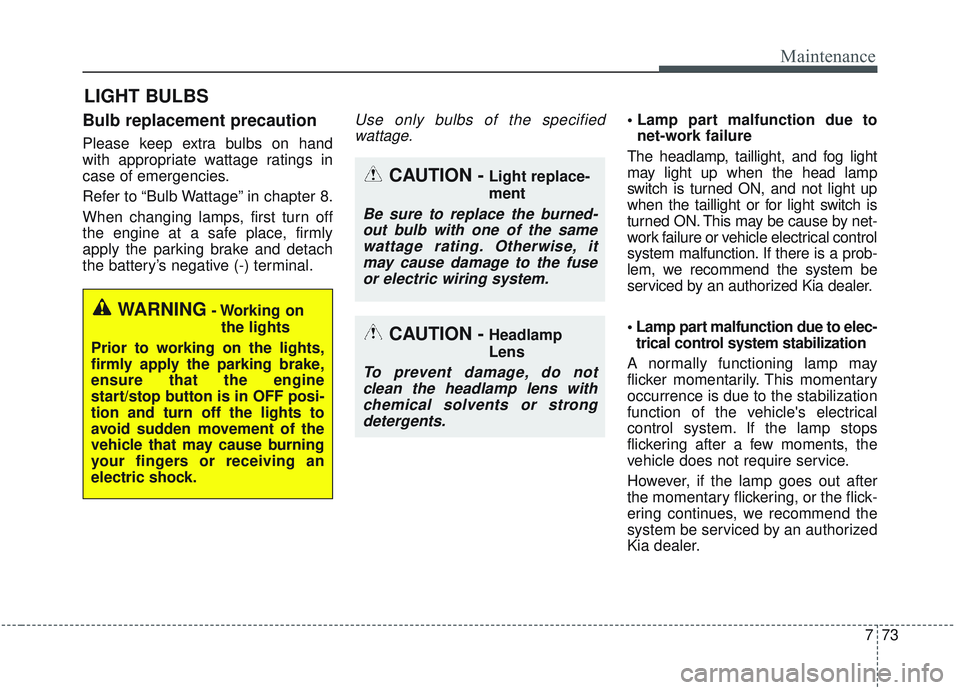
Bulb replacement precaution
Please keep extra bulbs on hand
with appropriate wattage ratings in
case of emergencies.
Refer to “Bulb Wattage” in chapter 8.
When changing lamps, first turn off
the engine at a safe place, firmly
apply the parking brake and detach
the battery’s negative (-) terminal.
Use only bulbs of the specifiedwattage. net-work failure
The headlamp, taillight, and fog light
may light up when the head lamp
switch is turned ON, and not light up
when the taillight or for light switch is
turned ON. This may be cause by net-
work failure or vehicle electrical control
system malfunction. If there is a prob-
lem, we recommend the system be
serviced by an authorized Kia dealer.
trical control system stabilization
A normally functioning lamp may
flicker momentarily. This momentary
occurrence is due to the stabilization
function of the vehicle's electrical
control system. If the lamp stops
flickering after a few moments, the
vehicle does not require service.
However, if the lamp goes out after
the momentary flickering, or the flick-
ering continues, we recommend the
system be serviced by an authorized
Kia dealer.
WARNING- Working on the lights
Prior to working on the lights,
firmly apply the parking brake,
ensure that the engine
start/stop button is in OFF posi-
tion and turn off the lights to
avoid sudden movement of the
vehicle that may cause burning
your fingers or receiving an
electric shock.
CAUTION -Light replace-
ment
Be sure to replace the burned- out bulb with one of the samewattage rating. Otherwise, itmay cause damage to the fuseor electric wiring system.
CAUTION -Headlamp
Lens
To prevent damage, do notclean the headlamp lens withchemical solvents or strongdetergents.
Page 580 of 589
Index
2I
Air bag - advanced supplemental restraint system ........3-44Adding equipment to or modifying your air bag-equipped vehicle ..........................................3-71
Air bag warning label ................................................3-71
Air bag warning light ..................................................3-47
Curtain air bag ............................................................3-64
Driver's and passenger's front air bag ........................3-59
How does the air bag system operate? ......................3-45
Inflation and non-inflation conditions of the air bag..3-65
Occupant Detection System (ODS) ............................3-51
Side air bag ................................................................3-62
SRS Care ....................................................................3-70\
SRS components and functions ..................................3-48
Air cleaner ....................................................................7-28\
Filter replacement ......................................................7-28
Air conditioner compressor label ....................................8-9
Air conditioning system ..................................................8-5
Appearance care ............................................................7-90 Exterior care ................................................................7-90
Interior care ................................................................7-96
Audio system ..............................................................4-154 Antenna ....................................................................4-15\
4
How vehicle radio works ..........................................4-155
Automatic climate control system ..............................4-121 Air Conditioning refrigerant label ............................4-135
Automatic heating and air conditioning ..................4-122 Checking the amount of air conditioner refrigerant and
compressor lubricant ..............................................4-134
Climate control air filter ..........................................4-133
Manual heating and air conditioning ........................4-123
System operation ......................................................4-131
Automatic transmission ................................................5-12 Automatic transmission operation ..............................5-12
Good driving practices ................................................5-18
Battery........................................................................\
....7-36 For best battery service ..............................................7-36
Recharging the battery ................................................7-37
Reset items ..................................................................7-38
Before driving ..................................................................5-5 Before entering vehicle ................................................5-5
Before starting ........................................................\
......5-5
Necessary inspections ..................................................5-5
Blind spot Collision Warning (BCW)/Rear Cross-traffic Collision Warning (RCCW) ......................................5-100Blind-spot Collision Warning (BCW) ......................5-100
Limitations of the system..........................................5-109\
Rear Cross-traffic Collision Warning (RCCW) ........5-104
Rear/Side detecting sensors ......................................5-107
System setting and activation ..................................5-101
System setting and activation ..................................5-104
A
B