evap KIA OPTIMA 2020 Owners Manual
[x] Cancel search | Manufacturer: KIA, Model Year: 2020, Model line: OPTIMA, Model: KIA OPTIMA 2020Pages: 589, PDF Size: 11.37 MB
Page 268 of 589
4133
Features of your vehicle
Air conditioning system operation tips
If the vehicle has been parked indirect sunlight during hot weather,
open the windows for a short time
to let the hot air inside the vehicle
escape.
To help reduce moisture inside of the windows on rainy or humid
days, decrease the humidity inside
the vehicle by operating the air
conditioning system.
During air conditioning system operation, you may occasionally
notice a slight change in engine
speed as the air conditioning com-
pressor cycles. This is a normal
system operation characteristic.
Use the air conditioning system every month only for at least a few
minutes to ensure maximum sys-
tem performance. When using the air conditioning
system, you may notice clear water
dripping (or even puddling) on the
ground under the passenger side
of the vehicle. This is a normal sys-
tem operation characteristic.
Operating the air conditioning sys- tem in the recirculated air position
provides maximum cooling, how-
ever, continual operation in this
mode may cause the air inside the
vehicle to become stale.
During cooling operation, you may occasionally notice a misty air flow
because of rapid cooling and
humid air intake. This is a normal
system operation characteristic.Climate control air filter
(if equipped)
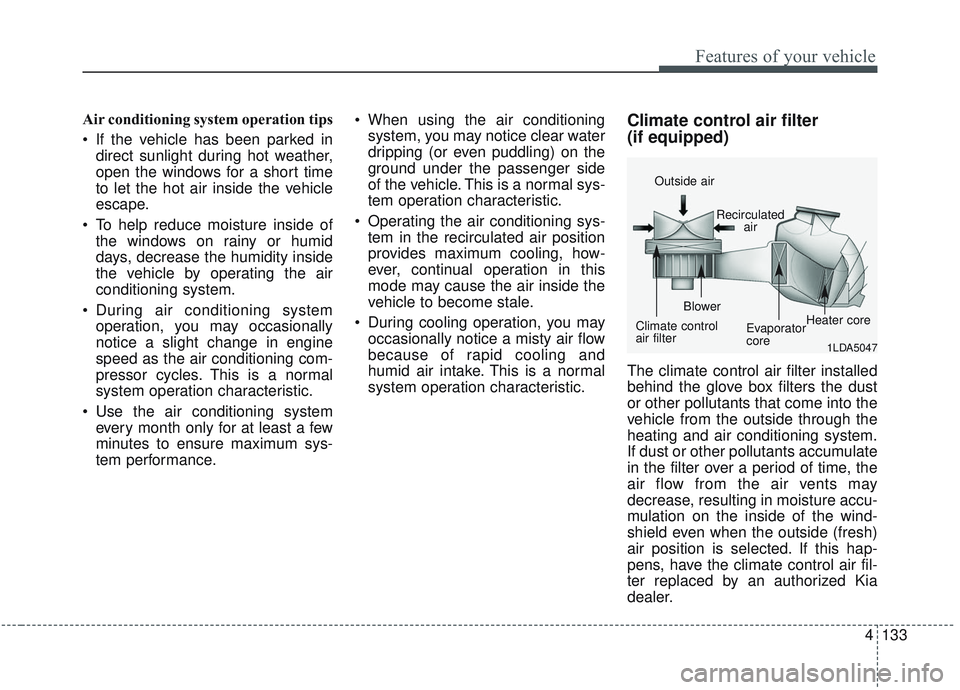
The climate control air filter installed
behind the glove box filters the dust
or other pollutants that come into the
vehicle from the outside through the
heating and air conditioning system.
If dust or other pollutants accumulate
in the filter over a period of time, the
air flow from the air vents may
decrease, resulting in moisture accu-
mulation on the inside of the wind-
shield even when the outside (fresh)
air position is selected. If this hap-
pens, have the climate control air fil-
ter replaced by an authorized Kia
dealer.
1LDA5047
Outside air
Recirculatedair
Climate control
air filter Blower
Evaporator
coreHeater core
Page 468 of 589
7
• All season tires . . . . . . . . . . . . . . . . . . . . . . . . . . . . . . 7-51
• Summer tires . . . . . . . . . . . . . . . . . . . . . . . . . . . . . . . . 7-51
• Snow tires . . . . . . . . . . . . . . . . . . . . . . . . . . . . . . . . . . . 7-\
51
• Radial-ply tires . . . . . . . . . . . . . . . . . . . . . . . . . . . . . . 7-52
Fuses . . . . . . . . . . . . . . . . . . . . . . . . . . . . . . . . . . . . \
7-53
• Inner panel fuse replacement . . . . . . . . . . . . . . . . . . . 7-55
• Engine compartment fuse replacement. . . . . . . . . . . 7-57
• Fuse/relay panel description. . . . . . . . . . . . . . . . . . . . 7-59
Light bulbs . . . . . . . . . . . . . . . . . . . . . . . . . . . . . . . 7-73
• Bulb replacement precaution . . . . . . . . . . . . . . . . . . 7-73
• Light bulb position (Front) . . . . . . . . . . . . . . . . . . . . 7-75
• Light bulb position (Rear) . . . . . . . . . . . . . . . . . . . . . 7-76
• Light bulb position (Side) . . . . . . . . . . . . . . . . . . . . . . 7-76
• Headlamp (Low beam) bulb replacement(Headlamp Type A) . . . . . . . . . . . . . . . . . . . . . . . . . . 7-77
• Headlamp (High beam) bulb replacement (Headlamp Type A) . . . . . . . . . . . . . . . . . . . . . . . . . . 7-78
• Headlamp (Low/High beam) (LED type) bulb replacement (Headlamp Type B) . . . . . . . . . . . . . . . 7-79
• Front turn signal lamp (Bulb type) bulb replacement (Headlamp Type B) . . . . . . . . . . . . . . . 7-80
• Front turn signal lamp (Bulb type) bulb replacement (Headlamp Type A) . . . . . . . . . . . . . . . 7-80
• Front fog lamp (Bulb and LED type) bulb replacement . . . . . . . . . . . . . . . . . . . . . . . . . . . . . . . . 7-81
• Position lamp + DRL (LED type) bulb replacement . . 7-81• Side repeater lamp (LED type) bulb replacement . . 7-82
• Rear turn signal lamp bulb replacement . . . . . . . . . 7-82
• Tail lamp (LED type) bulb replacement (Sedan) . . . 7-84
• Stop lamp (LED type) bulb replacement (Sedan) . . 7-84
• Back-up lamp (Bulb type) bulb replacement . . . . . . 7-84
• License plate lamp (Bulb type) bulb replacement . . 7-85
• High mounted stop lamp (LED type) bulb
replacement . . . . . . . . . . . . . . . . . . . . . . . . . . . . . . . . 7-86
• Map lamp (LED type) bulb replacement . . . . . . . . . 7-86
• Vanity mirror lamp (Bulb type) bulb replacement . . 7-87
• Room lamp (Bulb type) bulb replacement . . . . . . . . 7-87
• Personal lamp (LED type) bulb replacement . . . . . . 7-88
• Glove box lamp (Bulb type) bulb replacement . . . . 7-88
• Trunk lamp (LED type) bulb replacement . . . . . . . . 7-89
Appearance care . . . . . . . . . . . . . . . . . . . . . . . . . . . 7-90
• Exterior care . . . . . . . . . . . . . . . . . . . . . . . . . . . . . . . . 7-90
• Interior care . . . . . . . . . . . . . . . . . . . . . . . . . . . . . . . . . 7-96
Emission control system . . . . . . . . . . . . . . . . . . . . 7-99
• Crankcase emission control system . . . . . . . . . . . . . . 7-99
• Evaporative emission control (including ORVR : Onboard Refueling Vapor Recovery) system . . . . . 7-99
• Exhaust emission control system . . . . . . . . . . . . . . . 7-100
Page 560 of 589
Maintenance
94
7
Corrosion protection
Protecting your vehicle from corrosion
By using advanced design and con-
struction practices to combat corro-
sion, we produce vehicles of excel-
lent quality. However, this is only part
of the job. To achieve the long-term
corrosion resistance your vehicle can
deliver, the owner's cooperation and
assistance is also required.
Common causes of corrosion
The most common causes of corro-
sion on your vehicle are:
Road salt, dirt and moisture that is
allowed to accumulate underneath
the vehicle.
Removal of paint or protective coatings by stones, gravel, abra-
sion or minor scrapes and dents
which leave unprotected metal
exposed to corrosion. High-corrosion areas
If you live in an area where your vehi-
cle is regularly exposed to corrosive
materials, corrosion protection is
particularly important. Some of the
common causes of accelerated cor-
rosion are road salts, dust control
chemicals, ocean air and industrial
pollution.
Moisture breeds corrosion
Moisture creates the conditions in
which corrosion is most likely to
occur. For example, corrosion is
accelerated by high humidity, partic-
ularly when temperatures are just
above freezing. In such conditions,
the corrosive material is kept in con-
tact with the vehicle’s surface by
moisture that evaporates slowly.
Mud is particularly corrosive
because it dries slowly and holds
moisture in contact with the vehicle.
Although the mud appears to be dry,
it can still retain the moisture and
promote corrosion.WARNING
After washing the vehicle, test
the brakes while driving slowly
to see if they have been affected
by water. If braking performance
is impaired, dry the brakes by
applying them lightly while
maintaining a slow forward
speed.
Page 565 of 589
799
Maintenance
EMISSION CONTROL SYSTEM
The emission control system of your
vehicle is covered by a written limited
warranty. Please see the warranty
information contained in the
Warranty & Consumer Information
manual in your vehicle.
Your vehicle is equipped with an
emission control system to meet all
applicable emission regulations.
There are three emission control
systems, as follows.
(1) Crankcase emission control sys-tem
(2) Evaporative emission control sys- tem
(3) Exhaust emission control system
In order to assure the proper function
of the emission control systems, it is
recommended that you have your
vehicle inspected and maintained by
an authorized Kia dealer in accor-
dance with the maintenance sched-
ule in this manual. Caution for the Inspection and
Maintenance Test (With Electronic
Stability Control (ESC) system)
To prevent the vehicle from mis-
firing during dynamometer test-
ing, turn the Electronic Stability
Control (ESC) system off by
pressing the ESC switch.
After dynamometer testing is completed, turn the ESC system
back on by pressing the ESC
switch again.1. Crankcase emission control system
The positive crankcase ventilation
system is employed to prevent air
pollution caused by blow-by gases
being emitted from the crankcase.
This system supplies fresh filtered air
to the crankcase through the air
intake hose. Inside the crankcase,
the fresh air mixes with blow-by
gases, which then pass through the
PCV valve into the induction system.
2. Evaporative emission con-trol (including ORVR:
Onboard Refueling Vapor
Recovery)
system
The Evaporative Emission Control
System is designed to prevent fuel
vapors from escaping into the atmos-
phere.
(The ORVR system is designed to
allow the vapors from the fuel tank to
be loaded into a canister while refu-
eling at the gas station, preventing
the escape of fuel vapors into the
atmosphere.)
Page 566 of 589
Maintenance
100
7
Canister
Fuel vapors generated inside the fuel
tank are absorbed and stored in the
onboard canister. When the engine is
running, the fuel vapors absorbed in
the canister are drawn into the surge
tank through the purge control sole-
noid valve.
Purge Control Solenoid Valve
(PCSV)
The purge control solenoid valve is
controlled by the Engine Control
Module (ECM); when the engine
coolant temperature is low during
idling, the PCSV closes so that evap-
orated fuel is not taken into the
engine. After the engine warms up
during ordinary driving, the PCSV
opens to introduce evaporated fuel to
the engine.
3. Exhaust emission control system
The Exhaust Emission Control
System is a highly effective system
which controls exhaust emissions
while maintaining good vehicle per-
formance.
Engine exhaust gas precautions
(carbon monoxide)
Carbon monoxide can be present with other exhaust fumes.
Therefore, if you smell exhaust
fumes of any kind inside your vehi-
cle, have it inspected and repaired
immediately. If you ever suspect
exhaust fumes are coming into
your vehicle, drive it only with all
the windows fully open. Have your
vehicle checked and repaired
immediately.
WARNING - Exhaust
Engine exhaust gases contain
carbon monoxide (CO). Though
colorless and odorless, it is
dangerous and could be lethal if
inhaled. Follow the instructions
on this page to avoid CO poi-
soning.
Page 582 of 589
Index
4I
Limitation of ECO operation ......................................5-97
When ECO is activated ..............................................5-97
Driver Attention Warning (DAW)................................5-125 Resetting the system ................................................5-127
System disabled ........................................................5-127
System malfunction ..................................................5-128
System setting and activation ..................................5-125
ECO system ..................................................................5-98 Limitation of ECO operation ......................................5-99
Plug-in hybrid vehicle ................................................5-98
When ECO is activated ..............................................5-99
Economical operation ..................................................5-130
Emergency starting ..........................................................6-5 Jump starting ................................................................6-5
Push-starting ................................................................6-6
Emission control system ................................................7-99 Crankcase emission control system ............................7-99
Evaporative emission control (including ORVR : Onboard Refueling Vapor Recovery) system ..........7-99
Exhaust emission control system ..............................7-100
Engine ........................................................................\
......8-2
Engine compartment ................................................2-6, 7-3 Engine maintenance mode (for plug-in Hybrid) ..........7-20
Starting Engine Maintenance Mode ..........................7-20
Stopping Engine Maintenance Mode..........................7-20
Engine number ................................................................8-9
Engine oil ......................................................................7-\
18 Changing the engine oil and filter ..............................7-19
Checking the engine oil level ....................................7-18
Engine start/stop button ..................................................5-7 Engine start/stop button position ..................................5-7
Illuminated engine start/stop button ............................5-7
Starting the hybrid system ............................................5-9
Explanation of scheduled maintenance items ..............7-14
Exterior overview ............................................................2-2
Forward Collision-avoidance Assist (FCA) system ......5-43 Brake operation ..........................................................5-47
FCA sensor (Front view camera)................................5-48
FCA warning message and system control ................5-45
Limitation of the system ............................................5-51
System malfunction ....................................................5-49
System setting and activation ....................................5-43
Forward Collision-avoidance Assist (FCA) system - sensor fusion type (front radar+front view camera) ..5-57Brake operation ..........................................................5-61
E
F