engine oil KIA Optima Hybrid 2016 4.G Owner's Guide
[x] Cancel search | Manufacturer: KIA, Model Year: 2016, Model line: Optima Hybrid, Model: KIA Optima Hybrid 2016 4.GPages: 466, PDF Size: 14.92 MB
Page 423 of 466
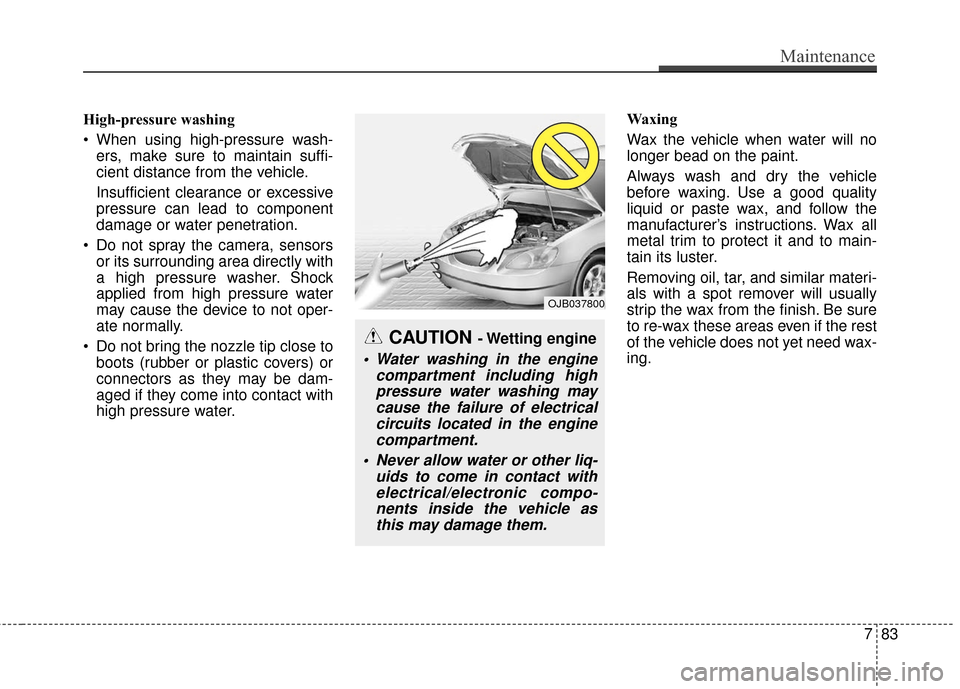
High-pressure washing
When using high-pressure wash-ers, make sure to maintain suffi-
cient distance from the vehicle.
Insufficient clearance or excessive
pressure can lead to component
damage or water penetration.
Do not spray the camera, sensors or its surrounding area directly with
a high pressure washer. Shock
applied from high pressure water
may cause the device to not oper-
ate normally.
Do not bring the nozzle tip close to boots (rubber or plastic covers) or
connectors as they may be dam-
aged if they come into contact with
high pressure water. Waxing
Wax the vehicle when water will no
longer bead on the paint.
Always wash and dry the vehicle
before waxing. Use a good quality
liquid or paste wax, and follow the
manufacturer’s instructions. Wax all
metal trim to protect it and to main-
tain its luster.
Removing oil, tar, and similar materi-
als with a spot remover will usually
strip the wax from the finish. Be sure
to re-wax these areas even if the rest
of the vehicle does not yet need wax-
ing.
CAUTION - Wetting engine
Water washing in the engine
compartment including highpressure water washing maycause the failure of electricalcircuits located in the enginecompartment.
Never allow water or other liq- uids to come in contact withelectrical/electronic compo-nents inside the vehicle asthis may damage them.
OJB037800
Maintenance
83
7
Page 437 of 466
68
Specifications & Consumer information
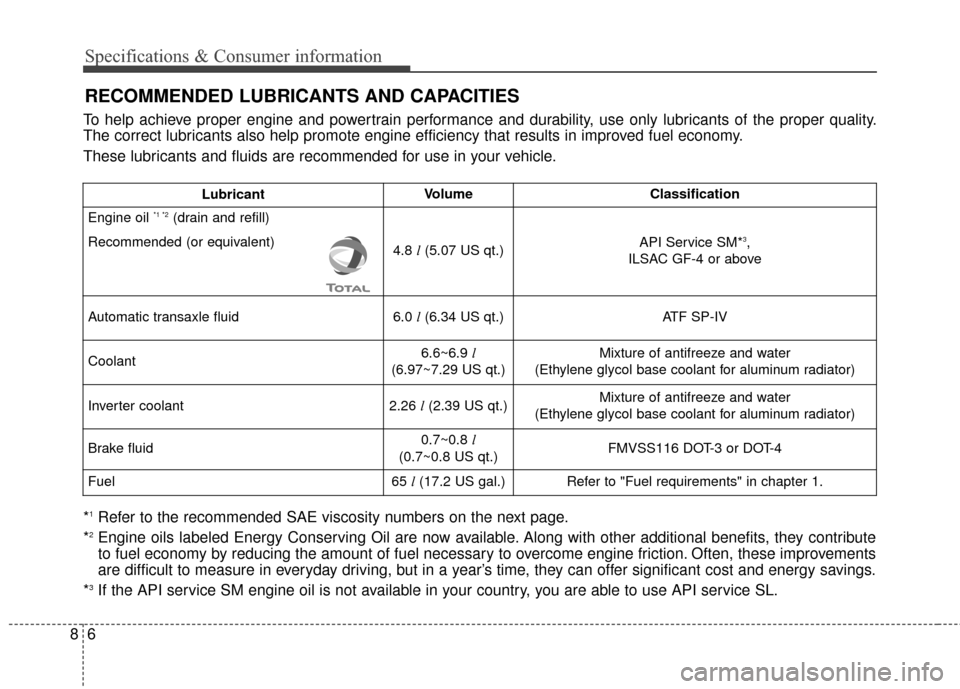
RECOMMENDED LUBRICANTS AND CAPACITIES
To help achieve proper engine and powertrain performance and durability, use only lubricants of the proper quality.
The correct lubricants also help promote engine efficiency that results in improved fuel economy.
These lubricants and fluids are recommended for use in your vehicle.
*1Refer to the recommended SAE viscosity numbers on the next page.
*2Engine oils labeled Energy Conserving Oil are now available. Along with other additional benefits, they contribute
to fuel economy by reducing the amount of fuel necessary to overcome engine friction. Often, these improvements
are difficult to measure in everyday driving, but in a year’s time, they can offer significant cost and energy savings.
*
3If the API service SM engine oil is not available in your country, you are able to use API service SL.
LubricantVolumeClassification
Engine oil *1 *2 (drain and refill)
Recommended (or equivalent)
4.8 l(5.07 US qt.)API Service SM*3,
ILSAC GF-4 or above
Automatic transaxle fluid6.0 l(6.34 US qt.)ATF SP-IV
Coolant 6.6~6.9 l
(6.97~7.29 US qt.)Mixture of antifreeze and water
(Ethylene glycol base coolant for aluminum radiator)
Inverter coolant2.26 l(2.39 US qt.)Mixture of antifreeze and water
(Ethylene glycol base coolant for aluminum radiator)
Brake fluid0.7~0.8 l
(0.7~0.8 US qt.)FMVSS116 DOT-3 or DOT-4
Fuel65 l(17.2 US gal.)Refer to "Fuel requirements" in chapter 1.
Page 438 of 466
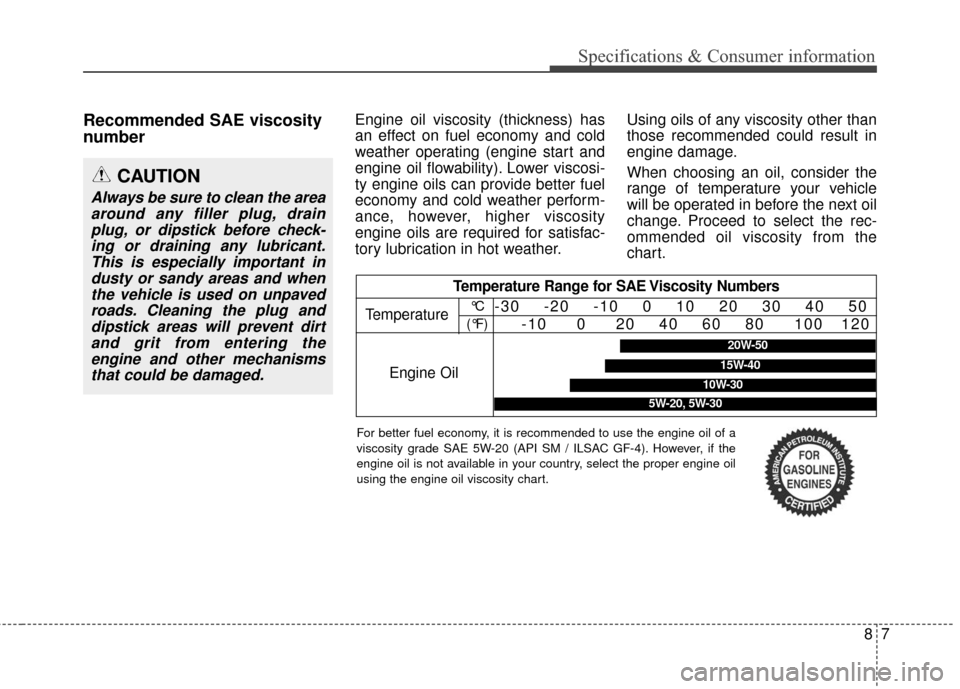
Recommended SAE viscosity
numberEngine oil viscosity (thickness) has
an effect on fuel economy and cold
weather operating (engine start and
engine oil flowability). Lower viscosi-
ty engine oils can provide better fuel
economy and cold weather perform-
ance, however, higher viscosity
engine oils are required for satisfac-
tory lubrication in hot weather.Using oils of any viscosity other than
those recommended could result in
engine damage.
When choosing an oil, consider the
range of temperature your vehicle
will be operated in before the next oil
change. Proceed to select the rec-
ommended oil viscosity from the
chart.
CAUTION
Always be sure to clean the area
around any filler plug, drainplug, or dipstick before check-ing or draining any lubricant.This is especially important industy or sandy areas and whenthe vehicle is used on unpavedroads. Cleaning the plug anddipstick areas will prevent dirtand grit from entering theengine and other mechanismsthat could be damaged.
Temperature Range for SAE Viscosity Numbers
Temperature
Engine Oil°C
(°F)-30 -20 -10 0 10 20 30 40 50 -10 0 20 40 60 80 100 120
5W-20, 5W-30
20W-50
10W-30
15W-40
87
Specifications & Consumer information
For better fuel economy, it is recommended to use the engine oil of a
viscosity grade SAE 5W-20 (API SM / ILSAC GF-4). However, if the
engine oil is not available in your country, select the proper engine oil
using the engine oil viscosity chart.
Page 449 of 466
H9
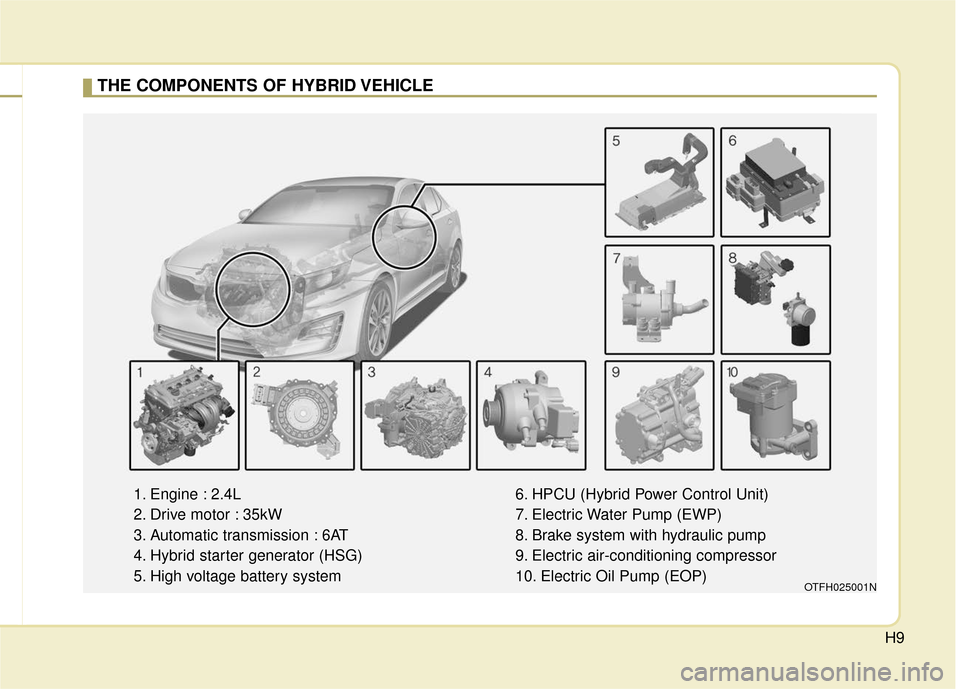
THE COMPONENTS OF HYBRID VEHICLE
1. Engine : 2.4L
2. Drive motor : 35kW
3. Automatic transmission : 6AT
4. Hybrid starter generator (HSG)
5. High voltage battery system6. HPCU (Hybrid Power Control Unit)
7. Electric Water Pump (EWP)
8. Brake system with hydraulic pump
9. Electric air-conditioning compressor
10. Electric Oil Pump (EOP)
OTFH025001N
Page 461 of 466
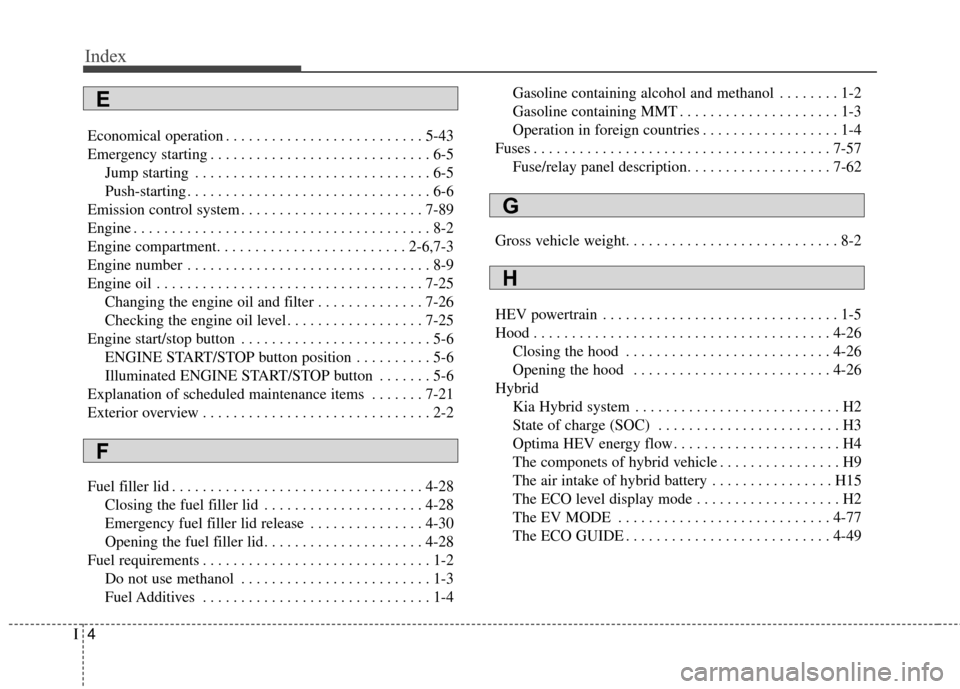
Index
4I
Economical operation . . . . . . . . . . . . . . . . . . . . . . . . . . 5-43
Emergency starting . . . . . . . . . . . . . . . . . . . . . . . . . . . . . 6-5Jump starting . . . . . . . . . . . . . . . . . . . . . . . . . . . . . . . 6-5
Push-starting . . . . . . . . . . . . . . . . . . . . . . . . . . . . . . . . 6-6
Emission control system . . . . . . . . . . . . . . . . . . . . . . . . 7-89
Engine . . . . . . . . . . . . . . . . . . . . . . . . . . . . . . . . . . . . \
. . . 8-2
Engine compartment. . . . . . . . . . . . . . . . . . . . . . . . . 2-6,7-3
Engine number . . . . . . . . . . . . . . . . . . . . . . . . . . . . . . . . 8-9
Engine oil . . . . . . . . . . . . . . . . . . . . . . . . . . . . . . . . . . . 7-\
25 Changing the engine oil and filter . . . . . . . . . . . . . . 7-26
Checking the engine oil level . . . . . . . . . . . . . . . . . . 7-25
Engine start/stop button . . . . . . . . . . . . . . . . . . . . . . . . . 5-6 ENGINE START/STOP button position . . . . . . . . . . 5-6
Illuminated ENGINE START/STOP button . . . . . . . 5-6
Explanation of scheduled maintenance items . . . . . . . 7-21
Exterior overview . . . . . . . . . . . . . . . . . . . . . . . . . . . . . . 2-2
Fuel filler lid . . . . . . . . . . . . . . . . . . . . . . . . . . . . . . . . . 4-28 Closing the fuel filler lid . . . . . . . . . . . . . . . . . . . . . 4-28
Emergency fuel filler lid release . . . . . . . . . . . . . . . 4-30
Opening the fuel filler lid. . . . . . . . . . . . . . . . . . . . . 4-28
Fuel requirements . . . . . . . . . . . . . . . . . . . . . . . . . . . . . . 1-2 Do not use methanol . . . . . . . . . . . . . . . . . . . . . . . . . 1-3
Fuel Additives . . . . . . . . . . . . . . . . . . . . . . . . . . . . . . 1-4 Gasoline containing alcohol and methanol . . . . . . . . 1-2
Gasoline containing MMT . . . . . . . . . . . . . . . . . . . . . 1-3
Operation in foreign countries . . . . . . . . . . . . . . . . . . 1-4
Fuses . . . . . . . . . . . . . . . . . . . . . . . . . . . . . . . . . . . . \
. . . 7-57 Fuse/relay panel description. . . . . . . . . . . . . . . . . . . 7-62
Gross vehicle weight. . . . . . . . . . . . . . . . . . . . . . . . . . . . 8-2
HEV powertrain . . . . . . . . . . . . . . . . . . . . . . . . . . . . . . . 1-5
Hood . . . . . . . . . . . . . . . . . . . . . . . . . . . . . . . . . . . . \
. . . 4-26 Closing the hood . . . . . . . . . . . . . . . . . . . . . . . . . . . 4-26
Opening the hood . . . . . . . . . . . . . . . . . . . . . . . . . . 4-26
Hybrid Kia Hybrid system . . . . . . . . . . . . . . . . . . . . . . . . . . . H2
State of charge (SOC) . . . . . . . . . . . . . . . . . . . . . . . . H3
Optima HEV energy flow . . . . . . . . . . . . . . . . . . . . . . H4
The componets of hybrid vehicle . . . . . . . . . . . . . . . . H9
The air intake of hybrid battery . . . . . . . . . . . . . . . . H15
The ECO level display mode . . . . . . . . . . . . . . . . . . . H2
The EV MODE . . . . . . . . . . . . . . . . . . . . . . . . . . . . 4-77
The ECO GUIDE . . . . . . . . . . . . . . . . . . . . . . . . . . . 4-49
E
F
G
H