heating KIA OPTIMA PHEV 2017 User Guide
[x] Cancel search | Manufacturer: KIA, Model Year: 2017, Model line: OPTIMA PHEV, Model: KIA OPTIMA PHEV 2017Pages: 604, PDF Size: 13.16 MB
Page 257 of 604
4127
Features of your vehicle
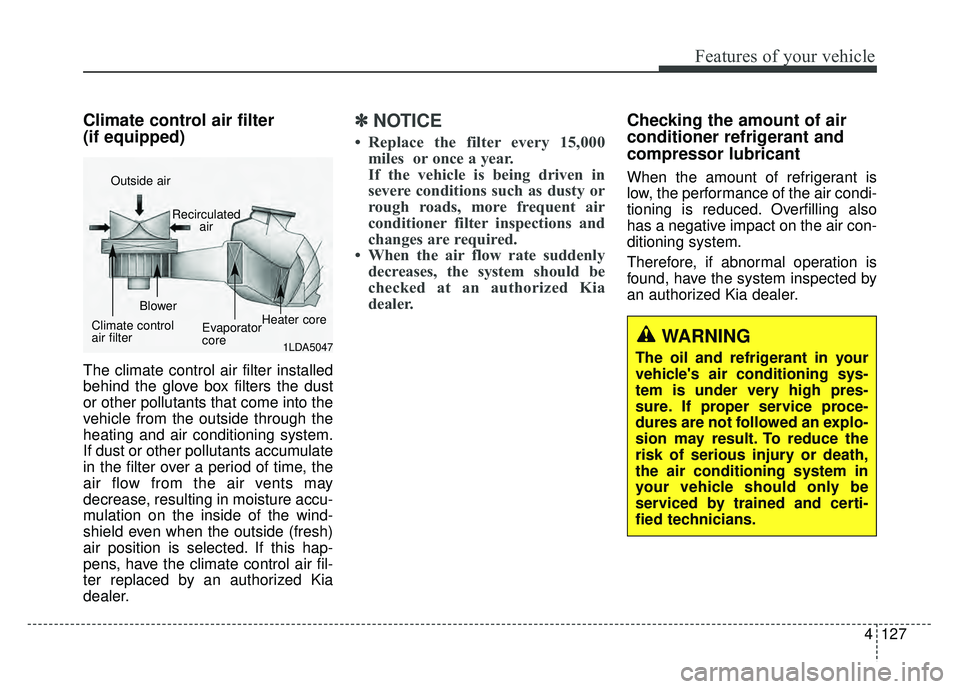
Climate control air filter
(if equipped)
The climate control air filter installed
behind the glove box filters the dust
or other pollutants that come into the
vehicle from the outside through the
heating and air conditioning system.
If dust or other pollutants accumulate
in the filter over a period of time, the
air flow from the air vents may
decrease, resulting in moisture accu-
mulation on the inside of the wind-
shield even when the outside (fresh)
air position is selected. If this hap-
pens, have the climate control air fil-
ter replaced by an authorized Kia
dealer.
✽ ✽NOTICE
• Replace the filter every 15,000
miles or once a year.
If the vehicle is being driven in
severe conditions such as dusty or
rough roads, more frequent air
conditioner filter inspections and
changes are required.
• When the air flow rate suddenly decreases, the system should be
checked at an authorized Kia
dealer.
Checking the amount of air
conditioner refrigerant and
compressor lubricant
When the amount of refrigerant is
low, the performance of the air condi-
tioning is reduced. Overfilling also
has a negative impact on the air con-
ditioning system.
Therefore, if abnormal operation is
found, have the system inspected by
an authorized Kia dealer.
1LDA5047
Outside air
Recirculatedair
Climate control
air filter Blower
Evaporator
coreHeater core
WARNING
The oil and refrigerant in your
vehicle's air conditioning sys-
tem is under very high pres-
sure. If proper service proce-
dures are not followed an explo-
sion may result. To reduce the
risk of serious injury or death,
the air conditioning system in
your vehicle should only be
serviced by trained and certi-
fied technicians.
Page 259 of 604
4129
Features of your vehicle
For maximum defrosting, set thetemperature control to the extreme
right/hot position and the fan speed
control to the highest speed.
If warm air to the floor is desired while defrosting or defogging, set
the mode to the floor-defrost posi-
tion.
Before driving, clear all snow and ice from the windshield, rear win-
dow, outside rear view mirrors, and
all side windows.
Clear all snow and ice from the hood and air inlet in the cowl grill to
improve heater and defroster effi-
ciency and to reduce the probabili-
ty of fogging up the inside of the
windshield.Automatic climate control
system
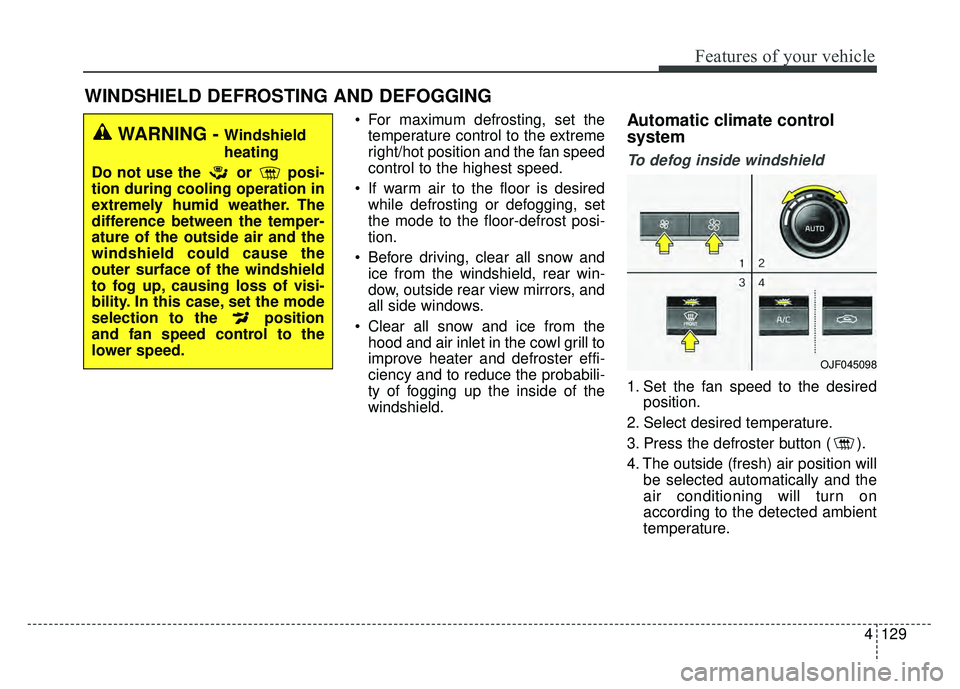
To defog inside windshield
1. Set the fan speed to the desired position.
2. Select desired temperature.
3. Press the defroster button ( ).
4. The outside (fresh) air position will be selected automatically and the
air conditioning will turn on
according to the detected ambient
temperature.
WINDSHIELD DEFROSTING AND DEFOGGING
WARNING - Windshield
heating
Do not use the or posi-
tion during cooling operation in
extremely humid weather. The
difference between the temper-
ature of the outside air and the
windshield could cause the
outer surface of the windshield
to fog up, causing loss of visi-
bility. In this case, set the mode
selection to the position
and fan speed control to the
lower speed.
OJF045098
Page 266 of 604
Features of your vehicle
136
4
Seat warmer (if equipped)
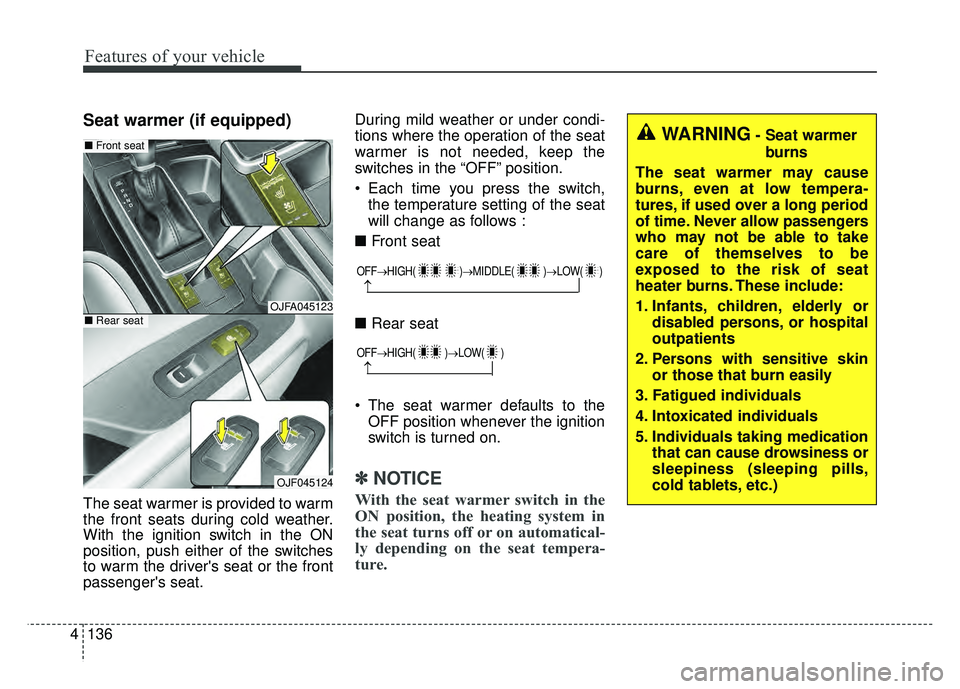
The seat warmer is provided to warm
the front seats during cold weather.
With the ignition switch in the ON
position, push either of the switches
to warm the driver's seat or the front
passenger's seat. During mild weather or under condi-
tions where the operation of the seat
warmer is not needed, keep the
switches in the “OFF” position.
Each time you press the switch,
the temperature setting of the seat
will change as follows :
■ Front seat
■ Rear seat
The seat warmer defaults to the OFF position whenever the ignition
switch is turned on.
✽ ✽ NOTICE
With the seat warmer switch in the
ON position, the heating system in
the seat turns off or on automatical-
ly depending on the seat tempera-
ture.
OJFA045123
OJF045124
■ Front seat
■Rear seat
OFF→ HIGH( )→ MIDDLE( )→LOW( )
→
OFF→HIGH( )→ LOW( )
→
WARNING- Seat warmer
burns
The seat warmer may cause
burns, even at low tempera-
tures, if used over a long period
of time. Never allow passengers
who may not be able to take
care of themselves to be
exposed to the risk of seat
heater burns. These include:
1. Infants, children, elderly or disabled persons, or hospital
outpatients
2. Persons with sensitive skin or those that burn easily
3. Fatigued individuals
4. Intoxicated individuals
5. Individuals taking medication that can cause drowsiness or
sleepiness (sleeping pills,
cold tablets, etc.)
Page 428 of 604
691
Driving your vehicle
Hazardous driving conditions
When hazardous driving conditions
are encountered such as water,
snow, ice, mud, sand, or similar haz-
ards, follow these suggestions:
Drive cautiously and allow extradistance for braking.
Avoid sudden braking or steering.
When braking with non-ABS brakes pump the brake pedal with
a light up-and-down motion until
the vehicle is stopped.
Do not pump the brake pedal on a
vehicle equipped with ABS. If stalled in snow, mud, or sand,
use the second gear. Accelerate
slowly to avoid spinning the drive
wheels.
Use sand, rock salt, or other non- slip material under the drive
wheels to provide traction when
stalled in ice, snow, or mud.
Rocking the vehicle
If it is necessary to rock the vehicle
to free it from snow, sand, or mud,
first turn the steering wheel right and
left to clear the area around your
front wheels. Then, shift back and
forth between R (Reverse) and any
forward gear in vehicles equipped
with an Automatic Transaxle. Do not
race the engine, and spin the wheels
as little as possible. If you are still
stuck after a few tries, have the vehi-
cle pulled out by a tow vehicle to
avoid engine overheating and possi-
ble damage to the transaxle.
SPECIAL DRIVING CONDITIONS
WARNING- Downshifting
Do not downshift with an auto-
matic transaxle while driving on
slippery surfaces. The sudden
change in tire speed could
cause the tires to skid and
result in an accident.
WARNING- Sudden
Vehicle Movement
Do not attempt to rock the vehi-
cle if people or objects are near-
by. The vehicle may suddenly
move forward or backwards as it
becomes unstuck.
Page 429 of 604
Driving your vehicle
92
6
The ESC system should be turned
OFF prior to rocking the vehicle.
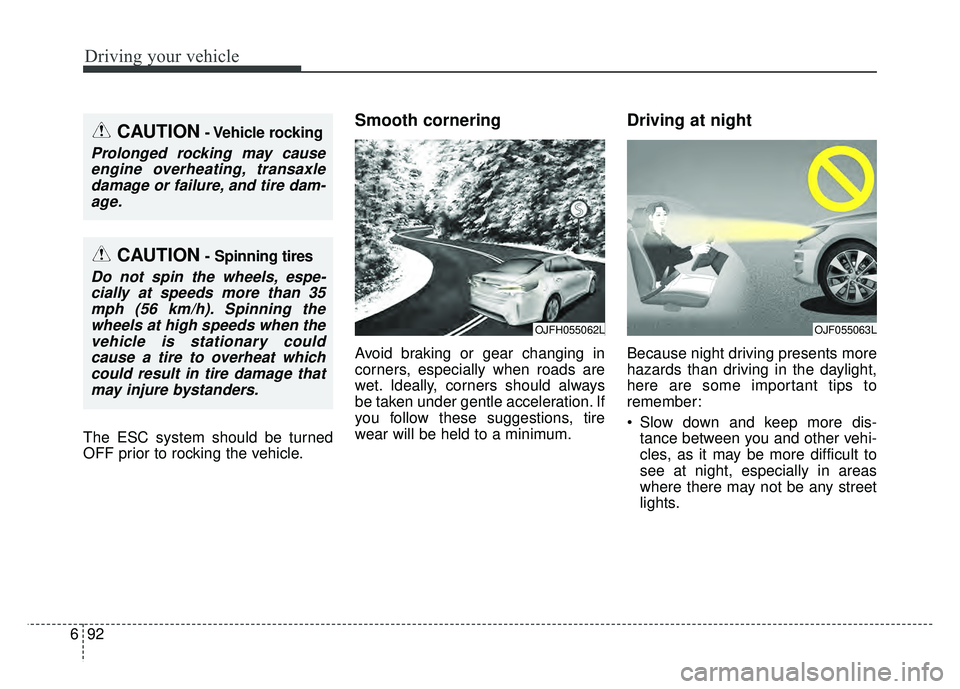
Smooth cornering
Avoid braking or gear changing in
corners, especially when roads are
wet. Ideally, corners should always
be taken under gentle acceleration. If
you follow these suggestions, tire
wear will be held to a minimum.
Driving at night
Because night driving presents more
hazards than driving in the daylight,
here are some important tips to
remember:
Slow down and keep more dis-
tance between you and other vehi-
cles, as it may be more difficult to
see at night, especially in areas
where there may not be any street
lights.
CAUTION- Vehicle rocking
Prolonged rocking may causeengine overheating, transaxledamage or failure, and tire dam-age.
CAUTION- Spinning tires
Do not spin the wheels, espe-cially at speeds more than 35mph (56 km/h). Spinning thewheels at high speeds when thevehicle is stationary couldcause a tire to overheat whichcould result in tire damage thatmay injure bystanders.
OJFH055062LOJF055063L
Page 431 of 604
Driving your vehicle
94
6
Driving in flooded areas
Avoid driving through flooded areas
unless you are sure the water is no
higher than the bottom of the wheel
hub. Drive through any water slowly.
Allow adequate stopping distance
because brake performance may be
affected.
After driving through water, dry the
brakes by gently applying them sev-
eral times while the vehicle is moving
slowly.
Driving off-road
Drive carefully off-road because your
vehicle may be damaged by rocks or
roots of trees. Become familiar with
the off-road conditions where you
are going to drive before you begin
driving.
Highway driving
Tires
Adjust the tire inflation pressures to
specification. Low tire inflation pres-
sures will result in overheating and
possible failure of the tires.
Avoid using worn or damaged tires
which may result in reduced traction
or tire failure.
Never exceed the maximum tire
inflation pressure shown on the tires.
Fuel, engine coolant and engine oil
High speed travel consumes more
fuel than urban motoring. Do not for-
get to check both the engine coolant
and engine oil.
Drive belt
A loose or damaged drive belt may
result in overheating of the engine.
WARNING- Under/over
inflated tires
Always check the tires for proper
inflation before driving.
Underinflated or overinflated
tires can cause poor handling,
loss of vehicle control, and sud-
den tire failure leading to acci-
dents, injuries, and even death.
For proper tire pressures, refer to
“Tires and wheels” in chapter 9.
WARNING- Tire tread
Always check the tire tread
before driving your vehicle.
Worn-out tires can result in loss
of vehicle control. Worn-out tires
should be replaced as soon as
possible. For further information
and tread limits, refer to "Tires
and wheels" in chapter 8.
Page 447 of 604
77
What to do in an emergency
IF THE ENGINE OVERHEATS
If your temperature gauge indicates
overheating, you will experience a
loss of power, or hear loud pinging or
knocking, the engine is probably too
hot. If this happens, you should:
1. Turn on the emergency warningflasher and stop in a safe place.
Move the shift lever to P (Park)
and engage the parking brake.
2. If hot steam does not come out from the engine room, carefully
open the engine room and check
whether the water pump connec-
tor is properly engaged. If the con-
nector is not properly engaged,
stop the engine immediately and
properly engage the connector.
Then, turn the engine on.
3. Turn on the air conditioner. 4. If the “HEV Warning” light turns on
in the driver instrument cluster, or
engine coolant or hot steam emits
from the engine coolant filler, stop
the engine immediately. Then, call
the nearest authorized Kia dealer
for assistance. If the “Engine
Warning” light remains illuminated
or the engine coolant is not flowing
out, keep the engine running.
Open the engine hood for ventila-
tion to help cool down the engine. 5. Check whether the engine coolant
temperature is low enough by
checking its temperature. If the
engine coolant level is low, please
check the connecting parts
between the radiator hose, heater
hose, and water pump for any
signs of leakage. When there is no
sign of leakage, please refill the
engine coolant. If causes and
signs of engine overheating such
as warning light illumination,
engine coolant leakage, or cooling
fan malfunction are found, stop the
vehicle the earliest. Then, call the
nearest authorized Kia dealer for
assistance.
WARNING
While the engine is running,
keep hair, hands and clothing
away from moving parts such
as the fan and drive belts to pre-
vent injury.
Page 448 of 604
What to do in an emergency
87
6. If you cannot find the cause of theoverheating, wait until the engine
temperature has returned to nor-
mal. Then, if coolant has been lost,
carefully add coolant to the reser-
voir to bring the fluid level in the
reservoir up to the halfway mark.
7. Proceed with caution, keeping alert for further signs of overheat-
ing. If over heating happens again,
call the nearest authorized Kia
dealer for assistance.
✽ ✽NOTICE
Serious loss of coolant indicates
there is a leak in the cooling system
and should be checked as soon as
possible by an authorized Kia dealer.
CAUTION
When the engine overheats from
low engine coolant, suddenlyadding engine coolant maycause cracks in the engine. Toprevent damage, add enginecoolant slowly in small quantities
WARNING
Do not remove the
radiator cap when the
engine is hot. This
can allow coolant to
blow out of the open-
ing and cause seri-
ous burns.
Page 495 of 604
Maintenance
26
8
ENGINE MAINTENANCE MODE(FOR PLUG-IN HYBRID)
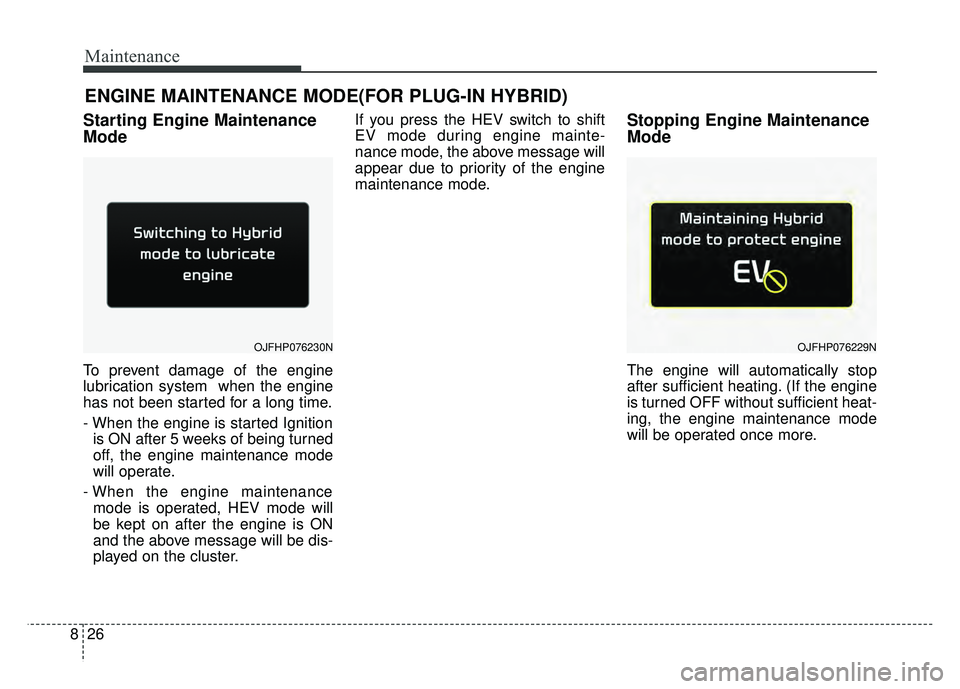
Starting Engine Maintenance
Mode
To prevent damage of the engine
lubrication system when the engine
has not been started for a long time.
- When the engine is started Ignition
is ON after 5 weeks of being turned
off, the engine maintenance mode
will operate.
- When the engine maintenance mode is operated, HEV mode will
be kept on after the engine is ON
and the above message will be dis-
played on the cluster. If you press the HEV switch to shift
EV mode during engine mainte-
nance mode, the above message will
appear due to priority of the engine
maintenance mode.
Stopping Engine Maintenance
Mode
The engine will automatically stop
after sufficient heating. (If the engine
is turned OFF without sufficient heat-
ing, the engine maintenance mode
will be operated once more.
OJFHP076230NOJFHP076229N
Page 591 of 604
Index
2I
Active ECO system. . . . . . . . . . . . . . . . . . . . . . . . . . . . 6-75ECO (Active ECO) mode. . . . . . . . . . . . . . . . . . . . . 6-75
A/V Mode . . . . . . . . . . . . . . . . . . . . . . . . . . . . . . . . . . . 4-\
72
Advanced smart cruise control system . . . . . . . . . . . . . 6-56 Speed setting . . . . . . . . . . . . . . . . . . . . . . . . . . . . . . 6-57
Vehicle to vehicle distance setting . . . . . . . . . . . . . . 6-62
To adjust the sensitivity of Smart Cruise Control . . 6-66
To convert to cruise control mode . . . . . . . . . . . . . . 6-67
Limitations of the system . . . . . . . . . . . . . . . . . . . . . 6-68
AFLS (Adaptive Front Lighting System) . . . . . . . . . . 4-106
Air bag warning label . . . . . . . . . . . . . . . . . . . . . . . . . . 3-70
Air bag warning light . . . . . . . . . . . . . . . . . . . . . . . . . . 3-46
Air bags. . . . . . . . . . . . . . . . . . . . . . . . . . . . . . . . . . . . \
. 3-43 Operation . . . . . . . . . . . . . . . . . . . . . . . . . . . . . . . . . 3-44
Air bag warning light . . . . . . . . . . . . . . . . . . . . . . . . 3-46
SRS components and functions . . . . . . . . . . . . . . . . 3-47
Occupant Detection System . . . . . . . . . . . . . . . . . . . 3-50
Driver's and passenger's front air bag . . . . . . . . . . . 3-58
Side air bag. . . . . . . . . . . . . . . . . . . . . . . . . . . . . . . . 3-61
Curtain air bag . . . . . . . . . . . . . . . . . . . . . . . . . . . . . 3-63
Inflation conditions . . . . . . . . . . . . . . . . . . . . . . . . . 3-65
Non-inflation conditions . . . . . . . . . . . . . . . . . . . . . 3-67
SRS Care . . . . . . . . . . . . . . . . . . . . . . . . . . . . . . . . . 3-69
Air bag warning label. . . . . . . . . . . . . . . . . . . . . . . . 3-70
Air cleaner . . . . . . . . . . . . . . . . . . . . . . . . . . . . . . . . . . 8-34\
Filter replacement. . . . . . . . . . . . . . . . . . . . . . . . . . . 8-34 Air Conditioning refrigerant label . . . . . . . . . . . . . . . 4-128
Air conditioning system lubricants. . . . . . . . . . . . . . . . . 9-5
Air ventilation seat . . . . . . . . . . . . . . . . . . . . . . . . . . . 4-137
Anti-lock brake system (ABS) . . . . . . . . . . . . . . . . . . . 6-32
Appearance care . . . . . . . . . . . . . . . . . . . . . . . . . . . . . . 8-94
Exterior care . . . . . . . . . . . . . . . . . . . . . . . . . . . . . . . 8-94
Interior care . . . . . . . . . . . . . . . . . . . . . . . . . . . . . . . 8-99
Armed stage . . . . . . . . . . . . . . . . . . . . . . . . . . . . . . . . . 4-10
ASCC/LDWS Mode . . . . . . . . . . . . . . . . . . . . . . . . . . 4-72
AUDIO (With Touch Screen) . . . . . . . . . . . . . . . . . . . . 5-8 Feature of Your Audio . . . . . . . . . . . . . . . . . . . . . . . . 5-9
Radio Mode . . . . . . . . . . . . . . . . . . . . . . . . . . . . . . . 5-20
SiriusXM Radio Mode . . . . . . . . . . . . . . . . . . . . . . 5-23
Media Mode . . . . . . . . . . . . . . . . . . . . . . . . . . . . . . . 5-25
Phone Mode . . . . . . . . . . . . . . . . . . . . . . . . . . . . . . . 5-40
Voice Recognition Mode . . . . . . . . . . . . . . . . . . . . . 5-48
Setup Mode . . . . . . . . . . . . . . . . . . . . . . . . . . . . . . . 5-56
Audio system . . . . . . . . . . . . . . . . . . . . . . . . . . . . . . . . . 5-2 Antenna . . . . . . . . . . . . . . . . . . . . . . . . . . . . . . . . . . . 5-\
2
Steering wheel audio controls . . . . . . . . . . . . . . . . . . 5-3
AUX, USB port . . . . . . . . . . . . . . . . . . . . . . . . . . . . . 5-4
How vehicle radio works . . . . . . . . . . . . . . . . . . . . . . 5-5
Auto defogging system . . . . . . . . . . . . . . . . . . . . . . . . 4-131
AUTO HOLD . . . . . . . . . . . . . . . . . . . . . . . . . . . . . . . . 6-28
Auto light . . . . . . . . . . . . . . . . . . . . . . . . . . . . . . . . . . 4-10\
1
Automatic climate control system . . . . . . . . . . . . . . . 4-115 Automatic heating and air conditioning. . . . . . . . . 4-116
Climate control air filter . . . . . . . . . . . . . . . . . . . . 4-127
A