recommended oil KIA OPTIMA PHEV 2017 User Guide
[x] Cancel search | Manufacturer: KIA, Model Year: 2017, Model line: OPTIMA PHEV, Model: KIA OPTIMA PHEV 2017Pages: 604, PDF Size: 13.16 MB
Page 570 of 604
8101
Maintenance
Cleaning the upholstery and inte-rior trim
Vinyl
Remove dust and loose dirt from
vinyl with a whisk broom or vacuum
cleaner. Clean vinyl surfaces with a
vinyl cleaner.
Fabric
Remove dust and loose dirt from fab-
ric with a whisk broom or vacuum
cleaner. Clean with a mild soap solu-
tion recommended for upholstery or
carpets. Remove fresh spots imme-
diately with a fabric spot cleaner. If
fresh spots do not receive immediate
attention, the fabric can be stained
and its color can be affected. Also, its
fire-resistant properties can be
reduced if the material is not proper-
ly maintained.
Using anything but recommended
cleaners and procedures may affect
the fabric’s appearance and fire-
resistant properties.
Cleaning the lap/shoulder beltwebbing
Clean the belt webbing with any mild
soap solution recommended for
cleaning upholstery or carpet. Follow
the instructions provided with the
soap. Do not bleach or re-dye the
webbing because this may weaken it.
Cleaning the interior windowglass
If the interior glass surfaces of the
vehicle become fogged (that is, cov-
ered with an oily, greasy or waxy
film), they should be cleaned with a
glass cleaner. Follow the directions
on the glass cleaner container.
Window tinting precaution
Window tint(especially metallic film)
might cause communication disorder
or poor radio reception, and malfunc-
tion of the automatic lighting system
due to excessive change of illumina-
tion inside the vehicle. The solution
used might also flow into electric,
electronic devices causing disorder
and failure.
CAUTION- Rear window
Do not scrape or scratch theinside of the rear window. Thismay result in damage of the rearwindow defroster grid.
Page 580 of 604

Specifications, Consumer information, Reporting safety defects
69
RECOMMENDED LUBRICANTS AND CAPACITIES
To help achieve proper engine and powertrain performance and durability, use only lubricants of the proper quality.
The correct lubricants also help promote engine efficiency that results in improved fuel economy.
These lubricants and fluids are recommended for use in your vehicle.
*1Refer to the recommended SAE viscosity numbers on the next page.
*2Engine oils labeled Energy Conserving Oil are now available. Along with other additional benefits, they contribute to fuel econo my by reducing
the amount of fuel necessary to overcome engine friction. Often, these improvements are difficult to measure in everyday driving, but in a year’s
time, they can offer significant cost and energy savings.
*
3If the API service SM engine oil is not available in your country, you are able to use API service SL.
Lubricant VolumeClassification
Engine oil *1*2
(drain and refill)
Recommends
4.33 US qt. (4.1 l)API Service SM or above *³ / ILSAC GF-4 or above
Automatic transaxle fluid6.34 US qt. (6.0 l)
- ATF SP-IV
(Recommended SK ATF SP-IV,
MICHANG ATF SP-IV, NOCA ATF SP-IV)
Coolant7.12 US qt. (6.74 l)Mixture of antifreeze and water
(Ethylene glycol base coolant for aluminum radiator)
Inverter coolant3.30 US qt. (3.13 l)Mixture of antifreeze and water
(Ethylene glycol base coolant for aluminum radiator)
Brake0.52 ± 0.02 US qt. (0.49 ± 0.02 L)DOT 3 or DOT 4
FuelHybrid17.17 US gal. (65 l)Refer to Fuel requirements in chapter 1.Plug-in hybrid14.52 US gal. (55 l)
Page 581 of 604
97
Specifications, Consumer information, Reporting safety defects
Recommended SAE viscosity
number
Always be sure to clean the area
around any filler plug, drain plug, or
dipstick before checking or draining
any lubricant. This is especially impor-
tant in dusty or sandy areas and when
the vehicle is used on unpaved roads.
Cleaning the plug and dipstick areas
will prevent dirt and grit from entering
the engine and other mechanisms
that could be damaged. Engine oil vis-
cosity (thickness) has an effect on fuel
economy and cold weather operating
(engine start and engine oil flowabili-
ty). Lower viscosity engine oils can
provide better fuel economy and cold
weather performance; however, high-
er viscosity engine oils are required
for satisfactory lubrication in hot
weather. Using oils of any viscosity
other than those recommended could
result in engine damage. When
choosing an oil, consider the range of
temperature your vehicle will be oper-
ated in before the next oil change.
Proceed to select the recommended
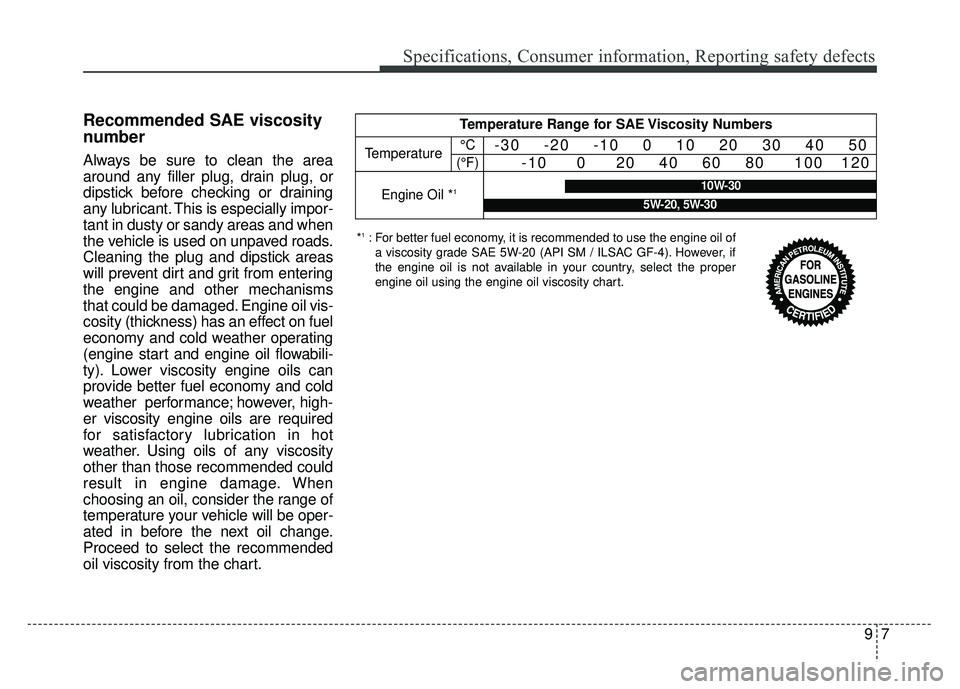
oil viscosity from the chart.
*1: For better fuel economy, it is recommended to use the engine oil ofa viscosity grade SAE 5W-20 (API SM / ILSAC GF-4). However, if
the engine oil is not available in your country, select the proper
engine oil using the engine oil viscosity chart.
Temperature Range for SAE Viscosity Numbers
Temperature°C
(°F)-30 -20 -10 0 10 20 30 40 50 -10 0 20 40 60 80 100 120
Engine Oil *110W-30
5W-20, 5W-30
Page 583 of 604
99
Specifications, Consumer information, Reporting safety defects
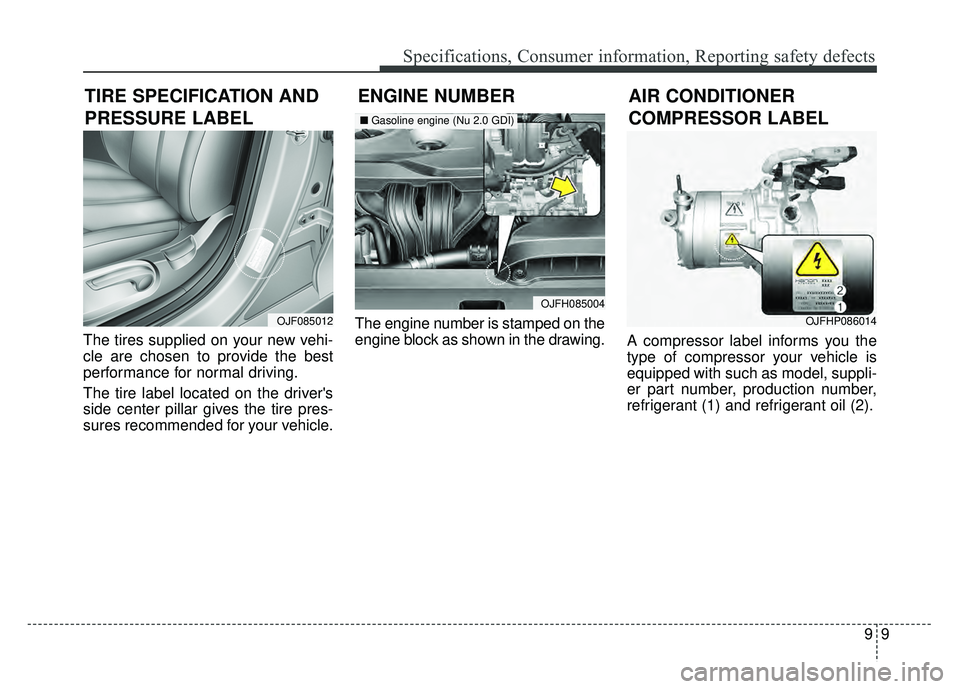
The tires supplied on your new vehi-
cle are chosen to provide the best
performance for normal driving.
The tire label located on the driver's
side center pillar gives the tire pres-
sures recommended for your vehicle.The engine number is stamped on the
engine block as shown in the drawing.
A compressor label informs you the
type of compressor your vehicle is
equipped with such as model, suppli-
er part number, production number,
refrigerant (1) and refrigerant oil (2).
ENGINE NUMBER
TIRE SPECIFICATION AND
PRESSURE LABEL
OJF085012
OJFH085004
■ Gasoline engine (Nu 2.0 GDI)
AIR CONDITIONER
COMPRESSOR LABEL
OJFHP086014