ESP KIA PICANTO 2006 User Guide
[x] Cancel search | Manufacturer: KIA, Model Year: 2006, Model line: PICANTO, Model: KIA PICANTO 2006Pages: 281, PDF Size: 9.89 MB
Page 172 of 281
517
Driving tips
1 23456789
Safety chains
You should always attach chains
between your vehicle and your trail-
er. Cross the safety chains under the
tongue of the trailer so that thetongue will not drop to the road if it
becomes separated from the hitch.
Instructions about safety chains may
be provided by the hitch manufactur-
er or by the trailer manufacturer.
Follow the manufacturer’s recom-
mendation for attaching safety
chains. Always leave just enough
slack so you can turn with your trail-
er. And, never allow safety chains to
drag on the ground.
Trailer brakes
If your trailer weighs more than the
maximum trailer weight without trailer
brakes loaded, then it needs its own
brakes and they must be adequate.
Be sure to read and follow the
instructions for the trailer brakes so
you’ll be able to install, adjust and
maintain them properly.
Don’t tap into your vehicle's brake system.
Driving with a trailer
Towing a trailer requires a certain
amount of experience. Before setting
out for the open road, you must get
to know your trailer. Acquaint your-
self with the feel of handling and
braking with the added weight of the
trailer. And always keep in mind that
the vehicle you are driving is now a
good deal longer and not nearly so
responsive as your vehicle is by
itself.
Before you start, check the trailer
hitch and platform, safety chains,
electrical connector(s), lights, tires
and mirror adjustment. If the trailer
has electric brakes, start your vehicle
and trailer moving and then apply the
trailer brake controller by hand to be
sure the brakes are working. This lets
you check your electrical connection
at the same time.
During your trip, check occasionally
to be sure that the load is secure,
and that the lights and any trailer
brakes are still working.
WARNING
Do not use a trailer with its own
brakes unless you are absolute-
ly certain that you have properly
set up the brake system. This is
not a task for amateurs. Use an
experienced, competent trailer
shop for this work.
Page 198 of 281
In case of an emergency
20
6
The compact spare should be inflat-
ed to 60 psi (420 kPa).
✽✽
NOTICE
Check the inflation pressure after
installing the spare tire. Adjust it to
the specified pressure, as necessary.
When using a compact spare tire,
observe the following precautions:
Under no circumstances should you exceed 50 mph (80 km/h); a higher speed could damage the
tire.
Ensure that you drive slowly enough for the road conditions to
avoid all hazards. Any road hazard,
such as a pothole or debris, could
seriously damage the compact
spare.
Any continuous road use of this tire could result in tire failure, loss of
vehicle control, and possible per-
sonal injury.
Do not exceed the vehicle’s maxi- mum load rating or the load-carry-
ing capacity shown on the sidewall
of the compact spare tire.
Avoid driving over obstacles. The compact spare tire diameter issmaller than the diameter of a con-
ventional tire and reduces the
ground clearance approximately 1inch (25 mm), which could result in
damage to the vehicle. Do not take this vehicle through an
automatic car wash.
Do not use tire chains on this tire. Because of the smaller size, a tire
chain will not fit properly. This could
damage the vehicle and result inloss of the chain.
This tire should not be installed on the front axle if the vehicle must be
driven in snow or on ice.
Do not use the compact spare tire on any other vehicle because thistire has been designed especially
for your vehicle.
The compact spare tire’s tread life is shorter than a regular tire.
Inspect your compact spare tire
regularly and replace worn com-
pact spare tires with the same sizeand design, mounted on the samewheel.
1 23456789
CAUTION
This spare tire should be used
only for VERY short distances.Compact spares should NEVER be used for long drives orextended distances.
Page 203 of 281
625
In case of an emergency
1 23456789
IF YOU HAVE A FLAT TIRE (IF THE VEHICLE IS EQUIPPED WITH TIREMOBILITYKIT)
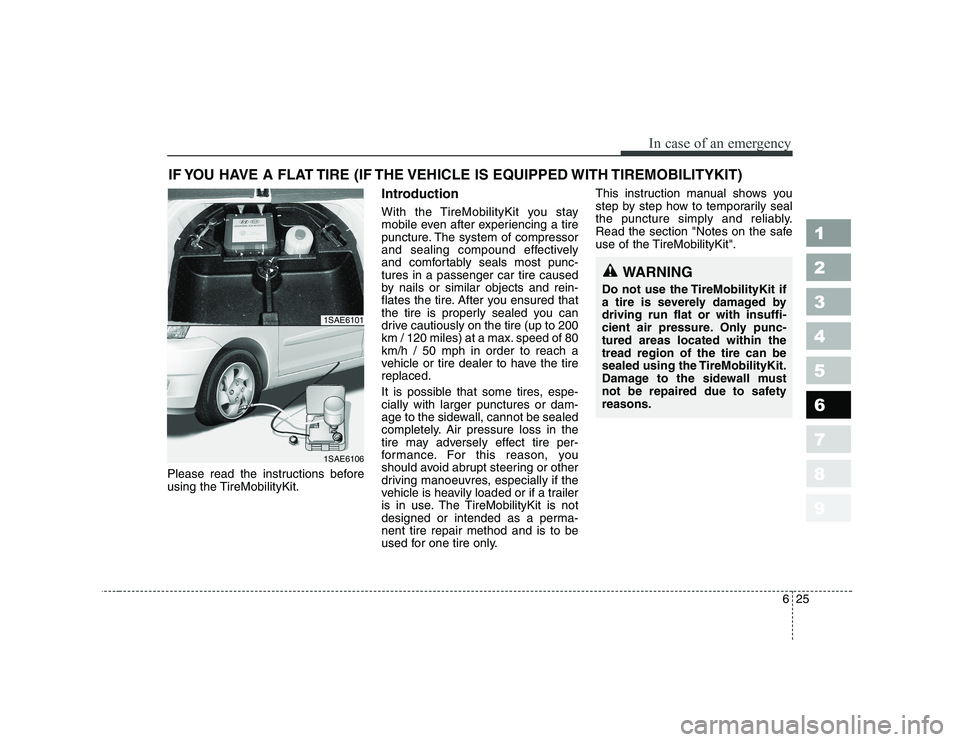
Please read the instructions before
using the TireMobilityKit. Introduction
With the TireMobilityKit you stay
mobile even after experiencing a tire
puncture. The system of compressor
and sealing compound effectively
and comfortably seals most punc-tures in a passenger car tire caused
by nails or similar objects and rein-
flates the tire. After you ensured that
the tire is properly sealed you can
drive cautiously on the tire (up to 200
km / 120 miles) at a max. speed of 80km/h / 50 mph in order to reach a
vehicle or tire dealer to have the tirereplaced.
It is possible that some tires, espe- cially with larger punctures or dam-
age to the sidewall, cannot be sealed
completely. Air pressure loss in the
tire may adversely effect tire per-
formance. For this reason, you
should avoid abrupt steering or other
driving manoeuvres, especially if the
vehicle is heavily loaded or if a trailer
is in use. The TireMobilityKit is not
designed or intended as a perma-nent tire repair method and is to be
used for one tire only.This instruction manual shows you
step by step how to temporarily seal
the puncture simply and reliably.
Read the section "Notes on the safe
use of the TireMobilityKit".
WARNING
Do not use the TireMobilityKit if
a tire is severely damaged bydriving run flat or with insuffi-
cient air pressure. Only punc-tured areas located within thetread region of the tire can be
sealed using the TireMobilityKit.
Damage to the sidewall must
not be repaired due to safetyreasons.
1SAE6101
1SAE6106
Page 208 of 281
In case of an emergency
30
6
1 23456789
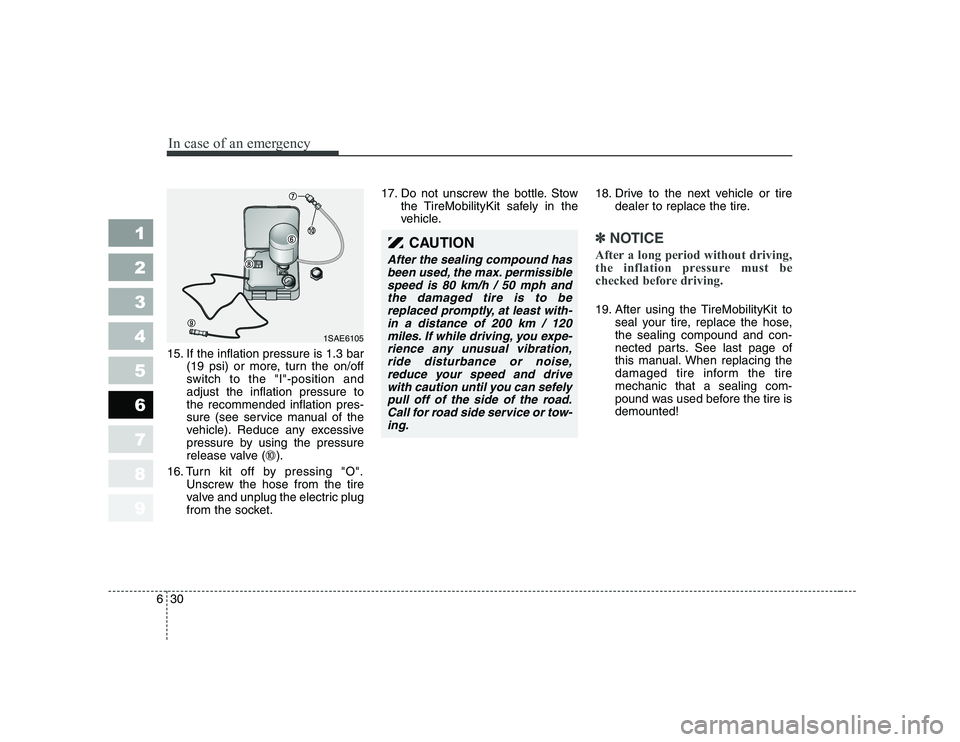
15. If the inflation pressure is 1.3 bar
(19 psi) or more, turn the on/off
switch to the "I"-position andadjust the inflation pressure tothe recommended inflation pres-
sure (see service manual of the
vehicle). Reduce any excessive
pressure by using the pressure
release valve ( ➉).
16. Turn kit off by pressing "O". Unscrew the hose from the tire
valve and unplug the electric plug
from the socket. 17. Do not unscrew the bottle. Stow
the TireMobilityKit safely in the
vehicle. 18. Drive to the next vehicle or tire
dealer to replace the tire.
✽✽NOTICE
After a long period without driving,
the inflation pressure must be
checked before driving.
19. After using the TireMobilityKit to seal your tire, replace the hose, the sealing compound and con-
nected parts. See last page of
this manual. When replacing the
damaged tire inform the tiremechanic that a sealing com-
pound was used before the tire isdemounted!
CAUTION
After the sealing compound has
been used, the max. permissiblespeed is 80 km/h / 50 mph andthe damaged tire is to be replaced promptly, at least with-in a distance of 200 km / 120miles. If while driving, you expe- rience any unusual vibration,ride disturbance or noise,reduce your speed and drive with caution until you can sefelypull off of the side of the road.Call for road side service or tow- ing.
1SAE6105
Page 212 of 281
In case of an emergency
34
6
1 23456789
EMERGENCY COMMODITY (IF EQUIPPED)
There are some emergency com-
modities in the vehicle to help yourespond to the emergency situation. Fire extinguisher
The fire extinguisher is located in the
trunk.
If there is small fire and you know
how to use the fire extinguisher, take
the following steps carefully.
1.Pull the pin at the top of the extin-
guisher that keeps the handle from being accidentally pressed.
2.Aim the nozzle toward the base of the fire.
3.Stand approximately 2.5 m (8 ft) away from the fire and squeeze the
handle to discharge the extinguish-
er. If you release the handle, the
discharge will stop.
4.Sweep the nozzle back and forth at the base of the fire. After the fire
appears to be out, watch it careful-
ly since it may re-ignite. First aid kit There are some items such as scis-
sors, bandage and adhesive tape
and etc. in the kit to give first aid toan injured person.
Triangle reflector
Place the triangle reflector on the
road to warn oncoming vehicles dur-
ing emergencies, such as when the
vehicle is parked by the roadside due
to any problems.
Page 216 of 281
73
Maintenance
MAINTENANCE SERVICES
You should exercise the utmost care
to prevent damage to your vehicle
and injury to yourself whenever per-
forming any maintenance or inspec-
tion procedures.
Should you have any doubts con-
cerning the inspection or servicing of
your vehicle, we strongly recom-
mend that you have an authorized
Kia Dealer perform this work.
An Authorized Kia Dealer has facto-
ry-trained technicians and genuine
Kia parts to service your vehicle
properly. For expert advice and qual-
ity service, see an Authorized Kia
Dealer.
Inadequate, incomplete or insuffi-
cient servicing may result in opera-
tional problems with your vehicle that
could lead to vehicle damage, an
accident, or personal injury. Owner’s responsibility
✽✽
NOTICE
Maintenance Service and Record
Retention are the owner's responsi-
bility.
You should retain documents that
show proper maintenance has been
performed on your vehicle in accor-dance with the scheduled mainte-
nance service charts shown on the
following pages. You need this infor-
mation to establish your compliance
with the servicing and maintenance
requirements of your Kia warranties.
Detailed warranty information is pro-
vided in your Warranty & Maintenancebook. Repairs and adjustments required asa result of improper maintenance or
a lack of required maintenance are
not covered.
We recommend you have your vehi-
cle maintained and repaired by an
authorized Kia dealer.
An authorized Kia dealer meets Kia's
high service quality standards and
receives technical support from Kia
in order to provide you with a high
level of service satisfaction.
1 23456789
Page 224 of 281
711
Maintenance
1 23456789
At least once a year :
Clean body and door drain holes.
Lubricate door hinges and checks,and hood hinges.
Lubricate door and hood locks and latches.
Lubricate door rubber weather- strips.
Check the air conditioning system before the warm weather season.
Check the power steering fluid level.
Inspect and lubricate automatic transaxle linkage and controls.
Clean battery and terminals.
Check the brake fluid level. Owner maintenance precau- tions
Improper or incomplete service may
result in problems. This section gives
instructions only for the maintenance
items that are easy to perform.
As explained earlier in this section,
several procedures can be done only
by an Authorized Kia Dealer with
special tools.
✽✽
NOTICE
Improper owner maintenance dur- ing the warranty period may affect
warranty coverage. For details, read
the separate Kia Warranty &
Maintenance book provided with
the vehicle. If you're unsure about
any servicing or maintenance proce-
dure, have it done by an Authorized
Kia Dealer.
WARNING - Maintenance
work
Performing maintenance work on a vehicle can be danger-
ous. You can be seriously
injured while performing some
maintenance procedures. If
you lack sufficient knowledge
and experience or the propertools and equipment to do the
work, have it done by an
Authorized Kia Dealer.
Working under the hood with the engine running is danger-
ous. It becomes even more
dangerous when you wear
jewelry or loose clothing.These can become entangled
in moving parts and result in
injury. Therefore, if you must
run the engine while working
under the hood, make certain
that you remove all jewelry
(especially rings, bracelets,
watches, and necklaces) and
all neckties, scarves, and sim-
ilar loose clothing before get-ting near the engine or cool-ing fans.
Page 242 of 281
729
Maintenance
Changing the automatic transaxle fluid
1. Raise and suitably support thevehicle.
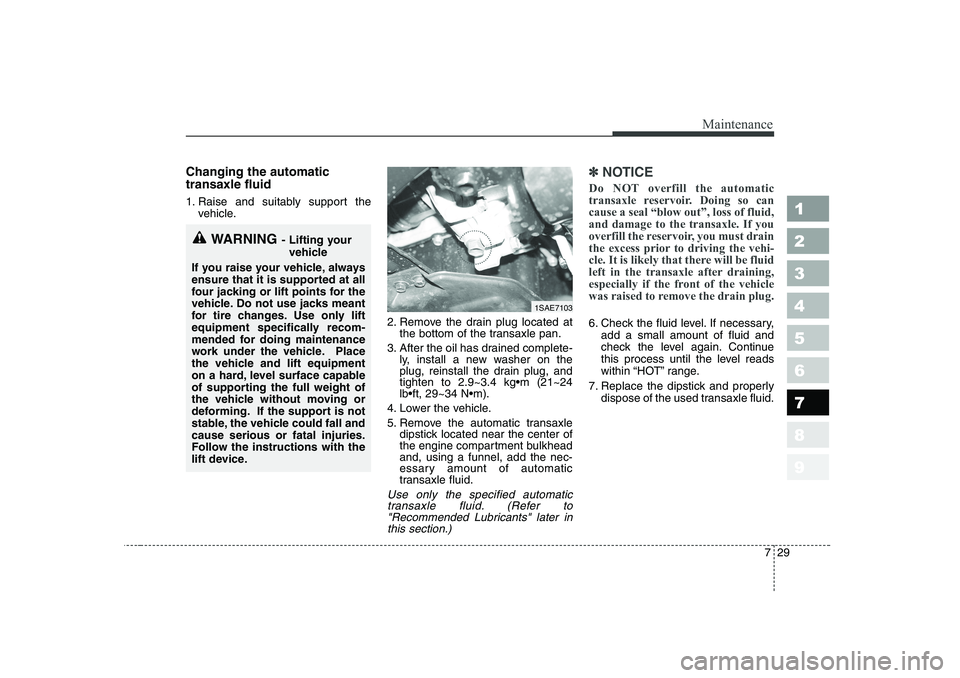
2. Remove the drain plug located atthe bottom of the transaxle pan.
3. After the oil has drained complete- ly, install a new washer on the
plug, reinstall the drain plug, andtighten to 2.9~3.4 kgm (21~24lbft, 29~34 Nm).
4. Lower the vehicle.
5. Remove the automatic transaxle dipstick located near the center of
the engine compartment bulkheadand, using a funnel, add the nec-
essary amount of automatic
transaxle fluid.
Use only the specified automatic
transaxle fluid. (Refer to"Recommended Lubricants" later inthis section.)
✽✽ NOTICE
Do NOT overfill the automatic
transaxle reservoir. Doing so cancause a seal “blow out”, loss of fluid,and damage to the transaxle. If you
overfill the reservoir, you must drain
the excess prior to driving the vehi-
cle. It is likely that there will be fluid
left in the transaxle after draining,
especially if the front of the vehicle
was raised to remove the drain plug.
6. Check the fluid level. If necessary, add a small amount of fluid and
check the level again. Continue
this process until the level reads
within “HOT” range.
7. Replace the dipstick and properly dispose of the used transaxle fluid.
1 23456789
WARNING - Lifting your
vehicle
If you raise your vehicle, always
ensure that it is supported at all
four jacking or lift points for the
vehicle. Do not use jacks meant
for tire changes. Use only lift
equipment specifically recom-
mended for doing maintenance
work under the vehicle. Place
the vehicle and lift equipment
on a hard, level surface capable
of supporting the full weight of
the vehicle without moving or
deforming. If the support is not
stable, the vehicle could fall andcause serious or fatal injuries.
Follow the instructions with the
lift device.
1SAE7103
Page 257 of 281
Maintenance
44
7
1 23456789
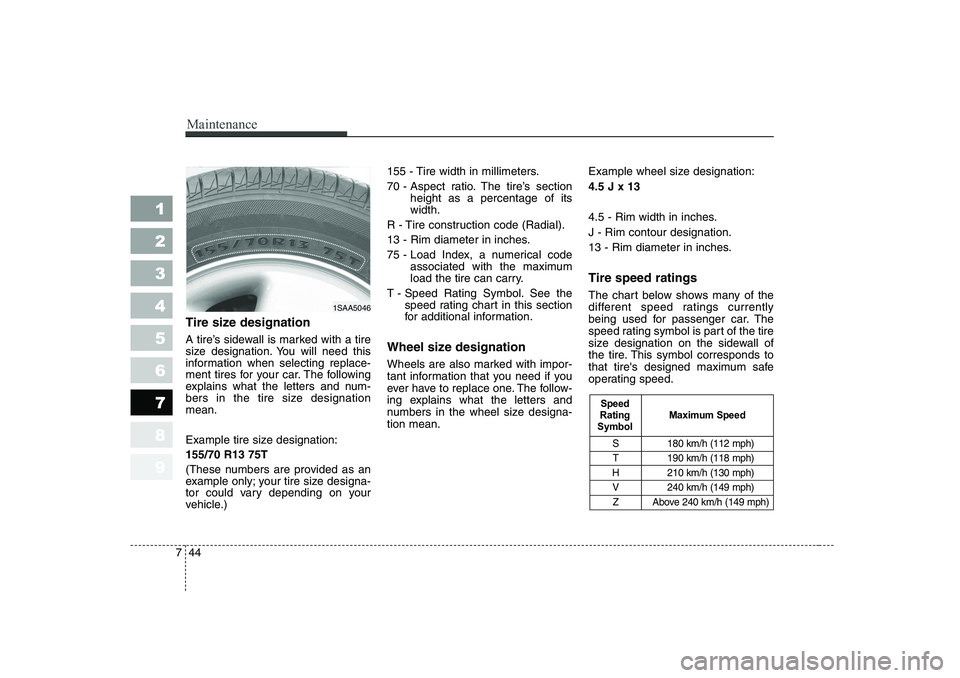
Tire size designation
A tire’s sidewall is marked with a tire
size designation. You will need this
information when selecting replace-
ment tires for your car. The following
explains what the letters and num-
bers in the tire size designationmean.
Example tire size designation: 155/70 R13 75T
(These numbers are provided as an
example only; your tire size designa-
tor could vary depending on your
vehicle.) 155 - Tire width in millimeters.
70 - Aspect ratio. The tire’s section
height as a percentage of its width.
R - Tire construction code (Radial).
13 - Rim diameter in inches.
75 - Load Index, a numerical code associated with the maximum
load the tire can carry.
T - Speed Rating Symbol. See the speed rating chart in this section
for additional information.
Wheel size designation
Wheels are also marked with impor-
tant information that you need if you
ever have to replace one. The follow-
ing explains what the letters and
numbers in the wheel size designa-tion mean. Example wheel size designation: 4.5 J x 13
4.5 - Rim width in inches. J - Rim contour designation.
13 - Rim diameter in inches. Tire speed ratings
The chart below shows many of the
different speed ratings currently
being used for passenger car. The
speed rating symbol is part of the tire
size designation on the sidewall of
the tire. This symbol corresponds to
that tire's designed maximum safe
operating speed.
S 180 km/h (112 mph)
T 190 km/h (118 mph)
H 210 km/h (130 mph) V 240 km/h (149 mph)
Z Above 240 km/h (149 mph)
Maximum Speed
Speed
Rating
Symbol
1SAA5046
Page 258 of 281
745
Maintenance
1 23456789
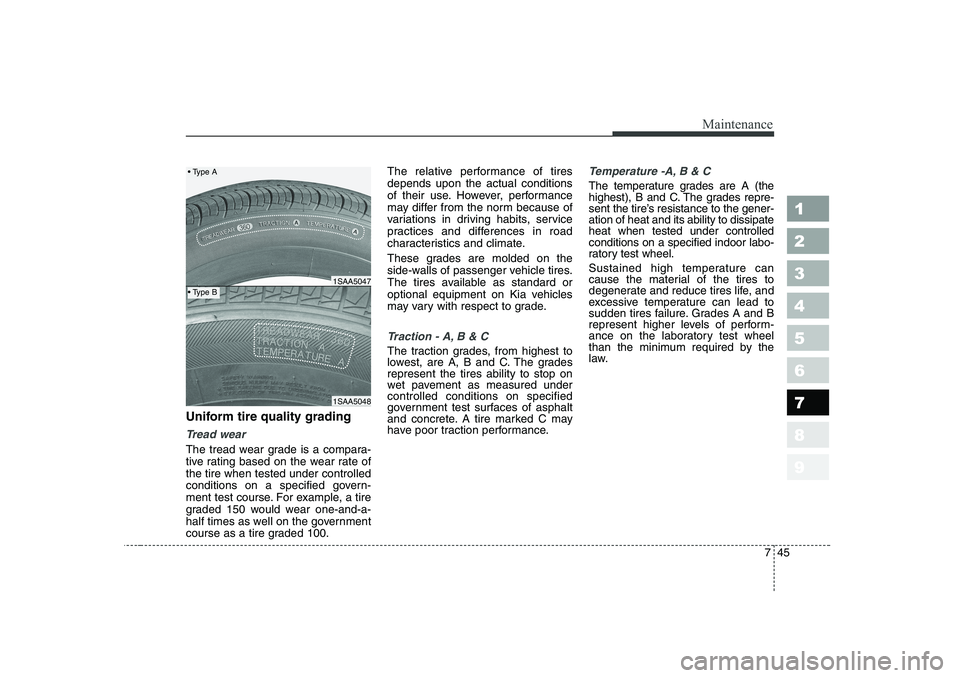
Uniform tire quality grading
Tread wear
The tread wear grade is a compara-
tive rating based on the wear rate ofthe tire when tested under controlled
conditions on a specified govern-
ment test course. For example, a tire
graded 150 would wear one-and-a-
half times as well on the government
course as a tire graded 100.The relative performance of tiresdepends upon the actual conditions
of their use. However, performance
may differ from the norm because of
variations in driving habits, service
practices and differences in road
characteristics and climate.
These grades are molded on the
side-walls of passenger vehicle tires.
The tires available as standard or
optional equipment on Kia vehicles
may vary with respect to grade.
Traction - A, B & C
The traction grades, from highest to
lowest, are A, B and C. The gradesrepresent the tires ability to stop on
wet pavement as measured undercontrolled conditions on specified
government test surfaces of asphalt
and concrete. A tire marked C may
have poor traction performance.
Temperature -A, B & C
The temperature grades are A (the
highest), B and C. The grades repre-
sent the tire’s resistance to the gener-ation of heat and its ability to dissipateheat when tested under controlledconditions on a specified indoor labo-
ratory test wheel.
Sustained high temperature can
cause the material of the tires to
degenerate and reduce tires life, and
excessive temperature can lead to
sudden tires failure. Grades A and B
represent higher levels of perform-
ance on the laboratory test wheel
than the minimum required by the
law.
1SAA5047
Type A
Type B
1SAA5048