lock KIA PICANTO 2008 Manual PDF
[x] Cancel search | Manufacturer: KIA, Model Year: 2008, Model line: PICANTO, Model: KIA PICANTO 2008Pages: 335, PDF Size: 12.98 MB
Page 250 of 335
627
What to do in an emergency
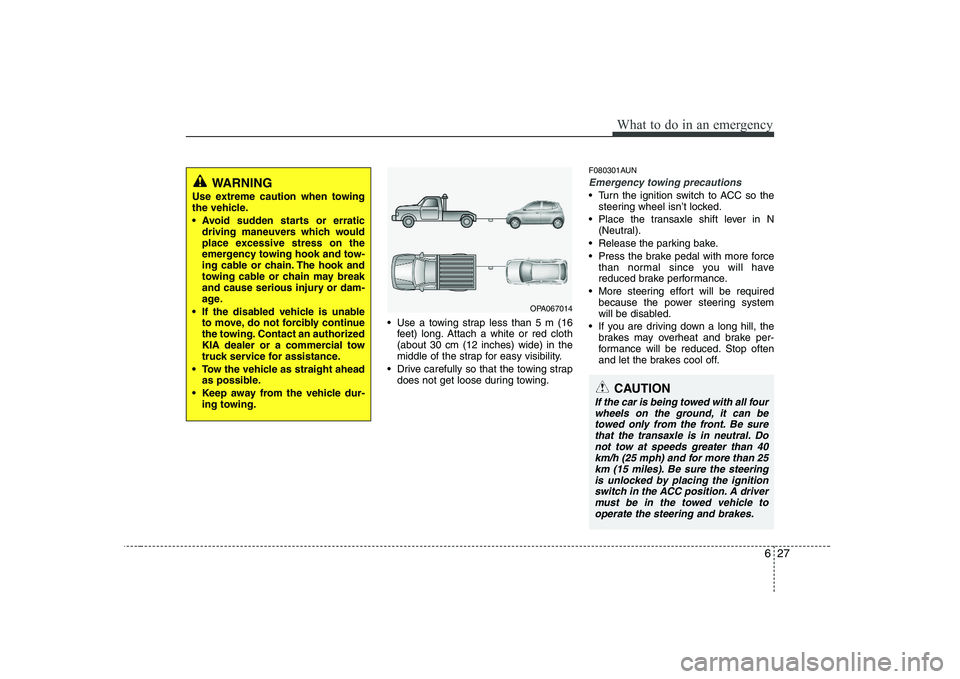
Use a towing strap less than 5 m (16feet) long. Attach a white or red cloth (about 30 cm (12 inches) wide) in the
middle of the strap for easy visibility.
Drive carefully so that the towing strap does not get loose during towing. F080301AUN
Emergency towing precautions
Turn the ignition switch to ACC so the
steering wheel isn’t locked.
Place the transaxle shift lever in N (Neutral).
Release the parking bake.
Press the brake pedal with more force than normal since you will have
reduced brake performance.
More steering effort will be required because the power steering system
will be disabled.
If you are driving down a long hill, the brakes may overheat and brake per-
formance will be reduced. Stop often
and let the brakes cool off.
WARNING
Use extreme caution when towing
the vehicle.
driving maneuvers which would
place excessive stress on the
emergency towing hook and tow-
ing cable or chain. The hook and
towing cable or chain may break
and cause serious injury or dam-
age.
If the disabled vehicle is unable to move, do not forcibly continue
the towing. Contact an authorized
KIA dealer or a commercial tow
truck service for assistance.
Tow the vehicle as straight ahead as possible.
Keep away from the vehicle dur- ing towing.
OPA067014
CAUTION
If the car is being towed with all four
wheels on the ground, it can be
towed only from the front. Be sure that the transaxle is in neutral. Do not tow at speeds greater than 40km/h (25 mph) and for more than 25
km (15 miles). Be sure the steeringis unlocked by placing the ignition switch in the ACC position. A drivermust be in the towed vehicle to
operate the steering and brakes.
Page 258 of 335
77
Maintenance
G030103AUN
At least monthly:
Check coolant level in the enginecoolant reservoir.
Check the operation of all exterior lights, including the stoplights, turn sig-
nals and hazard warning flashers.
Check the inflation pressures of all tires including the spare. G030104AUN
At least twice a year
(i.e., every Spring and Fall):
Check radiator, heater and air condi- tioning hoses for leaks or damage.
Check windshield washer spray and wiper operation. Clean the wiper
blades with clean cloth dampened with
washer fluid.
Check the headlight alignment.
Check the muffler, exhaust pipes, shields and clamps.
Check the lap/shoulder belts for wear and function.
Check for worn tires and loose wheel lug nuts. G030105APA
At least once a year:
Clean body and door drain holes.
Lubricate door hinges and checks, and
hood hinges.
Lubricate door and hood locks and latches.
Lubricate door rubber weatherstrips.
Check the air conditioning system.
Inspect and lubricate automatic transaxle linkage and controls.
Clean battery and terminals.
Check the brake/clutch fluid level.
Page 276 of 335
725
Maintenance
ENGINE COOLANT
G070000AUN The high-pressure cooling system has a
reservoir filled with year-round antifreeze
coolant. The reservoir is filled at the fac-
tory.
Check the antifreeze protection and
coolant level at least once a year, at thebeginning of the winter season, and
before traveling to a colder climate. G070100ASA
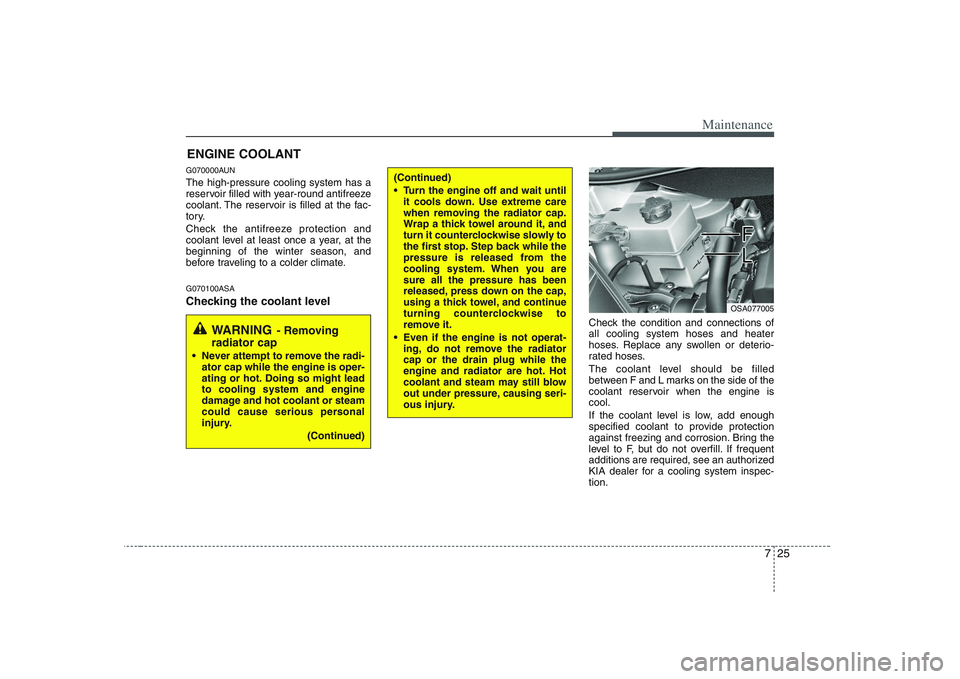
Checking the coolant level Check the condition and connections of all cooling system hoses and heater
hoses. Replace any swollen or deterio-
rated hoses.
The coolant level should be filled
between F and L marks on the side of the
coolant reservoir when the engine iscool.
If the coolant level is low, add enough
specified coolant to provide protection
against freezing and corrosion. Bring the
level to F, but do not overfill. If frequent
additions are required, see an authorized
KIA dealer for a cooling system inspec-tion.
WARNING- Removing
radiator cap
Never attempt to remove the radi- ator cap while the engine is oper-
ating or hot. Doing so might leadto cooling system and engine
damage and hot coolant or steam
could cause serious personal
injury.
(Continued)
(Continued)
Turn the engine off and wait untilit cools down. Use extreme care
when removing the radiator cap.
Wrap a thick towel around it, and
turn it counterclockwise slowly to
the first stop. Step back while the
pressure is released from the
cooling system. When you aresure all the pressure has been
released, press down on the cap,
using a thick towel, and continue
turning counterclockwise to
remove it.
Even if the engine is not operat- ing, do not remove the radiatorcap or the drain plug while the
engine and radiator are hot. Hot
coolant and steam may still blow
out under pressure, causing seri-
ous injury.
OSA077005
Page 285 of 335
Maintenance
34
7
AIR CLEANER
G160100AUN Filter replacement
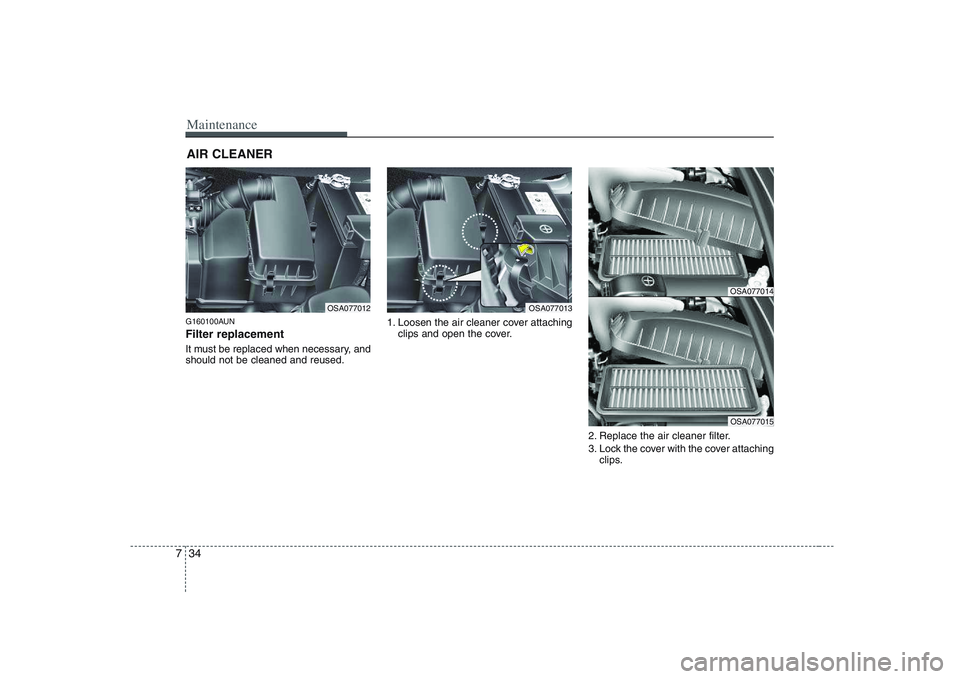
It must be replaced when necessary, and should not be cleaned and reused. 1. Loosen the air cleaner cover attaching
clips and open the cover.
2. Replace the air cleaner filter.
3. Lock the cover with the cover attachingclips.
OSA077012OSA077013
OSA077014
OSA077015
Page 289 of 335
Maintenance
38
7
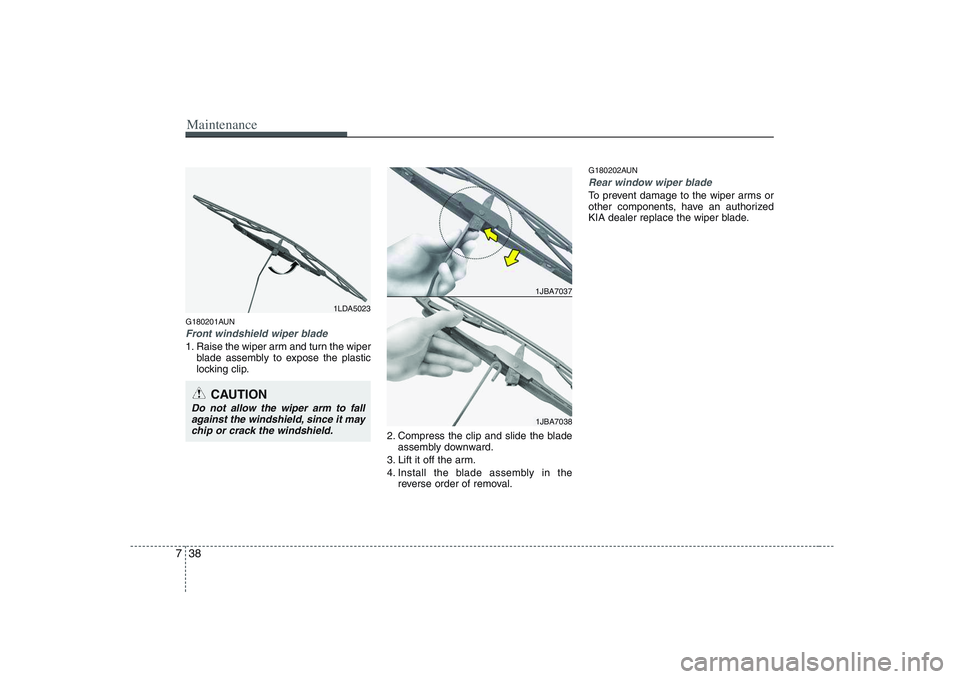
G180201AUN
Front windshield wiper blade
1. Raise the wiper arm and turn the wiper
blade assembly to expose the plastic
locking clip.
2. Compress the clip and slide the bladeassembly downward.
3. Lift it off the arm.
4. Install the blade assembly in the reverse order of removal. G180202AUN
Rear window wiper blade
To prevent damage to the wiper arms or
other components, have an authorized
KIA dealer replace the wiper blade.
1LDA5023
CAUTION
Do not allow the wiper arm to fall
against the windshield, since it may
chip or crack the windshield.
1JBA7037
1JBA7038
Page 291 of 335
Maintenance
40
7
G190200AUN
Battery recharging
Your vehicle has a maintenance-free,
calcium-based battery.
If the battery becomes discharged in a
short time (because, for example, the
headlights or interior lights were left on
while the vehicle was not in use),
recharge it by slow charging (trickle)
for 10 hours.
If the battery gradually discharges because of high electric load while the
vehicle is being used, recharge it at 20-
30A for two hours. G190300ASA Reset items
Items should be reset after the battery
has been discharged or the battery hasbeen disconnected.
Auto down window (See section 4)
Climate control system (See section 4)
Clock (See section 4)
Audio (See section 4)
(Continued)
The electrical ignition system
works with high voltage. Never
touch these components with theengine running or the ignition
switched on.
Failure to follow the above warn-
ings can result in serious bodily
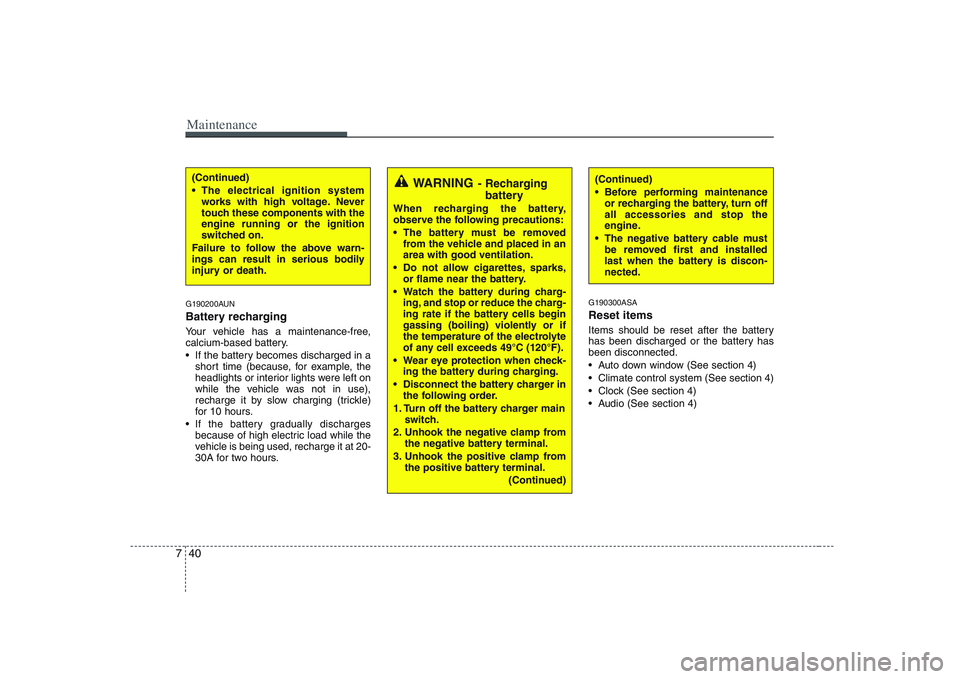
injury or death.WARNING - Recharging
battery
When recharging the battery,
observe the following precautions:
The battery must be removed from the vehicle and placed in an area with good ventilation.
Do not allow cigarettes, sparks, or flame near the battery.
Watch the battery during charg- ing, and stop or reduce the charg-
ing rate if the battery cells begin
gassing (boiling) violently or if
the temperature of the electrolyte
of any cell exceeds 49°C (120°F).
Wear eye protection when check- ing the battery during charging.
Disconnect the battery charger in the following order.
1. Turn off the battery charger main switch.
2. Unhook the negative clamp from the negative battery terminal.
3. Unhook the positive clamp from the positive battery terminal.
(Continued)(Continued)
Before performing maintenanceor recharging the battery, turn off all accessories and stop the
engine.
The negative battery cable must be removed first and installed
last when the battery is discon-nected.
Page 307 of 335
Maintenance
56
7
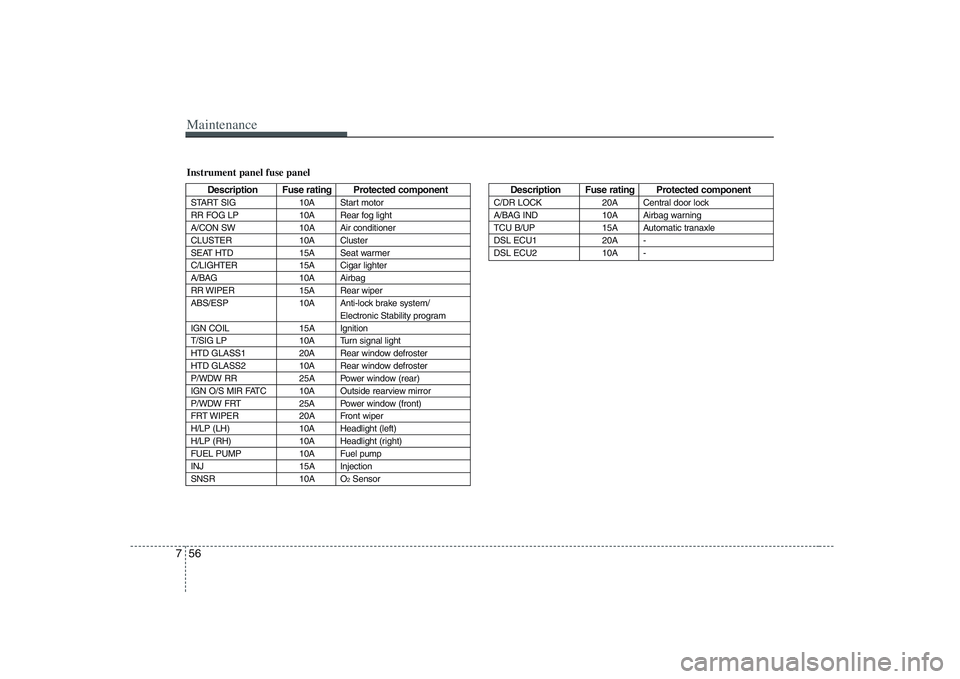
Instrument panel fuse panel
Description Fuse rating Protected component
START SIG 10A Start motor
RR FOG LP 10A Rear fog light
A/CON SW 10A Air conditioner
CLUSTER 10A Cluster
SEAT HTD 15A Seat warmer
C/LIGHTER 15A Cigar lighter
A/BAG 10A Airbag
RR WIPER 15A Rear wiper
ABS/ESP 10A Anti-lock brake system/ Electronic Stability program
IGN COIL 15A Ignition
T/SIG LP 10A Turn signal light
HTD GLASS1 20A Rear window defroster
HTD GLASS2 10A Rear window defroster
P/WDW RR 25A Power window (rear)
IGN O/S MIR FATC 10A Outside rearview mirror
P/WDW FRT 25A Power window (front)
FRT WIPER 20A Front wiper
H/LP (LH) 10A Headlight (left)
H/LP (RH) 10A Headlight (right)
FUEL PUMP 10A Fuel pump
INJ 15A Injection
SNSR 10A O 2SensorDescription Fuse rating Protected component
C/DR LOCK 20A Central door lock
A/BAG IND 10A Airbag warning
TCU B/UP 15A Automatic tranaxle
DSL ECU1 20A -
DSL ECU2 10A -
Page 308 of 335
757
Maintenance
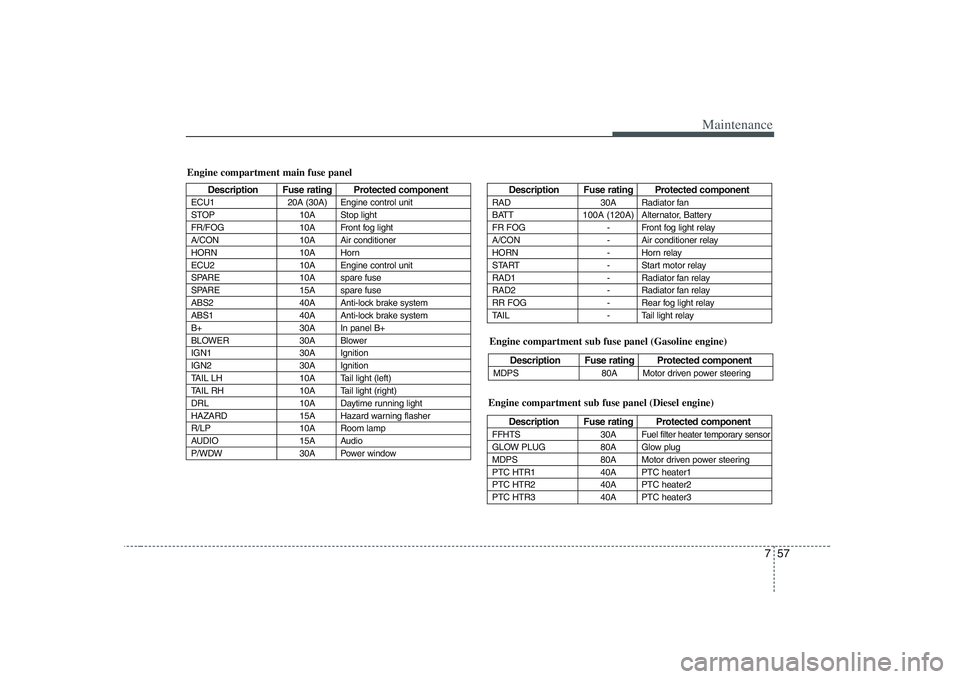
Engine compartment main fuse panel
Description Fuse rating Protected component
ECU1 20A (30A) Engine control unit
STOP 10A Stop light
FR/FOG 10A Front fog light
A/CON 10A Air conditioner
HORN 10A Horn
ECU2 10A Engine control unit
SPARE 10A spare fuse
SPARE 15A spare fuse
ABS2 40A Anti-lock brake system
ABS1 40A Anti-lock brake system
B+ 30A In panel B+
BLOWER 30A Blower
IGN1 30A Ignition
IGN2 30A Ignition
TAIL LH 10A Tail light (left)
TAIL RH 10A Tail light (right)
DRL 10A Daytime running light
HAZARD 15A Hazard warning flasher
R/LP 10A Room lamp
AUDIO 15A Audio
P/WDW 30A Power windowDescription Fuse rating Protected component
RAD 30A Radiator fan
BATT 100A (120A) Alternator, Battery
FR FOG - Front fog light relay
A/CON - Air conditioner relay
HORN - Horn relay
START - Start motor relay
RAD1 - Radiator fan relay
RAD2 - Radiator fan relay
RR FOG - Rear fog light relay
TAIL - Tail light relay
Engine compartment sub fuse panel (Diesel engine)
Description Fuse rating Protected component
FFHTS 30A
Fuel filter heater temporary sensor
GLOW PLUG 80A Glow plug
MDPS 80A Motor driven power steering
PTC HTR1 40A PTC heater1
PTC HTR2 40A PTC heater2
PTC HTR3 40A PTC heater3
Engine compartment sub fuse panel (Gasoline engine)
Description Fuse rating Protected component
MDPS 80A Motor driven power steering
Page 309 of 335
Maintenance
58
7
LIGHT BULBS
G220000AUN
Use only the bulbs of the specified wattage.
✽✽ NOTICE
After heavy rain or washing, headlight
and taillight lenses could appear frosty.This condition is caused by the tempera-
ture difference between the lamp inside
and outside. This is similar to the con-
densation on your windows inside yourvehicle during rain and doesn’t indicate a
problem with your vehicle. If the water
leaks into the lamp bulb circuitry, havethe vehicle checked by an authorized
KIA dealer.
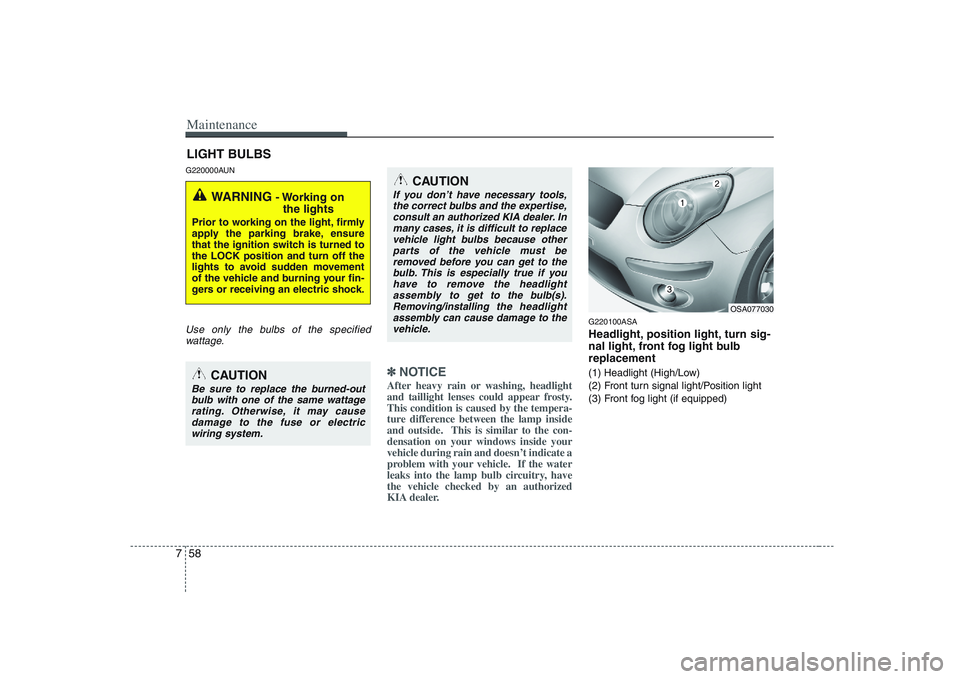
G220100ASA
Headlight, position light, turn sig-
nal light, front fog light bulbreplacement
(1) Headlight (High/Low)
(2) Front turn signal light/Position light
(3) Front fog light (if equipped)
WARNING - Working on
the lights
Prior to working on the light, firmly
apply the parking brake, ensure
that the ignition switch is turned tothe LOCK position and turn off the
lights to avoid sudden movement
of the vehicle and burning your fin-
gers or receiving an electric shock.
CAUTION
Be sure to replace the burned-out bulb with one of the same wattage rating. Otherwise, it may cause
damage to the fuse or electric wiring system.
CAUTION
If you don’t have necessary tools, the correct bulbs and the expertise,consult an authorized KIA dealer. In
many cases, it is difficult to replace vehicle light bulbs because otherparts of the vehicle must be
removed before you can get to the bulb. This is especially true if you
have to remove the headlight assembly to
get to the bulb(s).
Removing/installingthe headlight
assembly can cause damage to the
vehicle.OSA077030
Page 310 of 335
759
Maintenance
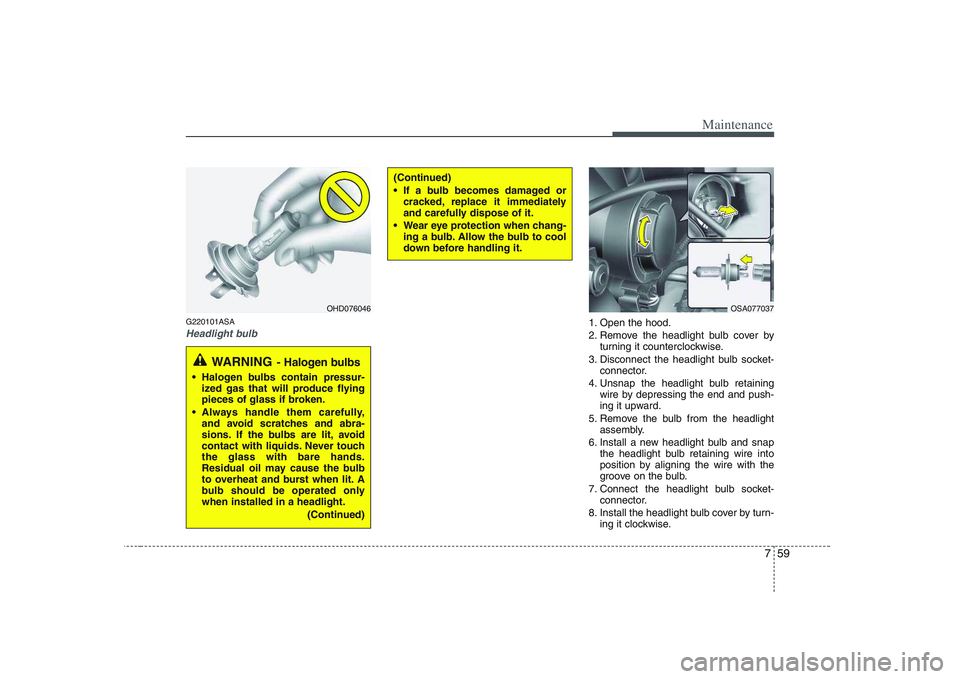
G220101ASA
Headlight bulb1. Open the hood.
2. Remove the headlight bulb cover byturning it counterclockwise.
3. Disconnect the headlight bulb socket- connector.
4. Unsnap the headlight bulb retaining wire by depressing the end and push-
ing it upward.
5. Remove the bulb from the headlight assembly.
6. Install a new headlight bulb and snap the headlight bulb retaining wire into
position by aligning the wire with the
groove on the bulb.
7. Connect the headlight bulb socket- connector.
8. Install the headlight bulb cover by turn- ing it clockwise.
(Continued)
If a bulb becomes damaged orcracked, replace it immediately
and carefully dispose of it.
Wear eye protection when chang- ing a bulb. Allow the bulb to cool
down before handling it.
OHD076046
WARNING - Halogen bulbs
Halogen bulbs contain pressur-
ized gas that will produce flying
pieces of glass if broken.
Always handle them carefully, and avoid scratches and abra-
sions. If the bulbs are lit, avoid
contact with liquids. Never touchthe glass with bare hands.
Residual oil may cause the bulb
to overheat and burst when lit. A
bulb should be operated onlywhen installed in a headlight.
(Continued)
OSA077037