starting engine KIA PICANTO 2016 User Guide
[x] Cancel search | Manufacturer: KIA, Model Year: 2016, Model line: PICANTO, Model: KIA PICANTO 2016Pages: 488, PDF Size: 31.22 MB
Page 209 of 488
Features of your vehicle
1344
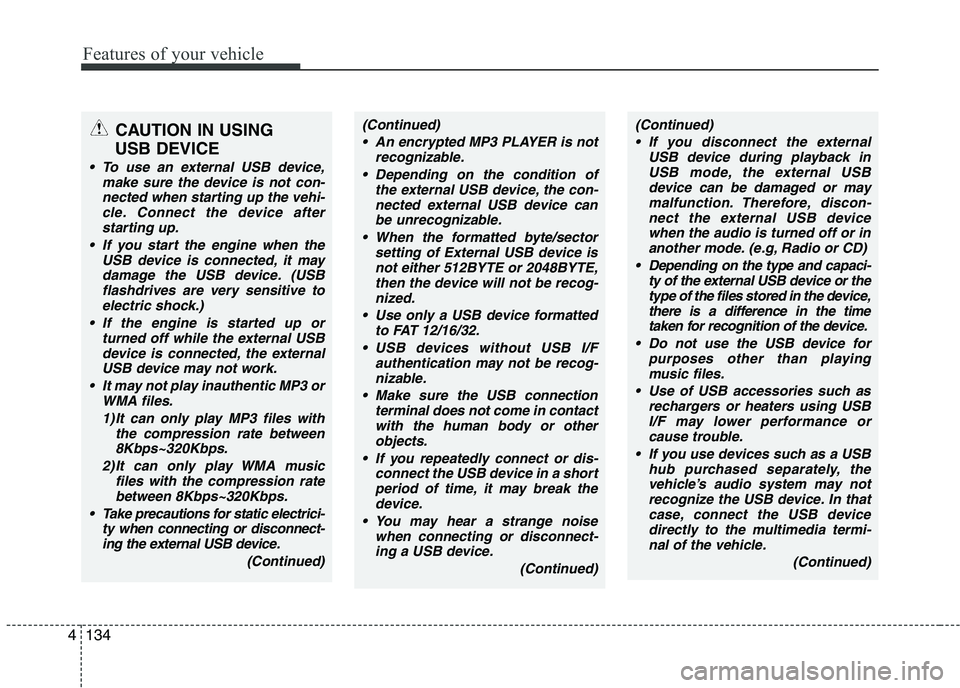
CAUTION IN USING
USB DEVICE
To use an external USB device, make sure the device is not con-nected when starting up the vehi-cle. Connect the device afterstarting up.
If you start the engine when the USB device is connected, it maydamage the USB device. (USBflashdrives are very sensitive to
electric shock.)
If the engine is started up or turned off while the external USBdevice is connected, the externalUSB device may not work.
It may not play inauthentic MP3 or WMA files.
1) It can only play MP3 files with the compression rate between8Kbps~320Kbps.
2) It can only play WMA music files with the compression ratebetween 8Kbps~320Kbps.
Take precautions for static electrici- ty when connecting or disconnect-ing the external USB device.
(Continued)
(Continued) An encrypted MP3 PLAYER is not recognizable.
Depending on the condition of the external USB device, the con-
nected external USB device can be unrecognizable.
When the formatted byte/sector setting of External USB device isnot either 512BYTE or 2048BYTE,
then the device will not be recog-nized.
Use only a USB device formatted to FAT 12/16/32.
USB devices without USB I/F authentication may not be recog-nizable.
Make sure the USB connection terminal does not come in contactwith the human body or other
objects.
If you repeatedly connect or dis- connect the USB device in a shortperiod of time, it may break thedevice.
You may hear a strange noise when connecting or disconnect-ing a USB device.
(Continued)(Continued) If you disconnect the external USB device during playback inUSB mode, the external USBdevice can be damaged or may
malfunction. Therefore, discon-nect the external USB device when the audio is turned off or in
another mode. (e.g, Radio or CD)
Depending on the type and capaci- ty of the external USB device or thetype of the files stored in the device,there is a difference in the time
taken for recognition of the device.
Do not use the USB device for purposes other than playingmusic files.
Use of USB accessories such as rechargers or heaters using USBI/F may lower performance orcause trouble.
If you use devices such as a USB hub purchased separately, the
vehicle’s audio system may notrecognize the USB device. In that case, connect the USB devicedirectly to the multimedia termi-
nal of the vehicle.
(Continued)
Page 283 of 488
5
Before driving / 5-3
Key positions / 5-5
Engine start/stop button / 5-6
Starting the engine / 5-9
LPG system / 5-12
Manual transaxle / 5-18
Automatic transaxle / 5-21
Brake system / 5-27
ISG (Idle Stop and Go) system / 5-39
Cruise control system / 5-44
Speed limit control system / 5-49
Economical operation / 5-52
Special driving conditions / 5-54
Winter driving / 5-58
Vehicle weight / 5-62
Driving your vehicle
Page 285 of 488
53
Driving your vehicle
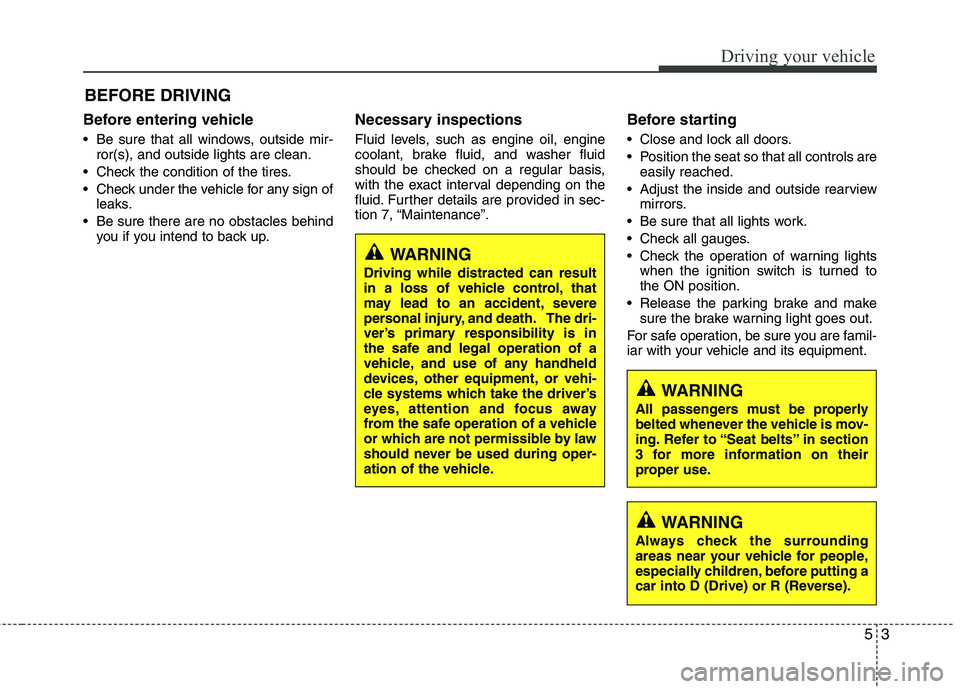
Before entering vehicle
• Be sure that all windows, outside mir-ror(s), and outside lights are clean.
Check the condition of the tires.
Check under the vehicle for any sign of leaks.
Be sure there are no obstacles behind you if you intend to back up. Necessary inspections
Fluid levels, such as engine oil, engine
coolant, brake fluid, and washer fluid
should be checked on a regular basis,
with the exact interval depending on the
fluid. Further details are provided in sec-
tion 7, “Maintenance”.
Before starting
Close and lock all doors.
Position the seat so that all controls are
easily reached.
Adjust the inside and outside rearview mirrors.
Be sure that all lights work.
Check all gauges.
Check the operation of warning lights when the ignition switch is turned to the ON position.
Release the parking brake and make sure the brake warning light goes out.
For safe operation, be sure you are famil-
iar with your vehicle and its equipment.
BEFORE DRIVING
WARNING
All passengers must be properly
belted whenever the vehicle is mov-
ing. Refer to “Seat belts” in section
3 for more information on their
proper use.
WARNING
Always check the surrounding
areas near your vehicle for people,
especially children, before putting a
car into D (Drive) or R (Reverse).
WARNING
Driving while distracted can result
in a loss of vehicle control, that
may lead to an accident, severe
personal injury, and death. The dri-
ver’s primary responsibility is in
the safe and legal operation of a
vehicle, and use of any handheld
devices, other equipment, or vehi-
cle systems which take the driver’s
eyes, attention and focus away
from the safe operation of a vehicle
or which are not permissible by law
should never be used during oper-
ation of the vehicle.
Page 291 of 488
59
Driving your vehicle
✽✽
NOTICE - Kick down mecha- nism (if equipped)
If your vehicle is equipped with a kick
down mechanism in the accelerator
pedal, it prevents you from driving at
full throttle unintentionally by making
the driver require increased effort to
depress the accelerator pedal. However,
if you depress the pedal more than
approximately 80%, the vehicle can be
at full throttle and the accelerator pedal
will be easier to depress. This is not a
malfunction but a normal condition.
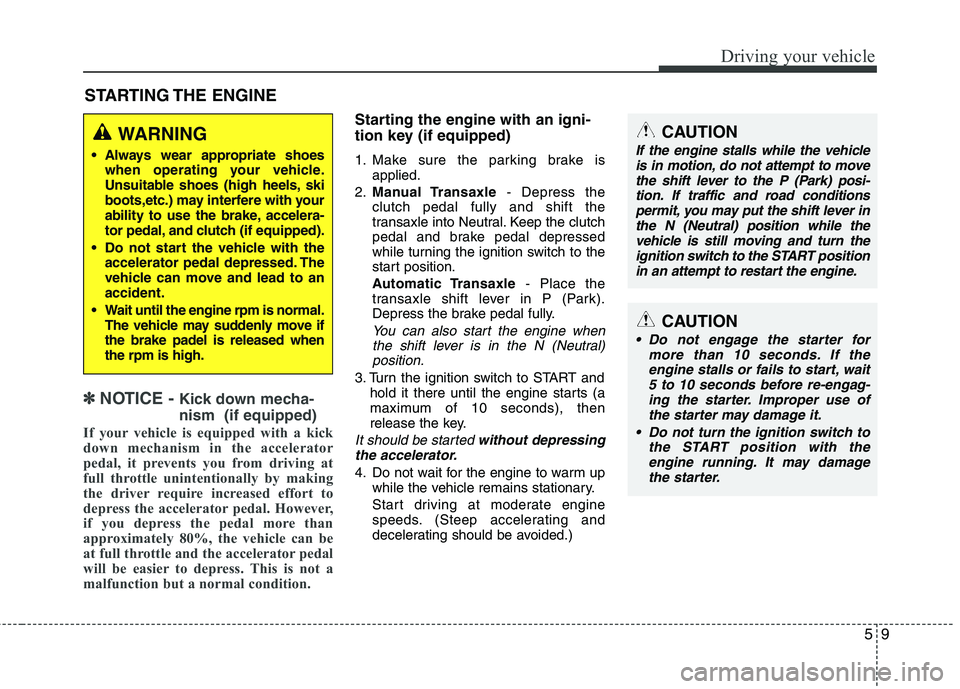
Starting the engine with an igni-
tion key (if equipped)
1. Make sure the parking brake is applied.
2. Manual Transaxle - Depress the
clutch pedal fully and shift the
transaxle into Neutral. Keep the clutch
pedal and brake pedal depressed
while turning the ignition switch to the
start position.
Automatic Transaxle - Place the
transaxle shift lever in P (Park).
Depress the brake pedal fully.
You can also start the engine when
the shift lever is in the N (Neutral)position.
3. Turn the ignition switch to START and hold it there until the engine starts (a
maximum of 10 seconds), then
release the key.
It should be started without depressing
the accelerator.
4. Do not wait for the engine to warm up while the vehicle remains stationary.
Start driving at moderate engine
speeds. (Steep accelerating and
decelerating should be avoided.)
STARTING THE ENGINE
WARNING
Always wear appropriate shoes when operating your vehicle.
Unsuitable shoes (high heels, ski
boots,etc.) may interfere with your
ability to use the brake, accelera-
tor pedal, and clutch (if equipped).
Do not start the vehicle with the accelerator pedal depressed. The
vehicle can move and lead to anaccident.
Wait until the engine rpm is normal. The vehicle may suddenly move ifthe brake padel is released whenthe rpm is high.CAUTION
If the engine stalls while the vehicle
is in motion, do not attempt to move
the shift lever to the P (Park) posi- tion. If traffic and road conditionspermit, you may put the shift lever inthe N (Neutral) position while the
vehicle is still moving and turn theignition switch to the START position in an attempt to restart the engine.
CAUTION
Do not engage the starter for more than 10 seconds. If the
engine stalls or fails to start, wait 5 to 10 seconds before re-engag-ing the starter. Improper use of the starter may damage it.
Do not turn the ignition switch to the START position with theengine running. It may damagethe starter.
Page 292 of 488
Driving your vehicle
10
5
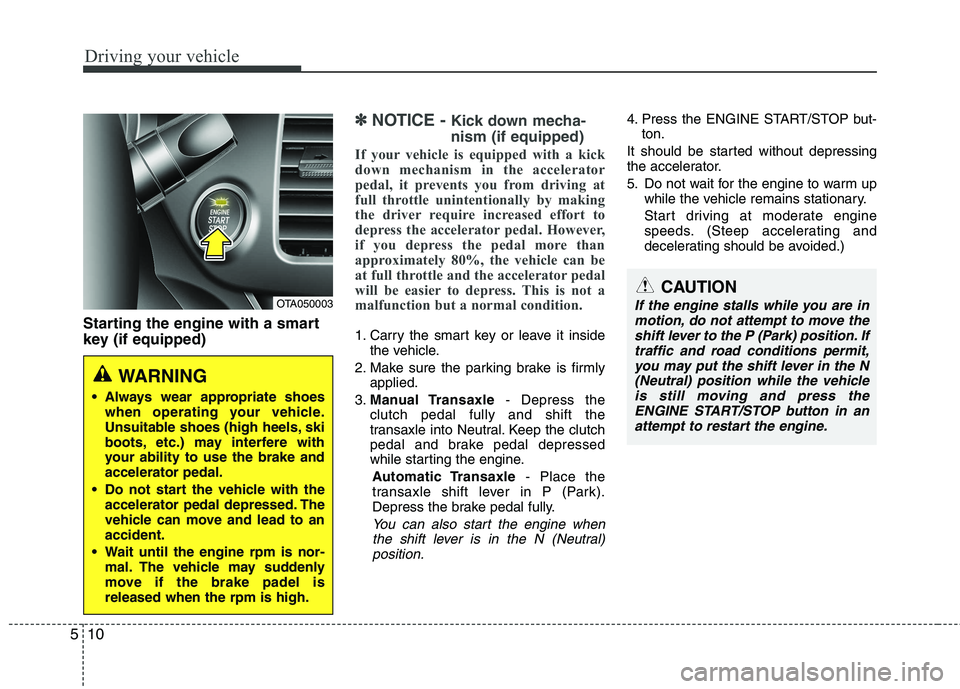
Starting the engine with a smart
key (if equipped)
✽✽
NOTICE - Kick down mecha- nism (if equipped)
If your vehicle is equipped with a kick
down mechanism in the accelerator
pedal, it prevents you from driving at
full throttle unintentionally by making
the driver require increased effort to
depress the accelerator pedal. However,
if you depress the pedal more than
approximately 80%, the vehicle can be
at full throttle and the accelerator pedal
will be easier to depress. This is not a
malfunction but a normal condition.
1. Carry the smart key or leave it inside the vehicle.
2. Make sure the parking brake is firmly applied.
3. Manual Transaxle - Depress the
clutch pedal fully and shift the
transaxle into Neutral. Keep the clutch
pedal and brake pedal depressed
while starting the engine.
Automatic Transaxle - Place the
transaxle shift lever in P (Park).
Depress the brake pedal fully.
You can also start the engine when
the shift lever is in the N (Neutral)position.
4. Press the ENGINE START/STOP but- ton.
It should be started without depressing
the accelerator.
5. Do not wait for the engine to warm up while the vehicle remains stationary.
Start driving at moderate engine
speeds. (Steep accelerating and
decelerating should be avoided.)
OTA050003
WARNING
Always wear appropriate shoes when operating your vehicle.
Unsuitable shoes (high heels, ski
boots, etc.) may interfere with
your ability to use the brake andaccelerator pedal.
Do not start the vehicle with the accelerator pedal depressed. The
vehicle can move and lead to anaccident.
Wait until the engine rpm is nor- mal. The vehicle may suddenly
move if the brake padel isreleased when the rpm is high.
CAUTION
If the engine stalls while you are in
motion, do not attempt to move the
shift lever to the P (Park) position. If traffic and road conditions permit,you may put the shift lever in the N (Neutral) position while the vehicleis still moving and press the
ENGINE START/STOP button in an attempt to restart the engine.
Page 293 of 488
511
Driving your vehicle
Even if the smart key is in the vehicle,if it is far away from you, the engine
may not start.
When the ENGINE START/STOP but- ton is in the ACC position or above, if
any door is opened, the system checks
for the smart key. If the smart key is not
in the vehicle, the “ ”or “KEY OUT”
indicator will blink. And if all doors are
closed, the chime will sound for 5 sec-
onds. The warning will turn off while
the vehicle is moving. Always have the
smart key with you.
✽✽
NOTICE
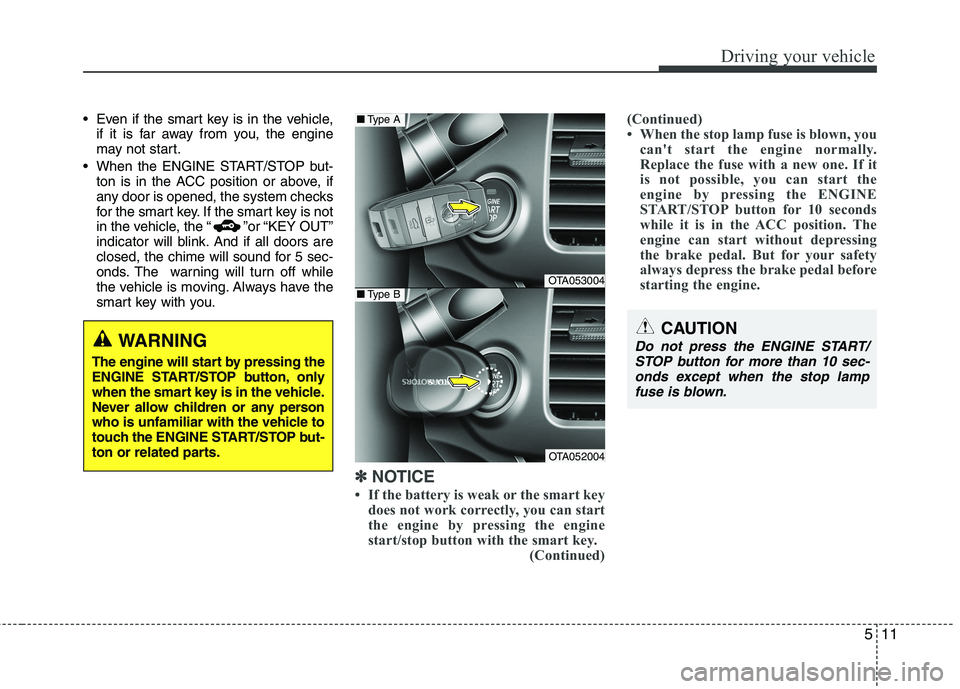
If the battery is weak or the smart key does not work correctly, you can start
the engine by pressing the engine
start/stop button with the smart key.
(Continued)(Continued)
When the stop lamp fuse is blown, you
can't start the engine normally.
Replace the fuse with a new one. If it
is not possible, you can start the
engine by pressing the ENGINE
START/STOP button for 10 seconds
while it is in the ACC position. The
engine can start without depressing
the brake pedal. But for your safety
always depress the brake pedal before
starting the engine.
CAUTION
Do not press the ENGINE START/
STOP button for more than 10 sec-
onds except when the stop lamp fuse is blown.WARNING
The engine will start by pressing the
ENGINE START/STOP button, only
when the smart key is in the vehicle.
Never allow children or any person
who is unfamiliar with the vehicle to
touch the ENGINE START/STOP but-
ton or related parts.
OTA053004
OTA052004
■ Type A
■Type B
Page 295 of 488
513
Driving your vehicle
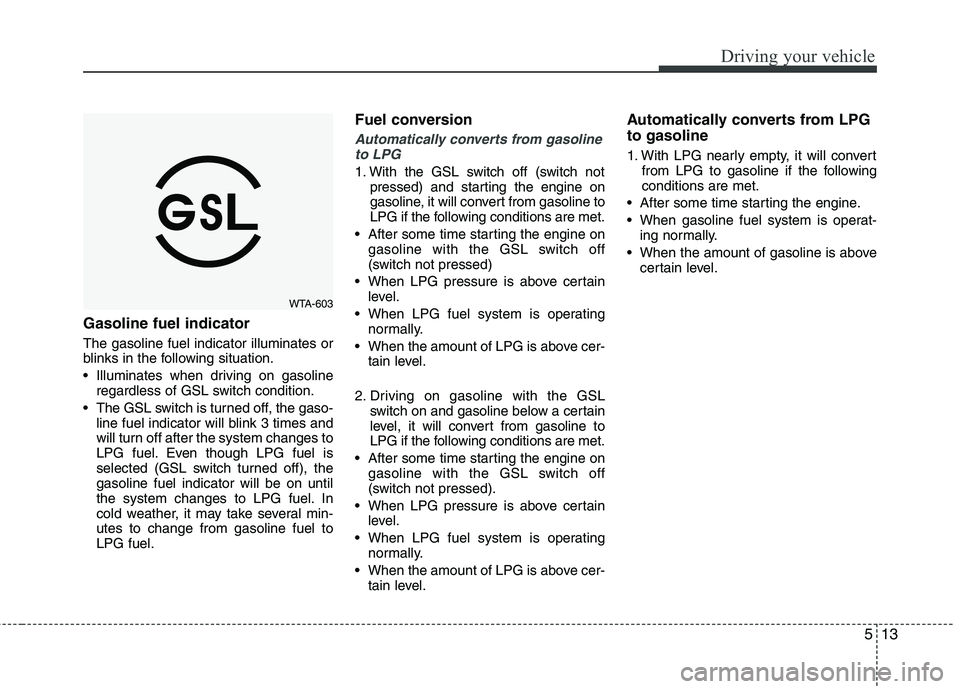
Gasoline fuel indicator The gasoline fuel indicator illuminates or
blinks in the following situation.
Illuminates when driving on gasolineregardless of GSL switch condition.
The GSL switch is turned off, the gaso- line fuel indicator will blink 3 times and
will turn off after the system changes to
LPG fuel. Even though LPG fuel is
selected (GSL switch turned off), thegasoline fuel indicator will be on until
the system changes to LPG fuel. In
cold weather, it may take several min-utes to change from gasoline fuel toLPG fuel. Fuel conversion
Automatically converts from gasoline
to LPG
1. With the GSL switch off (switch not pressed) and starting the engine on
gasoline, it will convert from gasoline to
LPG if the following conditions are met.
After some time starting the engine on gasoline with the GSL switch off
(switch not pressed)
When LPG pressure is above certain level.
When LPG fuel system is operating normally.
When the amount of LPG is above cer- tain level.
2. Driving on gasoline with the GSL switch on and gasoline below a certain
level, it will convert from gasoline to
LPG if the following conditions are met.
After some time starting the engine on gasoline with the GSL switch off
(switch not pressed).
When LPG pressure is above certain level.
When LPG fuel system is operating normally.
When the amount of LPG is above cer- tain level. Automatically converts from LPG to gasoline
1. With LPG nearly empty, it will convert
from LPG to gasoline if the following conditions are met.
After some time starting the engine.
When gasoline fuel system is operat- ing normally.
When the amount of gasoline is above certain level.
WTA-603
Page 296 of 488
Driving your vehicle
14
5
Manually converts from gasoline to LPG
1. When the GSL switch is turned off
(switch not pressed), while driving with
the GSL switch on (switch pressed), it
will convert to from gasoline to LPG if
the following conditions are met.
After some time starting the engine on gasoline.
When LPG pressure is above certain level.
When LPG fuel system is operating normally.
When the amount of LPG is above cer- tain level. Manually converts from LPG to gasoline
1. When GSL switch is turned on (switch
pressed) while driving on LPG with the
GSL switch off (switch not pressed), it
will convert from LPG to gasoline if the
following conditions are met.
After some time starting the engine.
When gasoline fuel system is operat- ing normally.
When the amount of gasoline is above certain level.
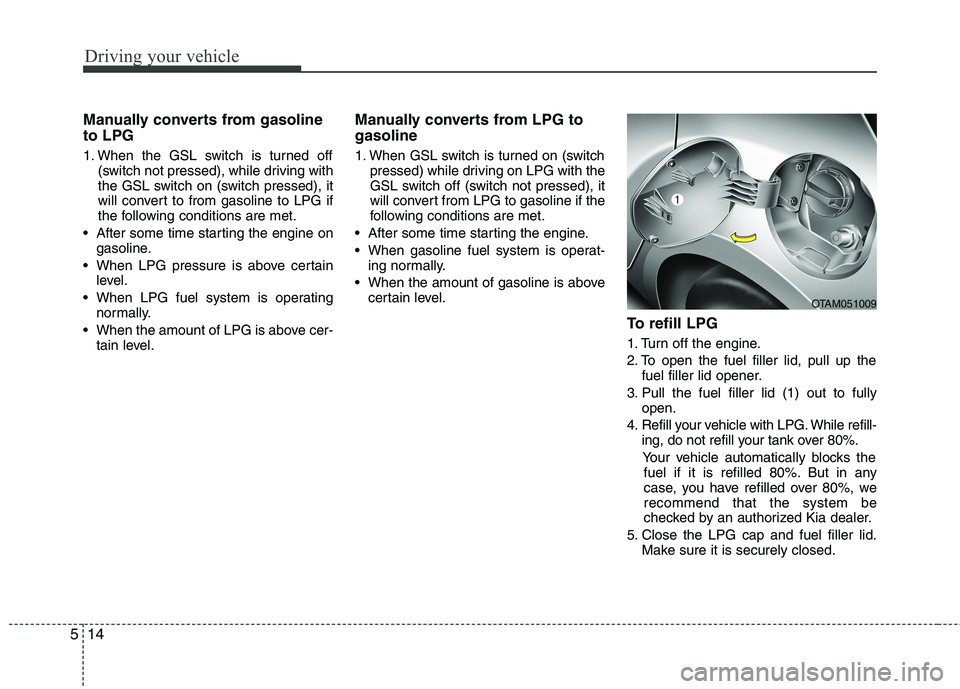
To refill LPG
1. Turn off the engine.
2. To open the fuel filler lid, pull up thefuel filler lid opener.
3. Pull the fuel filler lid (1) out to fully open.
4. Refill your vehicle with LPG. While refill- ing, do not refill your tank over 80%.
Your vehicle automatically blocks the fuel if it is refilled 80%. But in any
case, you have refilled over 80%, werecommend that the system be
checked by an authorized Kia dealer.
5. Close the LPG cap and fuel filler lid. Make sure it is securely closed.
OTAM051009
Page 300 of 488
Driving your vehicle
18
5
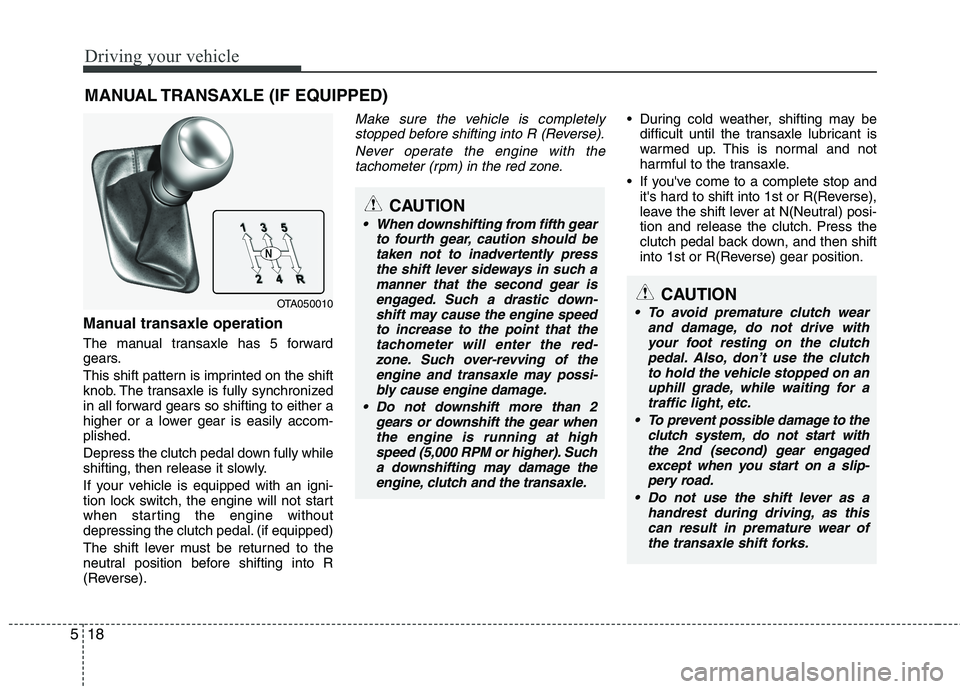
Manual transaxle operation
The manual transaxle has 5 forward
gears.
This shift pattern is imprinted on the shift
knob. The transaxle is fully synchronized
in all forward gears so shifting to either a
higher or a lower gear is easily accom-plished.
Depress the clutch pedal down fully while
shifting, then release it slowly.
If your vehicle is equipped with an igni-
tion lock switch, the engine will not start
when starting the engine without
depressing the clutch pedal. (if equipped)
The shift lever must be returned to the
neutral position before shifting into R
(Reverse).
Make sure the vehicle is completely
stopped before shifting into R (Reverse).
Never operate the engine with thetachometer (rpm) in the red zone. During cold weather, shifting may be difficult until the transaxle lubricant is
warmed up. This is normal and not
harmful to the transaxle.
If you've come to a complete stop and it's hard to shift into 1st or R(Reverse),
leave the shift lever at N(Neutral) posi-
tion and release the clutch. Press the
clutch pedal back down, and then shift
into 1st or R(Reverse) gear position.
MANUAL TRANSAXLE (IF EQUIPPED)
OTA050010
CAUTION
When downshifting from fifth gear
to fourth gear, caution should betaken not to inadvertently pressthe shift lever sideways in such a
manner that the second gear isengaged. Such a drastic down-shift may cause the engine speed to increase to the point that the
tachometer will enter the red-zone. Such over-revving of theengine and transaxle may possi-bly cause engine damage.
Do not downshift more than 2 gears or downshift the gear whenthe engine is running at highspeed (5,000 RPM or higher). Sucha downshifting may damage the
engine, clutch and the transaxle.
CAUTION
To avoid premature clutch wear and damage, do not drive withyour foot resting on the clutch
pedal. Also, don’t use the clutchto hold the vehicle stopped on an uphill grade, while waiting for atraffic light, etc.
To prevent possible damage to the clutch system, do not start withthe 2nd (second) gear engagedexcept when you start on a slip- pery road.
Do not use the shift lever as a handrest during driving, as thiscan result in premature wear ofthe transaxle shift forks.
Page 301 of 488

519
Driving your vehicle
Using the clutch
The clutch should be pressed all the way
to the floor before shifting, then released
slowly. The clutch pedal should always be
fully released while driving. Do not rest
your foot on the clutch pedal while driv-
ing. This can cause unnecessary wear.
Do not partially engage the clutch to hold
the vehicle on an incline. This causes
unnecessary wear. Use the foot brake or
parking brake to hold the vehicle on an
incline. Do not operate the clutch pedal
rapidly and repeatedly.
Downshifting
When you must slow down in heavy traf-
fic or while driving up steep hills, down-
shift before the engine starts to labor.
Downshifting reduces the chance of
stalling and gives better acceleration
when you again need to increase your
speed. When the vehicle is traveling
down steep hills, downshifting helps
maintain safe speed and prolongs brake
life.WARNING
Before leaving the driver’s seat, always set the parking brake fully
and shut the engine off. Thenmake sure the transaxle is shifted
into 1st gear when the vehicle is
parked on a level or uphill grade,
and shifted into R (Reverse) on a
downhill grade. Unexpected and
sudden vehicle movement canoccur if these precautions are not
followed in the order identified.
Do not use the engine brake (shifting from a high gear to
lower gear) rapidly on slippery
roads. The vehicle may slip caus-ing an accident.
If your vehicle has a manual transaxle not equipped with an
ignition lock switch, it may moveand cause a serious accident
when starting the engine without
depressing the clutch pedal whilethe parking brake is released and
the shift lever not in the N(Neutral) position.
CAUTION
When operating the clutch pedal,
press the clutch pedal down fully. If
you don’t press the clutch pedalfully, the clutch may be damaged ornoise may occur.