oil KIA PICANTO 2016 Owner's Guide
[x] Cancel search | Manufacturer: KIA, Model Year: 2016, Model line: PICANTO, Model: KIA PICANTO 2016Pages: 488, PDF Size: 31.22 MB
Page 444 of 488
Maintenance
66
7
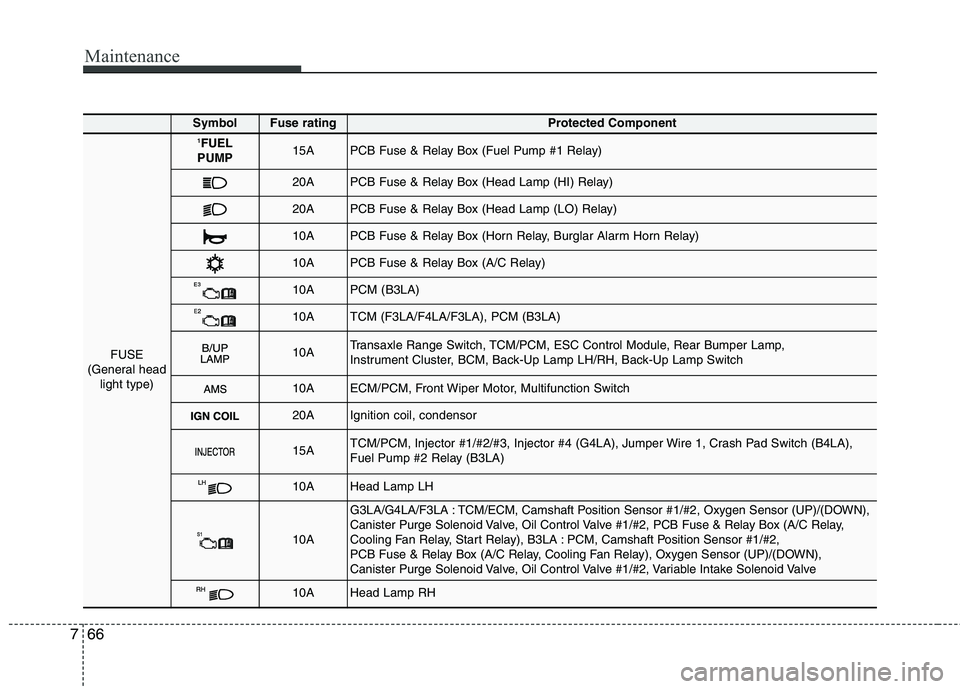
SymbolFuse ratingProtected Component
FUSE
(General head light type)
1FUEL
PUMP15APCB Fuse & Relay Box (Fuel Pump #1 Relay)
20APCB Fuse & Relay Box (Head Lamp (HI) Relay)
20APCB Fuse & Relay Box (Head Lamp (LO) Relay)
10APCB Fuse & Relay Box (Horn Relay, Burglar Alarm Horn Relay)
10APCB Fuse & Relay Box (A/C Relay)
10APCM (B3LA)
10ATCM (F3LA/F4LA/F3LA), PCM (B3LA)
10ATransaxle Range Switch, TCM/PCM, ESC Control Module, Rear Bumper Lamp,
Instrument Cluster, BCM, Back-Up Lamp LH/RH, Back-Up Lamp Switch
10AECM/PCM, Front Wiper Motor, Multifunction Switch
20AIgnition coil, condensor
15ATCM/PCM, Injector #1/#2/#3, Injector #4 (G4LA), Jumper Wire 1, Crash Pad Switch (B4LA),
Fuel Pump #2 Relay (B3LA)
10AHead Lamp LH
10A
G3LA/G4LA/F3LA : TCM/ECM, Camshaft Position Sensor #1/#2, Oxygen Sensor (UP)/(DOWN),
Canister Purge Solenoid Valve, Oil Control Valve #1/#2, PCB Fuse & Relay Box (A/C Relay,
Cooling Fan Relay, Start Relay), B3LA : PCM, Camshaft Position Sensor #1/#2,
PCB Fuse & Relay Box (A/C Relay, Cooling Fan Relay), Oxygen Sensor (UP)/(DOWN),
Canister Purge Solenoid Valve, Oil Control Valve #1/#2, Variable Intake Solenoid Valve
10AHead Lamp RH
Page 445 of 488
767
Maintenance
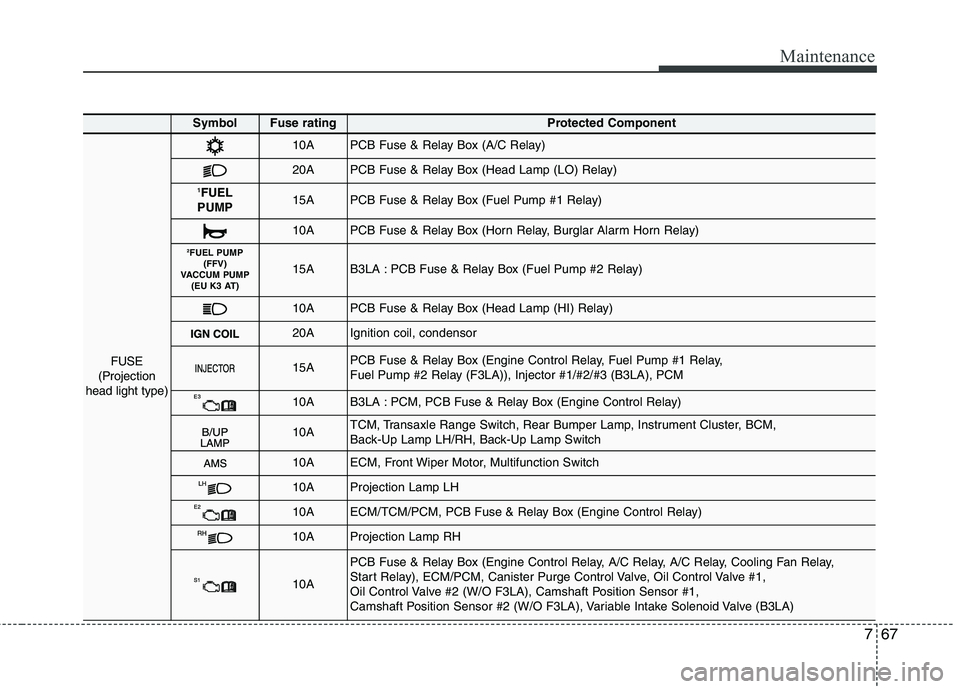
SymbolFuse ratingProtected Component
FUSE
(Projection
head light type)
10APCB Fuse & Relay Box (A/C Relay)
20APCB Fuse & Relay Box (Head Lamp (LO) Relay)
1 FUEL
PUMP15APCB Fuse & Relay Box (Fuel Pump #1 Relay)
10APCB Fuse & Relay Box (Horn Relay, Burglar Alarm Horn Relay)
2 FUEL PUMP
(FFV)
VACCUM PUMP (EU K3 AT)
15AB3LA : PCB Fuse & Relay Box (Fuel Pump #2 Relay)
10APCB Fuse & Relay Box (Head Lamp (HI) Relay)
20AIgnition coil, condensor
15APCB Fuse & Relay Box (Engine Control Relay, Fuel Pump #1 Relay,
Fuel Pump #2 Relay (F3LA)), Injector #1/#2/#3 (B3LA), PCM
10AB3LA : PCM, PCB Fuse & Relay Box (Engine Control Relay)
10ATCM, Transaxle Range Switch, Rear Bumper Lamp, Instrument Cluster, BCM,
Back-Up Lamp LH/RH, Back-Up Lamp Switch
10AECM, Front Wiper Motor, Multifunction Switch
10AProjection Lamp LH
10AECM/TCM/PCM, PCB Fuse & Relay Box (Engine Control Relay)
10AProjection Lamp RH
10A
PCB Fuse & Relay Box (Engine Control Relay, A/C Relay, A/C Relay, Cooling Fan Relay,
Start Relay), ECM/PCM, Canister Purge Control Valve, Oil Control Valve #1,
Oil Control Valve #2 (W/O F3LA), Camshaft Position Sensor #1,
Camshaft Position Sensor #2 (W/O F3LA), Variable Intake Solenoid Valve (B3LA)
Page 447 of 488
769
Maintenance
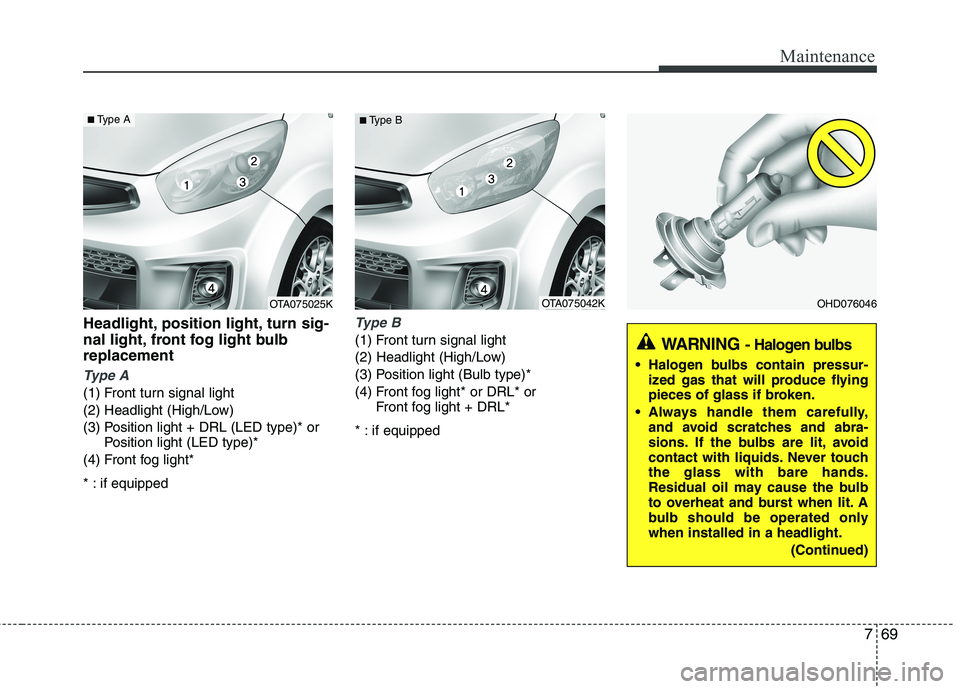
Headlight, position light, turn sig-
nal light, front fog light bulbreplacement
Type A
(1) Front turn signal light
(2) Headlight (High/Low)
(3) Position light + DRL (LED type)* orPosition light (LED type)*
(4) Front fog light*
* : if equipped
Type B
(1) Front turn signal light
(2) Headlight (High/Low)
(3) Position light (Bulb type)*
(4) Front fog light* or DRL* or Front fog light + DRL*
* : if equipped
OHD076046
WARNING - Halogen bulbs
Halogen bulbs contain pressur-
ized gas that will produce flying
pieces of glass if broken.
Always handle them carefully, and avoid scratches and abra-
sions. If the bulbs are lit, avoid
contact with liquids. Never touchthe glass with bare hands.
Residual oil may cause the bulb
to overheat and burst when lit. A
bulb should be operated onlywhen installed in a headlight.
(Continued)
OTA075042K
■
Type BOTA075025K
■Type A
Page 455 of 488
777
Maintenance
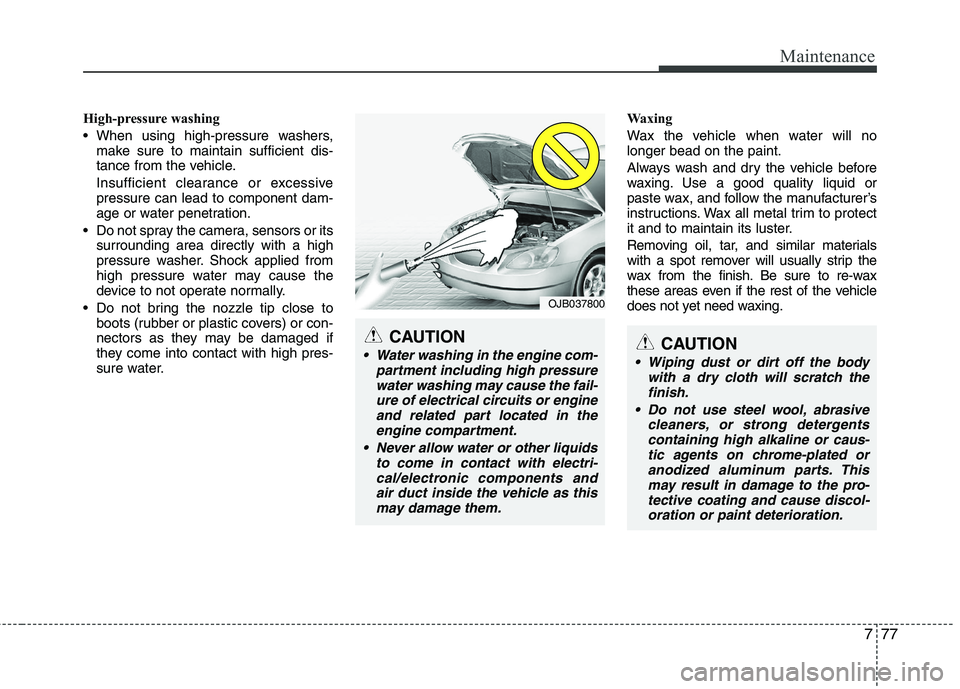
High-pressure washing
When using high-pressure washers,make sure to maintain sufficient dis-
tance from the vehicle.
Insufficient clearance or excessive pressure can lead to component dam-
age or water penetration.
Do not spray the camera, sensors or its surrounding area directly with a high
pressure washer. Shock applied from
high pressure water may cause the
device to not operate normally.
Do not bring the nozzle tip close to boots (rubber or plastic covers) or con-
nectors as they may be damaged if
they come into contact with high pres-
sure water. Waxing
Wax the vehicle when water will no longer bead on the paint.
Always wash and dry the vehicle before
waxing. Use a good quality liquid or
paste wax, and follow the manufacturer’s
instructions. Wax all metal trim to protect
it and to maintain its luster.
Removing oil, tar, and similar materials
with a spot remover will usually strip the
wax from the finish. Be sure to re-wax
these areas even if the rest of the vehicle
does not yet need waxing.
CAUTION
Wiping dust or dirt off the body
with a dry cloth will scratch the
finish.
Do not use steel wool, abrasive cleaners, or strong detergentscontaining high alkaline or caus- tic agents on chrome-plated or
anodized aluminum parts. This may result in damage to the pro-tective coating and cause discol- oration or paint deterioration.
CAUTION
Water washing in the engine com-
partment including high pressurewater washing may cause the fail- ure of electrical circuits or engineand related part located in the
engine compartment.
Never allow water or other liquids to come in contact with electri-cal/electronic components and
air duct inside the vehicle as thismay damage them.
OJB037800
Page 459 of 488
781
Maintenance
Interior care
Interior general precautions
Prevent chemicals such as perfume, cos- metic oil, sun cream, hand cleaner and
air freshener from contacting the interior
parts because they may cause damage
or discoloration. If they do contact the
interior parts, wipe them off immediately.
See the instructions that follow for the
proper way to clean vinyl.
Cleaning the upholstery and interiortrim
Vinyl
Remove dust and loose dirt from vinyl
with a whisk broom or vacuum cleaner.
Clean vinyl surfaces with a vinyl cleaner.
Fabric
Remove dust and loose dirt from fabric
with a whisk broom or vacuum cleaner.Clean with a mild soap solution recom-
mended for upholstery or carpets.
Remove fresh spots immediately with a
fabric spot cleaner. If fresh spots do not
receive immediate attention, the fabriccan be stained and its color can be
affected. Also, its fire-resistant properties
can be reduced if the material is not
properly maintained.
Cleaning the lap/shoulder belt web-bing
Clean the belt webbing with any mild
soap solution recommended for cleaning
upholstery or carpet. Follow the instruc-
tions provided with the soap. Do not
bleach or re-dye the webbing because
this may weaken it.
Cleaning the interior window glass
If the interior glass surfaces of the vehi-
cle become fogged (that is, covered with
an oily, greasy or waxy film), they should
be cleaned with glass cleaner. Follow the
directions on the glass cleaner container.
CAUTION
Using anything but recommended cleaners and procedures may affect
the fabric’s appearance and fire-resistant properties.
CAUTION
Do not scrape or scratch the insideof the rear window. This may result in damage to the rear windowdefroster grid.
CAUTION
Never allow water or other liquids to come in contact with electrical/electronic components inside thevehicle as this may damage them.
CAUTION
When cleaning leather products
(steering wheel, seats etc.), useneutral detergents or low alcoholcontent solutions. If you use highalcohol content solutions or
acid/alkaline detergents, the color of the leather may fade or the sur-face may get stripped off.
Page 467 of 488
85
Specifications & Consumer information
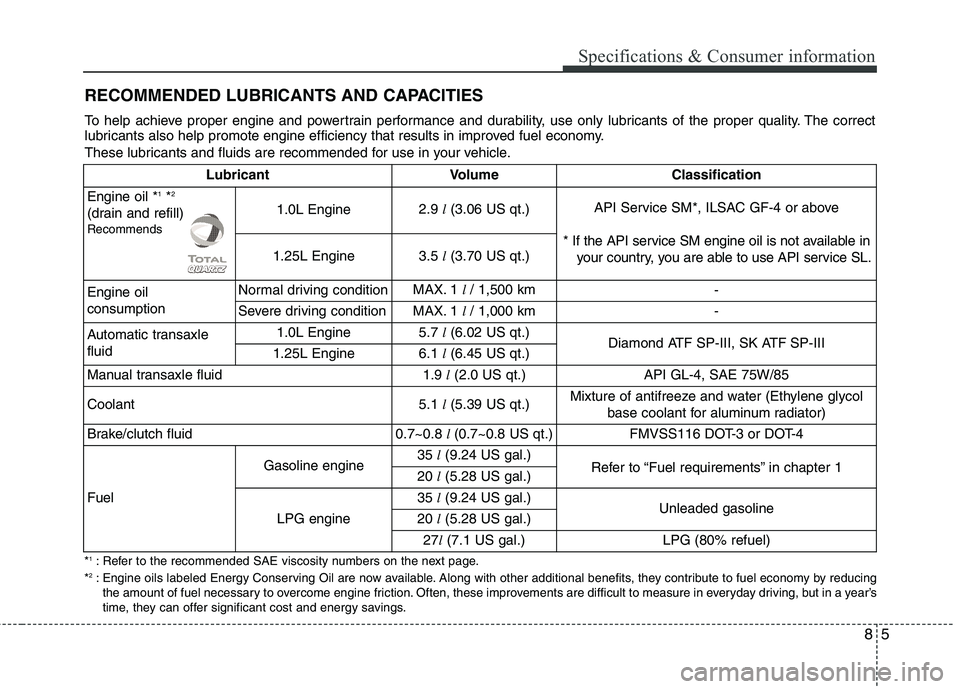
RECOMMENDED LUBRICANTS AND CAPACITIES
* 1
: Refer to the recommended SAE viscosity numbers on the next page.
* 2
: Engine oils labeled Energy Conserving Oil are now available. Along with other additional benefits, they contribute to fuel economy by reducing
the amount of fuel necessary to overcome engine friction. Often, these improvements are difficult to measure in everyday driving, but in a year’s
time, they can offer significant cost and energy savings.
To help achieve proper engine and powertrain performance and durability, use only lubricants of the proper quality. The correct
lubricants also help promote engine efficiency that results in improved fuel economy.
These lubricants and fluids are recommended for use in your vehicle.
Lubricant Volume Classification
Engine oil * 1
*2
(drain and refill) Recommends 1.0L Engine
2.9
l(3.06 US qt.) API Service SM*, ILSAC GF-4 or above
* If the API service SM engine oil is not available in your country, you are able to use API service SL.
1.25L Engine3.5 l(3.70 US qt.)
Engine oil consumption Normal driving condition
MAX. 1
l/ 1,500 km
-
Severe driving condition MAX. 1
l/ 1,000 km
-
Automatic transaxlefluid 1.0L Engine
5.7
l(6.02 US qt.)
Diamond ATF SP-III, SK ATF SP-III
1.25L Engine 6.1
l(6.45 US qt.)
Manual transaxle fluid 1.9
l(2.0 US qt.)
API GL-4, SAE 75W/85
Coolant 5.1
l(5.39 US qt.) Mixture of antifreeze and water (Ethylene glycol
base coolant for aluminum radiator)
Brake/clutch fluid 0.7~0.8
l (0.7~0.8 US qt.)
FMVSS116 DOT-3 or DOT-4
Fuel Gasoline engine
35
l(9.24 US gal.)
Refer to “Fuel requirements” in chapter 1
20 l(5.28 US gal.)
LPG engine 35
l(9.24 US gal.)
Unleaded gasoline
20 l(5.28 US gal.)
27 l(7.1 US gal.)LPG (80% refuel)
Page 468 of 488
Specifications & Consumer information
6
8
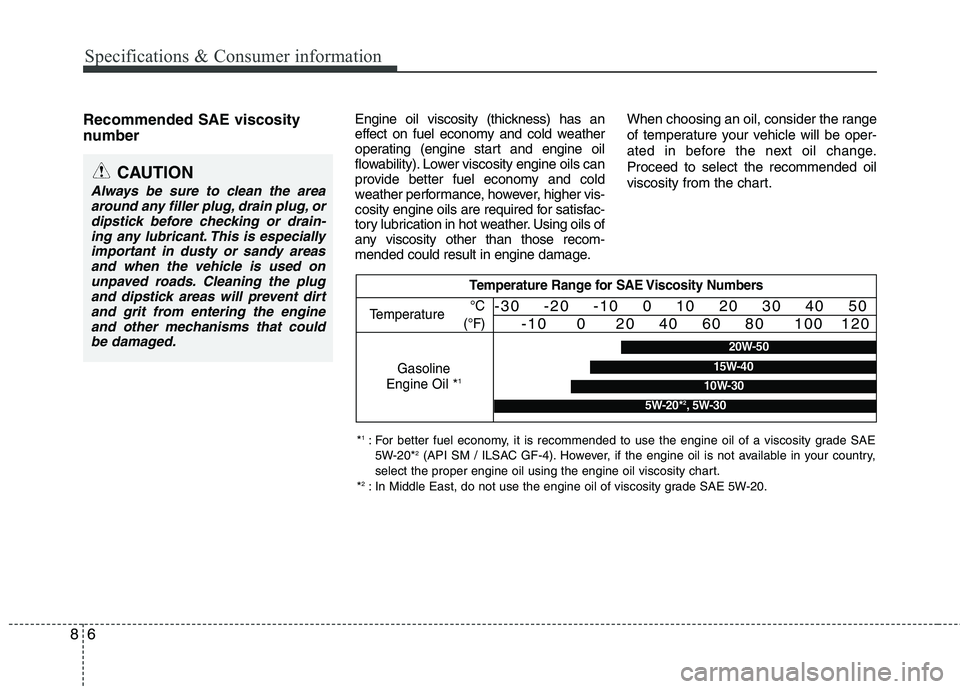
Recommended SAE viscosity
number Engine oil viscosity (thickness) has an
effect on fuel economy and cold weather
operating (engine start and engine oil
flowability). Lower viscosity engine oils can
provide better fuel economy and cold
weather performance, however, higher vis-
cosity engine oils are required for satisfac-
tory lubrication in hot weather. Using oils of
any viscosity other than those recom-
mended could result in engine damage.When choosing an oil, consider the range
of temperature your vehicle will be oper-
ated in before the next oil change.Proceed to select the recommended oil
viscosity from the chart.
Temperature Range for SAE Viscosity Numbers
Temperature
Gasoline
Engine Oil * 1°C
(°F)-30 -20 -10 0 10 20 30 40 50 -10 0 20 40 60 80 100 120
*1
: For better fuel economy, it is recommended to use the engine oil of a viscosity grade SAE
5W-20* 2
(API SM / ILSAC GF-4). However, if the engine oil is not available in your country,
select the proper engine oil using the engine oil viscosity chart.
* 2
: In Middle East, do not use the engine oil of viscosity grade SAE 5W-20.
20W-50
10W-30
15W-40
5W-20* 2
, 5W-30
CAUTION
Always be sure to clean the area
around any filler plug, drain plug, ordipstick before checking or drain-
ing any lubricant. This is especiallyimportant in dusty or sandy areasand when the vehicle is used on unpaved roads. Cleaning the plug
and dipstick areas will prevent dirt and grit from entering the engine and other mechanisms that couldbe damaged.
Page 470 of 488
Specifications & Consumer information
8
8
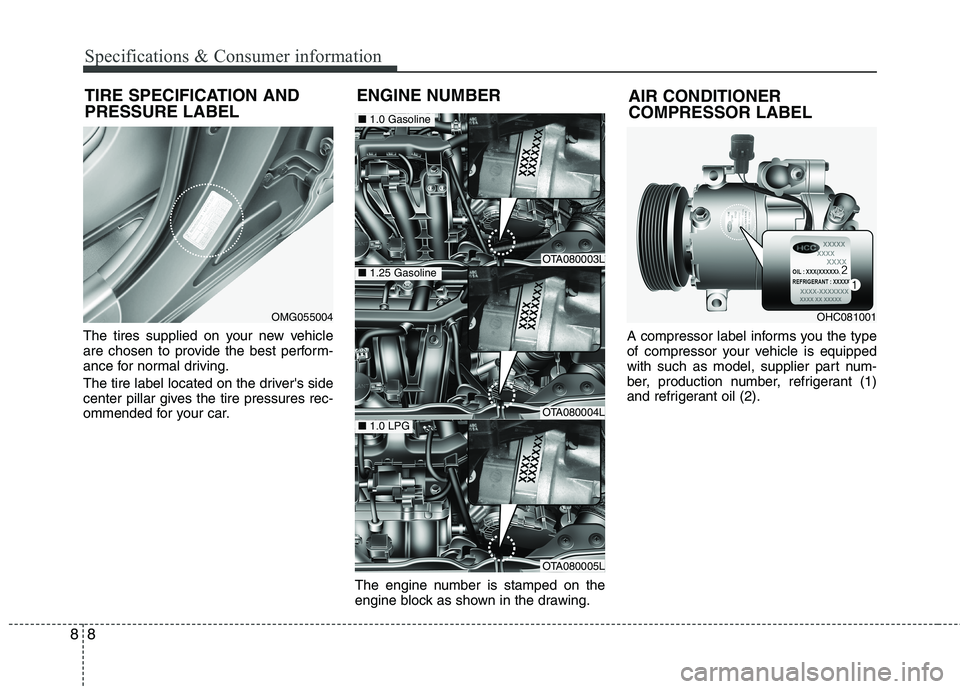
The tires supplied on your new vehicle
are chosen to provide the best perform-
ance for normal driving.
The tire label located on the driver's side
center pillar gives the tire pressures rec-
ommended for your car.
The engine number is stamped on the
engine block as shown in the drawing.A compressor label informs you the type
of compressor your vehicle is equipped
with such as model, supplier part num-
ber, production number, refrigerant (1)
and refrigerant oil (2).
TIRE SPECIFICATION AND PRESSURE LABEL
OMG055004
ENGINE NUMBER
AIR CONDITIONER COMPRESSOR LABELOHC081001
OTA080003L
OTA080004L
■1.25 Gasoline
■1.0 Gasoline
OTA080005L
■1.0 LPG
Page 483 of 488
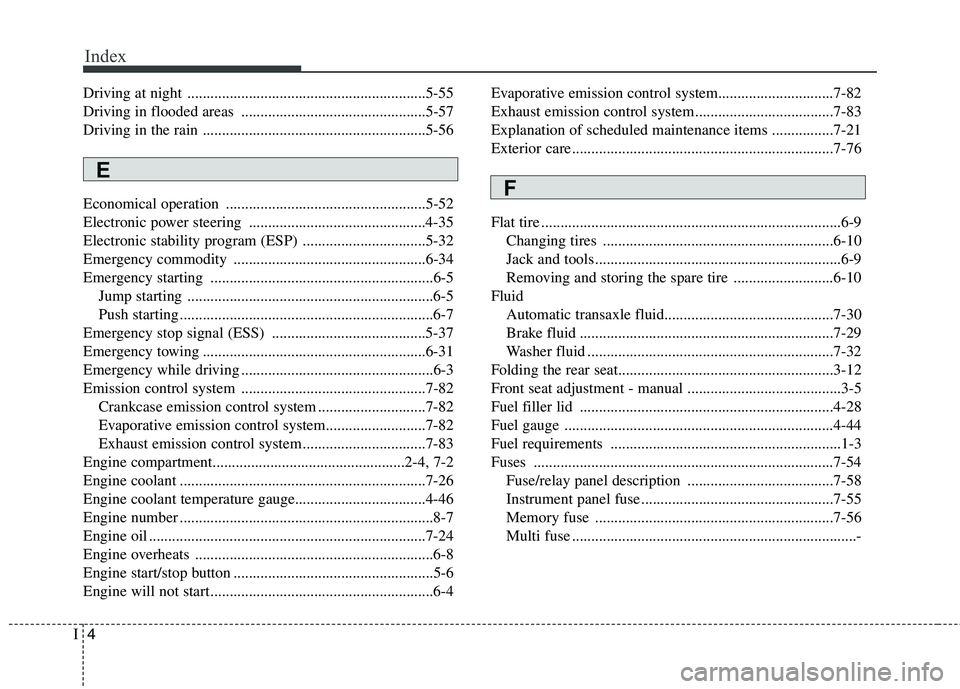
Index
4
I
Driving at night ..............................................................5-55
Driving in flooded areas ................................................5-57
Driving in the rain ..........................................................5-56
Economical operation ....................................................5-52
Electronic power steering ..............................................4-35
Electronic stability program (ESP) ................................5-32
Emergency commodity ..................................................6-34
Emergency starting ..........................................................6-5
Jump starting ................................................................6-5
Push starting ..................................................................6-7
Emergency stop signal (ESS) ........................................5-37
Emergency towing ..........................................................6-31
Emergency while driving ..................................................6-3
Emission control system ................................................7-82 Crankcase emission control system ............................7-82
Evaporative emission control system..........................7-82
Exhaust emission control system ................................7-83
Engine compartment..................................................2-4, 7-2
Engine coolant ................................................................7-26Engine coolant temperature gauge..................................4-46
Engine number ..................................................................8-7
Engine oil ........................................................................7-24
Engine overheats ..............................................................6-8
Engine start/stop button ....................................................5-6
Engine will not start..........................................................6-4 Evaporative emission control system..............................7-82
Exhaust emission control system ....................................7-83
Explanation of scheduled maintenance items ................7-21
Exterior care....................................................................7-76
Flat tire ..............................................................................6-9
Changing tires ............................................................6-10
Jack and tools ................................................................6-9
Removing and storing the spare tire ..........................6-10
Fluid Automatic transaxle fluid............................................7-30
Brake fluid ..................................................................7-29
Washer fluid ................................................................7-32
Folding the rear seat........................................................3-12
Front seat adjustment - manual ........................................3-5
Fuel filler lid ..................................................................4-28
Fuel gauge ......................................................................4-44
Fuel requirements ............................................................1-3
Fuses ..............................................................................7-54 Fuse/relay panel description ......................................7-58
Instrument panel fuse ..................................................7-55
Memory fuse ..............................................................7-56
Multi fuse ..........................................................................-
F
E
Page 486 of 488
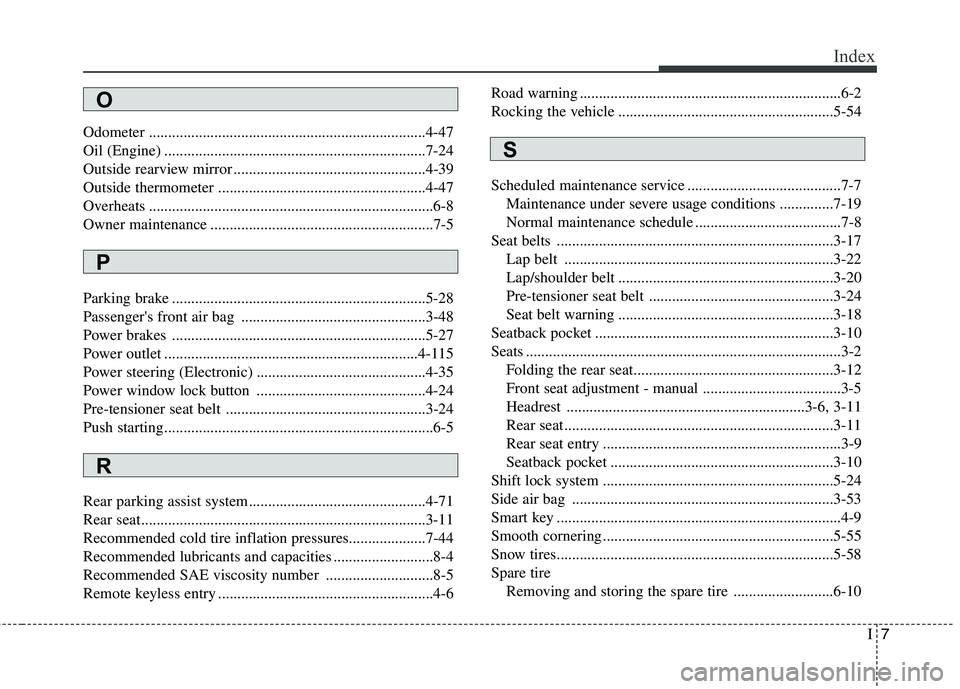
I7
Index
Odometer ........................................................................4-47
Oil (Engine) ....................................................................7-24
Outside rearview mirror ..................................................4-39
Outside thermometer ......................................................4-47
Overheats ..........................................................................6-8
Owner maintenance ..........................................................7-5
Parking brake ..................................................................5-28
Passenger's front air bag ................................................3-48
Power brakes ..................................................................5-27
Power outlet ..................................................................4-115
Power steering (Electronic) ............................................4-35
Power window lock button ............................................4-24
Pre-tensioner seat belt ....................................................3-24
Push starting......................................................................6-5
Rear parking assist system ..............................................4-71
Rear seat..........................................................................3-11Recommended cold tire inflation pressures....................7-44
Recommended lubricants and capacities ..........................8-4
Recommended SAE viscosity number ............................8-5
Remote keyless entry ........................................................4-6 Road warning ....................................................................6-2
Rocking the vehicle ........................................................5-54
Scheduled maintenance service ........................................7-7
Maintenance under severe usage conditions ..............7-19
Normal maintenance schedule ......................................7-8
Seat belts ........................................................................3-17 Lap belt ......................................................................3-22
Lap/shoulder belt ........................................................3-20
Pre-tensioner seat belt ................................................3-24
Seat belt warning ........................................................3-18
Seatback pocket ..............................................................3-10
Seats ..................................................................................3-2 Folding the rear seat....................................................3-12
Front seat adjustment - manual ....................................3-5
Headrest ..............................................................3-6, 3-11
Rear seat ......................................................................3-11
Rear seat entry ..............................................................3-9
Seatback pocket ..........................................................3-10
Shift lock system ............................................................5-24
Side air bag ....................................................................3-53
Smart key ..........................................................................4-9
Smooth cornering............................................................5-55
Snow tires........................................................................5-58Spare tire Removing and storing the spare tire ..........................6-10
P
R
S
O