lid KIA PICANTO 2017 Owner's Manual
[x] Cancel search | Manufacturer: KIA, Model Year: 2017, Model line: PICANTO, Model: KIA PICANTO 2017Pages: 488, PDF Size: 31.26 MB
Page 296 of 488
Driving your vehicle
14
5
Manually converts from gasoline to LPG
1. When the GSL switch is turned off
(switch not pressed), while driving with
the GSL switch on (switch pressed), it
will convert to from gasoline to LPG if
the following conditions are met.
After some time starting the engine on gasoline.
When LPG pressure is above certain level.
When LPG fuel system is operating normally.
When the amount of LPG is above cer- tain level. Manually converts from LPG to gasoline
1. When GSL switch is turned on (switch
pressed) while driving on LPG with the
GSL switch off (switch not pressed), it
will convert from LPG to gasoline if the
following conditions are met.
After some time starting the engine.
When gasoline fuel system is operat- ing normally.
When the amount of gasoline is above certain level.
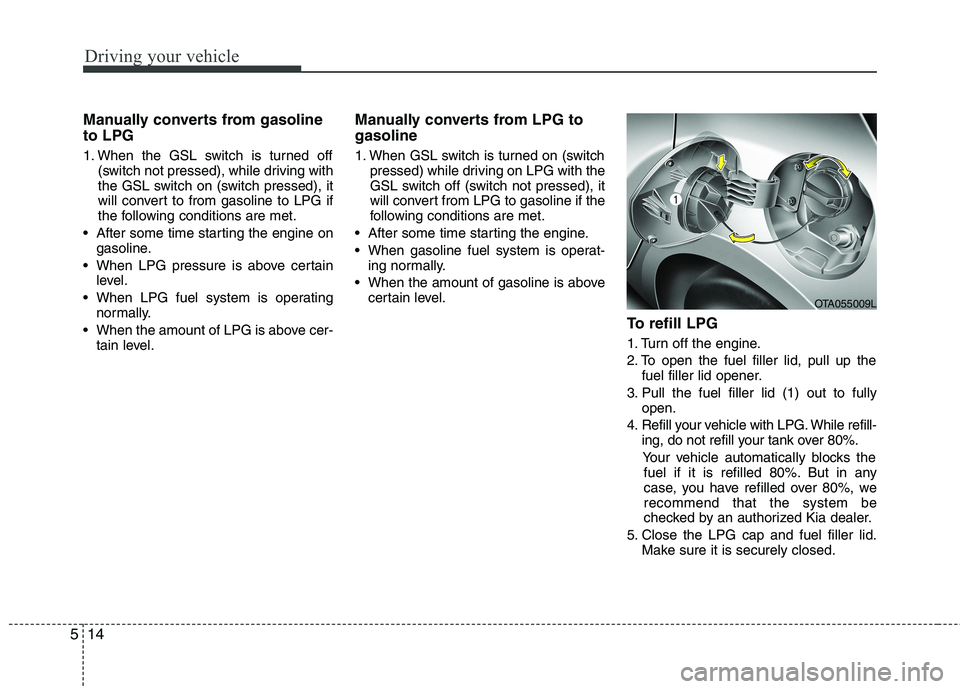
To refill LPG
1. Turn off the engine.
2. To open the fuel filler lid, pull up thefuel filler lid opener.
3. Pull the fuel filler lid (1) out to fully open.
4. Refill your vehicle with LPG. While refill- ing, do not refill your tank over 80%.
Your vehicle automatically blocks the fuel if it is refilled 80%. But in any
case, you have refilled over 80%, werecommend that the system be
checked by an authorized Kia dealer.
5. Close the LPG cap and fuel filler lid. Make sure it is securely closed.
OTA055009L
Page 356 of 488
What to do in an emergency
12
6
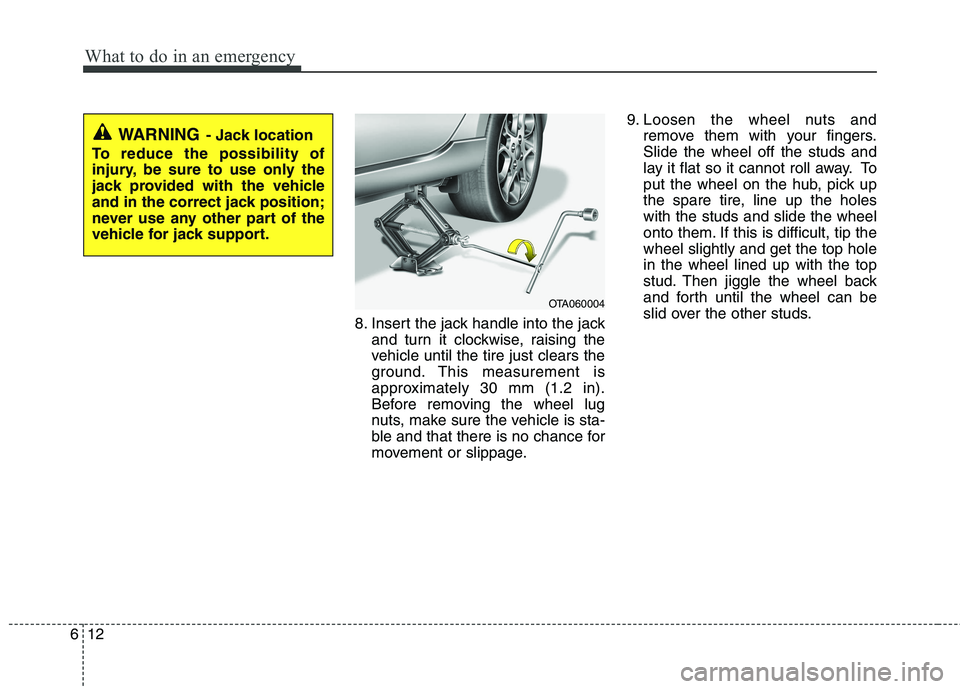
8. Insert the jack handle into the jack
and turn it clockwise, raising the
vehicle until the tire just clears the
ground. This measurement is
approximately 30 mm (1.2 in).
Before removing the wheel lug
nuts, make sure the vehicle is sta-
ble and that there is no chance for
movement or slippage. 9. Loosen the wheel nuts and
remove them with your fingers.Slide the wheel off the studs and
lay it flat so it cannot roll away. To
put the wheel on the hub, pick up
the spare tire, line up the holeswith the studs and slide the wheel
onto them. If this is difficult, tip thewheel slightly and get the top holein the wheel lined up with the top
stud. Then jiggle the wheel back
and forth until the wheel can be
slid over the other studs.
WARNING - Jack location
To reduce the possibility of
injury, be sure to use only the
jack provided with the vehicle
and in the correct jack position;
never use any other part of the
vehicle for jack support.
OTA060004
Page 357 of 488
613
What to do in an emergency
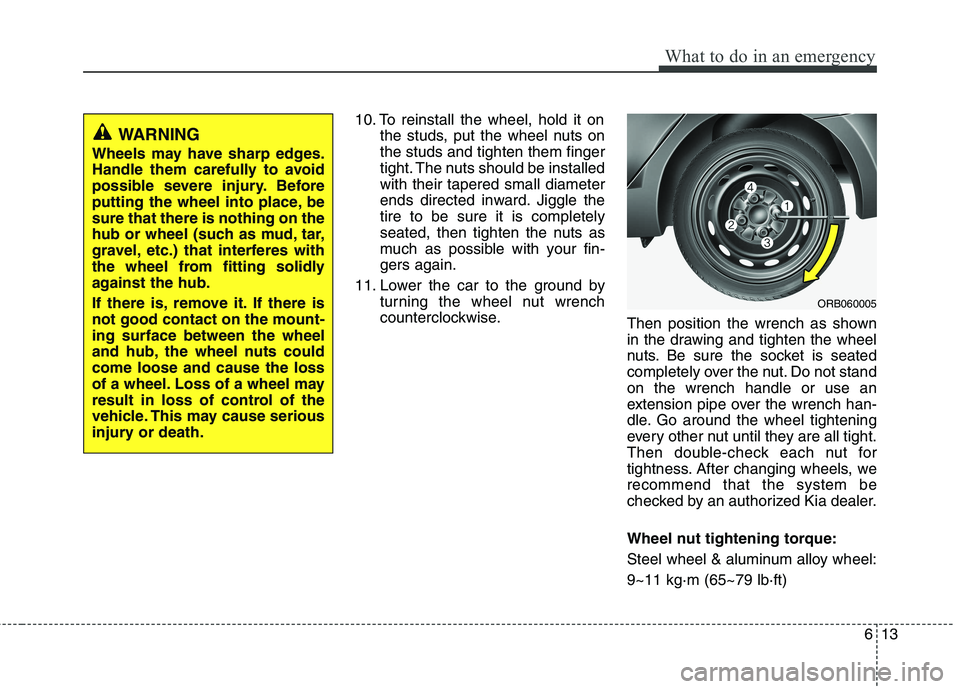
10. To reinstall the wheel, hold it onthe studs, put the wheel nuts on the studs and tighten them finger
tight. The nuts should be installedwith their tapered small diameter
ends directed inward. Jiggle thetire to be sure it is completely
seated, then tighten the nuts as
much as possible with your fin-gers again.
11. Lower the car to the ground by turning the wheel nut wrench
counterclockwise. Then position the wrench as shown
in the drawing and tighten the wheel
nuts. Be sure the socket is seated
completely over the nut. Do not standon the wrench handle or use an
extension pipe over the wrench han-
dle. Go around the wheel tightening
every other nut until they are all tight.
Then double-check each nut for
tightness. After changing wheels, werecommend that the system be
checked by an authorized Kia dealer.
Wheel nut tightening torque:
Steel wheel & aluminum alloy wheel:9~11 kg·m (65~79 lb·ft)
WARNING
Wheels may have sharp edges.
Handle them carefully to avoid
possible severe injury. Before
putting the wheel into place, besure that there is nothing on the
hub or wheel (such as mud, tar,
gravel, etc.) that interferes with
the wheel from fitting solidly
against the hub.
If there is, remove it. If there is not good contact on the mount-ing surface between the wheel
and hub, the wheel nuts couldcome loose and cause the loss
of a wheel. Loss of a wheel may
result in loss of control of the
vehicle. This may cause serious
injury or death.
ORB060005
Page 416 of 488
Maintenance
38
7
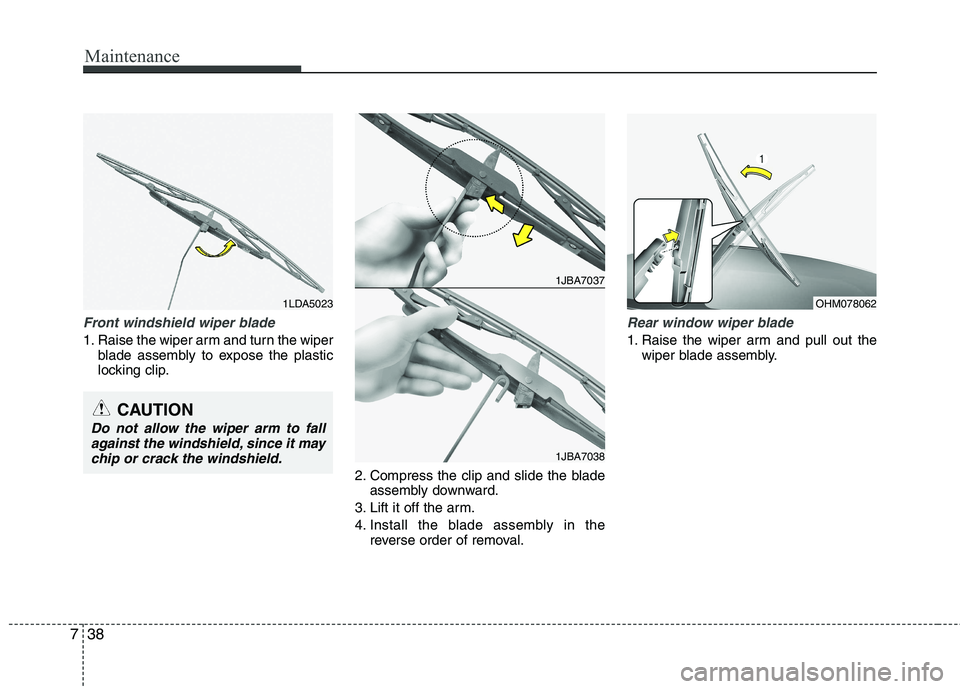
Front windshield wiper blade
1. Raise the wiper arm and turn the wiper
blade assembly to expose the plastic
locking clip.
2. Compress the clip and slide the bladeassembly downward.
3. Lift it off the arm.
4. Install the blade assembly in the reverse order of removal.
Rear window wiper blade
1. Raise the wiper arm and pull out thewiper blade assembly.
1LDA5023
CAUTION
Do not allow the wiper arm to fall
against the windshield, since it maychip or crack the windshield.
1JBA7037
1JBA7038
OHM078062
Page 425 of 488
747
Maintenance
Disc brake pads should be inspectedfor wear whenever tires are rotated.
✽✽ NOTICE
Rotate radial tires that have an
asymmetric tread pattern only from
front to rear and not from right to
left.
Wheel alignment and tire balance
The wheels on your vehicle were aligned and balanced carefully at the
factory to give you the longest tire life
and best overall performance.
In most cases, you will not need to
have your wheels aligned again.
However, if you notice unusual tire
wear or your vehicle pulling one way
or the other, the alignment may needto be reset.
If you notice your vehicle vibrating
when driving on a smooth road, your
wheels may need to be rebalanced. Tire replacement
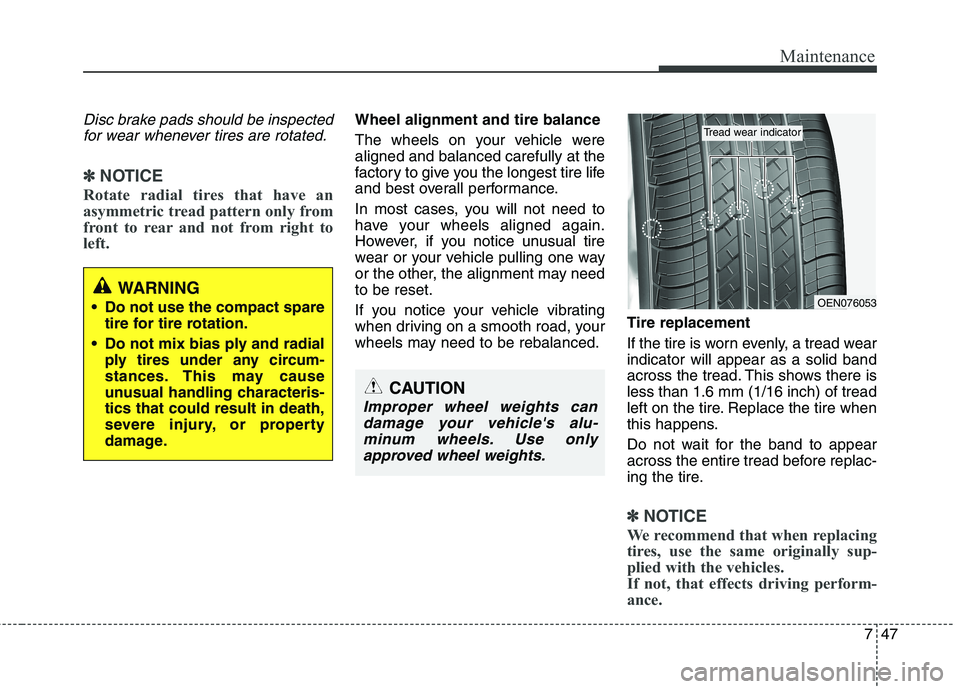
If the tire is worn evenly, a tread wear indicator will appear as a solid band
across the tread. This shows there isless than 1.6 mm (1/16 inch) of tread
left on the tire. Replace the tire when
this happens.
Do not wait for the band to appear
across the entire tread before replac-
ing the tire.
✽✽
NOTICE
We recommend that when replacing
tires, use the same originally sup-
plied with the vehicles.
If not, that effects driving perform-
ance.
WARNING
Do not use the compact spare tire for tire rotation.
Do not mix bias ply and radial ply tires under any circum-
stances. This may cause
unusual handling characteris-tics that could result in death,
severe injury, or property
damage.
CAUTION
Improper wheel weights can
damage your vehicle's alu-minum wheels. Use only approved wheel weights.
OEN076053
Tread wear indicator
Page 483 of 488

Index
4
I
Driving at night ..............................................................5-55
Driving in flooded areas ................................................5-57
Driving in the rain ..........................................................5-56
Economical operation ....................................................5-52
Electronic power steering ..............................................4-35
Electronic stability control (ESC) ..................................5-32
Emergency commodity ..................................................6-34
Emergency starting ..........................................................6-5
Jump starting ................................................................6-5
Push starting ..................................................................6-7
Emergency stop signal (ESS) ........................................5-37
Emergency towing ..........................................................6-31
Emergency while driving ..................................................6-3
Emission control system ................................................7-82 Crankcase emission control system ............................7-82
Evaporative emission control system..........................7-82
Exhaust emission control system ................................7-83
Engine compartment..................................................2-4, 7-2
Engine coolant ................................................................7-26Engine coolant temperature gauge..................................4-46
Engine number ..................................................................8-8
Engine oil ........................................................................7-24
Engine overheats ..............................................................6-8
Engine start/stop button ....................................................5-6
Engine will not start..........................................................6-4 Evaporative emission control system..............................7-82
Exhaust emission control system ....................................7-83
Explanation of scheduled maintenance items ................7-21
Exterior care....................................................................7-76
Flat tire ..............................................................................6-9
Changing tires ............................................................6-10
Jack and tools ................................................................6-9
Removing and storing the spare tire ..........................6-10
Fluid Automatic transaxle fluid............................................7-30
Brake fluid ..................................................................7-29
Washer fluid ................................................................7-32
Folding the rear seat........................................................3-12
Front seat adjustment - manual ........................................3-5
Fuel filler lid ..................................................................4-28
Fuel gauge ......................................................................4-44
Fuel requirements ............................................................1-3
Fuses ..............................................................................7-54 Fuse/relay panel description ......................................7-58
Instrument panel fuse ..................................................7-55
Memory fuse ..............................................................7-56
Multi fuse ..........................................................................-
F
E