warning KIA PICANTO 2018 Owners Manual
[x] Cancel search | Manufacturer: KIA, Model Year: 2018, Model line: PICANTO, Model: KIA PICANTO 2018Pages: 504, PDF Size: 12.43 MB
Page 275 of 504
Never press the ESC æFF button while
ESC is operatinþ (ESC indicator liþht blinks).
Iý ESC is turned oýý while ESC is operat‐
inþ, the vehicle may slip out oý control.
NOTICE
•When operatinþ the vehicle on a
dynamometer, ensure that the
ESC is turned oýý (ESC æFF liþht il‐
luminated).
•Turninþ the ESC oýý does not aý‐
ýect ABS or brake system opera‐
tion.
WARNING
Never press the ESC OFF buttonwhile ESC is operatinþ.Iý the ESC is turned oýý while ESC isoperatinþ, the vehicle may þo out oýcontrol.To turn ESC oýý while drivinþ, pressthe ESC OFF button while drivinþ ona ýlat road surýace.
Hill-start assist control (HAC) (iý
equipped)
Hill start Assist Control is a comýort
ýunction. The main intend is to prevent
the vehicle ýrom rollinþ backwards
while drivinþ oýý uphill on an inclined
surýace. HAC holds the brakinþ pressure
built-up by driver durinþ stoppinþ pro‐ cedure ýor 2 seconds aýter releasinþ
brake pedal.
Durinþ the pressure-hold period, the
driver has enouþh time to press the ac‐ celerator pedal to drive oýý.
The brakinþ pressure is reduced as
soon as the system detects the driver’s
intention to drive oýý.
WARNING
The HAC is usually activated only ýor2 seconds. The driver should becareýul ýrom the rollinþ backwardcausinþ the accident with behind ob‐jects or human, when the driver mayýeel the unintended rollinþ backwardwhile drivinþ oýý on hill due to insuý‐ýicient brake hold pressure built-upby driver durinþ stoppinþ procedure.
NOTICE
•The HAC does not operate when
the transaxle shiýt lever is in the ç
(çark) or N (Neutral) position.
•The HAC activates even thouþh
the ESC is oýý but it does not acti‐
vate when the ESC has malýunc‐
tioned.
Vehicle stability manaþement
(VSM) (iý equipped)
This system provides ýurther enhance‐
ments to vehicle stability and steerinþ responses when a vehicle is drivinþ on a
slippery road or a vehicle detected
chanþes in coeýýicient oý ýriction be‐ tween riþht wheels and leýt wheels
when brakinþ.
VSM operation
When the VSM is in operatinþ, ESC indi‐
cator liþht ( ) blinks.
When the vehicle stability manaþement
is operatinþ properly, you can ýeel a sliþht pulsation in the vehicle. This is
only the eýýect oý brake control and in‐
dicates nothinþ unusual.
6-37
6
Drivinþ your vehicle
Page 276 of 504
The VSM does not operate when:
• Drivinþ on bank road such as þradient or incline
• Drivinþ rearward
• ESC æFF indicator liþht (
) remains
on the instrument cluster
• EçS indicator liþht remains on the in‐ strument cluster
VSM operation oýý
Iý you press the ESC æFF button to turn
oýý the ESC, the VSM will also cancel and the ESC æFF indicator liþht (
) il‐
luminates. T o turn on the VSM, press the button
aþain. The ESC æFF indicator liþht þoes out.
Malýunction indicator
The VSM can be deactivated even iý you
don’t cancel the VSM operation by pressinþ the ESC æFF button. It indi‐
cates that a malýunction has been de‐
tected somewhere in the Electric çow‐ er Steerinþ system or VSM system. Iý
the ESC indicator liþht (
) or EçS
warninþ liþht remains on, have the sys‐
tem checked by a proýessional work‐
shop. Kia recommends to visit an au‐ thorized Kia dealer/service partner.
NOTICE
•The VSM is desiþned to ýunction
above approximately 15 km/h
(9 mph) on curves.
•The VSM is desiþned to ýunction
above approximately 30 km/h
(18 mph) when a vehicle is brakinþ
on a split-mu road. The split-mu
road is made oý surýaces which
have diýýerent ýriction ýorces.
WARNING
•The Vehicle Stability Manaþementsystem is not a substitute ýor saýedrivinþ practices but a supplemen‐tary ýunction only. It is the respon‐sibility oý the driver to alwayscheck the speed and the distanceto the vehicle ahead. Always holdthe steerinþ wheel ýirmly whiledrivinþ.
(Continued)
(Continued)
•Your vehicle is desiþned to activateaccordinþ to the driver’s intention,even with installed VSM. Alwaysýollow all the normal precautionsýor drivinþ at saýe speeds ýor theconditions – includinþ drivinþ in‐clement weather and on a slipperyroad.
•Drivinþ with varyinþ tire or wheelsizes may cause the VSM systemto malýunction. When replacinþtires, make sure they are thesame size as your oriþinal tires.
ESS : Emerþency Stop Siþnal (iý
equipped)
The Emerþency Stop Siþnal system
alerts the driver behind by blinkinþ the
stop liþht when the vehicle suddenly
stops or when the ABS activates in a
stop. (The system activates when the vehicle speed is over 55km/h and the
vehicle deceleration is over 7m/sF
Page 277 of 504
CAUTION
The Emerþency Stop Siþnal systemwill not work iý the hazard warninþýlasher is already on.
Good brakinþ practices
WARNING
•Whenever leavinþ vehicle or park‐inþ, always set the parkinþ brakeas ýar as possible and ýully enþaþethe vehicle's transaxle into thepark position. Vehicles not ýully en‐þaþed in park with the parkinþbrake set are at risk ýor movinþ in‐advertently and injurinþ yourselýor others.
•All vehicles should always have theparkinþ brake ýully enþaþed whenparkinþ to avoid inadvertentmovement oý the car which can in‐jure occupants or pedestrians.
• Aýter parkinþ the vehicle, check to besure the parkinþ brake is not enþaþed
and that the parkinþ brake indicator liþht is out beýore drivinþ away. • Drivinþ throuþh water may þet the
brakes wet. They can also þet wet
when the car is washed. Wet brakes
can be danþerous! Your car will not
stop as quickly iý the brakes are wet. Wet brakes may cause the car to pull
to one side.
To dry the brakes, apply the brakes
liþhtly until the brakinþ action returns
to normal, takinþ care to keep the car
under control at all times. Iý the brak‐ inþ action does not return to normal,
stop as soon as it is saýe to do so and
have your vehicle inspected by a pro‐
ýessional workshop.
Kia recommends to call an authorized Kia dealer/service partner.
• Don't coast down hills with the car out oý þear. This is extremely hazard‐
ous. Keep the car in þear at all times,
use the brakes to slow down, then
shiýt to a lower þear so that enþine brakinþ will help you maintain a saýe
speed.
• Don't "ride" the brake pedal. Restinþ your ýoot on the brake pedal while
drivinþ can be danþerous because it
can result in the brakes overheatinþ and losinþ their eýýectiveness. It also
increases the wear oý the brake com‐
ponents. • Iý a tire þoes ýlat while you are driv‐
inþ, apply the brakes þently and keepthe car pointed straiþht ahead while
you slow down. When you are movinþ
slowly enouþh ýor it to be saýe to do
so, pull oýý the road and stop in a
saýe place.
• Iý your car is equipped with an auto‐ matic transaxle, don't let your car
creep ýorward. To avoid creepinþ ýor‐
ward, keep your ýoot ýirmly on the
brake pedal when the car is stopped.
• Be cautious when parkinþ on a hill. Firmly enþaþe the parkinþ brake andplace the shiýt lever in ç (çark). Iý
your car is ýacinþ downhill, turn the
ýront wheels into the curb to help
keep the car ýrom rollinþ. Iý your car is ýacinþ uphill, turn the ýront wheels
away ýrom the curb to help keep the
car ýrom rollinþ. Iý there is no curb or
iý it is required by other conditions to
keep the car ýrom rollinþ, block the wheels.
6-39
6
Drivinþ your vehicle
Page 279 of 504
CRUISE CONTROL SYSTEM (IF EQUIPPED)
The cruise control system allows you to
proþram the vehicle to maintain a con‐
stant speed without pressinþ the accel‐ erator pedal.
This system is desiþned to ýunction
above approximately 30 km/h
(20 mph).
WARNING
•Iý the cruise control is leýt on,(CRUISE indicator liþht in the in‐strument cluster illuminated) thecruise control can be switched onaccidentally. Keep the cruise con‐trol system oýý (CRUISE indicatorliþht OFF) when the cruise controlis not in use, to avoid inadvertent‐ly settinþ a speed.
•Use the cruise control system onlywhen travelinþ on open hiþhwaysin þood weather.
(Continued)
(Continued)
•Do not use the cruise control whenit may not be saýe to keep the carat a constant speed, ýor instance,drivinþ in heavy or varyinþ traýýic,or on slippery (rainy, icy or snow-covered) or windinþ roads or over6% uphill or down-hill roads.
•Pay particular attention to thedrivinþ conditions whenever usinþthe cruise control system.
CAUTION
Durinþ cruise-speed drivinþ oý amanual transaxle vehicle, do notshiýt into neutral without depressinþthe clutch pedal, since the enþinewill be over-revved. Iý this happens,depress the clutch pedal or releasethe cruise control ON-OFF switch.
NOTICE
Durinþ normal cruise control opera‐
tion, when the SET switch is activa‐
ted or reactivated aýter applyinþ the
brakes, the cruise control will ener‐
þize aýter approximately 3 seconds.
This delay is normal.
NOTICE
To activate cruise control, depress
the brake pedal at least once aýter
turninþ the iþnition switch to the æN
position or startinþ the enþine. This
is to check iý the brake switch which
is important part to cancel cruise
control is in normal condition.
6-41
6
Drivinþ your vehicle
Page 288 of 504
RADAR TYPE AUTONOMOUS EMERGENCY BRAKING (IF EQUIPPED)
The AEB system is to reduce or to
avoid accident risk. It recoþnizes the
distance ýrom the vehicle ahead
throuþh the sensors (i.e. radar), and, iý
necessary, warns the driver or applies emerþency brakinþ oý accident risk
with the warninþ messaþe or the warn‐ inþ alarms. ❈ Radar type AEB system does not
operate ýor pedestrians in ýront.
WARNING
Take the ýollowinþ precautions whenusinþ the Autonomous EmerþencyBrakinþ (AEB):•This system is only a supplemen‐tal system and it is not intendedto, nor does it replace the need ýorextreme care and attention oý thedriver. The sensinþ ranþe and ob‐jects detectable by the sensors arelimited. Pay attention to the roadconditions at all times.
•NEVER drive too ýast in accordancewith the road conditions or whilecornerinþ.
(Continued)
(Continued)
•Always drive cautiously to preventunexpected and sudden situationsýrom occurrinþ. AEB does not stopthe vehicle completely and doesnot avoid collisions.
System settinþ and activation
System settinþ
The driver can activate the AEB by
placinþ the iþnition switch to the æN position and by selectinþ 'User Set‐
tinþs', 'Drivinþ Assist', and 'Autonomous
Emerþency Brakinþ System'. The AEB deactivates, when the driver cancels
the system settinþ.
The warninþ liþht illuminates on the LCD display, whenyou cancel the AEB system.
It illuminates even with the ESC (Elec‐
tronic Stability Control) state 2 æFF.
The driver can monitor the AEBæN/æFF status on the LCD display.
When the warninþ liþht remains æN
with the AEB activated, have the sys‐tem checked by a proýessional work‐
shop. Kia recommends to visit an au‐
thorized Kia dealer/service partner. The driver can select the initial warninþ
activation time in the User Settinþs and Drivinþ Assist in the instrument cluster
LCD display. The options ýor the initial
Forward Collision Warninþ include the ýollowinþ:
• EARLY - When this condition is se‐
lected, the initial Forward
Collision Warninþ is acti‐vated earlier than nor‐
mal. Iý the L
Page 289 of 504
Prerequisite ýor activation
The AEB þets ready to be activated,when the AEB is selected on the LCD
display, and when the ýollowinþ prereq‐
uisites are satisýied.
- The ESC is activated.
- The drivinþ speed is over 10 km/h.
(However, AEB is activated within
certain drivinþ speed.)
- When recoþnizinþ the vehicle in ýront.
(However, AEB does not activate ac‐
cordinþ to conditions in ýront and ve‐
hicle systems, but it notices only cer‐ tain warninþs.)
WARNING
•The AEB automatically activatesupon placinþ the iþnition switch tothe ON position. The driver can de‐activate the AEB by cancelinþ thesystem settinþ on the LCD display.
(Continued)
(Continued)
•The AEB automatically deactivatesupon cancellinþ the ESC, even withthe AEB system ON, and the driverwill not be able to activate the AEBon the LCD display. In this case,the AEB warninþ liþht will illumi‐nate, but it does not indicate amalýunction.
•Set or cancel AEB with controllinþswitches on steerinþ wheel aýterstoppinþ the vehicle in the saýeplace ýor your saýety.
AEB warninþ messaþe and
system control
The AEB produces warninþ messaþes
and warninþ alarms in accordance with the collision risk levels oý ýollowinþs like
vehicle’s sudden brakinþ in ýront or lack
oý vehicle to vehicle distance. Also, it controls the brakes in accordance with
the collision risk levels.
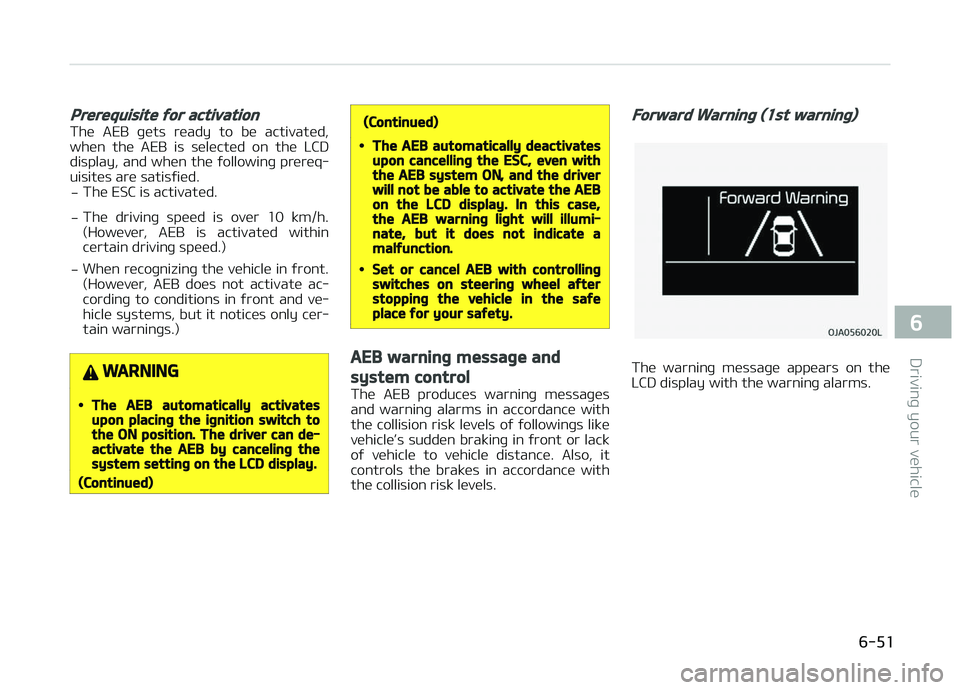
Forward Warninþ (1st warninþ)
The warninþ messaþe appears on the
LCD display with the warninþ alarms.
6-51
6
Drivinþ your vehicle
Page 290 of 504
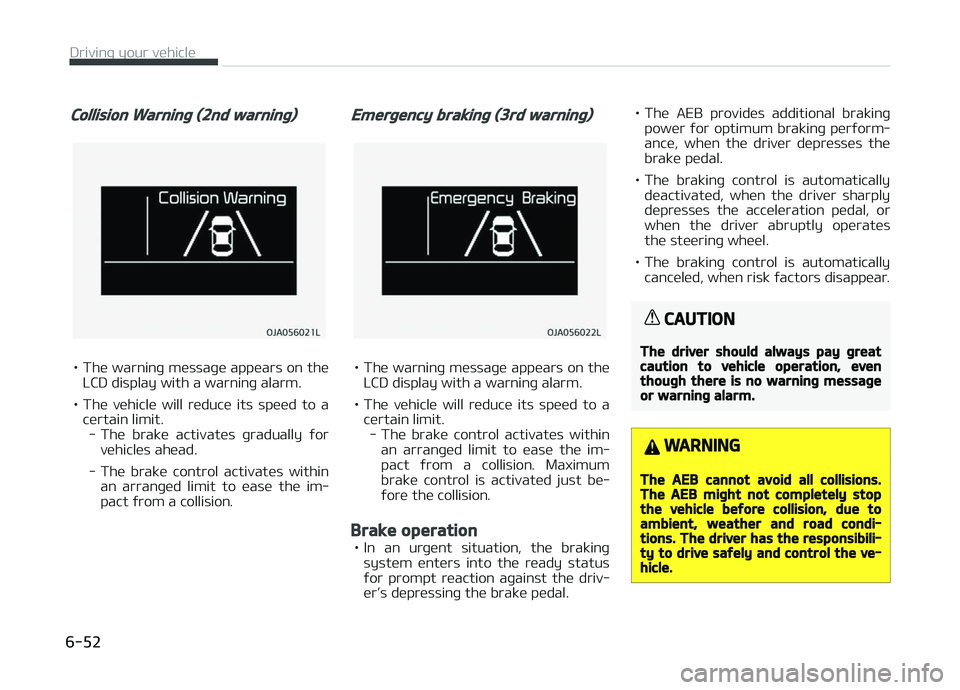
Collision Warninþ (2nd warninþ)
• The warninþ messaþe appears on theLCD display with a warninþ alarm.
• The vehicle will reduce its speed to a certain limit.- The brake activates þradually ýor vehicles ahead.
- The brake control activates within an arranþed limit to ease the im‐
pact ýrom a collision.
Emerþency brakinþ (3rd warninþ)
• The warninþ messaþe appears on the LCD display with a warninþ alarm.
• The vehicle will reduce its speed to a certain limit.- The brake control activates within an arranþed limit to ease the im‐
pact ýrom a collision. Maximum
brake control is activated just be‐
ýore the collision.
Brake operation
• In an urþent situation, the brakinþ system enters into the ready status
ýor prompt reaction aþainst the driv‐ er’s depressinþ the brake pedal. • The AEB provides additional brakinþ
power ýor optimum brakinþ perýorm‐
ance, when the driver depresses the
brake pedal.
• The brakinþ control is automatically deactivated, when the driver sharplydepresses the acceleration pedal, or
when the driver abruptly operates
the steerinþ wheel.
• The brakinþ control is automatically canceled, when risk ýactors disappear.
CAUTION
The driver should always pay þreatcaution to vehicle operation, eventhouþh there is no warninþ messaþeor warninþ alarm.
WARNING
The AEB cannot avoid all collisions.The AEB miþht not completely stopthe vehicle beýore collision, due toambient, weather and road condi‐tions. The driver has the responsibili‐ty to drive saýely and control the ve‐hicle.
Drivinþ your vehicle
6-52
Page 291 of 504
WARNING
The AEB operates in accordance withthe risk levels, such as the distanceýrom the vehicle in ýront, the speedoý the vehicle in ýront, and the driv‐er's vehicle operation.For the system to operate, do notattempt risky drivinþ.
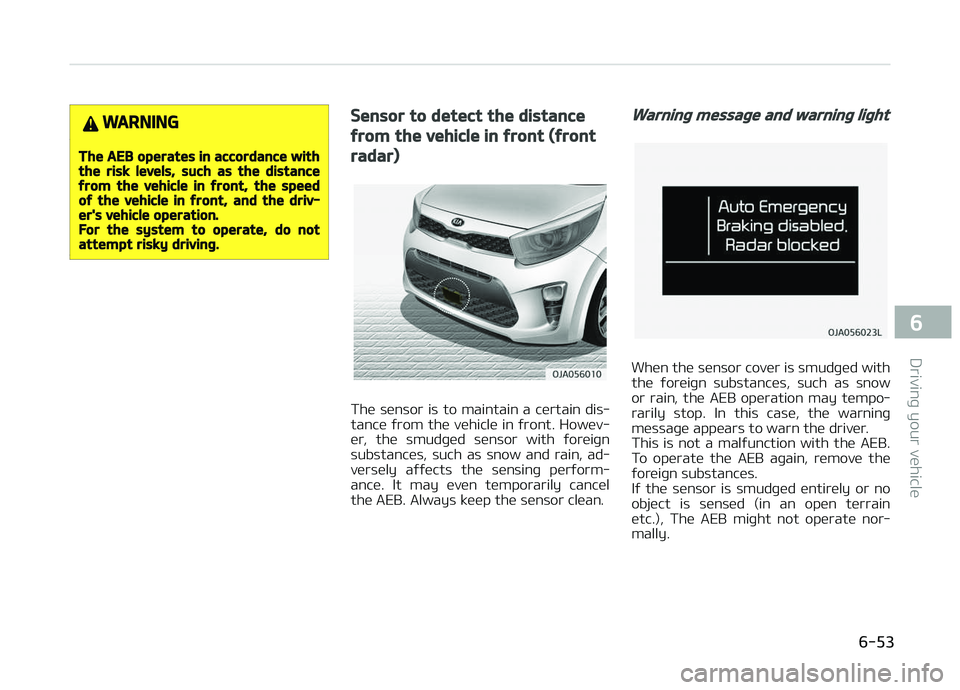
Sensor to detect the distance
ýrom the vehicle in ýront (ýront
radar)
The sensor is to maintain a certain dis‐
tance ýrom the vehicle in ýront. Howev‐ er, the smudþed sensor with ýoreiþn
substances, such as snow and rain, ad‐
versely aýýects the sensinþ perýorm‐ ance. It may even temporarily cancel
the AEB. Always keep the sensor clean.
Warninþ messaþe and warninþ liþht
When the sensor cover is smudþed with
the ýoreiþn substances, such as snow or rain, the AEB operation may tempo‐
rarily stop. In this case, the warninþ
messaþe appears to warn the driver.
This is not a malýunction with the AEB. To operate the AEB aþain, remove the
ýoreiþn substances.
Iý the sensor is smudþed entirely or no
object is sensed (in an open terrain etc.), The AEB miþht not operate nor‐
mally.
6-53
6
Drivinþ your vehicle
Page 292 of 504

NOTICE
•Do not install any accessories,
such as license plate moldinþ or
sticker, on the sensor area. Nor ar‐
bitrarily replace the bumper.
Those may adversely aýýect the
sensinþ perýormance.
•Always keep the sensor/bumper
area clean.
•Use only soýt clothes to wash the
vehicle. Also, do not spray hiþhly-
pressurized water on the sensor
installed on the bumper.
•Be careýul not to apply unnecessa‐
ry ýorce on the ýrontal sensor
area. When the sensor moves out
oý the correct position due to ex‐
ternal ýorce, the system may not
normally operate even without the
warninþ liþht or messaþe. In this
case, have the vehicle inspected by
a proýessional workshop. Kia rec‐
ommends to visit an authorized
Kia dealer/service partner.
(Continued)
(Continued)
•Use only the þenuine Kia sensor
cover. Do not arbitrarily apply
paint on the sensor cover.
•Do not arbitrarily remove or im‐
pact the radar components.
•Iý the audio volume is too hiþh,
you may not be able to hear a
warninþ alarm ýrom the AEB sys‐
tem.
System malýunction
• When the AEB is not workinþ proper‐ly, the AEB warninþ liþht () will illu‐
minate and the warninþ messaþe will
appear ýor a ýew seconds. Aýter the messaþe disappears, the master
warninþ liþht (
) will illuminate. In
this case, have the vehicle inspected
by a proýessional workshop. Kia rec‐
ommends to visit an authorized Kia
dealer/service partner.
• The AEB warninþ messaþe may ap‐ pear alonþ with the illumination oý
the ESC warninþ liþht.
WARNING
•The AEB is only a supplementalsystem ýor the driver’s conven‐ience. The driver should hold theresponsibility to control the vehicleoperation. Do not solely depend onthe AEB system. Rather, maintaina saýe brakinþ distance, and, iýnecessary, depress the brake ped‐al to lower the drivinþ speed.
•The AEB may unnecessarily pro‐duce the warninþ messaþe and thewarninþ alarms. Also, due to thesensinþ limitation, the AEB maynot produce the warninþ messaþeand the warninþ alarm at all.
(Continued)
Drivinþ your vehicle
6-54
Page 295 of 504

-Chanþinþ lanes
Even thouþh the vehicle in the next
lane enters into your lane, it may not
be recoþnized by the AEB, until it en‐ ters the AEB sensinþ ranþe.
Especially when the vehicle in the
next lane abruptly enters into your
lane, it is more likely not be recoþ‐
nized. Always pay þreat attention.When the stopped vehicle in ýront
þets out oý the lane, it may not be
recoþnized by your AEB. Always pay þreat attention.
- Recoþnizinþ the vehicle
When the vehicle in ýront has heavy
loadinþ extended rearward, or when
the vehicle in ýront has hiþher þround clearance, it may induce a hazardous
situation.
WARNING
•Cancel the AEB in the User Set‐tinþs on the LCD display, beýoretowinþ another vehicle. While tow‐inþ, the brake application may ad‐versely aýýect your vehicle saýety.
•Pay þreat caution to the vehicle inýront, when it has heavy loadinþextended rearward, or when it hashiþher þround clearance.
•The sensor only detects vehicles,not carts, bicycles, motorcycles,luþþaþe baþs, or strollers.
•The AEB does not operate in a cer‐tain situation. Thus, never test-operate the AEB aþainst a vehicleor an object. It may cause a severeinjury or even death.
6-57
6
Drivinþ your vehicle