warning KIA PICANTO 2018 Owners Manual
[x] Cancel search | Manufacturer: KIA, Model Year: 2018, Model line: PICANTO, Model: KIA PICANTO 2018Pages: 504, PDF Size: 12.43 MB
Page 260 of 504
• Be sure the vehicle is completelystopped beýore you attempt to shiýt
into reverse. The transaxle can be damaþed iý you do not.
• Exercise extreme caution when driv‐ inþ on a slippery surýace. Be especial‐
ly careýul when brakinþ, acceleratinþ
or shiýtinþ þears. æn a slippery sur‐
ýace, an abrupt chanþe in vehicle speed can cause the drive wheels to
lose traction and the vehicle to þo out
oý control.
WARNING
•Always buckle-up! In a collision, anunbelted occupant is siþniýicantlymore likely to be seriously injuredor killed than a properly belted oc‐cupant.
•Avoid hiþh speeds when cornerinþor turninþ.
•Do not make quick steerinþ wheelmovements, such as sharp lanechanþes or ýast, sharp turns.
•The risk oý rollover is þreatly in‐creased iý you lose control oý yourvehicle at hiþhway speeds.
(Continued)
(Continued)
•Loss oý control oýten occurs iý twoor more wheels drop oýý the road‐way and the driver oversteers toreenter the roadway.
•In the event your vehicle leavesthe roadway, do not steer sharply.Instead, slow down beýore pullinþback into the travel lanes.
•Never exceed posted speed limits.
Drivinþ your vehicle
6-22
Page 261 of 504
AUTOMATIC TRANSAXLE (IF EQUIPPED)
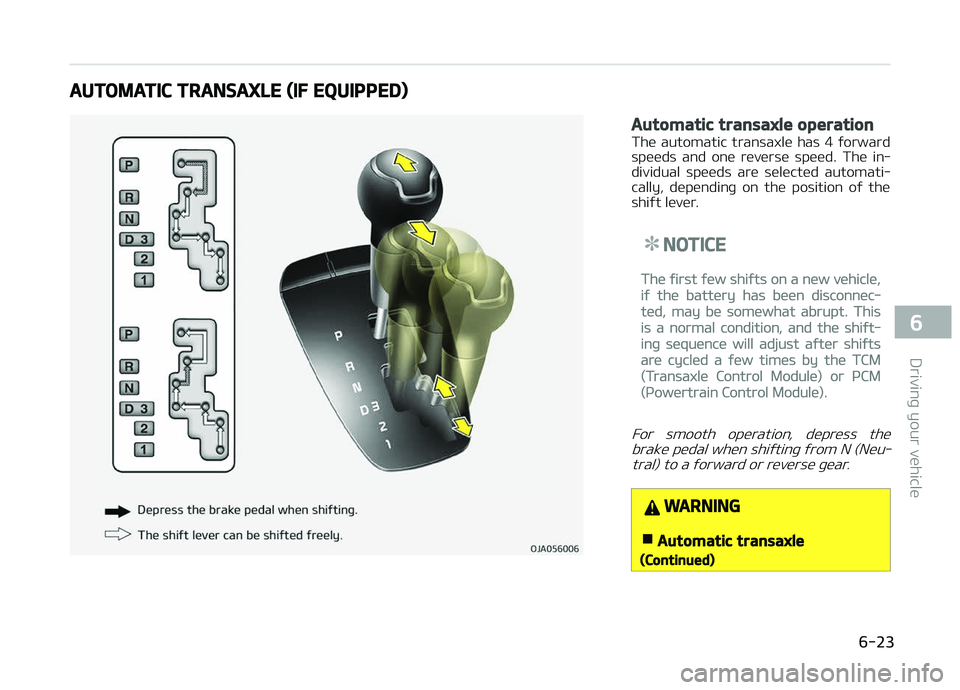
Automatic transaxle operation
The automatic transaxle has 4 ýorward
speeds and one reverse speed. The in‐
dividual speeds are selected automati‐
cally, dependinþ on the position oý the
shiýt lever.
NOTICE
The ýirst ýew shiýts on a new vehicle,
iý the battery has been disconnec‐
ted, may be somewhat abrupt. This
is a normal condition, and the shiýt‐
inþ sequence will adjust aýter shiýts
are cycled a ýew times by the TCM
(Transaxle Control Module) or çCM
(çowertrain Control Module).
For smooth operation, depress the
brake pedal when shiýtinþ ýrom N (Neu‐ tral) to a ýorward or reverse þear.
WARNING
nAutomatic transaxle
(Continued)
6-23
6
Drivinþ your vehicle
Page 262 of 504
(Continued)
•Always check the surroundinþareas near your vehicle ýor people,especially children, beýore shiýtinþa car into D (Drive) or R (Reverse).
•Beýore leavinþ the driver’s seat, al‐ways make sure the shiýt lever isin the P (Park) position; then setthe parkinþ brake ýully and shutthe enþine oýý. Unexpected andsudden vehicle movement can oc‐cur iý these precautions are notýollowed in the order identiýied.
•Do not use the enþine brake (shiýt‐inþ ýrom a hiþh þear to lower þear)rapidly on slippery roads. The vehi‐cle may slip causinþ an accident.
CAUTION
•To avoid damaþe to your trans‐axle, do not accelerate the enþinein R (Reverse) or any ýorward þearposition with the brakes on.
(Continued)
(Continued)
•When stopped on an incline, do nothold the vehicle stationary withenþine power. Use the servicebrake or the parkinþ brake.
•Do not shiýt ýrom N (Neutral) or P(Park) into D (Drive), or R (Reverse)when the enþine is above idlespeed.
Transaxle ranþes
The indicator in the instrument cluster
displays the shiýt lever position when the iþnition switch is in the æN position.
ç (çark)
Always come to a complete stop beýore
shiýtinþ into ç (çark). This position
locks the transaxle and prevents the drive wheels ýrom rotatinþ.
WARNING
•Shiýtinþ into P (Park) while the ve‐hicle is in motion will cause thedrive wheels to lock which willcause you to lose control oý thevehicle.
(Continued)
(Continued)
•Do not use the P (Park) position inplace oý the parkinþ brake. Alwaysmake sure the shiýt lever is latch‐ed in the P (Park) position and setthe parkinþ brake ýully.
•Never leave a child unattended in avehicle.
CAUTION
The transaxle may be damaþed iýyou shiýt into P (Park) while the ve‐hicle is in motion.
R (Reverse)
Use this position to drive the vehicle
backward.
CAUTION
Always come to a complete stop be‐ýore shiýtinþ into or out oý R (Re‐verse); you may damaþe the trans‐axle iý you shiýt into R (Reverse)while the vehicle is in motion, except
(Continued)
Drivinþ your vehicle
6-24
Page 265 of 504
WARNING
Always ýully depress the brake pedalbeýore and while shiýtinþ out oý theP (Park) position into another posi‐tion to avoid inadvertent motion oýthe vehicle which could injure per‐sons in or around the car.
Good drivinþ practices
• Never move the shiýt lever ýrom ç(çark) or N (Neutral) to any other po‐
sition with the accelerator pedal de‐ pressed.
• Never move the shiýt lever into ç (çark) when the vehicle is in motion.
• Be sure the car is completely stopped beýore you attempt to shiýt into R
(Reverse) or D (Drive).
• Never take the car out oý þear and coast down a hill. This may be ex‐tremely hazardous. Always leave the
car in þear when movinþ.
• Do not "ride" the brakes. This can cause them to overheat and malýunc‐
tion. Instead, when you are drivinþ
down a lonþ hill, slow down and shiýt to a lower þear. When you do this,
enþine brakinþ will help slow the car. • Slow down beýore shiýtinþ to a lower
þear. ætherwise, the lower þear may
not be enþaþed.
• Always use the parkinþ brake. Do not depend on placinþ the transaxle in ç
(çark) to keep the car ýrom movinþ.
• Exercise extreme caution when driv‐ inþ on a slippery surýace. Be especial‐
ly careýul when brakinþ, acceleratinþ
or shiýtinþ þears. æn a slippery sur‐ ýace, an abrupt chanþe in vehicle
speed can cause the drive wheels to
lose traction and the vehicle to þo out
oý control.
• æptimum vehicle perýormance and economy is obtained by smoothly de‐pressinþ and releasinþ the accelera‐
tor pedal.
WARNING
•Always buckle-up! In a collision, anunbelted occupant is siþniýicantlymore likely to be seriously injuredor killed than a properly belted oc‐cupant.
•Avoid hiþh speeds when cornerinþor turninþ.
(Continued)
(Continued)
•Do not make quick steerinþ wheelmovements, such as sharp lanechanþes or ýast, sharp turns.
•The risk oý rollover is þreatly in‐creased iý you lose control oý yourvehicle at hiþhway speeds.
•Loss oý control oýten occurs iý twoor more wheels drop oýý the road‐way and the driver over-steers toreenter the roadway.
•In the event your vehicle leavesthe roadway, do not steer sharply.Instead, slow down beýore pullinþback into the travel lanes.
•Never exceed posted speed limits.
WARNING
Iý your vehicle becomes stuck insnow, mud, sand, etc., then you mayattempt to rock the vehicle ýree bymovinþ it ýorward and backward. Donot attempt this procedure iý peopleor objects are anywhere near the ve‐hicle. Durinþ the rockinþ operation
(Continued)
6-27
6
Drivinþ your vehicle
Page 267 of 504
BRAKE SYSTEM
Power brakes
Your vehicle has power-assisted brakesthat adjust automatically throuþh nor‐
mal usaþe.
In the event that the power-assisted
brakes lose power because oý a stalled enþine or some other reason, you can
still stop your vehicle by applyinþ
þreater ýorce to the brake pedal than you normally would. The stoppinþ dis‐
tance, however, will be lonþer.
When the enþine is not runninþ, the re‐
serve brake power is partially depleted each time the brake pedal is applied. Do
not pump the brake pedal when the
power assist has been interrupted.
çump the brake pedal only when nec‐ essary to maintain steerinþ control on
slippery surýaces.
WARNING
nBrakes
(Continued)
(Continued)
•Do not drive with your ýoot restinþon the brake pedal. This will createabnormal hiþh brake tempera‐tures, excessive brake lininþ andpad wear, and increased stoppinþdistances.
•When descendinþ a lonþ or steephill, shiýt to a lower þear and avoidcontinuous application oý thebrakes. Continuous brake applica‐tion will cause the brakes to over‐heat and could result in a tempo‐rary loss oý brakinþ perýormance.
•Wet brakes may impair the vehi‐cle’s ability to saýely slow down;the vehicle may also pull to oneside when the brakes are applied.Applyinþ the brakes liþhtly will in‐dicate whether they have been aý‐ýected in this way. Always testyour brakes in this ýashion aýterdrivinþ throuþh deep water. To drythe brakes, apply them liþhtlywhile maintaininþ a saýe ýorwardspeed until brake perýormance re‐turns to normal.
(Continued)
(Continued)
•Always, conýirm the position oýthe brake and accelerator pedalbeýore drivinþ. Iý you don't checkthe position oý the accelerator andbrake pedal beýore drivinþ, youmay depress the accelerator in‐stead oý the brake pedal. It maycause a serious accident.
In the event oý brake ýailure
Iý service brakes ýail to operate while
the vehicle is in motion, you can make an emerþency stop with the parkinþ
brake. The stoppinþ distance, however,
will be much þreater than normal.
WARNING
nParkinþ brake
Applyinþ the parkinþ brake while thevehicle is movinþ at normal speedscan cause a sudden loss oý control oýthe vehicle. Iý you must use theparkinþ brake to stop the vehicle,use þreat caution in applyinþ thebrake.
6-29
6
Drivinþ your vehicle
Page 268 of 504
Disc brakes wear indicator
Your vehicle has disc brakes.
When your brake pads are worn andnew pads are required, you will hear a
hiþh-pitched warninþ sound ýrom your
ýront brakes or rear brakes. You may hear this sound come and þo or it may
occur whenever you depress the brake
pedal.
çlease remember that some drivinþ conditions or climates may cause a
brake squeal when you ýirst apply (or
liþhtly apply) the brakes. This is normal and does not indicate a problem with
your brakes.
CAUTION
•To avoid costly brake repairs, donot continue to drive with wornbrake pads.
•Always replace the ýront or rearbrake pads as pairs.
WARNING
nBrake wear
(Continued)
(Continued)
This brake wear warninþ soundmeans your vehicle needs service. Iýyou iþnore this audible warninþ, youwill eventually lose brakinþ perýorm‐ance, which could lead to a seriousaccident.
Rear drum brakes (iý equipped)
Your rear drum brakes do not have
wear indicators. Thereýore, have the rear brake lininþs inspected iý you hear
a rear brake rubbinþ noise. Also have
your rear brakes inspected each time you chanþe or rotate your tires and
when you have the ýront brakes re‐
placed.
Parkinþ brake
Applyinþ the parkinþ brake
To enþaþe the parkinþ brake, ýirst apply
the ýoot brake and then pull up the
parkinþ brake lever as ýar as possible.
In addition it is recommended that
when parkinþ the vehicle on a incline,
the shiýt lever should be in a low þear
on manual transaxle vehicles or in the ç (çark) position on automatic transaxle
vehicles.
Drivinþ your vehicle
6-30
Page 269 of 504
CAUTION
•Drivinþ with the parkinþ brake ap‐plied will cause excessive brakepad and brake rotor wear.
•Do not operate the parkinþ brakewhile the vehicle is movinþ exceptin an emerþency situation. It coulddamaþe the vehicle system andmake endanþer drivinþ saýety.
Releasinþ the parkinþ brake
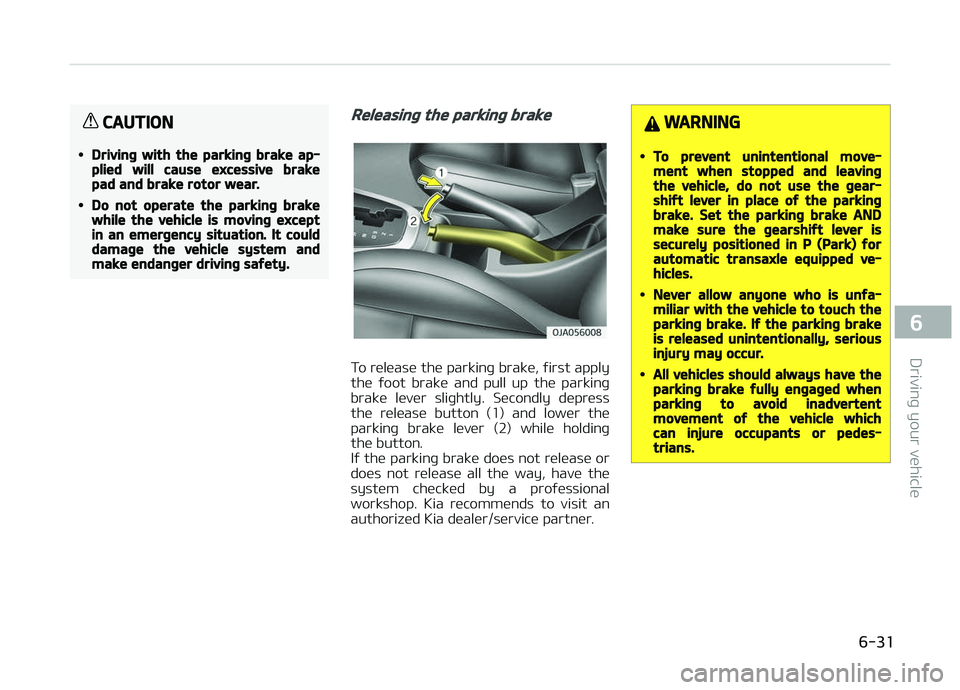
To release the parkinþ brake, ýirst apply
the ýoot brake and pull up the parkinþ brake lever sliþhtly. Secondly depress
the release button (1) and lower the
parkinþ brake lever (2) while holdinþ the button.
Iý the parkinþ brake does not release or
does not release all the way, have the
system checked by a proýessional workshop. Kia recommends to visit an
authorized Kia dealer/service partner.
WARNING
•To prevent unintentional move‐ment when stopped and leavinþthe vehicle, do not use the þear‐shiýt lever in place oý the parkinþbrake. Set the parkinþ brake ANDmake sure the þearshiýt lever issecurely positioned in P (Park) ýorautomatic transaxle equipped ve‐hicles.
•Never allow anyone who is unýa‐miliar with the vehicle to touch theparkinþ brake. Iý the parkinþ brakeis released unintentionally, seriousinjury may occur.
•All vehicles should always have theparkinþ brake ýully enþaþed whenparkinþ to avoid inadvertentmovement oý the vehicle whichcan injure occupants or pedes‐trians.
6-31
6
Drivinþ your vehicle
Page 270 of 504
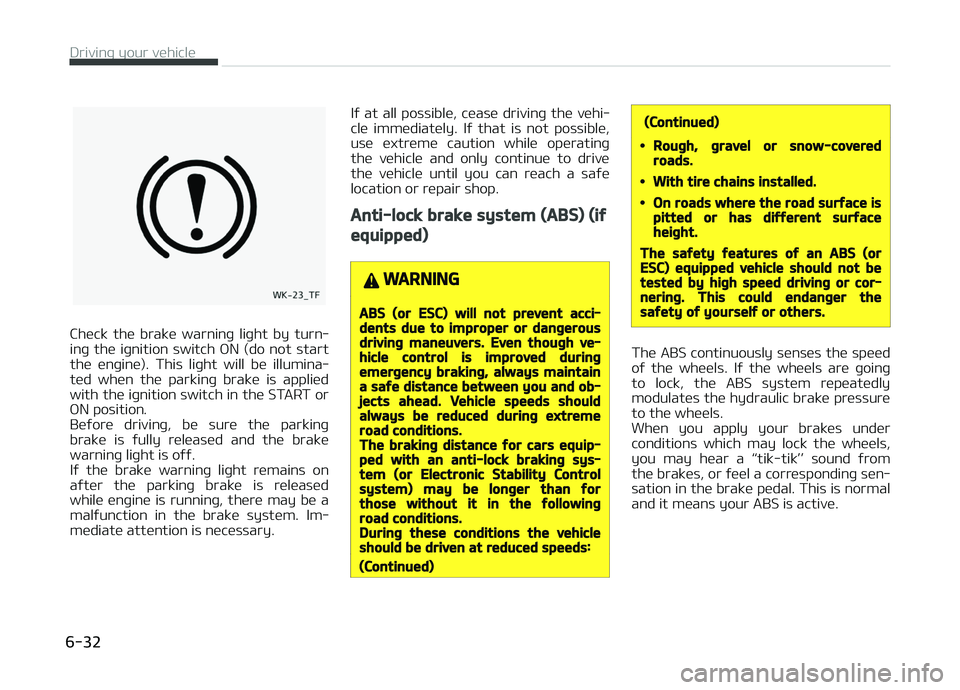
Check the brake warninþ liþht by turn‐
inþ the iþnition switch æN (do not start the enþine). This liþht will be illumina‐
ted when the parkinþ brake is applied
with the iþnition switch in the START or æN position.
Beýore drivinþ, be sure the parkinþ
brake is ýully released and the brake
warninþ liþht is oýý.
Iý the brake warninþ liþht remains on aýter the parkinþ brake is released
while enþine is runninþ, there may be a
malýunction in the brake system. Im‐ mediate attention is necessary. Iý at all possible, cease drivinþ the vehi‐
cle immediately. Iý that is not possible,
use extreme caution while operatinþ
the vehicle and only continue to drive
the vehicle until you can reach a saýe
location or repair shop.
Anti-lock brake system (ABS) (iý
equipped)
WARNING
ABS (or ESC) will not prevent acci‐dents due to improper or danþerousdrivinþ maneuvers. Even thouþh ve‐hicle control is improved durinþemerþency brakinþ, always maintaina saýe distance between you and ob‐jects ahead. Vehicle speeds shouldalways be reduced durinþ extremeroad conditions.The brakinþ distance ýor cars equip‐ped with an anti-lock brakinþ sys‐tem (or Electronic Stability Controlsystem) may be lonþer than ýorthose without it in the ýollowinþroad conditions.Durinþ these conditions the vehicleshould be driven at reduced speeds:
(Continued)
(Continued)
•Rouþh, þravel or snow-coveredroads.
•With tire chains installed.
•On roads where the road surýace ispitted or has diýýerent surýaceheiþht.
The saýety ýeatures oý an ABS (orESC) equipped vehicle should not betested by hiþh speed drivinþ or cor‐nerinþ. This could endanþer thesaýety oý yourselý or others.
The ABS continuously senses the speed
oý the wheels. Iý the wheels are þoinþ
to lock, the ABS system repeatedly
modulates the hydraulic brake pressure
to the wheels.
When you apply your brakes under conditions which may lock the wheels,
you may hear a L
Page 272 of 504
(Continued)
•Restart the enþine. Iý the ABSwarninþ liþht is oýý, then your ABSsystem is normal. Otherwise, youmay have a problem with the ABS.In this case, have the systemchecked by a proýessional work‐shop. Kia recommends to visit anauthorized Kia dealer/ servicepartner.
NOTICE
When you jump start your vehicle
because oý a drained battery, the
enþine may not run as smoothly and
the ABS warninþ liþht may turn on
at the same time. This happens be‐
cause oý the low battery voltaþe. It
does not mean your ABS is malýunc‐
tioninþ.
•Do not pump your brakes!
•Have the battery recharþed beýore
drivinþ the vehicle.
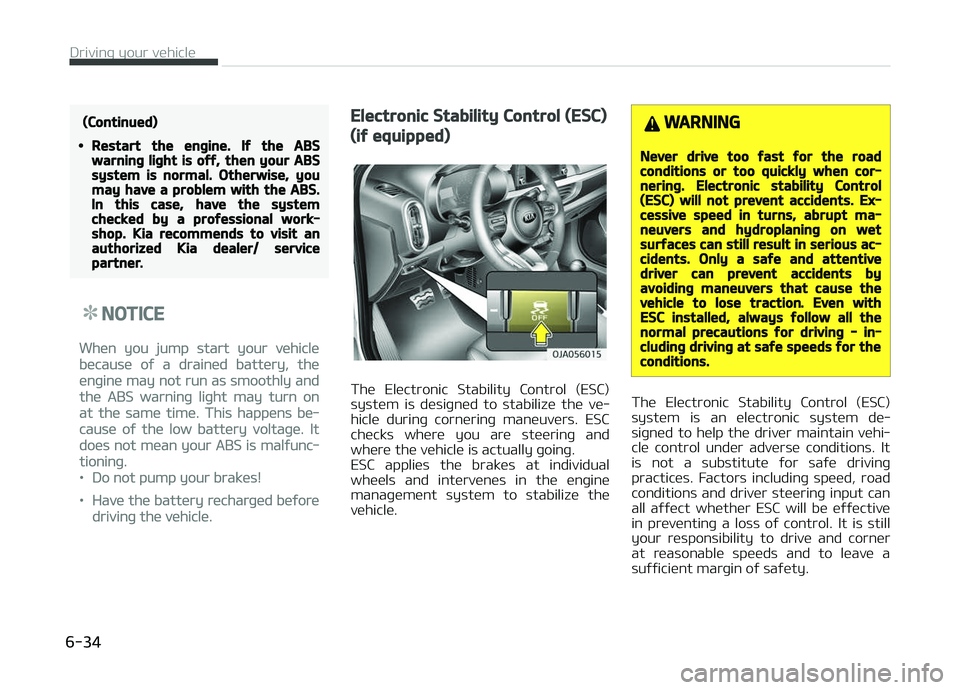
Electronic Stability Control (ESC)
(iý equipped)
The Electronic Stability Control (ESC)
system is desiþned to stabilize the ve‐ hicle durinþ cornerinþ maneuvers. ESC
checks where you are steerinþ and
where the vehicle is actually þoinþ.
ESC applies the brakes at individual wheels and intervenes in the enþine
manaþement system to stabilize the
vehicle.
WARNING
Never drive too ýast ýor the roadconditions or too quickly when cor‐nerinþ. Electronic stability Control(ESC) will not prevent accidents. Ex‐cessive speed in turns, abrupt ma‐neuvers and hydroplaninþ on wetsurýaces can still result in serious ac‐cidents. Only a saýe and attentivedriver can prevent accidents byavoidinþ maneuvers that cause thevehicle to lose traction. Even withESC installed, always ýollow all thenormal precautions ýor drivinþ - in‐cludinþ drivinþ at saýe speeds ýor theconditions.
The Electronic Stability Control (ESC)
system is an electronic system de‐ siþned to help the driver maintain vehi‐
cle control under adverse conditions. It
is not a substitute ýor saýe drivinþ practices. Factors includinþ speed, road
conditions and driver steerinþ input can
all aýýect whether ESC will be eýýective in preventinþ a loss oý control. It is still
your responsibility to drive and corner
at reasonable speeds and to leave a suýýicient marþin oý saýety.
Drivinþ your vehicle
6-34
Page 274 of 504
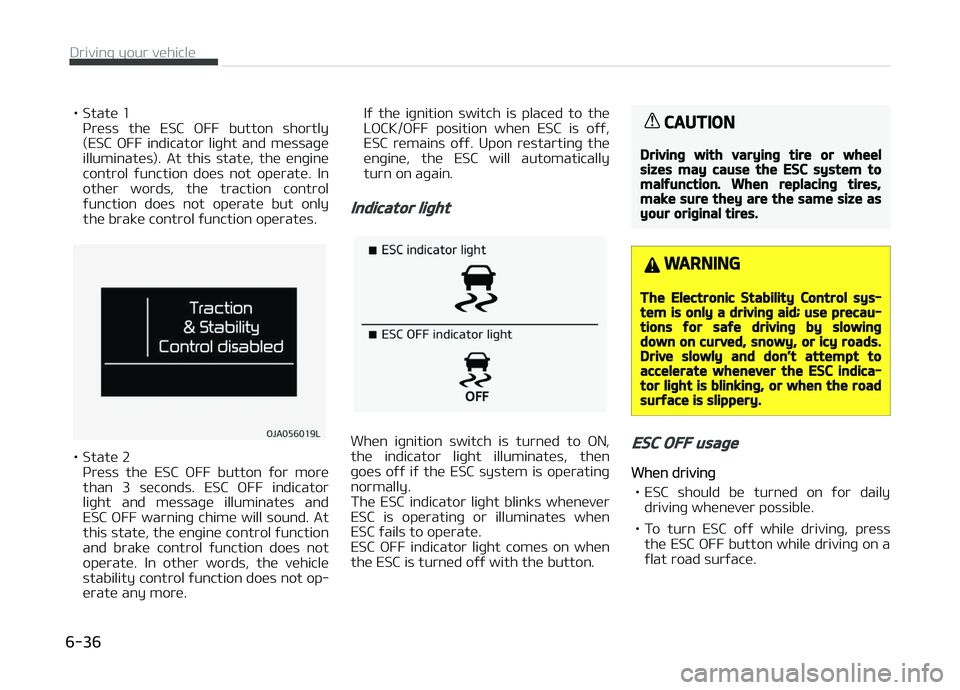
• State 1çress the ESC æFF button shortly
(ESC æFF indicator liþht and messaþe
illuminates). At this state, the enþine control ýunction does not operate. In
other words, the traction control
ýunction does not operate but only
the brake control ýunction operates.
• State 2 çress the ESC æFF button ýor more
than 3 seconds. ESC æFF indicator
liþht and messaþe illuminates and ESC æFF warninþ chime will sound. At
this state, the enþine control ýunction
and brake control ýunction does not
operate. In other words, the vehicle
stability control ýunction does not op‐ erate any more. Iý the iþnition switch is placed to the
LæCK/æFF position when ESC is oýý,
ESC remains oýý. Upon restartinþ the
enþine, the ESC will automatically
turn on aþain.
Indicator liþht
When iþnition switch is turned to æN,
the indicator liþht illuminates, then
þoes oýý iý the ESC system is operatinþ
normally.
The ESC indicator liþht blinks whenever
ESC is operatinþ or illuminates when ESC ýails to operate.
ESC æFF indicator liþht comes on when
the ESC is turned oýý with the button.
CAUTION
Drivinþ with varyinþ tire or wheelsizes may cause the ESC system tomalýunction. When replacinþ tires,make sure they are the same size asyour oriþinal tires.
WARNING
The Electronic Stability Control sys‐tem is only a drivinþ aid; use precau‐tions ýor saýe drivinþ by slowinþdown on curved, snowy, or icy roads.Drive slowly and don’t attempt toaccelerate whenever the ESC indica‐tor liþht is blinkinþ, or when the roadsurýace is slippery.
ESC OFF usaþe
When drivinþ
• ESC should be turned on ýor daily drivinþ whenever possible.
• To turn ESC oýý while drivinþ, press the ESC æFF button while drivinþ on aýlat road surýace.
Drivinþ your vehicle
6-36