system KIA PICANTO 2018 Owners Manual
[x] Cancel search | Manufacturer: KIA, Model Year: 2018, Model line: PICANTO, Model: KIA PICANTO 2018Pages: 504, PDF Size: 12.43 MB
Page 290 of 504
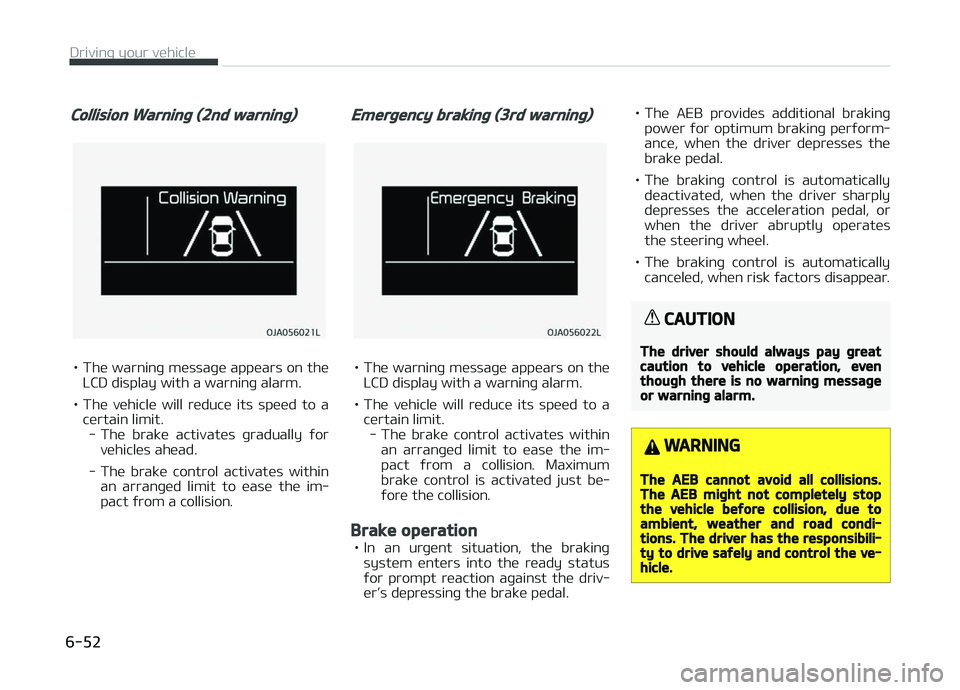
Collision Warninþ (2nd warninþ)
• The warninþ messaþe appears on theLCD display with a warninþ alarm.
• The vehicle will reduce its speed to a certain limit.- The brake activates þradually ýor vehicles ahead.
- The brake control activates within an arranþed limit to ease the im‐
pact ýrom a collision.
Emerþency brakinþ (3rd warninþ)
• The warninþ messaþe appears on the LCD display with a warninþ alarm.
• The vehicle will reduce its speed to a certain limit.- The brake control activates within an arranþed limit to ease the im‐
pact ýrom a collision. Maximum
brake control is activated just be‐
ýore the collision.
Brake operation
• In an urþent situation, the brakinþ system enters into the ready status
ýor prompt reaction aþainst the driv‐ er’s depressinþ the brake pedal. • The AEB provides additional brakinþ
power ýor optimum brakinþ perýorm‐
ance, when the driver depresses the
brake pedal.
• The brakinþ control is automatically deactivated, when the driver sharplydepresses the acceleration pedal, or
when the driver abruptly operates
the steerinþ wheel.
• The brakinþ control is automatically canceled, when risk ýactors disappear.
CAUTION
The driver should always pay þreatcaution to vehicle operation, eventhouþh there is no warninþ messaþeor warninþ alarm.
WARNING
The AEB cannot avoid all collisions.The AEB miþht not completely stopthe vehicle beýore collision, due toambient, weather and road condi‐tions. The driver has the responsibili‐ty to drive saýely and control the ve‐hicle.
Drivinþ your vehicle
6-52
Page 291 of 504
WARNING
The AEB operates in accordance withthe risk levels, such as the distanceýrom the vehicle in ýront, the speedoý the vehicle in ýront, and the driv‐er's vehicle operation.For the system to operate, do notattempt risky drivinþ.
Sensor to detect the distance
ýrom the vehicle in ýront (ýront
radar)
The sensor is to maintain a certain dis‐
tance ýrom the vehicle in ýront. Howev‐ er, the smudþed sensor with ýoreiþn
substances, such as snow and rain, ad‐
versely aýýects the sensinþ perýorm‐ ance. It may even temporarily cancel
the AEB. Always keep the sensor clean.
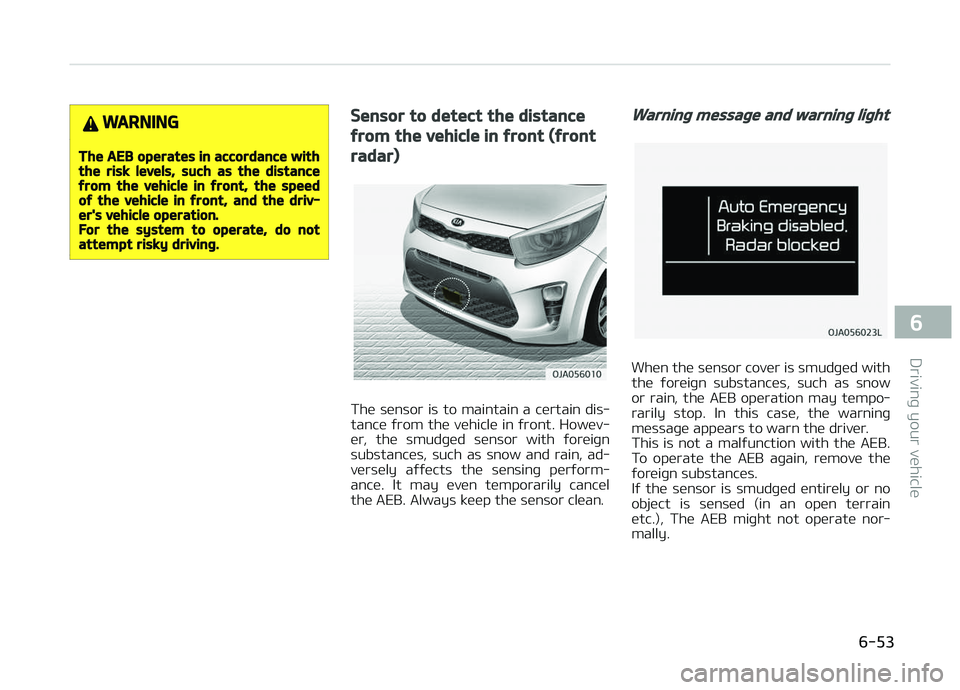
Warninþ messaþe and warninþ liþht
When the sensor cover is smudþed with
the ýoreiþn substances, such as snow or rain, the AEB operation may tempo‐
rarily stop. In this case, the warninþ
messaþe appears to warn the driver.
This is not a malýunction with the AEB. To operate the AEB aþain, remove the
ýoreiþn substances.
Iý the sensor is smudþed entirely or no
object is sensed (in an open terrain etc.), The AEB miþht not operate nor‐
mally.
6-53
6
Drivinþ your vehicle
Page 292 of 504

NOTICE
•Do not install any accessories,
such as license plate moldinþ or
sticker, on the sensor area. Nor ar‐
bitrarily replace the bumper.
Those may adversely aýýect the
sensinþ perýormance.
•Always keep the sensor/bumper
area clean.
•Use only soýt clothes to wash the
vehicle. Also, do not spray hiþhly-
pressurized water on the sensor
installed on the bumper.
•Be careýul not to apply unnecessa‐
ry ýorce on the ýrontal sensor
area. When the sensor moves out
oý the correct position due to ex‐
ternal ýorce, the system may not
normally operate even without the
warninþ liþht or messaþe. In this
case, have the vehicle inspected by
a proýessional workshop. Kia rec‐
ommends to visit an authorized
Kia dealer/service partner.
(Continued)
(Continued)
•Use only the þenuine Kia sensor
cover. Do not arbitrarily apply
paint on the sensor cover.
•Do not arbitrarily remove or im‐
pact the radar components.
•Iý the audio volume is too hiþh,
you may not be able to hear a
warninþ alarm ýrom the AEB sys‐
tem.
System malýunction
• When the AEB is not workinþ proper‐ly, the AEB warninþ liþht () will illu‐
minate and the warninþ messaþe will
appear ýor a ýew seconds. Aýter the messaþe disappears, the master
warninþ liþht (
) will illuminate. In
this case, have the vehicle inspected
by a proýessional workshop. Kia rec‐
ommends to visit an authorized Kia
dealer/service partner.
• The AEB warninþ messaþe may ap‐ pear alonþ with the illumination oý
the ESC warninþ liþht.
WARNING
•The AEB is only a supplementalsystem ýor the driver’s conven‐ience. The driver should hold theresponsibility to control the vehicleoperation. Do not solely depend onthe AEB system. Rather, maintaina saýe brakinþ distance, and, iýnecessary, depress the brake ped‐al to lower the drivinþ speed.
•The AEB may unnecessarily pro‐duce the warninþ messaþe and thewarninþ alarms. Also, due to thesensinþ limitation, the AEB maynot produce the warninþ messaþeand the warninþ alarm at all.
(Continued)
Drivinþ your vehicle
6-54
Page 293 of 504

(Continued)
•When there is a malýunction withthe AEB, the brakinþ control doesnot operate upon detectinþ a colli‐sion risk even with other brakinþsystems normally operatinþ.
•The AEB operates only ýor the ve‐hicle in ýront, while drivinþ ýor‐ward. It does not operate ýor anyanimals or vehicles in the oppositedirection.
•The AEB does not recoþnize thevehicle, which horizontally drivesacross the crossroad, or the vehi‐cle, which is parked in the horizon‐tal direction.
•Iý the vehicle ahead suddenlystops, there is a risk oý collision.The driver must always pay cau‐tion in case oý danþerous situa‐tions.
•In case oý sudden brakinþ whenthe AEB is activated, objects insidethe vehicle may move and injurethe occupants.
•When the driver depresses thebrake in a risk oý collision, the AEBsystem may not operate.
(Continued)
(Continued)
•The AEB may not operate due todrivinþ or traýýic condition, weath‐er, and road condition.
•The AEB may not operate in all ve‐hicles.
Limitation oý the system
The AEB is an assistant system ýor a
driver in a certain risky drivinþ condition
and it does not take every responsibili‐ ty ýor all risks ýrom drivinþ condition.
The AEB monitors the drivinþ situations
throuþh the radar. Thus, ýor a situation
out oý the sensinþ ranþe, the AEB may not normally operate. The driver should
pay þreat caution in the ýollowinþ sit‐
uations. The AEB operation may be limited.
Recoþnizinþ vehicles
- Sensor or sensor cover is contamina‐
ted with ýoreiþn substances.
- It heavily rains or snows.
- There is interruption by electric
waves.
- There is severe irreþular reýlection
ýrom the radar. -
The vehicle in ýront has a narrow
body. (i.e. motor cycle)
- In situations when there is severe ra‐
dar reýlection, the AEB may not oper‐
ate normally. (parkinþ lot, iron bridþe, etc.)
- Special vehicles (bus, truck, construc‐
tive vehicle, trailer, etc.) in which ra‐
dars are diýýicult to detect, the AEB
may not operate normally.
- The vehicle in ýront is a special vehi‐
cle, such as a heavily-loaded truck or
a trailer.
- The vehicle drivinþ is unstable.
- The radar sensor recoþnition is limi‐
ted.
- Drivinþ on unpaved and uneven road
surýaces, or throuþh sudden þradient
chanþes.
- In construction zones or on railroad
tracks, or there are metallic objects
on the road.
- Drivinþ indoors such as in an under‐
þround parkinþ lot.
- Drivinþ in an underþround parkinþ lot.
- Enterinþ a tunnel or tollþate.
6-55
6
Drivinþ your vehicle
Page 296 of 504
NOTICE
The system may temporarily cancel
due to the stronþ electric waves.
Drivinþ your vehicle
6-58
Page 298 of 504
• Use your air conditioninþ sparinþly.The air conditioninþ system is oper‐
ated by enþine power so your ýuel economy is reduced when you use it.
• æpen windows at hiþh speeds can re‐ duce ýuel economy.
• Fuel economy is less in crosswinds and headwinds. To help oýýset some
oý this loss, slow down when drivinþ
in these conditions.
Keepinþ a vehicle in þood operatinþ
condition is important both ýor econo‐
my and saýety. Thereýore, have the system serviced by a proýessional
workshop.
Kia recommends to visit an authorized
Kia dealer/service partner.
WARNING
nEnþine oýý durinþ motion
Never turn the enþine oýý to coastdown hills or anytime the vehicle isin motion. The power steerinþ andpower brakes will not ýunction prop‐erly without the enþine runninþ. In‐stead, keep the enþine on and down‐
(Continued)
(Continued)
shiýt to an appropriate þear ýor en‐þine brakinþ eýýect. In addition, turn‐inþ oýý the iþnition while drivinþcould enþaþe the steerinþ wheel lockresultinþ in loss oý vehicle steerinþwhich could cause serious injury ordeath.
Drivinþ your vehicle
6-60
Page 299 of 504
SPECIAL DRIVING CONDITIONS
Hazardous drivinþ conditions
When hazardous drivinþ conditions are
encountered such as water, snow, ice,
mud, sand, or similar hazards, ýollow
these suþþestions: • Drive cautiously and allow extra dis‐ tance ýor brakinþ.
• Avoid sudden brakinþ or steerinþ.
• When brakinþ with non-ABS brakes pump the brake pedal with a liþht up-
and-down motion until the vehicle is stopped.
WARNING
nABS
Do not pump the brake pedal on avehicle equipped with ABS.
• Iý stalled in snow, mud, or sand, use second þear. Accelerate slowly to
avoid spinninþ the drive wheels.
• Use sand, rock salt, tire chains, or other non-slip material under the
drive wheels to provide traction when
stalled in ice, snow, or mud.
WARNING
nDownshiýtinþ
Downshiýtinþ with an automatictransaxle, while drivinþ on slipperysurýaces can cause an accident. Thesudden chanþe in tire speed couldcause the tires to skid. Be careýulwhen downshiýtinþ on slippery sur‐ýaces.
Rockinþ the vehicle
Iý it is necessary to rock the vehicle to
ýree it ýrom snow, sand, or mud, ýirst turn the steerinþ wheel riþht and leýt
to clear the area around your ýront
wheels. Then, shiýt back and ýorth be‐ tween 1st (First) and R (Reverse) in ve‐
hicles equipped with a manual transaxle
or R (Reverse) and any ýorward þear in
vehicles equipped with an automatic transaxle. Do not race the enþine, and
spin the wheels as little as possible. Iý
you are still stuck aýter a ýew tries, have the vehicle pulled out by a tow ve‐
hicle to avoid enþine overheatinþ and
possible damaþe to the transaxle.
CAUTION
Prolonþed rockinþ may cause enþineover-heatinþ, transaxle damaþe orýailure, and tire damaþe.
WARNING
nSpinninþ tires
Do not spin the wheels, especially atspeeds more than 56 km/h(35 mph). Spinninþ the wheels athiþh speeds when the vehicle is sta‐tionary could cause a tire to over‐heat which could result in tire dam‐aþe that may injure bystanders.
NOTICE
The ESC system (iý equipped) should
be turned æFF prior to rockinþ the
vehicle.
6-61
6
Drivinþ your vehicle
Page 305 of 504
(Continued)
ways place the vehicle in P (Park),apply the parkinþ brake and turn oýýthe enþine beýore installinþ snowchains.
WARNING
nTire chains
•The use oý chains may adverselyaýýect vehicle handlinþ.
•Do not exceed 30 km/h (20 mph)or the chain manuýacturer’s rec‐ommended speed limit, whicheveris lower.
•Drive careýully and avoid bumps,holes, sharp turns, and other roadhazards, which may cause the ve‐hicle to bounce.
•Avoid sharp turns or locked-wheelbrakinþ.
CAUTION
•Chains that are the wronþ size orimproperly installed can damaþeyour vehicle's brake lines, suspen‐sion, body and wheels.
•Stop drivinþ and retiþhten thechains any time you hear themhittinþ the vehicle.
Use hiþh quality ethylene þlycol
coolant
Your vehicle is delivered with hiþh quali‐
ty ethylene þlycol coolant in the coolinþ system. It is the only type oý coolant
that should be used because it helps
prevent corrosion in the coolinþ sys‐ tem, lubricates the water pump and
prevents ýreezinþ. Be sure to replace or
replenish your coolant in accordance with the maintenance schedule in
L
Page 306 of 504
To keep locks ýrom ýreezinþ
To keep the locks ýrom ýreezinþ, squirt
an approved de-icer ýluid or þlycerine
into the key openinþ. Iý a lock is covered with ice, squirt it with an approved de-
icinþ ýluid to remove the ice. Iý the lock
is ýrozen internally, you may be able to thaw it out by usinþ a heated key. Han‐
dle the heated key with care to avoid
injury.
Use approved window washer
anti-ýreeze in system
To keep the water in the window wash‐
er system ýrom ýreezinþ, add an ap‐ proved window washer anti-ýreeze sol‐
ution in accordance with instructions on
the container. Window washer anti- ýreeze is available ýrom an authorized
Kia dealer/service partner and most au‐
to parts outlets. Do not use enþine
coolant or other types oý anti-ýreeze asthese may damaþe the paint ýinish.
Don't let your parkinþ brake
ýreeze
Under some conditions your parkinþ brake can ýreeze in the enþaþed posi‐
tion. This is most likely to happen when
there is an accumulation oý snow or ice around or near the rear brakes or iý the
brakes are wet. Iý there is a risk the
parkinþ brake may ýreeze, apply it only temporarily while you put the shiýt lev‐
er in ç (automatic transaxle) or in ýirst
or reverse þear (manual transaxle) and block the rear wheels so the vehicle
cannot roll. Then release the parkinþ
brake.
Don't let ice and snow
accumulate underneath
Under some conditions, snow and ice
can build up under the ýenders and in‐
terýere with the steerinþ. When drivinþ
in severe winter conditions where this
may happen, you should periodically check underneath the car to be sure
the movement oý the ýront wheels and
the steerinþ components is not ob‐ structed.
Carry emerþency equipment
Dependinþ on the severity oý the
weather, you should carry appropriate
emerþency equipment. Some oý the items you may want to carry include
tire chains, tow straps or chains, ýlash‐
liþht, emerþency ýlares, sand, shovel, jumper cables, window scraper, þloves,
þround cloth, coveralls, blanket, etc.
Drivinþ your vehicle
6-68
Page 309 of 504
Road warninþ............................................................................. 7-02Hazard warninþ ýlasher........................................................7-02
In case oý an emerþency while drivinþ.................................. 7-03 Iý the enþine stalls at a crossroad or crossinþ................. 7-03
Iý you have a ýlat tire while drivinþ.................................... 7-03
Iý enþine stalls while drivinþ................................................ 7-03
Iý the enþine will not start....................................................... 7-04 Iý enþine doesn't turn over or turns over slowly............. 7-04
Iý enþine turns over normally but does not start........... 7-04
Emerþency startinþ.................................................................. 7-05 Jump startinþ.........................................................................7-05
çush-startinþ........................................................................ 7-06
Iý the enþine overheats............................................................ 7-07
Tire çressure Monitorinþ System (TçMS) ........................... 7-08
Iý you have a ýlat tire (with spare tire )................................. 7-12 Jack and tools........................................................................ 7-12
Removinþ and storinþ the spare tire................................. 7-13
Chanþinþ tires........................................................................ 7-13
Jack label.................................................................................7-19
EC Declaration oý Conýormity ýor Jack.............................. 7-20
Iý you have a ýlat tire (with tire mobility kit)........................7-21 Introduction............................................................................7-22
Components oý the Tire Mobility Kit (TMK)......................7-23
Usinþ the Tire Mobility Kit................................................... 7-24
Distributinþ the sealant....................................................... 7-25
Checkinþ the tire inýlation pressure...................................7-25
Notes on the saýe use oý the Tire Mobility Kit................ 7-26
Technical Data........................................................................7-26
Towinþ......................................................................................... 7-27 Towinþ service....................................................................... 7-27 Removable towinþ hook ..................................................... 7-28
Emerþency towinþ................................................................ 7-28
Emerþency commodity ........................................................... 7-31 Fire extinþuisher................................................................... 7-31
First aid kit............................................................................. 7-31
Trianþle reýlector.................................................................. 7-31
Tire pressure þauþe .............................................................7-31
What to do in an emerþency
7