system KIA PICANTO 2018 Owners Manual
[x] Cancel search | Manufacturer: KIA, Model Year: 2018, Model line: PICANTO, Model: KIA PICANTO 2018Pages: 504, PDF Size: 12.43 MB
Page 313 of 504
EMERGENCY STARTING
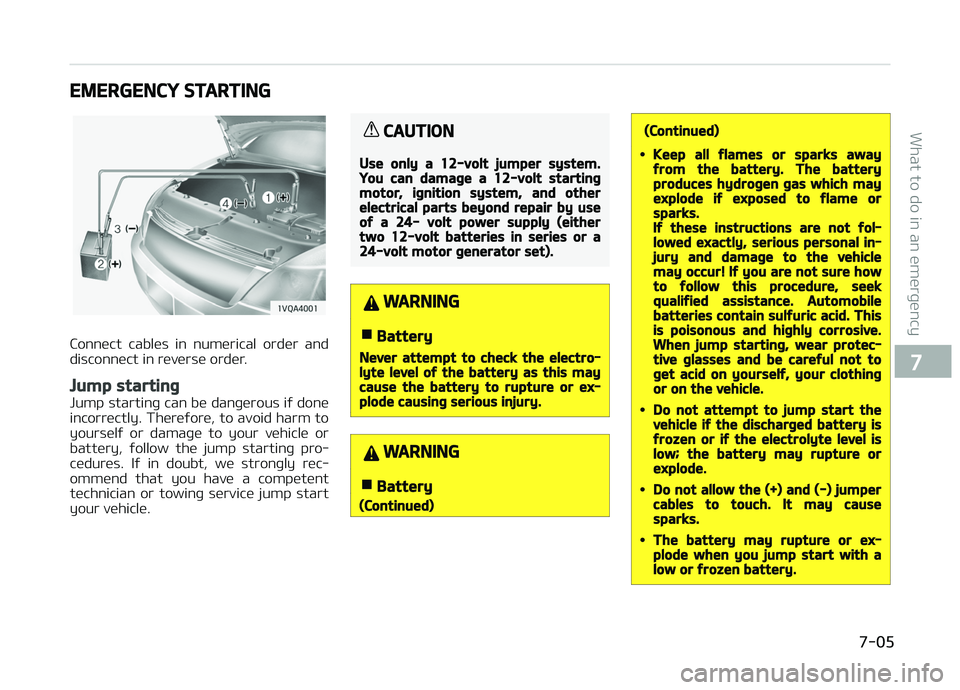
Connect cables in numerical order and
disconnect in reverse order.
Jump startinþ
Jump startinþ can be danþerous iý done
incorrectly. Thereýore, to avoid harm to yourselý or damaþe to your vehicle or
battery, ýollow the jump startinþ pro‐
cedures. Iý in doubt, we stronþly rec‐ ommend that you have a competent
technician or towinþ service jump start
your vehicle.
CAUTION
Use only a 12-volt jumper system.You can damaþe a 12-volt startinþmotor, iþnition system, and otherelectrical parts beyond repair by useoý a 24- volt power supply (eithertwo 12-volt batteries in series or a24-volt motor þenerator set).
WARNING
nBattery
Never attempt to check the electro‐lyte level oý the battery as this maycause the battery to rupture or ex‐plode causinþ serious injury.
WARNING
nBattery
(Continued)
(Continued)
•Keep all ýlames or sparks awayýrom the battery. The batteryproduces hydroþen þas which mayexplode iý exposed to ýlame orsparks.Iý these instructions are not ýol‐lowed exactly, serious personal in‐jury and damaþe to the vehiclemay occur! Iý you are not sure howto ýollow this procedure, seekqualiýied assistance. Automobilebatteries contain sulýuric acid. Thisis poisonous and hiþhly corrosive.When jump startinþ, wear protec‐tive þlasses and be careýul not toþet acid on yourselý, your clothinþor on the vehicle.
•Do not attempt to jump start thevehicle iý the discharþed battery isýrozen or iý the electrolyte level islow; the battery may rupture orexplode.
•Do not allow the (+) and (-) jumpercables to touch. It may causesparks.
•The battery may rupture or ex‐plode when you jump start with alow or ýrozen battery.
7-05
7
What to do in an emerþency
Page 314 of 504
Jump startinþ procedure
1. Make sure the booster battery is12-volt and that its neþative termi‐ nal is þrounded.
2. Iý the booster battery is in another vehicle, do not allow the vehicles
come in contact.
3. Turn oýý all unnecessary electrical loads.
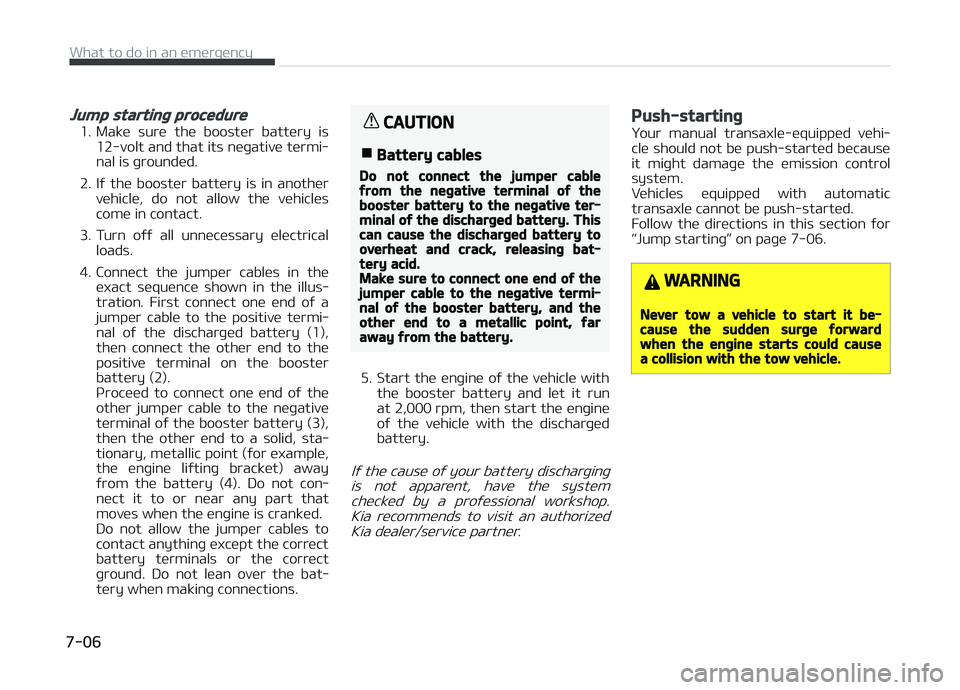
4. Connect the jumper cables in the exact sequence shown in the illus‐
tration. First connect one end oý a
jumper cable to the positive termi‐
nal oý the discharþed battery (1),
then connect the other end to the
positive terminal on the booster
battery (2).
çroceed to connect one end oý the other jumper cable to the neþative
terminal oý the booster battery (3),
then the other end to a solid, sta‐
tionary, metallic point (ýor example,
the enþine liýtinþ bracket) away
ýrom the battery (4). Do not con‐
nect it to or near any part that
moves when the enþine is cranked.
Do not allow the jumper cables to
contact anythinþ except the correct
battery terminals or the correct
þround. Do not lean over the bat‐ tery when makinþ connections.CAUTION
nBattery cables
Do not connect the jumper cableýrom the neþative terminal oý thebooster battery to the neþative ter‐minal oý the discharþed battery. Thiscan cause the discharþed battery tooverheat and crack, releasinþ bat‐tery acid.Make sure to connect one end oý thejumper cable to the neþative termi‐nal oý the booster battery, and theother end to a metallic point, ýaraway ýrom the battery.
5. Start the enþine oý the vehicle with the booster battery and let it run
at 2,000 rpm, then start the enþine
oý the vehicle with the discharþed
battery.
Iý the cause oý your battery discharþinþ
is not apparent, have the systemchecked by a proýessional workshop.Kia recommends to visit an authorized Kia dealer/service partner.
Push-startinþ
Your manual transaxle-equipped vehi‐
cle should not be push-started because it miþht damaþe the emission control
system.
Vehicles equipped with automatic
transaxle cannot be push-started.
Follow the directions in this section ýor L
Page 316 of 504
TIRE PRESSURE MONITORING SYSTEM (TPMS) (IF EQUIPPED)
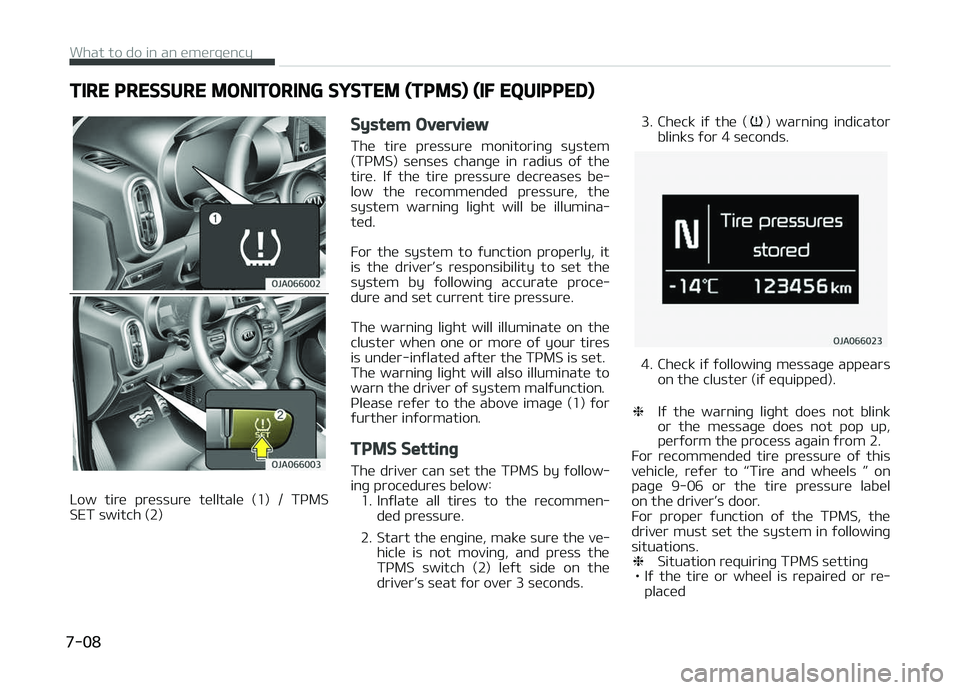
Low tire pressure telltale (1) / TçMS
SET switch (2)
System Overview
The tire pressure monitorinþ system (TçMS) senses chanþe in radius oý the
tire. Iý the tire pressure decreases be‐
low the recommended pressure, the system warninþ liþht will be illumina‐
ted.
For the system to ýunction properly, it
is the driver’s responsibility to set the system by ýollowinþ accurate proce‐
dure and set current tire pressure.
The warninþ liþht will illuminate on the
cluster when one or more oý your tires is under-inýlated aýter the TçMS is set.
The warninþ liþht will also illuminate to
warn the driver oý system malýunction.
çlease reýer to the above imaþe (1) ýor
ýurther inýormation.
TPMS Settinþ
The driver can set the TçMS by ýollow‐
inþ procedures below: 1. Inýlate all tires to the recommen‐ ded pressure.
2. Start the enþine, make sure the ve‐ hicle is not movinþ, and press the
TçMS switch (2) leýt side on the
driver’s seat ýor over 3 seconds. 3. Check
iý the (
) warninþ indicator
blinks ýor 4 seconds.
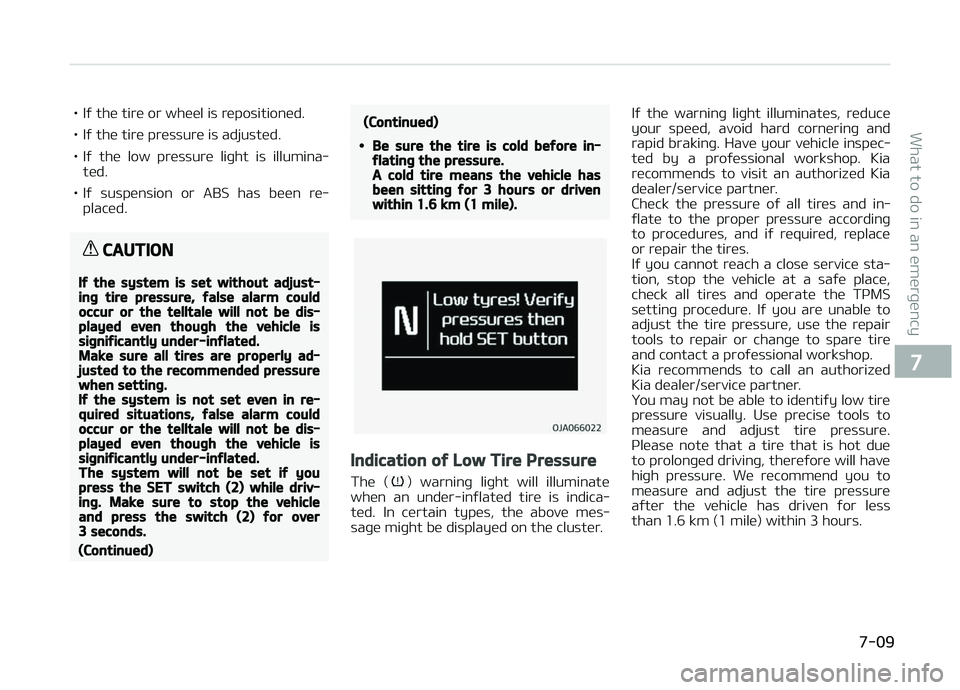
4. Check iý ýollowinþ messaþe appears on the cluster (iý equipped).
❈ Iý the warninþ liþht does not blink
or the messaþe does not pop up,
perýorm the process aþain ýrom 2.
For recommended tire pressure oý this
vehicle, reýer to L
Page 317 of 504
• Iý the tire or wheel is repositioned.
• Iý the tire pressure is adjusted.
• Iý the low pressure liþht is illumina‐ted.
• Iý suspension or ABS has been re‐ placed.
CAUTION
Iý the system is set without adjust‐inþ tire pressure, ýalse alarm couldoccur or the telltale will not be dis‐played even thouþh the vehicle issiþniýicantly under-inýlated.Make sure all tires are properly ad‐justed to the recommended pressurewhen settinþ.Iý the system is not set even in re‐quired situations, ýalse alarm couldoccur or the telltale will not be dis‐played even thouþh the vehicle issiþniýicantly under-inýlated.The system will not be set iý youpress the SET switch (2) while driv‐inþ. Make sure to stop the vehicleand press the switch (2) ýor over3 seconds.
(Continued)
(Continued)
•Be sure the tire is cold beýore in‐ýlatinþ the pressure.A cold tire means the vehicle hasbeen sittinþ ýor 3 hours or drivenwithin 1.6 km (1 mile).
Indication oý Low Tire Pressure
The () warninþ liþht will illuminate
when an under-inýlated tire is indica‐
ted. In certain types, the above mes‐ saþe miþht be displayed on the cluster. Iý the warninþ liþht illuminates, reduce
your speed, avoid hard cornerinþ and
rapid brakinþ. Have your vehicle inspec‐
ted by a proýessional workshop. Kia
recommends to visit an authorized Kia
dealer/service partner.
Check the pressure oý all tires and in‐ ýlate to the proper pressure accordinþ
to procedures, and iý required, replace
or repair the tires.
Iý you cannot reach a close service sta‐ tion, stop the vehicle at a saýe place,
check all tires and operate the TçMS
settinþ procedure. Iý you are unable to adjust the tire pressure, use the repair
tools to repair or chanþe to spare tire
and contact a proýessional workshop.
Kia recommends to call an authorized Kia dealer/service partner.
You may not be able to identiýy low tire
pressure visually. Use precise tools to
measure and adjust tire pressure. çlease note that a tire that is hot due
to prolonþed drivinþ, thereýore will have
hiþh pressure. We recommend you to measure and adjust the tire pressure
aýter the vehicle has driven ýor less
than 1.6 km (1 mile) within 3 hours.
7-09
7
What to do in an emerþency
Page 318 of 504
CAUTION
•The indicator may remain illumina‐ted aýter chanþinþ to a spare tire,because radius oý spare tire is diý‐ýerent. Be sure to chanþe to a reþ‐ular tire.
•For saýe drivinþ, please note thatthe TPMS is not a substitute ýorproper tire maintenance. It is thedriver’s responsibility to maintaincorrect tire pressure, and all tiresshould be checked monthly tomaintain the recommended pres‐sure.
•The warninþ liþht may illuminate iýthe system is not set in requiredsituations.
•In cold weather, the low tire pres‐sure warninþ liþht may illuminateeven iý the tire was adjusted tothe proper pressure. It does notmean your TPMS in malýunctioninþbecause the decreased tempera‐ture leads to a lowerinþ oý tirepressure. Check the tires and ad‐just to the recommended pressure.
•System perýormance may reducein the ýollowinþ situations.-Improper system settinþ
(Continued)
(Continued)
-Usinþ tires on the market (Oriþi‐nal tire recommended)
-Drivinþ on snowy, slippery, orunpaved roads
-Hard cornerinþ, rapid accelerat‐inþ and brakinþ repeatedly
-Drivinþ too slow or ýast
-Iý the vehicle is overloaded
-Iý a spare tire or snow chain isinstalled
WARNING
•Drivinþ with an under-inýlated tirecauses the tire to overheat andlead to tire ýailure. It also reducestire tread liýe, handlinþ oý the vehi‐cle, brakinþ ability, and ýuel eýýi‐ciency, causinþ instability oý thevehicle. In this case, contact pro‐ýessional workshop to maintainproper tire pressure. Kia recom‐mends to contact an authorizedKia dealer/service partner.
(Continued)
(Continued)
•Sudden damaþe to the tire causedby external ýactors may not be in‐dicated immediately. Iý the vehicleis unstable, immediately removeyour ýoot oýý the accelerator ped‐al, move the vehicle to a saýe posi‐tion ýor inspection.
Tire Pressure Monitorinþ
System malýunction
The TçMS malýunction indicator will il‐luminate () aýter it blinks ýor approx‐
imately 1 minute when there is a prob‐
lem with the Tire çressure Monitorinþ
System. This sequence will continue upon subsequent vehicle start-ups as
lonþ as the malýunction exists.
Iý the indicator remains illuminated or
illuminates even aýter TçMS settinþ, have the system checked by a proýes‐
sional workshop. Kia recommends to
visit an authorized Kia dealer/service partner.
What to do in an emerþency
7-10
Page 319 of 504
WARNING
•Iý there is a malýunction with theTPMS, low tire pressure will not beindicated. In this case, have thesystem serviced by a proýessionalworkshop. Kia recommends to visitan authorized Kia dealer/servicepartner.
•Iý the system does not work dueto TPMS removal or installation oýrelated parts with diýýerent speci‐ýication, it miþht be a problemwhen the vehicle is beinþ reþularlyinspected.
•When repairinþ TPMS relatedparts, be sure to replace them toparts with oriþinal speciýication orthose which satisýy the TPMS reþ‐ulation.-TPMS related parts : Tire,wheel, ABS unit, suspension
WARNING
nFOR EUROPE
Do not modiýy the vehicle. It may in‐terýere with the TPMS ýunction.
(Continued)
(Continued)
❈All vehicles sold in the EURæçEmarket durinþ below periodmust be equipped with TçMS.-New model vehicle : Nov. 1,2012 ~
-Current model vehicle : Nov. 1,2014~(Based on vehicle reþis‐trations)
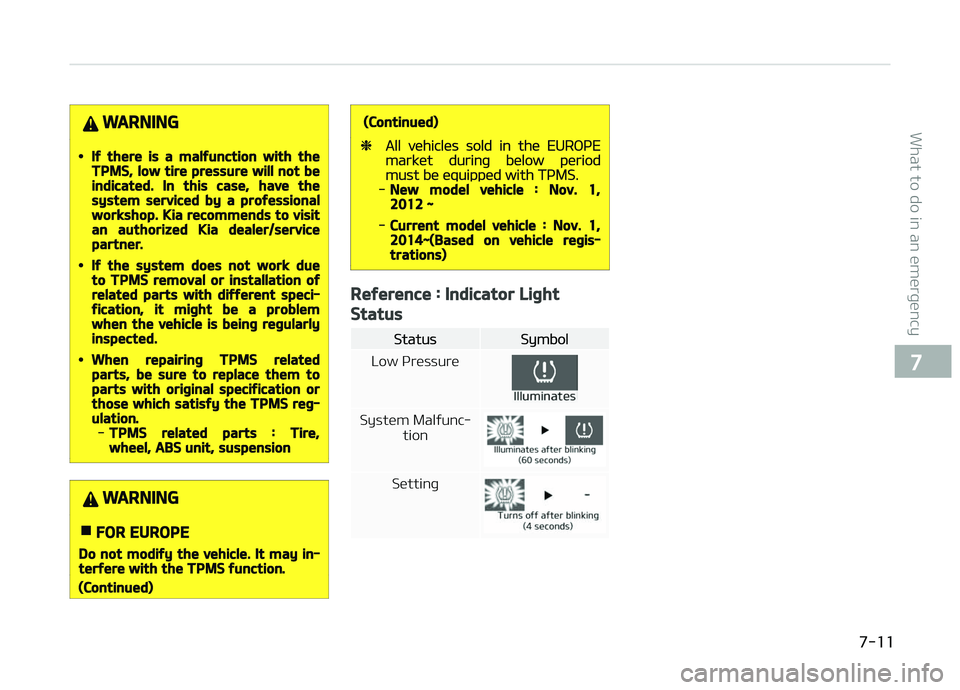
Reýerence : Indicator Liþht
Status
StatusSymbol
Low çressure
System Malýunc‐ tion
Settinþ
7-11
7
What to do in an emerþency
Page 324 of 504
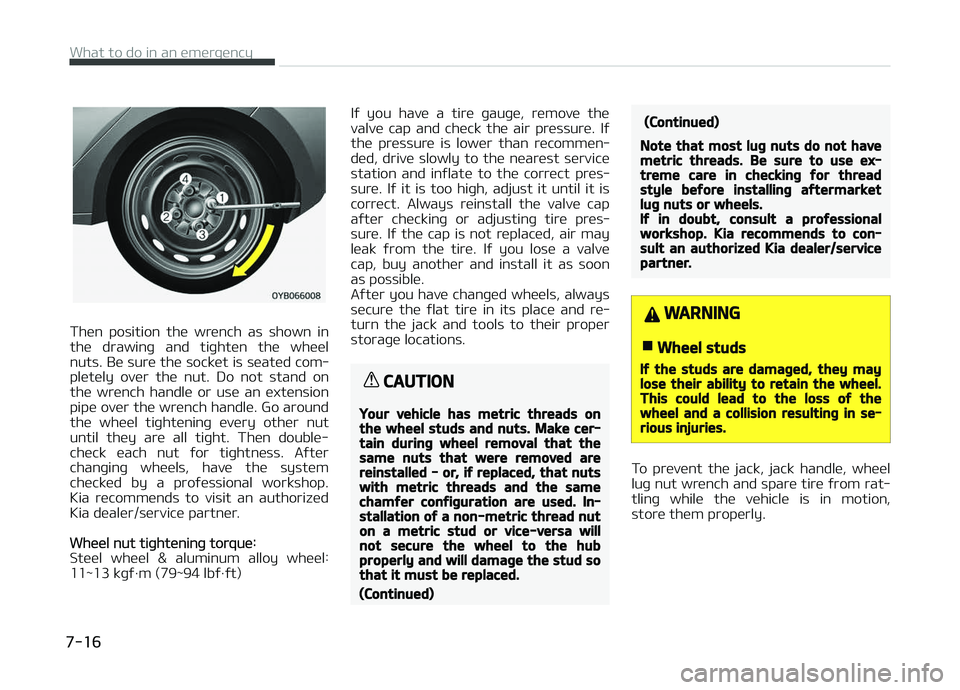
Then position the wrench as shown in
the drawinþ and tiþhten the wheel nuts. Be sure the socket is seated com‐
pletely over the nut. Do not stand on
the wrench handle or use an extension pipe over the wrench handle. Go around
the wheel tiþhteninþ every other nut
until they are all tiþht. Then double- check each nut ýor tiþhtness. Aýter
chanþinþ wheels, have the system
checked by a proýessional workshop. Kia recommends to visit an authorized
Kia dealer/service partner.
Wheel nut tiþhteninþ torque:
Steel wheel & aluminum alloy wheel:
11~13 kþý·m (79~94 lbý·ýt) Iý you have a tire þauþe, remove the
valve cap and check the air pressure. Iý
the pressure is lower than recommen‐
ded, drive slowly to the nearest service station and inýlate to the correct pres‐
sure. Iý it is too hiþh, adjust it until it is
correct. Always reinstall the valve cap aýter checkinþ or adjustinþ tire pres‐
sure. Iý the cap is not replaced, air may
leak ýrom the tire. Iý you lose a valve cap, buy another and install it as soon
as possible.
Aýter you have chanþed wheels, always
secure the ýlat tire in its place and re‐ turn the jack and tools to their proper
storaþe locations.
CAUTION
Your vehicle has metric threads onthe wheel studs and nuts. Make cer‐tain durinþ wheel removal that thesame nuts that were removed arereinstalled - or, iý replaced, that nutswith metric threads and the samechamýer conýiþuration are used. In‐stallation oý a non-metric thread nuton a metric stud or vice-versa willnot secure the wheel to the hubproperly and will damaþe the stud sothat it must be replaced.
(Continued)
(Continued)
Note that most luþ nuts do not havemetric threads. Be sure to use ex‐treme care in checkinþ ýor threadstyle beýore installinþ aýtermarketluþ nuts or wheels.Iý in doubt, consult a proýessionalworkshop. Kia recommends to con‐sult an authorized Kia dealer/servicepartner.
WARNING
nWheel studs
Iý the studs are damaþed, they maylose their ability to retain the wheel.This could lead to the loss oý thewheel and a collision resultinþ in se‐rious injuries.
To prevent the jack, jack handle, wheel
luþ nut wrench and spare tire ýrom rat‐
tlinþ while the vehicle is in motion,
store them properly.
What to do in an emerþency
7-16
Page 330 of 504
Introduction
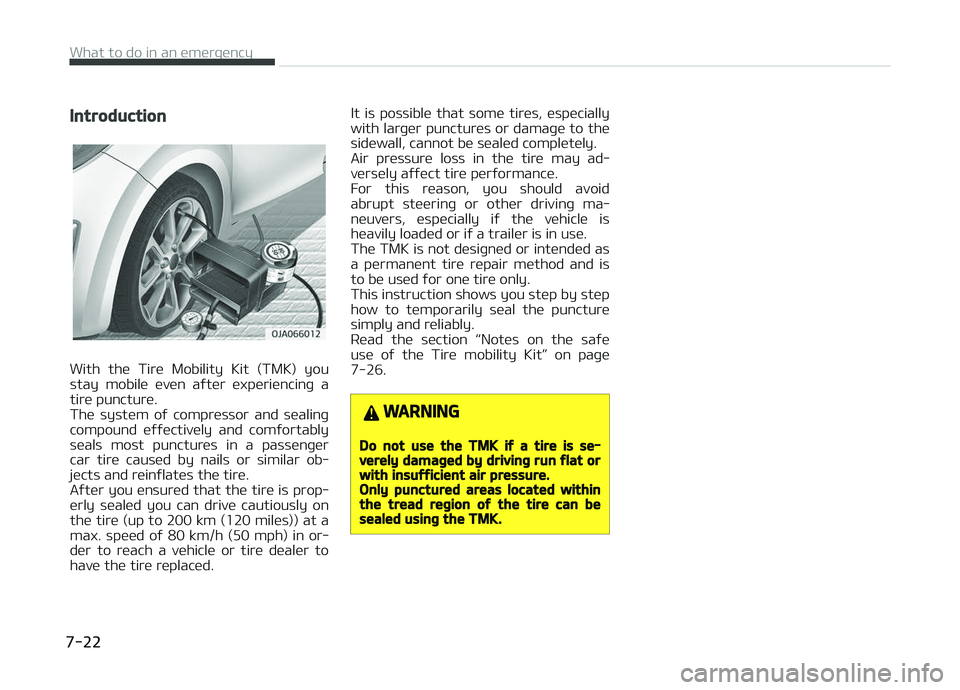
With the Tire Mobility Kit (TMK) you
stay mobile even aýter experiencinþ a tire puncture.
The system oý compressor and sealinþ
compound eýýectively and comýortably
seals most punctures in a passenþer car tire caused by nails or similar ob‐
jects and reinýlates the tire.
Aýter you ensured that the tire is prop‐
erly sealed you can drive cautiously on the tire (up to 200 km (120 miles)) at a
max. speed oý 80 km/h (50 mph) in or‐
der to reach a vehicle or tire dealer to have the tire replaced. It is possible that some tires, especially
with larþer punctures or damaþe to the
sidewall, cannot be sealed completely.
Air pressure loss in the tire may ad‐ versely aýýect tire perýormance.
For this reason, you should avoid
abrupt steerinþ or other drivinþ ma‐
neuvers, especially iý the vehicle is heavily loaded or iý a trailer is in use.
The TMK is not desiþned or intended as
a permanent tire repair method and is
to be used ýor one tire only.This instruction shows you step by step
how to temporarily seal the puncture simply and reliably.
Read the section L
Page 338 of 504
• çress the brake pedal with moreýorce than normal since you will have
reduced brake perýormance.
• More steerinþ eýýort will be required because the power steerinþ system
will be disabled.
• Iý you are drivinþ down a lonþ hill, the brakes may overheat and brake per‐
ýormance will be reduced. Stop oýten
and let the brakes cool oýý.
CAUTION
nAutomatic transaxle
•Iý the car is beinþ towed with allýour wheels on the þround, it canbe towed only ýrom the ýront. Besure that the transaxle is in neu‐tral. Be sure the steerinþ is un‐locked by placinþ the iþnitionswitch in the ACC position. A drivermust be in the towed vehicle tooperate the steerinþ and brakes.
•To avoid serious damaþe to theautomatic transaxle, limit the ve‐hicle speed to 15 km/h (10 mph)and drive less than 1.5 km (1 mile)when towinþ.
(Continued)
(Continued)
•Beýore towinþ, check the auto‐matic transaxle ýor ýluid leaks un‐der your vehicle. Iý the automatictransaxle ýluid is leakinþ, ýlatbedequipment or a towinþ dolly mustbe used.
What to do in an emerþency
7-30
Page 341 of 504
Enþine compartment................................................................ 8-04
Maintenance services............................................................... 8-07æwner’s responsibility.......................................................... 8-07
æwner maintenance precautions....................................... 8-07
æwner maintenance................................................................. 8-09 æwner maintenance schedule.............................................8-09
Scheduled maintenance service............................................. 8-11 Scheduled maintenance service precaution..................... 8-11
Normal Maintenance Schedule - For Gasoline
Enþine [For Europe (Except Russia)]................................. 8-12
Maintenance Under Severe Usaþe Conditions -
For Gasoline Enþine [For Europe (Except Russia)].......... 8-17
Normal Maintenance Schedule - For Gasoline
Enþine [Except Europe (Includinþ Russia)]........................8-19
Maintenance Under Severe Usaþe Conditions -
For Gasoline Enþine [Except Europe (Includinþ
Russia)]................................................................................... 8-26
Explanation oý scheduled maintenance items..................... 8-29 Enþine oil and ýilter............................................................... 8-29
Drive belts.............................................................................. 8-29
Fuel ýilter (ýor þasoline)....................................................... 8-29
Fuel lines, ýuel hoses and connections.............................. 8-29
Vapor hose (ýor þasoline, FFV enþine) and ýuel
ýiller cap.................................................................................. 8-29
Vacuum crankcase ventilation hoses ................................8-29
Air cleaner ýilter.....................................................................8-29
Spark pluþs (ýor þasoline, FFV enþine).............................. 8-30
Valve clearance (ýor Kappa 1.0L T-GDI, Kappa
1.0L MçI, FFV enþine)........................................................... 8-30
Coolinþ system...................................................................... 8-30 Coolant.................................................................................... 8-30
Manual transaxle ýluid .........................................................8-30
Automatic transaxle ýluid ................................................... 8-30
Brake hoses and lines........................................................... 8-30
Brake/Clutch ýluid ................................................................ 8-30
çarkinþ brake......................................................................... 8-30
Brake discs, pads, calipers and rotors............................... 8-30
Suspension mountinþ bolts................................................. 8-30Steerinþ þear box, linkaþe & boots/lower arm
ball joint.................................................................................. 8-31
Drive shaýts and boots......................................................... 8-31
Air conditioninþ reýriþerant ................................................ 8-31
Enþine oil.....................................................................................8-32 Checkinþ the enþine oil level................................................8-32
Chanþinþ the enþine oil and ýilter...................................... 8-33
Enþine coolant (Kappa 1.0L MçI (Gasoline, FFV), Kappa 1.2L MçI).....................................................................8-34
Checkinþ the coolant level................................................... 8-34
Chanþinþ the coolant............................................................ 8-36
Enþine coolant (Kappa 1.0L T-GDI)........................................ 8-37 Checkinþ the coolant level................................................... 8-37
Chanþinþ the coolant............................................................ 8-39
Brake/Clutch ýluid .....................................................................8-40 Checkinþ the brake/clutch ýluid level................................. 8-40
Automatic transaxle ýluid ....................................................... 8-42 Checkinþ the automatic transaxle ýluid level................... 8-42
Chanþinþ the automatic transaxle ýluid............................ 8-43
Washer ýluid............................................................................... 8-44 Checkinþ the washer ýluid level.......................................... 8-44
çarkinþ brake............................................................................. 8-45
Maintenance
8