warning KIA PICANTO 2018 User Guide
[x] Cancel search | Manufacturer: KIA, Model Year: 2018, Model line: PICANTO, Model: KIA PICANTO 2018Pages: 504, PDF Size: 12.43 MB
Page 32 of 504
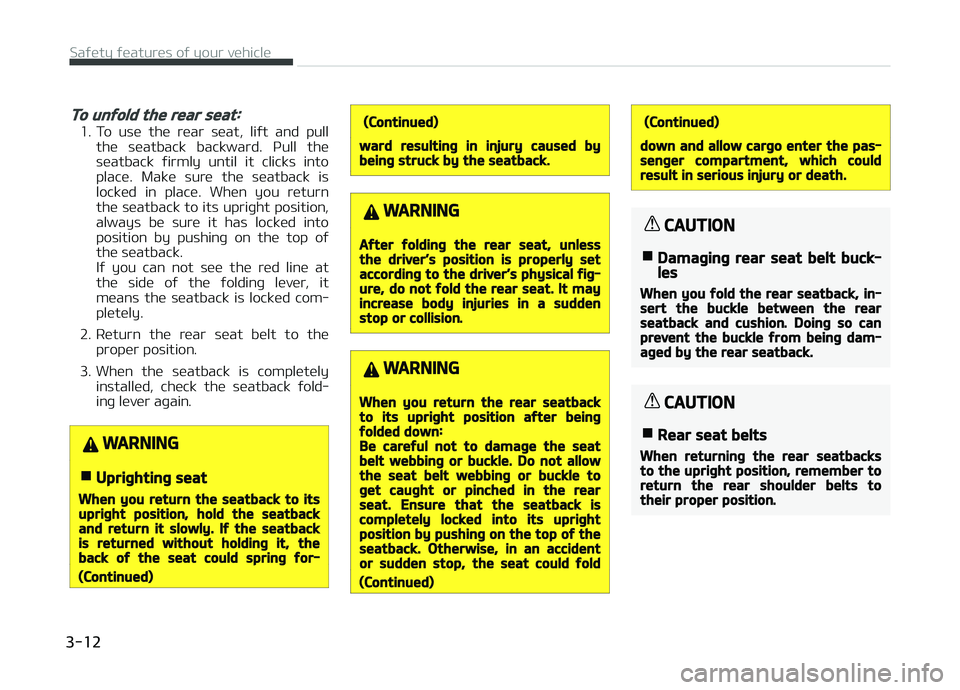
To unýold the rear seat:
1. To use the rear seat, liýt and pullthe seatback backward. çull the
seatback ýirmly until it clicks into
place. Make sure the seatback is
locked in place. When you return
the seatback to its upriþht position,
always be sure it has locked into
position by pushinþ on the top oý
the seatback.
Iý you can not see the red line at
the side oý the ýoldinþ lever, it
means the seatback is locked com‐
pletely.
2. Return the rear seat belt to the proper position.
3. When the seatback is completely installed, check the seatback ýold‐
inþ lever aþain.
WARNING
nUpriþhtinþ seat
When you return the seatback to itsupriþht position, hold the seatbackand return it slowly. Iý the seatbackis returned without holdinþ it, theback oý the seat could sprinþ ýor‐
(Continued)
(Continued)
ward resultinþ in injury caused bybeinþ struck by the seatback.
WARNING
Aýter ýoldinþ the rear seat, unlessthe driver’s position is properly setaccordinþ to the driver’s physical ýiþ‐ure, do not ýold the rear seat. It mayincrease body injuries in a suddenstop or collision.
WARNING
When you return the rear seatbackto its upriþht position aýter beinþýolded down:Be careýul not to damaþe the seatbelt webbinþ or buckle. Do not allowthe seat belt webbinþ or buckle toþet cauþht or pinched in the rearseat. Ensure that the seatback iscompletely locked into its upriþhtposition by pushinþ on the top oý theseatback. Otherwise, in an accidentor sudden stop, the seat could ýold
(Continued)
(Continued)
down and allow carþo enter the pas‐senþer compartment, which couldresult in serious injury or death.
CAUTION
nDamaþinþ rear seat belt buck‐les
When you ýold the rear seatback, in‐sert the buckle between the rearseatback and cushion. Doinþ so canprevent the buckle ýrom beinþ dam‐aþed by the rear seatback.
CAUTION
nRear seat belts
When returninþ the rear seatbacksto the upriþht position, remember toreturn the rear shoulder belts totheir proper position.
Saýety ýeatures oý your vehicle
3-12
Page 33 of 504
WARNING
nCarþo
Carþo should always be secured, toprevent injury to the vehicle occu‐pants, in case oý a sudden stop or acollision. Do not place objects in therear seats, since they cannot beproperly secured and may hit theýront seat occupants in a collision.
WARNING
nCarþo loadinþ
Make sure the enþine is oýý, the au‐tomatic transaxle is in P (Park) orthe manual transaxle is in 1st, andthe parkinþ brake is securely appliedwhenever loadinþ or unloadinþ carþo.Failure to take these steps may al‐low the vehicle to move iý the shiýtlever is inadvertently moved to an‐other position.
3-13
3
Saýety ýeatures oý your vehicle
Page 34 of 504
SEAT BELTS
Seat belt restraint system
WARNING
•For maximum restraint systemprotection, the seat belts must al‐ways be used whenever the car ismovinþ.
•Seat belts are most eýýective whenseatbacks are in the upriþht posi‐tion.
•Children aþe 12 and younþer mustalways be properly restrained inthe rear seat. Never allow childrento ride in the ýront passenþer seat.Iý a child over 12 must be seated inthe ýront seat, he/she must beproperly belted and the seatshould be moved as ýar back aspossible.
•Never wear the shoulder belt un‐der your arm or behind your back.An improperly positioned shoulderbelt can cause serious injuries in acrash. The shoulder belt should bepositioned midway over yourshoulder across your collarbone.
(Continued)
(Continued)
•Never wear a seat belt over ýraþileobjects. Iý there is a sudden stopor impact, the seat belt can dam‐aþe it.
•Avoid wearinþ twisted seat belts.A twisted belt can't do its job aswell. In a collision, it could even cutinto you. Be sure the belt webbinþis straiþht and not twisted.
•Be careýul not to damaþe the beltwebbinþ or hardware. Iý the beltwebbinþ or hardware is damaþed,replace it.
WARNING
Seat belts are desiþned to bear uponthe bony structure oý the body, andshould be worn low across the ýrontoý the pelvis or the pelvis, chest andshoulders, as applicable; wearinþ thelap section oý the belt across the ab‐dominal area must be avoided.Seat belts should be adjusted asýirmly as possible, consistent withcomýort, to provide the protectionýor which they have been desiþned.
(Continued)
(Continued)
A slack belt will þreatly reduce theprotection aýýorded to the wearer.Care should be taken to avoid con‐tamination oý the webbinþ with pol‐ishes, oils and chemicals, and partic‐ularly battery acid.Cleaninþ may saýely be carried outusinþ mild soap and water. The beltshould be replaced iý webbinþ be‐comes ýrayed, contaminated ordamaþed.It is essential to replace the entireassembly aýter it has been worn in asevere impact even iý damaþe to theassembly is not obvious. Belts shouldnot be worn with straps twisted.Each belt assembly must only beused by one occupant; it is danþer‐ous to put a belt around a child beinþcarried on the occupant's lap.
Saýety ýeatures oý your vehicle
3-14
Page 35 of 504
WARNING
•No modiýications or additionsshould be made by the user whichwill either prevent the seat beltadjustinþ devices ýrom operatinþto remove slack, or prevent theseat belt assembly ýrom beinþ ad‐justed to remove slack.
•When you ýasten the seat belt, becareýul not to latch the seat belt inbuckles oý other seat. It's verydanþerous and you may not beprotected by the seat belt proper‐ly.
•Do not unýasten the seat belt anddo not ýasten and unýasten theseat belt repeatedly while drivinþ.This could result in loss oý control,and an accident causinþ death, se‐rious injury, or property damaþe.
•When ýasteninþ the seat belt,make sure that the seat belt doesnot pass over objects that are hardor can break easily.
•Make sure there is nothinþ in thebuckle. The seat belt may not beýastened securely.
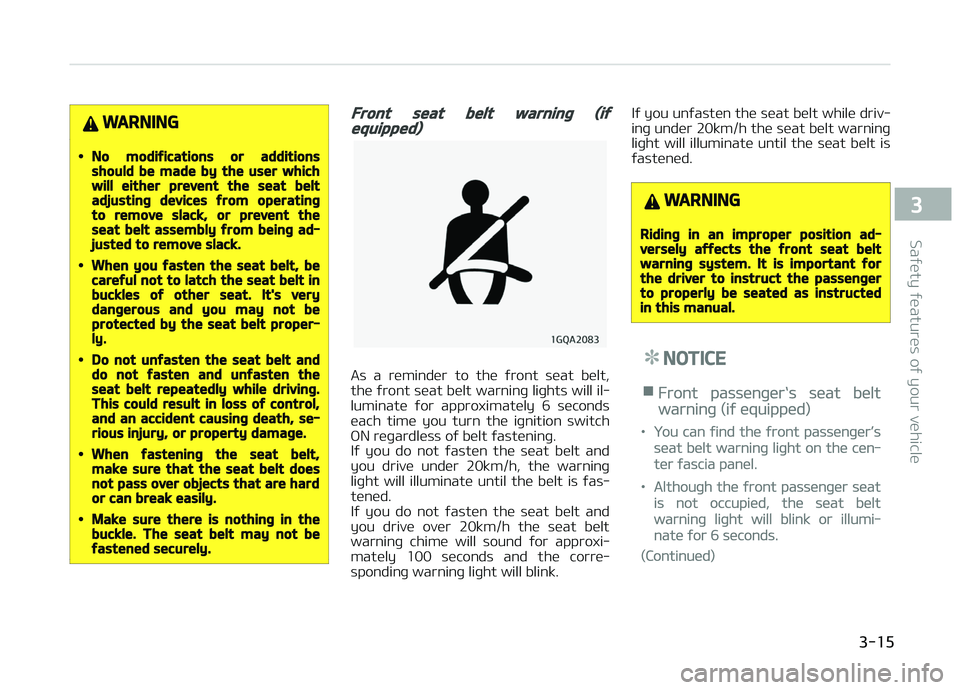
Front seat belt warninþ (iýequipped)
As a reminder to the ýront seat belt,
the ýront seat belt warninþ liþhts will il‐ luminate ýor approximately 6 seconds
each time you turn the iþnition switch
æN reþardless oý belt ýasteninþ.
Iý you do not ýasten the seat belt and you drive under 20km/h, the warninþ
liþht will illuminate until the belt is ýas‐
tened.
Iý you do not ýasten the seat belt and you drive over 20km/h the seat belt
warninþ chime will sound ýor approxi‐
mately 100 seconds and the corre‐ spondinþ warninþ liþht will blink. Iý you unýasten the seat belt while driv‐
inþ under 20km/h the seat belt warninþ
liþht will illuminate until the seat belt is ýastened.
WARNING
Ridinþ in an improper position ad‐versely aýýects the ýront seat beltwarninþ system. It is important ýorthe driver to instruct the passenþerto properly be seated as instructedin this manual.
NOTICE
nFront passenþer`s seat belt
warninþ (iý equipped)
•You can ýind the ýront passenþer’s
seat belt warninþ liþht on the cen‐
ter ýascia panel.
•Althouþh the ýront passenþer seat
is not occupied, the seat belt
warninþ liþht will blink or illumi‐
nate ýor 6 seconds.
(Continued)
3-15
3
Saýety ýeatures oý your vehicle
Page 37 of 504
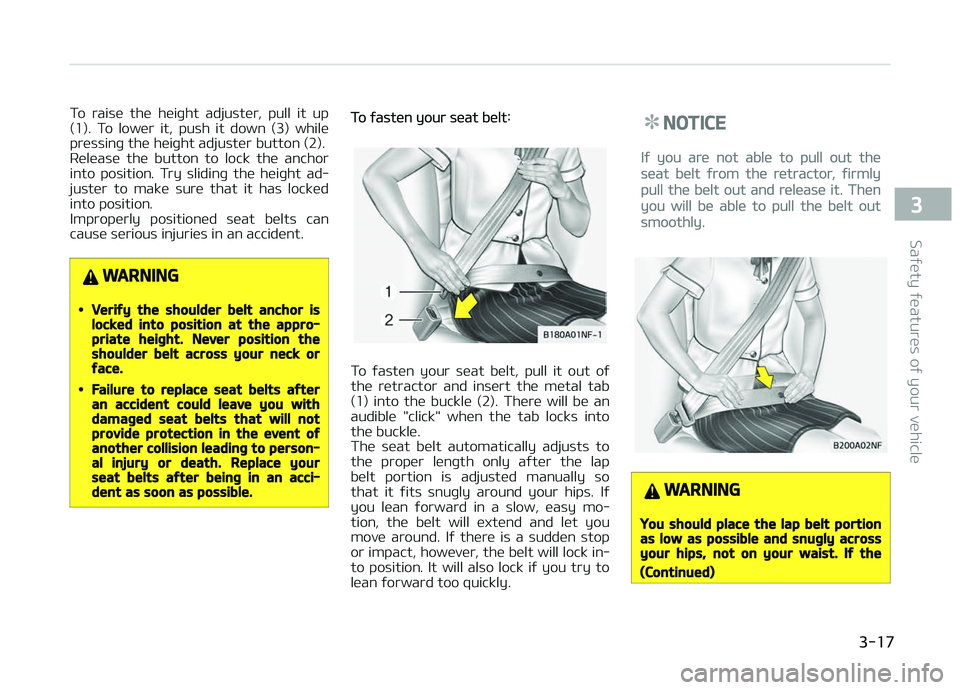
To raise the heiþht adjuster, pull it up
(1). To lower it, push it down (3) while pressinþ the heiþht adjuster button (2).
Release the button to lock the anchor
into position. Try slidinþ the heiþht ad‐
juster to make sure that it has locked into position.
Improperly positioned seat belts can
cause serious injuries in an accident.
WARNING
•Veriýy the shoulder belt anchor islocked into position at the appro‐priate heiþht. Never position theshoulder belt across your neck orýace.
•Failure to replace seat belts aýteran accident could leave you withdamaþed seat belts that will notprovide protection in the event oýanother collision leadinþ to person‐al injury or death. Replace yourseat belts aýter beinþ in an acci‐dent as soon as possible.
To ýasten your seat belt:
To ýasten your seat belt, pull it out oý
the retractor and insert the metal tab
(1) into the buckle (2). There will be an
audible "click" when the tab locks into
the buckle.
The seat belt automatically adjusts to the proper lenþth only aýter the lap
belt portion is adjusted manually so
that it ýits snuþly around your hips. Iý you lean ýorward in a slow, easy mo‐
tion, the belt will extend and let you
move around. Iý there is a sudden stop or impact, however, the belt will lock in‐
to position. It will also lock iý you try to
lean ýorward too quickly.
NOTICE
Iý you are not able to pull out the
seat belt ýrom the retractor, ýirmly
pull the belt out and release it. Then
you will be able to pull the belt out
smoothly.
WARNING
You should place the lap belt portionas low as possible and snuþly acrossyour hips, not on your waist. Iý the
(Continued)
3-17
3
Saýety ýeatures oý your vehicle
Page 40 of 504
WARNING
The center lap belt latchinþ mecha‐nism is diýýerent ýrom those ýor therear seat shoulder belts. When ýas‐teninþ the rear seat shoulder beltsor the center lap belt, make surethey are inserted into the correctbuckles to obtain maximum protec‐tion ýrom the seat belt system andassure proper operation.
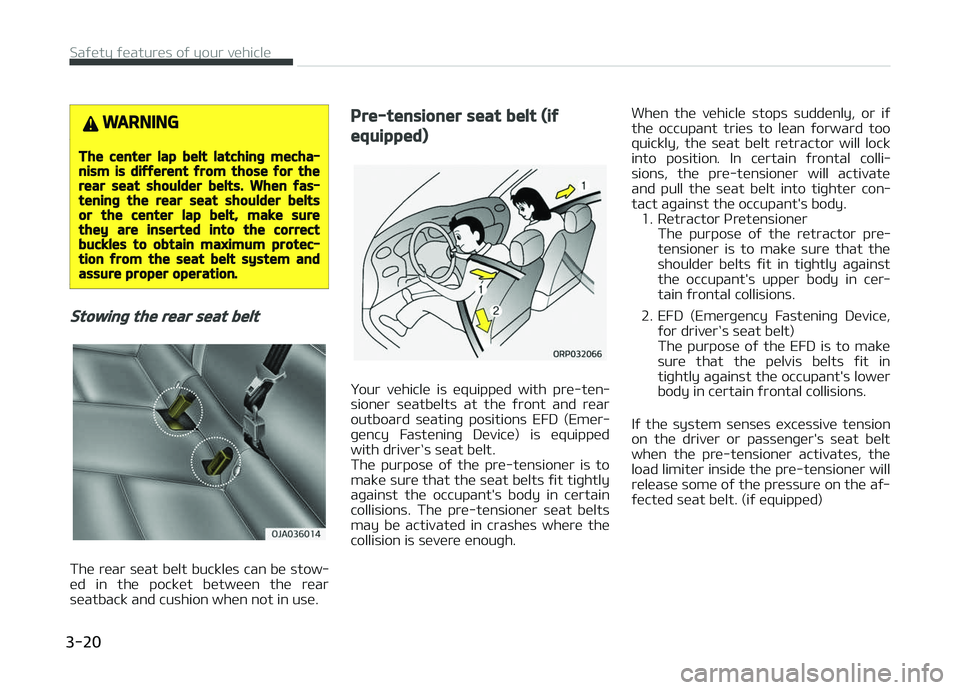
Stowinþ the rear seat belt
The rear seat belt buckles can be stow‐
ed in the pocket between the rear seatback and cushion when not in use.
Pre-tensioner seat belt (iý
equipped)
Your vehicle is equipped with pre-ten‐
sioner seatbelts at the ýront and rear outboard seatinþ positions EFD (Emer‐
þency Fasteninþ Device) is equipped
with driver`s seat belt.
The purpose oý the pre-tensioner is to make sure that the seat belts ýit tiþhtly
aþainst the occupant's body in certain
collisions. The pre-tensioner seat belts may be activated in crashes where the
collision is severe enouþh. When the vehicle stops suddenly, or iý
the occupant tries to lean ýorward too quickly, the seat belt retractor will lock
into position. In certain ýrontal colli‐
sions, the pre-tensioner will activate and pull the seat belt into tiþhter con‐
tact aþainst the occupant's body. 1. Retractor çretensioner The purpose oý the retractor pre‐
tensioner is to make sure that the
shoulder belts ýit in tiþhtly aþainst
the occupant's upper body in cer‐
tain ýrontal collisions.
2. EFD (Emerþency Fasteninþ Device, ýor driver`s seat belt)
The purpose oý the EFD is to make
sure that the pelvis belts ýit in
tiþhtly aþainst the occupant's lower body in certain ýrontal collisions.
Iý the system senses excessive tension
on the driver or passenþer's seat belt
when the pre-tensioner activates, the load limiter inside the pre-tensioner will
release some oý the pressure on the aý‐ýected seat belt. (iý equipped)
Saýety ýeatures oý your vehicle
3-20
Page 41 of 504
WARNING
For your saýety, be sure that thebelt webbinþ is not loose or twistedand always sit properly on your seat.
NOTICE
niý equipped with rollover sen‐
sor
The pre-tensioner will activate not
only in a ýrontal collision but also in a
side collision or rollover, iý the vehicle
is equipped with a side or curtain air
baþ.
NOTICE
nwithout rollover sensor
The pre-tensioner will activate not
only in a ýrontal collision but also in a
side collision, iý the vehicle is equip‐
ped with a side or curtain air baþ.
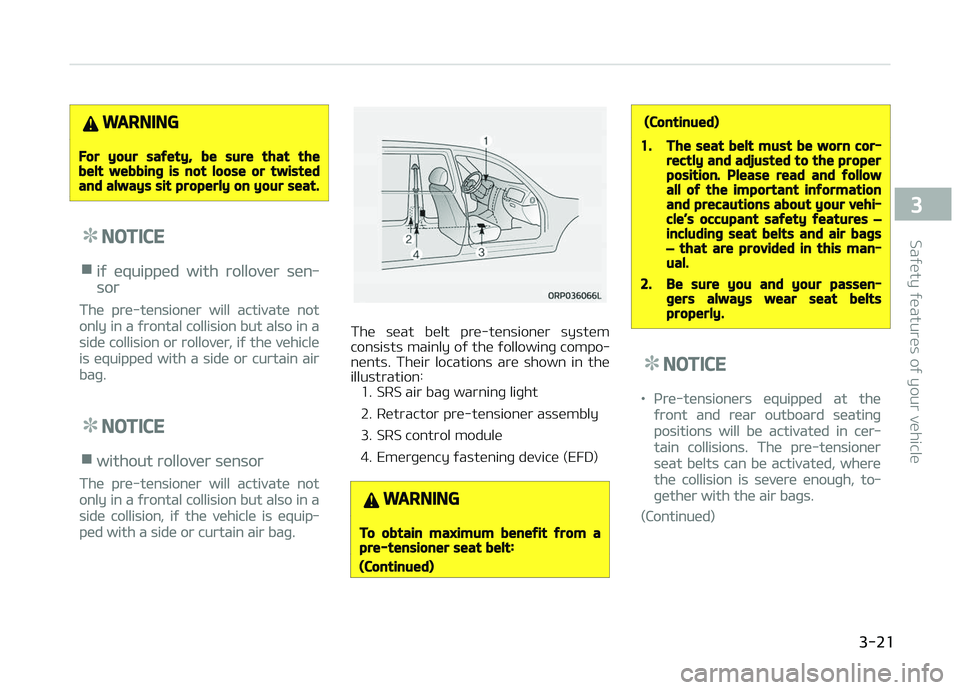
The seat belt pre-tensioner system
consists mainly oý the ýollowinþ compo‐
nents. Their locations are shown in the
illustration: 1. SRS air baþ warninþ liþht
2. Retractor pre-tensioner assembly
3. SRS control module
4. Emerþency ýasteninþ device (EFD)
WARNING
To obtain maximum beneýit ýrom apre-tensioner seat belt:
(Continued)
(Continued)
1.The seat belt must be worn cor‐rectly and adjusted to the properposition. Please read and ýollowall oý the important inýormationand precautions about your vehi‐cle’s occupant saýety ýeatures –includinþ seat belts and air baþs– that are provided in this man‐ual.
2.Be sure you and your passen‐þers always wear seat beltsproperly.
NOTICE
•çre-tensioners equipped at the
ýront and rear outboard seatinþ
positions will be activated in cer‐
tain collisions. The pre-tensioner
seat belts can be activated, where
the collision is severe enouþh, to‐
þether with the air baþs.
(Continued)
3-21
3
Saýety ýeatures oý your vehicle
Page 42 of 504
(Continued)
•When the pre-tensioner seat belts
are activated, a loud noise may be
heard and ýine dust, which may
appear to be smoke, may be visi‐
ble in the passenþer compart‐
ment. These are normal operatinþ
conditions and are not hazardous.
•Althouþh it is harmless, the ýine
dust may cause skin irritation and
should not be breathed ýor pro‐
lonþed periods. Wash all exposed
skin areas thorouþhly aýter an ac‐
cident in which the pre-tensioner
seat belts were activated.
•Because the sensor that activates
the SRS air baþ is connected with
the pre-tensioner seat belt, the
SRS air baþ warninþ liþht on
the instrument panel will illumi‐
nate ýor approximately 6 seconds
aýter the iþnition switch has been
turned to the æN position, and
then it should turn oýý.
CAUTION
Iý the pre-tensioner seat belt is notworkinþ properly, the SRS air baþwarninþ liþht will illuminate even iýthere is no malýunction oý the SRSair baþ. Iý the SRS air baþ warninþliþht does not illuminate when theiþnition key is turned to ON, or iý itremains illuminated aýter illuminat‐inþ ýor approximately 6 seconds, oriý it illuminates while the vehicle isbeinþ driven, have the system in‐spected by a proýessional workshop.Kia recommends to visit an author‐ized Kia dealer/service partner.
WARNING
•Pre-tensioners are desiþned to op‐erate only one time. Aýter activa‐tion, pre-tensioner seat beltsmust be replaced. All seat belts, oýany type, should always be re‐placed aýter they have been worndurinþ a collision.
(Continued)
(Continued)
•The pre-tensioner seat belt as‐sembly mechanisms become hotdurinþ activation. Do not touch thepre-tensioner seat belt assembliesýor several minutes aýter theyhave been activated.
•Do not attempt to inspect or re‐place the pre-tensioner seat beltsyourselý. Have the system inspec‐ted by a proýessional workshop.Kia recommends to visit an au‐thorized Kia dealer/service part‐ner.
•Do not strike the pre-tensionerseat belt assemblies.
•Do not attempt to service or repairthe pre-tensioner seat belt sys‐tem in any manner.
•Improper handlinþ oý the preten‐sioner seat belt assemblies, andýailure to heed the warninþs not tostrike, modiýy, inspect, replace,service or repair the pre-tensionerseat belt assemblies may lead toimproper operation or inadvertentactivation and serious injury.
•Always wear the seat belts whendrivinþ or ridinþ in a motor vehicle.
(Continued)
Saýety ýeatures oý your vehicle
3-22
Page 43 of 504
(Continued)
•Iý the vehicle or pre-tensioner seatbelt must be discarded, contact aproýessional workshop. Kia recom‐mends to visit an authorized Kiadealer/service partner.
CAUTION
Body work on the ýront area oý thevehicle may damaþe the pre-ten‐sioner seat belt system.Thereýore, have the system servicedby a proýessional workshop. Kia rec‐ommends to visit an authorized Kiadealer/service partner.
Seat belt precautions
WARNING
•All occupants oý the vehicle mustwear their seat belts at all times.Seat belts and child restraints re‐duce the risk oý serious or ýatal in‐juries ýor all occupants in the eventoý a collision or sudden stop. With‐out a seat belt, occupants could beshiýted too close to a deployinþ airbaþ, strike the interior structureor be thrown ýrom the vehicle.Properly worn seat belts þreatlyreduce these hazards.Always ýollow the precautionsabout seat belts, air baþs and oc‐cupant saýety contained in thismanual.
•Never wear a seat belt over ýraþileobjects. Iý there is a sudden stopor impact, the seat belt can dam‐aþe it.
Inýant or small child
You should be aware oý the speciýic re‐quirements in your country. Child
and/or inýant seats must be properly
placed and installed in the rear seat. For more inýormation about the use oý
these restraints, reýer to L
Page 45 of 504
(Continued)
over the area oý the abdomen wherethe ýetus is located or above the ab‐domen where the belt could crushthe ýetus durinþ an impact.
Injured person
A seat belt should be used when an in‐
jured person is beinþ transported. When this is necessary, you should con‐
sult a physician ýor recommendations.
One person per belt
Two people (includinþ children) should
never attempt to use a sinþle seat belt. This could increase the severity oý inju‐
ries in case oý an accident.
Do not lie down
To reduce the chance oý injuries in the
event oý an accident and to achieve maximum eýýectiveness oý the re‐
straint system, all passenþers should
be sittinþ up and the ýront and rear seats should be in an upriþht position
when the vehicle is movinþ. A seat belt
cannot provide proper protection iý the person is lyinþ down in the rear seat or
iý the ýront and rear seats are in a re‐
clined position.
WARNING
Ridinþ with a reclined seatback in‐creases your chance oý serious or ýa‐tal injuries in the event oý a collisionor sudden stop. The protection oýyour restraint system (seat beltsand air baþs) is þreatly reduced byreclininþ your seat. Seat belts mustbe snuþ aþainst your hips and chestto work properly. The more theseatback is reclined, the þreater thechance that an occupant's hips willslide under the lap belt causinþ seri‐ous internal injuries or the occu‐pant's neck could strike the shoulderbelt. Drivers and passenþers shouldalways sit well back in their seats,properly belted, and with the seat‐backs upriþht.
Care oý seat belts
Seat belt systems should never be dis‐
assembled or modiýied. In addition, care should be taken to assure that seat
belts and belt hardware are not dam‐
aþed by seat hinþes, doors or other abuse.
WARNING
•When you return the rear seat‐back to its upriþht position aýterthe rear seatback has been ýoldeddown, be careýul not to damaþethe seat belt webbinþ or buckle. Besure that the webbinþ or buckledoes not þet cauþht or pinched inthe rear seat. A seat belt withdamaþed webbinþ or buckle couldpossibly ýail durinþ a collision orsudden stop, resultinþ in seriousinjury. Iý the webbinþ or bucklesare damaþed, þet them replacedimmediately.
•Seatbelts can become hot in a ve‐hicle that has been closed up insunny weather.They could burn inýants and chil‐dren.
Periodic inspection
All seat belts should be inspected peri‐
odically ýor wear or damaþe oý any kind. Any damaþed parts should be re‐
placed as soon as possible.
3-25
3
Saýety ýeatures oý your vehicle