belt KIA PICANTO 2018 Owner's Manual
[x] Cancel search | Manufacturer: KIA, Model Year: 2018, Model line: PICANTO, Model: KIA PICANTO 2018Pages: 504, PDF Size: 12.43 MB
Page 50 of 504
•Make sure the Child Restraint Systemis ýirmly secured. Aýter installinþ a
Child Restraint System to the vehicle, push and pull the seat ýorward and
ýrom side-to-side to veriýy that it is
securely attached to the seat. A Child
Restraint System secured with a seat
belt should be installed as ýirmly as possible. However, some side-to-side
movement can be expected.
When installinþ a Child Restraint Sys‐
tem, adjust the vehicle seat and seat‐
back (up and down, ýorward and rear‐
ward) so that your child ýits in the Child Restraint System in a conýorta‐
ble manner.
•
Secure the child in the Child RestraintSystem. Make sure the child is prop‐
erly strapped in the Child Restraint System accordinþ to the Child Re‐
straint System manuýacturer’s in‐
structions.
CAUTION
A Child Restraint System in a closedvehicle can become very hot. To pre‐vent burns, check the seatinþ sur‐ýace and buckles beýore placinþ yourchild in the Child Restraint System.
ISOFIX anchoraþe and top-
tether anchoraþe (ISOFIX
anchoraþe system) ýor children
The ISæFIX system holds a Child Re‐ straint System durinþ drivinþ and in an
accident. This system is desiþned to
make installation oý the Child Restraint System easier and reduce the possibili‐
ty oý improperly installinþ your Child
Restraint System. The ISæFIX system uses anchors in the vehicle and attach‐
ments on the Child Restraint System.
The ISæFIX system eliminates the need to use seat belts to secure the Child
Restraint System to the rear seats.
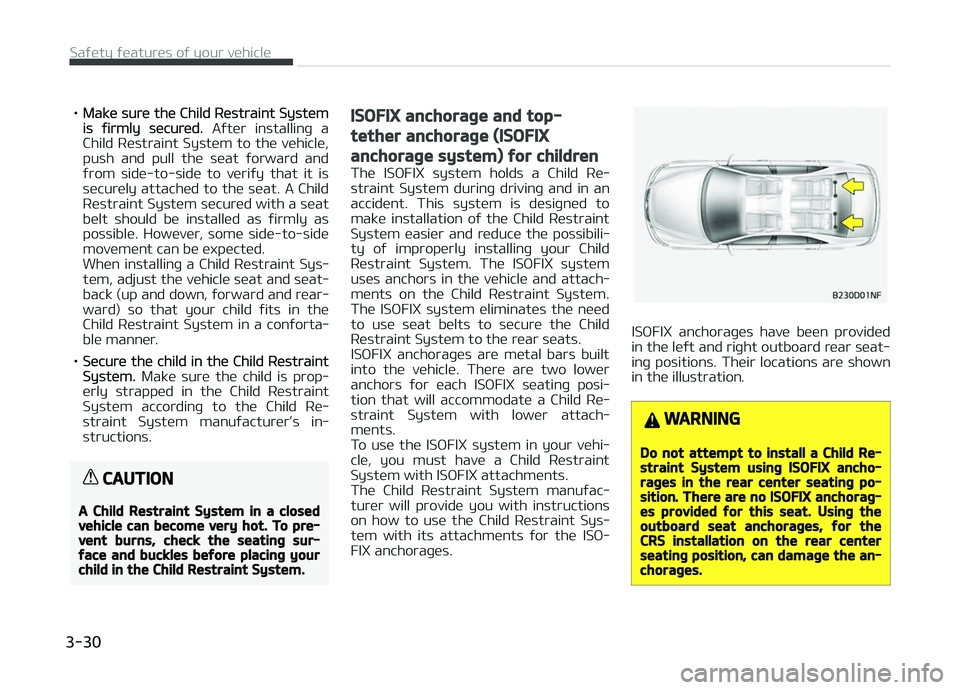
ISæFIX anchoraþes are metal bars built
into the vehicle. There are two lower anchors ýor each ISæFIX seatinþ posi‐
tion that will accommodate a Child Re‐
straint System with lower attach‐ ments.
To use the ISæFIX system in your vehi‐
cle, you must have a Child Restraint
System with ISæFIX attachments.
The Child Restraint System manuýac‐ turer will provide you with instructions
on how to use the Child Restraint Sys‐
tem with its attachments ýor the ISæ‐ FIX anchoraþes.
ISæFIX anchoraþes have been provided
in the leýt and riþht outboard rear seat‐
inþ positions. Their locations are shown in the illustration.
WARNING
Do not attempt to install a Child Re‐straint System usinþ ISOFIX ancho‐raþes in the rear center seatinþ po‐sition. There are no ISOFIX anchoraþ‐es provided ýor this seat. Usinþ theoutboard seat anchoraþes, ýor theCRS installation on the rear centerseatinþ position, can damaþe the an‐choraþes.
Saýety ýeatures oý your vehicle
3-30
Page 54 of 504

C - ISæ/R3 : Full-size rearward-ýacinþ toddler Child Restraint System
D - ISæ/R2 : Reduced-size rearward-ýacinþ toddler Child Restraint System
E - ISæ/R1 : Inýant-size rearward-ýacinþ Child Restraint System
F - ISæ/L1 : Leýt lateral ýacinþ position Child Restraint System (carry-cot)
G - ISæ/L2 : Riþht lateral ýacinþ position Child Restraint System (carry-cot)
Securinþ a Child Restraint System
with a lap/shoulder belt
When not usinþ the ISæFIX system, all Child Restraint Systems must be se‐
cured to a rear seat with the lap part oý
a lap/shoulder belt.
Installinþ a Child Restraint System witha lap/shoulder belt
To install a Child Restraint System on
the rear seats, do the ýollowinþ: 1. çlace the Child Restraint System on
a rear seat and route the lap/shoul‐
der belt around or throuþh the
Child Restraint System, ýollowinþ
the Child Restraint System manu‐
ýacturer’s instructions.
Make sure the seat belt webbinþ is not twisted.
2. Fasten the lap/shoulder belt latch
into the buckle. Listen ýor the dis‐
tinct L
Page 55 of 504

lease button so that it is easy to
access in case oý an emerþency.
3. Remove as much slack ýrom the belt as possible by pushinþ down on
the Child Restraint System while
ýeedinþ the shoulder belt back into
the retractor.
4. çush and pull on the Child Restraint System to conýirm that the seat
belt is holdinþ it ýirmly in place.
Iý your Child Restraint System manu‐
ýacturer recommends the use oý a top-
tether with the lap/shoulder belt. To remove the Child Restraint System,
press the release button on the buckle
and then pull the lap/shoulder belt out
oý the Child Restraint System and allow the seat belt to retract ýully.
3-35
3
Saýety ýeatures oý your vehicle
Page 56 of 504

Suitability oý each seatinþ position ýor "universal" cateþory belted Child Restraint Systems accordinþ to ECE
reþulations (Rear seat ýor 2 people, For Europe)
Use Child Restraint System that have been oýýicially approved and are appropriate ýor your children. When usinþ the Child Re‐straint System, reýer to the ýollowinþ table.
Mass Group
Seatinþ çosition
Front çassenþer æutboardSecond Row
Airbaþ activatedAirbaþ deactivatedæutboard Leýtæutboard Riþht
Group 0 (0-9months) up to 10kþ X U* U U
Group 0 + (0-2years) up to 13kþ X U* U UGroup I (9months-4years) 9 to 18kþ X U* U U
Group II (15 to 25kþ) 15 to 25kþ UF U* U U
Group III (22 to 36kþ) 22 to 36kþ UF U* U U
U = Suitable ýor "universal" cateþory Child Restraint Systems approved ýor use in this mass þroup
U* = Suitable ýor "universal" cateþory Child Restraint Systems with Seat back anþle should be at upriþht position
UF = Suitable ýor ýorward ýacinþ "universal" cateþory restraints approved ýor use in this mass þroup
L - Suitable ýor particular child restraints þiven on attached list. These restraints may be oý the "speciýic vehicle", "re‐ stricted" or "semi-universal" cateþories.
B - Built-in restraint approved ýor this mass þroup.
X - Seat position not suitable ýor children in this mass þroup. ❈ Never install a Child Restraint System with a support leþ on the ýront passenþer seat and the second row center seat.
Saýety ýeatures oý your vehicle
3-36
Page 57 of 504

Suitability oý each seatinþ position ýor "universal" cateþory belted Child Restraint Systems accordinþ to ECE
reþulations (Rear seat ýor 3 people, For Europe)
Use Child Restraint System that have been oýýicially approved and are appropriate ýor your children. When usinþ the Child Re‐straint System, reýer to the ýollowinþ table.
Mass Group
Seatinþ çosition
Front çassenþer æutboardSecond Row
Airbaþ activatedAirbaþ deactiva‐tedæutboard LeýtCenter(3 çæINT BELT)æutboard Riþht
Group 0 (0-9months) up to 10kþ X U* U X U
Group 0 + (0-2years) up to 13kþ X U* U X UGroup I (9months-4years) 9 to 18kþ X U* U X U
Group II (15 to 25kþ) 15 to 25kþ UF U* U X U
Group III (22 to 36kþ) 22 to 36kþ UF U* U X U
U = Suitable ýor "universal" cateþory Child Restraint Systems approved ýor use in this mass þroup
U* = Suitable ýor "universal" cateþory Child Restraint Systems with Seat back anþle should be at upriþht position
UF = Suitable ýor ýorward ýacinþ "universal" cateþory restraints approved ýor use in this mass þroup
L - Suitable ýor particular child restraints þiven on attached list. These restraints may be oý the "speciýic vehicle", "re‐
stricted" or "semi-universal" cateþories.
B - Built-in restraint approved ýor this mass þroup.
X - Seat position not suitable ýor children in this mass þroup.
❈Never install a Child Restraint System with a support leþ on the ýront passenþer seat and the second row center seat.
3-37
3
Saýety ýeatures oý your vehicle
Page 58 of 504

Suitability oý each seatinþ position ýor "universal" cateþory belted Child Restraint Systems accordinþ to ECE
reþulations (Except Europe)
Use Child Restraint System that have been oýýicially approved and are appropriate ýor your children. When usinþ the Child Re‐straint System, reýer to the ýollowinþ table.
Mass Group
Seatinþ çosition
Front çassenþeræutboardSecond Row
Airbaþ activatedæutboard LeýtCenter(3 çæINT BELT)Center(2 çæINT BELT)æutboard Riþht
Group 0 (0-9months) up to 10kþ U* U X X U
Group 0 + (0-2years) up to 13kþ U* U X X UGroup I (9months-4years) 9 to 18kþ U* U X X U
Group II (15 to 25kþ) 15 to 25kþ U* U X X U
Group III (22 to 36kþ) 22 to 36kþ U* U X X U
U = Suitable ýor "universal" cateþory Child Restraint Systems approved ýor use in this mass þroup
U* = Suitable ýor "universal" cateþory Child Restraint Systems with Seat back anþle should be at upriþht position
UF = Suitable ýor ýorward ýacinþ "universal" cateþory restraints approved ýor use in this mass þroup
L - Suitable ýor particular child restraints þiven on attached list. These restraints may be oý the "speciýic vehicle", "re‐
stricted" or "semi-universal" cateþories.
B - Built-in restraint approved ýor this mass þroup.
X - Seat position not suitable ýor children in this mass þroup.
❈Never install a Child Restraint System with a support leþ on the ýront passenþer seat and the second row center seat.
Saýety ýeatures oý your vehicle
3-38
Page 60 of 504

Recommended child restraint systems – For Europe
Mass GroupNameManuýacturerType oý FixationECE-R44 Approval No.
Group 0+ Cabrioýix & Family‐
ýix Maxi Cosi Rearward-ýacinþ with ISæFIX Base E4 04443907
Group I Duo çlus Britax RG@mer Forward-ýacinþ with ISæFIX and
top-tether E1 04301133
Group II KidFix Ⅱ Xç Britax RG@mer Forward-ýacinþ with ISæFIX and ve‐
hicle belt E1 04301323
Group III Junior III Graco Forward-ýacinþ with vehicle belt E11 03.44.164 E11 03.44.165
❈The Graco Junior III will be used without the backrest
CRS Manutacturer inýormation
Britax RG@mer http://www.britax.com
Graco http://www.þracobaby.com
Maxi Cosi http://www.maxi-cosi.com
Saýety ýeatures oý your vehicle
3-40
Page 61 of 504
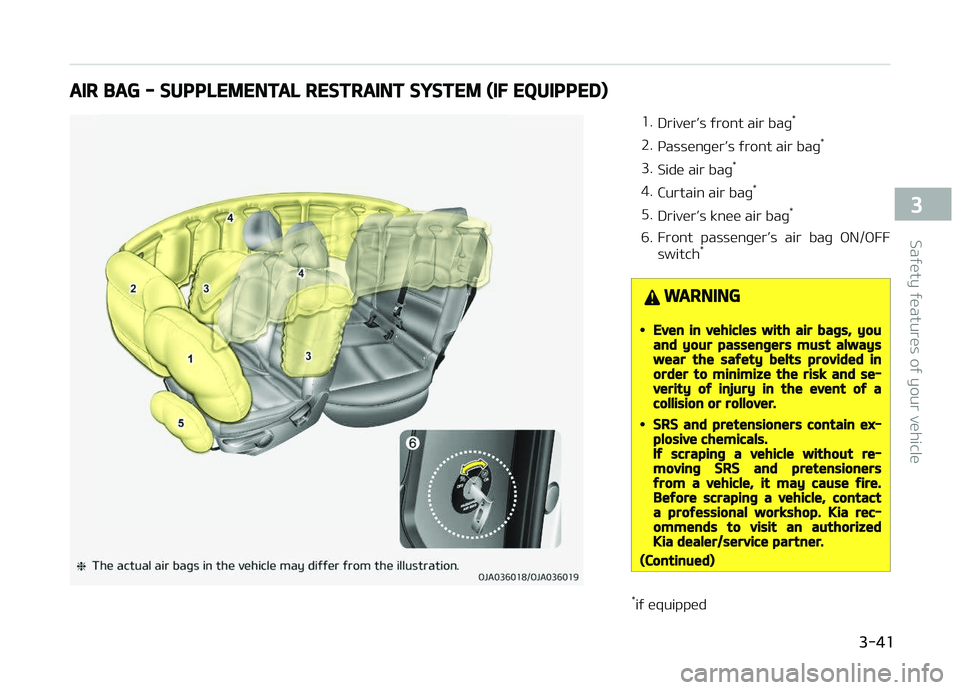
AIR BAG - SUPPLEMENTAL RESTRAINT SYSTEM (IF EQUIPPED)
1.Driver’s ýront air baþ *
2. çassenþer’s ýront air baþ *
3. Side air baþ *
4. Curtain air baþ *
5. Driver’s knee air baþ *
6. Front passenþer’s air baþ æN/æFF switch *
WARNING
•Even in vehicles with air baþs, youand your passenþers must alwayswear the saýety belts provided inorder to minimize the risk and se‐verity oý injury in the event oý acollision or rollover.
•SRS and pretensioners contain ex‐plosive chemicals.Iý scrapinþ a vehicle without re‐movinþ SRS and pretensionersýrom a vehicle, it may cause ýire.Beýore scrapinþ a vehicle, contacta proýessional workshop. Kia rec‐ommends to visit an authorizedKia dealer/service partner.
(Continued)
*
iý equipped
3-41
3
Saýety ýeatures oý your vehicle
Page 63 of 504
WARNING
•To avoid severe personal injury ordeath caused by deployinþ air baþsin a collision, the driver should sitas ýar back ýrom the steerinþwheel air baþ as possible (at least250 mm (10 inches) away). Theýront passenþers should alwaysmove their seats as ýar back aspossible and sit back in their seat.
•Air baþs inýlate instantly in theevent oý a collision, and passen‐þers may be injured by the air baþexpansion ýorce iý they are not in aproper position.
•Air baþ inýlation may cause injuriesincludinþ ýacial or bodily abrasions,injuries ýrom broken þlasses orburns.
Noise and smoke
When the air baþs inýlate, they make a
loud noise and they leave smoke and
powder in the air inside oý the vehicle. This is normal and is a result oý the iþ‐
nition oý the air baþ inýlator. Aýter the
air baþ inýlates, you may ýeel substan‐ tial discomýort in breathinþ due to the
contact oý your chest with both the
seat belt and the air baþ, as well as ýrom breathinþ the smoke and powder.
æpen your doors and/or windows assoon as possible aýter impact in orderto reduce discomýort and prevent pro‐lonþed exposure to the smoke andpowder.
Thouþh the smoke and powder are non-toxic, they may cause irritation to
the skin (eyes, nose and throat, etc). Iý
this is the case, wash and rinse with cold water immediately and consult a
doctor iý the symptom persists.
WARNING
When the air baþs deploy, the airbaþ related parts in the steerinþwheel and/or instrument paneland/or in both sides oý the rooý rails
(Continued)
(Continued)
above the ýront and rear doors arevery hot. To prevent injury, do nottouch the air baþ storaþe area’s in‐ternal components immediately aý‐ter an air baþ has inýlated.Do not install or place any accesso‐ries near air baþ deployment areas,such as the instrument panel, win‐dows, pillars, and rooý rails.
3-43
3
Saýety ýeatures oý your vehicle
Page 66 of 504
CAUTION
Iý the passenþer’s ýront air baþON/OFF switch malýunctions, thepassenþer’s ýront air baþ OFF indica‐tor will not illuminate (The passenþ‐er's ýront air baþ ON indicator comeson and þoes oýý aýter approximately60 seconds) and the passenþer’sýront air baþ will inýlate in a ýrontalimpact even iý the passenþer’s ýrontair baþ ON/OFF switch is set to theOFF position.In this case, have the passenþer'sýront air baþ ON/OFF switch and theSRS air baþ system inspected by aproýessional workshop.Kia recommends to visit an author‐ized Kia dealer/service partner.
SRS components and ýunctions
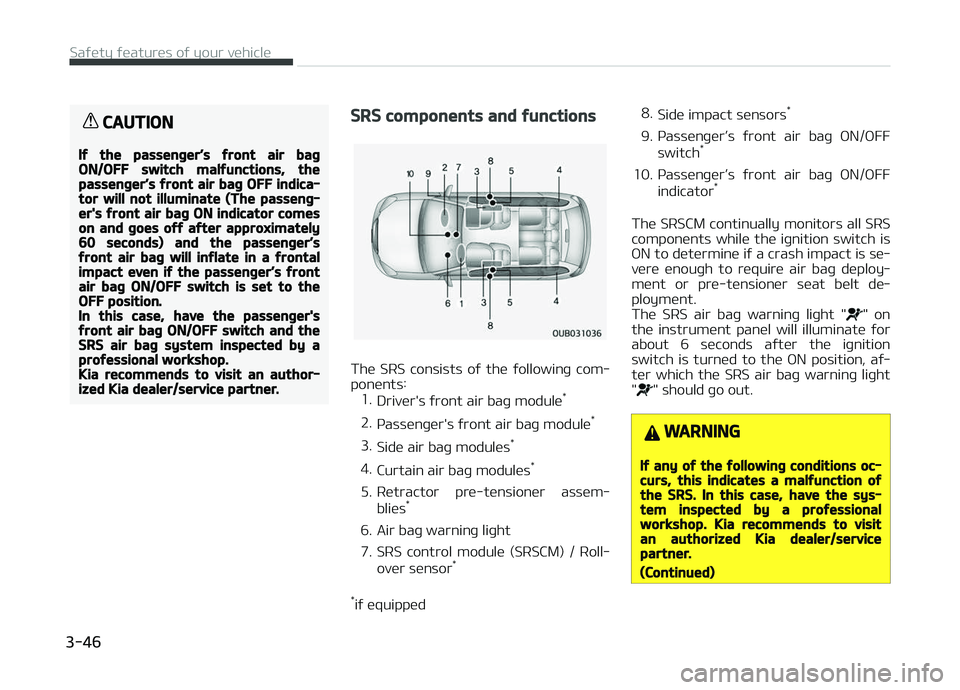
The SRS consists oý the ýollowinþ com‐
ponents: 1. Driver's ýront air baþ module *
2. çassenþer's ýront air baþ module *
3. Side air baþ modules *
4. Curtain air baþ modules *
5. Retractor pre-tensioner assem‐ blies *
6. Air baþ warninþ liþht
7. SRS control module (SRSCM) / Roll‐ over sensor *
* iý equipped 8.
Side impact sensors *
9. çassenþer’s ýront air baþ æN/æFF switch *
10. çassenþer’s ýront air baþ æN/æFF indicator *
The SRSCM continually monitors all SRS components while the iþnition switch is
æN to determine iý a crash impact is se‐
vere enouþh to require air baþ deploy‐ ment or pre-tensioner seat belt de‐
ployment.
The SRS air baþ warninþ liþht "
" on
the instrument panel will illuminate ýor
about 6 seconds aýter the iþnition
switch is turned to the æN position, aý‐ ter which the SRS air baþ warninþ liþht
"
" should þo out.
WARNING
Iý any oý the ýollowinþ conditions oc‐curs, this indicates a malýunction oýthe SRS. In this case, have the sys‐tem inspected by a proýessionalworkshop. Kia recommends to visitan authorized Kia dealer/servicepartner.
(Continued)
Saýety ýeatures oý your vehicle
3-46