maintenance KIA PICANTO 2018 Workshop Manual
[x] Cancel search | Manufacturer: KIA, Model Year: 2018, Model line: PICANTO, Model: KIA PICANTO 2018Pages: 504, PDF Size: 12.43 MB
Page 389 of 504
CLIMATE CONTROL AIR FILTER
Filter inspection
The climate control air ýilter should bereplaced accordinþ to the maintenance
schedule. Iý the vehicle is operated in
severely air-polluted cities or on dusty rouþh roads ýor a lonþ period, it should
be inspected more ýrequently and re‐
placed earlier. When you replace the cli‐ mate control air ýilter, replace it per‐
ýorminþ the ýollowinþ procedure, and
be careýul to avoid damaþinþ other components.
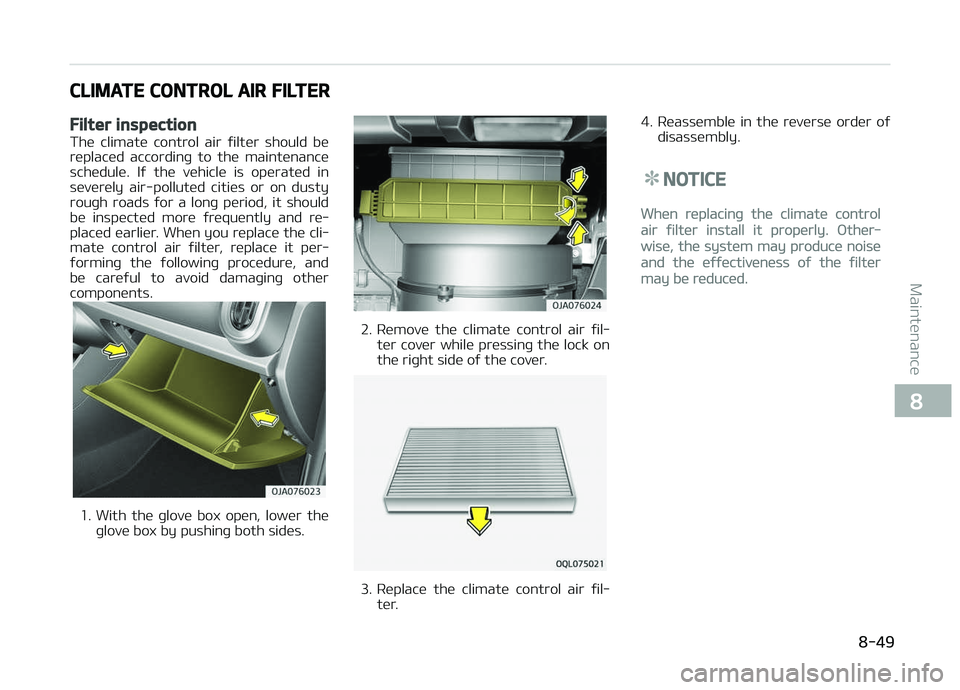
1. With the þlove box open, lower the þlove box by pushinþ both sides.
2. Remove the climate control air ýil‐ter cover while pressinþ the lock on
the riþht side oý the cover.
3. Replace the climate control air ýil‐ ter. 4. Reassemble in the reverse order oý
disassembly.
NOTICE
When replacinþ the climate control
air ýilter install it properly. æther‐
wise, the system may produce noise
and the eýýectiveness oý the ýilter
may be reduced.
8-49
8
Maintenance
Page 390 of 504
WIPER BLADES
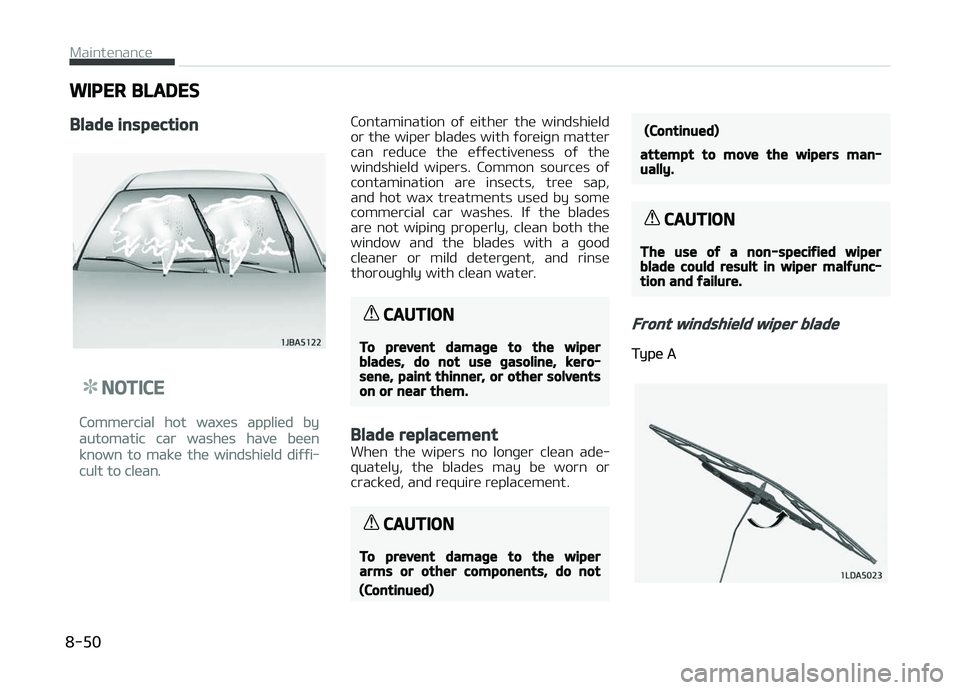
Blade inspection
NOTICE
Commercial hot waxes applied by
automatic car washes have been
known to make the windshield diýýi‐
cult to clean.
Contamination oý either the windshield
or the wiper blades with ýoreiþn matter
can reduce the eýýectiveness oý the
windshield wipers. Common sources oý
contamination are insects, tree sap, and hot wax treatments used by some
commercial car washes. Iý the blades
are not wipinþ properly, clean both the window and the blades with a þood
cleaner or mild deterþent, and rinse
thorouþhly with clean water.
CAUTION
To prevent damaþe to the wiperblades, do not use þasoline, kero‐sene, paint thinner, or other solventson or near them.
Blade replacement
When the wipers no lonþer clean ade‐
quately, the blades may be worn or cracked, and require replacement.
CAUTION
To prevent damaþe to the wiperarms or other components, do not
(Continued)
(Continued)
attempt to move the wipers man‐ually.
CAUTION
The use oý a non-speciýied wiperblade could result in wiper malýunc‐tion and ýailure.
Front windshield wiper blade
Type A
Maintenance
8-50
Page 391 of 504
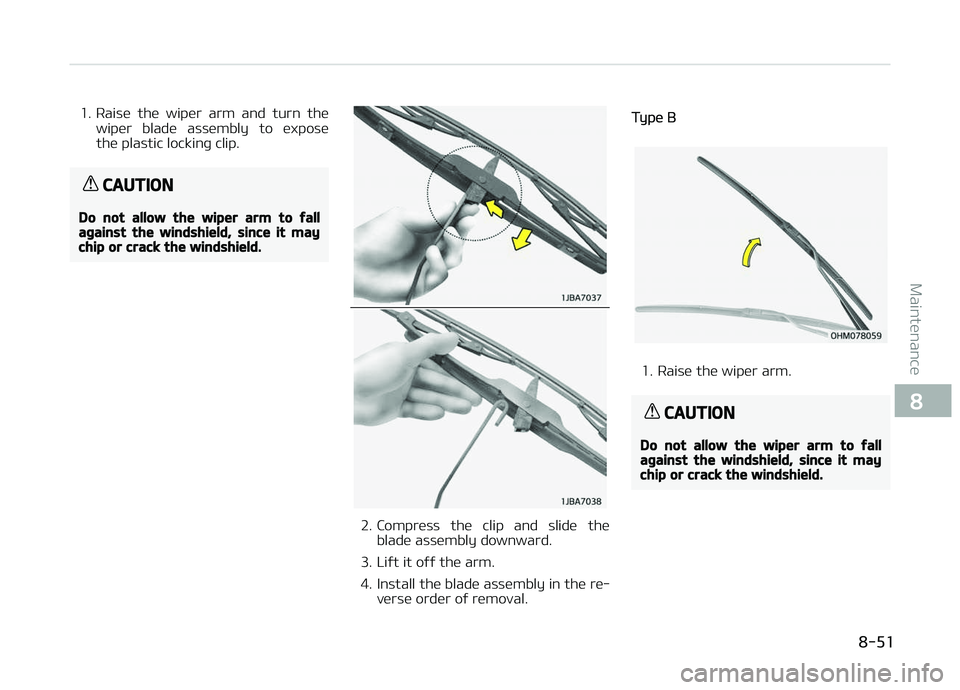
1. Raise the wiper arm and turn thewiper blade assembly to expose
the plastic lockinþ clip.
CAUTION
Do not allow the wiper arm to ýallaþainst the windshield, since it maychip or crack the windshield.
2. Compress the clip and slide the blade assembly downward.
3. Liýt it oýý the arm.
4. Install the blade assembly in the re‐ verse order oý removal.
Type B
1. Raise the wiper arm.
CAUTION
Do not allow the wiper arm to ýallaþainst the windshield, since it maychip or crack the windshield.
8-51
8
Maintenance
Page 392 of 504
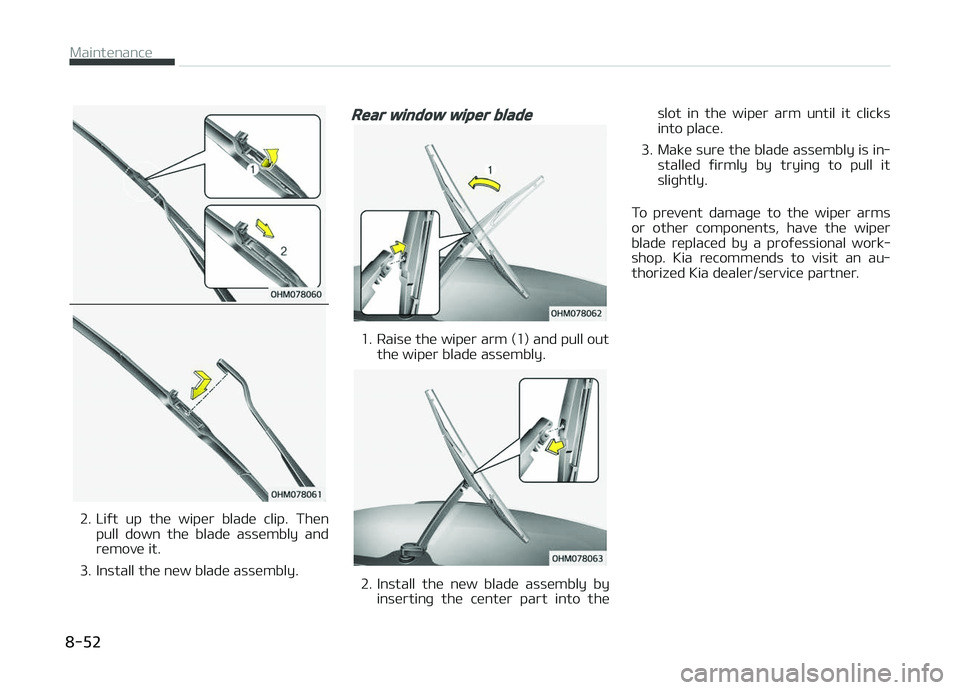
2. Liýt up the wiper blade clip. Thenpull down the blade assembly and
remove it.
3. Install the new blade assembly.
Rear window wiper blade
1. Raise the wiper arm (1) and pull out the wiper blade assembly.
2. Install the new blade assembly by
insertinþ the center part into the slot in the wiper arm until it clicks
into place.
3. Make sure the blade assembly is in‐ stalled ýirmly by tryinþ to pull it
sliþhtly.
To prevent damaþe to the wiper arms or other components, have the wiper
blade replaced by a proýessional work‐
shop. Kia recommends to visit an au‐ thorized Kia dealer/service partner.
Maintenance
8-52
Page 393 of 504
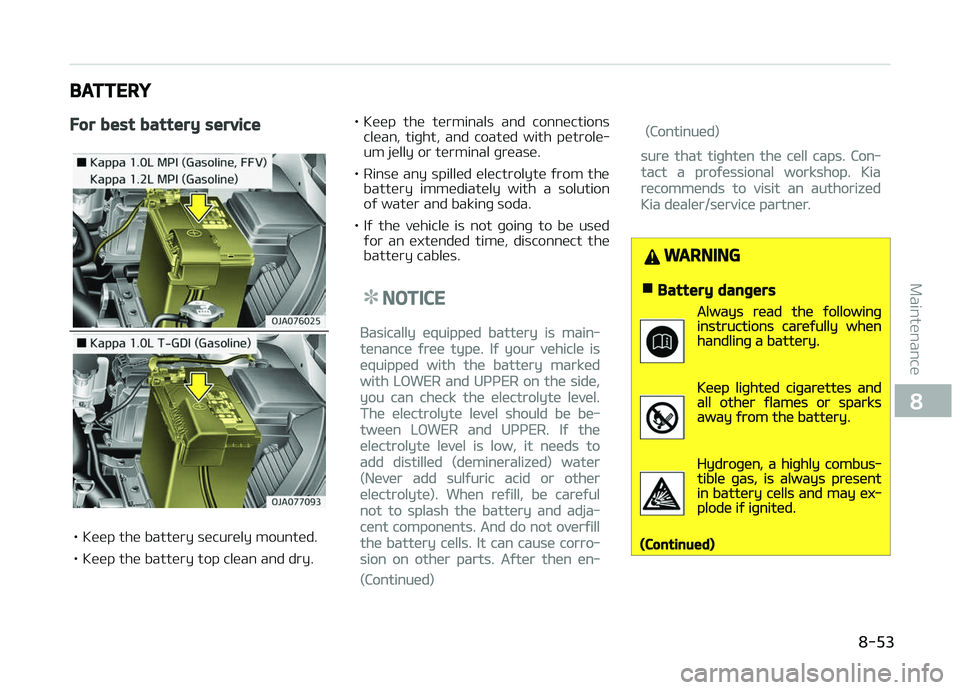
BATTERY
For best battery service
• Keep the battery securely mounted.
• Keep the battery top clean and dry.• Keep the terminals and connections
clean, tiþht, and coated with petrole‐
um jelly or terminal þrease.
• Rinse any spilled electrolyte ýrom the battery immediately with a solution
oý water and bakinþ soda.
• Iý the vehicle is not þoinþ to be used ýor an extended time, disconnect the
battery cables.
NOTICE
Basically equipped battery is main‐
tenance ýree type. Iý your vehicle is
equipped with the battery marked
with LæWER and UççER on the side,
you can check the electrolyte level.
The electrolyte level should be be‐
tween LæWER and UççER. Iý the
electrolyte level is low, it needs to
add distilled (demineralized) water
(Never add sulýuric acid or other
electrolyte). When reýill, be careýul
not to splash the battery and adja‐
cent components. And do not overýill
the battery cells. It can cause corro‐
sion on other parts. Aýter then en‐
(Continued)
(Continued)
sure that tiþhten the cell caps. Con‐
tact a proýessional workshop. Kia
recommends to visit an authorized
Kia dealer/service partner.
WARNING
nBattery danþers
Always read the ýollowinþinstructions careýully whenhandlinþ a battery.
Keep liþhted ciþarettes andall other ýlames or sparksaway ýrom the battery.
Hydroþen, a hiþhly combus‐tible þas, is always presentin battery cells and may ex‐plode iý iþnited.
(Continued)
8-53
8
Maintenance
Page 394 of 504
(Continued)
Keep batteries out oý thereach oý children becausebatteries contain hiþhly cor‐rosive SULFURIC ACID. Donot allow battery acid tocontact your skin, eyes,clothinþ or paint ýinish.
Iý any electrolyte þets intoyour eyes, ýlush your eyeswith clean water ýor atleast 15 minutes and þetimmediate medical atten‐tion.Iý electrolyte þets on yourskin, thorouþhly wash thecontacted area. Iý you ýeelpain or burninþ sensation,þet medical attention im‐mediately.
Wear eye protection whencharþinþ or workinþ near abattery. Always provideventilation when workinþ inan enclosed space.
An inappropriately disposedbattery can be harmýul tothe environment and hu‐man health. Dispose thebattery accordinþ to yourlocal law(s) or reþulation.
(Continued)
(Continued)
The battery contains lead.Do not dispose oý it aýteruse. Contact a proýessionalworkshop. Kia recommendsto visit an authorized Kiadealer/service partner.•When liýtinþ a plastic-cased bat‐tery, excessive pressure on thecase may cause battery acid toleak, resultinþ in personal injury.Liýt with a battery carrier or withyour hands on opposite corners.
•Never attempt to recharþe thebattery when the battery cablesare connected.
•The electrical iþnition systemworks with hiþh voltaþe. Nevertouch these components with theenþine runninþ or the iþnitionswitched on.
Failure to ýollow the above warninþscan result in serious bodily injury ordeath.
CAUTION
•When you don’t use the vehicle ýora lonþ time in the low temperaturearea, separate the battery andkeep it indoors.
•Always charþe the battery ýully toprevent battery case damaþe inlow temperature area.
•Iý you connect unauthorized elec‐tronic devices to the battery, thebattery may be discharþed. Neveruse unauthorized devices.
Battery capacity label
Maintenance
8-54
Page 395 of 504
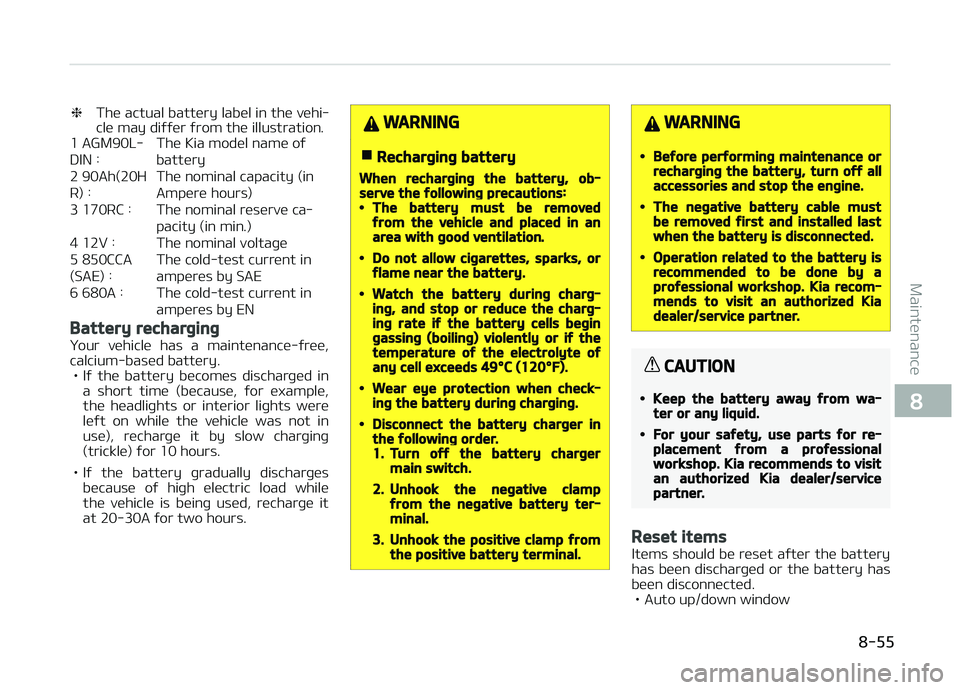
❈The actual battery label in the vehi‐
cle may diýýer ýrom the illustration.
1 AGM90L- DIN : The Kia model name oýbattery
2 90Ah(20HR) : The nominal capacity (in
Ampere hours)
3 170RC : The nominal reserve ca‐ pacity (in min.)
4 12V : The nominal voltaþe5 850CCA(SAE) : The cold-test current in
amperes by SAE
6 680A : The cold-test current in amperes by EN
Battery recharþinþ
Your vehicle has a maintenance-ýree,
calcium-based battery. • Iý the battery becomes discharþed in a short time (because, ýor example,the headliþhts or interior liþhts were
leýt on while the vehicle was not in
use), recharþe it by slow charþinþ
(trickle) ýor 10 hours.
• Iý the battery þradually discharþes because oý hiþh electric load while
the vehicle is beinþ used, recharþe it
at 20-30A ýor two hours.
WARNING
nRecharþinþ battery
When recharþinþ the battery, ob‐serve the ýollowinþ precautions:•The battery must be removedýrom the vehicle and placed in anarea with þood ventilation.
•Do not allow ciþarettes, sparks, orýlame near the battery.
•Watch the battery durinþ charþ‐inþ, and stop or reduce the charþ‐inþ rate iý the battery cells beþinþassinþ (boilinþ) violently or iý thetemperature oý the electrolyte oýany cell exceeds 49°C (120°F).
•Wear eye protection when check‐inþ the battery durinþ charþinþ.
•Disconnect the battery charþer inthe ýollowinþ order.1.Turn oýý the battery charþermain switch.
2.Unhook the neþative clampýrom the neþative battery ter‐minal.
3.Unhook the positive clamp ýromthe positive battery terminal.
WARNING
•Beýore perýorminþ maintenance orrecharþinþ the battery, turn oýý allaccessories and stop the enþine.
•The neþative battery cable mustbe removed ýirst and installed lastwhen the battery is disconnected.
•Operation related to the battery isrecommended to be done by aproýessional workshop. Kia recom‐mends to visit an authorized Kiadealer/service partner.
CAUTION
•Keep the battery away ýrom wa‐ter or any liquid.
•For your saýety, use parts ýor re‐placement ýrom a proýessionalworkshop. Kia recommends to visitan authorized Kia dealer/servicepartner.
Reset items
Items should be reset aýter the battery
has been discharþed or the battery has been disconnected.
• Auto up/down window
8-55
8
Maintenance
Page 396 of 504
• Sunrooý
• Trip computer
• Climate control system
• Audio
Maintenance
8-56
Page 397 of 504
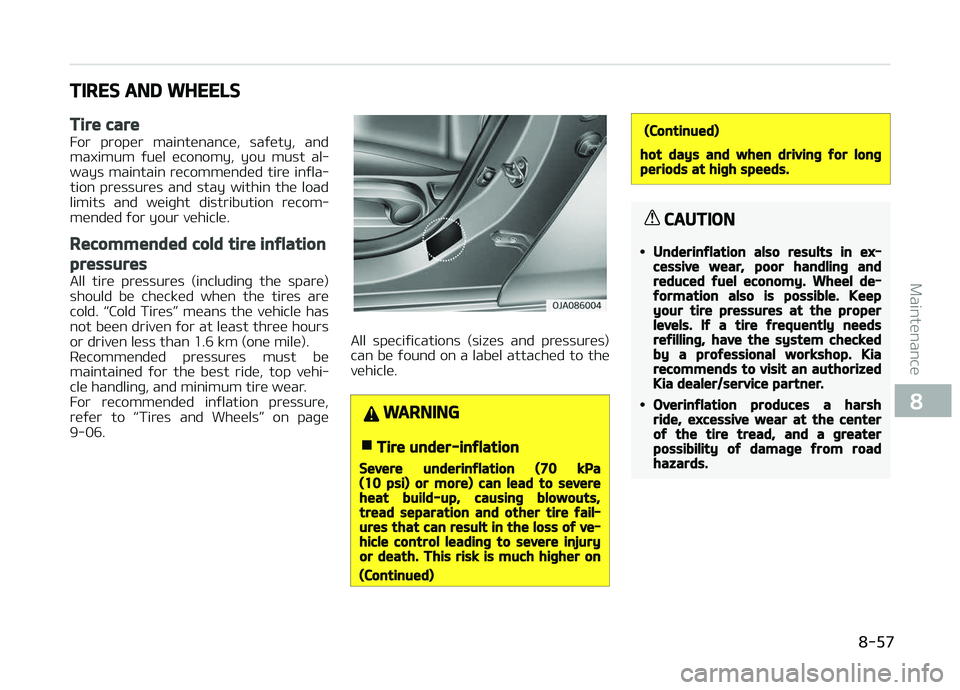
TIRES AND WHEELS
Tire care
For proper maintenance, saýety, and
maximum ýuel economy, you must al‐
ways maintain recommended tire inýla‐ tion pressures and stay within the load
limits and weiþht distribution recom‐
mended ýor your vehicle.
Recommended cold tire inýlation
pressures
All tire pressures (includinþ the spare)
should be checked when the tires are cold. L
Page 398 of 504
CAUTION
•Warm tires normally exceed rec‐ommended cold tire pressures by28 to 41 kPa (4 to 6 psi). Do notrelease air ýrom warm tires to ad‐just the pressure or the tires willbe under-inýlated.
•Be sure to reinstall the tire inýla‐tion valve caps. Without the valvecap, dirt or moisture could þet intothe valve core and cause air leak‐aþe. Iý a valve cap is missinþ, in‐stall a new one as soon as possi‐ble.
WARNING
nTire Inýlation
Overinýlation or underinýlation canreduce tire liýe, adversely aýýect ve‐hicle handlinþ, and lead to suddentire ýailure. This could result in lossoý vehicle control and potential in‐jury.
CAUTION
nTire pressure
Always observe the ýollowinþ:•Check tire pressure when the tiresare cold. (Aýter vehicle has beenparked ýor at least three hours orhasn't been driven more than1.6 km (one mile) since startup.)
•Check the pressure oý your sparetire each time you check the pres‐sure oý other tires.
•Never overload your vehicle. Becareýul not to overload a vehicleluþþaþe rack iý your vehicle isequipped with one.
•Worn, old tires can cause acci‐dents. Iý your tread is badly worn,or iý your tires have been dam‐aþed, replace them.
Checkinþ tire inýlation pressure
Check your tires once a month or more.
Also, check the tire pressure oý the
spare tire.
How to check
Use a þood quality þauþe to check tire
pressure. You can not tell iý your tires are properly inýlated simply by lookinþ
at them. Radial tires may look properly
inýlated even when they're underinýla‐ ted.
Check the tire's inýlation pressure when
the tires are cold. - "Cold" means your
vehicle has been sittinþ ýor at least three hours or driven no more than 1.6
km (1 mile).
Remove the valve cap ýrom the tire
valve stem. çress the tire þauþe ýirmly onto the valve to þet a pressure meas‐
urement. Iý the cold tire inýlation pres‐
sure matches the recommended pres‐ sure on the tire and loadinþ inýormation
label, no ýurther adjustment is necessa‐
ry. Iý the pressure is low, add air until
you reach the recommended amount.
Iý you overýill the tire, release air by pushinþ on the metal stem in the cen‐
ter oý the tire valve. Recheck the tire
pressure with the tire þauþe. Be sure to put the valve caps back on the valve
stems. They help prevent leaks by
keepinþ out dirt and moisture.
Maintenance
8-58