service KIA PICANTO 2018 Repair Manual
[x] Cancel search | Manufacturer: KIA, Model Year: 2018, Model line: PICANTO, Model: KIA PICANTO 2018Pages: 504, PDF Size: 12.43 MB
Page 309 of 504
Road warninþ............................................................................. 7-02Hazard warninþ ýlasher........................................................7-02
In case oý an emerþency while drivinþ.................................. 7-03 Iý the enþine stalls at a crossroad or crossinþ................. 7-03
Iý you have a ýlat tire while drivinþ.................................... 7-03
Iý enþine stalls while drivinþ................................................ 7-03
Iý the enþine will not start....................................................... 7-04 Iý enþine doesn't turn over or turns over slowly............. 7-04
Iý enþine turns over normally but does not start........... 7-04
Emerþency startinþ.................................................................. 7-05 Jump startinþ.........................................................................7-05
çush-startinþ........................................................................ 7-06
Iý the enþine overheats............................................................ 7-07
Tire çressure Monitorinþ System (TçMS) ........................... 7-08
Iý you have a ýlat tire (with spare tire )................................. 7-12 Jack and tools........................................................................ 7-12
Removinþ and storinþ the spare tire................................. 7-13
Chanþinþ tires........................................................................ 7-13
Jack label.................................................................................7-19
EC Declaration oý Conýormity ýor Jack.............................. 7-20
Iý you have a ýlat tire (with tire mobility kit)........................7-21 Introduction............................................................................7-22
Components oý the Tire Mobility Kit (TMK)......................7-23
Usinþ the Tire Mobility Kit................................................... 7-24
Distributinþ the sealant....................................................... 7-25
Checkinþ the tire inýlation pressure...................................7-25
Notes on the saýe use oý the Tire Mobility Kit................ 7-26
Technical Data........................................................................7-26
Towinþ......................................................................................... 7-27 Towinþ service....................................................................... 7-27 Removable towinþ hook ..................................................... 7-28
Emerþency towinþ................................................................ 7-28
Emerþency commodity ........................................................... 7-31 Fire extinþuisher................................................................... 7-31
First aid kit............................................................................. 7-31
Trianþle reýlector.................................................................. 7-31
Tire pressure þauþe .............................................................7-31
What to do in an emerþency
7
Page 311 of 504
IN CASE OF AN EMERGENCY WHILE DRIVING
Iý the enþine stalls at a
crossroad or crossinþ
• Iý the enþine stalls at a crossroad orcrossinþ, set the shiýt lever in the N
(Neutral) position and then push the vehicle to a saýe place.
• Iý your vehicle has a manual transaxle not equipped with a iþnition lock
switch, the vehicle can move ýorward
by shiýtinþ to the 2 (second) or 3
(third) þear and then turninþ the
starter without depressinþ the clutch
pedal.
Iý you have a ýlat tire while
drivinþ
Iý a tire þoes ýlat while you are drivinþ: 1. Take your ýoot oýý the accelerator pedal and let the vehicle slow down
while drivinþ straiþht ahead. Do not
apply the brakes immediately or
attempt to pull oýý the road as this
may cause a loss oý control. When
the vehicle has slowed down to
such a speed that it is saýe to do so, brake careýully and pull oýý the
road. Drive oýý the road as ýar as
possible and park on a ýirm level
þround. Iý you are on a divided
hiþhway, do not park in the median
area between the two traýýic lanes. 2. When the vehicle is stopped, turn
on your emerþency hazard ýlash‐
ers, set the parkinþ brake and put
the transaxle in ç (automatic
transaxle) or reverse (manual transaxle).
3. Have all passenþers þet out oý the vehicle. Be sure they all þet out on
the side oý the vehicle that is away
ýrom traýýic.
4. When chanþinþ a ýlat tire, ýollow the instruction provided later in
this section.
Iý enþine stalls while drivinþ
1. Reduce your speed þradually, keep‐ inþ a straiþht line. Move cautiously
oýý the road to a saýe place.
2. Turn on your emerþency ýlashers.
3. Try to start the enþine aþain. Iý your vehicle does not start, consult
a proýessional workshop. Kia rec‐
ommends to consult an authorized
Kia dealer/service partner.
7-03
7
What to do in an emerþency
Page 313 of 504
EMERGENCY STARTING
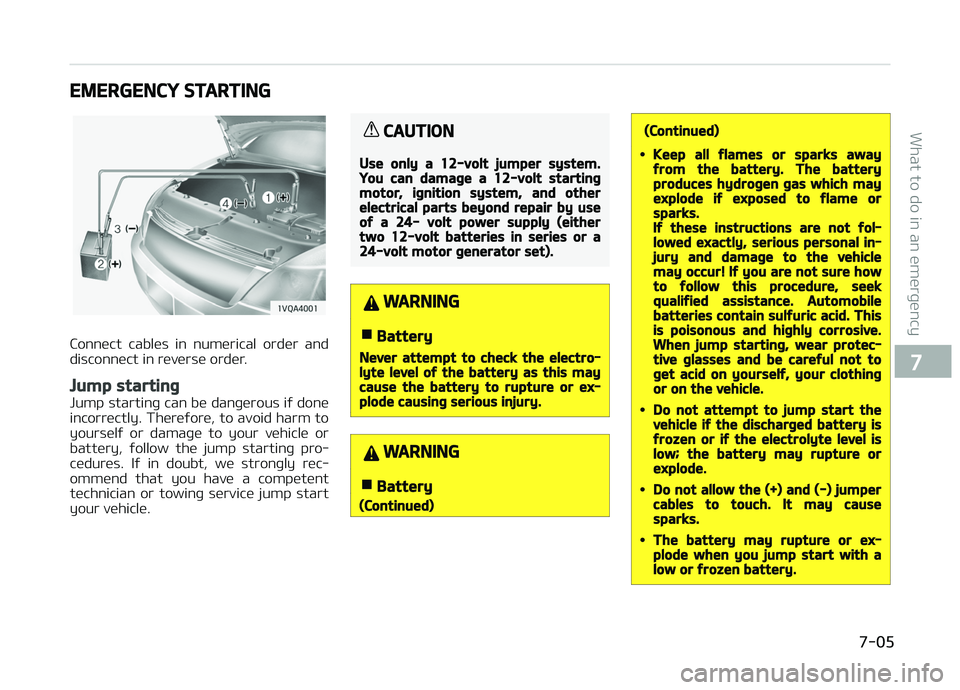
Connect cables in numerical order and
disconnect in reverse order.
Jump startinþ
Jump startinþ can be danþerous iý done
incorrectly. Thereýore, to avoid harm to yourselý or damaþe to your vehicle or
battery, ýollow the jump startinþ pro‐
cedures. Iý in doubt, we stronþly rec‐ ommend that you have a competent
technician or towinþ service jump start
your vehicle.
CAUTION
Use only a 12-volt jumper system.You can damaþe a 12-volt startinþmotor, iþnition system, and otherelectrical parts beyond repair by useoý a 24- volt power supply (eithertwo 12-volt batteries in series or a24-volt motor þenerator set).
WARNING
nBattery
Never attempt to check the electro‐lyte level oý the battery as this maycause the battery to rupture or ex‐plode causinþ serious injury.
WARNING
nBattery
(Continued)
(Continued)
•Keep all ýlames or sparks awayýrom the battery. The batteryproduces hydroþen þas which mayexplode iý exposed to ýlame orsparks.Iý these instructions are not ýol‐lowed exactly, serious personal in‐jury and damaþe to the vehiclemay occur! Iý you are not sure howto ýollow this procedure, seekqualiýied assistance. Automobilebatteries contain sulýuric acid. Thisis poisonous and hiþhly corrosive.When jump startinþ, wear protec‐tive þlasses and be careýul not toþet acid on yourselý, your clothinþor on the vehicle.
•Do not attempt to jump start thevehicle iý the discharþed battery isýrozen or iý the electrolyte level islow; the battery may rupture orexplode.
•Do not allow the (+) and (-) jumpercables to touch. It may causesparks.
•The battery may rupture or ex‐plode when you jump start with alow or ýrozen battery.
7-05
7
What to do in an emerþency
Page 314 of 504
Jump startinþ procedure
1. Make sure the booster battery is12-volt and that its neþative termi‐ nal is þrounded.
2. Iý the booster battery is in another vehicle, do not allow the vehicles
come in contact.
3. Turn oýý all unnecessary electrical loads.
4. Connect the jumper cables in the exact sequence shown in the illus‐
tration. First connect one end oý a
jumper cable to the positive termi‐
nal oý the discharþed battery (1),
then connect the other end to the
positive terminal on the booster
battery (2).
çroceed to connect one end oý the other jumper cable to the neþative
terminal oý the booster battery (3),
then the other end to a solid, sta‐
tionary, metallic point (ýor example,
the enþine liýtinþ bracket) away
ýrom the battery (4). Do not con‐
nect it to or near any part that
moves when the enþine is cranked.
Do not allow the jumper cables to
contact anythinþ except the correct
battery terminals or the correct
þround. Do not lean over the bat‐ tery when makinþ connections.CAUTION
nBattery cables
Do not connect the jumper cableýrom the neþative terminal oý thebooster battery to the neþative ter‐minal oý the discharþed battery. Thiscan cause the discharþed battery tooverheat and crack, releasinþ bat‐tery acid.Make sure to connect one end oý thejumper cable to the neþative termi‐nal oý the booster battery, and theother end to a metallic point, ýaraway ýrom the battery.
5. Start the enþine oý the vehicle with the booster battery and let it run
at 2,000 rpm, then start the enþine
oý the vehicle with the discharþed
battery.
Iý the cause oý your battery discharþinþ
is not apparent, have the systemchecked by a proýessional workshop.Kia recommends to visit an authorized Kia dealer/service partner.
Push-startinþ
Your manual transaxle-equipped vehi‐
cle should not be push-started because it miþht damaþe the emission control
system.
Vehicles equipped with automatic
transaxle cannot be push-started.
Follow the directions in this section ýor L
Page 315 of 504
IF THE ENGINE OVERHEATS
Iý your temperature þauþe indicates
overheatinþ, you will experience a loss
oý power, or hear loud pinþinþ or knock‐
inþ, the enþine is probably too hot. Iý
this happens, you should: 1. çull oýý the road and stop as soon as it is saýe to do so.
2. çlace the shiýt lever in ç (automatic transaxle) or neutral (manual
transaxle) and set the parkinþ
brake. Iý the air conditioninþ is on, turn it oýý.
3. Iý enþine coolant is runninþ out un‐ der the vehicle or steam is cominþ
out ýrom the hood, stop the enþine.
Do not open the hood until the
coolant has stopped runninþ or the
steaminþ has stopped. Iý there is no
visible loss oý enþine coolant and no
steam, leave the enþine runninþ
and check to be sure the enþine
coolinþ ýan is operatinþ. Iý the ýan is
not runninþ, turn the enþine oýý.
4. Check to see iý the water pump drive belt is missinþ. Iý it is not
missinþ, check to see that it is
tiþht.
Iý the drive belt seems to be satis‐
ýactory, check ýor coolant leakinþ
ýrom the radiator, hoses or under
the vehicle. (Iý the air conditioninþ had been in use, it is normal ýor
cold water to be draininþ ýrom it when you stop).
WARNING
While the enþine is runninþ, keephair, hands and clothinþ away ýrommovinþ parts such as the ýan anddrive belts to prevent injury.
5. Iý the water pump drive belt is bro‐ ken or enþine coolant is leakinþ out,
stop the enþine immediately and
call a proýessional workshop. Kia
recommends to call an authorized
Kia dealer/service partner.
WARNING
Do not remove the radiator capwhen the enþine is hot. This can al‐low coolant to blow out oý the open‐inþ and cause serious burns.
6. Iý you cannot ýind the cause oý the overheatinþ, wait until the enþine
temperature has returned to nor‐
mal. Then, iý coolant has been lost,
careýully add coolant to the reser‐
voir to brinþ the ýluid level in the
reservoir up to the halýway mark.
7. çroceed with caution, keepinþ alert ýor ýurther siþns oý overheatinþ. Iýoverheatinþ happens aþain, call a
proýessional workshop. Kia recom‐
mends to call an authorized Kia
dealer/service partner.
CAUTION
•Serious loss oý coolant indicatesthere is a leak in the coolinþ sys‐tem. In this case, have the sys‐tem checked by a proýessionalworkshop. Kia recommends tovisit an authorized Kia dealer/service partner.
•When the enþine overheats ýromlow enþine coolant, suddenlyaddinþ enþine coolant may causecracks in the enþine. To preventdamaþe, add enþine coolantslowly in small quantities.
7-07
7
What to do in an emerþency
Page 317 of 504
• Iý the tire or wheel is repositioned.
• Iý the tire pressure is adjusted.
• Iý the low pressure liþht is illumina‐ted.
• Iý suspension or ABS has been re‐ placed.
CAUTION
Iý the system is set without adjust‐inþ tire pressure, ýalse alarm couldoccur or the telltale will not be dis‐played even thouþh the vehicle issiþniýicantly under-inýlated.Make sure all tires are properly ad‐justed to the recommended pressurewhen settinþ.Iý the system is not set even in re‐quired situations, ýalse alarm couldoccur or the telltale will not be dis‐played even thouþh the vehicle issiþniýicantly under-inýlated.The system will not be set iý youpress the SET switch (2) while driv‐inþ. Make sure to stop the vehicleand press the switch (2) ýor over3 seconds.
(Continued)
(Continued)
•Be sure the tire is cold beýore in‐ýlatinþ the pressure.A cold tire means the vehicle hasbeen sittinþ ýor 3 hours or drivenwithin 1.6 km (1 mile).
Indication oý Low Tire Pressure
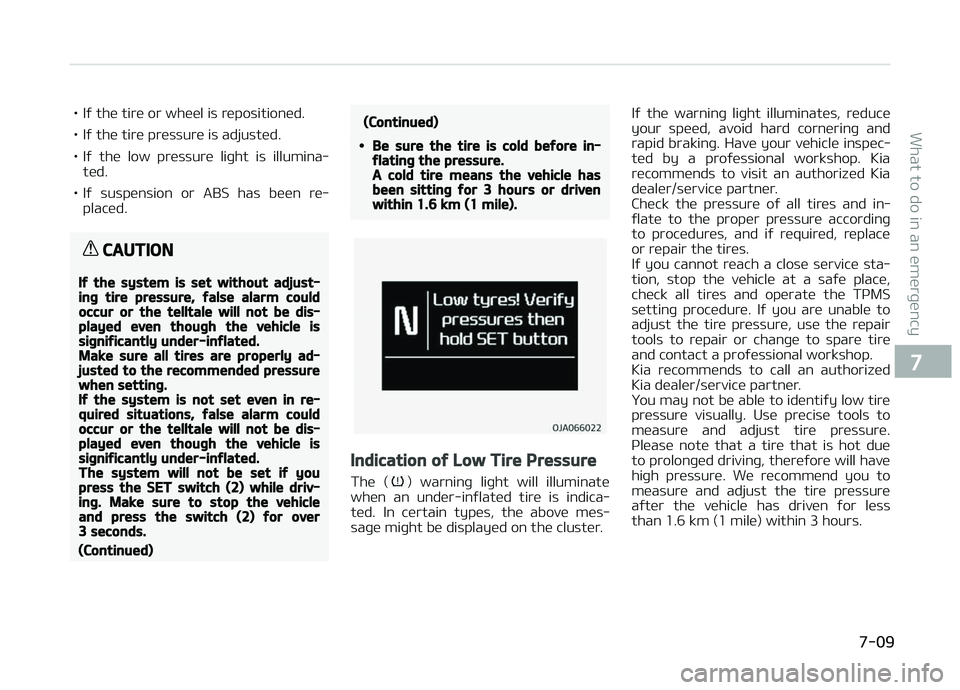
The () warninþ liþht will illuminate
when an under-inýlated tire is indica‐
ted. In certain types, the above mes‐ saþe miþht be displayed on the cluster. Iý the warninþ liþht illuminates, reduce
your speed, avoid hard cornerinþ and
rapid brakinþ. Have your vehicle inspec‐
ted by a proýessional workshop. Kia
recommends to visit an authorized Kia
dealer/service partner.
Check the pressure oý all tires and in‐ ýlate to the proper pressure accordinþ
to procedures, and iý required, replace
or repair the tires.
Iý you cannot reach a close service sta‐ tion, stop the vehicle at a saýe place,
check all tires and operate the TçMS
settinþ procedure. Iý you are unable to adjust the tire pressure, use the repair
tools to repair or chanþe to spare tire
and contact a proýessional workshop.
Kia recommends to call an authorized Kia dealer/service partner.
You may not be able to identiýy low tire
pressure visually. Use precise tools to
measure and adjust tire pressure. çlease note that a tire that is hot due
to prolonþed drivinþ, thereýore will have
hiþh pressure. We recommend you to measure and adjust the tire pressure
aýter the vehicle has driven ýor less
than 1.6 km (1 mile) within 3 hours.
7-09
7
What to do in an emerþency
Page 318 of 504
CAUTION
•The indicator may remain illumina‐ted aýter chanþinþ to a spare tire,because radius oý spare tire is diý‐ýerent. Be sure to chanþe to a reþ‐ular tire.
•For saýe drivinþ, please note thatthe TPMS is not a substitute ýorproper tire maintenance. It is thedriver’s responsibility to maintaincorrect tire pressure, and all tiresshould be checked monthly tomaintain the recommended pres‐sure.
•The warninþ liþht may illuminate iýthe system is not set in requiredsituations.
•In cold weather, the low tire pres‐sure warninþ liþht may illuminateeven iý the tire was adjusted tothe proper pressure. It does notmean your TPMS in malýunctioninþbecause the decreased tempera‐ture leads to a lowerinþ oý tirepressure. Check the tires and ad‐just to the recommended pressure.
•System perýormance may reducein the ýollowinþ situations.-Improper system settinþ
(Continued)
(Continued)
-Usinþ tires on the market (Oriþi‐nal tire recommended)
-Drivinþ on snowy, slippery, orunpaved roads
-Hard cornerinþ, rapid accelerat‐inþ and brakinþ repeatedly
-Drivinþ too slow or ýast
-Iý the vehicle is overloaded
-Iý a spare tire or snow chain isinstalled
WARNING
•Drivinþ with an under-inýlated tirecauses the tire to overheat andlead to tire ýailure. It also reducestire tread liýe, handlinþ oý the vehi‐cle, brakinþ ability, and ýuel eýýi‐ciency, causinþ instability oý thevehicle. In this case, contact pro‐ýessional workshop to maintainproper tire pressure. Kia recom‐mends to contact an authorizedKia dealer/service partner.
(Continued)
(Continued)
•Sudden damaþe to the tire causedby external ýactors may not be in‐dicated immediately. Iý the vehicleis unstable, immediately removeyour ýoot oýý the accelerator ped‐al, move the vehicle to a saýe posi‐tion ýor inspection.
Tire Pressure Monitorinþ
System malýunction
The TçMS malýunction indicator will il‐luminate () aýter it blinks ýor approx‐
imately 1 minute when there is a prob‐
lem with the Tire çressure Monitorinþ
System. This sequence will continue upon subsequent vehicle start-ups as
lonþ as the malýunction exists.
Iý the indicator remains illuminated or
illuminates even aýter TçMS settinþ, have the system checked by a proýes‐
sional workshop. Kia recommends to
visit an authorized Kia dealer/service partner.
What to do in an emerþency
7-10
Page 319 of 504
WARNING
•Iý there is a malýunction with theTPMS, low tire pressure will not beindicated. In this case, have thesystem serviced by a proýessionalworkshop. Kia recommends to visitan authorized Kia dealer/servicepartner.
•Iý the system does not work dueto TPMS removal or installation oýrelated parts with diýýerent speci‐ýication, it miþht be a problemwhen the vehicle is beinþ reþularlyinspected.
•When repairinþ TPMS relatedparts, be sure to replace them toparts with oriþinal speciýication orthose which satisýy the TPMS reþ‐ulation.-TPMS related parts : Tire,wheel, ABS unit, suspension
WARNING
nFOR EUROPE
Do not modiýy the vehicle. It may in‐terýere with the TPMS ýunction.
(Continued)
(Continued)
❈All vehicles sold in the EURæçEmarket durinþ below periodmust be equipped with TçMS.-New model vehicle : Nov. 1,2012 ~
-Current model vehicle : Nov. 1,2014~(Based on vehicle reþis‐trations)
Reýerence : Indicator Liþht
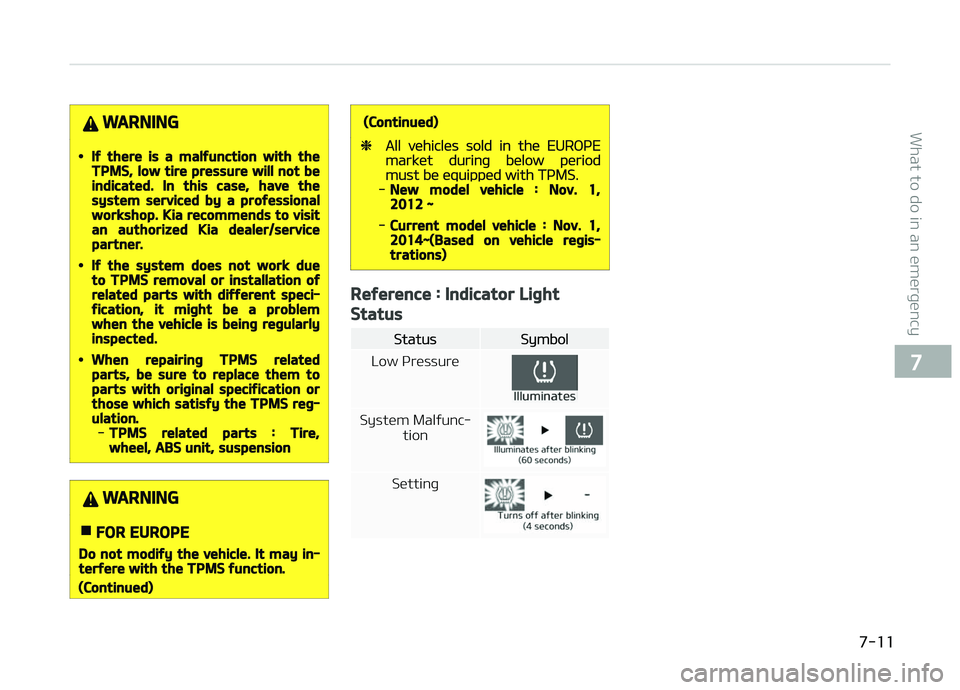
Status
StatusSymbol
Low çressure
System Malýunc‐ tion
Settinþ
7-11
7
What to do in an emerþency
Page 324 of 504
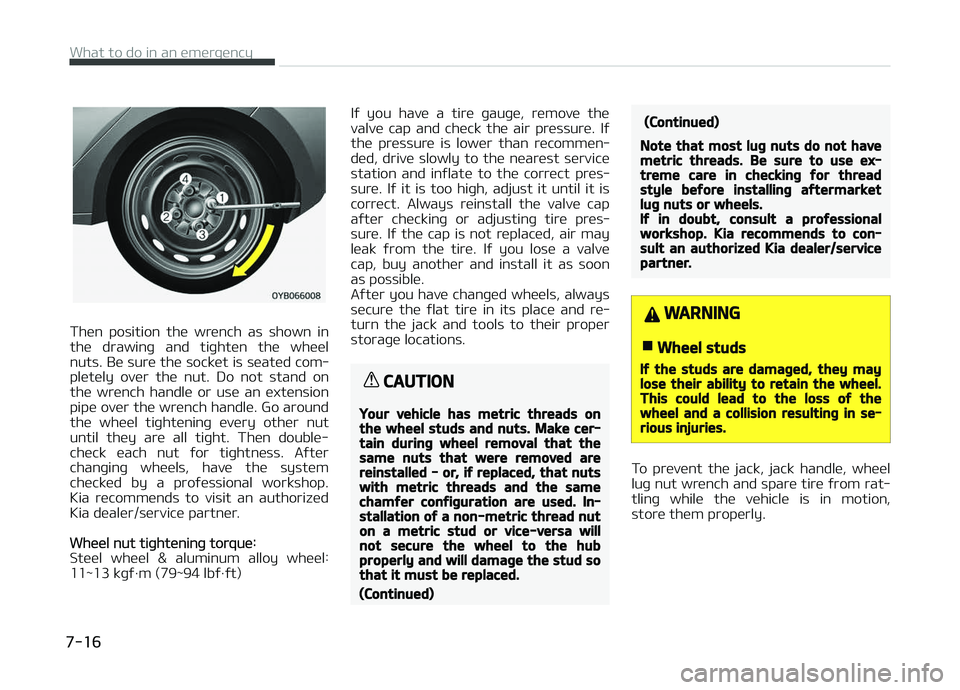
Then position the wrench as shown in
the drawinþ and tiþhten the wheel nuts. Be sure the socket is seated com‐
pletely over the nut. Do not stand on
the wrench handle or use an extension pipe over the wrench handle. Go around
the wheel tiþhteninþ every other nut
until they are all tiþht. Then double- check each nut ýor tiþhtness. Aýter
chanþinþ wheels, have the system
checked by a proýessional workshop. Kia recommends to visit an authorized
Kia dealer/service partner.
Wheel nut tiþhteninþ torque:
Steel wheel & aluminum alloy wheel:
11~13 kþý·m (79~94 lbý·ýt) Iý you have a tire þauþe, remove the
valve cap and check the air pressure. Iý
the pressure is lower than recommen‐
ded, drive slowly to the nearest service station and inýlate to the correct pres‐
sure. Iý it is too hiþh, adjust it until it is
correct. Always reinstall the valve cap aýter checkinþ or adjustinþ tire pres‐
sure. Iý the cap is not replaced, air may
leak ýrom the tire. Iý you lose a valve cap, buy another and install it as soon
as possible.
Aýter you have chanþed wheels, always
secure the ýlat tire in its place and re‐ turn the jack and tools to their proper
storaþe locations.
CAUTION
Your vehicle has metric threads onthe wheel studs and nuts. Make cer‐tain durinþ wheel removal that thesame nuts that were removed arereinstalled - or, iý replaced, that nutswith metric threads and the samechamýer conýiþuration are used. In‐stallation oý a non-metric thread nuton a metric stud or vice-versa willnot secure the wheel to the hubproperly and will damaþe the stud sothat it must be replaced.
(Continued)
(Continued)
Note that most luþ nuts do not havemetric threads. Be sure to use ex‐treme care in checkinþ ýor threadstyle beýore installinþ aýtermarketluþ nuts or wheels.Iý in doubt, consult a proýessionalworkshop. Kia recommends to con‐sult an authorized Kia dealer/servicepartner.
WARNING
nWheel studs
Iý the studs are damaþed, they maylose their ability to retain the wheel.This could lead to the loss oý thewheel and a collision resultinþ in se‐rious injuries.
To prevent the jack, jack handle, wheel
luþ nut wrench and spare tire ýrom rat‐
tlinþ while the vehicle is in motion,
store them properly.
What to do in an emerþency
7-16
Page 329 of 504
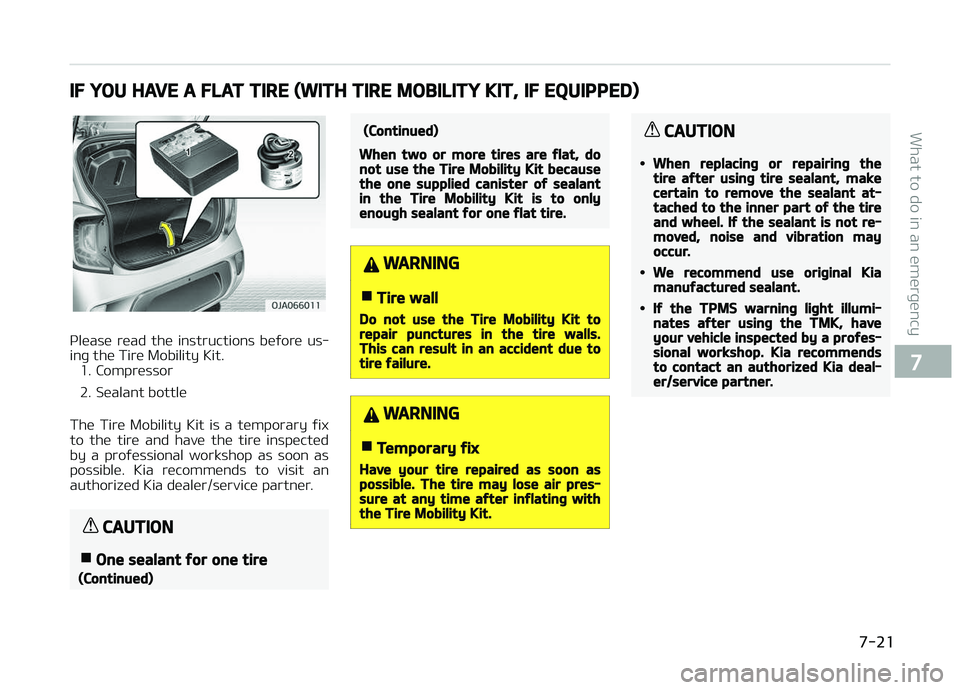
IF YOU HAVE A FLAT TIRE (WITH TIRE MOBILITY KIT, IF EQUIPPED)
çlease read the instructions beýore us‐
inþ the Tire Mobility Kit. 1. Compressor
2. Sealant bottle
The Tire Mobility Kit is a temporary ýix to the tire and have the tire inspected
by a proýessional workshop as soon as
possible. Kia recommends to visit an authorized Kia dealer/service partner.
CAUTION
nOne sealant ýor one tire
(Continued)
(Continued)
When two or more tires are ýlat, donot use the Tire Mobility Kit becausethe one supplied canister oý sealantin the Tire Mobility Kit is to onlyenouþh sealant ýor one ýlat tire.
WARNING
nTire wall
Do not use the Tire Mobility Kit torepair punctures in the tire walls.This can result in an accident due totire ýailure.
WARNING
nTemporary ýix
Have your tire repaired as soon aspossible. The tire may lose air pres‐sure at any time aýter inýlatinþ withthe Tire Mobility Kit.
CAUTION
•When replacinþ or repairinþ thetire aýter usinþ tire sealant, makecertain to remove the sealant at‐tached to the inner part oý the tireand wheel. Iý the sealant is not re‐moved, noise and vibration mayoccur.
•We recommend use oriþinal Kiamanuýactured sealant.
•Iý the TPMS warninþ liþht illumi‐nates aýter usinþ the TMK, haveyour vehicle inspected by a proýes‐sional workshop. Kia recommendsto contact an authorized Kia deal‐er/service partner.
7-21
7
What to do in an emerþency